ICSE Class 10 Physics — All Questions

647 solved questions from 16 papers. Filter by year, section or marks, or search the full bank.

Year
Section
Marks
Insight
1(i)1 Mark · 2027 · Section A · 2027 SpecimenFull page

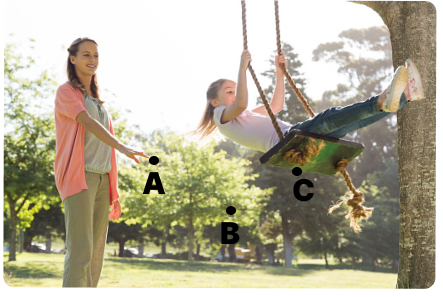
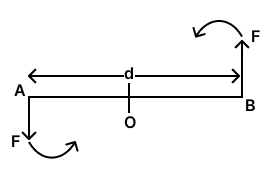
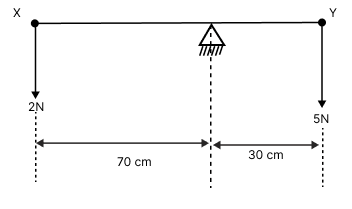
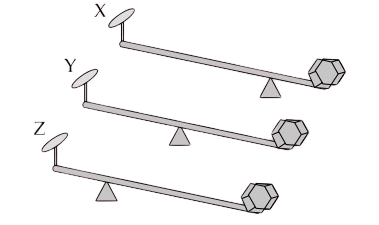
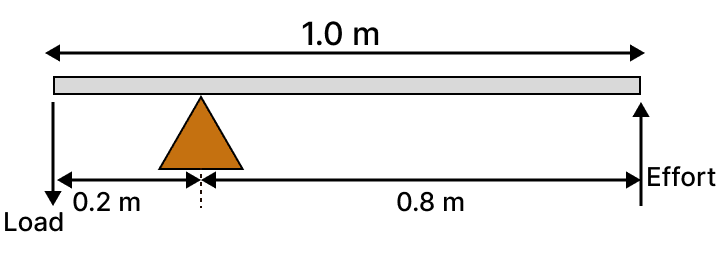
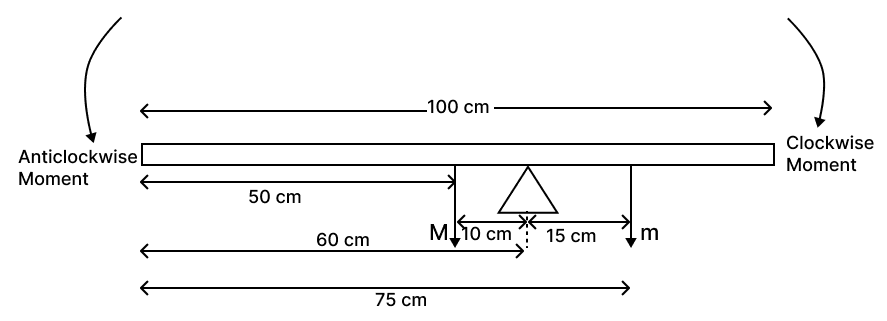
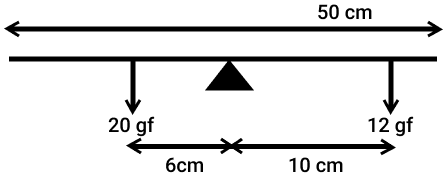
A heavy object and a light object are placed on a seesaw. Which arrangement produces the maximum turning effect about the pivot?

Show SolutionHide Solution↓

Light object close to the pivot; heavy object at the far end on the opposite side.

Reason — Moment = force × perpendicular distance from the pivot. This arrangement maximises the heavy object’s moment and minimises the opposing moment of the light object.

1(ii)1 Mark · 2027 · Section A · 2027 Specimen · 🔁 also 2026Full page

The energy transformation taking place during photosynthesis in plants is:

Show SolutionHide Solution↓

light to chemical

Reason — Photosynthesis converts sunlight into chemical energy stored in food.

1(iii)1 Mark · 2027 · Section A · 2027 SpecimenFull page

Two balls, A and B have the same gravitational potential energy. Ball A is six times the mass of ball B. How do their heights above the ground compare?

Show SolutionHide Solution↓

Height of A is one-sixth the height of B.

Reason — The gravitational potential energy of a body of mass m raised to a height h is U = mgh.

Given,

mA = 6mB and UA = UB

So,

$$\begin{aligned}\text m_\text A \text g \text h_\text A = \text m_\text B \text g \text h_\text B \\[1em] \Rightarrow 6\text m_\text B \text g \text h_\text A = \text m_\text B \text g \text h_\text B \\[1em] \Rightarrow \text h_\text A = \frac{\text h_\text B}{6}\end{aligned}$$

Hence, the height of A is one-sixth the height of B.

1(iv)1 Mark · 2027 · Section A · 2027 SpecimenFull page

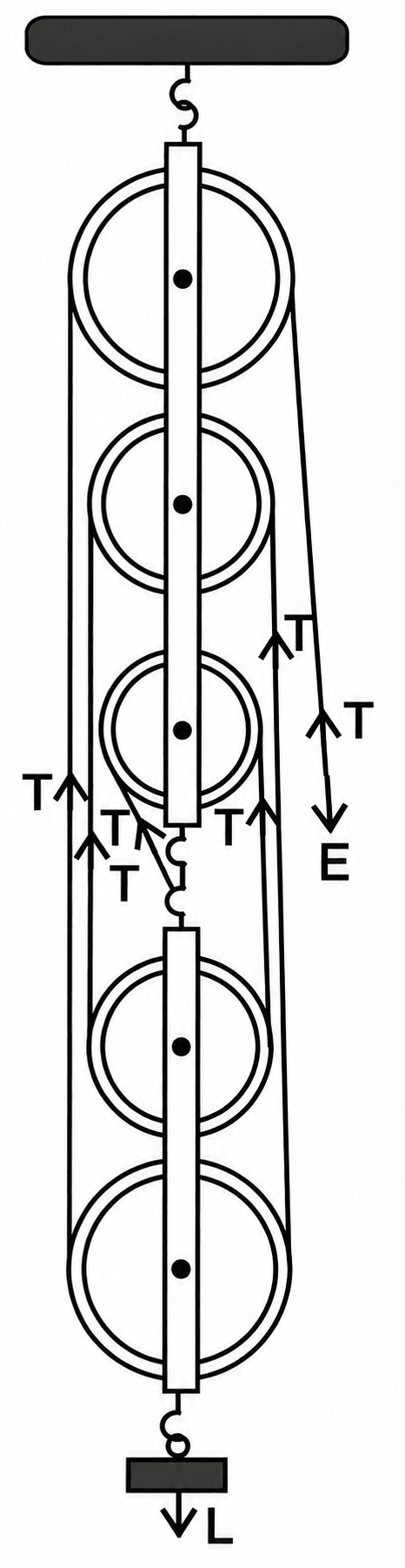
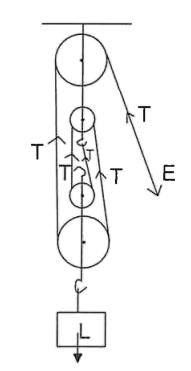
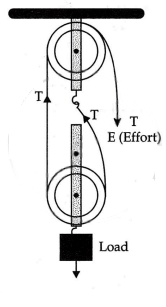
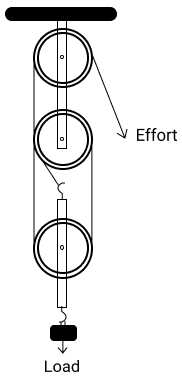
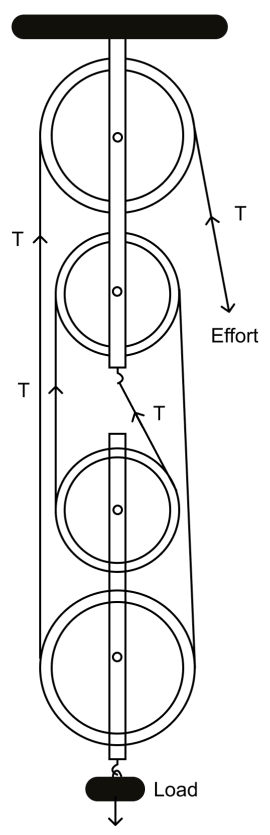
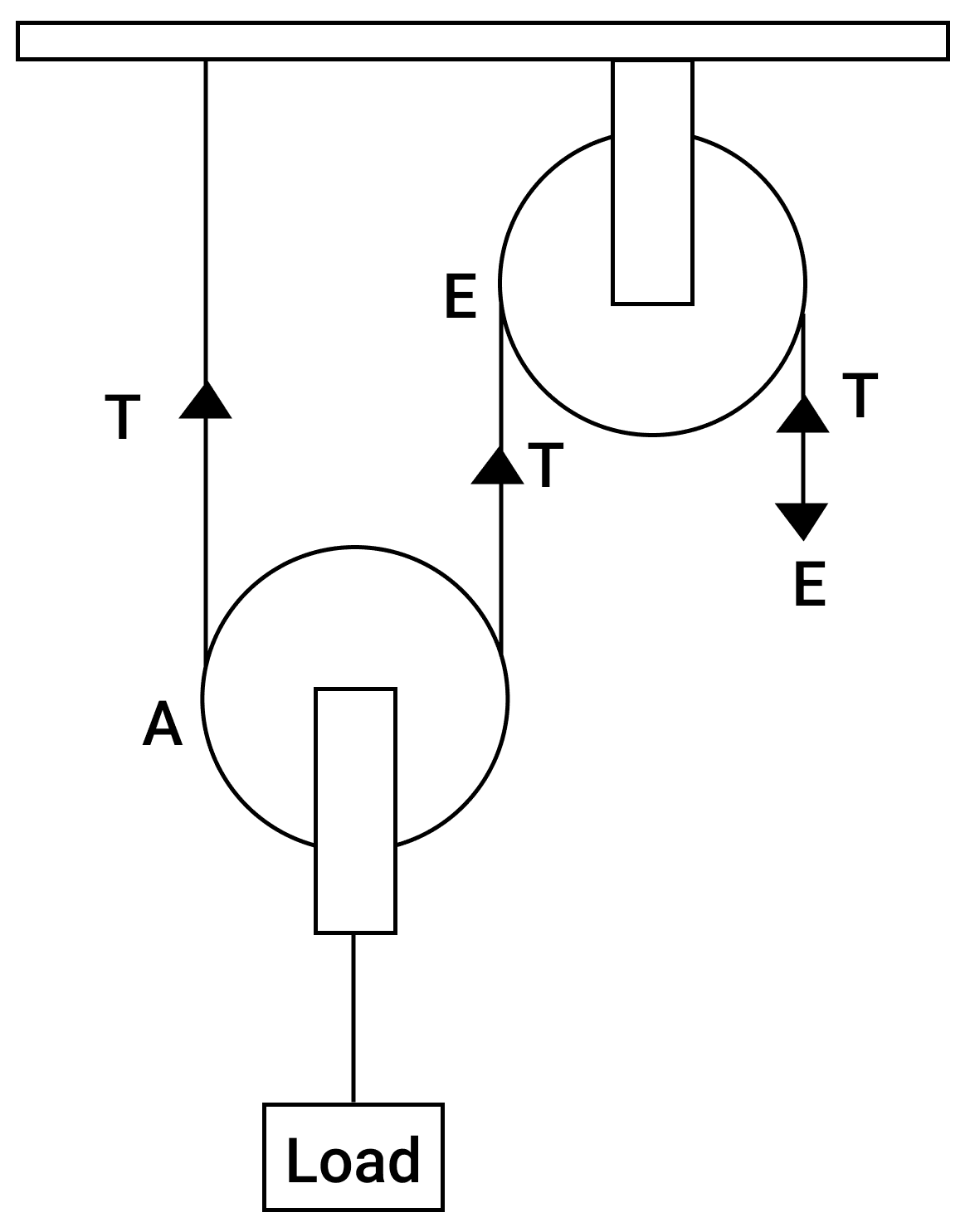
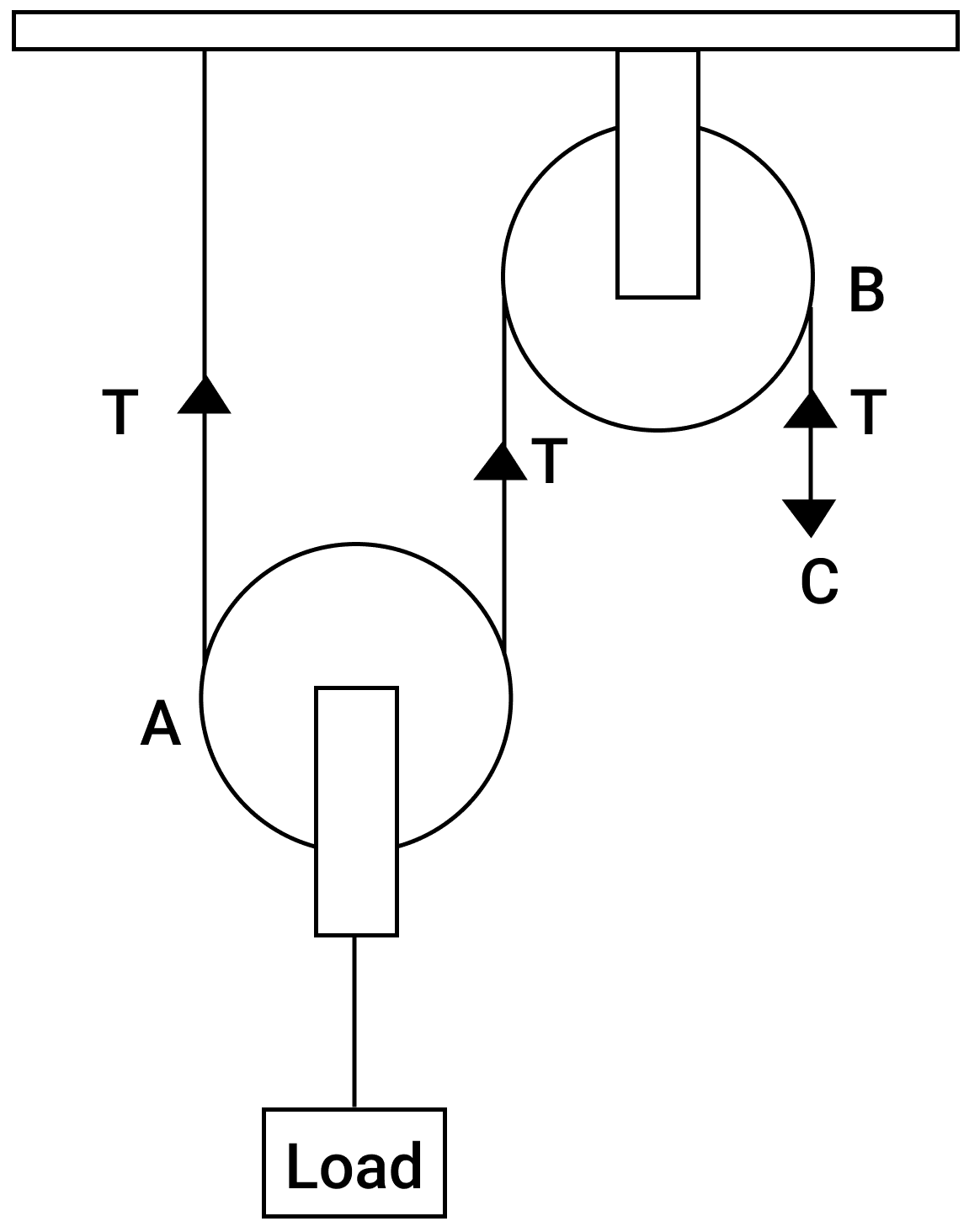
The Velocity Ratio (V.R.) of a block and tackle system of three pulleys with the effort in upward direction is:

Show SolutionHide Solution↓

4

Reason — With the effort directed upwards, two pulleys are in the movable block and one is fixed. Four string segments support the load, so V.R. = 4.

1(v)1 Mark · 2027 · Section A · 2027 SpecimenFull page

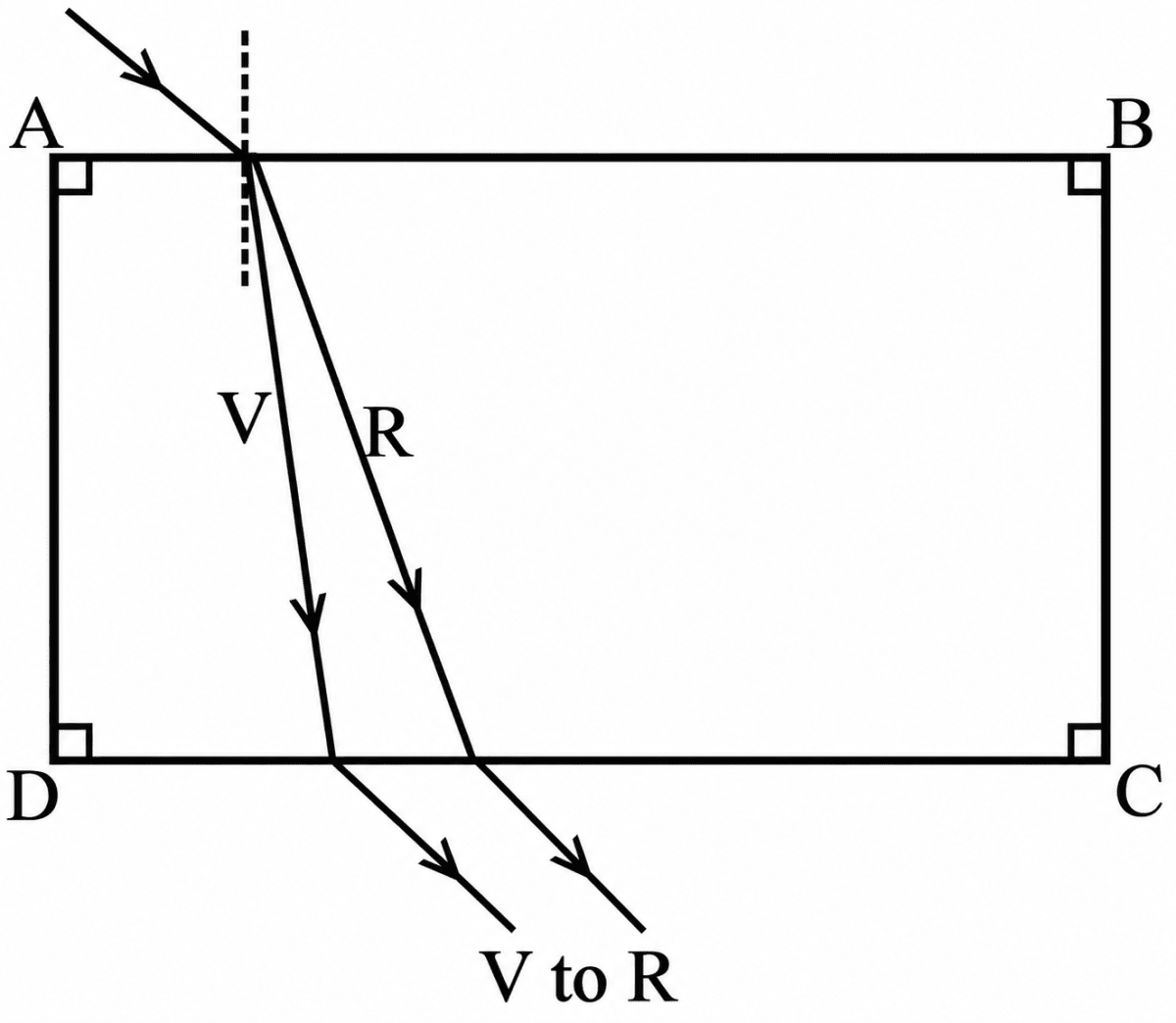
If red, blue, green and yellow lights are allowed to enter the same glass block with the same angle of incidence (∠i), then for which colour will the angle of deviation be the greatest?

Show SolutionHide Solution↓

blue

Reason — The refractive index of a given transparent medium decreases with the increase in the wavelength of light. Among red, yellow, green and blue, blue light has the shortest wavelength, so glass has the highest refractive index for blue light.

Since a medium of higher refractive index bends the light more, blue light is refracted (i.e., deviated) the most and red light the least for the same angle of incidence.

Hence, the angle of deviation is greatest for blue light.

1(vi)1 Mark · 2027 · Section A · 2027 SpecimenFull page

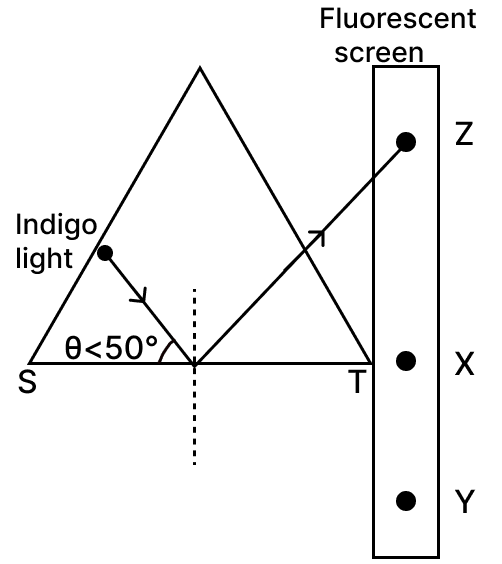
The figure shows a source of light S at the bottom of a trough containing a transparent liquid. Rays X and Y emerge from the source. If ∠SOP = 43°, state the possible angle of incidence of ray Y.

The figure shows a source of light S at the bottom of a trough containing a transparent liquid. Rays X and Y emerge from the source. If ∠SOP = 43°, state the possible angle of incidence of ray Y. Specimen Board Paper 2027, ICSE 2027 Specimen Physics Solved Question Paper.
Show SolutionHide Solution↓

49°

Reason — Ray X grazes the liquid surface, so its incidence angle is the critical angle: 90° − 43° = 47°. Ray Y undergoes total internal reflection, requiring an incidence angle greater than 47°; hence, 49°.

1(vii)1 Mark · 2027 · Section A · 2027 SpecimenFull page

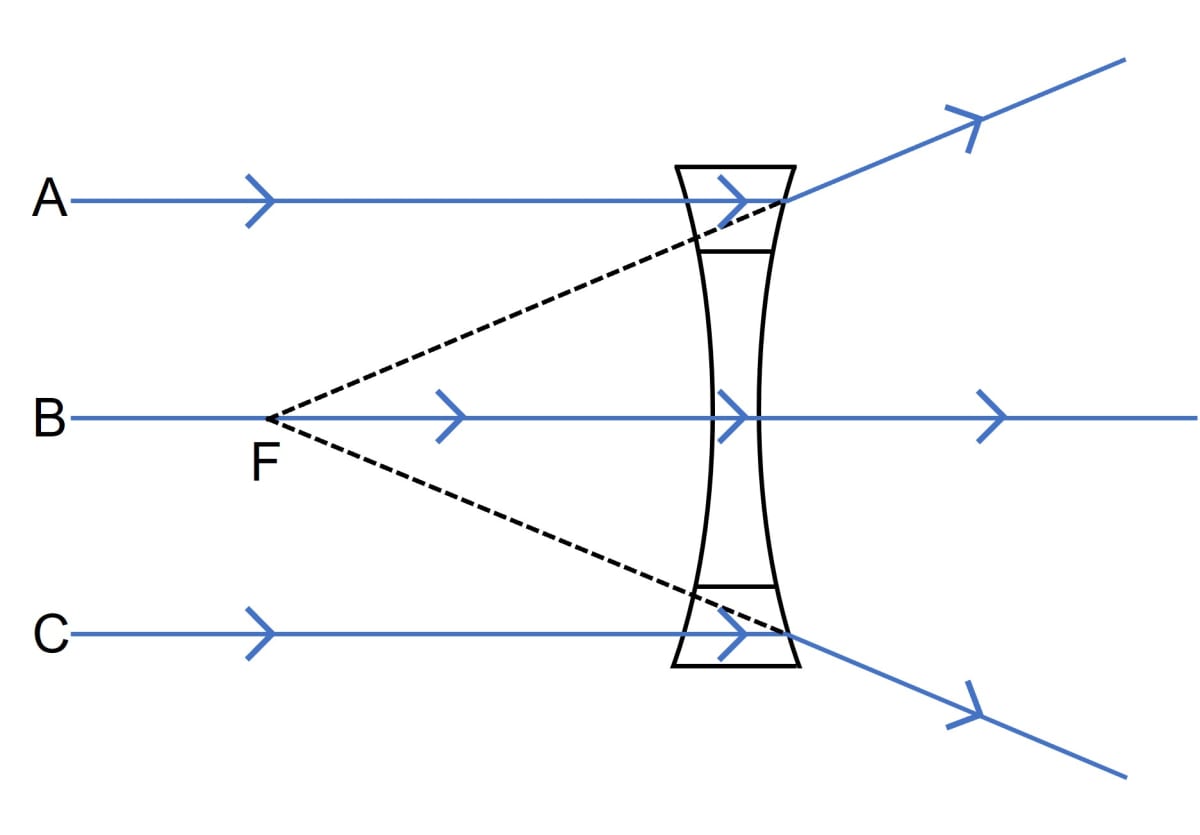
A concave lens diverges light because its upper and lower parts act as:

Show SolutionHide Solution↓

inverted and upright prisms respectively

Reason — The upper and lower parts of a concave lens act as prisms with their bases upwards and downwards respectively. Each bends light towards its base, causing the rays to diverge.

A concave lens diverges light because its upper and lower parts act as inverted and upright prisms respectively. ICSE 2027 Specimen Physics Solved Question Paper.
1(viii)1 Mark · 2027 · Section A · 2027 SpecimenFull page

Assertion (A): Blue light scatters more than red light in the atmosphere.

Reason (R): Intensity of scattered light is inversely proportional to the fourth power of wavelength.

Show SolutionHide Solution↓

Both (A) and (R) are true, and (R) is the correct explanation of (A).

Explanation

(A) is true: blue light has a shorter wavelength and scatters more than red light. (R) is true: scattering intensity varies inversely as the fourth power of wavelength. Therefore, (R) explains (A).

1(ix)1 Mark · 2027 · Section A · 2027 Specimen · 🔁 also 2025 & 2026Full page

Two sound waves, X and Y have the same amplitude and the same wave pattern, but their frequencies are 60 Hz and 120 Hz respectively, then:

Show SolutionHide Solution↓

X will be grave, and Y will be shriller.

Reason — The shrillness of a sound wave is directly proportional to its frequency, meaning that higher frequencies result in shriller sounds and lower frequencies result in grave sound.

1(x)1 Mark · 2027 · Section A · 2027 SpecimenFull page

A radioactive nucleus has 90 protons and 140 neutrons. It undergoes two successive alpha decays. What are the mass number and atomic number of the final nucleus?

Show SolutionHide Solution↓

Mass number = 222, atomic number = 86

Reason — For the given nucleus,

Atomic number Z = number of protons = 90

Mass number A = number of protons + number of neutrons = 90 + 140 = 230

An alpha particle is a helium nucleus 4He2, so each alpha emission decreases the mass number by 4 and the atomic number by 2.

For two successive alpha decays,

New mass number = 230 − (2 × 4) = 230 − 8 = 222

New atomic number = 90 − (2 × 2) = 90 − 4 = 86

Hence, the final nucleus has mass number 222 and atomic number 86.

1(xi)1 Mark · 2027 · Section A · 2027 Specimen · 🔁 also 2025 & 2026Full page

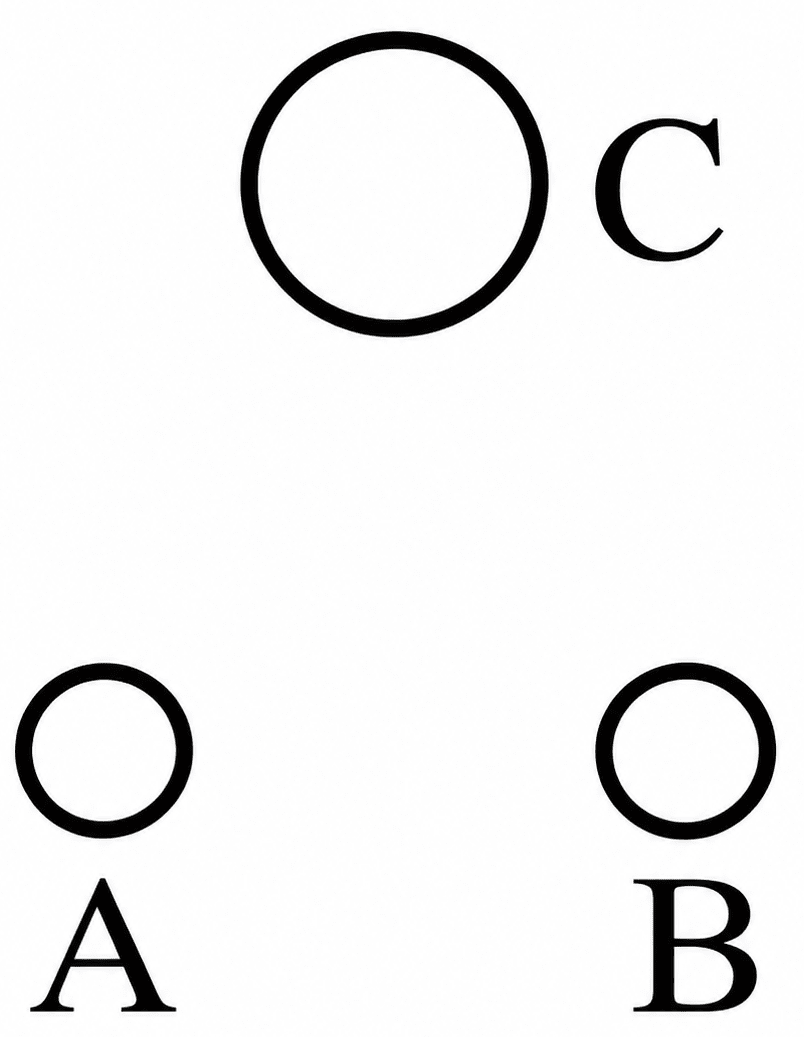
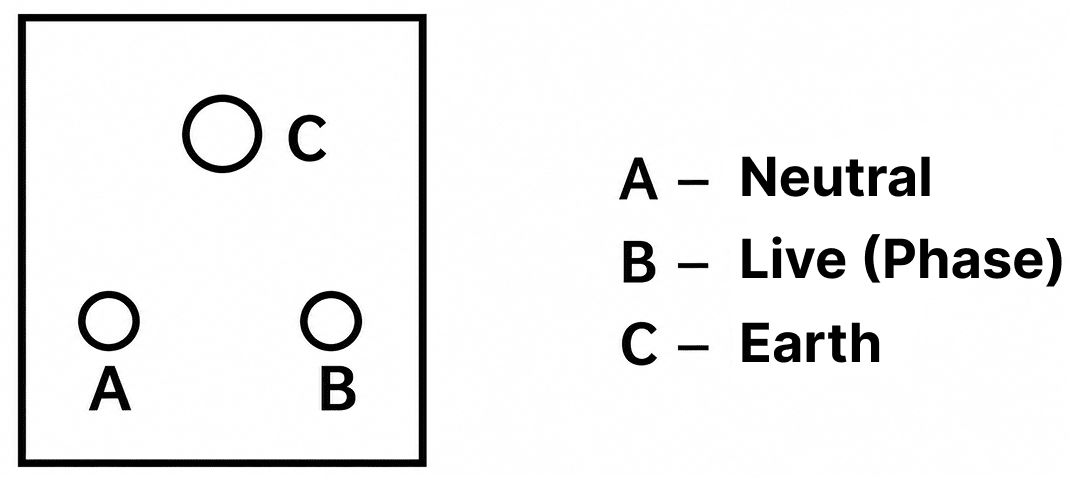
According to the old convention, the colour of the earth wire is:

Show SolutionHide Solution↓

green

Reason — In the old colour convention, the earth wire is green.

1(xii)1 Mark · 2027 · Section A · 2027 SpecimenFull page

The amount of heat energy required to melt a given mass of a substance at its melting point, without any rise in its temperature is called the:

Show SolutionHide Solution↓

latent heat of fusion

Reason — The heat energy absorbed by a substance in changing its phase from solid to liquid at its melting point, which is not externally manifested by any rise in temperature, is called the latent heat of fusion.

1(xiii)1 Mark · 2027 · Section A · 2027 SpecimenFull page
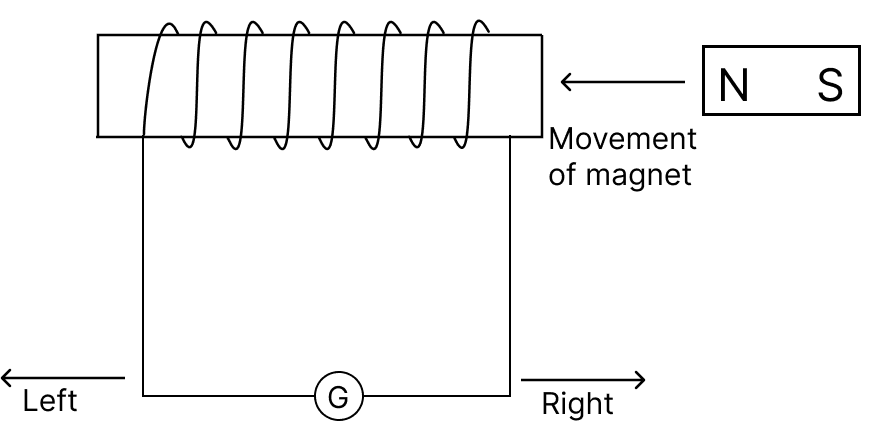
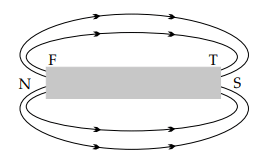
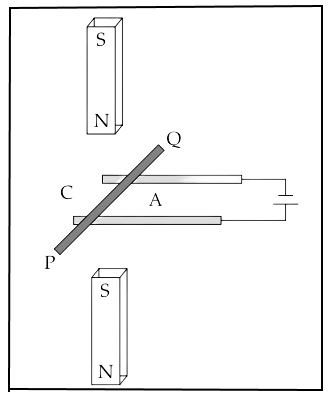
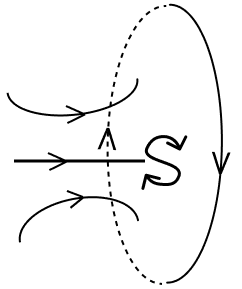
The above diagram shows a strong bar magnet moved towards the coil PQ along its axis, in the direction shown by the arrow. Which option correctly shows the momentary deflection of magnetic needle N 1 and the direction of current through the galvanometer? Specimen Board Paper 2027, ICSE 2027 Specimen Physics Solved Question Paper.

The above diagram shows a strong bar magnet moved towards the coil PQ along its axis, in the direction shown by the arrow. Which option correctly shows the momentary deflection of magnetic needle N1 and the direction of current through the galvanometer?

The above diagram shows a strong bar magnet moved towards the coil PQ along its axis, in the direction shown by the arrow. Which option correctly shows the momentary deflection of magnetic needle N 1 and the direction of current through the galvanometer? Specimen Board Paper 2027, ICSE 2027 Specimen Physics Solved Question Paper.
Show SolutionHide Solution↓
The above diagram shows a strong bar magnet moved towards the coil PQ along its axis, in the direction shown by the arrow. Which option correctly shows the momentary deflection of magnetic needle N 1 and the direction of current through the galvanometer? Specimen Board Paper 2027, ICSE 2027 Specimen Physics Solved Question Paper.

Reason — As the magnet moves towards the coil, the magnetic flux linked with the coil PQ changes, so an e.m.f. is induced in it and a momentary current flows through the galvanometer. This is electromagnetic induction.

By Lenz's law, the direction of the induced current is such that it opposes the cause producing it. Here the south pole of the magnet approaches the end Q, so the end Q of the coil must itself become a south pole in order to repel the approaching south pole. Consequently the other end P of the coil becomes a north pole, and the induced current flows from P to Q through the galvanometer.

Since the end P near the needle now behaves as a north pole, it repels the north pole of the magnetic needle N1, so the needle is deflected away from the coil.

1(xiv)1 Mark · 2027 · Section A · 2027 Specimen · 🔁 also 2026Full page

A metallic wire is stretched in such a way that its new length becomes twice the original length. How does its specific heat capacity change?

Show SolutionHide Solution↓

remains the same

Reason — Specific heat capacity is a property of the material and does not depend on the shape, length or size of the object. When the metallic wire is stretched so that its length becomes twice the original length, only its dimensions change, while the material remains the same.

Therefore, the specific heat capacity remains unchanged.

1(xv)1 Mark · 2027 · Section A · 2027 SpecimenFull page

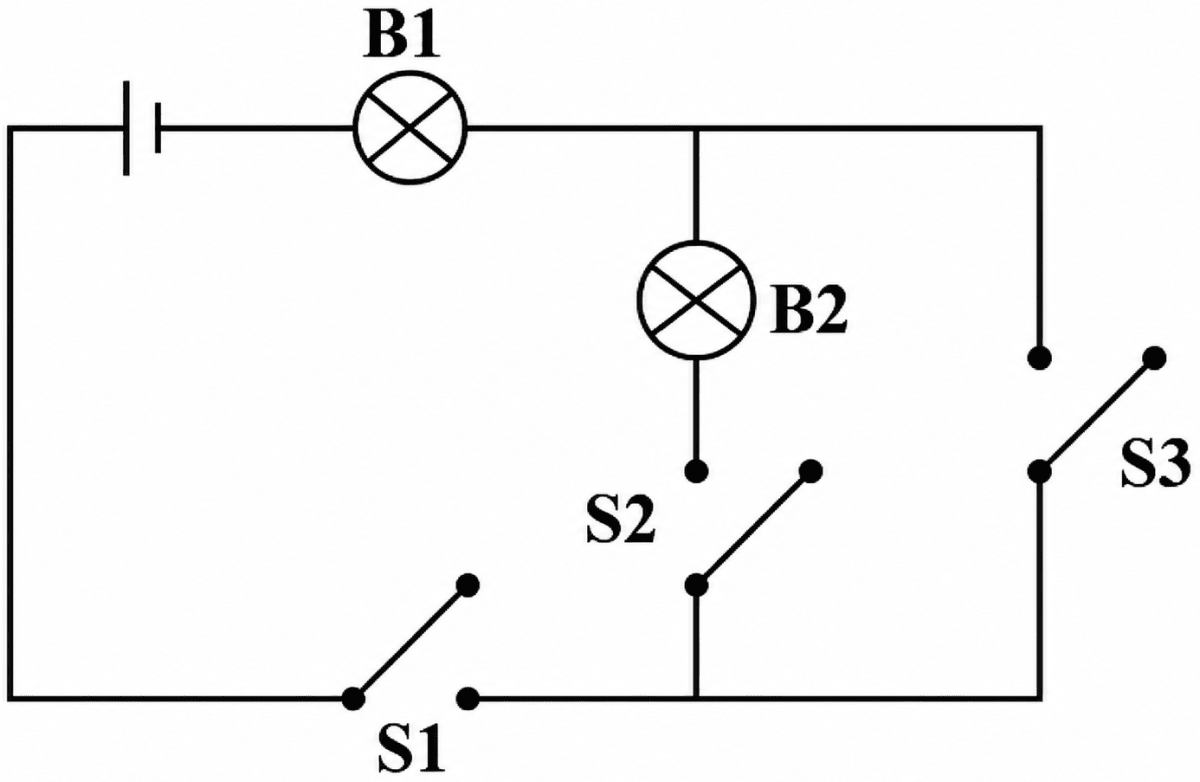
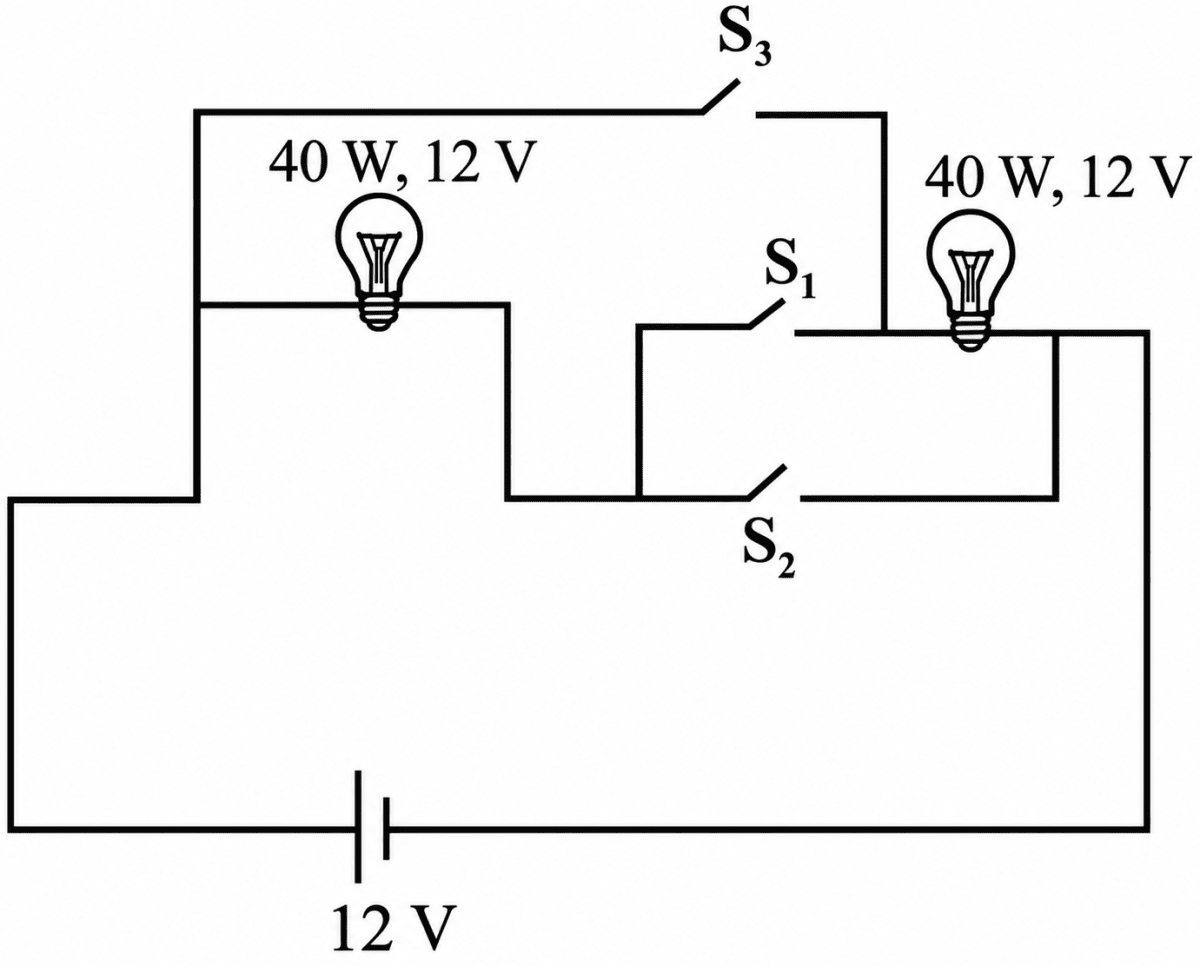
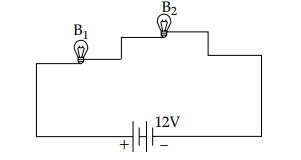
Priya built the circuit as shown in the figure given below. If she wants both bulbs (B1 and B2) to glow, which switches (S1, S2, S3) should be kept ON?

Priya built the circuit as shown in the figure given below. If she wants both bulbs (B1 and B2) to glow, which switches (S1, S2, S3) should be kept ON? Specimen Board Paper 2027, ICSE 2027 Specimen Physics Solved Question Paper.
Show SolutionHide Solution↓

S1 and S2 only

Reason — The bulb B1 lies in the main circuit, so it can glow only when the circuit is complete. This requires the switch S1 (which lies in the main line) to be ON.

The bulb B2 together with the switch S2 forms one branch, and the switch S3 forms a second branch connected in parallel with it. If S3 is put ON, it provides a path of practically zero resistance across the branch containing B2, so B2 gets short circuited and no current passes through it.

Hence, both the bulbs glow only when S1 and S2 are ON and S3 is OFF.

2(i)1 Mark · 2027 · Section A · 2027 SpecimenFull page

Complete the following by choosing the correct answers from the bracket:

(a) Friction acts ............... [tangential / radial] to a car undergoing circular motion.

(b) A glass prism is immersed in water. The angle of minimum deviation will ............... [decrease / increase].

(c) The CGS unit of specific heat capacity is ............... [erg g-1 K-1 / cal g-1 K-1].

(d) The minimum distance for distinct echo formation is ............... [greater / lesser] in water as compared to air.

(e) Two copper wires can have different resistivity if they have different ............... [lengths / temperatures].

(f) Nuclear ............... [fusion / fission] is possible at ordinary temperature and pressure.

Show SolutionHide Solution↓

(a) Friction acts radial to a car undergoing circular motion.

(b) A glass prism is immersed in water. The angle of minimum deviation will decrease.

(c) The CGS unit of specific heat capacity is erg g-1 K-1.

(d) The minimum distance for distinct echo formation is greater in water as compared to air.

(e) Two copper wires can have different resistivity if they have different temperatures.

(f) Nuclear fission is possible at ordinary temperature and pressure.

2(ii)1 Mark · 2027 · Section A · 2027 Specimen · 🔁 also 2026Full page

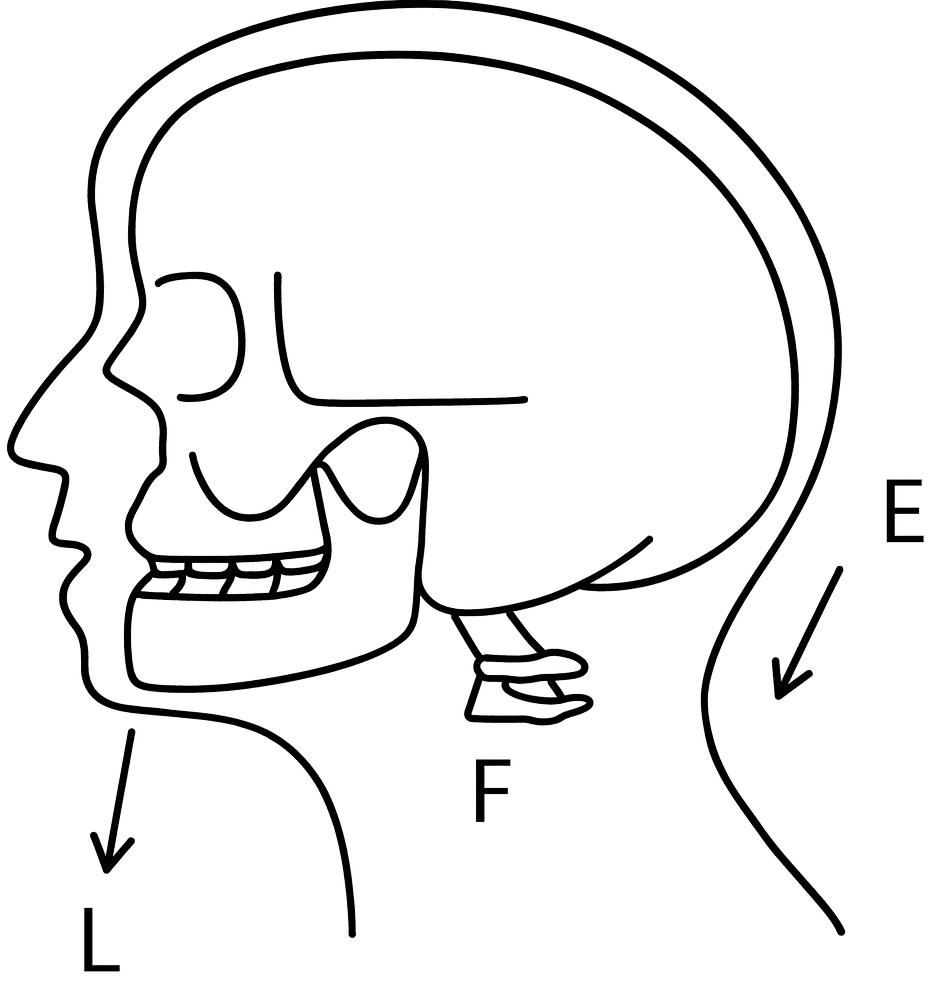
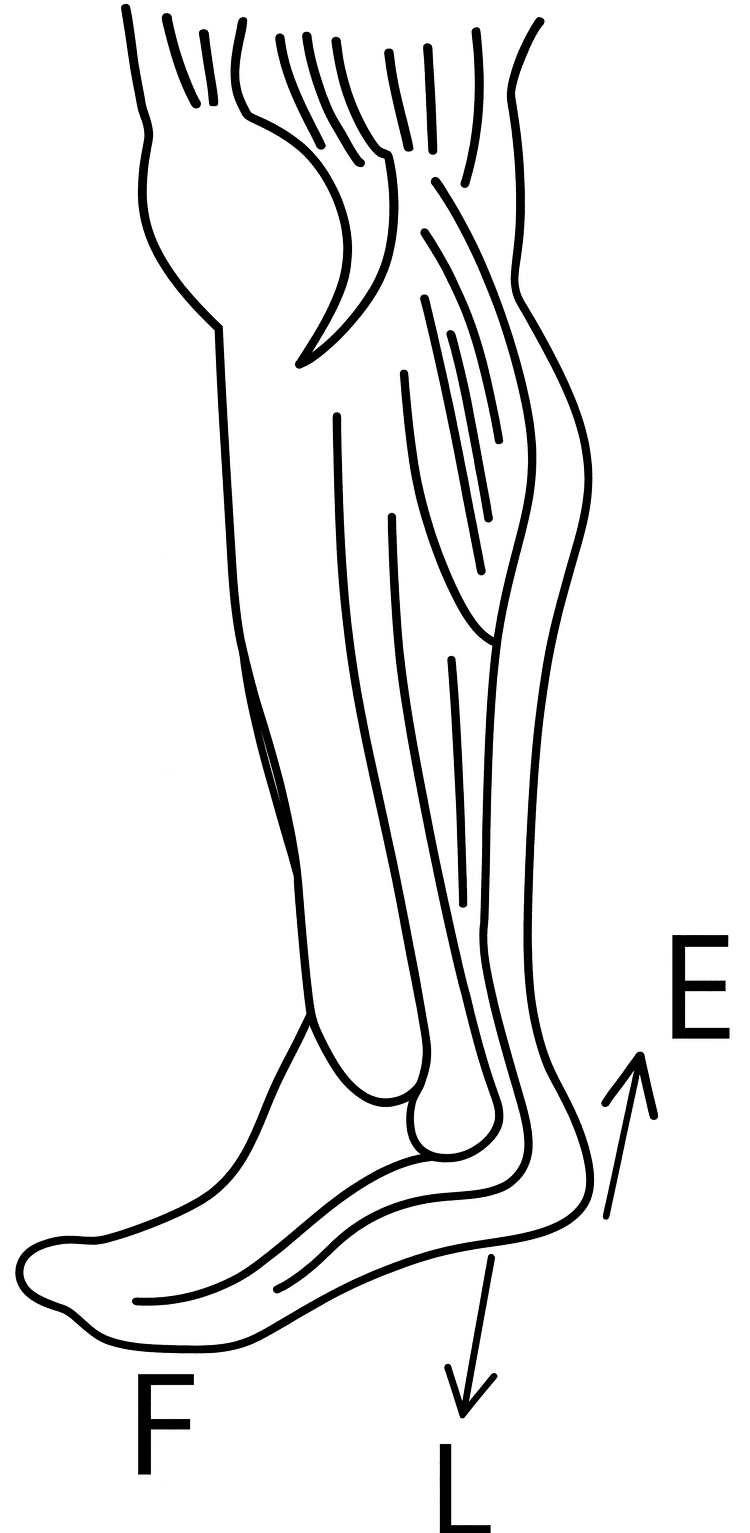
Match the movement of the body part in Column A to the class of lever in Column B.

Column AColumn B
(a) Nodding head1. Class III
(b) Lifting body weight on your toes2. Class II
 3. Class I
Show SolutionHide Solution↓
Movement of the body part (Column A)Class of lever (Column B)
(a) Nodding head• Class I
(b) Lifting body weight on your toes• Class II

Reason —

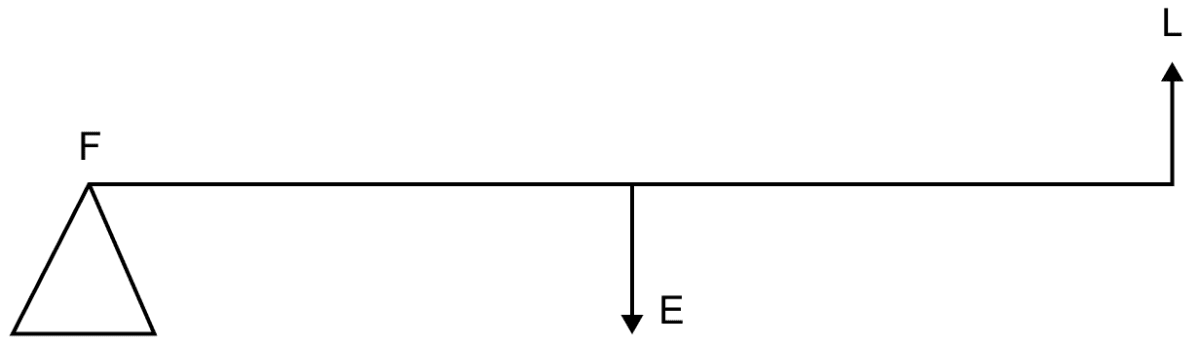
(a) In class I lever, the fulcrum is in between the effort and the load so in the same manner in nodding head, the spine acts as the fulcrum, load is at its front part while effort is at its rear part as shown in below figure.

Nodding the head is a class I lever: the fulcrum lies between effort and load. ICSE 2027 Specimen Physics Solved Question Paper.

(b) In class II lever, the fulcrum and the effort are at the two ends of the lever and the load is somewhere in between the effort and the fulcrum so like class II, the weight of the body is raised on toes where the fulcrum is at the toes at one end, the load (i.e., weight of the body) is in the middle and effort by muscles is at the other end as shown in below figure.

Raising the body on the toes is a class II lever: the load lies between fulcrum and effort. ICSE 2027 Specimen Physics Solved Question Paper.
2(iii)1 Mark · 2027 · Section A · 2027 SpecimenFull page

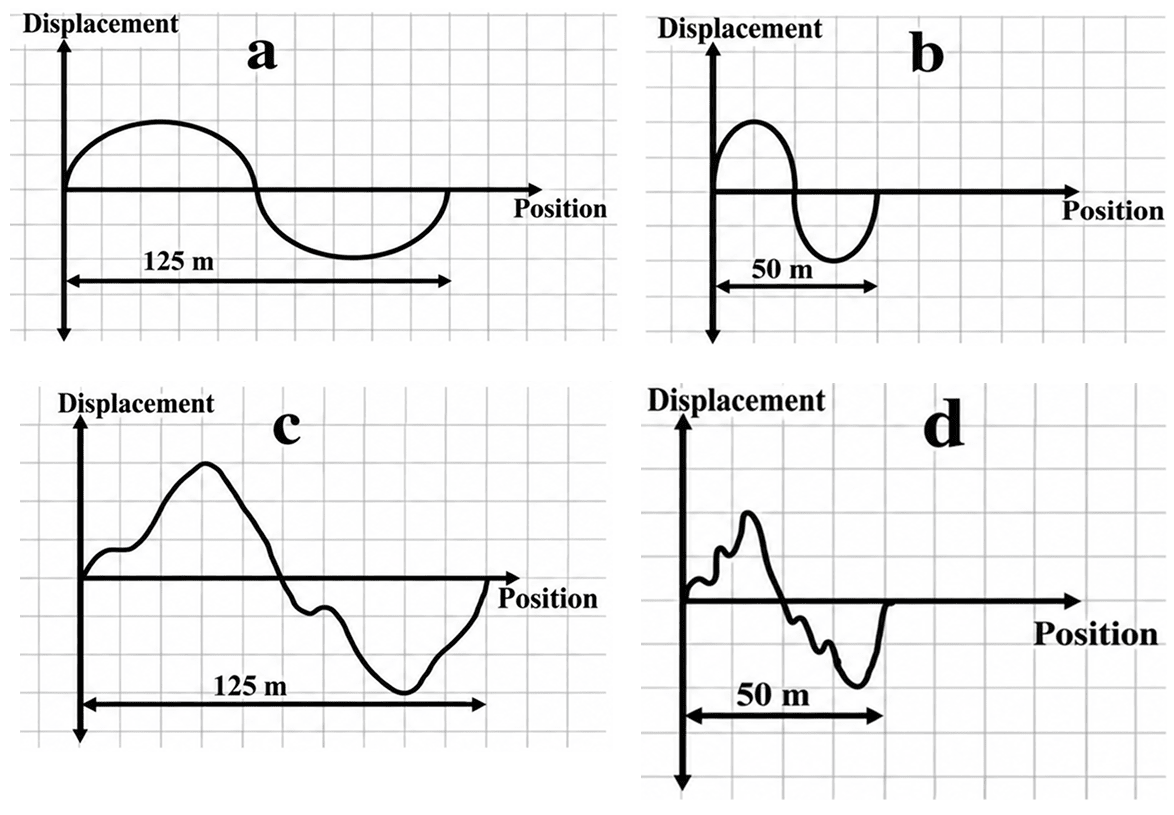
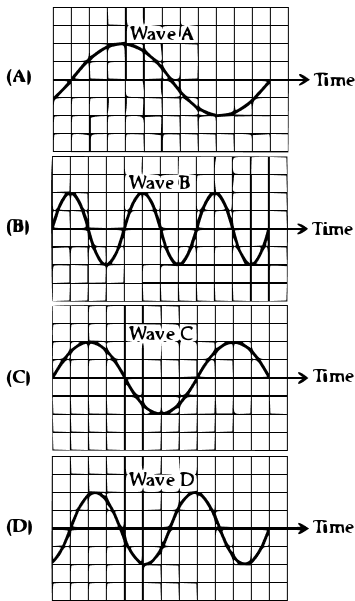
Analyse the displacement position graph and answer the questions that follow.

Analyse the displacement position graph and answer the questions that follow. Find *two* figures that show:. Specimen Board Paper 2027, ICSE 2027 Specimen Physics Solved Question Paper.

Find two figures that show:

(a) sound of same loudness and pitch but different quality.

(b) sound of same pitch but different loudness.

Show SolutionHide Solution↓

(a) Figures b and d.

(b) Figures a and c.

Reason —

(a) Loudness depends on the amplitude and pitch depends on the frequency (i.e., on the wavelength for the same speed), while quality depends on the wave form. Waves b and d have the same amplitude and the same wavelength (50 m), but their wave forms are different. So they represent sounds of the same loudness and pitch but of different quality.

(b) Waves a and c have the same wavelength (125 m), so they have the same pitch, but their amplitudes are different, so they differ in loudness.

3(i)1 Mark · 2027 · Section A · 2027 SpecimenFull page

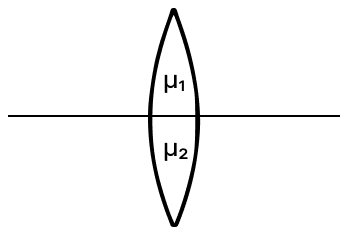
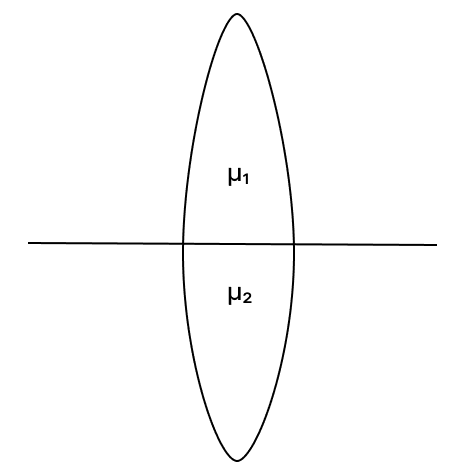
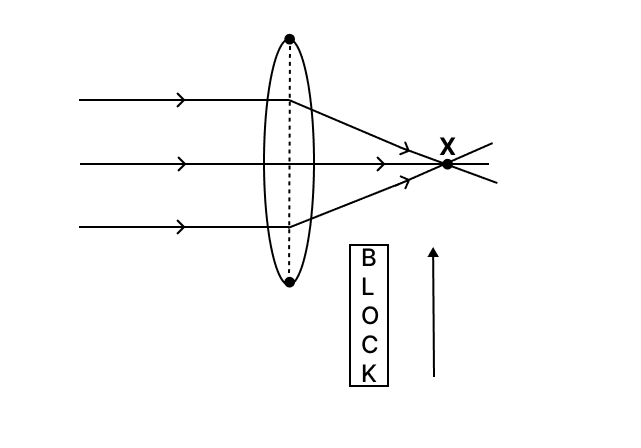
(a) Refer to the diagram given below. A lens is made of two materials of different refractive indices (μ1, μ2) as shown. If the rays are coming from a distant object, then how many images will be formed?

A lens made from two materials of different refractive indices receives parallel rays from a distant object. ICSE 2027 Specimen Physics Solved Question Paper.

(b) A glass lens always forms a virtual, erect, and diminished image of an object kept in front of it. Identify the lens.

Show SolutionHide Solution↓

(a) The two materials bend the incoming rays by different amounts and produce two focal points. Hence, two images are formed.

(b) Concave lens because irrespective of the position of the object, the image formed by a thin concave (or divergent) lens is always virtual, upright, diminished, and it is situated on the side of the object between the focus and the lens.

3(ii)1 Mark · 2027 · Section A · 2027 SpecimenFull page

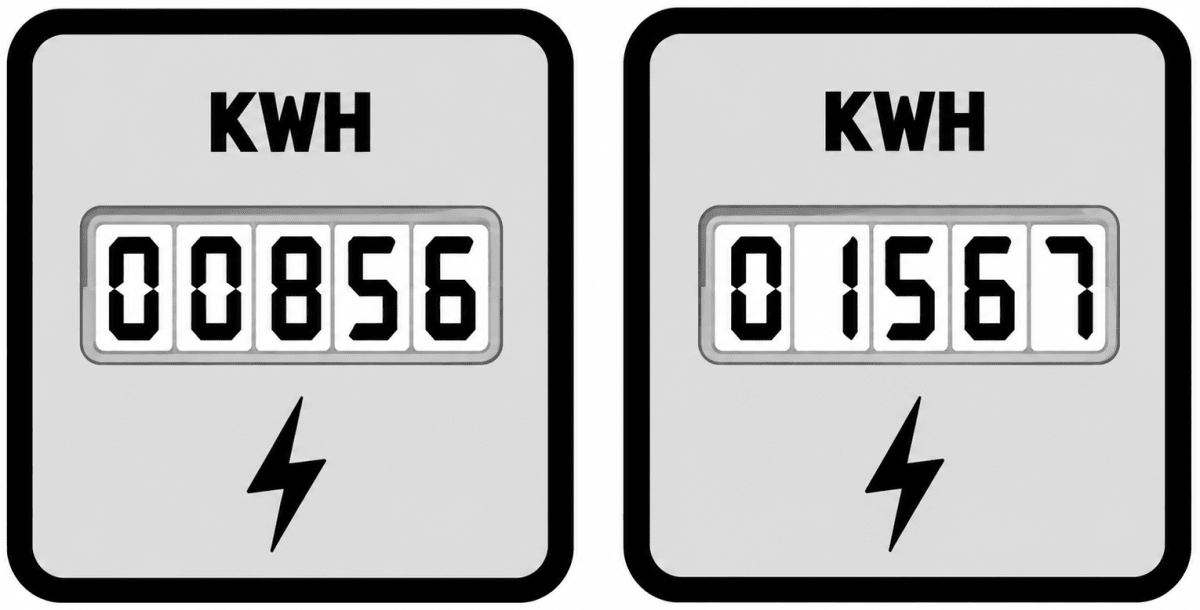
The image given below displays kilowatt-hour meter readings recorded at two distinct points in time.

The image given below displays kilowatt-hour meter readings recorded at *two* distinct points in time. Assuming a continuously running 2000W air conditioner as the sole electrical device in use, calculate the time interval, in hours, between these *two* meter readings. Specimen Board Paper 2027, ICSE 2027 Specimen Physics Solved Question Paper.

Assuming a continuously running 2000W air conditioner as the sole electrical device in use, calculate the time interval, in hours, between these two meter readings.

Show SolutionHide Solution↓

Given,

  • Power rating of air conditioner (P) = 2000 W
  • Initial meter reading = 856 kWh
  • Final meter reading = 1567 kWh

Now,

Electrical energy used (E) = 1567 − 856 = 711 kWh

$\text{Time} = \frac{\text{Energy}}{\text{Power}} = \frac{711 \text{ kWh}}{2 \text{ kW}} = 355.5 \text{ h}$

Hence, the time interval is 355.5 h.

3(iii)1 Mark · 2027 · Section A · 2027 Specimen · 🔁 also 2026Full page

ABCDE is a regular pentagon with its centre of gravity (CG) at O. What will be the most probable position (W, X, Y, Z or O) of the new centre of gravity:

A regular pentagon ABCDE shows its centre of gravity O, point A, cutting line PQ and candidate positions. ICSE 2027 Specimen Physics Solved Question Paper.

(a) if a piece of clay is attached at point A?

(b) if the pentagon is cut along the line PQ? (CG of the remaining part DCBQPE)

Show SolutionHide Solution↓

(a) X

(b) Z

Reason —

(a) If a piece of clay is attached at point A of the pentagon ABCDE then new centre of gravity will be shifted towards A; hence, the most probable position is X.

(b) If the pentagon is cut along the line PQ then only DCBQPE remains which has equal mass distribution on left and right portions about the point O but has greater mass distributed on the upper portion than the lower portion about the point O. So, new centre of gravity will shift towards upper portion i.e. at a point above O; hence, the most probable position of the new centre of gravity is Z.

3(iv)1 Mark · 2027 · Section A · 2027 Specimen · 🔁 also 2026Full page

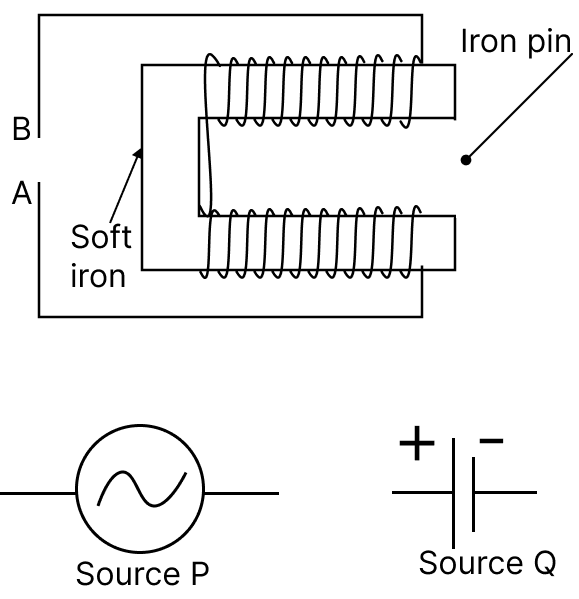
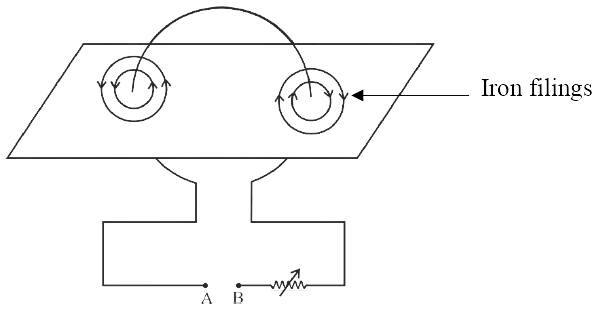
The diagram given below shows a copper wire wound around a U-shape soft iron bar. An iron pin is brought near the arrangement. First Source P and then Source Q are connected across AB, each operating independently.

The diagram given below shows a copper wire wound around a U-shape soft iron bar. An iron pin is brought near the arrangement. First Source P and then Source Q are connected across AB, each operating independently. ICSE 2026 Specimen Physics Solved Question Paper.

(a) State True or False: Source P as well as Source Q, when connected across AB, can attract the iron pin.

(b) Justify your answer to (a) with a suitable reason.

Show SolutionHide Solution↓

(a) True.

(b) The coil on a soft-iron core acts as an electromagnet with either supply.

  • With P (AC): an alternating magnetic field repeatedly magnetises the soft iron; a ferromagnetic pin is attracted in both half-cycles (polarity doesn't matter).
  • With Q (DC): a steady field magnetises the core continuously, so the pin is attracted.
3(v)1 Mark · 2027 · Section A · 2027 SpecimenFull page

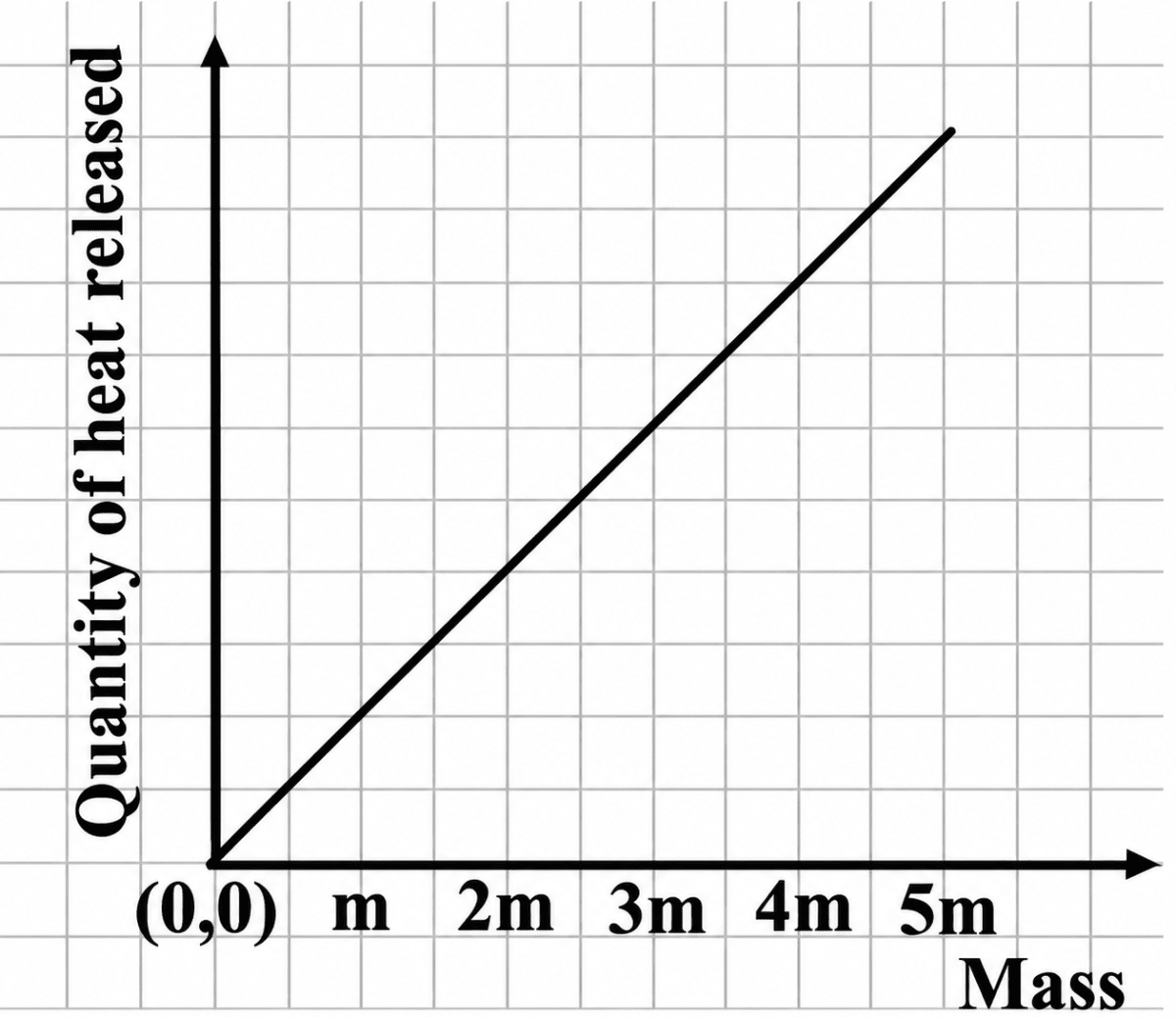
Blocks of identical material, having masses m, 2m, 3m, 4m, and 5m are heated to 150°C, and then cooled to 50°C.

(a) Draw the nature of the graph connecting the amount of heat released vs the mass of the blocks.

(b) Write the mathematical expression that enables the determination of the specific heat capacity using the graph.

Show SolutionHide Solution↓

(a) The heat energy released by a block is Q = mcΔt, where c is the specific heat capacity of the material and Δt = 150 − 50 = 100°C is the same for all the blocks.

Since c and Δt are constant, Q ∝ m. So the graph of heat released against mass is a straight line passing through the origin, as shown below.

Blocks of identical material, having masses m, 2m, 3m, 4m, and 5m are heated to 150°C, and then cooled to 50°C. Specimen Board Paper 2027, ICSE 2027 Specimen Physics Solved Question Paper.

(b) The slope of the above straight line is

$\text {slope} = \frac{\text Q}{\text m} = \text c\Delta \text t$

So the specific heat capacity is

$\text c = \frac{\text {slope of the graph}}{\Delta \text t} = \frac{\text {slope of the graph}}{100}$

3(vi)1 Mark · 2027 · Section A · 2027 SpecimenFull page

Answer the following questions according to the instructions given:

(a) When 6Li3 is bombarded with a neutron, it produces 4He2 and an isotope of hydrogen. Write the notation for the hydrogen isotope formed.

(b) Fill in the blank:

The mass of the reactants in a fission reaction is ............... (greater / less) than the mass of the products.

Show SolutionHide Solution↓

(a) The nuclear reaction is

6Li3 + 1n0 ⟶ 4He2 + 3H1

Balancing the mass numbers, 6 + 1 = 4 + 3, and balancing the atomic numbers, 3 + 0 = 2 + 1.

Hence, the hydrogen isotope formed is 3H1 (tritium).

(b) The mass of the reactants in a fission reaction is greater than the mass of the products.

Reason — In a fission reaction a small part of the mass of the reactants disappears. This loss of mass (mass defect) is converted into a large amount of energy in accordance with E = mc2, so the total mass of the products is less than the total mass of the reactants.

3(vii)1 Mark · 2027 · Section A · 2027 SpecimenFull page

Advanced optical sensors in missiles use fibre optic cables to transmit light signals with minimal loss. This relies on a physical phenomenon that confines light within the fibres, making the system very dependable for guiding the missile precisely.

(a) Name the optical phenomenon that allows light signals to remain confined within the fibre optic cables during transmission.

(b) List the two main conditions necessary for this phenomenon to occur.

Show SolutionHide Solution↓

(a) Total internal reflection.

(b) The two necessary conditions for total internal reflection are :

  1. The light must travel from an optically denser medium to an optically rarer medium.
  2. The angle of incidence in the denser medium must be greater than the critical angle for that pair of media.
4(i)Written · 2027 · Section B · 2027 SpecimenFull page

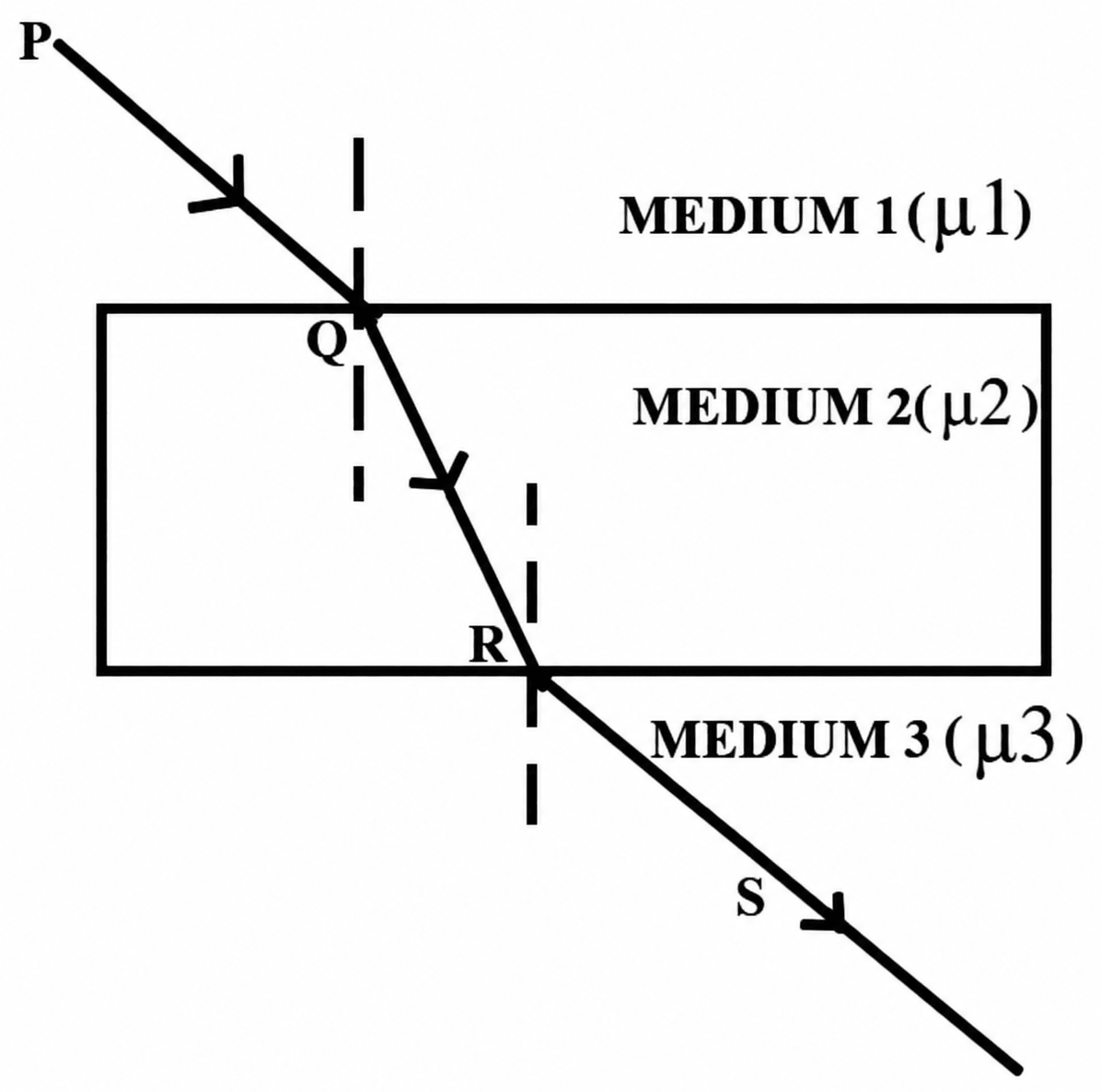
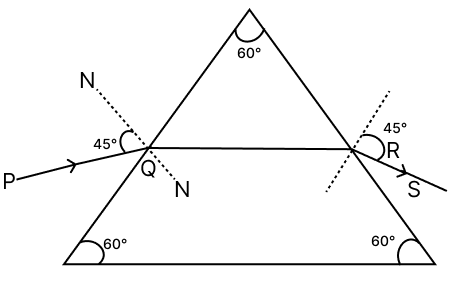
A diagram shows a ray of light travelling through three different transparent media having refractive indices μ1, μ2 and μ3 as shown. Points Q and R are points on the surfaces separating the media. Given PQ || RS.

A diagram shows a ray of light travelling through *three* different transparent media having refractive indices μ 1, μ 2 and μ 3 as shown. Points Q and R are points on the surfaces separating the media. Given PQ || RS. Specimen Board Paper 2027, ICSE 2027 Specimen Physics Solved Question Paper.

(a) Among the three media shown, in which medium is the speed of light minimum?

(b) As the ray of light travels from medium 1 to medium 2, how does the wavelength of light change? (State whether it increases, decreases, or remains constant.)

(c) State the relationship between the refractive indices μ1 and μ3 that ensures the emergent ray (RS) is parallel to the incident ray (PQ).

Show SolutionHide Solution↓

(a) When the light ray travels from Medium 1 to Medium 2, it bends towards the normal, indicating that Medium 2 is optically denser than Medium 1. When it travels from Medium 2 to Medium 3, it bends away from the normal, indicating Medium 2 is also denser than Medium 3. Because light travels slowest in the optically densest medium, its speed is minimum in Medium 2.

(b) The frequency of light does not change on refraction, and speed = frequency × wavelength. Since the speed of light decreases on entering medium 2, the wavelength also decreases.

Hence, the wavelength decreases.

(c) The emergent ray RS is parallel to the incident ray PQ only when the ray suffers equal and opposite bending at the two surfaces, i.e., when the first and the third media are optically identical.

Hence, μ1 = μ3.

4(ii)Written · 2027 · Section B · 2027 SpecimenFull page

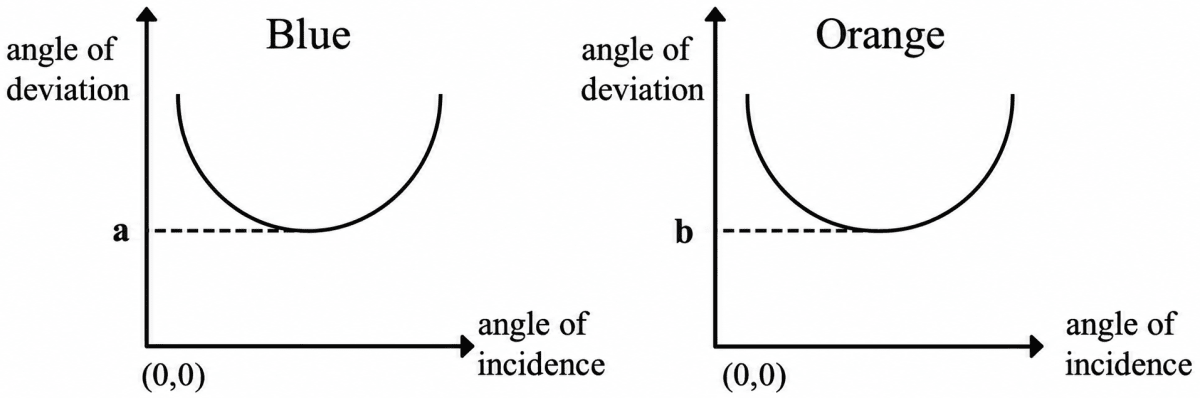
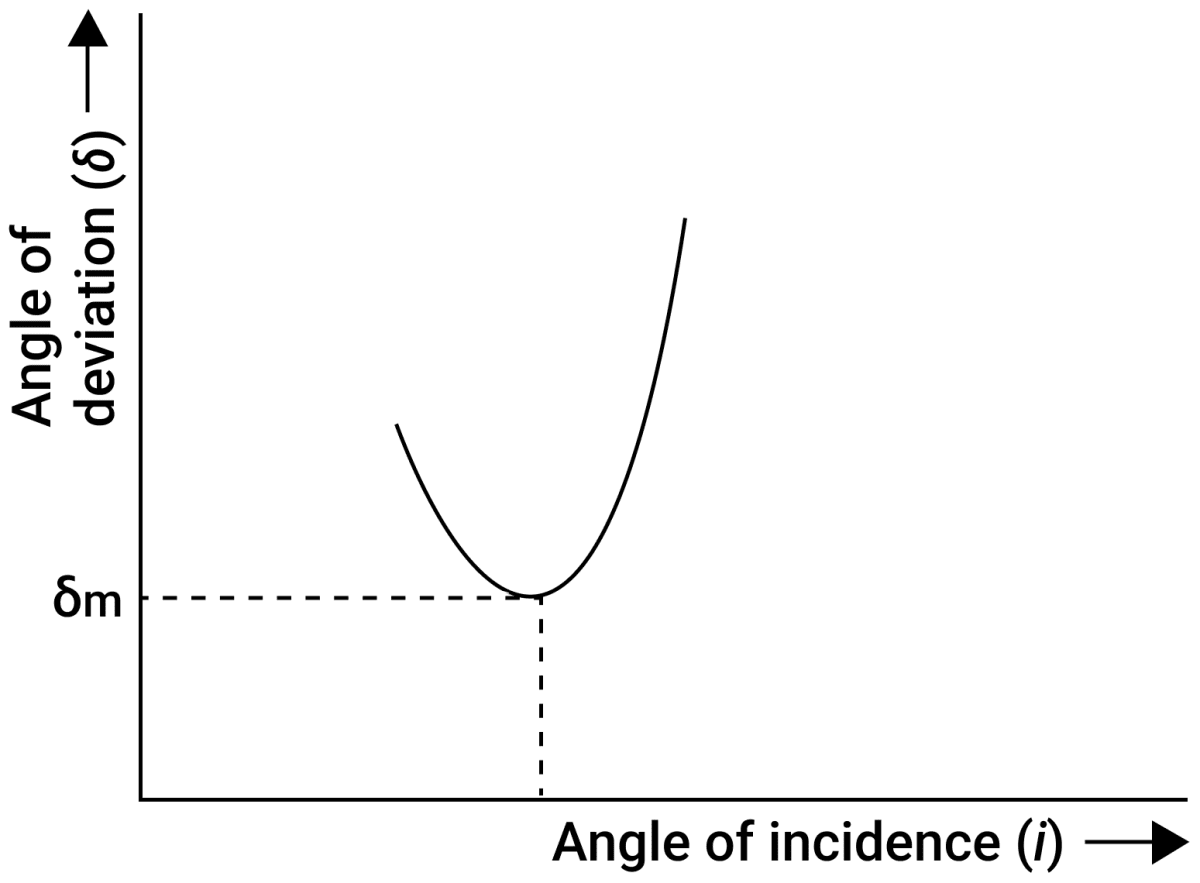
The diagram below shows two graphs showing variation in angle of deviation against angle of incidence for two colours of light (blue, orange) while passing through the same prism. [Diagrams are not drawn to the same scale.]

The diagram below shows *two* graphs showing variation in angle of deviation against angle of incidence for *two* colours of light (blue, orange) while passing through the same prism. [*Diagrams are not drawn to the same scale.*]. Specimen Board Paper 2027, ICSE 2027 Specimen Physics Solved Question Paper.

(a) State with a reason whether a = b, a < b, or a > b.

(b) If we increase the angle of the prism then what is the effect on the values of a and b?

Show SolutionHide Solution↓

(a) a > b

Reason — In each graph the lowest point of the curve gives the angle of minimum deviation, so a is the angle of minimum deviation for blue light and b is that for orange light.

The refractive index of the material of a prism decreases with the increase in the wavelength of light. As the wavelength of blue light is smaller than that of orange light, the prism has a greater refractive index for blue light and therefore deviates it more.

Hence, a > b.

(b) The angle of deviation produced by a prism increases with the increase in the angle of the prism.

Hence, on increasing the angle of the prism, the values of both a and b will increase.

4(iii)Written · 2027 · Section B · 2027 SpecimenFull page

A candle and a screen are placed 90 cm apart. Steve placed a lens between them such that a clear image is formed on the screen and the image is twice the size of the object.

(a) Which type of lens is used by Steve?

(b) Write an equation relating the object distance u, image distance v, and the distance between the candle and the screen.

(c) State the ratio between the image distance v and the object distance u.

(d) Calculate the image distance.

Show SolutionHide Solution↓

(a) A clear image is obtained on a screen, so the image is real and magnified. Only a convex lens can form a real and magnified image.

Hence, Steve used a convex lens.

(b) The candle and the screen lie on opposite sides of the lens, so the sum of the two distances is equal to the separation between them.

u + v = 90 cm

(c) The image is twice the size of the object, so its image distance is twice its object distance.

Hence, v : u = 2 : 1

(d) From part (c), v = 2u

Substituting in u + v = 90, we get

$$\begin{aligned}\text u + 2\text u = 90 \\[1em] \Rightarrow 3\text u = 90 \\[1em] \Rightarrow \text u = 30 \text { cm}\end{aligned}$$

Then,

v = 90 − 30 = 60 cm

Hence, the image distance is 60 cm.

5(i)Written · 2027 · Section B · 2027 SpecimenFull page

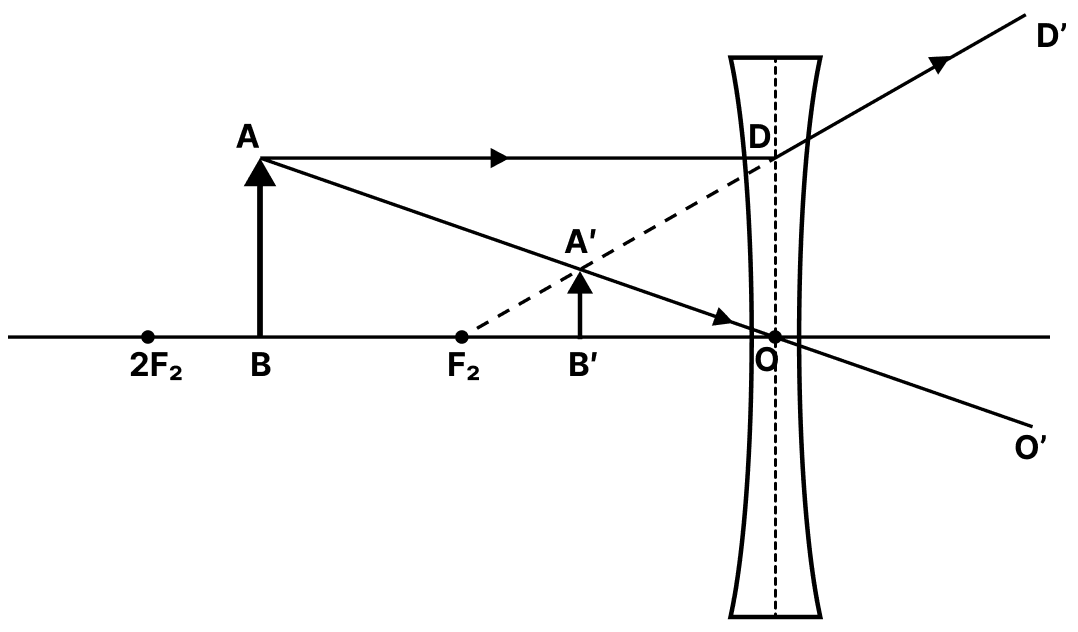
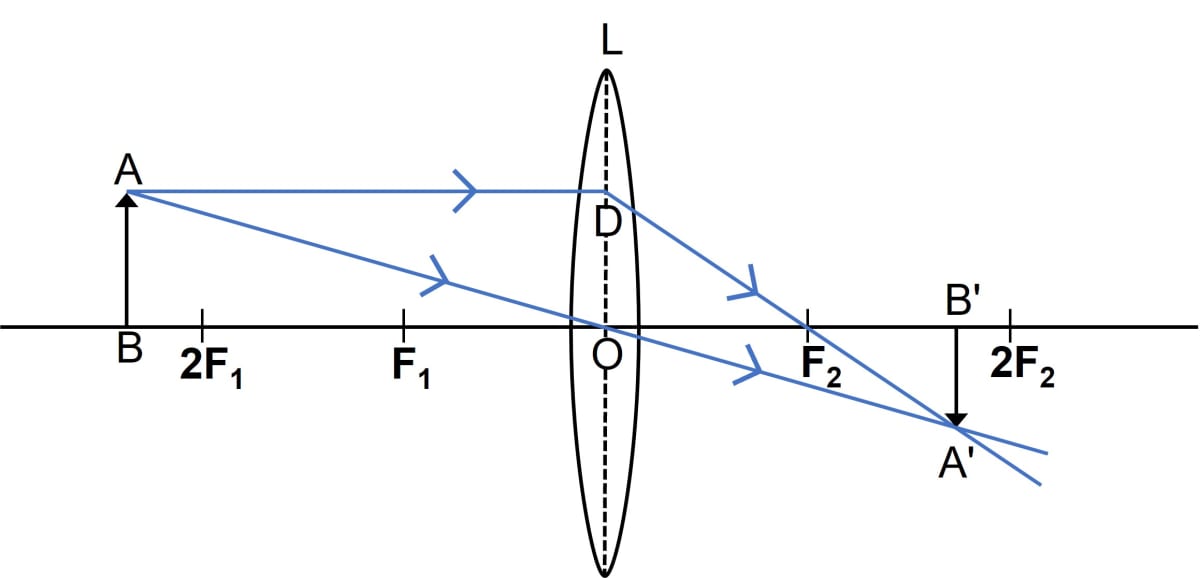
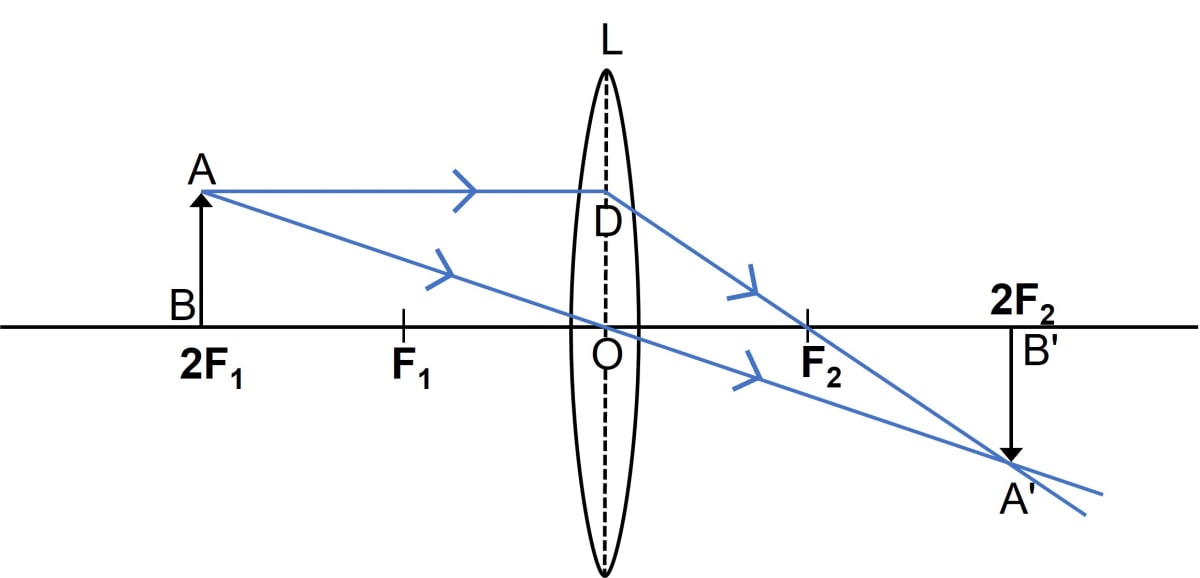
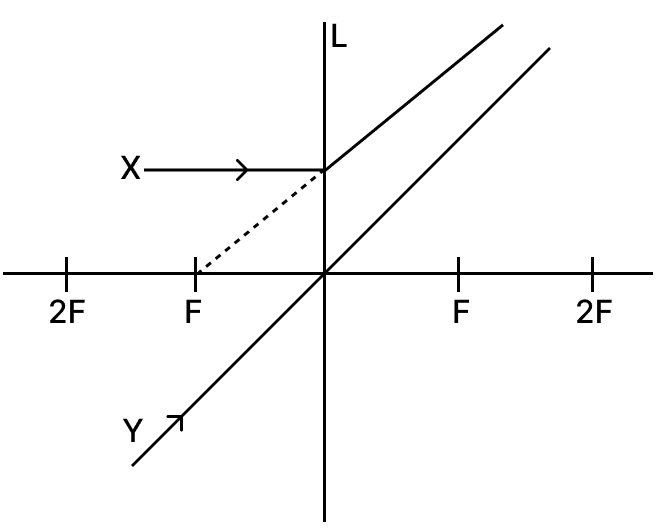
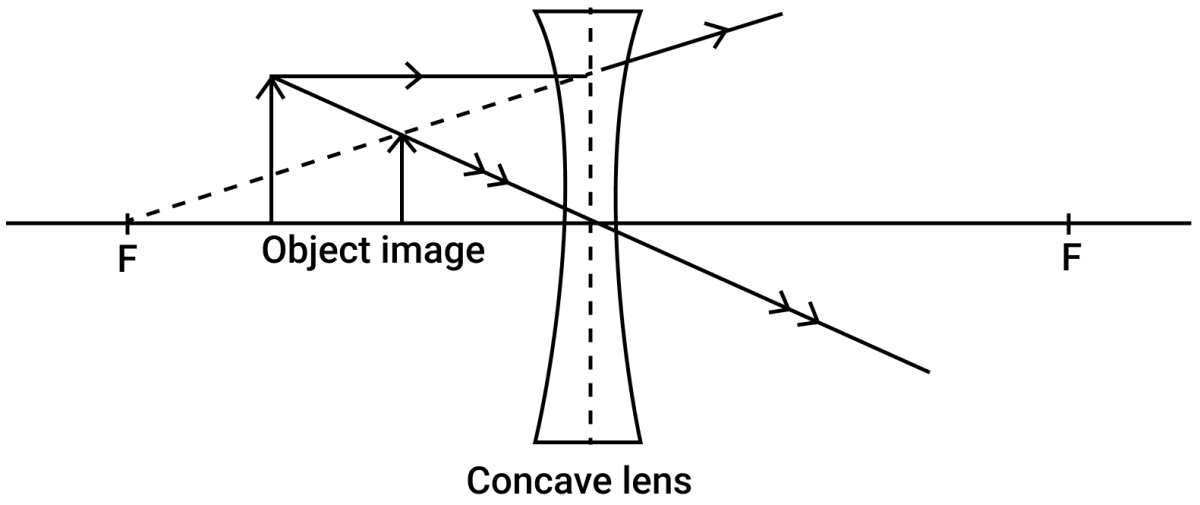
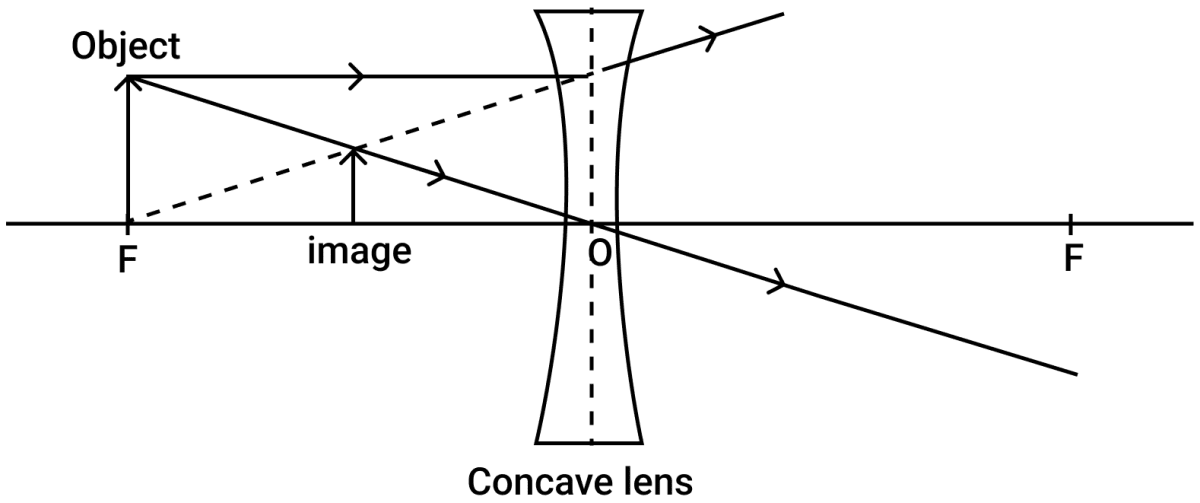
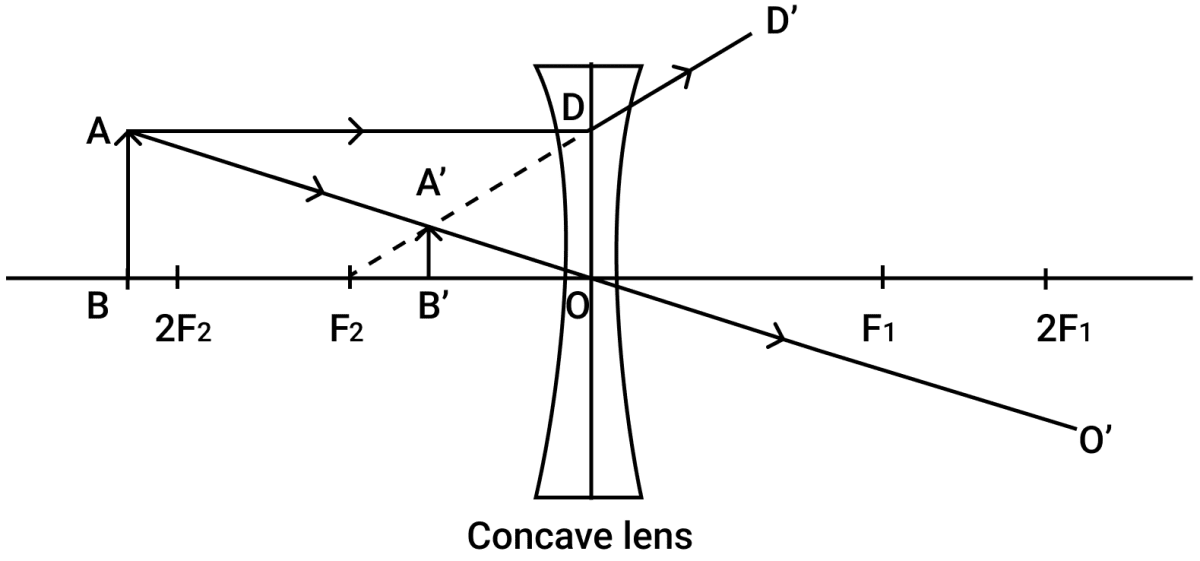
Draw a ray diagram to show the formation of an image by a concave lens when the object is placed between F and 2F.

Show SolutionHide Solution↓

The ray diagram is shown below :

Draw a ray diagram to show the formation of an image by a concave lens when the object is placed between F and 2F. Specimen Board Paper 2027, ICSE 2027 Specimen Physics Solved Question Paper.

A ray from the top of the object travelling parallel to the principal axis, after refraction, appears to come from the focus F1 on the same side of the lens, while a ray directed towards the optical centre O passes undeviated. These two refracted rays appear to meet at A'.

The image A'B' so formed is virtual, erect and diminished, and it lies between the optical centre and the focus F1, on the same side of the lens as the object.

5(ii)Written · 2027 · Section B · 2027 SpecimenFull page

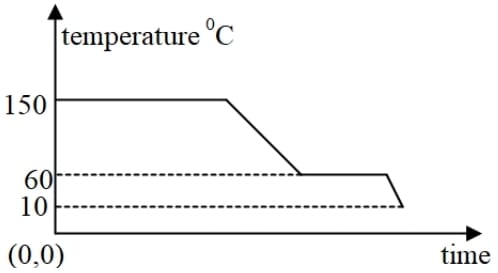
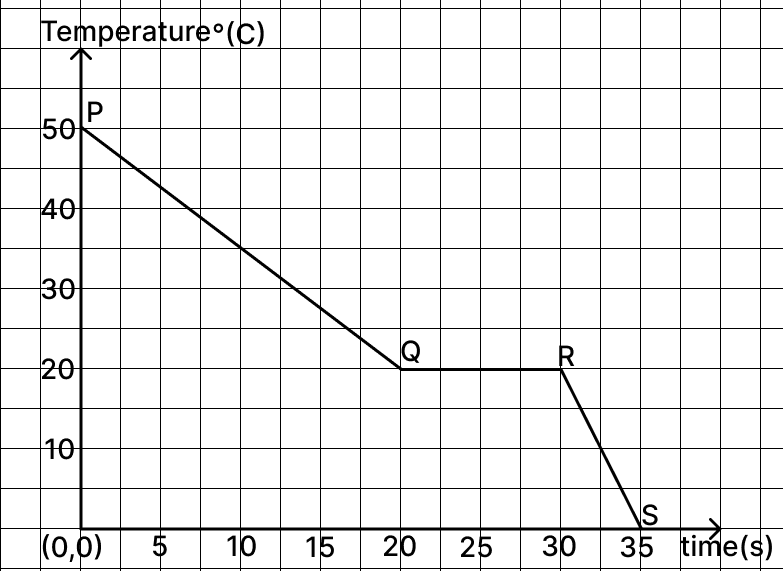
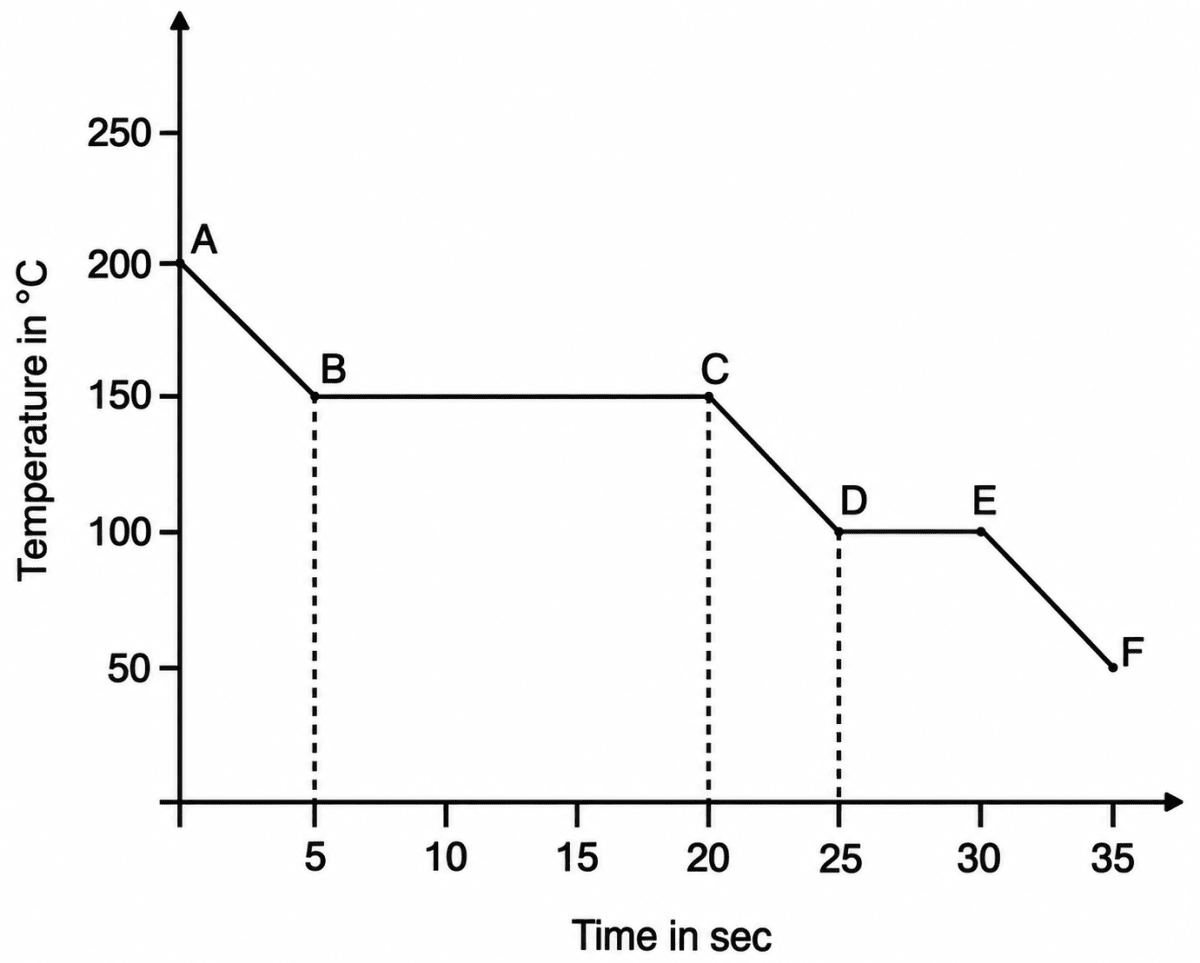
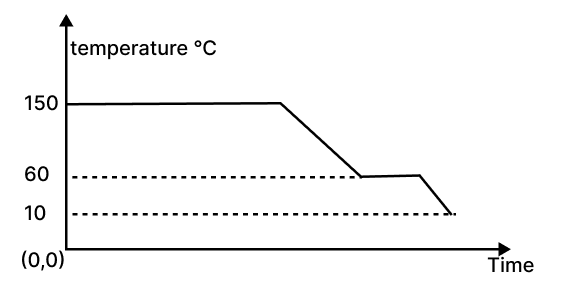
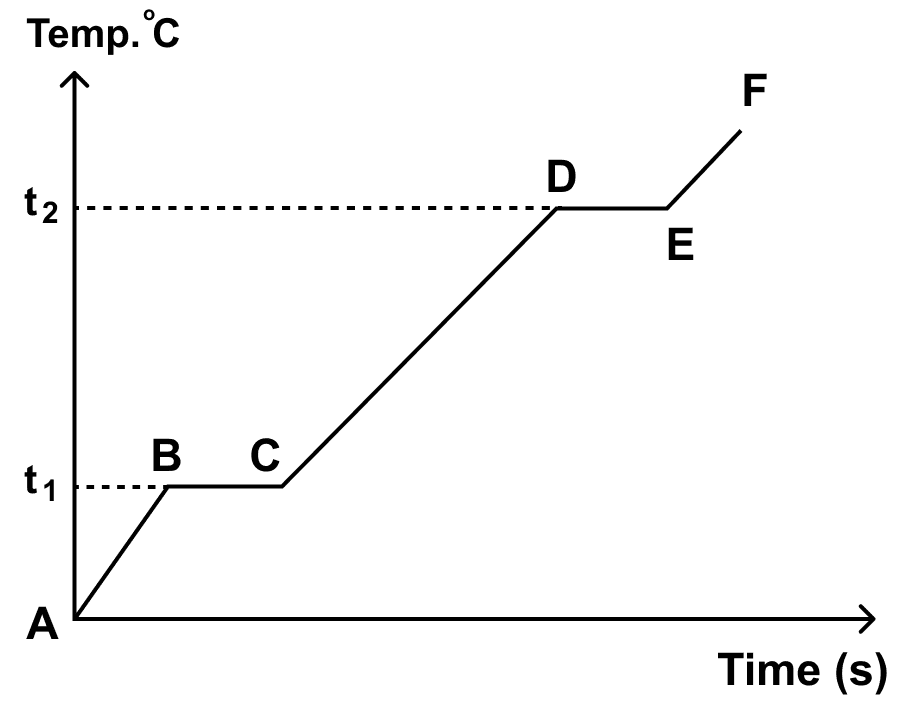
The diagram below shows a cooling curve for a substance X:

The cooling curve for substance X has horizontal sections at 150°C and 60°C. ICSE 2027 Specimen Physics Solved Question Paper.

(a) State the temperature at which the substance condenses.

(b) Mention the temperature range in which the substance is in its liquid state.

(c) State True or False: The amount of heat released when a substance is cooled by 10°C in its liquid state is greater than the heat released when it is cooled by the same amount in its solid state.

Show SolutionHide Solution↓

(a) Substance condenses at 150 °C.

(b) 150 °C to 60 °C.

(c) True.

Reason — The amount of heat released when a substance is cooled depends on :

Q = mcΔT

Where:

  • Q = heat released
  • m = mass of the substance
  • c = specific heat capacity
  • ΔT = change in temperature

Now, for the same mass and same temperature drop (10°C), the specific heat capacity (c) of a liquid is usually greater than that of its solid form.

So,

Qliquid > Qsolid

Hence, more heat is released when cooling a substance by 10°C in its liquid state than in its solid state, due to higher specific heat capacity.

5(iii)Written · 2027 · Section B · 2027 SpecimenFull page

In an experiment to measure the temperature of the flame of a Bunsen burner, a lump of copper of mass 0.12 kg is heated on the flame for a long time. The copper then is quickly transferred into a beaker of negligible heat capacity containing 0.84 kg of water and the temperature of the water rose from 15°C to 35°C. Calculate the temperature of the flame.

[Given sp. Heat capacity of copper = 0.4 Jg-1 oC-1, Sp. Heat capacity of water = 4.2 Jg-1 oC-1.]

Show SolutionHide Solution↓

Given,

  • Mass of copper (mC) = 0.12 kg = 0.12 x 1000 g = 120 g
  • Mass of water (mW) = 0.84 kg = 0.84 x 1000 = 840 g
  • Initial Temperature of water (T1) = 15 °C
  • Final Temperature of water = Final Temperature of copper = (T2) = 35 °C
  • Specific heat capacity of copper (cC) = 0.4 J g-1 °C-1
  • Specific heat capacity of water (cW) = 4.2 J g-1 °C-1

Let,

Temperature of the flame = Initial Temperature of copper = T

Now,

Heat lost by copper = mC x cC x (T - T2)

= 120 x 0.4 x (T - 35)

= 48 x (T - 35)

And

Heat gained by water = mW x cW x (T2 - T1)

= 840 x 4.2 x (35 - 15)

= 840 x 4.2 x 20

= 70560 J

As,

Heat lost by copper = Heat gained by water

⟹ 48 x (T - 35) = 70560

⟹ T - 35 = $\frac{70560}{48}$ = 1470

⟹ T = 1470 + 35 = 1505 °C

Hence, temperature of the flame is 1505 °C.

6(i)Written · 2027 · Section B · 2027 Specimen · 🔁 also 2026Full page

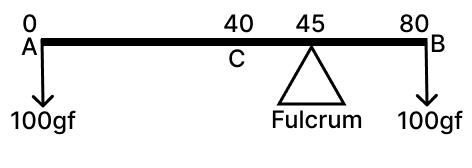
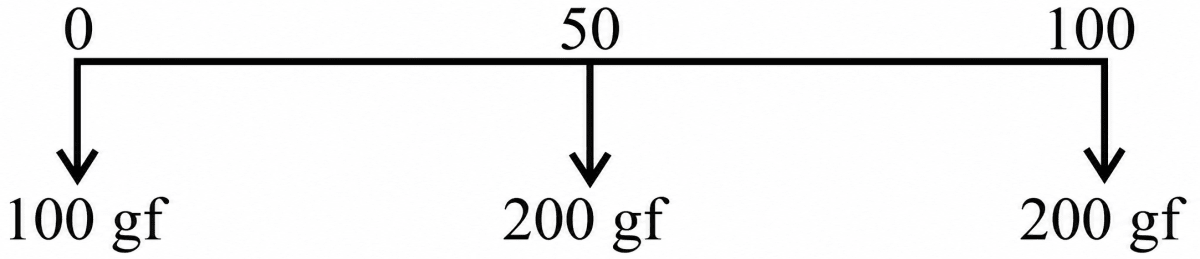
A metal rod AB of length 80 cm is balanced at 45 cm from the end A with 100 gf weights suspended from the two ends.

A rod AB of length 80 cm balances at a point 45 cm from A with 100 gf weights at both ends. ICSE 2027 Specimen Physics Solved Question Paper.

(a) If this rod is cut at the centre C, then compare the weight of AC to the weight of BC. (Use >, < or =)

(b) Give a reason for your answer in (a).

Show SolutionHide Solution↓

(a) Given,

  • Weight at the end A (WA) = 100 gf
  • Weight at the end B (WB) = 100 gf
  • Length of the rod (L) = 80 cm
  • Distance of A from the fulcrum (lA) = 45 cm
  • Distance of B from the fulcrum (lB) = 80 cm - 45 cm = 35 cm

Let,

Weight of the rod AC is (WAC) and distance of centre of gravity of the rod AC from the fulcrum is (lAC).

And

Weight of the rod BC is (WBC) and distance of centre of gravity of the rod BC from the fulcrum is (lBC).

Here,

(lAC) = 45 - 20 = 25 cm,

(lBC) = 60 - 45 = 15 cm,

Now,

Anticlockwise moment (due to weight of 100 gf at end A and weight of rod AC) = lA x WA + lAC x WAC = 45 x 100 + 25 x WAC

Clockwise moment (due to weight of 100 gf at end B and weight of rod BC) = lB x WB + lBC x WBC = 35 x 100 + 15 x WBC

As system is balanced then for equilibrium,

Anticlockwise moment of force about the fulcrum = Clockwise moment of force about the fulcrum

45 x 100 + 25 x WAC = 35 x 100 + 15 x WBC

⇒ 4500 + 25WAC = 3500 + 15WBC

⇒ 15WBC - 25WAC = 4500 - 3500 = 1000

⇒ 3WBC - 5WAC = 200

⇒ 3WBC - 5WAC > 0

⇒ 3WBC > 5WAC

$\frac {{\text W}<em>\text {BC}}{\text W</em>\text {AC}} \gt \frac{5}{3} \gt 1$

⇒ WBC > WAC

Hence, weight of AC < weight of BC.

(b) Even though the weights present are the same at both ends and the torque arm of B is less than the torque arm of A. This means the moment of the weight of the rod acts from side B and the C.G. lies beyond 45. Thus, more weight is concentrated between C to B.

6(ii)Written · 2027 · Section B · 2027 SpecimenFull page

For each of the following scenarios, state whether the work done by gravity is positive, negative, or zero.

(a) A person walks on a levelled road.

(b) A person climbs a ladder.

(c) A car in a neutral gear is coming down the slope.

Show SolutionHide Solution↓

(a) Zero

(b) Negative

(c) Positive

Reason —

(a) Zero because when a person walks on a levelled road, no work is done against the force of gravity as the displacement of the person is normal to the direction of force of gravity which is vertically downwards.

(b) Negative because when a person climbs a ladder (upward), the displacement covered by the person is opposite to the direction of force of gravity (downwards), so the work done on the person by the force of gravity is negative.

(c) Positive because when a car in neutral gear is coming down the slope, the direction of displacement covered by it has some angle θ with the direction of force of gravity (downwards) such that 0° ≤ θ < 90°, so the work done on the car by the force of gravity is positive.

6(iii)Written · 2027 · Section B · 2027 SpecimenFull page

An empty supermarket trolley of mass 10 kg is moving with a speed of 8 m s-1. An identical trolley is loaded with 10 kg of goods and moves with a speed of 4 m s-1. Both trolleys are brought to rest over the same stopping distance.

(a) Calculate the kinetic energy of the empty trolley.

(b) Calculate the kinetic energy of the loaded trolley.

(c) Compare the braking force required to stop the empty trolley and the loaded trolley.

(d) Name the principle applied in solving part (c).

Show SolutionHide Solution↓

Given,

  • Mass of the empty trolley (m1) = 10 kg
  • Speed of the empty trolley (v1) = 8 m s-1
  • Mass of the loaded trolley (m2) = 10 + 10 = 20 kg
  • Speed of the loaded trolley (v2) = 4 m s-1

(a) Kinetic energy of the empty trolley

$\text K_1 = \frac{1}{2}\text m_1 {\text v_1}^2 = \frac{1}{2} \times 10 \times 8 \times 8 = 320 \text { J}$

Hence, the kinetic energy of the empty trolley is 320 J.

(b) Kinetic energy of the loaded trolley

$\text K_2 = \frac{1}{2}\text m_2 {\text v_2}^2 = \frac{1}{2} \times 20 \times 4 \times 4 = 160 \text { J}$

Hence, the kinetic energy of the loaded trolley is 160 J.

(c) The work done by the braking force in stopping a trolley is equal to its kinetic energy. If the stopping distance is s and the braking force is F, then

F × s = kinetic energy

So,

$\frac{\text F_1}{\text F_2} = \frac{\text K_1 / \text s}{\text K_2 / \text s} = \frac{\text K_1}{\text K_2} = \frac{320}{160} = \frac{2}{1}$

Hence, F1 : F2 = 2 : 1, i.e., the braking force needed for the empty trolley is twice that needed for the loaded trolley.

(d) The work-energy theorem, i.e., the work done by the braking force is equal to the change in the kinetic energy of the trolley.

7(i)Written · 2027 · Section B · 2027 SpecimenFull page

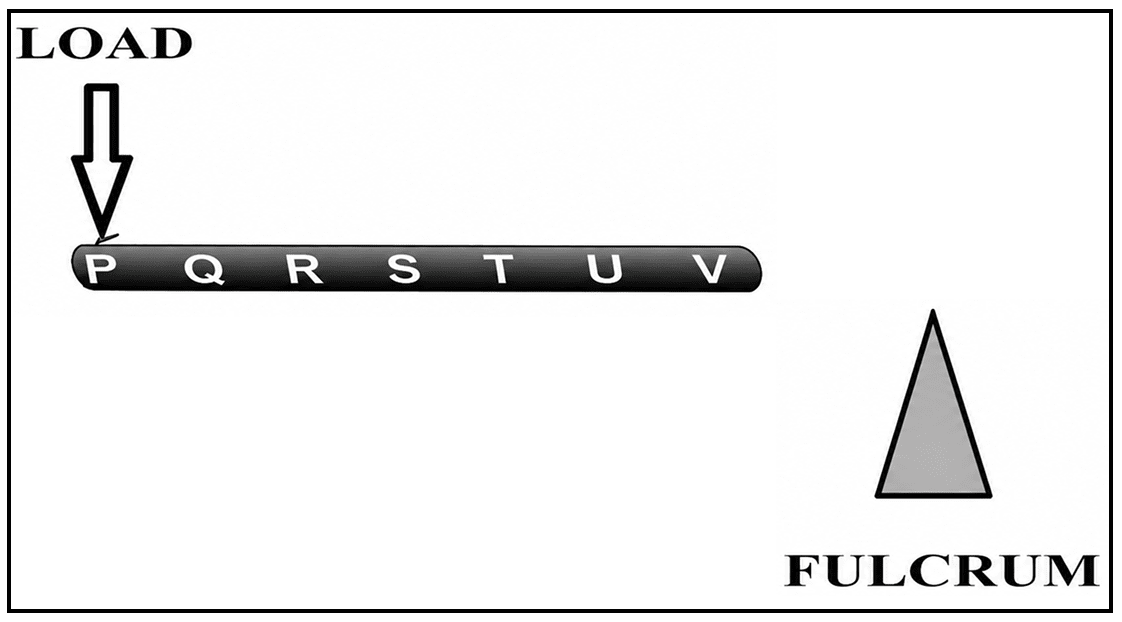
A bar of length 120 cm is used as a lever to raise a load placed at point P. Seven equidistant points are marked along the bar: P, Q, R, S, T, U, and V, each 20 cm apart. You are permitted to place the fulcrum at any of the marked points and exert the effort at a different point.

A bar of length 120 cm is used as a lever to raise a load placed at point P. Seven equidistant points are marked along the bar: P, Q, R, S, T, U, and V, each 20 cm apart. You are permitted to place the fulcrum at any of the marked points and exert the effort at a different point. Specimen Board Paper 2027, ICSE 2027 Specimen Physics Solved Question Paper.

(a) Specify the fulcrum and effort points that yield the greatest mechanical advantage.

(b) Based on the lever arrangement identified in part (a), calculate the maximum mechanical advantage using the distances shown in the diagram.

(c) To which class of lever does this arrangement belong?

Show SolutionHide Solution↓

(a) For a lever,

$\text {M.A.} = \frac{\text {effort arm}}{\text {load arm}}$

So the mechanical advantage is greatest when the load arm is as small as possible and the effort arm as large as possible. The load is at P, so the fulcrum must be at the point nearest to P and the effort must be applied at the farthest point.

Hence, the fulcrum should be at Q and the effort should be applied at V.

(b) Load arm = PQ = 20 cm

Effort arm = QV = 120 − 20 = 100 cm

$\text {M.A.} = \frac{\text {effort arm}}{\text {load arm}} = \frac{100}{20} = 5$

Hence, the maximum mechanical advantage is 5.

(c) In this arrangement the fulcrum Q lies in between the load at P and the effort at V.

Hence, it is a class I (first class) lever.

7(ii)Written · 2027 · Section B · 2027 SpecimenFull page

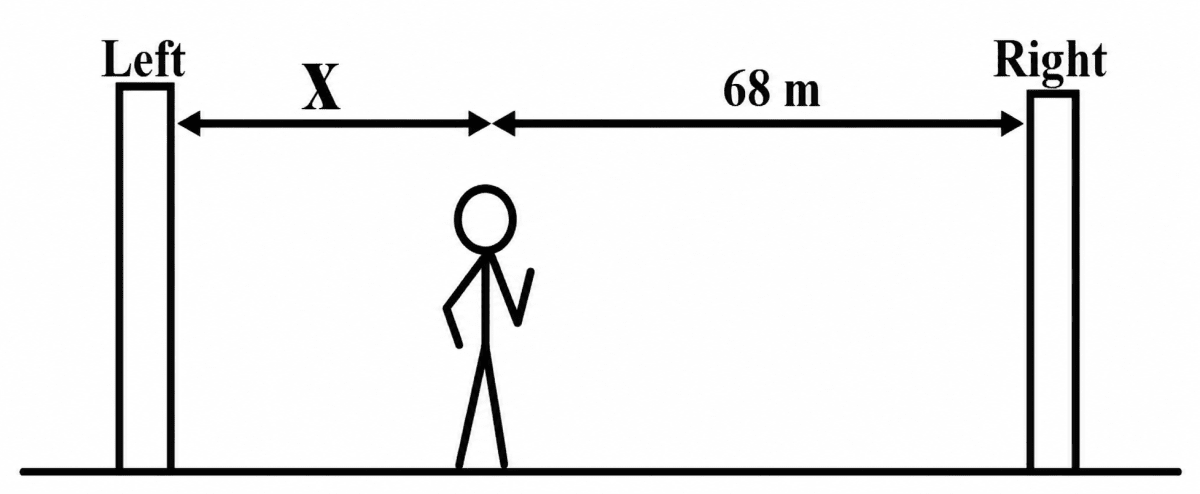
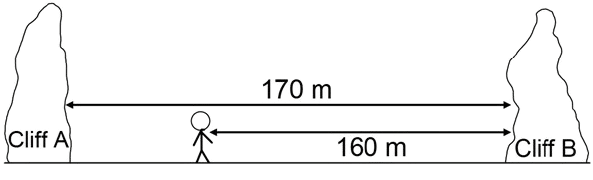
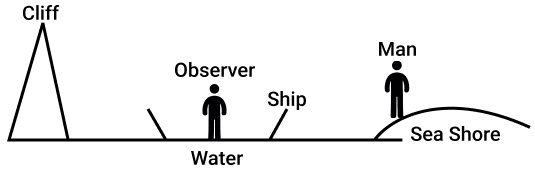
A boy is located asymmetrically between two parallel walls, closer to the left wall than the right. If he claps, the time interval between successive echoes is 0.25 s, then find the value of X in metres. [speed of sound in air = 340 m/s.]

A boy is located asymmetrically between two parallel walls, closer to the left wall than the right. If he claps, the time interval between successive echoes is 0.25 s, then find the value of X in metres. *[speed of sound in air = 340 m/s.]*. Specimen Board Paper 2027, ICSE 2027 Specimen Physics Solved Question Paper.
Show SolutionHide Solution↓

Given,

  • Distance of the boy from the right wall = 68 m
  • Distance of the boy from the left wall = X
  • Time interval between the two echoes = 0.25 s
  • Speed of sound in air (v) = 340 m s-1

Since the boy is nearer to the left wall, the echo from the left wall is heard first and that from the right wall is heard later.

Time taken by the echo from the right wall,

$\text t_2 = \frac{2 \times 68}{340} = \frac{136}{340} = 0.4 \text { s}$

Time taken by the echo from the left wall,

t1 = t2 − 0.25 = 0.4 − 0.25 = 0.15 s

Now,

$$\begin{aligned}\text t_1 = \frac{2\text X}{\text v} \\[1em] \Rightarrow 0.15 = \frac{2\text X}{340} \\[1em] \Rightarrow 2\text X = 0.15 \times 340 \\[1em] \Rightarrow 2\text X =51 \\[1em] \Rightarrow \text X = 25.5 \text { m}\end{aligned}$$

Hence, the value of X is 25.5 m.

7(iii)Written · 2027 · Section B · 2027 SpecimenFull page

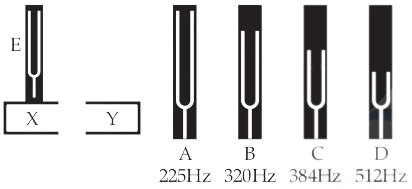
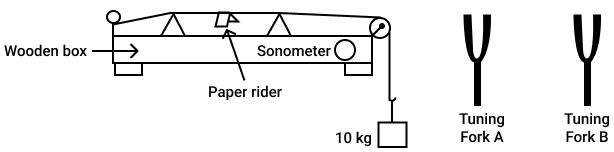
Two wires A and B of the same material and length are fixed to a wooden board and stretched under the same tension. The cross-sectional area of wire A is greater than that of wire B. When set into vibration using identical tuning forks of frequency 300 Hz, only wire B produces a loud sound.

(a) Name and explain the phenomenon responsible for the loud sound produced by wire B.

(b) A loud sound is heard from wire A when the experiment is repeated using a tuning fork of frequency f. Is 'f' greater than, less than or equal to 300 Hz? Justify your answer.

Show SolutionHide Solution↓

(a) The phenomenon is resonance.

The vibrating tuning fork applies an external periodic force of frequency 300 Hz on both the wires, so both of them execute forced vibrations. The natural frequency of wire B happens to be exactly equal to 300 Hz, so wire B vibrates with a very large amplitude and sends out a large amount of energy into the surrounding air. Hence a loud sound is heard from wire B only.

(b) f < 300 Hz

Reason — For wires of the same material, same length and under the same tension, a thicker wire has a greater mass per unit length and therefore a lower natural frequency of vibration. Since wire A is thicker than wire B, the natural frequency of A is less than that of B, i.e., less than 300 Hz.

A loud sound will be heard from wire A only when the frequency of the tuning fork is equal to the natural frequency of A, so that resonance occurs.

Hence, f is less than 300 Hz.

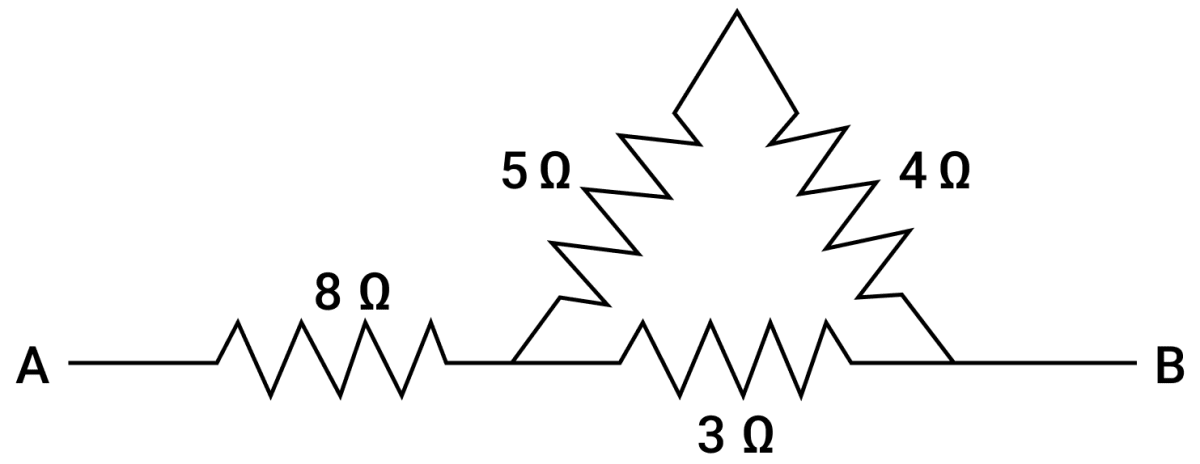
8(i)Written · 2027 · Section B · 2027 SpecimenFull page

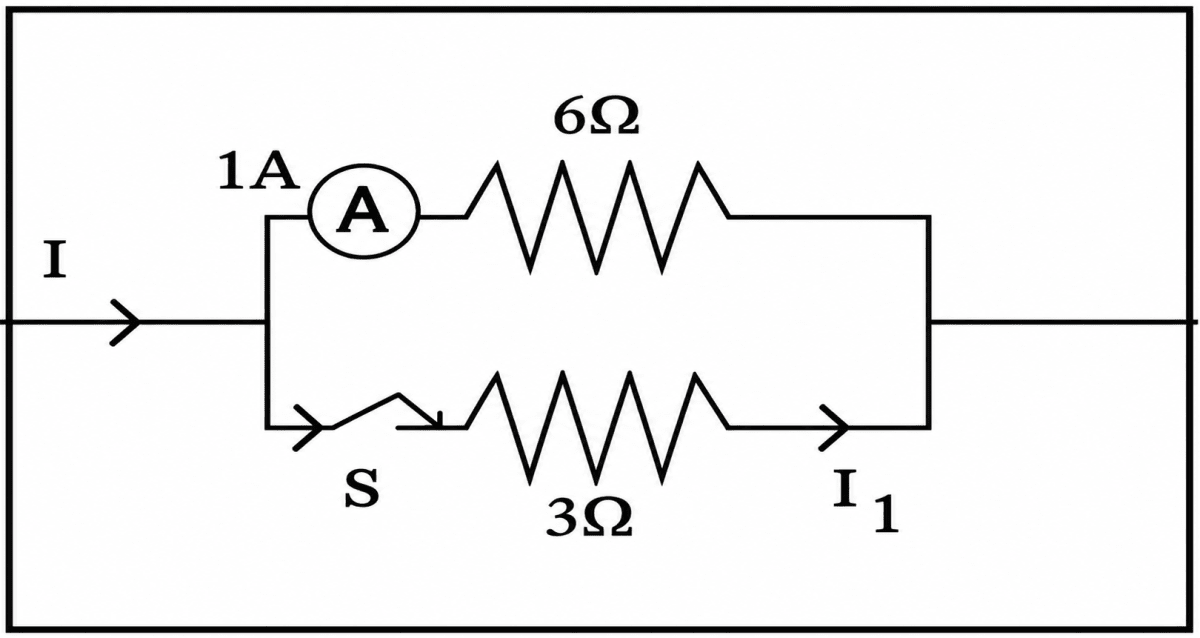
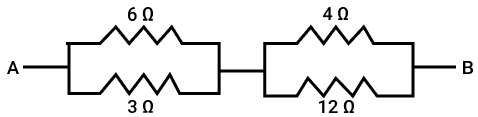
The below diagram shows the part of a complete circuit. The ammeter reads 1A.

The below diagram shows the part of a complete circuit. The ammeter reads 1A. Calculate:. Specimen Board Paper 2027, ICSE 2027 Specimen Physics Solved Question Paper.

Calculate:

(a) the current I1 through the 3Ω resistor.

(b) the total current I in the circuit.

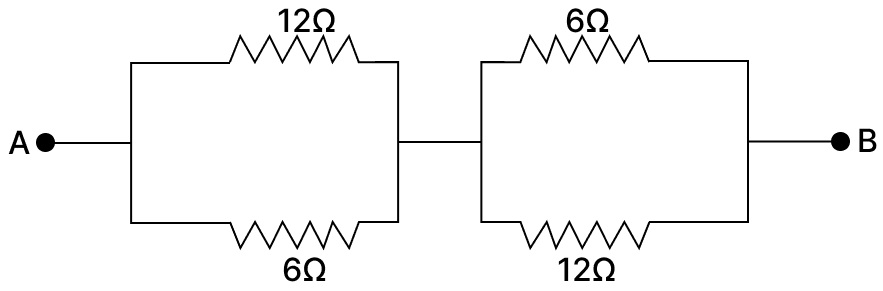
(c) State True or False: When the switch (S) is opened and the entire current flows through the 6Ω resistor, the ammeter reading will be (1+I1).

Show SolutionHide Solution↓

Given,

  • Current through the 6Ω resistor = ammeter reading = 1 A

(a) The 6Ω and 3Ω resistors are joined in parallel, so the potential difference across both of them is the same.

$$\begin{aligned}1 \times 6 = \text I_1 \times 3 \\[1em] \Rightarrow \text I_1 = \frac{6}{3} = 2 \text { A}\end{aligned}$$

Hence, the current through the 3Ω resistor is 2 A.

(b) In a parallel combination the main current is the sum of the currents in the branches.

I = 1 + I1 = 1 + 2 = 3 A

Hence, the total current in the circuit is 3 A.

(c) False.

Reason — When the switch S is opened, the 3Ω branch is broken and only the 6Ω resistor is left in the circuit. The resistance of the parallel combination was

$\text R_\text p = \frac{6 \times 3}{6 + 3} = 2\ \Omega$

which now rises to 6 Ω. For the same supply voltage, an increase in resistance decreases the current.

Hence, the ammeter reading will become less than 1 A, and not (1 + I1) = 3 A.

8(ii)Written · 2027 · Section B · 2027 SpecimenFull page

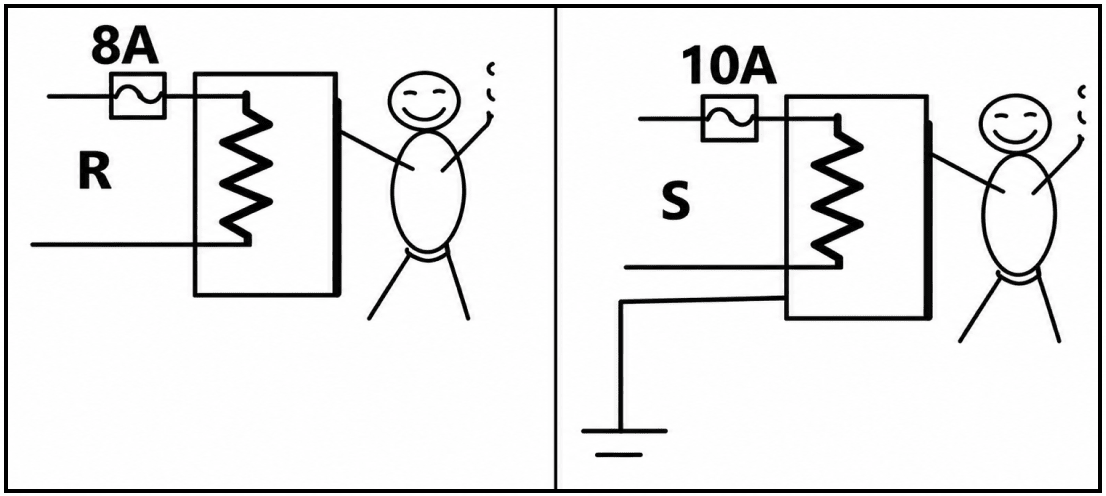
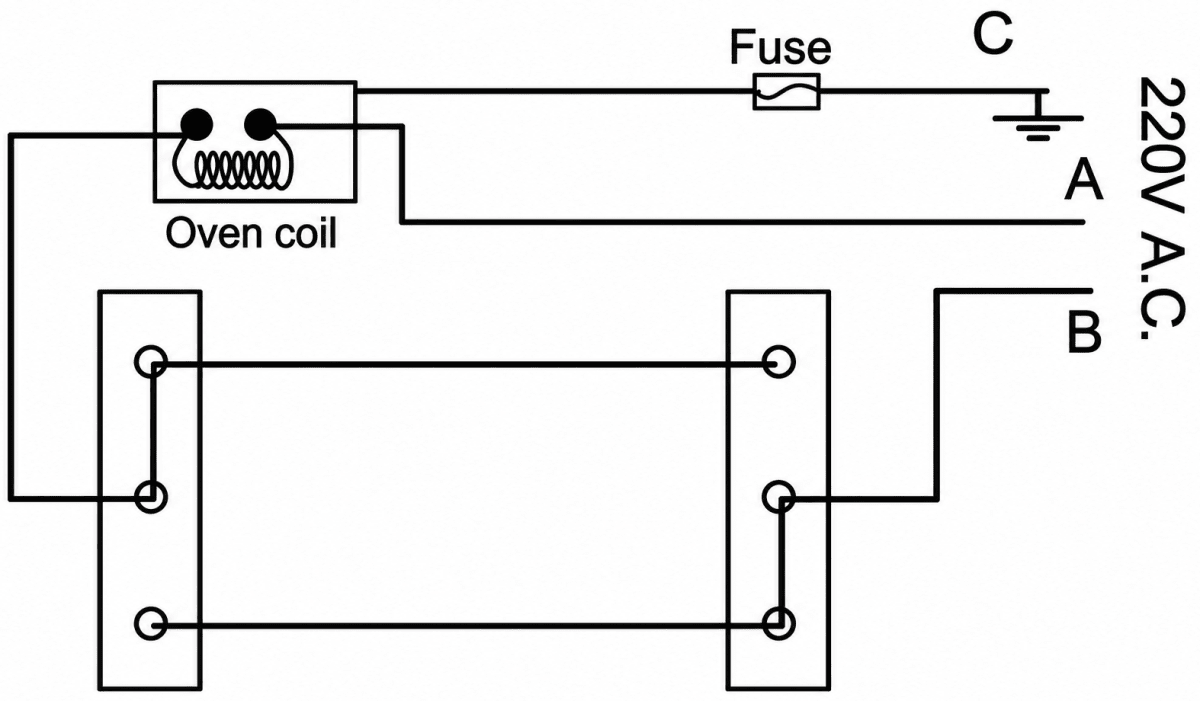
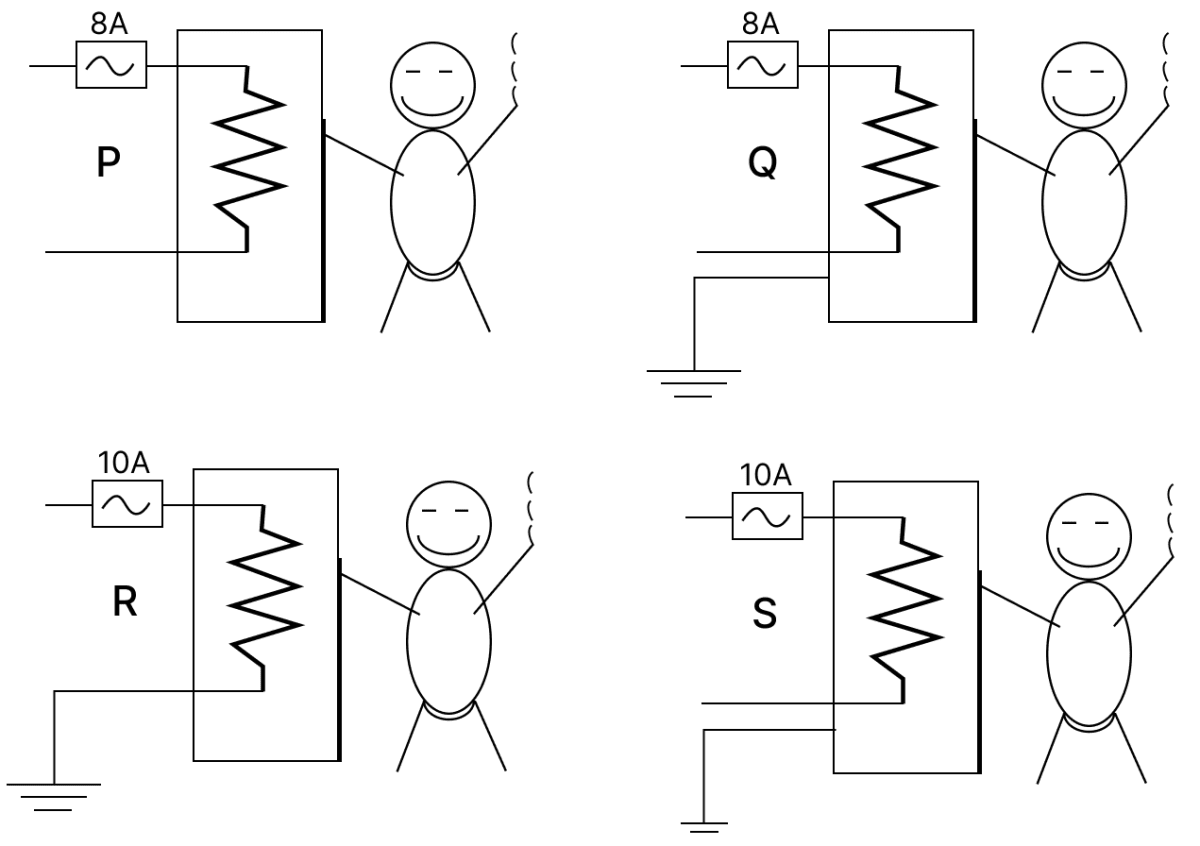
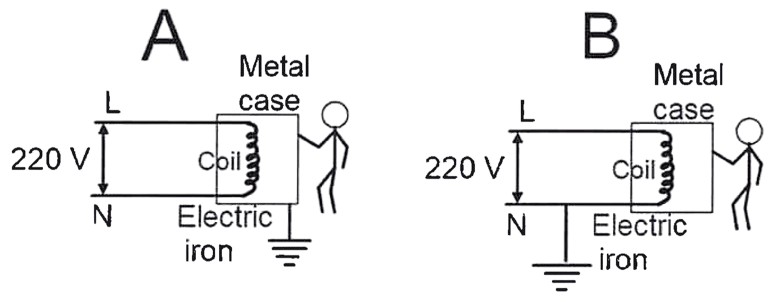
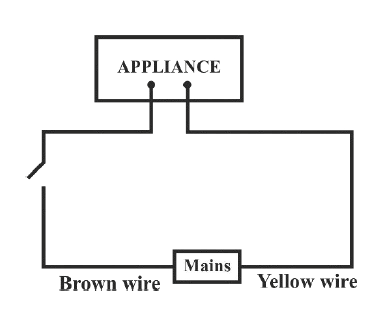
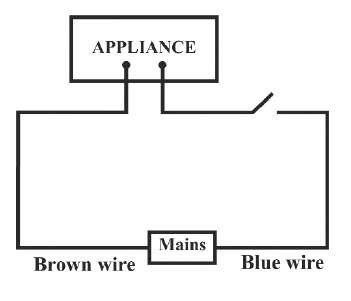
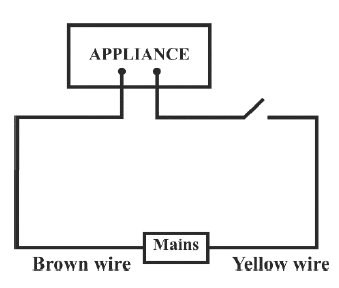
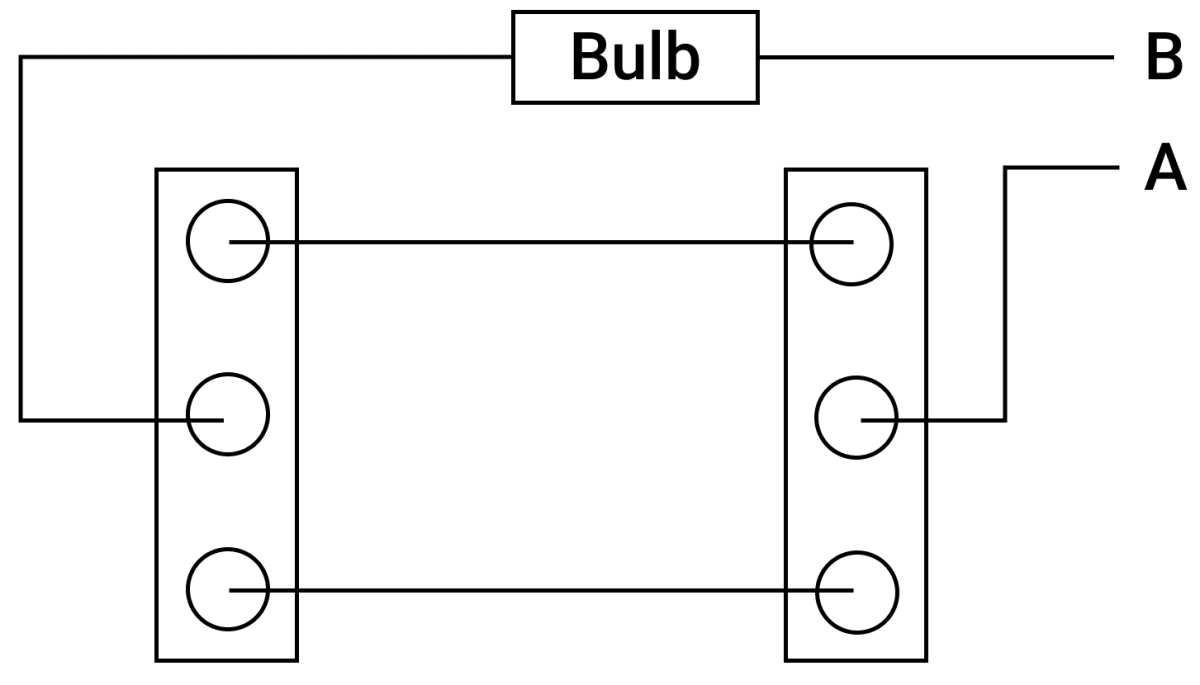
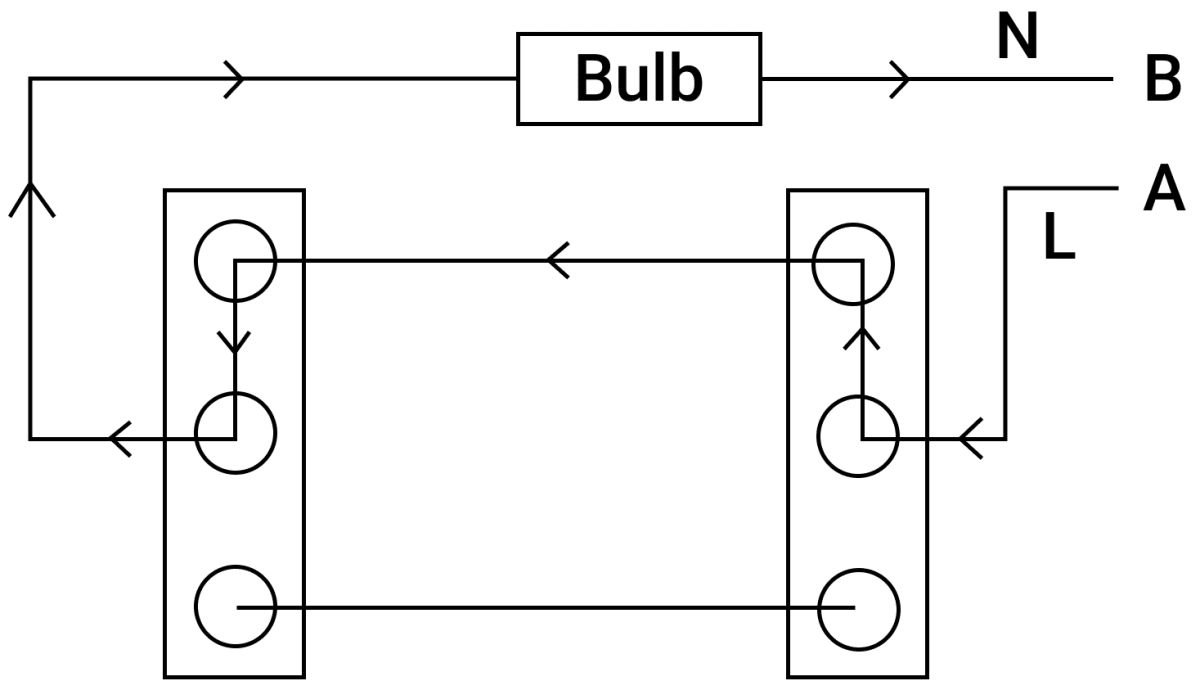
An appliance with a metal covering, rated at 2 kW, 220 V, is to be connected in a circuit. Given below are two diagrams (R & S) depicting different circuit configurations.

An appliance with a metal covering, rated at 2 kW, 220 V, is to be connected in a circuit. Given below are *two* diagrams (R & S) depicting different circuit configurations. Specimen Board Paper 2027, ICSE 2027 Specimen Physics Solved Question Paper.

(a) Identify the safest circuit.

(b) Write two reasons, supported by mathematical calculations, where applicable, to justify your choice.

Show SolutionHide Solution↓

Given,

  • Power rating of the appliance (P) = 2 kW = 2000 W
  • Voltage rating (V) = 220 V

(a) The safest circuit is S.

(b) The current drawn by the appliance is

$\text I = \frac{\text P}{\text V} = \frac{2000}{220} = 9.09 \text { A}$

  1. Earthing — The appliance has a metal covering. In circuit S the metal body is connected to the earth, so if the live wire accidentally touches the body, a large fault current flows through the earth wire, helping the fuse disconnect the supply and protecting a person touching the appliance. Circuit R has no earth connection, so it is unsafe.

  2. Correct fuse rating — The current rating of the fuse must be slightly more than the current drawn by the appliance. In circuit S the fuse is rated 10 A, which is just above 9.09 A, so it carries the normal current safely and blows only when the current becomes excessive. In circuit R the fuse is rated 8 A, which is less than 9.09 A, so it would blow even during the normal working of the appliance.

Hence, circuit S satisfies both the requirements of a safe circuit.

8(iii)Written · 2027 · Section B · 2027 Specimen · 🔁 also 2026Full page

A Nichrome wire X with length (l) and cross-sectional area (A) is connected to a 10 V source and another Nichrome wire Y with length (2 l) and cross-sectional area $\left(\frac{A}{2}\right)$, is connected to a 20 V source.

(a) Compare the resistances of wires X and Y. [Given that the resistivity of Nichrome is (ρ).]

(b) Compare the electrical power consumed by each wire.

(c) Compare the masses of these wires. [Given that the density of nichrome is d.]

(d) State True or False: Wire X and wire Y both show the same rise in temperature at the same time.

Show SolutionHide Solution↓

Given,

  • Length of nichrome wire X (lX) = l
  • Cross-sectional area of nichrome wire X (AX) = A
  • Potential difference across nichrome wire X (VX) = 10 V
  • Length of nichrome wire Y (lY) = 2l
  • Cross-sectional area of nichrome wire Y (AY) = A/2
  • Potential difference across nichrome wire Y (VY) = 20 V
  • Resistivity of nichrome = ρ

(a) Let 'RX' and 'RY' be the resistance of nichrome wire X and Y respectively.

Now,

$\text R_\text X = \text ρ \frac {\text l}{\text A}$

And

$\text R_\text Y = \text ρ \frac {2\text l}{\frac {\text A}{2}} =\text ρ \frac {4\text l}{\text A} = 4\text R_\text X$

As,

$\frac{\text R_\text Y}{\text R_\text X} = 4$

So, RX : RY = 1 : 4

(b) $\text P_\text X = \frac{{\text V_\text X}^2}{\text R_\text X} = \frac{10^2}{\text R_\text X} = \frac{100}{\text R_\text X}$

And

$\text P_\text Y = \frac{{\text V_\text Y}^2}{\text R_\text Y} = \frac{20^2}{4\text R_\text X} = \frac{400}{4\text R_\text X} =\frac{100}{\text R_\text X} = \text P_\text X$

So, PX : PY = 1 : 1

(c) Given,

Mass density of nichrome = d

Then,

Mass of wire X (mX) = d x volume = d x Al

And,

Mass of wire Y (mY) = d x volume = d x 2l x $\frac{\text A}{2}$ = d x Al = mX

So, mX : mY = 1 : 1

(d) True.

Reason —

Let, heat gained by the wire X be 'QX' and change in temperature be 'ΔTX'. Similarly, heat gained by the wire Y be 'QY' and change in temperature be 'ΔTY'.

Again, let specific heat capacity of nichrome be 'c' and same time be 't'.

Then,

QX = PX x t = mXc x ΔTX

and

QY = PY x t = mYc x ΔTY

As, PX = PY then QX = QY for same time t.

⇒ mXc x ΔTX = mYc x ΔTY

⇒ mX x ΔTX = mY x ΔTY

So,

ΔTX : ΔTY = mY : mX = 1 : 1

Hence, wire X and wire Y both show the same rise in temperature in the same time.

9(i)Written · 2027 · Section B · 2027 SpecimenFull page

Three bulbs of powers P1, P2 and P3 (P1 < P2 < P3) are connected in a certain way such that P3 glows the brightest.

(a) What type of connection exists between these bulbs?

(b) Compare the voltages (V1, V2, V3) across these bulbs. (Use >, < or =)

(c) Will the circuit still function if one of the bulbs is fused?

Show SolutionHide Solution↓

(a) All bulbs are connected in parallel combination because in a parallel connection, voltage across each bulb is the same, and brightness depends directly on power rating. So, the bulb with the highest power rating (P3) will draw the most current and glow brightest.

(b) In a parallel circuit, all components share the same voltage.

So,

V1 = V2 = V3

(c) Yes because in a parallel circuit, each bulb has an independent path to the power supply and if one bulb fuses, the others continue to receive power and function normally.

9(ii)Written · 2027 · Section B · 2027 SpecimenFull page

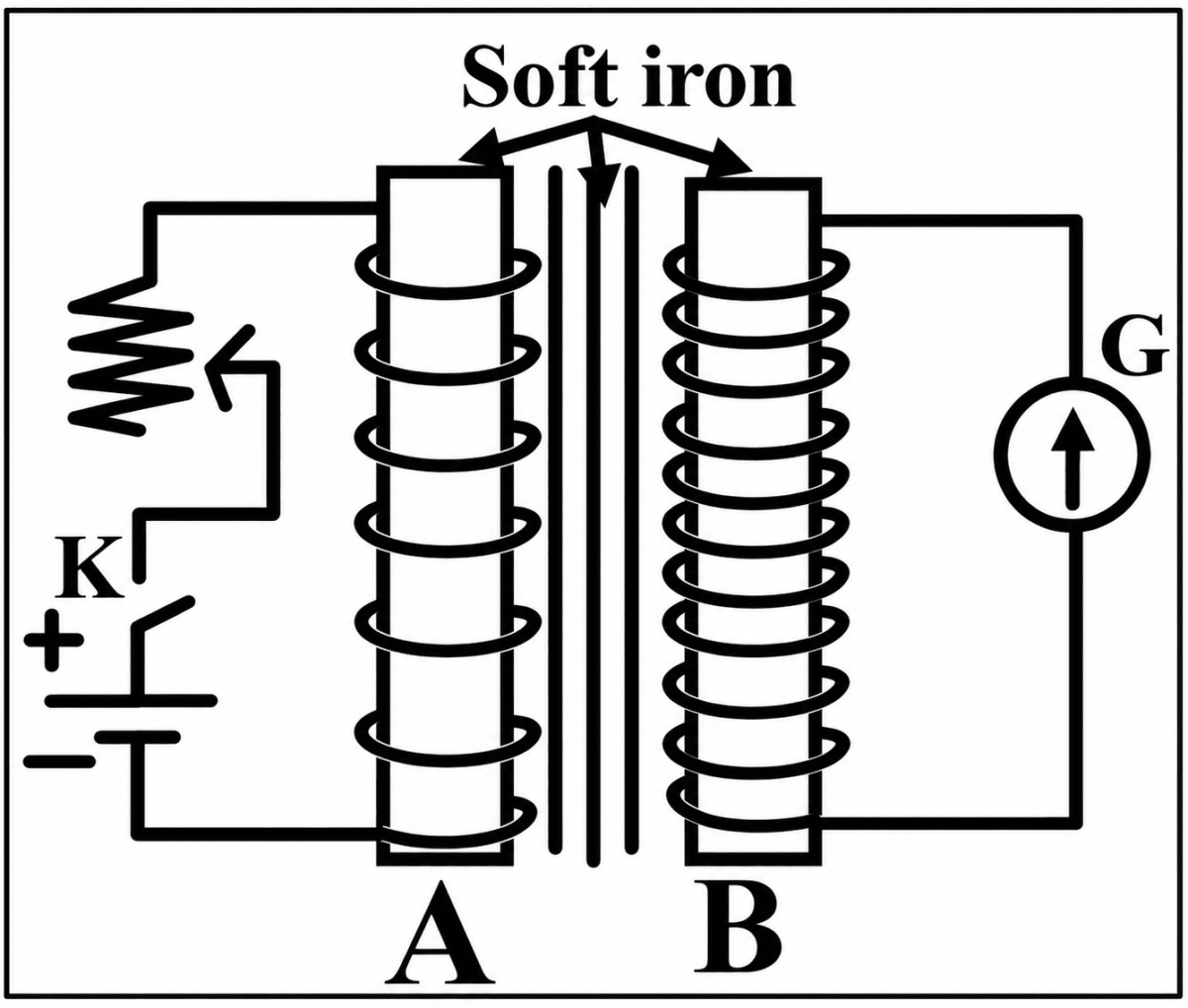
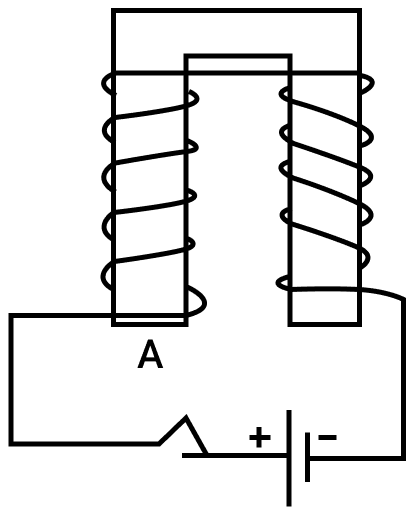
Study the diagram and answer the following questions:

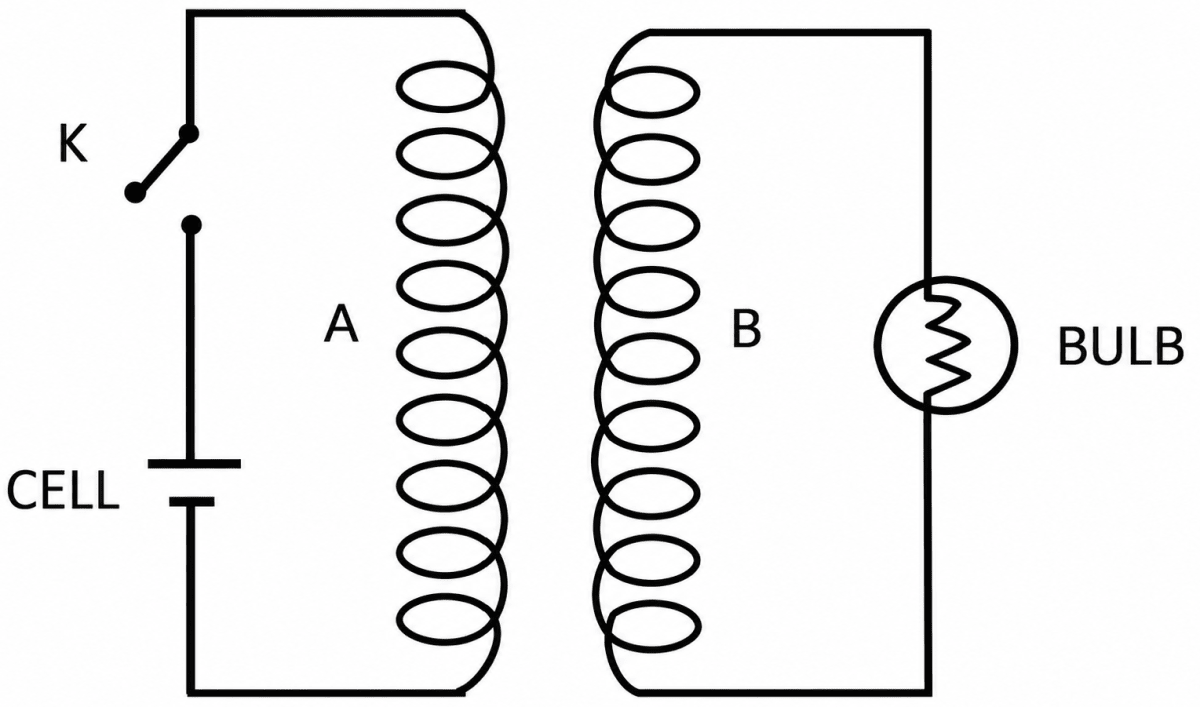
Study the diagram and answer the following questions:. Specimen Board Paper 2027, ICSE 2027 Specimen Physics Solved Question Paper.

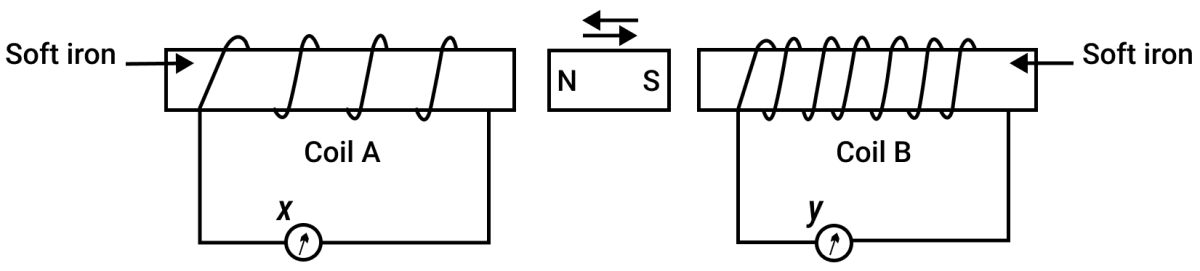
(a) In the given circuit when the key is closed, the galvanometer in the coil B shows momentary deflection. Give a reason for this deflection.

(b) How will the galvanometer deflect if the variable resistance in the closed circuit is decreased? (in the same direction / in the opposite direction)

(c) Give a reason for your answer to (b).

Show SolutionHide Solution↓

(a) When the key is closed, the current in the coil A grows from zero to its steady value, so the magnetic field produced by it changes. Since both the coils are wound on the same soft iron core, the magnetic flux linked with the coil B also changes and an e.m.f. is induced in it by electromagnetic induction. As the circuit of B is closed through the galvanometer, an induced current flows in it and the galvanometer shows a deflection.

The deflection is only momentary because once the current in A becomes steady, the flux linked with B no longer changes and the induced e.m.f. falls to zero.

(b) In the same direction.

(c) On decreasing the variable resistance, the current in the coil A increases. This increases the magnetic flux linked with the coil B, i.e., the flux again increases just as it did at the moment of closing the key.

Since the change in flux is of the same kind as before, by Lenz's law the induced current in B flows in the same direction as earlier, and hence the galvanometer deflects in the same direction.

9(iii)Written · 2027 · Section B · 2027 Specimen · 🔁 also 2026Full page

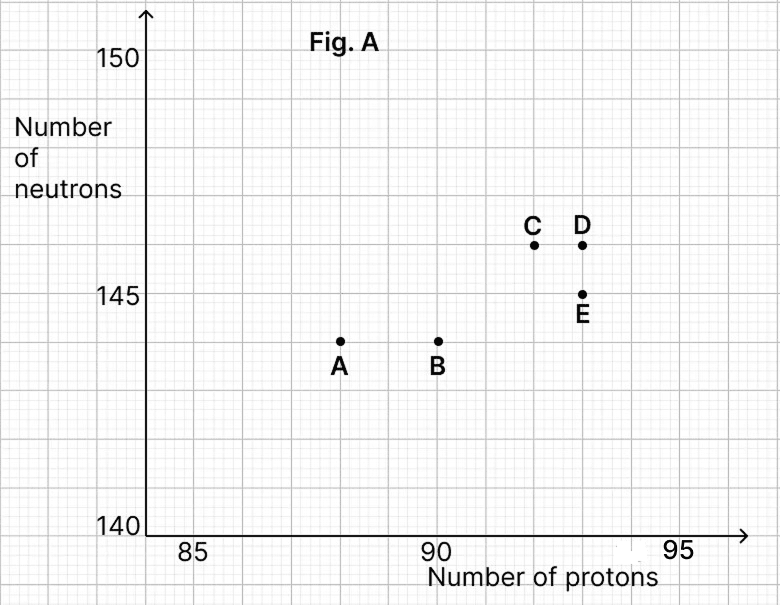
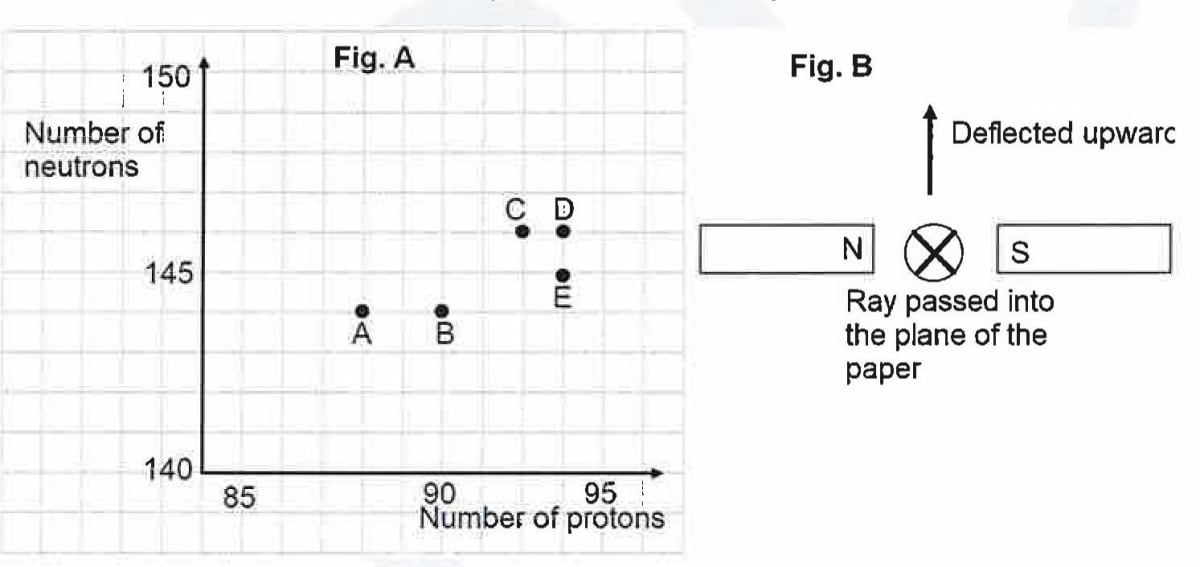
The graph given below illustrates the correlation between the number of protons (x-axis) and the number of neutrons (y-axis) for elements A, B, C, D, and E in the periodic table. These elements are denoted by the letters rather than their conventional symbols.

The graph (Fig. A) illustrates the correlation between the number of protons (x-axis) and the number of neutrons (y-axis) for elements A, B, C, D, and E in the periodic table. These elements are denoted by the letters rather than their conventional symbols. ICSE 2027 Specimen Physics Solved Question Paper.

(a) Identify the radioactive radiation emitted when element C decays into element E. Represent this using a nuclear reaction.

(b) What is the special name given to elements like D and E?

(c) If element C transforms into element B by emitting a radioactive ray, how will this ray behave in an electric field?

Show SolutionHide Solution↓

(a) From the graph,

Number of protons in C = 92

Number of neutrons in C = 146

Mass number of C = Number of protons in C + Number of neutrons in C = 92 + 146 = 238

Number of protons in E = 93

Number of neutrons in E = 145

Mass number of E = Number of protons in E + Number of neutrons in E = 93 + 145 = 238

Since element C has one less proton and one neutron more than the element E, if C decays into E, its proton number increases by one and its neutron number decreases by one, keeping the mass number the same, which happens only in the case of beta radiation.

Thus, the reaction will be as follows :

23892C → 23893E + 0-1β

(b) As points D and E are situated on the same vertical line but on different horizontal lines, they have the same number of protons but different numbers of neutrons, i.e., their atomic number is the same but their mass numbers are different, so they are isotopes of each other.

(c) Number of protons in B = 90

Number of neutrons in B = 144

Mass number of B = Number of protons in B + Number of neutrons in B = 90 + 144 = 234

As element B has two protons less than element C and a mass number four less than that of C, during the decay of C into B, two protons and two neutrons are emitted, which is nothing but an alpha particle.

Alpha particles shift towards the negative plate in an electric field.

1(i)1 Mark · 2026 · Section A · 2026 PaperFull page

For a body to be in dynamic equilibrium, its:

Show SolutionHide Solution↓

acceleration should be zero

Reason — A body is said to be in dynamic equilibrium when it is moving with uniform velocity. It means that the body is not at rest, its velocity is constant and hence its acceleration is zero.

Therefore, for dynamic equilibrium, acceleration should be zero.

1(ii)1 Mark · 2026 · Section A · 2026 Paper · 🔁 also 2027Full page

The energy transformation taking place during photosynthesis in plants is:

Show SolutionHide Solution↓

light to chemical

Reason — Photosynthesis converts sunlight into chemical energy stored in food.

Therefore, the energy transformation in photosynthesis is light energy to chemical energy.

1(iii)1 Mark · 2026 · Section A · 2026 PaperFull page

The Velocity Ratio (VR) of a block and tackle system of two pulleys with the effort in the upward direction is:

Show SolutionHide Solution↓

3

Reason — In a block and tackle system, the velocity ratio (V.R.) is equal to the number of strands of the rope supporting the moving block. When the system has two pulleys and the effort is applied in the upward direction, there are 3 supporting strands.

Therefore, the velocity ratio is 3.

1(iv)1 Mark · 2026 · Section A · 2026 PaperFull page

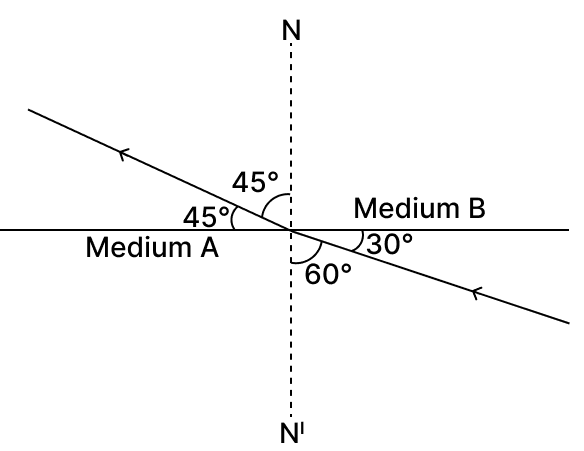
From the figure given below, the refractive index of medium B with respect to medium A (AμB) is:

From the figure given below, the refractive index of medium B with respect to medium A. ICSE 2025 Physics Solved Question Paper.
Show SolutionHide Solution↓

$$\begin{aligned}\frac{\text {sin }60^{\circ}}{\text {sin }45^{\circ}} \\[1em]\end{aligned}$$

Reason — The angle given in medium A is 30° with the surface, so the angle with the normal is:

$i = 90^{\circ} - 30^{\circ} = 60^{\circ}$

The angle given in medium B is 45° with the surface, so the angle with the normal is:

$r = 90^{\circ} - 45^{\circ} = 45^{\circ}$

From the figure given below, the refractive index of medium B with respect to medium A. ICSE 2025 Physics Solved Question Paper.

Now, refractive index of medium B with respect to medium A is:

$$\begin{aligned}{}_A\mu_B=\frac{\sin i}{\sin r} \\[1em] \Rightarrow {}_A\mu_B=\frac{\sin 60^\circ}{\sin 45^\circ}\end{aligned}$$

1(v)1 Mark · 2026 · Section A · 2026 PaperFull page

When a blackened bulb thermometer is moved beyond the red region of the visible spectrum, there is a rapid rise in the temperature. This is due to the presence of :

Show SolutionHide Solution↓

Infrared radiations

Reason — When a blackened bulb thermometer is placed beyond the red end of the visible spectrum, the temperature rises rapidly because this region contains infrared radiations. Infrared rays are invisible but carry significant heat energy, which is absorbed by the blackened bulb, causing the temperature to increase.

Therefore, the correct answer is Infrared radiations.

1(vi)1 Mark · 2026 · Section A · 2026 PaperFull page

A fast-moving cyclist stops pedalling on reaching a hilly track. If he continues to move with the acquired energy, then assuming no loss of energy:

Show SolutionHide Solution↓

his total mechanical energy remains constant.

Reason — When the cyclist stops pedalling and continues moving on a hilly track, his kinetic energy gradually converts into potential energy as he moves upward. If there is no loss of energy, the sum of kinetic and potential energy remains unchanged.

Therefore, the total mechanical energy remains constant during the motion.

1(vii)1 Mark · 2026 · Section A · 2026 PaperFull page

The distance (V) of a virtual image formed by a lens of focal length 15 cm never exceeds a certain finite value, then this value will be:

Show SolutionHide Solution↓

less than or equal to 15 cm

Reason — A virtual image whose distance never exceeds a fixed finite value is formed by a concave lens. In a concave lens, the image is always virtual and is formed between the optical centre and the principal focus. Hence, the image distance can never be greater than the focal length of the lens.

Therefore, for a lens of focal length 15 cm, the image distance is less than or equal to 15 cm.

1(viii)1 Mark · 2026 · Section A · 2026 PaperFull page

Assertion (A) : Tiny air molecules scatter blue light more than red light.

Reason (R) : The refractive index of a medium is greater for blue light than red light.

Show SolutionHide Solution↓

Both (A) and (R) are true and (R) is not the correct explanation of (A).

Explanation:
Assertion is true because blue light has a shorter wavelength than red light, so it is scattered more by tiny air molecules. Reason is also true because the refractive index of a medium is greater for blue light than for red light. However, scattering depends mainly on wavelength and not on refractive index.

Therefore, both (A) and (R) are true, but (R) is not the correct explanation of (A).

1(ix)1 Mark · 2026 · Section A · 2026 PaperFull page

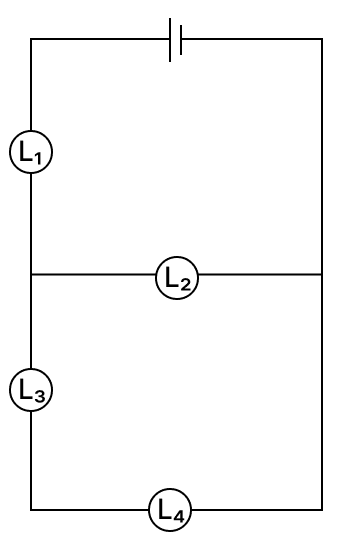
In the circuit given below, identify the lamp (L1, L2, L3 and L4) whose failure would not interrupt the power supply to the other lamps.

In the circuit given below, identify the lamp whose failure would not interrupt the power supply to the other lamps. ICSE 2025 Physics Solved Question Paper.
Show SolutionHide Solution↓

L2

Reason — In the circuit, L1 and L3 are placed in the main vertical branch, so if either of them fails, the circuit path breaks and current cannot reach the other lamps.

L4 is also part of the lower main path; its failure would interrupt the current in that branch.

However, L2 is connected in a separate parallel branch between the two sides of the circuit so if L2 fails, only that branch becomes open while current can still flow through the rest of the circuit containing L1, L3, and L4.

Therefore, the failure of L2 would not interrupt the power supply to the other lamps.

1(x)1 Mark · 2026 · Section A · 2026 PaperFull page

Equal volumes of water are added to three cylindrical jars A, B and C of same height and radii rA, rB and rC respectively with rB < rA < rC. If you blow air into the mouth of these jars, which tube will produce the shrillest note?

Show SolutionHide Solution↓

B

Reason — When air is blown across the mouth of a jar, the pitch of the sound depends on the length of the air column above the water. A shorter air column produces a higher-pitched (shriller) sound, while a longer air column produces a lower pitch.

As, volume of a cylindrical jar is given by,

Volume = πr2h

Where r is the radius and h is the height of the jar and since equal volumes of water are poured into jars with radii rB < rA < rC, the jar with the smallest radius (B) will have the greatest height of water, leaving the shortest air column.

Therefore, jar B produces the shrillest note.

1(xi)1 Mark · 2026 · Section A · 2026 Paper · 🔁 also 2027Full page

A metallic wire is stretched in such a way that its new length becomes twice the original length. How does its specific heat capacity change?

Show SolutionHide Solution↓

remains the same

Reason — Specific heat capacity is a property of the material and does not depend on the shape, length or size of the object. When the metallic wire is stretched so that its length becomes twice the original length, only its dimensions change, while the material remains the same.

Therefore, the specific heat capacity remains unchanged.

1(xii)1 Mark · 2026 · Section A · 2026 PaperFull page

The correct formula to calculate the equivalent resistance of two resistors R1 and R2 when connected in parallel, is:

Show SolutionHide Solution↓

$$\begin{aligned}\frac{\text R_1\text R_2}{\text R_1 + \text R_2} \\[1em]\end{aligned}$$

Reason — When two resistors are connected in parallel, the potential difference across each resistor is the same, while the current divides between the branches. For two resistors R1 and R2, the reciprocal of the equivalent resistance equals the sum of the reciprocals of the individual resistances i.e.,

$$\begin{aligned}\frac{1}{\text R} = \frac{1}{\text R_1} + \frac{1}{\text R_2} \\[1em] \Rightarrow \frac{1}{\text R} = \frac{\text R_1 + \text R_2}{\text R_1\text R_2} \\[1em] \Rightarrow \text R = \frac{\text R_1\text R_2}{\text R_1 + \text R_2} \\[1em]\end{aligned}$$

1(xiii)1 Mark · 2026 · Section A · 2026 PaperFull page

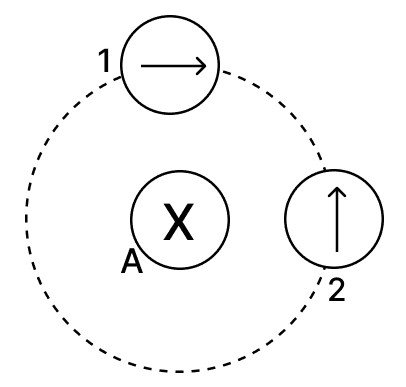
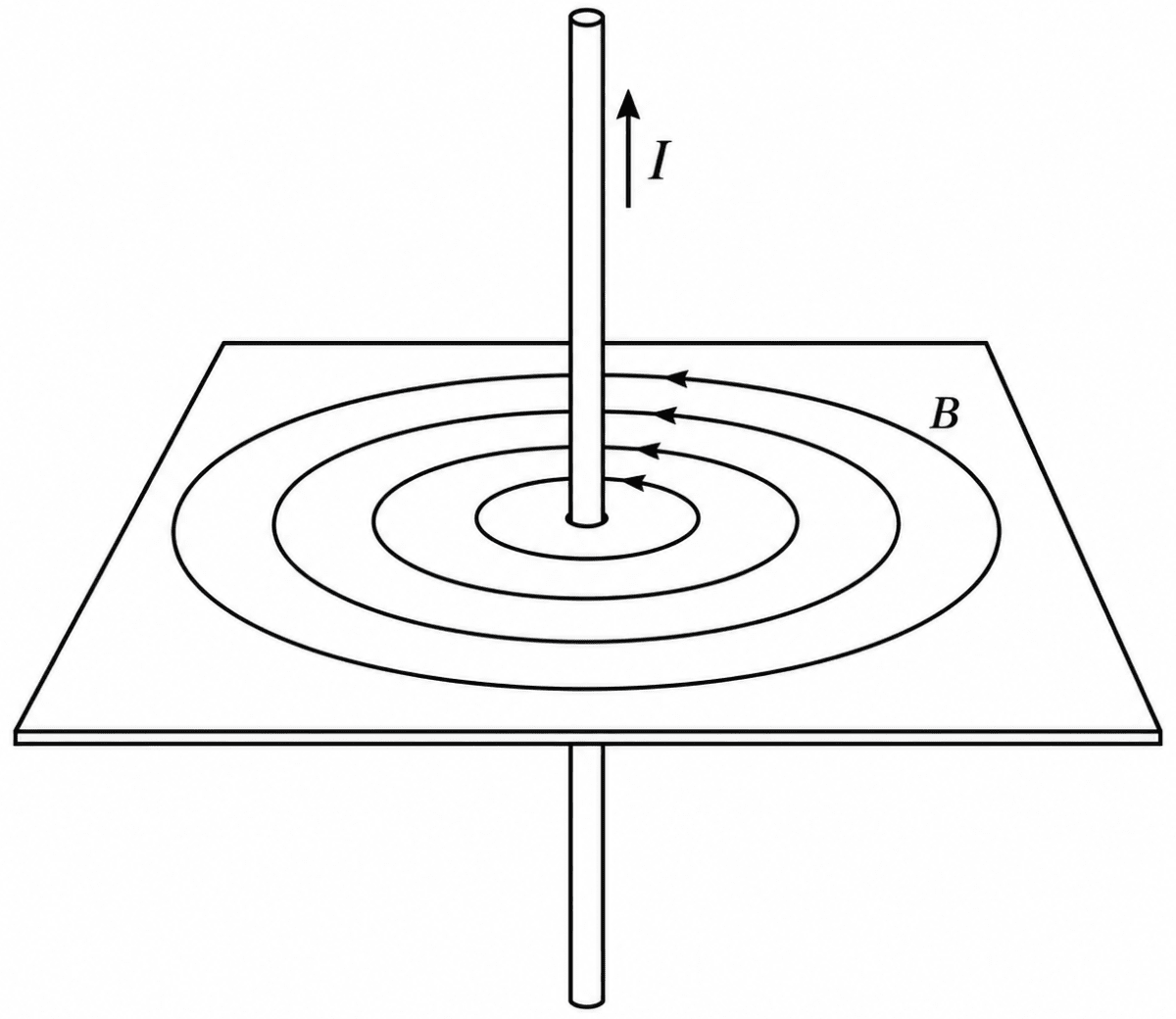
The diagram below shows the top view of the Wire A shown by a cross (X), carrying current into the plane of the paper. Which of the compasses is correctly aligned with the magnetic field produced by the current carrying wire?

The diagram below shows the top view of the Wire A shown by a cross (X), carrying current into the plane of the paper. Which of the compasses is correctly aligned with the magnetic field produced by the current carrying wire. ICSE 2025 Physics Solved Question Paper.
Show SolutionHide Solution↓

Only 1 is aligned

Reason — A straight current-carrying wire produces circular magnetic field lines around it so using the right-hand thumb rule, if the current is into the plane of the paper (shown by X), the magnetic field lines circulate clockwise.

A compass needle aligns tangentially to these field lines and at the position of compass 1, the field direction is towards the right, so compass 1 is correctly aligned.

At the position of compass 2, the magnetic field should point downward, but the compass is shown pointing upward, so it is not correctly aligned.

Therefore, only compass 1 is aligned correctly.

1(xiv)1 Mark · 2026 · Section A · 2026 PaperFull page

Three substances A, B and C of same mass are present at their respective melting points. On heating, if they melt completely in 5 minutes, 7 minutes and 3 minutes respectively, then which substance has the highest specific latent heat?

(Assume heat is absorbed at the same rate)

Show SolutionHide Solution↓

Substance B

Reason — When substances are at their melting point, the heat supplied is used for melting and is given by Q = mL, where L is the specific latent heat.

Since the masses are the same and heat is absorbed at the same rate, the substance that takes the longest time to melt requires more heat and therefore has a higher specific latent heat.

Among A (5 min), B (7 min), and C (3 min), substance B takes the longest time.

Hence, substance B has the highest specific latent heat.

1(xv)1 Mark · 2026 · Section A · 2026 PaperFull page

An atom of lithium contains 3 electrons, 3 protons and 4 neutrons. Its mass number is:

Show SolutionHide Solution↓

7

Reason — The mass number of an atom is the total number of protons and neutrons present in its nucleus. In a lithium atom, there are 3 protons and 4 neutrons, so the mass number is 3 + 4 = 7.

Therefore, the mass number of lithium is 7.

2(i)1 Mark · 2026 · Section A · 2026 PaperFull page

Complete the following by choosing the correct answers from the bracket:

(a) A car is moving in uniform circular motion. The direction of friction between the tyres and the path is ............... [towards the centre / tangential to the path].

(b) When a ray of light passes from a denser to a rarer medium, its wavelength ............... [decreases / increases].

(c) The lid of a calorimeter minimises heat loss by ............... [convection / radiation].

(d) Quality of sound depends on its ............... [amplitude / waveform].

(e) A substance whose resistance becomes almost negligible at a temperature near absolute zero is called a ............... [semiconductor / superconductor].

(f) ............... radiation deviates minimum in a magnetic field [Alpha / Beta].

Show SolutionHide Solution↓

(a) A car is moving in uniform circular motion. The direction of friction between the tyres and the path is tangential to the path.

(b) When a ray of light passes from a denser to a rarer medium, its wavelength increases.

(c) The lid of a calorimeter minimises heat loss by convection.

(d) Quality of sound depends on its waveform.

(e) A substance whose resistance becomes almost negligible at a temperature near absolute zero is called a superconductor.

(f) Alpha radiation deviates minimum in a magnetic field.

2(ii)1 Mark · 2026 · Section A · 2026 PaperFull page

State two factors on which the position of Center of Gravity of a body depends.

Show SolutionHide Solution↓

The position of the centre of gravity of a body depends mainly on two factors:

  1. Shape of the body
  2. Distribution of mass in the body

Explanation:

The position of the centre of gravity depends on the shape of the body and on how its mass is distributed.
For example, two rods may have the same shape and size, but if one rod is uniform and the other is heavier at one end, their centres of gravity will be at different positions.

2(iii)1 Mark · 2026 · Section A · 2026 PaperFull page

Case 1: Lata cuts a potato into two halves, using a cutter which belongs to a Class II lever. She needed effort E1.

Case 2: Then she cuts one half of this potato again, but this time she needed effort E2. If E1 > E2 then:

(a) In which case (1st or 2nd) was the potato closer to her hand applying the effort? (Assume normal reaction of the surface of the potato is same in both cases)

(b) Give a reason for your answer in (a) above.

Show SolutionHide Solution↓

(a) The potato was closer to her hand in Case 1.

(b) The cutter acts as a Class II lever, in which the load lies between the fulcrum and the effort. When the potato is placed closer to the hand applying effort, it is farther from the fulcrum, so the load arm becomes longer. For a fixed effort arm, a longer load arm requires greater effort to cut. Since E1 > E2, the potato must have been closer to her hand in the Case 1.

3(i)1 Mark · 2026 · Section A · 2026 PaperFull page

The graph below shows the variation of image distance (v) with the object distance (u) when an object is kept in front of a lens.

The graph below shows the variation of image distance (v) with the object distance (u) when an object is kept in front of a lens. ICSE 2025 Physics Solved Question Paper.

(a) Identify the type of lens used.

(b) What would be the magnification (more than 1 / less than 1 / equal to 1) if the object is placed between F and 2F of the above lens?

Show SolutionHide Solution↓

(a) The lens used is a convex lens.

(b) If the object is placed between F and 2F, the magnification will be more than 1.

Explanation:

(a) The graph shows that for an object placed in front of the lens, a real image is formed on the other side and the image distance changes according to the position of the object. This behaviour is shown by a convex lens.

(b) For a convex lens, when the object is placed between F and 2F, the image is formed beyond 2F. The image is real, inverted and magnified. Therefore, the magnification is more than 1.

3(ii)1 Mark · 2026 · Section A · 2026 PaperFull page

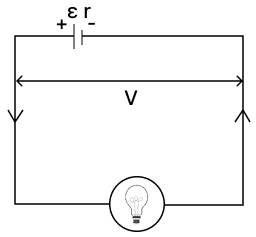
A resistance R is connected across a cell with a switch and a rheostat in series. A voltmeter is connected parallel across the cell. Current in the circuit is increased using the rheostat.

(a) How will the voltmeter reading change? (increase / decrease / remain the same)

(b) Justify your answer stated in (a) above.

Show SolutionHide Solution↓

(a) The voltmeter reading decreases.

(b) As, voltmeter reading is given by,

V = ε - Ir

where,

  • I is the current flowing in the circuit,
  • ε is the emf of the cell and
  • r is the internal resistance of the cell.

So, when the rheostat is adjusted to increase the current in the circuit, the current drawn from the cell becomes larger and due to the internal resistance of the cell, a greater potential drop occurs inside the cell.

As a result, the terminal voltage of the cell decreases and since the voltmeter measures this terminal voltage across the cell, its reading decreases.

3(iii)1 Mark · 2026 · Section A · 2026 PaperFull page

(a) Define natural vibrations.

(b) How is this vibration different from damped vibrations in terms of their amplitudes?

Show SolutionHide Solution↓

(a) The periodic vibrations of a body in the absence of any external force on it, are called natural (or free) vibrations.

(b) In natural vibrations, the amplitude remains constant because there is no loss of energy while in damped vibrations, the amplitude gradually decreases with time due to energy loss caused by the presence of resistive force.

3(iv)1 Mark · 2026 · Section A · 2026 PaperFull page

A metal piece of thermal capacity 40 JK-1, absorbs 800 J of heat. Calculate the rise in the temperature of this metal piece.

Show SolutionHide Solution↓

Given,

  • Thermal capacity of the metal piece = 40 JK-1
  • Heat absorbed by the substance = 800 J

Let, rise in temperature be T.

As, thermal capacity of a substance is given by,

$$\begin{aligned}\text {Thermal capacity} = \frac{\text {Heat absorbed}}{\text {Temperature rise}} \\[1em] \Rightarrow \text {Temperature rise} = \frac{\text {Heat absorbed}}{\text {Thermal capacity}} \\[1em] \Rightarrow \text T = \frac{800}{40} \\[1em] \Rightarrow \text T = 20\ \text K\end{aligned}$$

Since a rise of 1 K = 1°C, the rise in temperature is also 20°C.

Hence, the rise in the temperature of the metal piece is 20°C.

3(v)1 Mark · 2026 · Section A · 2026 PaperFull page

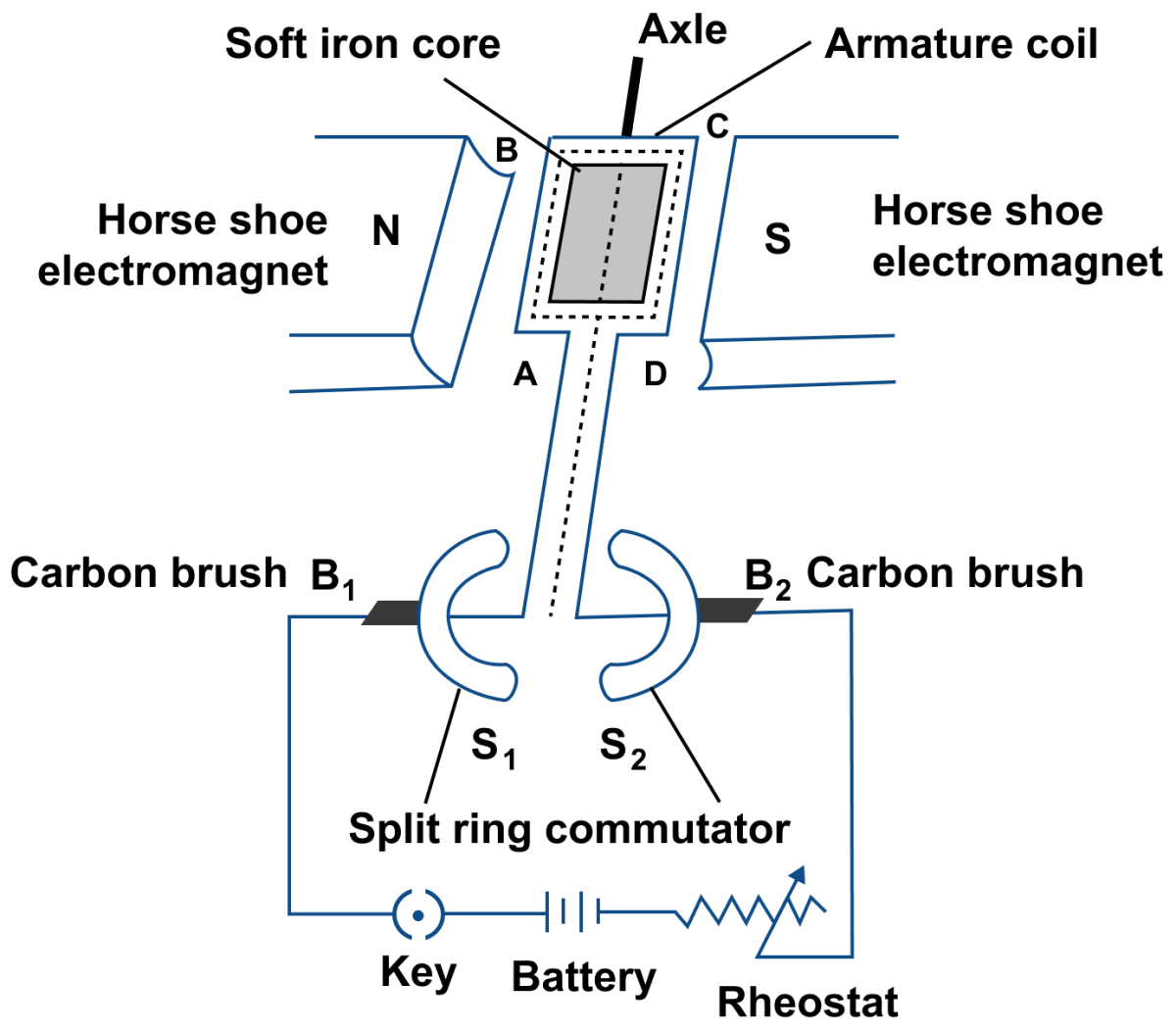
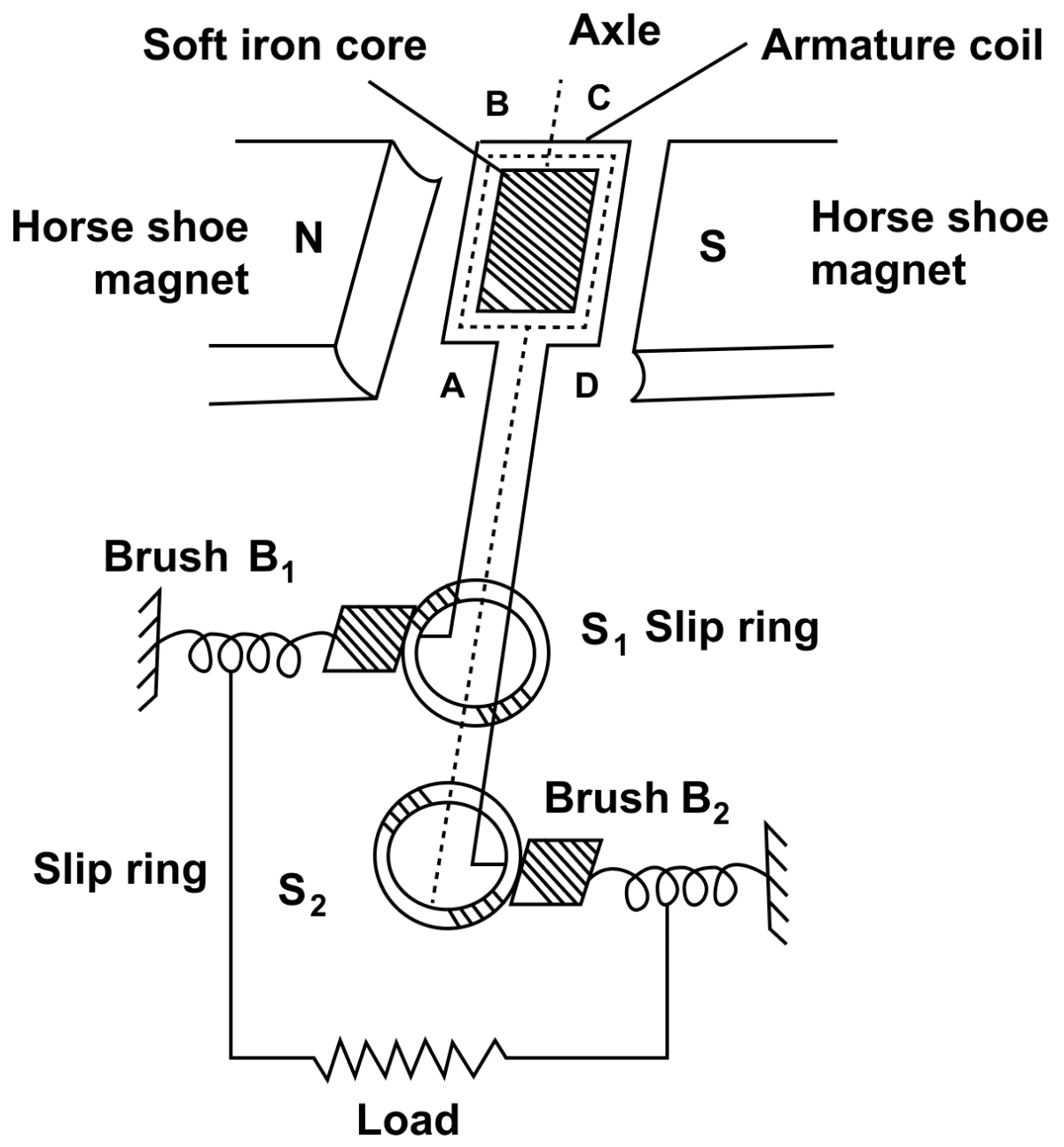
In an AC generator, name the part which has the following functions:

(a) intensifies the magnetic field.

(b) maintains electrical contact between the rotating parts and the external circuit.

Show SolutionHide Solution↓

(a) Soft iron core

(b) Carbon brushes

3(vi)1 Mark · 2026 · Section A · 2026 PaperFull page

Give two differences between nuclear fission and nuclear fusion.

Show SolutionHide Solution↓
 Nuclear fissionNuclear fusion
(a)Nuclear fission is the process of breaking of a heavy nucleus in two nearly equal fragments with the release of energy.Nuclear fusion is the process of combining light nuclei to form a larger nuclei at a very high temperature and pressure with the release of energy.
(b)This reaction is possible at ordinary temperature and ordinary pressure.This reaction is possible only at a very high temperature (≈ 107 K) and a very high pressure.
3(vii)1 Mark · 2026 · Section A · 2026 PaperFull page

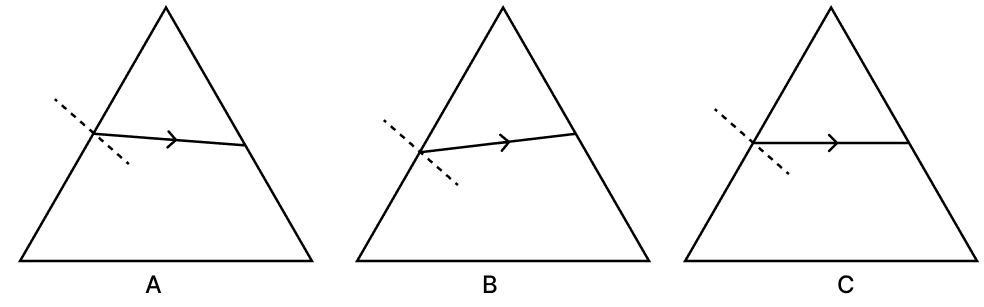
A monochromatic ray strikes the surface of identical prisms (A, B and C) at different angles of incidence. The diagram below shows their refracted rays. Study the path of these refracted rays and identify in which of the diagrams:

A monochromatic ray strikes the surface of identical prisms (A, B and C) at different angles of incidence. The diagram below shows their refracted rays. Study the path of these refracted rays and identify in which of the diagrams. ICSE 2025 Physics Solved Question Paper.

(a) the angle of incidence is maximum.

(b) the angle of incidence is minimum.

(c) the angle of incidence is equal to the angle of emergence.

Show SolutionHide Solution↓

(a) The angle of incidence is maximum for prism B.

(b) The angle of incidence is minimum for prism A.

(c) The angle of incidence is equal to the angle of emergence for prism C.

Explanation:

For identical prisms, a larger angle of incidence produces a refracted ray inside the prism making a larger angle with the normal. Hence, diagram B corresponds to maximum incidence, while diagram A corresponds to minimum incidence.
When the angle of incidence is equal to the angle of emergence, the path of the ray through the prism is symmetrical, and the refracted ray inside the prism becomes parallel to the base. This is shown in diagram C.

4(i)Written · 2026 · Section B · 2026 PaperFull page

A ray of light enters a glass block from air and comes out from the opposite surface. If the angle of refraction at the first surface is not the same as the angle of incidence at the second surface, then:

(a) What is the product of the ratio $\frac{\text {sin i}}{\text {sin r}}$ at the first surface and at the second surface?

(b) State whether the opposite surfaces are parallel or not parallel.

(c) How did you reach the conclusion in (b) above?

Show SolutionHide Solution↓

(a) At the first surface, from air to glass:

$\frac{\text {sin i}_1}{\text {sin r}_1} = \text μ$

where μ is the refractive index of glass with respect to air.

At the second surface, from glass to air:

$\frac{\text {sin i}_2}{\text {sin r}_2} = \frac{1}{\text μ}$ .

Therefore, the product of the two ratios is given by,

$\frac{\text {sin i}_1}{\text {sin r}_1}\times \frac{\text {sin i}_2}{\text {sin r}_2} = \text μ \times \frac{1}{\text μ} = 1$

Hence, the product of the ratio is 1.

(b) The opposite surfaces are not parallel.

(c) If the opposite surfaces were parallel, the angle of refraction at the first surface would be equal to the angle of incidence at the second surface and since these angles are not equal, the surfaces cannot be parallel.

4(ii)Written · 2026 · Section B · 2026 PaperFull page

A type of glass block has a refractive index of 1.8.

(a) Calculate the speed of light in this glass. (Given speed of light in air 3 x 10⁸ m s-1)

(b) If the width of this block is doubled, then what will be the speed of light in the block?

Show SolutionHide Solution↓

(a) Given,

  • Refractive index of the glass block = 1.8
  • Speed of light in air = 3 x 10⁸ m s-1

As, refractive index (μ) of the glass block is given by,

$$\begin{aligned}\text μ = \frac{\text {Speed of light in vacuum or air}}{\text {Speed of light in the glass block}} \\[1em] \Rightarrow \text {Speed of light in the glass block} = \frac{\text {Speed of light in vacuum or air}}{\text μ} \\[1em] = \frac{3\times 10^8}{1.8} \\[1em] = \frac{30\times 10^8}{18} \\[1em] = \frac{5\times 10^8}{3} \\[1em] \approx 1.67 \times 10^8 \text { m s}^{-1}\end{aligned}$$

Hence, speed of light in the glass block is approximately 1.67 x 10⁸ m s-1.

(b) If the width of the glass block is doubled, the speed of light does not change because the speed of light in a medium depends only on the refractive index of the material, not on its thickness or width.

Therefore, the speed remains 1.67 x 10⁸ m s-1.

4(iii)Written · 2026 · Section B · 2026 PaperFull page

(a) Name the electromagnetic radiation used to detect fake currency.

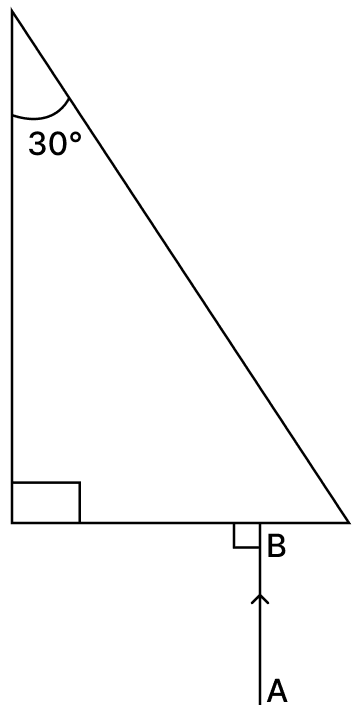
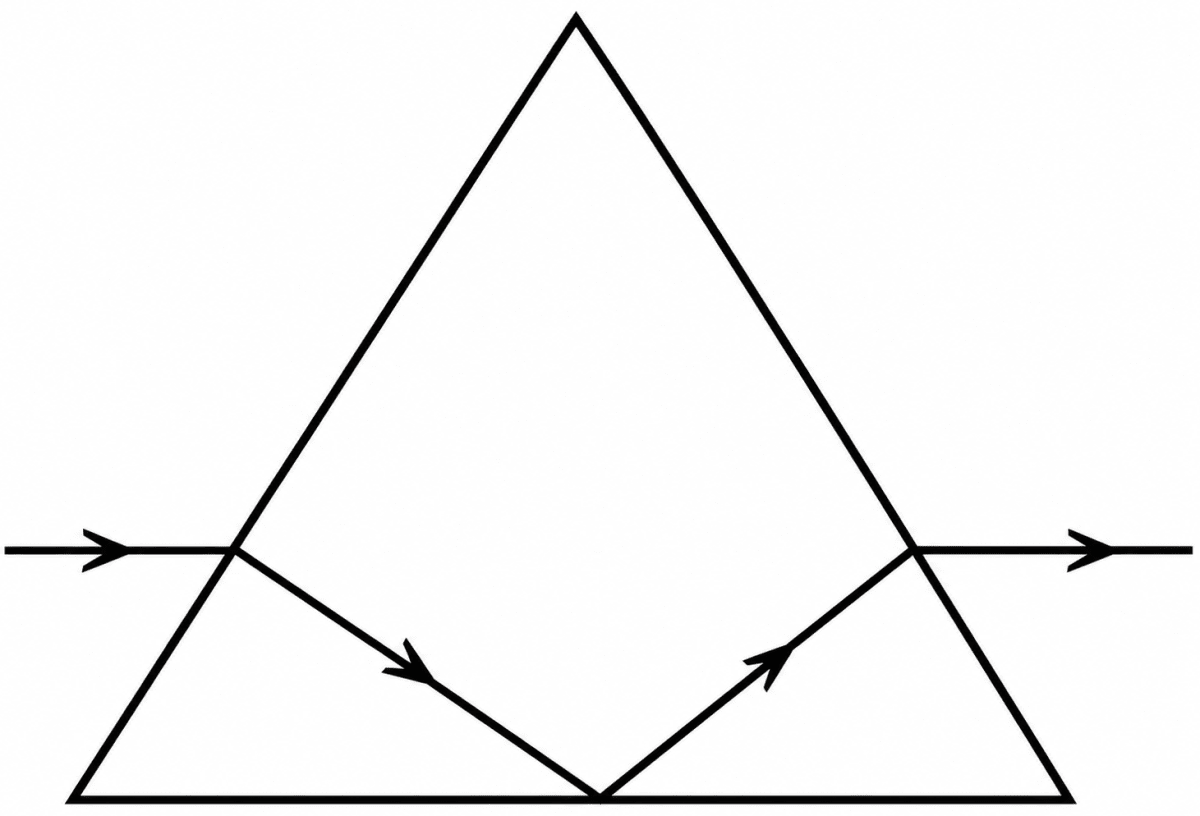
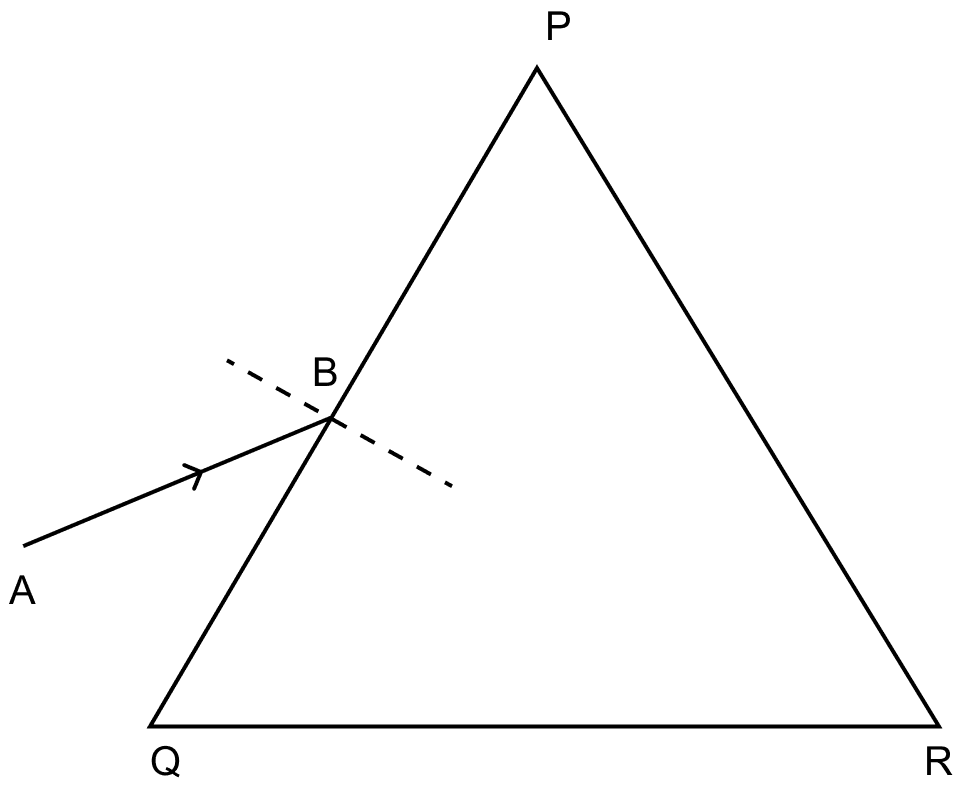
(b) Redraw the diagram given below and complete the path of the light ray AВ through the glass prism till it emerges out of the prism. Critical angle of the glass is 42°.

Redraw the diagram given below and complete the path of the light ray AВ through the glass prism till it emerges out of the prism. Critical angle of the glass is 42°. ICSE 2025 Physics Solved Question Paper.
Show SolutionHide Solution↓

(a) Ultraviolet (UV) radiation

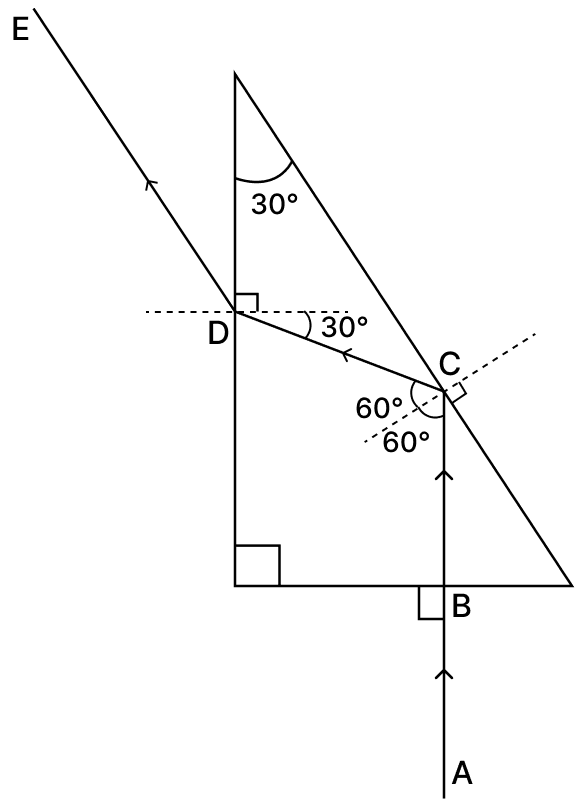
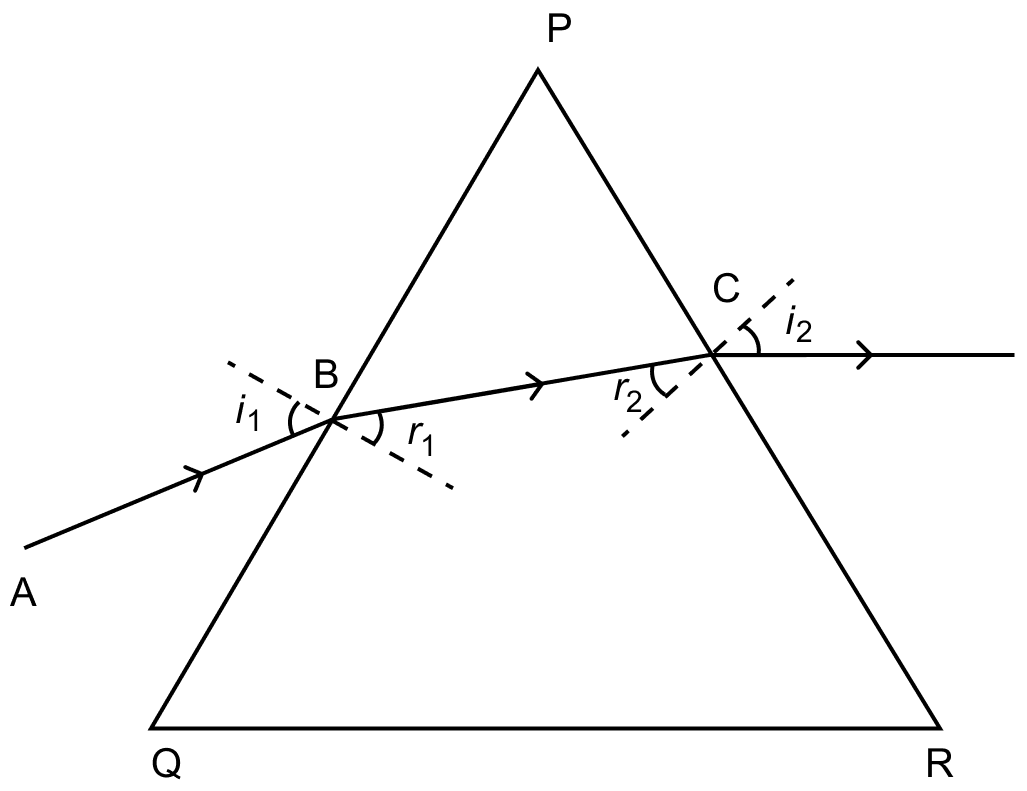
(b) The completed diagram is shown below :

Redraw the diagram given below and complete the path of the light ray AВ through the glass prism till it emerges out of the prism. Critical angle of the glass is 42°. ICSE 2025 Physics Solved Question Paper.

Explanation:

  • The ray AB enters the prism normally at point B, so it passes straight into the prism without bending.
  • It then travels vertically upward and strikes the slant face of the prism.
  • The angle between this face and the vertical side is 30°, so the angle of incidence at the slant face becomes 60°.
  • Since this angle is greater than the critical angle (42°), the ray undergoes total internal reflection at the slant surface.
  • After reflection, the ray travels at an angle of 60° with the normal of slant face and move towards opposite face.
  • The ray incident on this face at an angle of 30° which is smaller than the critical angle (42°) so the ray refract at this face.
5(i)Written · 2026 · Section B · 2026 PaperFull page

An object placed in front of a convex lens, forms an image of same size on a screen. Moving the object 12 cm closer to the lens results in the formation of a real image which is three times the size of the object. Calculate the focal length of the lens.

Show SolutionHide Solution↓

(a) Initially,

Let, initial object distance be u, image distance be v and focal length be f.

According to question,

Since the image is formed on a screen so it is real and inverted and it is also of the same size as the object which means magnification produced by the lens is -1.

Magnification (m) of a lens is given by,

$$\begin{aligned}\text m = \frac{\text {v}}{\text {u}} \\[1em] \Rightarrow -1 = \frac{\text {v}}{\text {u}} \\[1em] \Rightarrow \text {u} = -\text {v}\end{aligned}$$

From lens formula,

$$\begin{aligned}\frac{1}{\text f} = \frac{1}{\text v} - \frac{1}{\text u} \\[1em] \frac{1}{\text f} = \frac{1}{\text v} - \frac{1}{(-\text v)} \\[1em] \frac{1}{\text f} = \frac{1}{\text v} + \frac{1}{\text v} \\[1em] \frac{1}{\text f} = \frac{2}{\text v} \\[1em] \Rightarrow \text f = \frac{\text v}{2}\end{aligned}$$

Let, final object distance be u' and final image distance be v'.

According to question,

u' = u + 12 and m' = -3

Magnification (m') of a lens is given by,

$$\begin{aligned}\text m' = \frac{\text {v'}}{\text {u'}} \\[1em] \Rightarrow -3 = \frac{\text {v'}}{\text {u'}} \\[1em] \Rightarrow \text {u'} = -\frac{\text {v'}}{3} \\[1em] \Rightarrow \text {u} + 12 = -\frac{\text {v'}}{3} \\[1em] \Rightarrow -\text {v} + 12 = -\frac{\text {v'}}{3} \\[1em] \Rightarrow -3(\text {v} - 12) = -\text {v'} \\[1em] \Rightarrow 3(\text {v} - 12) = \text {v'} \\[1em] \Rightarrow 3\text {v} - 36 = \text {v'} \\[1em]\end{aligned}$$

From lens formula,

$$\begin{aligned}\frac{1}{\text f} = \frac{1}{\text v'} - \frac{1}{\text u'} \\[1em] \frac{1}{\text f} = \frac{1}{\text v'} - \frac{3}{-\text v'} \\[1em] \frac{1}{\text f} = \frac{1}{\text v'} + \frac{3}{\text v'} \\[1em] \frac{1}{\text f} = \frac{4}{\text v'} \\[1em] \Rightarrow \text f = \frac{\text v'}{4} \\[1em] \Rightarrow \text f = \frac{3\text {v} - 36}{4} \\[1em] \Rightarrow \text f = \frac{3\text {v}}{4} - \frac{36}{4} \\[1em] \Rightarrow \text f = \frac{3\text {f}}{2} - 9 \\[1em] \Rightarrow \frac{3\text {f}}{2} - \text f = 9 \\[1em] \Rightarrow \frac{3\text {f}}{2} - \frac {2\text f}{2} = 9 \\[1em] \Rightarrow \frac {\text f}{2} = 9 \\[1em] \Rightarrow \text f = 2\times 9 \\[1em] \Rightarrow \text f = 18 \text { cm}\end{aligned}$$

Hence, the focal length of the lens is 18 cm.

5(ii)Written · 2026 · Section B · 2026 PaperFull page

(a) Atmospheric temperature after a hailstorm is greater than the temperature during the hailstorm. State True or False.

(b) Which thermal physical quantity of a frying pan changes by making its base heavier?

(c) State the principle of Calorimetry.

Show SolutionHide Solution↓

(a) False
Reason — After the hail-strom, ice starts absorbing the heat energy required for its melting from the surroundings, so the temperature of the surroundings falls further down.

(b) Making the base of a frying pan heavier increases its heat capacity because heat capacity depends on the mass of the object so that a heavier base requires more heat to raise its temperature.

(c) The principle of calorimetry states that when a hot body is brought in contact with a cold body, then heat lost by the hot body is equal to the heat gained by the cold body, provided there is no heat loss in the environment.
Heat energy lost by the hot body = Heat energy gained by the cold body

5(iii)Written · 2026 · Section B · 2026 PaperFull page

The given graph represents the cooling curve of a liquid.

The given graph represents the cooling curve of a liquid. ICSE 2025 Physics Solved Question Paper.

(a) State the freezing temperature of the liquid.

(b) Name the phase change happening at the region QR.

(c) In which state (solid / liquid) does the above substance liberate heat at a faster rate? Justify.

Show SolutionHide Solution↓

(a) The freezing temperature of the liquid is 20 °C because at this temperature, the graph becomes horizontal, indicating that the temperature remains constant during the phase change.

(b) In the region QR, the phase change taking place is freezing (liquid changing into solid).

(c) The substance liberates heat at a faster rate in the solid state which is shown by the steeper slope of the graph after point R, indicating a faster decrease in temperature compared to the liquid state before point Q, where the slope is less steep.

6(i)Written · 2026 · Section B · 2026 PaperFull page

The diagram shows a wheel with a handle. Two forces, F1 and F2 of equal magnitudes are acting on the handle as shown in the diagram.

The diagram shows a wheel with a handle. Two forces of equal magnitudes are acting on the handle as shown in the diagram. ICSE 2025 Physics Solved Question Paper.

(a) Which force produces negative moment?

(b) Is the wheel in equilibrium? (Yes or No)

(c) Justify your answer stated in (b).

Show SolutionHide Solution↓

(a) The force F1 produces the negative moment because it tends to rotate the wheel in the clockwise direction, which is taken as negative.

(b) No, the wheel is not in equilibrium.

(c) For equilibrium, the sum of clockwise moments must be equal to the sum of anticlockwise moments about the centre O. Although F1 and F2 have equal magnitudes, their perpendicular distances from the centre (moment arms) are different. Hence, the moments produced by them are not equal and opposite, so the net moment is not zero and the wheel is not in equilibrium.

6(ii)Written · 2026 · Section B · 2026 PaperFull page

(a) Name the unit of work done, used in subatomic scale.

(b) To which class of lever does a pair of scissors belong?

(c) A stone is tied to a string and displaced from A to B by application of constant force F in three different ways as shown in the diagram below.

A stone is tied to a string and displaced from A to B by application of constant force F in three different ways as shown in the diagram below. ICSE 2025 Physics Solved Question Paper.

Arrange the three cases in ascending order of the work done by the force. (Given AJB is a semi-circle, θ < 90° and AB = 20 m)

Show SolutionHide Solution↓

(a) electron volt (eV)

(b) Class I lever

(c) Given,

  • AJB is a semi-circle.
  • θ < 90°
  • AB = 20 m

Work done by a force is given by

W = Force x Displacement x cos θ,

where θ is the angle between force and displacement.

  • Case 1 : The stone moves along a semicircular path, so the force is always perpendicular to the direction of displacement which makes θ = 90°.

Hence, work done is zero.

  • Case 2 : The force acts along the direction of displacement from A to B, so θ = 0°.

Hence, work done is maximum.

  • Case 3: The force acts at an angle θ < 90° to the displacement, so only the component Fcosθ does work.

Hence, the work done is less than Case 2 but more than Case 1.

Therefore, the ascending order of work done is Case 1 < Case 3 < Case 2

6(iii)Written · 2026 · Section B · 2026 PaperFull page

A ball of mass 20 g falls from a height of 45 m. It rebounds from the ground to a height of 40 m. Calculate :

(a) initial potential energy of the ball.

(b) the speed of the ball at which it hits the ground.

(c) the loss in kinetic energy on striking the ground.

[g = 10 m s-2]

Show SolutionHide Solution↓

(a) Given,

  • Mass of the ball (m) = 20 g = 0.02 kg
  • Initial height (h1) = 45 m
  • Final height (h2) = 40 m
  • g = 10 m s-2

(a) Initial potential energy of the ball is given by,

PE = mgh1
= 0.02 x 10 x 45
= 9 J

So, the initial potential energy is 9 J.

(b) Due to law of conservation of mechanical energy, just before hitting the ground, the initial potential energy converts into kinetic energy.

Let speed of the ball be v.

So,

$$\begin{aligned}\text {Kinetic energy} = 9 \\[1em] \Rightarrow \frac{1}{2} \text {mv}^2 = 9 \\[1em] \Rightarrow \frac{1}{2} \times 0.02\times \text {v}^2 = 9 \\[1em] \Rightarrow 0.01\times \text {v}^2 = 9 \\[1em] \Rightarrow \text {v}^2 = \frac{9}{0.01} \\[1em] \Rightarrow \text {v}^2 = 900 \\[1em] \Rightarrow \text {v} = \sqrt {900} \\[1em] \Rightarrow \text {v} = 30 \text { m s}^{-1}\end{aligned}$$

So, the speed of the ball on hitting the ground = 30 m s-1.

(c) Final kinetic energy after rebound is equal to potential energy at 40 m which is given by,

Final kinetic energy = mgh2
= 0.02 x 10 x 40
= 8 J

Loss in KE = Initial kinetic energy - Final kinetic energy = 9 − 8 = 1 J

So, the loss in kinetic energy = 1 J.

7(i)Written · 2026 · Section B · 2026 PaperFull page

To lift a load of 30 kgf, Suhas uses a single fixed pulley while Radha uses a single movable pulley. The displacement of efforts in both the cases are equal. In an ideal situation calculate the ratio of :

(a) the efforts in the two cases.

(b) the potential energy gained by the loads in the two cases.

(c) the efficiencies in the two cases.

Show SolutionHide Solution↓

Given,

  • Load = 30 kgf

(a) As, mechanical advantage (MA) of a machine is given by,

$\text {MA} = \frac{\text {Load}}{\text {Effort}}$

For a single fixed pulley, the mechanical advantage (MA) is 1.

Then,

$$\begin{aligned}\text {MA} = \frac{\text {Load}}{\text {Effort} (\text E_1)} \\[1em] \Rightarrow \text E_1 = \frac{\text {Load}}{\text {MA}} \\[1em] \Rightarrow \text E_1 = \frac{30}{1} \\[1em] \Rightarrow \text E_1 = 30 \text { kgf}\end{aligned}$$

For a single movable pulley, the mechanical advantage (MA) is 2.

Then,

$$\begin{aligned}\text {MA} = \frac{\text {Load}}{\text {Effort} (\text E_2)} \\[1em] \Rightarrow \text E_2 = \frac{\text {Load}}{\text {MA}} \\[1em] \Rightarrow \text E_2 = \frac{30}{2} \\[1em] \Rightarrow \text E_2 = 15 \text { kgf}\end{aligned}$$

Ratio of efforts = $\text E_1 : \text E_2$ = 30 : 15 = 2 : 1

Hence, the ratio of the efforts in the two cases is 2 : 1.

(b) Potential energy is given by,

Potential energy gained = Load × Height raised

If the effort displacement is the same:

  • In a fixed pulley, load rises by the same distance as the effort.
  • In a movable pulley, load rises by half the distance of the effort.

Let, for the fixed pulley, height raised by the load be h.

Therefore,

Ratio of the potential energies in two cases is given by,

$$\begin{aligned}\text {Ratio of PE} = \frac{\text {PE gained by the load in fixed pulley}}{\text {PE gained by the load in movable pulley}} \\[1em] = \frac {30 \times \text h}{30 \times \frac{\text h}{2}} \\[1em] = \frac {30\text h \times 2}{30 \text h} \\[1em] = \frac {2}{1} \\[1em] = 2 : 1\end{aligned}$$

Hence, the ratio of the potential energies in two cases is 2 : 1.

(c) In an ideal machine, efficiency = 100 % for both pulleys.

Then,

Efficiency ratio = 1 : 1

Hence, the ratio of the efficiencies in the two cases is 1 : 1.

7(ii)Written · 2026 · Section B · 2026 PaperFull page

(a) One end of a plastic foot ruler is held tightly at the edge of a table and the other end is plucked. Name the vibrations produced in the ruler.

(b) Now the ruler is pushed inside partially and plucked again from its freе end. State with a reason whether the frequency of vibration increases or decreases.

Show SolutionHide Solution↓

(a) When one end of the plastic ruler is held firmly at the edge of the table and the other end is plucked, the ruler vibrates on its own after being displaced and these vibrations are called natural vibrations.

(b) The frequency of vibration increases because when the ruler is pushed further inside, the length of the free vibrating part decreases and since a shorter vibrating length oscillates more rapidly, so the frequency increases.

7(iii)Written · 2026 · Section B · 2026 PaperFull page

Two persons A and B are standing in front of a cliff in the same line 170 m apart as shown in the diagram.

Two persons A and B are standing in front of a cliff in the same line 170 m apart as shown in the diagram. ICSE 2025 Physics Solved Question Paper.

Person B fires the gun and hears the echo in 3 s. Then the person A standing in front of the person B fires the gun.

(Speed of sound in air is 340 m s-1)

(a) Calculate:

(b) Fill in the blank.

The echo is softer (less loud) than the original sound due to the decrease in ............... [amplitude / frequency] of the wave.

Show SolutionHide Solution↓

Given,

  • Distance between A and B = 170 m
  • Time taken by the person B to hear the echo = 3 s
  • Speed of sound in air = 340 ms-1

(a)

1. Let, the distance of the person B from the cliff be d.

So,

$$\begin{aligned}\text d = \frac {\text {Speed of sound in air} \times \text {Time taken}}{2} \\[1em] = \frac{340 \times 3}{2} \\[1em] = 170 \times 3 \\[1em] = 510\ \text m\end{aligned}$$

Hence, the distance of the person B from the cliff is 510 m.

2. Person B first hears the direct sound of the gunshot and only afterwards hears its echo from the cliff. Therefore, the minimum time in which B hears the gunshot is the time taken by the sound to travel directly from person A to person B, who is 170 m away.

Then, minimum time (t) is given by,

$$\begin{aligned}\text t = \frac{\text {Distance between A and B}}{\text {Speed of sound in air}} \\[1em] = \frac{170}{340} \\[1em] = \frac{1}{2} \\[1em] = 0.5\ \text s\end{aligned}$$

Hence, the minimum time in which B hears the gunshot fired by A is 0.5 second.

(b) The echo is softer (less loud) than the original sound due to the decrease in amplitude of the wave.

8(i)Written · 2026 · Section B · 2026 PaperFull page

Bulb A rated 160 W, 40 V and Bulb B rated 40 W, 40 V are connected as shown in the diagram.

Bulb A rated 160 W, 40 V and Bulb B rated 40 W, 40 V are connected as shown in the diagram. ICSE 2025 Physics Solved Question Paper.

(a) Calculate the ratio V1 : V2.

(b) If the bulb A fuses, the current in the circuit remains the same. State True or False.

Show SolutionHide Solution↓

Given,

  • Power rating of the bulb A ($\text P_\text A$) = 160 W
  • Voltage rating of the bulb A ($\text V_\text A$) = 40 V
  • Power rating of the bulb B ($\text P_\text B$) = 40 W
  • Voltage rating of the bulb B ($\text V_\text B$) = 40 V
  • Supply voltage ($\text V$) = 40 V

(a) Resistance of bulb A is given by,

$$\begin{aligned}\text R_\text A = \frac{\text V_\text A^2}{\text P_\text A} \\[1em] = \frac{40^2}{160} \\[1em] = \frac{1600}{160} \\[1em] = 10\ \text Ω\end{aligned}$$

Similarly,

Resistance of bulb B is given by,

$$\begin{aligned}\text R_\text B = \frac{\text V_\text B^2}{\text P_\text B} \\[1em] = \frac{40^2}{40} \\[1em] = \frac{1600}{40} \\[1em] = 40\ \text Ω\end{aligned}$$

From Ohm's law,

Potential drop (V) = Current (I) x Resistance (R)

Since the bulbs are in series, so the same current flows through both bulbs and the potential difference divides in the ratio of their resistances i.e.,

V1 : V2 = $\text R_\text A : \text R_\text B$ = 10 : 40 = 1 : 4

Hence, the ratio V1 : V2 = 1 : 4.

(b) False because if bulb A fuses, the circuit becomes open, so no current can flow through the circuit. Hence the current becomes zero, not the same.

8(ii)Written · 2026 · Section B · 2026 PaperFull page

The reverse side of a three-pin plug with incorrect connection of wires is shown in the diagram below.

The reverse side of a three-pin plug with incorrect connections of wires is shown in the diagram below. ICSE 2025 Physics Solved Question Paper.

(a) Identify the fault in the above connection.

(b) Mention a risk factor involved, if the user operates the appliance without correcting it.

(c) Will the appliance function in the present situation? (Yes or No)

Show SolutionHide Solution↓

(a) Fault in the connection : The live (red) wire is incorrectly connected to the earth terminal (top thick pin) instead of the live terminal and the earth (green) wire is also wrongly connected to the live terminal. Thus, the live and earth wires should be interchanged.

(b) If the appliance is used in this condition, the outer metallic body of the appliance may become live, creating a risk of electric shock to the user.

(c) No, the appliance will not function because the wiring connections are incorrect.

8(iii)Written · 2026 · Section B · 2026 PaperFull page

In the combinations of resistors shown below. calculate:

In the combinations of resistors shown below. calculate. ICSE 2025 Physics Solved Question Paper.

(a) the resistance across AB when the switch S is open.

(b) the resistance across AB when the switch S is closed.

Show SolutionHide Solution↓

(a) When the switch is open, the middle connection does not join the two branches. So the circuit has two separate branches in parallel i.e., top and bottom branches where 12 Ω and 6 Ω resistances are in series.

the resistance across AB when the switch S is open. ICSE 2025 Physics Solved Question Paper.

Then net resistance of the top branch is given by,

$\text R_1 = 12 + 6 = 18 Ω$

Similarly, net resistance of the bottom branch is given by,

$\text R_2 = 12 + 6 = 18 Ω$

Now, $\text R_1$ and $\text R_2$ are in parallel connection and the net resistance is given by,

the resistance across AB when the switch S is open. ICSE 2025 Physics Solved Question Paper.

$$\begin{aligned}\frac{1}{\text R} = \frac{1}{\text R_1} + \frac{1}{\text R_2} \\[1em] = \frac {1}{18} + \frac {1}{18} \\[1em] = \frac {2}{18} \\[1em] \Rightarrow \frac{1}{\text R} = \frac {1}{9} \\[1em] \Rightarrow \text R = 9\ \text Ω\end{aligned}$$

Hence, the resistance across AB when the switch S is open is 9 Ω.

(b) When switch S is closed, the midpoints are connected which rearranges the circuit into two branches of parallel resistors that are connected in series as shown below.

the resistance across AB when the switch S is closed. ICSE 2025 Physics Solved Question Paper.

Then net resistance of the left branch (containing 12 Ω and 6 Ω resistances) is given by,

$$\begin{aligned}\frac{1}{\text R_1} = \frac{1}{12} + \frac{1}{6} \\[1em] = \frac {1}{12} + \frac {2}{12} \\[1em] = \frac {3}{12} \\[1em] \Rightarrow \frac{1}{\text R_1} = \frac {1}{4} \\[1em] \Rightarrow \text R_1 = 4\ \text Ω\end{aligned}$$

Similarly, net resistance of the right branch (containing 12 Ω and 6 Ω resistances) is given by,

$$\begin{aligned}\frac{1}{\text R_2} = \frac{1}{12} + \frac{1}{6} \\[1em] = \frac {1}{12} + \frac {2}{12} \\[1em] = \frac {3}{12} \\[1em] \Rightarrow \frac{1}{\text R_2} = \frac {1}{4} \\[1em] \Rightarrow \text R_2 = 4\ \text Ω\end{aligned}$$

Now, $\text R_1$ and $\text R_2$ are in series connection and the net resistance is given by,

the resistance across AB when the switch S is closed. ICSE 2025 Physics Solved Question Paper.

$$\begin{aligned}\text R = \text R_1 + \text R_2 \\[1em] = 4 + 4 \\[1em] = 8\ \text Ω\end{aligned}$$

Hence, the resistance across AB when the switch S is closed is 8 Ω.

9(i)Written · 2026 · Section B · 2026 PaperFull page

An electric iron rated 1100 W, 220 V is operated for 5 hours.

Calculate:

(a) the minimum rating of the fuse required.

(b) the energy consumed in kWh.

(c) the cost of the energy consumed, if the rate is ₹ 10 per unit.

Show SolutionHide Solution↓

Given,

  • Power rating of the iron ($\text P$) = 1100 W
  • Voltage rating of the iron ($\text V$) = 220 V
  • Operating time = 5 hours

(a) Power consumed by an appliance is given by,

$$\begin{aligned}\text P = \text {VI} \\[1em] \Rightarrow \text I = \frac{\text P}{\text V} \\[1em] = \frac{1100}{220} \\[1em] = 5\ \text A\end{aligned}$$

Here, $\text I$ is the operating current flowing through the appliance.

Since the fuse rating should be slightly higher than the operating current, so the minimum suitable fuse rating is 6 A.

Hence, 6 A is the minimum rating of the fuse required.

(b) Energy consumed by the iron = Power consumed x Operating time

= 1100 x 5

= 5500 Wh

= 5.5 x 10³ Wh

= 5.5 kWh

Hence, the energy consumed by the iron is 5.5 kWh.

(c) Given,

  • Electricity rate = ₹ 10 per unit

As, 1 unit = 1 kWh

Then,

The cost of energy consumed by the iron = Energy consumed x Electricity rate

= 5.5 x 10

= ₹ 55

Hence, the cost of the energy consumed is ₹ 55.

9(ii)Written · 2026 · Section B · 2026 PaperFull page

When the magnet as shown in the diagram, is moved towards the coil at a speed of 5 m s-1, the galvanometer shows a certain deflection to the right.

When the magnet as shown in the diagram, is moved towards the coil at a speed of 5 m, the galvanometer shows a certain deflection to the right. ICSE 2025 Physics Solved Question Paper.

How will the direction and magnitude of deflection change when the coil also moves with a speed of 5 m s-1:

(a) in the direction of the motion of the magnet?

(b) in the opposite direction of the motion of the magnet?

Show SolutionHide Solution↓

The deflection of the galvanometer depends on the rate of change of magnetic flux, which depends on the relative motion between the magnet and the coil.

(a) Both the magnet and the coil move in the same direction with the same speed, so there is no relative motion between them and hence, the magnetic flux through the coil does not change.

Therefore, no current is induced and the galvanometer shows no deflection.

(b) Since the magnet and the coil are moving opposite to each other so now the relative speed between them is given by the sum of individual speeds and becomes 10 m s-1 (5 + 5) which increases the rate of change of magnetic flux.

Therefore, the direction of deflection remains the same (to the right), but the magnitude of deflection increases.

9(iii)Written · 2026 · Section B · 2026 PaperFull page

(a)

  1. Which element is used in the lining of the special aprons worn by workers in nuclear power plants?
  2. Why is this element preferred?

(b) ${}_{11}^{24}\text {Na}$ emits a nuclear radiation which does not alter the mass number but is deflected by a magnetic field.

Show SolutionHide Solution↓

(a)

  1. Lead is used in the lining of the special aprons worn by workers in nuclear power plants.
  2. Lead is preferred because it is a dense metal and absorbs harmful nuclear radiations effectively.

(b)

  1. The radiation that does not change the mass number but is deflected by a magnetic field is beta (β) radiation.
    Hence, beta (β) radiation is emitted by $_{\textbf {11}}^{\textbf {24}}\textbf {Na}$.
  2. Radioactive decay equation:
    $_{11}^{24}\text {Na} \longrightarrow _{12}^{24}\text {Na} + _{-1}^{0}\text {β}$
    In this decay, a beta particle (electron) is emitted, the atomic number increases by 1, while the mass number remains unchanged.
1(i)1 Mark · 2026 · Section A · 2026 ImprovementFull page

The energy transformation taking place in a Thermocouple is:

Show SolutionHide Solution↓

Heat energy to electrical energy

Reason — A thermocouple is made by joining two wires of different metals so as to form two junctions. When one junction is kept hot and the other is kept cold, a current begins to flow in the circuit. Thus the heat energy supplied at the hot junction is converted into electrical energy.

1(ii)1 Mark · 2026 · Section A · 2026 ImprovementFull page

The unit of the physical quantity expressed by equation $\frac{p^2}{2m}$ is: (p is momentum and m is mass)

Show SolutionHide Solution↓

joule

Reason — As momentum p = mv, so

$\frac{p^2}{2m} = \frac{(mv)^2}{2m} = \frac{m^2v^2}{2m} = \frac{1}{2}mv^2$

which is the expression for kinetic energy. Since energy is measured in joule, the unit of $\frac{p^2}{2m}$ is joule.

1(iii)1 Mark · 2026 · Section A · 2026 ImprovementFull page

A block and tackle system has two pulleys in the movable block. In an ideal condition if L = 5T, then the number of pulleys in the fixed block is equal to:

(L is the load and T is the tension)

Show SolutionHide Solution↓

3

Reason — In a block and tackle system in which the effort is applied in the downward direction, the tension in the n segments of the string supports the load, so

L = nT

where n is the total number of pulleys used in both the blocks.

Here, L = 5T, so n = 5.

Then,

Number of pulleys in the fixed block = Total number of pulleys - Number of pulleys in the movable block = 5 - 2 = 3

1(iv)1 Mark · 2026 · Section A · 2026 ImprovementFull page

If three equal forces F1, F2 and F3 are acting at the end A of the rod AB, pivoted at the center O, as shown in the diagram given below, then the moment of force is:

If three equal forces F 1, F 2 and F 3 are acting at the end A of the rod AB, pivoted at the center O, as shown in the diagram given below, then the moment of force is:. Improvent Board Paper 2026, ICSE 2026 Improvent Physics Solved Question Paper.
Show SolutionHide Solution↓

least for F3 and maximum for F1

Reason — The moment of a force is the product of the force and the perpendicular distance of its line of action from the pivot. If a force F acts at A at an angle θ with the rod and OA = r, then

$\tau = \text{F r}\sin \theta$

All the three forces are equal and act at the same point A, so the moment of each depends only on the angle θ.

F3 acts along the rod, so θ = 0° and its line of action passes through O, giving τ3 = 0, the least.

F1 acts perpendicular to the rod, so θ = 90° and τ1 = F r, the maximum.

F2 acts at an angle between 0° and 90°, so its moment lies between the two.

1(v)1 Mark · 2026 · Section A · 2026 ImprovementFull page

The net angle of deviation produced by the prism in the diagram shown below is ...............

The net angle of deviation produced by the prism in the diagram shown below is............... Improvent Board Paper 2026, ICSE 2026 Improvent Physics Solved Question Paper.
Show SolutionHide Solution↓

0°

Reason — From the diagram, the light ray enters the prism through one refracting face, suffers total internal reflection at the base of the prism and finally emerges out through the other refracting face. The emergent ray is parallel to the incident ray and it travels in the same direction as the incident ray.

Since the emergent ray has not turned from the direction of the incident ray, the net angle of deviation produced by the prism is 0°.

1(vi)1 Mark · 2026 · Section A · 2026 ImprovementFull page

A crack in a glass vessel often shines, like a mirror, in sunlight. Which of the following phenomenon of light is responsible for this?

Show SolutionHide Solution↓

total internal reflection

Reason — A crack in a glass vessel contains a thin layer of air. When light travelling inside the glass (denser medium) strikes this air layer (rarer medium) at an angle of incidence greater than the critical angle for the glass-air interface, the entire light is reflected back into the glass. Because 100% of the light is returned, the crack appears bright and shines like a mirror.

1(vii)1 Mark · 2026 · Section A · 2026 ImprovementFull page

The magnification produced by a lens is +2. Then the image is:

Show SolutionHide Solution↓

virtual and magnified

Reason — The sign of magnification tells the nature of the image and its numerical value tells the size of the image.

Here, magnification is positive, which means the image is erect and hence virtual, and its numerical value is 2 (i.e., greater than 1), which means the image is twice the size of the object and hence magnified.

1(viii)1 Mark · 2026 · Section A · 2026 ImprovementFull page

Identify the radiation that scatters the least.

Show SolutionHide Solution↓

Radio waves

Reason — The scattering of a radiation decreases as its wavelength increases. Among the given radiations, radio waves have the longest wavelength, so they are scattered the least. Gamma rays, having the shortest wavelength, are scattered the most.

1(ix)1 Mark · 2026 · Section A · 2026 ImprovementFull page

Assertion (A): The buzzing of a mosquito is shriller than the roar of a lion.

Reason (R): The frequency of sound produced by a mosquito is greater than the frequency of sound produced by the roar of a lion.

Show SolutionHide Solution↓

Both (A) and (R) are true and (R) is the correct explanation of (A).

Explanation

Assertion (A) is correct: The buzzing of a mosquito is a shrill, that is, a high pitched sound, whereas the roar of a lion is a low pitched sound. The roar is much louder than the buzz, but loudness depends on the amplitude of the sound wave, while shrillness depends on its pitch.

Reason (R) is also correct: A mosquito vibrates its wings very rapidly and therefore produces a sound of high frequency, while the roar of a lion is produced by the slower vibration of its vocal cords and is of low frequency.

Since the shrillness, or pitch, of a sound is decided by its frequency — the greater the frequency, the shriller the sound — the higher frequency of the mosquito is exactly the cause of its sound being shriller.

Therefore, both (A) and (R) are true and (R) is the correct explanation of (A).

1(x)1 Mark · 2026 · Section A · 2026 ImprovementFull page

A straight wire of resistance R is bent in a U shape. Its resistance is:

Show SolutionHide Solution↓

R

Reason — The resistance of a wire is given by

$\text{R} = \rho\frac{l}{a}$

i.e., it depends on the resistivity of the material, the length of the wire and its area of cross-section.

On bending the wire into a U shape, neither its length, nor its area of cross-section, nor its material changes. Hence its resistance remains R.

1(xi)1 Mark · 2026 · Section A · 2026 ImprovementFull page

Which of the following is NOT a characteristic of a fuse wire?

Show SolutionHide Solution↓

It has high conductivity.

Reason — A fuse wire must get heated up quickly and melt when the current in the circuit exceeds the safe value. For this it is made of an alloy of lead and tin which has a high resistance and a low melting point. High conductivity means low resistance, so the wire would not get heated enough to melt. Hence high conductivity is not a characteristic of a fuse wire.

1(xii)1 Mark · 2026 · Section A · 2026 ImprovementFull page

Identify the correct statement with respect to the change of phase of a substance.

Show SolutionHide Solution↓

Kinetic energy of the molecules remains the same.

Reason — During a change of phase, the temperature of the substance does not change. Since the kinetic energy of the molecules depends on the temperature, the kinetic energy of the molecules remains the same. The heat energy supplied (i.e., the latent heat) is used up in increasing the potential energy of the molecules by increasing the separation between molecules against their attractive forces.

1(xiii)1 Mark · 2026 · Section A · 2026 ImprovementFull page

1 calorie is the amount of heat required to raise the temperature of:

Show SolutionHide Solution↓

1 g of water through 1 K

Reason — One calorie is defined as the amount of heat energy required to raise the temperature of 1 gram of water through 1 K (or 1 °C). Note that a change of 1 K is numerically equal to a change of 1 °C, so both express the same rise in temperature.

1(xiv)1 Mark · 2026 · Section A · 2026 ImprovementFull page

A current carrying conductor experiences a force when placed normal to a magnetic field. The force experienced does not depend on the:

Show SolutionHide Solution↓

mass of the conductor

Reason — For a conductor normal to the field, the force depends on the current, field strength and length of wire in the field; its mass does not determine the magnetic force.

1(xv)1 Mark · 2026 · Section A · 2026 ImprovementFull page

When the nuclear radiation is subjected to a magnetic field, the direction of deflection is governed by:

Show SolutionHide Solution↓

Flemming's Left Hand Rule

Reason — The α-particles and β-particles are charged particles, so a beam of these radiations is equivalent to a current flowing in a conductor. When such a beam passes through a magnetic field, it experiences a force whose direction is obtained by Fleming's left hand rule, which gives the direction of the force acting on a current carrying conductor placed in a magnetic field.

2(i)1 Mark · 2026 · Section A · 2026 ImprovementFull page

Complete the following by choosing the correct answers from the bracket:

(a) If the displacement of a load is greater than the displacement of the effort, then the velocity ratio of the machine is ............... [less than one / more than one].

(b) Out of multiple images of an object, formed by a thick plane glass mirror, the ............... [first / second] image is the brightest.

(c) No negative temperature is possible on the ............... [Kelvin scale / Fahrenheit scale].

(d) 250 dB is ............... [shriller / louder] than 10 dB.

(e) In a series combination, across each resistor, the ............... [current / potential difference] remains the same.

(f) 18Ar40 and 20Ca40 are the examples of ............... [isobars / isotopes].

Show SolutionHide Solution↓

(a) If the displacement of a load is greater than the displacement of the effort, then the velocity ratio of the machine is less than one.

(b) Out of multiple images of an object, formed by a thick plane glass mirror, the second image is the brightest.

(c) No negative temperature is possible on the Kelvin scale.

(d) 250 dB is louder than 10 dB.

(e) In a series combination, across each resistor, the current remains the same.

(f) 18Ar40 and 20Ca40 are the examples of isobars.

2(ii)1 Mark · 2026 · Section A · 2026 ImprovementFull page

Rekha has a metre ruler weighing 200 gf, half (50 cm) made of wood and half made of steel.

(a) Rekha wants to balance the ruler. To which part (wooden or steel) should she keep the knife edge?

(b) The above metre-rule is to be balanced by placing the knife edge at 50 cm mark using a known weight. Name the principle which can be used to calculate the position of the weight.

Show SolutionHide Solution↓

(a) The knife edge should be kept on the steel part.

Reason — Steel is much denser than wood, so for the same length the steel half is heavier than the wooden half. Hence the centre of gravity of the ruler is shifted from the 50 cm mark towards the steel half, and the ruler will balance only when the knife edge is placed at the centre of gravity, i.e., somewhere on the steel part.

(b) Principle of moments — according to which, in the equilibrium position, the sum of the anticlockwise moments about the knife edge is equal to the sum of the clockwise moments about it.

2(iii)1 Mark · 2026 · Section A · 2026 ImprovementFull page

(a) In a second-class lever, the ratio of the effort arm to the load arm is ............... (greater than 1 / less than 1).

(b) State one advantage of the combination of one fixed and one movable pulley over a single movable pulley.

Show SolutionHide Solution↓

(a) In a second-class lever, the ratio of the effort arm to the load arm is greater than 1.

Reason — In a class II lever the load lies in between the fulcrum and the effort, so the effort arm is always longer than the load arm. Hence the ratio $\frac{\text{effort arm}}{\text{load arm}}$, which is the mechanical advantage, is always greater than 1.

(b) In a single movable pulley the effort has to be applied in the upward direction, which is inconvenient. By adding a fixed pulley to it, the direction of the effort is changed, so that the effort can now be applied in the downward direction, which is much more convenient since the weight of the person applying the effort also helps. The mechanical advantage remains 2 in both cases.

3(i)1 Mark · 2026 · Section A · 2026 ImprovementFull page

An upright lens is divided horizontally into a number of parts and the diagram given below shows the magnified view of its lowest part.

An upright lens is divided horizontally into a number of parts and the diagram given below shows the magnified view of its lowest part. Improvent Board Paper 2026, ICSE 2026 Improvent Physics Solved Question Paper.

(a) Identify the lens.

(b) Justify your answer in (a) above.

Show SolutionHide Solution↓

(a) It is a concave (diverging) lens.

(b) The lowest part of the lens behaves like a small prism. From the diagram, this part is thicker at its lower edge and thinner at its upper edge, i.e., the base of this prism points away from the principal axis of the lens.

This means that as we move from the lower edge of the lens towards its middle, the lens becomes thinner. A lens which is thin at the middle and thick at the edges is a concave lens. Further, since each prism-like part bends the light towards its base, i.e., away from the principal axis, the lens diverges the incident light. Hence it is a concave lens.

3(ii)1 Mark · 2026 · Section A · 2026 ImprovementFull page

(a) Why are thick wires used to carry current in high power appliances such as electric heaters and radiators?

(b) Name a device used to protect the electric circuits from overloading and short circuits.

Show SolutionHide Solution↓

(a) High power appliances such as heaters and radiators draw a large current. Since the resistance of a wire is inversely proportional to its area of cross-section, a thick wire has a large area of cross-section and hence a low resistance. Therefore the heat produced (H = I2Rt) in a thick wire is small and it can carry a heavy current without getting over-heated, so there is no danger of the insulation burning or of a fire.

(b) A fuse (or a miniature circuit breaker, MCB) is used to protect the electric circuits from overloading and short circuits.

3(iii)1 Mark · 2026 · Section A · 2026 ImprovementFull page

The diagram below shows a socket in which the switch is ON.

The diagram below shows a socket in which the switch is ON. Will the bulb glow if:. Improvent Board Paper 2026, ICSE 2026 Improvent Physics Solved Question Paper.

Will the bulb glow if:

(a) it is connected across B and C?

(b) it is connected across A and C?

Show SolutionHide Solution↓

In a three pin socket, the upper bigger hole is for the earth wire, the hole on the right side is for the live wire and the hole on the left side is for the neutral wire.

So here, C is earth, B is live and A is neutral.

The diagram below shows a socket in which the switch is ON. Will the bulb glow if:. Improvent Board Paper 2026, ICSE 2026 Improvent Physics Solved Question Paper.

(a) Yes, the bulb will glow.

Reason — The live wire B is at a high potential (220 V) while the earth wire C is at zero potential, so there is a potential difference of 220 V across the bulb and a current flows through it.

(b) No, the bulb will not glow.

Reason — Both the neutral wire A and the earth wire C are at zero potential, so there is no potential difference across the bulb and hence no current flows through it.

3(iv)1 Mark · 2026 · Section A · 2026 ImprovementFull page

The temperatures of two liquids are 80°C and 20°C. When they are mixed in the mass ratio of 8:5, the temperature of the mixture becomes 60°C. Calculate the ratio of their specific heat capacities. (Neglecting heat lost to the surroundings)

Show SolutionHide Solution↓

Given,

  • Temperature of hot liquid = 80 °C
  • Temperature of cold liquid = 20 °C
  • Temperature of mixture = 60 °C
  • Ratio of masses m1 : m2 = 8 : 5

Let the masses be m1 = 8m and m2 = 5m, and their specific heat capacities be c1 and c2 respectively.

Heat energy lost by the hot liquid = m1 x c1 x (80 - 60) = 8m x c1 x 20 = 160 m c1

Heat energy gained by the cold liquid = m2 x c2 x (60 - 20) = 5m x c2 x 40 = 200 m c2

By the principle of calorimetry,

Heat energy lost by the hot liquid = Heat energy gained by the cold liquid

$$\begin{aligned}160\ \text m\ \text c_1 = 200\ \text m\ \text c_2 \\[1em] \Rightarrow \frac{\text c_1}{\text c_2} = \frac{200}{160} = \frac{5}{4}\end{aligned}$$

Hence, the ratio of their specific heat capacities is 5 : 4.

3(v)1 Mark · 2026 · Section A · 2026 ImprovementFull page

In the given figure, a cell is connected to a coil A and a bulb is connected to coil B.

In the given figure, a cell is connected to a coil A and a bulb is connected to coil B. Improvent Board Paper 2026, ICSE 2026 Improvent Physics Solved Question Paper.

(a) Fill in the blank.

When the key 'K' is closed, then the ............... [bulb glows continuously / bulb glows only for a moment].

(b) Support your answer to (a) above with a suitable reason.

Show SolutionHide Solution↓

(a) When the key 'K' is closed, then the bulb glows only for a moment.

(b) On closing the key, the current in coil A grows from zero to its maximum value. During this short interval the magnetic flux linked with coil B changes, so an e.m.f. is induced in coil B and an induced current flows through the bulb, making it glow.

Once the current in coil A becomes steady, the magnetic flux linked with coil B no longer changes. Hence no e.m.f. is induced, no current flows in coil B and the bulb stops glowing.

3(vi)1 Mark · 2026 · Section A · 2026 ImprovementFull page

A uranium nucleus (92U235) undergoes an alpha emission followed by 2 beta emissions.

Calculate the atomic number and mass number of the daughter nucleus formed.

Show SolutionHide Solution↓

Given,

  • Atomic number of uranium (Z) = 92
  • Mass number of uranium (A) = 235

On emission of one α-particle — the atomic number decreases by 2 and the mass number decreases by 4.

Atomic number = 92 - 2 = 90

Mass number = 235 - 4 = 231

On emission of two β-particles — the atomic number increases by 1 for each β-particle and the mass number remains unchanged.

So, for emission of two β-particles:

Atomic number = 90 + 2 = 92

Mass number = 231

Hence, the daughter nucleus has atomic number 92 and mass number 231.

3(vii)1 Mark · 2026 · Section A · 2026 ImprovementFull page

Two beakers A and B contain kerosene oil and water respectively. The speed of light in water is 2.25 x 10⁸ ms-1 and in kerosene oil 2.15 x 10⁸ ms-1.

(a) In which liquid will the angle of refraction be more, when light ray strikes the surface of both liquids at the same angle of incidence?

(b) Calculate the ratio of refractive indices of water to kerosene oil.

(c) If liquid A is heated, what change will you expect in the path of the refracted ray?

Show SolutionHide Solution↓

(a) The angle of refraction will be more in water (beaker B).

Reason — The refractive index of a medium is:

$\text{μ} = \frac{\text c}{\text v}$

Since the speed of light in water is greater than that in kerosene oil,

μ water $\lt$ μ kerosene

For the same angle of incidence, light bends less towards the normal in the optically rarer medium. Therefore, the angle of refraction is greater in water (beaker B).

(b) Given,

  • Speed of light in water (vw) = 2.25 x 10⁸ m s-1
  • Speed of light in kerosene oil (vk) = 2.15 x 10⁸ m s-1

As, refractive index of a medium = $\frac{\text{speed of light in air}}{\text{speed of light in the medium}} = \frac{\text c}{\text v}$

Then,

$$\begin{aligned}\frac{\text{μ}_\text w}{\text{μ}_\text k} = \frac{\frac{\text c}{\text v_\text w}}{\frac{\text c}{\text v_\text k}} \\[1em] = \frac{\text v_\text k}{\text v_\text w} \\[1em] = \frac{2.15 \times 10^8}{2.25 \times 10^8} \\[1em] = \frac{215}{225} \\[1em] = \frac{43}{45}\end{aligned}$$

Hence, the ratio of the refractive indices of water to kerosene oil is 43 : 45.

(c) Liquid A is kerosene oil. On heating, the refractive index of kerosene oil decreases. Therefore the light ray bends less towards the normal, i.e., the angle of refraction increases and the refracted ray shifts away from the normal.

4(i)Written · 2026 · Section B · 2026 ImprovementFull page

Rohit is travelling by a car through a highway on a hot summer afternoon. The road in front of him appears momentarily wet as shown in the picture below.

Rohit is travelling by a car through a highway on a hot summer afternoon. The road in front of him appears momentarily wet as shown in the picture below. Improvent Board Paper 2026, ICSE 2026 Improvent Physics Solved Question Paper.

(a) Name and define the phenomenon responsible for this.

(b) Provide another example that demonstrates the same phenomenon.

Show SolutionHide Solution↓

(a) The phenomenon is Total internal reflection.

Total internal reflection is the phenomenon in which a ray of light travelling from an optically denser medium to an optically rarer medium is completely reflected back into the denser medium when the angle of incidence is greater than the critical angle.

On a hot afternoon the air near the road is hot and rarer, while the air above it is cooler and denser. Light coming from the sky travels from the denser upper layers to the rarer lower layers, bending away from the normal at each layer, until it strikes a layer at an angle greater than the critical angle. It is then totally internally reflected and reaches the driver's eye from below, so the driver sees the image of the sky on the road and the road appears wet.

(b) A diamond sparkles because of total internal reflection.

4(ii)Written · 2026 · Section B · 2026 ImprovementFull page

In the diagram given below, a concave (L1) and a convex (L2) lens of focal lengths 20 cm and 12 cm respectively are placed parallel to each other such that they have a common principal axis. Study the path of the ray through the lenses.

In the diagram given below, a concave (L1) and a convex (L2) lens of focal lengths 20 cm and 12 cm respectively are placed parallel to each other such that they have a common principal axis. Study the path of the ray through the lenses. Improvent Board Paper 2026, ICSE 2026 Improvent Physics Solved Question Paper.

(a) Calculate the lengths of 'x' and 'y'.

(b) Define point P with respect to the concave lens (L1).

Show SolutionHide Solution↓

Given,

  • Focal length of the concave lens L1 = 20 cm
  • Focal length of the convex lens L2 = 12 cm

(a) Length x :

From the diagram, the ray travelling between the two lenses is parallel to the principal axis. A ray of light incident parallel to the principal axis of a convex lens passes, after refraction, through its second focal point.

Hence P is the second focal point of the convex lens L2, so

x = focal length of L2 = 12 cm

Length y :

The dotted line in the diagram shows that the ray incident on the concave lens L1 is directed towards the point P. After refraction through L1 this ray becomes parallel to the principal axis. This happens only when the incident ray is directed towards the first focal point of the concave lens.

Hence P is the first focal point of L1, so

Distance of P from L1 = focal length of L1 = 20 cm

Then,

y + x = 20

⇒ y = 20 - x = 20 - 12 = 8 cm

Hence, x = 12 cm and y = 8 cm.

(b) With respect to the concave lens L1, the point P is its first focal point (first focus) i.e., the point on the principal axis of the lens such that the incident rays of light appearing to meet at it become parallel to the principal axis after refraction through the lens.

4(iii)Written · 2026 · Section B · 2026 ImprovementFull page

(a) In an experiment to find the refractive index of glass, if yellow light is replaced by green light, then how will the refractive index of the glass change? Give a reason in support of your answer.

(b) What is the value of angle of deviation, when light ray falls normally on the surface during refraction?

(c) Is it possible to have a critical angle of water with respect to glass? (Write YES or NO)

Show SolutionHide Solution↓

(a) The refractive index of the glass will increase.

Reason — The refractive index of a medium increases as the wavelength of light decreases. Green light has a shorter wavelength than yellow light, so the refractive index of glass for green light is greater than that for yellow light.

(b) The angle of deviation is 0° (zero), because a ray falling normally on the surface is incident along the normal, so it passes into the second medium undeviated.

(c) NO

Reason — A critical angle exists only when light travels from a denser medium to a rarer medium. Here the light would travel from water to glass, i.e., from a rarer medium to a denser medium, so total internal reflection is not possible and there is no critical angle.

5(i)Written · 2026 · Section B · 2026 ImprovementFull page

The diagram given below shows refraction of white light through a rectangular glass block.

The diagram given below shows refraction of white light through a rectangular glass block. Improvent Board Paper 2026, ICSE 2026 Improvent Physics Solved Question Paper.

(a) Name the two phenomena taking place at the surface AB.

(b) With a reason state whether one can see these colours when seen from the side DC.

Show SolutionHide Solution↓

(a) The two phenomena taking place at the surface AB are :

  1. Refraction of light, and
  2. Dispersion of light.

(b) No, the separate colours cannot be seen when viewed from the side DC.

Reason — The two refracting surfaces AB and DC of a rectangular glass block are parallel to each other. At the first surface AB the colours get separated because each colour is deviated by a different amount. At the second surface DC, each colour is refracted in such a way that its emergent ray becomes parallel to the incident ray, so no further separation of colours takes place as it does in a prism. Hence the emergent coloured rays are parallel to one another and are so close together that they overlap, and the emergent light appears almost white.

5(ii)Written · 2026 · Section B · 2026 ImprovementFull page

The graph given below shows the change in temperature with time, when a substance is cooled.

The graph given below shows the change in temperature with time, when a substance is cooled. Improvent Board Paper 2026, ICSE 2026 Improvent Physics Solved Question Paper.

(a) State the boiling point of the substance.

(b) What is the phase change occurring in the region DE?

(c) State the range of temperature during which the substance is in liquid state.

Show SolutionHide Solution↓

(a) The temperature remains constant at 150 °C along the portion BC of the graph, during which the substance condenses from vapour to liquid.

Hence, the boiling point of the substance is 150 °C.

(b) Along DE the temperature remains constant at 100 °C while the substance is still giving out heat. Hence in the region DE the substance changes from the liquid state to the solid state, i.e., it is freezing (solidification).

(c) The substance is completely a liquid from the end of condensation (point C, at 150 °C) up to the beginning of freezing (point D, at 100 °C).

Hence, the substance is in the liquid state in the temperature range 150 °C to 100 °C.

5(iii)Written · 2026 · Section B · 2026 ImprovementFull page

280 g of ice at 0°C is mixed with 600 g of water at 50°C present in a metal container of mass 300 g.

If the final temperature of the mixture is 10°C. Assuming no loss of heat to the atmosphere, calculate the specific heat capacity of the metal container.

(Specific latent heat of ice is 336 J g-1,

Specific heat capacity of water is 4.2 J g-1 K-1)

Show SolutionHide Solution↓

Given,

  • Mass of ice (m1) = 280 g at 0 °C
  • Mass of water (m2) = 600 g at 50 °C
  • Mass of the metal container (m3) = 300 g at 50 °C
  • Final temperature of the mixture = 10 °C
  • Specific latent heat of ice (L) = 336 J g-1
  • Specific heat capacity of water (cw) = 4.2 J g-1 K-1

Let the specific heat capacity of the metal container be c.

Heat energy gained by the ice :

Heat used in melting the ice = m1 x L = 280 x 336 = 94080 J

Heat used in raising the temperature of the melted water from 0 °C to 10 °C

= m1 x cw x ΔT
= 280 x 4.2 x 10
= 11760 J

Total heat energy gained = 94080 + 11760 = 105840 J

Heat energy lost by the water and the container :

Heat lost by water = m2 x cw x ΔT
= 600 x 4.2 x (50 - 10)
= 600 x 4.2 x 40
= 100800 J

Heat lost by the container = m3 x c x ΔT
= 300 x c x 40
= 12000 c

By the principle of calorimetry,

Heat energy gained = Heat energy lost

$$\begin{aligned}105840 = 100800 + 12000\ \text c \\[1em] \Rightarrow 12000\ \text c = 105840 - 100800 \\[1em] \Rightarrow 12000\ \text c = 5040 \\[1em] \Rightarrow \text c = \frac{5040}{12000} = 0.42\end{aligned}$$

Hence, the specific heat capacity of the metal container is 0.42 J g-1 K-1.

6(i)Written · 2026 · Section B · 2026 ImprovementFull page

Observe the diagram of a uniform metre scale of mass 200 g given below. Weights of 200 gf and 100 gf are suspended from its ends. At which marking will the ruler be balanced?

Observe the diagram of a uniform metre scale of mass 200 g given below. Weights of 200 gf and 100 gf are suspended from its ends. At which marking will the ruler be balanced? Improvent Board Paper 2026, ICSE 2026 Improvent Physics Solved Question Paper.
Show SolutionHide Solution↓

Given,

  • Weight suspended at the 0 cm mark = 100 gf
  • Weight of the uniform metre scale = 200 gf, acting at its centre of gravity i.e., at the 50 cm mark
  • Weight suspended at the 100 cm mark = 200 gf

Let the ruler be balanced when the knife edge is placed at the x cm mark.

Observe the diagram of a uniform metre scale of mass 200 g given below. Weights of 200 gf and 100 gf are suspended from its ends. At which marking will the ruler be balanced? Improvent Board Paper 2026, ICSE 2026 Improvent Physics Solved Question Paper.

Taking moments about the knife edge,

Anticlockwise moments (due to the forces to the left of the knife edge)

= 100 x (x - 0) + 200 x (x - 50)

Clockwise moment (due to the force to the right of the knife edge)

= 200 x (100 - x)

By the principle of moments,

Anticlockwise moments = Clockwise moment

$$\begin{aligned}100(\text x - 0) + 200(\text x - 50) = 200(100 - \text x) \\[1em] \Rightarrow 100\text x + 200\text x - 10000 = 20000 - 200\text x \\[1em] \Rightarrow 300\text x - 10000 = 20000 - 200\text x \\[1em] \Rightarrow 300\text x + 200\text x = 20000 + 10000 \\[1em] \Rightarrow 500\text x = 30000 \\[1em] \Rightarrow \text x = \frac{30000}{500} = 60\end{aligned}$$

Hence, the ruler will be balanced at the 60 cm mark.

6(ii)Written · 2026 · Section B · 2026 ImprovementFull page

A constant force F acts on a horizontal uniform ruler AB at point A.

Case 1. The ruler is pivoted at the end B.

Case 2. Ruler is not pivoted.

(a) In which case is the moment of force greater? (Case 1 or Case 2)

(b) Give a reason for your answer in (a) above.

(c) In which case does the ruler exhibit both translational and rotational motion simultaneously? (Case 1 or Case 2)

Show SolutionHide Solution↓

(a) The moment of force is greater in Case 1.

(b) Reason — The moment of a force is the product of the force and the perpendicular distance of its line of action from the axis of rotation.

In Case 1, the ruler turns about the pivot at the end B, so the perpendicular distance of the force F at A from the axis is the whole length AB.

In Case 2, the ruler is free, so it turns about its centre of gravity which lies at the middle of the uniform ruler. Hence the perpendicular distance is only $\frac{\text{AB}}{2}$.

Since the force F is the same in both cases and the perpendicular distance in Case 1 is twice that in Case 2, the moment of force is greater in Case 1.

(c) The ruler exhibits both translational and rotational motion simultaneously in Case 2, because the ruler is free to move, so the force makes its centre of gravity move forward (translational motion) and at the same time turns the ruler about the centre of gravity (rotational motion).

6(iii)Written · 2026 · Section B · 2026 ImprovementFull page

(a) Derive a relation between mechanical advantage (MA), velocity ratio (VR) and efficiency (η).

(b) A stapler of Class III lever is used to staple papers.

Show SolutionHide Solution↓

(a) Let a machine overcome a load L by the application of an effort E. In the process, let the displacement of the effort be dE and the displacement of the load be dL.

Then,

Work input = effort x displacement of effort = E x dE ...(i)

Work output = load x displacement of load = L x dL ...(ii)

By definition,

$\text{Efficiency }\text{η} = \frac{\text{work output}}{\text{work input}}$

From eqns. (i) and (ii),

$$\begin{aligned}\text{η} = \frac{\text L \times \text d_\text L}{\text E \times \text d_\text E} = \frac{\text L}{\text E} \times \frac{\text d_\text L}{\text d_\text E} \\[1em] = \frac{\text L}{\text E} \times \frac{1}{\frac{\text d_\text E}{\text d_\text L}}\end{aligned}$$

But,

$\frac{\text L}{\text E}$ = M.A. and $\frac{\text d_\text E}{\text d_\text L}$ = V.R.

$$\begin{aligned}\therefore \text{η} = \frac{\text{M.A.}}{\text{V.R.}} \\[1em] \Rightarrow \text{M.A.} = \text{V.R.} \times \text{η}\end{aligned}$$

Thus, the mechanical advantage of a machine is equal to the product of its efficiency and velocity ratio.

(b)

  1. It is a speed multiplier.

  2. Reason — In a class III lever the effort is applied in between the fulcrum and the load, so the effort arm is always shorter than the load arm. Hence its mechanical advantage and velocity ratio are always less than 1. Such a lever does not give a gain in force, but it gives a gain in speed, i.e., a larger displacement of the load is obtained by a smaller displacement of the effort.

7(i)Written · 2026 · Section B · 2026 ImprovementFull page

A block and tackle system of pulleys has a Velocity Ratio (VR) = 5. Draw a labelled diagram of the system indicating clearly the direction of tension, load and effort.

Show SolutionHide Solution↓

As, in a block and tackle system,

V.R. = total number of pulleys used in both the blocks

So, for V.R. = 5, a total of five pulleys are needed. For the convenience of applying the effort in the downward direction, the upper (fixed) block is given three pulleys and the lower (movable) block is given two pulleys, and one end of the string is tied to the hook of the lower (movable) block.

The labelled diagram of the system is shown below :

A block and tackle system of pulleys has a Velocity Ratio (VR) = 5. Draw a labelled diagram of the system indicating clearly the direction of tension, load and effort. Improvent Board Paper 2026, ICSE 2026 Improvent Physics Solved Question Paper.

Here, the load L is attached to the hook of the lower movable block and the effort E is applied at the free end of the string in the downward direction. The tension T is the same all along the string, and the load is supported by the tension in the five segments of the string, so

L = 5T and E = T

7(ii)Written · 2026 · Section B · 2026 ImprovementFull page

It is observed during an earthquake, that the short period seismic waves damage low rise buildings while long period waves damage high rise buildings.

(a) Name the phenomenon responsible for the damage of the buildings.

(b) Why do long period seismic waves damage high rise buildings?

Show SolutionHide Solution↓

(a) Resonance.

(b) A high rise building is tall, so its natural time period of vibration is large (i.e., its natural frequency is low). When long period seismic waves reach such a building, the time period of these waves becomes equal to the natural time period of the building. The building therefore vibrates under resonance and the amplitude of its vibration becomes very large, so the building gets damaged.

7(iii)Written · 2026 · Section B · 2026 ImprovementFull page

A person standing between two vertical cliffs produces a sound and hears the first echo after 3 s. If the distance between the cliffs is 1760 m, then after how much time will he hear the second echo? (The speed of sound = 320 ms-1)

Show SolutionHide Solution↓

Given,

  • Time after which the first echo is heard (t1) = 3 s
  • Distance between the two cliffs = 1760 m
  • Speed of sound (v) = 320 m s-1

The first echo is heard from the nearer cliff.

Let the distance of the person from the nearer cliff be d1.

$$\begin{aligned}\text{Speed of sound} = \frac{2\text d_1}{\text t_1} \\[1em] \Rightarrow 2\text d_1 = \text v \times \text t_1 = 320 \times 3 = 960\ \text m \\[1em] \Rightarrow \text d_1 = \frac{960}{2} = 480\ \text m\end{aligned}$$

Then,

Distance of the person from the farther cliff (d2) = 1760 - 480 = 1280 m

Let the second echo be heard after time t2.

$$\begin{aligned}\text t_2 = \frac{2\text d_2}{\text v} = \frac{2 \times 1280}{320} \\[1em] = \frac{2560}{320} = 8\ \text s\end{aligned}$$

Hence, he will hear the second echo 8 s after producing the sound, i.e., 5 s after the first echo.

8(i)Written · 2026 · Section B · 2026 ImprovementFull page

Observe the circuit diagram given below.

Observe the circuit diagram given below. Calculate the current:. Improvent Board Paper 2026, ICSE 2026 Improvent Physics Solved Question Paper.

Calculate the current:

(a) through 3Ω resistor.

(b) drawn from the cell when the 3Ω resistance is replaced by a connecting wire of negligible resistance.

Show SolutionHide Solution↓

Given,

  • E.m.f. of the cell (ε) = 6 V
  • Internal resistance of the cell (r) = 0.6 Ω
  • Resistances in parallel = 6 Ω and 4 Ω
  • Resistance in series = 3 Ω

Let the resultant of the two parallel resistances be RP.

$$\begin{aligned}\frac{1}{\text R_\text P} = \frac{1}{6} + \frac{1}{4} \\[1em] \Rightarrow \frac{1}{\text R_\text P} = \frac{2 + 3}{12} = \frac{5}{12} \\[1em] \Rightarrow \text R_\text P = \frac{12}{5} = 2.4\ \text{Ω}\end{aligned}$$

(a) Now RP is in series with the 3 Ω resistor and the internal resistance of the cell.

Total resistance of the circuit (RS) = 2.4 + 3 + 0.6 = 6 Ω

Current drawn from the cell = $\frac{\text ε}{\text R_\text S} = \frac{6}{6}$ = 1 A

Since the 3 Ω resistor is in series with the cell, the whole of this current passes through it.

Hence, the current through the 3 Ω resistor is 1 A.

(b) When the 3 Ω resistance is replaced by a connecting wire of negligible resistance,

Total resistance of the circuit = 2.4 + 0.6 = 3 Ω

Current drawn from the cell = $\frac{\text ε}{\text R} = \frac{6}{3}$ = 2 A

Hence, the current drawn from the cell is 2 A.

8(ii)Written · 2026 · Section B · 2026 ImprovementFull page

(a) Which of the following graphs (A, B or C) shows the correct relation between Potential difference (V) and Current (I) for an Ohmic resistor? Give a reason for your answer.

Question 8(ii). Improvent Board Paper 2026, ICSE 2026 Improvent Physics Solved Question Paper.

(b) Give an example of an Ohmic resistor.

Show SolutionHide Solution↓

(a) Graph C shows the correct relation.

Question 8(ii). Improvent Board Paper 2026, ICSE 2026 Improvent Physics Solved Question Paper.

Reason — An ohmic resistor obeys Ohm's law, according to which the potential difference across the resistor is directly proportional to the current flowing through it (V ∝ I), provided the physical conditions remain unchanged. A directly proportional relation is represented by a straight line passing through the origin, which is the case only in graph C.

In graph A the line is straight but it does not pass through the origin, and in graph B the potential difference decreases with increase in current. Hence neither A nor B represents an ohmic resistor.

(b) All metallic conductors are ohmic resistors, for example a copper wire (or a resistor made of an alloy such as manganin or constantan).

8(iii)Written · 2026 · Section B · 2026 ImprovementFull page

(a) Ravi wants to install a fuse to the circuit of an oven and wants to control the oven from two different locations. Shown below is the circuit diagram which he used.

Question 8(iii). Improvent Board Paper 2026, ICSE 2026 Improvent Physics Solved Question Paper.

(b) What does the statement 'A bulb is rated 600W, 220 V' mean?

Show SolutionHide Solution↓

(a) 1. B should be the live wire.

Reason — From the diagram, the two dual control (two-way) switches used to operate the oven from two different places are connected in the wire that leads to the terminal B. A switch must always be connected in the live wire, so that when the oven is switched off, it gets disconnected from the high potential point of the supply and it is then safe to touch the appliance. If the switches were in the neutral wire, the oven would remain connected to the live wire even when switched off, which is dangerous.

  1. No, the fuse will not serve its purpose.

Reason — In the given circuit the fuse has been connected in the wire joining the metal body of the oven to the earth terminal C, and not in the live wire. During an overload, the excessive current flows through the live wire and the oven coil, while the earth wire normally carries no current. Hence this fuse will not melt and the circuit will not be broken. A fuse is always connected in the live wire before the appliance, so that when the current exceeds the rated value, the fuse melts and prevents the heavy current from reaching the appliance.

(b) The statement 'A bulb is rated 600 W, 220 V' means that if the bulb is connected across a supply of 220 V, it will consume 600 W of electrical power, i.e., it will consume 600 joule of electrical energy in one second.

9(i)Written · 2026 · Section B · 2026 ImprovementFull page

The diagram given below shows two bulbs rated 40 W, 12 V each.

The diagram given below shows two bulbs rated 40 W, 12 V each. Improvent Board Paper 2026, ICSE 2026 Improvent Physics Solved Question Paper.

(a) Calculate the resistance of a bulb.

(b) What is the total power consumed by the circuit:

Show SolutionHide Solution↓

Given,

  • Power rating of each bulb (P) = 40 W
  • Voltage rating of each bulb (V) = 12 V
  • E.m.f. of the battery = 12 V

(a) As,

$$\begin{aligned}\text P = \frac{\text V^2}{\text R} \\[1em] \Rightarrow \text R = \frac{\text V^2}{\text P} = \frac{12^2}{40} = \frac{144}{40} = 3.6\thinspace\text{Ω}\end{aligned}$$

Hence, the resistance of each bulb is 3.6 Ω.

(b) 1. When S1 is closed and S2 and S3 are open :

The current flows from the battery through the first bulb, then through the closed switch S1 and then through the second bulb. Hence the two bulbs are connected in series across the 12 V battery.

Total resistance (Rs) = 3.6 + 3.6 = 7.2 Ω

Total power consumed = $\frac{\text V^2}{\text R_s} = \frac{12^2}{7.2} = \frac{144}{7.2}$ = 20 W

Hence, the total power consumed by the circuit is 20 W.

  1. When S1 is open and S2 and S3 are closed :

The closed switch S3 provides a path from one terminal of the battery directly to the second bulb, and the closed switch S2 provides a path from the first bulb directly to the other terminal of the battery. Hence each bulb now gets connected directly across the 12 V battery, i.e., the two bulbs are connected in parallel.

So, total resistance:

$$\begin{aligned}\frac{1}{\text R_p}=\frac{1}{3.6}+ \frac{1}{3.6}\\[1em] \frac{1}{\text R_p} = \frac{2}{3.6}\\[1em] \text R_p= \frac{3.6}{2}\\[1em] \text R_p=1.8\thinspace\text{Ω}\end{aligned}$$

Total power consumed = $\frac{\text V^2}{\text R_p} = \frac{12^2}{1.8} = \frac{144}{1.8}$ = 80 W

Hence, the total power consumed by the circuit is 80 W.

9(ii)Written · 2026 · Section B · 2026 ImprovementFull page

(a) Draw a diagram showing the magnetic lines of force around the straight wire carrying current.

(b) What will be the effect on the magnetic field if the current through the wire increases?

Show SolutionHide Solution↓

(a) The magnetic lines of force around a straight wire carrying current are concentric circles, lying in a plane perpendicular to the wire, with their centres on the wire, as shown below :

Question 9(ii). Improvent Board Paper 2026, ICSE 2026 Improvent Physics Solved Question Paper.

(b) On increasing the current through the wire, the strength of the magnetic field increases. The magnetic field lines become denser (i.e., more crowded) near the wire, and the field remains effective up to a larger distance from the wire.

9(iii)Written · 2026 · Section B · 2026 ImprovementFull page

Scientists unearthed an ancient scroll for determining the age of a fossil. The process involved collecting 6C14 from the fossil and comparing it with a fresh sample. Scientist found that the ratio of 6C14 : 6C12 decreased as compared to the fresh sample.

(a) Name the process.

(b) 6C14 and 6C12 are collectively known as ...............

(c) Why did the ratio decrease in the fossil?

(d) Complete the equation by filling the blanks:

...............X............... + 0n1 ⟶ 6C14 + 1P1

Show SolutionHide Solution↓

(a) The process is called carbon dating.

(b) 6C14 and 6C12 are collectively known as isotopes (of carbon).

(c) 6C14 is radioactive and it goes on decaying into nitrogen by the emission of β-particles, while 6C12 is stable and its amount does not change.

While the organism is alive, it keeps taking in carbon from its surroundings, so the ratio 6C14 : 6C12 in it remains the same as in a fresh sample. After its death this intake stops, so the 6C14 present in it goes on decreasing due to decay while the 6C12 remains unchanged. Hence in the fossil the ratio 6C14 : 6C12 is less than that in a fresh sample.

(d) In a nuclear reaction, the mass number and the atomic number are conserved on both sides.

Let the atomic number of X be Z and its mass number be A.

Equating the mass numbers :

A + 1 = 14 + 1

⇒ A = 14

Equating the atomic numbers :

Z + 0 = 6 + 1

⇒ Z = 7

The element with atomic number 7 is nitrogen (N).

Hence, the complete equation is 7N14 + 0n1 ⟶ 6C14 + 1P1.

1(i)1 Mark · 2026 · Section A · 2026 SpecimenFull page

A moment of couple has a tendency to rotate the body in an anticlockwise direction. The moment of couple is taken as :

Show SolutionHide Solution↓

positive

Reason — Conventionally, if the effect on the body is to turn it anticlockwise, the moment of couple is called anticlockwise moment and it is taken positive, while if the effect on the body is to turn it clockwise, the moment of couple is called clockwise moment and it is taken negative.

1(ii)1 Mark · 2026 · Section A · 2026 Specimen · 🔁 also 2024 & 2025Full page

The kinetic energy of a given body depends on the :

Show SolutionHide Solution↓

momentum

Reason — As,

Kinetic Energy = $\frac{1}{2}$ mv2

And,

Momentum (p) = mv

Then,

$$\begin{aligned}\text {Kinetic Energy} = \frac{1}{2\text m}\text m^2 \text v^2 \\[1em] = \frac{1}{2\text m}\text p^2\end{aligned}$$

So, the kinetic energy of a given body depends on its momentum.

1(iii)1 Mark · 2026 · Section A · 2026 SpecimenFull page

During power production in a coal-based thermoelectric power plant, the correct sequence of energy conversions taking place is:

Show SolutionHide Solution↓

heat → mechanical → electrical

Reason — Coal's chemical energy is first released as heat in the boiler (steam). During power production, that heat drives the turbine (mechanical energy), and the generator converts it to electrical energy. Hence the sequence shown is heat → mechanical → electrical.

1(iv)1 Mark · 2026 · Section A · 2026 SpecimenFull page

Anita used a single movable pulley to lift a bucket of water from a well. She lubricates the pulley.

Which of the following statements is true regarding the performance of the pulley used?

Show SolutionHide Solution↓

Velocity Ratio remains unchanged and efficiency increases.

Reason — For an actual single movable pulley, due to (i) friction in the pulley bearings or at the axle, and (ii) the weight of the pulley and string, the effort needed to lift up a load L will be more than $\frac {\text L}{2}$, so the mechanical advantage will be less than 2. Since the velocity ratio remains 2, hence the efficiency will always be less than 1 or 100%.

As velocity ratio for a single movable pulley always remains constant (equal to 2) so on lubricating the pulley the frictional forces reduces which increases the mechanical advantage but velocity ratio remains the same and since efficiency is given by

$\text {Efficiency} = \frac {\text {Mechanical Advantage}}{\text {Velocity Ratio}}$

so it will also increases.

So, on lubricating the pulley, mechanical advantage and efficiency increases but velocity ratio remains constant.

1(v)1 Mark · 2026 · Section A · 2026 SpecimenFull page

Inside the prism, during the dispersion of white light, compared to blue, red light

Show SolutionHide Solution↓

slows down less and refracts less

Reason — In a prism, the refractive index of a given transparent medium decreases with the increase in the wavelength of light. Thus, for visible light the refractive index of the material of a prism is greater for blue colour and minimum for red colour i.e., speed of red colour is greater than speed of blue colour. Consequently, a given prism deviates blue light more as compared to red light.

1(vi)1 Mark · 2026 · Section A · 2026 SpecimenFull page

When objects are viewed through the rising heat of a campfire they appear to shimmer. The optical phenomenon responsible for this effect is:

Show SolutionHide Solution↓

refraction

Reason — The shimmering effect around a campfire is primarily caused by the refraction of light through varying temperature and density layers in the air.

1(vii)1 Mark · 2026 · Section A · 2026 SpecimenFull page

A convex lens with a focal length of 12 cm has an object at a distance of 20 cm in front of the lens. A blurred image is obtained on the screen placed at a distance of 23 cm in front of the lens. In order to obtain a clear image, the screen has to be moved:

Show SolutionHide Solution↓

away from the lens.

Reason —

Given,

Focal length (f) = +12 cm

Object distance (u) = -20 cm

Blurred image distance (v') = +23 cm

From the given information we can conclude that the object is placed between F1 and 2F1 of the convex lens. So, the image will be formed beyond 2F2 i.e., the image distance will be greater than 24 cm.

Hence, in order to obtain the clear image, the screen should be moved away from the lens.

1(viii)1 Mark · 2026 · Section A · 2026 SpecimenFull page

Assertion (A) : Soldiers avoid firing at a target in foggy weather conditions.

Reason (R) : In foggy weather, light gets scattered by tiny water droplets, reducing visibility.

Show SolutionHide Solution↓

Both (A) and (R) are true and (R) is the correct explanation of (A).

Explanation

Assertion (A) is true because poor visibility can cause misjudgment of target location, increasing the chance of accidental damage or friendly fire.

Reason (R) is true because fog contains tiny water droplets that cause scattering of light which reduces visibility.

Since, the reduced visibility caused by scattering is precisely why soldiers avoid firing as they can’t see the target clearly so here reason clearly explains the assertion.

1(ix)1 Mark · 2026 · Section A · 2026 Specimen · 🔁 also 2025 & 2027Full page

Two sound waves X and Y have the same amplitude and the same wave pattern but their frequencies are 60 Hz and 120 Hz respectively, then

Show SolutionHide Solution↓

X will be grave and Y will be shriller

Reason — The shrillness of a sound wave is directly proportional to its frequency, meaning that higher frequencies result in shriller sounds and lower frequencies result in grave sound.

1(x)1 Mark · 2026 · Section A · 2026 SpecimenFull page

In the circuit given below, identify the correct relation between the currents flowing through the 2 Ω, 3 Ω, and 5 Ω resistors:

In the circuit given below, identify the correct relation between the currents flowing through the 2 Ω, 3 Ω, and 5 Ω resistors: ICSE 2026 Specimen Physics Solved Question Paper.
Show SolutionHide Solution↓

current through 2Ω = current through 5Ω

Reason —

Given,

Emf of the cell (ε) = 12 V

As, same current flows through 3 Ω and 2 Ω resistances so they are connected in series and their net resistance will be :

RS = 2 + 3 = 5 Ω

Since, RS and 5 Ω have same potential difference so they are in parallel combination.

As resistance in both the arms is the same (5 Ω) so equal current flows through (3 Ω + 2 Ω) combination and 5 Ω.

Hence, current through 2Ω = current through 5Ω.

1(xi)1 Mark · 2026 · Section A · 2026 Specimen · 🔁 also 2025 & 2027Full page

According to the old convention, the colour of the earth wire is :

Show SolutionHide Solution↓

green

Reason — The colour coding is given below :

WireOld ConventionNew Convention
LiveRedBrown
NeutralBlackLight blue
EarthGreenGreen or Yellow
1(xii)1 Mark · 2026 · Section A · 2026 SpecimenFull page

For an ideal step up transformer :

Show SolutionHide Solution↓

$\frac{\text {power}_\text{primary}}{\text {power}_\text{secondary}} = 1$

Reason — The step up transformer is used to change a low alternating voltage to a high alternating voltage (of same frequency) i.e.,

VSecondary > VPrimary

⟹ $\frac{\text {Voltage}_\text{secondary}}{\text {Voltage}_\text{primary}} \gt 1$

Also,

In a step up transformer, the number of turns in the secondary coil is more than the number of turns in the primary coil i.e.,

number of turnsSecondary > number of turnsPrimary

⟹ $\frac{\text {number of turns}_\text{secondary}}{\text {number of turns}_\text{primary}} \gt 1$

And

The current in primary coil is more than in the secondary coil i.e.,

Currentprimary > Currentsecondary

⟹ $\frac{\text {Current}_\text{primary}}{\text {Current}_\text{secondary}} \gt 1$

As, for an ideal transformer, when there is no energy loss, the output power will be equal to the input power. i.e.,

powerprimary = powersecondary

⟹ $\frac{\text {power}_\text{primary}}{\text {power}_\text{secondary}} = 1$

1(xiii)1 Mark · 2026 · Section A · 2026 SpecimenFull page

Heat capacity of a body is the :

Show SolutionHide Solution↓

energy needed to raise the temperature of a body by 1°C

Reason — The heat capacity of a body is the amount of heat energy required to raise its temperature by 1°C (or 1 K).

1(xiv)1 Mark · 2026 · Section A · 2026 Specimen · 🔁 also 2025Full page

The amount of heat energy required to melt a given mass of a substance at its melting point without any rise in its temperature is called as the :

Show SolutionHide Solution↓

latent heat of fusion

Reason — Heat energy absorbed in change of phase that is not externally manifested by any rise in temperature is called the latent heat of fusion.

1(xv)1 Mark · 2026 · Section A · 2026 Specimen · 🔁 also 2024 & 2025Full page

A nucleus of an atom consists of 146 neutrons and 95 protons. It decays after emitting an alpha particle. How many protons and neutrons are left in the nucleus after an alpha emission?

Show SolutionHide Solution↓

protons = 93, neutrons = 144

Reason — An alpha particle consists of two protons and two neutrons. Emission of alpha particle reduces the number of protons by 2 and also the number of neutrons by 2. Hence, number of protons = 95 - 2 = 93 and number of neutrons = 146 - 2 = 144.

2(i)1 Mark · 2026 · Section A · 2026 SpecimenFull page

Complete the following by choosing the correct answers from the bracket :

(a) A ............... [Class II / Class III] lever will always have M.A. > 1.

(b) A boy uses a GPS device to locate his missing friend in a crowded area; the system primarily uses ............... [ultraviolet waves / microwaves] to track the location.

(c) Unit of specific heat capacity is ............... . [kg2m2s-2K-1 / m2s-2K-1]

(d) The threshold of hearing is ............... . [0 dB / 20 Hz]

(e) Two copper wires can have different resistivity if they have different ............... . [lengths / temperatures]

(f) The reaction responsible for the production of energy in the sun is ............... . [Nuclear Fusion / Nuclear Fission]

Show SolutionHide Solution↓

(a) A class II lever will always have M.A. > 1.

(b) A boy uses a GPS device to locate his missing friend in a crowded area; the system primarily uses microwaves to track the location.

(c) Unit of specific heat capacity is m2s-2K-1.

(d) The threshold of hearing is 0 dB.

(e) Two copper wires can have different resistivity if they have different temperatures.

(f) The reaction responsible for the production of energy in the sun is Nuclear Fusion.

2(ii)1 Mark · 2026 · Section A · 2026 Specimen · 🔁 also 2027Full page

Match the movement of the body part in Column A to the class of lever in Column B.

Column AColumn B
(a) Nodding head1. Class III
(b) Lifting body weight on your toes2. Class II
 3. Class I
Show SolutionHide Solution↓
Movement of the body part (Column A)Class of lever (Column B)
(a) Nodding head• Class I
(b) Lifting body weight on your toes• Class II

Reason —

(a) In class I lever, the fulcrum is in between the effort and the load so in the same manner in nodding head, the spine acts as the fulcrum, load is at its front part while effort is at its rear part as shown in below figure.

In class I lever, the fulcrum is in between the effort and the load so in the same manner in nodding head, the spine acts as the fulcrum, load is at its front part while effort is at its rear part as shown in below figure.ICSE 2026 Specimen Physics Solved Question Paper.

(b) In class II lever, the fulcrum and the effort are at the two ends of the lever and the load is somewhere in between the effort and the fulcrum so like class II, the weight of the body is raised on toes where the fulcrum is at the toes at one end, the load (i.e., weight of the body) is in the middle and effort by muscles is at the other end as shown in below figure.

In class II lever, the fulcrum and the effort are at the two ends of the lever and the load is somewhere in between the effort and the fulcrum so like class II, the weight of the body is raised on toes where the fulcrum is at the toes at one end.ICSE 2026 Specimen Physics Solved Question Paper.
2(iii)1 Mark · 2026 · Section A · 2026 SpecimenFull page

(a) Name the waves used for echo depth sounding.

(b) Give one reason why the waves mentioned in (a) is used for the above purpose.

Show SolutionHide Solution↓

(a) Ultrasonic waves.

(b) Ultrasonic waves are used for echo depth sounding because they travel long distance without deviation and is not easily absorbed by the medium or can be confined to a narrow beam.

3(i)1 Mark · 2026 · Section A · 2026 SpecimenFull page

(a) Refer to the diagram given below. A lens is made of two materials of different refractive indices (µ1, µ2) as shown. If the rays are coming from a distant object, then how many images will be seen?

Refer to the diagram. A lens with two different refractive indices is shown. If the rays are coming from a distant object, then how many images will be seen? ICSE 2026 Specimen Physics Solved Question Paper.

(b) A glass lens always forms a virtual, erect and diminished image of an object kept in front of it. Identify the lens.

Show SolutionHide Solution↓

(a) The two materials bend the incoming rays by different amounts and produce two focal points. Hence, two images are formed.

(b) Concave lens because irrespective of the position of the object, the image formed by a thin concave (or divergent) lens is always virtual, upright, diminished, and it is situated on the side of the object between the focus and the lens.

3(iii)1 Mark · 2026 · Section A · 2026 Specimen · 🔁 also 2027Full page

ABCDE is a regular pentagon with its centre of gravity (CG) at O. What will be the most probable position (W, X, Y, Z or O) of the new centre of gravity:

ABCDE is a regular pentagon with its centre of gravity at O. What will be the most probable position (W, X, Y, Z or O) of the new centre of gravity: ICSE 2026 Specimen Physics Solved Question Paper.

(a) if a piece of clay is attached at point A?

(b) if the pentagon is cut along the line PQ? (CG of the remaining part DCBQPE)

Show SolutionHide Solution↓

(a) X

(b) Z

Reason —

(a) If a piece of clay is attached at point A of the pentagon ABCDE then new centre of gravity will be shifted towards A; hence, the most probable position is X.

(b) If the pentagon is cut along the line PQ then only DCBQPE remains which has equal mass distribution on left and right portions about the point O but has greater mass distributed on the upper portion than the lower portion about the point O. So, new centre of gravity will shift towards upper portion i.e. at a point above O; hence, the most probable position of the new centre of gravity is Z.

3(iv)1 Mark · 2026 · Section A · 2026 SpecimenFull page

A solid of mass 60 g at 100°C is placed in 150 g of water at 20°C. The final steady temperature is 25°C. Calculate the heat capacity of solid.

[Specific heat capacity of water = 4.2 Jg-1K-1]

Show SolutionHide Solution↓

Given,

Mass of solid (ms) = 60 g

Mass of water (mw) = 150 g

Fall in temperature of solid (△ts) = (100 - 25) = 75°C

Rise in temperature of water (△tw) = (25 - 20) = 5°C

Specific heat capacity of water (cw) = 4.2 Jg-1K-1

Let specific heat capacity of solid be cs.

Then,

Heat energy given by solid = mscs△ts = 60 x cs x 75 = 4500 x cs ......(1)

Heat energy taken by water = mwcw△tw = 150 × 4.2 × 5 = 3150 ......(2)

Assuming that there is no loss of heat energy,

Heat energy given by solid = Heat energy taken by water.

Equating equations 1 & 2, we get,

4500 × cs = 3150

$⇒ \text c_\text s = \frac{3150}{4500}$

⇒ cs = 0.7 J g-1 K-1

Now,

Heat capacity of solid = mass x specific heat capacity = 60 x 0.7 = 42 J K-1

Hence, Heat capacity of solid = 42 J K-1.

3(v)1 Mark · 2026 · Section A · 2026 Specimen · 🔁 also 2027Full page

The diagram given below shows a copper wire wound around a U-shape soft iron bar. An iron pin is brought near the arrangement. First Source P and then Source Q are connected across AB, each operating independently.

The diagram given below shows a copper wire wound around a U-shape soft iron bar. An iron pin is brought near the arrangement. First Source P and then Source Q are connected across AB, each operating independently.. ICSE 2026 Specimen Physics Solved Question Paper.

(a) State True or False: Source P as well as Source Q, when connected across AB, can attract the iron pin.

(b) Justify your answer to (a) with a suitable reason.

Show SolutionHide Solution↓

(a) True.

(b) The coil on a soft-iron core acts as an electromagnet with either supply.

  • With P (AC): an alternating magnetic field repeatedly magnetises the soft iron; a ferromagnetic pin is attracted in both half-cycles (polarity doesn't matter).
  • With Q (DC): a steady field magnetises the core continuously, so the pin is attracted.
3(vi)1 Mark · 2026 · Section A · 2026 SpecimenFull page

(a) Name the radiation that is emitted during the decay of a nucleus that has the highest penetrating power.

(b) Does the emission of the above-mentioned radiation result in a change in the mass number?

Show SolutionHide Solution↓

(a) Gamma (γ) radiation.

(b) No, the emission of gamma radiation does not result in a change in the mass number as they are a form of electromagnetic radiation, essentially high-energy photons, and they have no mass or charge. Since they are massless, their emission does not affect the number of protons or neutrons in the nucleus, and therefore the mass number remains unchanged.

3(vii)1 Mark · 2026 · Section A · 2026 SpecimenFull page

Advanced optical sensors in air-to-air missiles use fiber optic cables to transmit light signals with minimal loss. This relies on a physical phenomenon that confines light within the fibers, making the system very dependable for guiding the missile precisely.

(a) Name the optical phenomenon that allows light signals to remain confined within the fiber optic cables during transmission.

(b) Explain the two main conditions necessary for this phenomenon to occur.

Show SolutionHide Solution↓

(a) Total internal reflection.

(b) There are two necessary conditions for total internal reflection :

  1. The light must travel from a denser to a rarer medium.
  2. The angle of incidence must be greater than the critical angle for the pair of media.
4(ii)Written · 2026 · Section B · 2026 SpecimenFull page

A scientist lowers a metallic ruler vertically into a transparent oil tank. The ruler touches an object placed at the bottom of the tank and gets wet up to the 25 cm mark. If the refractive index of the glycerin is 1.25:

(a) up to which mark will the ruler get wet, if the scientist lowers it up to the image of the object?

(b) how will this length in (a) change if another liquid of μ > 1.25 is used?

Show SolutionHide Solution↓

(a) Given,

  • Actual depth of the object = 25 cm
  • Refractive index of the glycerin = μ = 1.25
  • The ruler is seen to be touching the object visually, so it is lowered up to the apparent position of the object (i.e., the image due to refraction)

As,

$\text {Apparent depth} = \frac{\text {Real depth}}{\text μ} = \frac{25}{1.25}$ = 20 cm

So, the ruler will get wet up to the 20 cm mark.

(b) As,

$\text {Apparent depth} = \frac{\text {Real depth}}{\text μ}$

Here, apparent depth depends inversely on refractive index (μ) of the medium so if another liquid of μ > 1.25 is used then apparent depth decreases.

Hence, the wet length of the ruler will be less than 20 cm.

4(iii)Written · 2026 · Section B · 2026 SpecimenFull page

(a) A mixture of red, blue and green light rays is passed through a convex lens, as illustrated in the diagram below. State whether the ray passes through a single point or through different points on the principal axis after refraction.

Mixture of red + blue + green is passed through a convex lens as shown in the diagram below. State whether the ray passes through a single point or through different points on the principal axis after refraction. ICSE 2026 Specimen Physics Solved Question Paper.

(b) Name the invisible radiation which is studied using the quartz prism.

(c) State one use of the radiation mentioned by you in (b) above.

(d) Name one type of radiation with a wavelength greater than that of the radiation mentioned by you in (b) above.

Show SolutionHide Solution↓

(a) The ray will pass through different points on principal axis after refraction through the convex lens as the refractive index of a medium decreases with the increase in wavelength so red colour will deviate the least, followed by green and then blue will deviate the most.

(b) Ultraviolet radiations.

(c) Ultraviolet radiations are used for sterilizing air, surgical equipment, etc.

(d) Infrared radiation.

5(i)Written · 2026 · Section B · 2026 Specimen · 🔁 also 2024 & 2025Full page

An object is placed at a distance 24 cm in front of a convex lens of focal length 8 cm.

(a) What is the nature of the image so formed?

(b) Calculate the distance of the image from the lens.

Show SolutionHide Solution↓

(a) As, the object distance (= 24 cm) is greater than the focal length (= 8 cm) of the convex lens which means the object placed beyond it's focus so the lens will form a real and inverted image.

(b)

Given,

Object distance (u) = -24 cm

Focal length (f) = +8 cm

From lens formula,

$$\begin{aligned}\frac{1}{\text f} = \frac{1}{\text v} - \frac{1}{\text u} \\[1 em] ⇒ \frac{1}{\text v} = \frac{1}{\text f} + \frac{1}{\text u} \\[1 em] ⇒ \frac{1}{\text v} = \frac{1}{8}+\frac{1}{(-24)} \\[1 em] ⇒\frac{1}{8}-\frac{1}{24}= \frac{3-1}{24}\\[1 em] ⇒\frac{1}{\text v} = \frac{2}{24} \\[1 em] ⇒ \text v = \frac{24}{2} = 12 \text { cm}\end{aligned}$$

∴ The image is formed at a distance of 12 cm behind the lens.

5(ii)Written · 2026 · Section B · 2026 SpecimenFull page

The diagram below shows a cooling curve for a substance X :

The diagram shows a cooling curve for a substance. State the temperatures at which the substance condenses. The temperature range in which the substance is in liquid state. ICSE 2026 Specimen Physics Solved Question Paper.

(a) State the temperatures at which the substance condenses.

(b) Mention the temperature range in which the substance is in its liquid state.

(c) State True or False: The amount of heat released when a substance is cooled by 10°C in its liquid state is greater than the heat released when it is cooled by the same amount in its solid state.

Show SolutionHide Solution↓

(a) Substance condenses at 150 °C.

(b) 150 °C to 60 °C.

(c) True.

Reason — The amount of heat released when a substance is cooled depends on :

Q = mcΔT

Where:

  • Q = heat released
  • m = mass of the substance
  • c = specific heat capacity
  • ΔT = change in temperature

Now, for the same mass and same temperature drop (10°C), the specific heat capacity (c) of a liquid is usually greater than that of its solid form.

So,

Qliquid > Qsolid

Hence, more heat is released when cooling a substance by 10°C in its liquid state than in its solid state, due to higher specific heat capacity.

5(iii)Written · 2026 · Section B · 2026 SpecimenFull page

In an experiment to measure the temperature of the flame of a Bunsen burner, a lump of copper of mass 0.12 kg is heated on the flame for a long time. The copper then is quickly transferred into a beaker of negligible heat capacity containing 0.84 kg of water and the temperature of the water rose from 15 °C to 35 °C. Calculate the temperature of the flame.
[Given : Specific heat capacity of copper = 0.4 J g-1 °C-1, Specific heat capacity of water = 4.2 J g-1 °C-1]

Show SolutionHide Solution↓

Given,

  • Mass of copper (mC) = 0.12 kg = 0.12 x 1000 g = 120 g
  • Mass of water (mW) = 0.84 kg = 0.84 x 1000 = 840 g
  • Initial Temperature of water (T1) = 15 °C
  • Final Temperature of water = Final Temperature of copper = (T2) = 35 °C
  • Specific heat capacity of copper (cC) = 0.4 J g-1 °C-1
  • Specific heat capacity of water (cW) = 4.2 J g-1 °C-1

Let,

Temperature of the flame = Initial Temperature of copper = T

Now,

Heat lost by copper = mC x cC x (T - T2)

= 120 x 0.4 x (T - 35)

= 48 x (T - 35)

And

Heat gained by water = mW x cW x (T2 - T1)

= 840 x 4.2 x (35 - 15)

= 840 x 4.2 x 20

= 70560 J

As,

Heat lost by copper = Heat gained by water

⟹ 48 x (T - 35) = 70560

⟹ T - 35 = $\frac{70560}{48}$ = 1470

⟹ T = 1470 + 35 = 1505 °C

Hence, temperature of the flame is 1505 °C.

6(i)Written · 2026 · Section B · 2026 Specimen · 🔁 also 2027Full page

A metal rod AB of length 80 cm is balanced at 45 cm from the end A with 100 gf weights suspended from the two ends.

A metal rod AB of length 80 cm is balanced at 45 cm from the end A with 100 gf weights suspended from the two ends. ICSE 2026 Specimen Physics Solved Question Paper.

(a) If this rod is cut at the centre C, then compare the weight of AC to the weight of BC. (Use >, < or =)

(b) Give a reason for your answer in (a)

Show SolutionHide Solution↓

(a) Given,

Weight at the end A (WA) = 100 gf

Weight at the end B (WB) = 100 gf

Length of the rod (L) = 80 cm

Distance of A from the fulcrum (lA) = 45 cm

Distance of B from the fulcrum (lB) = 80 cm - 45 cm = 35 cm

Let,

Weight of the rod AC is (WAC) and distance of centre of gravity of the rod AC from the fulcrum is (lAC).

And

Weight of the rod BC is (WBC) and distance of centre of gravity of the rod BC from the fulcrum is (lBC).

Here,

(lAC) = 45 - 20 = 25 cm,

(lBC) = 60 - 45 = 15 cm,

Now,

Anticlockwise moment (due to weight of 100 gf at end A and weight of rod AC) = lA x WA + lAC x WAC = 45 x 100 + 25 x WAC

Clockwise moment (due to weight of 100 gf at end B and weight of rod BC) = lB x WB + lBC x WBC = 35 x 100 + 15 x WBC

As system is balanced then for equilibrium,

Anticlockwise moment of force about the fulcrum = Clockwise moment of force about the fulcrum

45 x 100 + 25 x WAC = 35 x 100 + 15 x WBC

⇒ 4500 + 25WAC = 3500 + 15WBC

⇒ 15WBC - 25WAC = 4500 - 3500 = 1000

⇒ 3WBC - 5WAC = 200

⇒ 3WBC - 5WAC > 0

⇒ 3WBC > 5WAC

$\frac {\text W_\text {BC}}{\text W_\text {AC}} \gt \frac{5}{3} \gt 1$

⇒ WBC > WAC

Hence, weight of AC < weight of BC.

(b) Even though the weights present are the same at both ends and the torque arm of B is less than the torque arm of A. This means the moment of the weight of the rod acts from side B and the C.G. lies beyond 45. Thus, more weight is concentrated between C to B.

6(ii)Written · 2026 · Section B · 2026 Specimen · 🔁 also 2025Full page

For each of the following scenarios, state whether the work done by gravity is positive, negative, or zero.

(a) a person walks on a levelled road.

(b) a person climbs a ladder.

(c) a car in neutral gear is coming down the slope.

Show SolutionHide Solution↓

(a) Zero

(b) Negative

(c) Positive

Reason —

(a) Zero because when a person walks on a levelled, no work is done against the force of gravity as the displacement of the person is normal to the direction of force of gravity which is vertically downwards.

(b) Negative because when a person climbs a ladder (upward), the displacement covered by the person is opposite to the direction of force of gravity (downwards), so the work done on the person by the force of gravity is negative.

(c) Positive because when a car in neutral gear is coming down the slope, the direction of displacement covered by it has some angle θ with the direction of force of gravity (downwards) such that such that 0° ≤ θ < 90°, so the work done on the car by the force of gravity is positive.

6(iii)Written · 2026 · Section B · 2026 SpecimenFull page

A, B, C and D are four points on a hemispherical cup placed inverted on the ground. Diameter BC = 360 cm and AE = R/3 (R is the radius of the cup). A small spherical mass 500 g at rest at the point A, slides down along the smooth surface of the cup. Assuming that there is no loss of energy, calculate its:

A, B, C and D are four points on a hemispherical cup placed inverted on the ground. Diameter BC = 360 cm and AE = R/3 (R is the radius of the cup). A small spherical mass 500 g at rest at the point A, slides down along the smooth surface of the cup. Assuming that there is no loss of energy, calculate its: ICSE 2026 Specimen Physics Solved Question Paper.

(a) Potential Energy at A relative to B.

(b) Speed at the point B (lowest point).

(c) Kinetic Energy at D (g = 10 m s-2).

Show SolutionHide Solution↓

Given,

  • Diameter (2R) = 360 cm = 3.6 m
  • Radius (R) = 1.8 m
  • Mass of the sphere (m) = 500 g = 0.5 kg
  • AE = $\frac {\text R}{3} = \frac {1.8}{3}$ = 0.6 m
  • Acceleration due to gravity (g) = 10 m s-2

Condition : No energy loss so energy is conserved.

(a) As, point B is on the ground then

Height of point A relative to point B = radius of hemisphere (R) = 1.8 m

Potential energy UA at A relative to B is given by

UA = m x g x R

Substituting the values we get,

UA = 0.5 x 10 x 1.8

⇒ UA = 9 J

Hence, the potential energy at point A relative to point B is 9 J.

(b) As there are no energy losses so total mechanical energy is same at all points of the path due to conservation of mechanical energy and all the potential energy at point A will be converted to kinetic energy at point B.

Let, speed at point B be 'vB'.

Then,

Kinetic energy at B = UA

$$\begin{aligned}\Rightarrow \frac{1}{2} \text m {\text v_ \text B}^2 = 9 \\[1em] \Rightarrow \frac{1}{2} \times 0.5 \times {\text v_ \text B}^2 = 9 \\[1em] \Rightarrow {\text v_ \text B}^2 = \frac{2\times 9}{0.5} = 36 \\[1em] \Rightarrow \text v_ \text B = \sqrt{36} = 6 \text { m s}^{-1} \\[1em]\end{aligned}$$

So, speed at point B is 6 m s-1.

(c) As points D and E are on the same height so at these points their potential and kinetic energies are equal i.e.,

Potential energy at point D = Potential energy at point E

And

Kinetic energy at point D = Kinetic energy at point E

Now,

Distance of point D from the ground = R - AE = 1.8 - 0.6 = 1.2 m

Thus, potential energy at point D = mg x 1.2 = 0.5 x 10 x 1.2 = 6 J

Mechanical energy at point D = Potential energy at point D + Kinetic energy at point D

As, mechanical energy is conserved,

Mechanical energy at point D = Potential energy at point A

⇒ Potential energy at point D + Kinetic energy at point D = 9

⇒ 6 + Kinetic energy at point D = 9

⇒ Kinetic energy at point D = 9 - 6 = 3 J

So, kinetic energy at point D is 3 J.
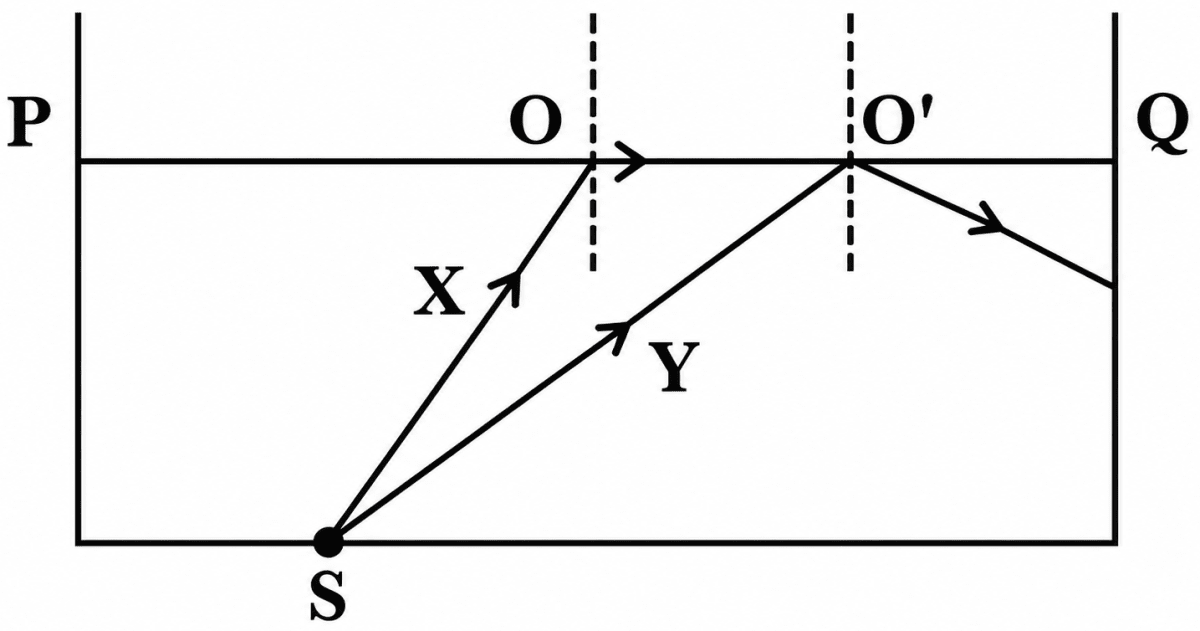
7(i)Written · 2026 · Section B · 2026 Specimen · 🔁 also 2025Full page

A block and tackle system of pulleys has velocity ratio 4.

(a) Draw a labelled diagram of the system indicating clearly, the direction of the load and effort.

(b) Calculate the potential energy of the load 100 kgf, lifted by this pulley to a height 5 m. (g = 10 m s-2)

Show SolutionHide Solution↓

(a) The labelled diagram of the system indicating clearly, the direction of the load and effort is shown below :

The labelled diagram of the system indicating clearly, the direction of the load and effort is shown below. ICSE 2025 Specimen Physics Solved Question Paper.

(b) Given,

m = 100 kg

h = 5 m

g = 10 m s-2

Then,

Potential Energy (U) = mgh = 100 × 10 × 5 = 5000 J

7(ii)Written · 2026 · Section B · 2026 SpecimenFull page

A person standing in front of a cliff fires a gun and hears its echo after 3s. Speed of sound in air is 336 m s-1.

(a) Calculate the distance of the person from the cliff.

(b) After moving a certain distance from the cliff, he fires the gun again and this time the echo is heard 1.5 s later than the first. Calculate the distance that the person has moved.

Show SolutionHide Solution↓

(a) Given,

Time taken to hear the echo = 3s

Speed of sound = 336 ms-1

So,

$$\begin{aligned}\text {Distance of the person from the cliff} = \frac {\text {Speed of sound} \times \text {Time taken}}{2} \\[1 em] =\frac{336 \times 3}{2} = \frac{1008}{2} \\[1 em] = 504\ \text m\end{aligned}$$

So, distance of the person from the cliff is 504 m.

(b) Given,

Time taken to hear the new echo = 3 s + 1.5 s = 4.5 s

So,

$$\begin{aligned}\text {New distance of the person from the cliff} = \frac {\text {Speed of sound} \times \text {Time taken}}{2} \\[1 em] =\frac{336 \times 4.5}{2} = \frac{1512}{2} \\[1 em] = 756\ \text m\end{aligned}$$

Distance moved by the person = 756 - 504 = 252 m

So, distance moved by the person is 252 m.

7(iii)Written · 2026 · Section B · 2026 SpecimenFull page

The below picture shows a mother pushing her daughter sitting on a swing. The swing is going through the positions A, B, C where A and C are extreme positions and B is the mean position.

The below picture shows a mother pushing her daughter sitting on a swing. The swing is going through the positions A, B, C where A and C are extreme positions and B is the mean position. ICSE 2025 Specimen Physics Solved Question Paper.

(a) Which is the right position i.e. at A, B or C, for the mother to give a constant periodic push to the swing, every time in the forward direction, to increase the amplitude of the swing?

(b) Name the phenomenon involved in this.

(c) On the basis of this example, explain how this phenomenon helps to increase the amplitude of the swing.

Show SolutionHide Solution↓

(a) At position A, the mother should give a constant periodic push to the swing every time in the forward direction to increase the amplitude of the swing because it is an extreme position where speed of the swing is zero and direction of motion changes from backward direction to forward so at this position direction of motion and direction of push are in parallel while for C it is opposite and B speed is maximum on either direction which can collide with mother and hurt her.

(b) Resonance phenomenon.

(c) The natural frequency of the swing will match the frequency of the force applied by mother this will increase the amplitude of the swing.

8(i)Written · 2026 · Section B · 2026 SpecimenFull page

The circuit depicted in the figure is employed for studying Ohm's Law. Instead of using a standard resistor, a student opts for a glass tube filled with mercury (tube 1), connected to the circuit through two electrodes E1 & E2. He records the readings of the ammeter and voltmeter, thereby calculates the resistance. The student repeats the experiment by substituting tube 1 with tube 2, where the same amount of mercury fills the tube 2.

The circuit depicted in the figure is employed for studying Ohm's Law. Instead of using a standard resistor, a student opts for a glass tube filled with mercury (tube 1), connected to the circuit through two electrodes E1 & E2. He records the readings of the ammeter and voltmeter, thereby calculates the resistance. ICSE 2026 Specimen Physics Solved Question Paper.

Neglecting internal resistance of the cell, use (> or < or =) to compare the following:

(a) Resistance in both cases.

(b) Voltmeter readings in both cases.

(c) Specific resistance in both cases.

Show SolutionHide Solution↓

(a) As the resistance depends directly on length and inversely on area of the resistor and since here tube 2 is thicker and shorter than tube 1 thus, resistance of the tube 2 < resistance of the tube 1.

(b) The voltmeter reading for tube 1 is the same as the voltmeter reading for tube 2 because according to Ohm's law potential difference across a resistor depends only on the current applied not on the resistance of the resistor.

(c) As the specific resistance of a resistor is independent of its dimensions but depends only on the contained material and since here both tubes contain only mercury thus, the specific resistance in both the cases is the same.

8(ii)Written · 2026 · Section B · 2026 SpecimenFull page

An appliance with a metal covering, rated at 2 kW, 220 V, is to be connected in a circuit. Given below are four diagrams (P, Q, R & S) depicting different circuit configurations.

An appliance with a metal covering, rated at 2 kW, 220 V, is to be connected in a circuit. Given below are four diagrams (P, Q, R & S) depicting different circuit configurations. ICSE 2026 Specimen Physics Solved Question Paper.

(a) Identify the safest circuit.

(b) Write two reasons, supported by mathematical calculations, where applicable, to justify your choice.

Show SolutionHide Solution↓

Given,

  • Power rating (P) = 2 KW = 2000 W
  • Voltage rating (V) = 220 V

(a) The safest circuit is S.

(b) There are two criteria to choose the circuit S :

  1. It is earthed so that in the case short circuit all the excess current can flow to earth without harming the person.
  2. The current in the supply should be less than or equal to the current rating of the fuse.

So, current in the circuit = $\frac {\text P}{\text V} = \frac {2000}{220}$ = 9.09 A

Circuit P

As the circuit is not earthed so it is not safe.

Circuit Q

  • Circuit is earthed properly.
  • Current in the circuit is 9.09 A but it has fuse which has current rating of 8 A so it will get damaged and hence someone can be hurt.

Circuit R

  • Circuit is not earthed properly so it is not safe.
  • Current in the circuit is 9.09 A and it has fuse which has current rating of 10 A.

Circuit S

  • Circuit is earthed properly.
  • Current in the circuit is 9.09 A and it has fuse which has current rating of 10 A.

So circuit S satisfy all the necessary criteria for a safe circuit.

8(iii)Written · 2026 · Section B · 2026 Specimen · 🔁 also 2027Full page

A Nichrome wire X with length (l) and cross-sectional area (A) is connected to a 10 V source and another Nichrome wire Y with length (2 l) and cross-sectional area $\left(\frac{A}{2}\right)$, is connected to a 20 V source.

(a) Compare the resistances of wires X and Y. [Given that the resistivity of Nichrome is (ρ).]

(b) Compare the electrical power consumed by each wire.

(c) Compare the masses of these wires. [Given that the density of nichrome is d.]

(d) State True or False: Wire X and wire Y both show the same rise in temperature at the same time.

Show SolutionHide Solution↓

Given,

  • Length of nichrome wire X (lX) = l
  • Cross-sectional area of nichrome wire X (AX) = A
  • Potential difference across nichrome wire X (VX) = 10 V
  • Length of nichrome wire Y (lY) = 2l
  • Cross-sectional area of nichrome wire Y (AY) = A/2
  • Potential difference across nichrome wire Y (VY) = 20 V
  • Resistivity of nichrome = ρ

(a) Let 'RX' and 'RY' be the resistance of nichrome wire X and Y respectively.

Now,

$\text R_\text X = \text ρ \frac {\text l}{\text A}$

And

$\text R_\text Y = \text ρ \frac {2\text l}{\frac {\text A}{2}} =\text ρ \frac {4\text l}{\text A} = 4\text R_\text X$

As,

$\frac{\text R_\text Y}{\text R_\text X} = 4$

So, RX : RY = 1 : 4

(b) $\text P_\text X = \frac{{\text V_\text X}^2}{\text R_\text X} = \frac{10^2}{\text R_\text X} = \frac{100}{\text R_\text X}$

And

$\text P_\text Y = \frac{{\text V_\text Y}^2}{\text R_\text Y} = \frac{20^2}{4\text R_\text X} = \frac{400}{4\text R_\text X} =\frac{100}{\text R_\text X} = \text P_\text X$

So, PX : PY = 1 : 1

(c) Given,

Mass density of nichrome = d

Then,

Mass of wire X (mX) = d x volume = d x Al

And,

Mass of wire Y (mY) = d x volume = d x 2l x $\frac{\text A}{2}$ = d x Al = mX

So, mX : mY = 1 : 1

(d) True.

Reason —

Let, heat gained by the wire X be 'QX' and change in temperature be 'ΔTX'. Similarly, heat gained by the wire Y be 'QY' and change in temperature be 'ΔTY'.

Again, let specific heat capacity of nichrome be 'c' and same time be 't'.

Then,

QX = PX x t = mXc x ΔTX

and

QY = PY x t = mYc x ΔTY

As, PX = PY then QX = QY for same time t.

⇒ mXc x ΔTX = mYc x ΔTY

⇒ mX x ΔTX = mY x ΔTY

So,

ΔTX : ΔTY = mY : mX = 1 : 1

Hence, wire X and wire Y both show the same rise in temperature in the same time.

9(i)Written · 2026 · Section B · 2026 SpecimenFull page

Three bulbs of powers P1, P2 and P3 (P1 < P2 < P3) are connected in a certain way that P3 glows brightest.

(a) What type of connection exists between these bulbs?

(b) Compare the voltage across these bulbs. (Use >, < or =)

(c) Will the circuit still function if one of the bulbs is fused?

Show SolutionHide Solution↓

(a) All bulbs are connected in parallel combination because in a parallel connection, voltage across each bulb is the same, and brightness depends directly on power rating. So, the bulb with the highest power rating (P3) will draw the most current and glow brightest.

(b) In a parallel circuit, all components share the same voltage.

So,

V1 = V2 = V3

(c) Yes because in a parallel circuit, each bulb has an independent path to the power supply and if one bulb fuses, the others continue to receive power and function normally.

9(ii)Written · 2026 · Section B · 2026 SpecimenFull page

The given diagram shows the output of an AC generator. If the speed of the generator coil is doubled, then:

The given diagram shows the output of an AC generator. If the speed of the generator coil is doubled, then: ICSE 2026 Specimen Physics Solved Question Paper.

(a) what is the effect on the physical quantity indicated by ‘a’?

(b) what is the effect on the physical quantity indicated as ‘b’?

(c) give reason for your answer in (b).

Show SolutionHide Solution↓

(a) As, the physical quantity indicated by 'a' is induced emf or output voltage of the a.c. generator so on doubling the speed of the generator, the output voltage also gets doubled.

(b) As, the physical quantity indicated by 'b' is time period of the generator so on doubling the speed, the period becomes half.

(c) When in an a.c generator the speed at which the coil rotates is doubled the frequency of output voltage is also doubled and since time period is reciprocal of the frequency so it gets halved.

9(iii)Written · 2026 · Section B · 2026 Specimen · 🔁 also 2027Full page

The graph given below illustrates the correlation between the number of protons (x-axis) and the number of neutrons (y-axis) for elements A, B, C, D, and E in the periodic table. These elements are denoted by the letters rather than their conventional symbols.

The graph (Fig. A) illustrates the correlation between the number of protons (x-axis) and the number of neutrons (y-axis) for elements A, B, C, D, and E in the periodic table. These elements are denoted by the letters rather than their conventional symbols. ICSE 2026 Specimen Physics Solved Question Paper.

(a) Identify the radioactive radiation emitted when element C decays into element E. Represent this using a nuclear reaction.

(b) What is the special name given to elements like D and E?

(c) If element C transforms into element B by emitting a radioactive ray, how will this ray behave in an electric field?

Show SolutionHide Solution↓

(a) From the graph,

Number of protons in C = 92

Number of neutrons in C = 146

Mass number of C = Number of protons in C + Number of neutrons in C = 92 + 146 = 238

Number of protons in E = 93

Number of neutrons in E = 145

Mass number of E = Number of protons in E + Number of neutrons in E = 93 + 145 = 238

Since element C has one less proton and one neutron more than the element E, if C decays into E, its proton number increases by one and its neutron number decreases by one, keeping the mass number the same, which happens only in the case of beta radiation.

Thus, the reaction will be as follows :

23892C → 23893E + 0-1β

(b) As points D and E are situated on the same vertical line but on different horizontal lines, they have the same number of protons but different numbers of neutrons, i.e., their atomic number is the same but their mass numbers are different, so they are isotopes of each other.

(c) Number of protons in B = 90

Number of neutrons in B = 144

Mass number of B = Number of protons in B + Number of neutrons in B = 90 + 144 = 234

As element B has two protons less than element C and a mass number four less than that of C, during the decay of C into B, two protons and two neutrons are emitted, which is nothing but an alpha particle.

Alpha particles shift towards the negative plate in an electric field.

1(i)1 Mark · 2025 · Section A · 2025 PaperFull page

A body is acted upon by two equal and opposite forces, that are NOT along the same straight line. The body will :

Show SolutionHide Solution↓

have only rotational motion

Reason — Forces are equal and opposite, but not along same straight line.

A body is acted upon by two equal and opposite forces, that are NOT along the same straight line. The body will : ICSE 2025 Physics Solved Question Paper.

So, the forces will form a couple and the body will have rotational motion only.

1(ii)1 Mark · 2025 · Section A · 2025 PaperFull page

Which among the following is a vector quantity?

Show SolutionHide Solution↓

moment of couple

Reason — A couple has both magnitude and direction, making it a vector quantity. Its direction is perpendicular to the plane in which the two forces lie. The magnitude is calculated by multiplying one of the forces with the perpendicular distance between their lines of action.

1(iii)1 Mark · 2025 · Section A · 2025 PaperFull page

What is the correct energy transformation during burning of a candle?

Show SolutionHide Solution↓

chemical → heat + light

Reason — When a candle burns, chemical energy stored in the wax is transformed into heat and light energy through a combustion reaction.

1(iv)1 Mark · 2025 · Section A · 2025 PaperFull page

When a ray of light passes from one optical medium to another, which of the following physical quantities does NOT change?

Show SolutionHide Solution↓

Frequency of the wave

Reason — Frequency of wave depends on the source and not on the medium through which it propagates.

1(v)1 Mark · 2025 · Section A · 2025 PaperFull page

Which one of the following combinations is the correct ascending order of electromagnetic waves in terms of wavelength?

Show SolutionHide Solution↓

Gamma-rays, visible light, microwaves

Reason — Wavelength of gamma rays is less than 0.01 nm, wavelength of visible light ranges from 400 to 800 nm and of microwave ranges from 1 mm to 1 m.

1(vi)1 Mark · 2025 · Section A · 2025 PaperFull page

For a lever, a graph is plotted with load on Y-axis and effort on X-axis. Which of the following represents the slope of the graph?

Show SolutionHide Solution↓

Mechanical advantage

Reason — Load vs effort graph is a straight line and slope of the graph = Load/effort = Mechanical advantage.

1(vii)1 Mark · 2025 · Section A · 2025 PaperFull page

For a real image formed by a convex lens, the ratio of I : O = 2 : 5, then the object is :

(I is the height of the image and O is the height of the object)

Show SolutionHide Solution↓

beyond 2F

Reason — Here, real image size < object size and this happens when the object is placed beyond 2F.

Classify as real or virtual, the image of a candle flame formed on a screen by a convex lens. Draw a ray diagram to illustrate how an image is formed. Refraction through a lens, Concise Physics Class 10 Solutions.
1(viii)1 Mark · 2025 · Section A · 2025 PaperFull page

A ray of light is incident normally on a face of an equilateral prism. The ray gets totally reflected at the second refracting surface. The total deviation produced in the path of the ray is:

Show SolutionHide Solution↓

60°

Reason — As, the ray is normally incident on face AB so it passes undeviated. Angle of incidence on face AC is 60˚. The reflected ray is incident normally on face BC and passes undeviated.

A ray of light is incident normally on a face of an equilateral prism. The ray gets totally reflected at the second refracting surface. The total deviation produced in the path of the ray is? ICSE 2025 Physics Solved Question Paper.

Now, from the above diagram,

∠NRS = 60˚

∴ ∠SRC = 30˚

∠ARQ = 30˚

∴ ∠CRT = 30˚

RT is the original path of the incident ray.

So, total deviation = ∠SRT = 30˚ + 30˚ = 60˚

1(ix)1 Mark · 2025 · Section A · 2025 PaperFull page

In a closed circuit containing a bulb and a cell, the electromotive force (ε) and the terminal voltage (V) is related as.

(Given I is current and r is internal resistance.)

Show SolutionHide Solution↓

V = ε – Ir

Reason — : The circuit is :

In a closed circuit containing a bulb and a cell, the electromotive force (ε) and the terminal voltage (V) is related as.ICSE 2025 Physics Solved Question Paper.

When current flows,

ε = V + Ir

∴ V = ε – Ir

1(x)1 Mark · 2025 · Section A · 2025 PaperFull page

A metal piece of mass 5 g has thermal capacity 2.5 J K⁻¹. If the mass of the metal is tripled, then its specific heat capacity will be :

Show SolutionHide Solution↓

0.5 J g⁻¹ K⁻¹

Reason — As,

$\text {Specific heat capacity} = \frac {\text {Thermal capacity}}{\text {mass}} = \frac{2.5\ \text J \text K⁻¹}{5\ \text g} = 0.5\ \text J\ \text g⁻¹\ \text K⁻¹$

1(xi)1 Mark · 2025 · Section A · 2025 PaperFull page

Assertion (A) : As the level of water in a tall measuring cylinder kept under running tap rises, the pitch of sound gradually increases.

Reason (R) : Frequency of sound is inversely proportional to the length of the water column.

Show SolutionHide Solution↓

(A) is true but (R) is false.

Explanation:

Assertion (A) is true because as the water column increases, air column decreases, frequency increases.

Reason (R) is false because the frequency is directly proportional to the length of water column.

1(xii)1 Mark · 2025 · Section A · 2025 PaperFull page

In the given circuits Y and Z, the resistors, R1 and R2, are connected in :

In the given circuits Y and Z, the resistors, R1 and R2, are connected in : ICSE 2025 Physics Solved Question Paper.
Show SolutionHide Solution↓

parallel in both the circuits

Reason — Circuit Y may be redrawn as :

parallel in both the circuits.ICSE 2025 Physics Solved Question Paper.

Both the resistors are connected across points A and B. Hence, those are connected in parallel.

Circuit Z may be redrawn as :

parallel in both the circuits.ICSE 2025 Physics Solved Question Paper.

Both the resistors are connected across points A and B. Hence, those are connected in parallel.

1(xiii)1 Mark · 2025 · Section A · 2025 PaperFull page

A radioactive element P emits one α-particle and transforms to a new element Q. What will be the position of the element Q in the periodic table?

Show SolutionHide Solution↓

Two groups to the left of P

Reason — The reaction is :

$$\begin{aligned}_{\text Z}^{\text A}\text{P}\ \longrightarrow \\ _{\text Z - 2}^{\text A - 4}\text{Q}\ + \\ _{2}^{4}\text{He}\end{aligned}$$

In periodic table elements are arranged in ascending order of atomic number and the atomic number of Q is 2 less than that of P. Hence, position of Q will 2 groups left of P.

1(xiv)1 Mark · 2025 · Section A · 2025 PaperFull page

Each of the substances given below is supplied with same amount of heat. Which one will attain the highest temperature?

SubstanceSpecific heat capacity (cal/g°C)
Lead0.031
Aluminium0.21
Copper0.095
Iron0.115
Show SolutionHide Solution↓

Lead

Reason — The substance whose specific heat capacity is the lowest will attain the highest temperature.

1(xv)1 Mark · 2025 · Section A · 2025 PaperFull page

The following figure shows a small bar magnet falling freely through a copper ring. For the observer at A, the direction of the induced current will be :

The following figure shows a small bar magnet falling freely through a copper ring. For the observer at A, the direction of the induced current will be. ICSE 2025 Physics Solved Question Paper.
Show SolutionHide Solution↓

anticlockwise when magnet is above the ring and clockwise when the magnet is below the ring

Reason

Magnet above the ring (approaching it)

  • Flux change The north pole of the magnet faces the ring, so magnetic field lines enter the ring downwards. As the magnet falls closer, the downward flux through the ring increases.

  • Opposition required To oppose this increase in downward flux, the ring must create an upward field (its own north pole must face the magnet).

  • Current direction Using the right-hand rule, a coil whose top acts as a north pole carries anticlockwise current when viewed from above.

Result: Anticlockwise current while the magnet is above the ring.

Magnet inside and leaving the ring (moving away below it)

  • Flux change Once the magnet has passed through, the same downward field lines are now moving away, so the downward flux decreases.

  • Opposition required The ring tries to maintain the original flux by producing more downward field—i.e., its top must now behave like a south pole.

  • Current direction A coil whose top is a south pole carries clockwise current when viewed from above.

Result: Clockwise current while the magnet is below the ring.

2(i)1 Mark · 2025 · Section A · 2025 PaperFull page

Complete the following by choosing the correct answers from the bracket:

(a) In uniform circular motion the centrifugal force acts ............... [towards the centre/away from the centre/along the tangential direction].

(b) Refractive index of a medium is independent of ............... [temperature/angle of incidence/wavelength of light].

(c) Heat absorbed during change of phase depends on ............... [mass/change in temperature/specific heat capacity] of the substance.

(d) Emf of a cell is ............... [greater than/less than/equal to] the terminal voltage when the cell is in open circuit.

(e) In a step-up transformer the turns ratio is ............... [more than 1/ less than 1/ equal to 1].

(f) The nuclear radiation with lowest ionising power is ............... [α/β/γ]

Show SolutionHide Solution↓

(a) In uniform circular motion the centrifugal force acts away from the centre.

(b) Refractive index of a medium is independent of angle of incidence.

(c) Heat absorbed during change of phase depends on mass of the substance.

(d) Emf of a cell is equal to the terminal voltage when the cell is in open circuit.

(e) In a step-up transformer the turns ratio is more than 1.

(f) The nuclear radiation with lowest ionising power is γ.

2(ii)1 Mark · 2025 · Section A · 2025 PaperFull page

A non-uniform kite is hanging freely from the branch of a tree as shown. Study the figure and answer the following :

A non-uniform kite is hanging freely from the branch of a tree as shown. Study the figure and answer the following. ICSE 2025 Physics Solved Question Paper.

(a) Fill in the blank.

............... [P, Q, R or S] is the most probable position of its centre of gravity.

(b) Support your answer to (a) with a reason

Show SolutionHide Solution↓

(a) R is the most probable position of its centre of gravity.

(b) When a body is freely suspended from a point, it comes to rest (i.e. stops oscillating) in such a position that its centre of gravity lies vertically below the point of suspension.
So, in the figure, the string from the branch passes vertically through point R, hence R is the most probable position of the kite’s centre of gravity.

2(iii)1 Mark · 2025 · Section A · 2025 PaperFull page

The displacement–time graph of a sound wave produced by a vibrating wire is shown below.

The displacement–time graph of a sound wave produced by a vibrating wire is shown below. ICSE 2025 Physics Solved Question Paper.

(a) How will you adjust the tension in the wire, to reduce the length of PR?

(b) Which characteristic of sound is affected by the reduction in the length of PR?

Show SolutionHide Solution↓

(a) As PR is the time period of the vibration and reduction of time period means the increase of frequency. Also, Frequency is proportional to square root of the tension.

So, tension is to be increased to increase the frequency i.e., to reduce the time period.

(b) Since, pitch depends on frequency, pitch will be affected by reduction of PR.

3(i)1 Mark · 2025 · Section A · 2025 PaperFull page

A ray of light enters a rectangular glass slab submerged in water at an angle of incidence 55°. Does this ray undergo total internal reflection when it moves from water to glass? Justify your answer. (The critical angle for glass–water interface is 54°)

Show SolutionHide Solution↓

This ray will not undergo total internal reflection because for total internal reflection, the light ray should travel from denser to rarer medium but in the given situation light ray travels from rarer to denser medium since refractive index of glass is more than that of water. So, there will be no total internal reflection.

3(ii)1 Mark · 2025 · Section A · 2025 PaperFull page

According to the NEW colour convention which colour of wire is connected to :

(a) the metal body of the appliance

(b) the switch of the appliance?

Show SolutionHide Solution↓

(a) Earth wire is connected to the metal body of electrical appliances and according to new convention the colour of earth wire is green or yellow.

(b) Live wire is connected to the switch of an appliance and according to new convention the colour of live wire is brown.

3(iii)1 Mark · 2025 · Section A · 2025 PaperFull page

(a) Which of the two, alternating current or direct current, produces a varying magnetic field when it flows through a conductor?

(b) State the frequency of the alternating current supply in India

Show SolutionHide Solution↓

(a) Alternating current produces a varying magnetic field when it flows through a conductor because alternating current changes its magnitude as well as direction periodically and thus, it provides a varying current and hence varying magnetic field as magnetic field is directly proportional to the applied current.

(b) 50 Hz.

3(iv)1 Mark · 2025 · Section A · 2025 PaperFull page

Calculate the amount of heat absorbed by 200 g of paraffin wax to melt completely at its melting point.

[Specific latent heat of fusion of paraffin wax = 146 Jg⁻¹]

Show SolutionHide Solution↓

Given,

Mass of paraffin (m) = 200 g

Specific latent heat of fusion of paraffin (L) = 146 J g⁻¹

Let, required heat be Q.

Then,

$\text Q = \text {mL} = 200 \times 146 = 29200\ \text J = 29.2\ \text {kJ}$

3(v)1 Mark · 2025 · Section A · 2025 PaperFull page

Copper wire is wound around a steel bar FT. Current is allowed to pass through the coil for some time and then the bar is removed.

Copper wire is wound around a steel bar FT. Current is allowed to pass through the coil for some time and then the bar is removed. ICSE 2025 Physics Solved Question Paper.

(a) Draw only the magnetised bar FT and mark its poles.

(b) Trace two magnetic lines of force around FT clearly indicating the direction.

Show SolutionHide Solution↓

(a) Since, looking from the F side current is flowing in anti-clockwise direction and hence, north pole developed at that end and south pole at the T end.

The labelled diagram is given below :

Since, looking from the F side current is flowing in anti-clockwise direction and hence, north pole developed at that end and south pole at the T end.ICSE 2025 Physics Solved Question Paper.

(b)

Since, looking from the F side current is flowing in anti-clockwise direction and hence, north pole developed at that end and south pole at the T end.ICSE 2025 Physics Solved Question Paper.
3(vi)1 Mark · 2025 · Section A · 2025 PaperFull page

A current flows through a metallic conductor for a long period of time. State the change you would expect in its:

(a) Resistance

(b) Resistivity

Show SolutionHide Solution↓

(a) As current flows for a long period of time, heat is generated and temperature increases. So, the resistance of metallic wire increases as resistance is directly proportional to the temperature of a conductor.

(b) As temperature increases, resistivity of metallic wire increases.

3(vii)1 Mark · 2025 · Section A · 2025 PaperFull page

Curium is a radioactive element with the symbol $_{96}^{247}\text{Cm}$ named in honour of Madam Curie. The graph of number of protons vs number of neutrons for some elements are shown below :

The graph of number ofprotons vs number of neutrons for some elements are shown below. ICSE 2025 Physics Solved Question Paper.

(a) Which point on the graph indicates the element Cm?

(b) Which point on the graph indicates daughter nucleus after Cm undergoes radioactive decay of 1α followed by 2β?

(c) State the mass number of the daughter nucleus.

Show SolutionHide Solution↓

(a) As, Curium has 96 protons and 247 – 96 = 151 neutrons and point P represents 96 protons and 151 neutrons. Hence, P point indicates element Curium.

(b) After the radioactive decay of 1 α and 2 β particles, the atomic number and mass number of daughter nucleus will be 243 and 96 respectively. So, it will have 243 – 96 = 147 neutrons.

As, point R represents 96 protons and 147 neutrons. Hence R point indicates the daughter nucleus.

(c) Mass number of daughter nucleus = Mass number of Curium – Mass number of α particle = 247 – 4 = 243

4(i)Written · 2025 · Section B · 2025 PaperFull page

(a) Out of the three rays (I, J, H) shown in the diagram, which ray will suffer Total Internal Reflection while inside the prism? (Critical angle of the prism is 42°.)

Out of the three rays (I, J, H) shown in the diagram, which ray will suffer Total Internal Reflection while inside the prism?  The body will : ICSE 2025 Physics Solved Question Paper.

(b) Copy the diagram to complete the path of the ray which you have named in (a) till it comes out of the prism.

Show SolutionHide Solution↓

(a)

Out of the three rays (I, J, H) shown in the diagram, which ray will suffer Total Internal Reflection while inside the prism?  The body will : ICSE 2025 Physics Solved Question Paper.

From the above diagram, it is visible that inside the prism, the angles of incidence of rays I, J and H are respectively 30˚, 60˚ and 30˚. Hence only the ray J will suffer total internal reflection.

(b)

Copy the diagram to complete the path of the ray which you have named in (a) till it comes out of the prism. ICSE 2025 Physics Solved Question Paper.
4(ii)Written · 2025 · Section B · 2025 PaperFull page

A rectangular glass block of refractive index 1.5 has an air bubble trapped inside it as shown in the diagram. When seen from the surface AB, it appears to be 4 cm deep.

A rectangular glass block of refractive index 1.5 has an air bubble trapped inside it as shown in the diagram. When seen from the surface AB, it appears to be 4 cm deep.ICSE 2025 Physics Solved Question Paper.

(a) Calculate the actual depth of the air bubble from the surface AB.

(b) For which colour of light, blue or yellow, the apparent depth will be greater?

(c) Turning the glass block upside down, DOES NOT change the apparent depth of the air bubble. State True or False.

Show SolutionHide Solution↓

(a) Given,

Refractive index of glass = 1.5

Apparent depth of air bubble = 4 cm

As,

$$\begin{aligned}\text {Refractive index of glass} = \frac{\text {Real depth of air bubble}}{\text {Apparent depth of air bubble}} \\[1em] ⇒ \text {Real depth of air bubble} = \text {Refractive index of glass}\times \text {Apparent depth of air bubble} \\[1em] = 1.5 \times 4 = 6 \text { cm}\end{aligned}$$

So, actual depth of the air bubble from the surface AB is 6 cm.

(b) As,

$$\begin{aligned}\text {Refractive index of glass} = \frac{\text {Real depth of air bubble}}{\text {Apparent depth of air bubble}} \\[1em] ⇒ \text {Real depth of air bubble} = \text {Refractive index of glass}\times \text {Apparent depth of air bubble} \\[1em]\end{aligned}$$

Now, apparent depth will increase, if refractive index decreases and as wavelength increases, refractive index decreases. As wavelength of yellow light is greater than wavelength of blue light so, refractive index for yellow light is smaller than refractive index of blue light.

Hence, for yellow light apparent depth will be greater.

(c) When the block is turned upside down, then the real depth of the bubble is 15 – 6 = 9 cm

And,

$$\begin{aligned}\text {Apparent depth of air bubble} = \frac{\text {Real depth of air bubble}}{\text {Refractive index of glass}}=\frac{9}{1.5} =6 \text { cm}\\[1 em]\end{aligned}$$

So, the statement is false.

4(iii)Written · 2025 · Section B · 2025 PaperFull page

(a) An object is placed at 2F position of a convex lens. Draw a ray diagram showing the formation of the image.

(b) How will the size of the image change if we, ONLY replace the lens in the above arrangement with another lens of a greater focal length?

Show SolutionHide Solution↓

(a) Ray diagram showing the formation of the image when the object is placed at 2F position of a convex lens is shown below:

State the changes in the position, size and nature of the image when the object is brought from infinity up to the convex lens. Illustrate your answer by drawing the ray diagrams. Refraction through a lens, Concise Physics Class 10 Solutions.

(b) If we ONLY replace the original lens with another lens of greater focal length then object distance (u) which was at 2F1 earlier, now comes between F1 and 2F1.

And

When an object is placed between F1 and 2F1 of the convex lens then it produces real, inverted and magnified image beyond 2F2 behind the lens.

Hence, if we, ONLY replace the original lens with another lens of a greater focal length then the size of the image increases.

5(i)Written · 2025 · Section B · 2025 PaperFull page

An object is placed in front of a concave lens at a distance of 45 cm from it. If its image is formed at a distance of 30 cm from the lens, calculate the focal length of the lens.

Show SolutionHide Solution↓

(a) Given,

Object distance (u) = -45 cm

Image distance (v) = -30 cm

From lens formula,

$$\begin{aligned}\frac{1}{\text f} = \frac{1}{\text v} - \frac{1}{\text u} \\[1em] \frac{1}{\text f} = \frac{1}{-30}-\frac{1}{(-45)}\\[1em] \frac{1}{\text f}=-\frac{1}{30}+\frac{1}{45}\\[1em] \frac{1}{\text f} = \frac{-3+2}{90}\\[1em] \frac{1}{\text f} = -\frac{1}{90} \\[1 em] \text f = -\frac{90}{1}\\[1 em] \text f= - 90 \text { cm}\end{aligned}$$

5(ii)Written · 2025 · Section B · 2025 PaperFull page

Two rays PQ and RS are incident on a rectangular glass block as shown in the diagram. Observe the diagram and answer the questions that follow.

Two rays PQ and RS are incident on a rectangular glass block as shown in the diagram. Observe the diagram and answer the questions that follow. ICSE 2025 Physics Solved Question Paper.

Which of these two rays will :

(a) have greater lateral displacement on emerging out of the block?

(b) travel with greater speed in the block?

(c) scatter more in the atmosphere?

Show SolutionHide Solution↓

(a) Angle of incidence for both the rays being same, the directions of both the rays remain same. As the refracted ray corresponding to RS bends towards the normal is more than that corresponding to ray PQ hence, the lateral displacement of the emergent ray corresponding to incident ray RS will also be more.

have greater lateral displacement on emerging out of the block?.ICSE 2025 Physics Solved Question Paper.

Diagram shows, x1 and x2 are the lateral shifts of the emergent rays corresponding to incident rays PQ and RS.

So, here x2 > x1

(b) Since, the refracted ray corresponding to incident ray PQ bends less towards the normal, hence this travels with greater speed.

(c) Speed corresponding to incident ray PQ is more than the speed corresponding to incident ray RS. So, wavelength corresponding to incident ray PQ is more than the wavelength corresponding to incident ray RS. So, RS will scatter more in atmosphere.

5(iii)Written · 2025 · Section B · 2025 PaperFull page

(a) Name the radiations :

(b) Name one property common to all electromagnetic radiations.

Show SolutionHide Solution↓

(a)

  1. For ultraviolet radiation, a quartz prism is used since, ordinary glass absorbs UV radiation.
  2. Infra red radiation.
  3. Visible light radiation (Red, Yellow, Green)

(b) All electromagnetic radiations travels with the same speed ie., 3 × 10⁸ ms-1.

6(i)Written · 2025 · Section B · 2025 PaperFull page

Akash takes a uniform metre scale and suspends a weight of 2 N at one end ‘X’, and a weight of 5 N on the other end ‘Y”. He then balances the ruler horizontally on a knife edge placed at 70 cm from X. Draw a diagram of the arrangement and calculate the weight of the ruler.

Show SolutionHide Solution↓

The diagram of the arrangement is shown below :

Akash takes a uniform metre scale and suspends a weight of 2 N at one end. ICSE 2025 Physics Solved Question Paper.

Given,

Weight at the end X (W1) = 2 N

Weight at the end Y (W2) = 5 N

Distance of X from the knife (R1) = 70 cm

Distance of Y from the knife (R2) = 100 cm - 70 cm = 30 cm

Let,

W = weight of the scale

Now,

Anticlockwise moment (due to 2N) = R1 x W1 = 2 × 70 = 140 Nm

Clockwise moment (due to 5N) = R2 x W2 = 5 × 30 = 150 Nm

Anticlockwise moment (due to weight of the scale) = W × 20 = 20 W

For equilibrium,

Anticlockwise moment of force about knife = Clockwise moment of force about knife

$$\begin{aligned}150 = 140 + 20\text { W} \\[1em] 20 \text W = 150 - 140 = 10 \\[1em] \text W = \frac{10}{20} = 0.5\ \text N\end{aligned}$$

So, weight of the scale is 0.5 N.

6(ii)Written · 2025 · Section B · 2025 PaperFull page

Three levers X, Y, Z of equal lengths are shown in the diagram.

Three levers X, Y, Z of equal lengths are shown in the diagram. ICSE 2025 Physics Solved Question Paper.

(a) Which class of lever do these belong to?

(b) Among these (X, Y or Z) which one will give the maximum mechanical advantage? Justify your answer.

Show SolutionHide Solution↓

(a) All are class I levers since, the fulcrum is in between the load and effort.

(b) As,

$\text {Mechanical Advantage} = \frac{\text {Effort Arm}}{\text {Load Arm}}$

For X, effort arm is greater than the load arm. Hence, it has the maximum mechanical advantage.

6(iii)Written · 2025 · Section B · 2025 PaperFull page

Richa weighing 40 kgf leaves point P on her skateboard and reaches point Q on the ground with velocity 10 ms-1. Calculate.

Richa weighing 40 kgf leaves point P on her skateboard and reaches point Q on the ground with velocity 10. ICSE 2025 Physics Solved Question Paper.

(a) the kinetic energy of Richa at point Q

(b) the vertical height of point P above the ground. (use g as 10 m/s2 and neglect friction)

(c) the kinetic energy of Richa at point R. (While moving from Q to R, she loses 500 J of energy against friction.)

Show SolutionHide Solution↓

(a) Given,

Speed at Q (v) = 10 ms-1

Then,

Kinetic energy at Q = $\frac{1}{2}$ mv2 = $\frac{1}{2}$ × 40 × 102 = 2000 J

(b) If the height of P is H, then :

Potential energy at P = mgH = 40 x 10 x H = 400H

As, friction is negligible so total mechanical energy is conserved.

From law of conservation of total mechanical energy,

Potential energy at P = Kinetic energy at Q

⇒ 400H = 2000 J

⇒ H = $\frac{2000}{400}$ = 5 m

(c) Given,

Height of point R (h) = 3 m

Energy lost from Q to R through friction = 500 J

Now

Potential energy at R = mgh = 40 × 10 × 3 = 1200 J

So, from law of conservation of energy

Kinetic energy at R + Potential energy at R + Energy lost from Q to R through friction = Potential energy at P

⇒ Kinetic energy at R = Potential energy at P - Potential energy at R - Energy lost from Q to R through friction

⇒ Kinetic energy at R = 2000 - 1200 - 500 = 300 J

7(i)Written · 2025 · Section B · 2025 PaperFull page

Draw a block and tackle system of pulleys with velocity ratio equal to 3.

Show SolutionHide Solution↓

The block and tackle system of pulleys with velocity ratio equal to 3 is shown below :

The block and tackle system of pulleys with velocity ratio equal to 3 is shown below. ICSE 2025 Physics Solved Question Paper.
7(ii)Written · 2025 · Section B · 2025 PaperFull page

A submarine in the sea, sends ultrasonic ping and a stopwatch is started simultaneously. The stopwatch stops on receiving the reflected wave from an obstacle and reads 1 minute 40 seconds. Calculate the distance of the obstacle from the submarine (Speed of sound in water 1500 ms-1)

Show SolutionHide Solution↓

Given,

Time taken = 1 minute 40 seconds = 100 s

Speed of sound = 1500 ms-1)

So,

$$\begin{aligned}\text {Distance of the obstacle} = \frac {\text {Speed of sound} \times \text {Time taken}}{2} \\[1em] =\frac{1500 \times 100}{2} = \frac{150000}{2} \\[1em] = 75000\ \text m = 75\ \text {km}\end{aligned}$$

7(iii)Written · 2025 · Section B · 2025 PaperFull page

The diagrams given below show two sound boxes A and B with wires of same length (l) and tension (10 kgf) but different cross-sectional areas. Simultaneously, vibrating tuning forks of frequency 300 Hz are placed on the boxes A and B. The paper rider falls off in case of B but not in case of A.

The diagrams given below show two sound boxes A and B with wires of same length (l) and tension (10 kgf) but different cross-sectional areas. Simultaneously, vibrating tuning forks of frequency 300 Hz are placed on the boxes A and B. The paper rider falls off in case of B but not in case of A.ICSE 2025 Physics Solved Question Paper.

(a) Name and explain the phenomenon responsible for the falling off of the paper rider in B.

(b) The wire A resonates with a tuning fork of frequency ‘f’. Is ‘f’ greater than, less than or equal to 300 Hz? Justify your answer.

Show SolutionHide Solution↓

(a) The phenomenon responsible for falling off the paper rider is resonance.
Resonance is a special case of forced vibrations. When the frequency of the externally applied periodic force on a body is equal to its natural frequency, the body readily begins to vibrate with an increased amplitude. This phenomenon is known as resonance.

(b) A thicker wire will vibrate at a lower resonant frequency than a thinner wire if the length, tension, and material are unchanged. This is because the thicker wire has greater mass per unit length, which lowers its natural frequency of vibration. Therefore, the frequency will be less than 300 Hz.

8(i)Written · 2025 · Section B · 2025 PaperFull page

The diagram shows wiring in a meter room of a building.

The diagram shows wiring in a meter room of a building. ICSE 2025 Physics Solved Question Paper.

(a) What is the current rating of device X?

(b) What is the difference between the switch Z shown in the diagram and the switches you use to operate different appliances at home?

(c) What is the unit of the physical quantity displayed in Y?

Show SolutionHide Solution↓

(a) X is a company fuse or pole fuse. It does not have a fixed current rating. It depends on the load capacity of the connection.

(b) Z can connect & disconnected live and neutral line simultaneously. But the switch which is used to operate domestic appliances connect & disconnected live line only.

(c) Unit is kWh.

8(ii)Written · 2025 · Section B · 2025 PaperFull page

Study the diagram given below and answer the questions that follow :

Study the diagram given below and answer the questions that follow. ICSE 2025 Physics Solved Question Paper.

(a) Name the process depicted in the diagram.

(b) What is the value of X?

(c) Identify Y, the missing product of the reaction.

Show SolutionHide Solution↓

(a) Nuclear fission.

(b) X = 236

(c) As, the mass number and atomic number is conserved in the reaction then

From conservation of mass number

Let, mass number of Y be y.

mass number of neutron + mass number of $_{92}^{235}\text{U}$ = 3 x mass number of Y + mass number of $_{36}^{89}\text{Kr}$ + mass number of $_{56}^{144}\text{Ba}$

$$\begin{aligned}1 + 235 = 3 \times \text y + 89 + 144 \\[1em] ⇒ 236 = 3 \text y + 233 \\[1em] ⇒ 3 \text y = 236 - 233 = 3 \\[1em] ⇒ \text y = \frac{3}{3}=1 \\[1em]\end{aligned}$$

So, mass number of Y is 3.

From conservation of atomic number

Let, atomic number of Y be z.

atomic number of neutron + atomic number of $_{92}^{235}\text{U}$ = atomic number of Y + atomic number of $_{36}^{89}\text{Kr}$ + atomic number of $_{56}^{144}\text{Ba}$

$$\begin{aligned}⇒ 92 + 0 = \text z + 36 + 56 \\[1em] ⇒ 92 = \text z + 92 \\[1em] ⇒ \text z = 92 - 92 = 0 \\[1em]\end{aligned}$$

As mass number of Y is 1 and it's atomic number is zero which is a property of a neutron.

Hence, Y is a neutron.

8(iii)Written · 2025 · Section B · 2025 PaperFull page

Three identical bulbs B1, B2 and B3 each of power rating 18 W, 12 V are connected to a battery of 12 V.

Three identical bulbs B1, B2 and B3 each of power rating 18 W, 12 V are connected to a battery of 12 V. ICSE 2025 Physics Solved Question Paper.

(a) Calculate :

(b) If the bulb B3 is removed from the circuit, then will the brightness of the bulb B1 increase, decrease or remain the same?

Show SolutionHide Solution↓

Given,

Battery emf (ε) = 12 V

Voltage rating of eac bulb (V) = 12 V

Power rating of eac bulb (P) = 18 W

(a)

  1. Let resistance of each bulb be R.

Then,

$$\begin{aligned}\text P = \frac {\text V^2}{\text R} \\[1 em] ⇒ \text R = \frac {\text V^2}{\text P} = \frac {12^2}{18} = \frac {144}{18}\\[1 em] ⇒ \text R = 8\ \text Ω\end{aligned}$$

  1. As, B2 and B3 are in parallel combination then

$$\begin{aligned}\frac{1}{\text R_\text P} = \frac{1}{\text R_1} + \frac{1}{\text R_2} \\[1 em]\end{aligned}$$

Here, R1 = R2 = 8 Ω

$$\begin{aligned}⇒ \frac{1}{\text R_\text P} = \frac{1}{8} + \frac{1}{8} = \frac{2}{8}\\[1 em] ⇒ \text R_\text P = \frac{8}{2} = 4\ \text Ω\end{aligned}$$

Now this combination is in series with B1 then

RS = RP + R = 4 + 8 = 12 Ω

So,

$$\begin{aligned}\text {Current drawn} = \frac{\text {Battery emf}}{\text {Total resistance}} = \frac{\text ε}{\text R_\text S} \\[1 em] =\frac{12}{12} = 1\ \text A\end{aligned}$$

Hence, current drawn from the battery is 1 A.

(b) When B3 is removed, the circuit becomes :

When B3 is removed, the circuit becomes : ICSE 2025 Physics Solved Question Paper.

Now, the equivalent resistance = 8 + 8 = 16 Ω.

Since, the resistance increases, current in the circuit decreases.

Hence, brightness of B1 decreases.

9(i)Written · 2025 · Section B · 2025 PaperFull page

30 g of ice at 0°C is used to bring down the temperature of a certain mass of water at 70°C to 20°C. Find the mass of water.

[Specific heat capacity of water = 4.2 J g⁻¹ °C⁻¹ and specific latent heat of ice = 336 J g⁻¹]

Show SolutionHide Solution↓

Given,

For ice

Mass of ice (mi) = 30 g

Initial temperature (Ti) = 0°C

Final temperature (Tf) = 20°C

Specific latent heat of ice (Li) = 336 J g⁻¹

For water

Initial temperature (Ti) = 70°C

Final temperature (Tf) = 20°C

Specific heat capacity of water (cw) = 4.2 J g⁻¹ °C⁻¹

Let,

Mass of water = (mw)

Now,

Heat lost by water = mwcw△t

= mw × 4.2 × (70 - 20)

= mw × 4.2 × 50 = 210mw

Heat gained by ice = miLi + micw△t

= 30 × 336 + 30 × 4.2 × (20-0)

= 10080 + 2520 = 12600 J

By principle of calorimetry,

Heat lost by water = Heat gained by ice

⟹ 210mw = 12600

⟹ mw = $\frac{12600}{210}$ = 60 g

So, the mass of required water is 60 g.

9(ii)Written · 2025 · Section B · 2025 PaperFull page

(a) A certain amount of heat will warm 1 g of material X by 10°C and 1 g of material Y by 40°C. Which material has higher specific heat capacity?

(b) Which material, X or Y, would you select to make a calorimeter?

(c) The specific heat capacity of a substance remains the same when it changes its state from solid to liquid. State True or False.

Show SolutionHide Solution↓

(a) Given,

Mass of X = mass of Y = m = 1 g

Change in temperature of X (△tX) = 10°C

Change in temperature of Y (△tY) = 40°C

Let,

Amount of heat = Q

Specific heat capacity of X = cX

Specific heat capacity of X = cY

Now,

For X,

Q = m × cX × ΔtX = 1 × cX × 10 = 10cX

For Y,

Q = m × cY × ΔtY = 1 × cY × 40 = 40cY

⟹ 10cX = 40cY

⟹ cX = 4cY

Hence, material X has higher specific heat capacity.

(b) Material chosen for calorimeter should have low specific heat capacity. So, here Y material should be used to make a calorimeter.

(c) False as the specific heat capacity of a substance does not remain the same when it changes state and it is phase dependant.

9(iii)Written · 2025 · Section B · 2025 PaperFull page

A copper rod PQ carrying current is kept in a magnetic field as shown in the diagram.

A copper rod PQ carrying current is kept in a magnetic field as shown in the diagram. ICSE 2025 Physics Solved Question Paper.

(a) The copper rod PQ will move towards C. State True or False.

(b) Name the law used to determine the direction of motion of PQ.

(c) What will be the effect on the force experienced, if the rod PQ is replaced by another copper rod of same length but of greater cross-sectional area?

(d) Justify your answer in (c).

Show SolutionHide Solution↓

(a) The statement is true. as the magnetic field is upward to downward direction and the direction of current is from left to right so, the rod PQ will experience a force towards C. So, PQ will move towards C.

(b) Fleming’s left hand rule.

(c) If the replaced copper rod has same length but greater cross-sectional area then the resistance of this rod will be lower than the previous rod. So, the current through the new rod will be more than the previous one. Hence, the force experienced will also be more.

(d) As force experienced is directly proportional to the applied current so if current increases, then force obviously increases.

1(i)1 Mark · 2025 · Section A · 2025 ImprovementFull page

Centre of gravity of the given square PQRO lies at:

Centre of gravity of the given square PQRO lies at: ICSE 2025 Improvement Physics Solved Question Paper.
Show SolutionHide Solution↓

(2, –2)

Reason — As given figure is a square with side length of 4 units which is a uniform shape so it's centre of gravity lies on the point of intersection of it's diagonals and since diagonals of a square are equal to each other then it's centre of gravity lies on it's geometrical centre.

So,

Coordinates of C.G. = Coordinates of geometrical centre of the square PQRO = (2,-2)

1(ii)1 Mark · 2025 · Section A · 2025 ImprovementFull page

An object is thrown vertically up. It reaches the highest point and then comes down. The work done by the force of gravity on the object is:

Show SolutionHide Solution↓

negative for the way up and positive for the way down

Reason — As, work done by an object is given by

W = FS cos θ

where,

  • F is magnitude of force,
  • S is magnitude of displacement, and
  • cos θ is cosine of the angle θ between the directions of force F and displacement S .

Case 1 : When the object is thrown vertically up

When an object is thrown upwards then the displacement (upward) is opposite to the direction of force of gravity (downwards) i.e., θ = 180° so the work done on the body by the force of gravity is negative.

Case 2 : When the object is falling vertically down

When the object comes down, the force of gravity (downwards) is in the direction of displacement (downwards) i.e., θ = 0° and the work done by the force of gravity is positive.

1(iii)1 Mark · 2025 · Section A · 2025 ImprovementFull page

10 eV is ............... .

Show SolutionHide Solution↓

1.6 x 10⁻¹⁸ J

Reason — As,

1 eV = 1.6 x 10⁻¹⁹ J

Then,

10 eV = 10 x 1 eV = 10 x 1.6 x 10-19 J = 1.6 x 10⁻¹⁸ J

1(iv)1 Mark · 2025 · Section A · 2025 ImprovementFull page

A crowbar of length 1.0 m has its fulcrum at a distance of 0.2 m from the load. The mechanical advantage of the crowbar is:

Show SolutionHide Solution↓

4

Reason —

Given,

  • Total length of crowbar = 1.0 m
  • Fulcrum distance from the load = Load arm = 0.2 m

Crowbar is a class I lever shown below :

A crowbar of length 1.0 m has its fulcrum at a distance of 0.2 m from the load. The mechanical advantage of the crowbar is: ICSE 2025 Improvement Physics Solved Question Paper.

Now,

Effort arm = Total length of crowbar - Load arm = 1.0 - 0.2 = 0.8 m

As,

$\text {Mechanical Advantage (MA)} = \frac {\text {Effort arm}}{\text {Load arm}}$

$= \frac{0.8}{0.2}$ = 4

So, mechanical advantage of the crowbar is 4.

1(v)1 Mark · 2025 · Section A · 2025 ImprovementFull page

Which of the following figures will depict deviation of a ray of light through 90° when it emerges out of the prism.

Which of the following figures will depict deviation of a ray of light through 90° when it emerges out of the prism. ICSE 2025 Improvement Physics Solved Question Paper.
Show SolutionHide Solution↓

option (1)

Which of the following figures will depict deviation of a ray of light through 90° when it emerges out of the prism. ICSE 2025 Improvement Physics Solved Question Paper.

Reason — When light passes through a right-angled isosceles prism, and is incident perpendicularly on one of its sides, it can undergo total internal reflection (TIR) at the hypotenuse and finally emerge at 90° from the original direction.

Such a situation occurs when :

  • The light enters one perpendicular face,
  • Reflects off the hypotenuse (TIR at 45°), and
  • emerges from the other perpendicular face, making a 90° turn overall.

So, a prism satisfying above conditions will definitely produce a ray deviated by 90°.

Now,

In option (1)

  • Isosceles Right-angled triangle.
  • Light enters perpendicularly to one of the perpendicular sides.
  • Will reflect off the hypotenuse and exit from the other perpendicular side as shown in below figure.
Which of the following figures will depict deviation of a ray of light through 90° when it emerges out of the prism. ICSE 2025 Improvement Physics Solved Question Paper.

Hence, it deviates the incident ray by 90°.

In option (2)

  • Isosceles triangle with the vertex angle at the top being 90°.
  • Light enters symmetrically from one side.
  • Due to symmetry, this setup generally leads to no net deviation as shown in below figure.
Which of the following figures will depict deviation of a ray of light through 90° when it emerges out of the prism. ICSE 2025 Improvement Physics Solved Question Paper.

Hence, it can not deviate the incident ray by 90°.

In option (3)

  • Isosceles Right-angled triangle.
  • Ray enters at the hypotenuse, perpendicularly.
  • Emerges from the hypotenuse again and deviates the ray by 180° as shown in below figure.
Which of the following figures will depict deviation of a ray of light through 90° when it emerges out of the prism. ICSE 2025 Improvement Physics Solved Question Paper.

Hence, it can not deviate the incident ray by 90°.

In option (4)

  • Triangle with 60°, 90°, and 30° angles.
  • Light enters at the face opposite 60°.
  • Not a right-angled isosceles prism.
  • Path will not lead to 90° deviation as shown in below figure.
Which of the following figures will depict deviation of a ray of light through 90° when it emerges out of the prism. ICSE 2025 Improvement Physics Solved Question Paper.

Hence, it can not deviate the incident ray by 90°.

1(vi)1 Mark · 2025 · Section A · 2025 ImprovementFull page

Which of the following values can represent the magnification of a simple microscope?

Show SolutionHide Solution↓

+2

Reason — In a simple microscope a convex lens is used to view close objects so it's magnification should be positive, because the image formed is virtual, erect, and magnified, typically greater than 1, since the purpose is to enlarge the image.

So, from the given options +2 power is justified since it will produce virtual, erect and 2x magnified image of the object.

1(vii)1 Mark · 2025 · Section A · 2025 ImprovementFull page

An object placed at a distance 30 cm in front of a lens produces clear inverted image at a distance 60 cm from the lens. If the object is placed at 60 cm from the lens, then it produces a clear inverted image at a distance of ............... from the lens.

Show SolutionHide Solution↓

30 cm

Reason

Case 1 :

Given,

  • Object distance (u) = -30 cm
  • Image distance (v) = +60 cm

Let, focal length be 'f'.

From lens formula,

$$\begin{aligned}\frac{1}{\text f} = \frac{1}{\text v} - \frac{1}{\text u} \\[1em] \Rightarrow \frac{1}{\text f} = \frac{1}{60}-\frac{1}{(-30)} \\[1em] \Rightarrow \frac{1}{\text f} =\frac{1}{60}+\frac{1}{30} \\[1em] \Rightarrow \frac{1}{\text f} = \frac{1+2}{60}\\[1em] \frac{1}{\text f} = \frac{3}{60} \\[1em] \Rightarrow \text f = \frac{60}{3} = +20 \text { cm}\end{aligned}$$

Case 2 :

Given,

  • Object distance (u) = -60 cm
  • Focal length (f) = +20 cm

Let, image distance be 'v'.

Again using lens formula,

$$\begin{aligned}\frac{1}{\text f} = \frac{1}{\text v} - \frac{1}{\text u} \\[1em] \Rightarrow \frac{1}{\text v} = \frac{1}{\text f} + \frac{1}{\text u} \\[1em] \Rightarrow \frac{1}{\text v} = \frac{1}{20}+\frac{1}{(-60)} \\[1em] \Rightarrow \frac{1}{\text v} =\frac{1}{20}-\frac{1}{60} \\[1em] \Rightarrow \frac{1}{\text v} = \frac{3-1}{60}\\[1em] \Rightarrow \frac{1}{\text v} = \frac{2}{60} \\[1em] \Rightarrow \text v = \frac{60}{2} = +30 \text { cm}\end{aligned}$$

1(viii)1 Mark · 2025 · Section A · 2025 ImprovementFull page

Assertion (A) : Quartz prism is used to study ultraviolet spectrum.

Reason (R) : Quartz does not absorb ultraviolet radiations.

Show SolutionHide Solution↓

Both (A) and (R) are true and (R) is the correct explanation of (A).

Explanation

Assertion (A) is true because glass absorbs ultraviolet (UV) radiation, so it cannot be used in prisms or lenses for UV studies whereas quartz, on the other hand, allows UV light to pass through, making it suitable for dispersing and studying the UV spectrum.

Reason (R) is true because quartz is transparent to ultraviolet light down to wavelengths of about 200 nm (far UV) so it does not absorb UV radiation, which is why it's preferred for UV applications.

1(ix)1 Mark · 2025 · Section A · 2025 ImprovementFull page

The amplitude of a sound wave is reduced from 2 mm to 1 mm. The intensity of the sound will:

Show SolutionHide Solution↓

become one fourth of the initial

Reason —

Given,

  • Initial amplitude = 2 mm
  • Final amplitude = 1 mm

As,

Intensity of a sound wave ∝ (Amplitude of vibrations)2

Then,

$\frac{\text {Final intensity}}{\text {Initial intensity}} = \left({\frac{\text {Final amplitude}}{\text {Initial amplitude}}}\right)^2 = \left(\frac{1}{2}\right)^2 = \frac {1}{4}$

So,

Final intensity = $\frac {1}{4}$ x Initial intensity

1(x)1 Mark · 2025 · Section A · 2025 ImprovementFull page

According to the NEW international convention, what is the colour coding for the live, neutral and earth wires in household circuits?

Show SolutionHide Solution↓

Live – brown, Neutral – blue, Earth – yellow

Reason — The colour coding is given below :

WireOld ConventionNew Convention
LiveRedBrown
NeutralBlackLight blue
EarthGreenGreen or Yellow
1(xi)1 Mark · 2025 · Section A · 2025 ImprovementFull page

An alloy constantan has resistivity 5 x 10⁻⁷ Ω m at 25°C. If the temperature of this alloy is increased to 50°C then its resistivity will be:

Show SolutionHide Solution↓

5 x 10⁻⁷ Ω m

Reason — The specific resistance of a substance depends on its temperature but for an alloy of constantan, it remains practically unchanged or constant with change in temperature. So here on increasing the temperature of the alloy, its resistivity does not change much and hence it's final value will be same as initial value i.e., 5 x 10⁻⁷ Ω m.

1(xii)1 Mark · 2025 · Section A · 2025 ImprovementFull page

A current carrying circular loop is lying in a horizontal plane as shown in the diagram. Which of the following is the correct statement with respect to the direction of magnetic lines of force.

A current carrying circular loop is lying in a horizontal plane as shown in the diagram. Which of the following is the correct statement with respect to the direction of magnetic lines of force. ICSE 2025 Improvement Physics Solved Question Paper.
Show SolutionHide Solution↓

upward at X and downward at Y

Reason — The current in the loop is in clockwise direction. By the right-hand thumb rule, if we curl our fingers in the direction of current, our thumb points along the magnetic field through the loop. For a clockwise current, the field inside the loop (point Y) is downward (into the plane). Magnetic field lines must return outside the loop, so outside (point X) they are in the upward direction (out of the plane).

1(xiii)1 Mark · 2025 · Section A · 2025 ImprovementFull page

For a body of mass m the relationship between the heat capacity (C') and specific heat capacity (c) is:

Show SolutionHide Solution↓

C' = mc

Reason — The heat capacity (C') is given by the product of the mass (m) and the specific heat capacity (c).

1(xiv)1 Mark · 2025 · Section A · 2025 ImprovementFull page

A piece of a cake and a watermelon of the same mass are taken out of the freezer at the same time. Which of the following statement is correct?

Show SolutionHide Solution↓

Cake will attain the room temperature faster.

Reason — The rate at which an object warms depends, among other factors, on its specific heat capacity. Watermelon consists mainly of water, whose specific heat capacity is high (about 4.2 J g-1 °C-1). Cake contains far less water and more fats and carbohydrates, whose specific heat capacities are roughly half that of water. Therefore, for the same mass and under identical external conditions, the cake requires less heat to raise its temperature by 1 °C and will reach room temperature sooner than the watermelon.

1(xv)1 Mark · 2025 · Section A · 2025 ImprovementFull page

During β emission the parent and daughter nuclei will be:

Show SolutionHide Solution↓

isobars

Reason — During emission of a β-particle, the number of nucleons in the nucleus (i.e., sum of protons and neutrons) remains the same, but the number of neutrons is decreased by one and the number of protons is increased by one i.e., the mass number A does not change, but the atomic number Z is increased by one. Therefore the parent and daughter nuclei have the same mass number but different atomic numbers. Hence, they form isobars.

2(i)1 Mark · 2025 · Section A · 2025 ImprovementFull page

Complete the following by choosing the correct answers from the bracket:

(a) The ideal mechanical advantage of a single movable pulley is ............... [less than 1 / more than 1 / equal to 1].

(b) If different colours of light strike a rectangular glass block at same angle of incidence, then maximum lateral displacement will be shown by ............... [Red / Green / Blue] colour.

(c) 1 joule equals to ............... [0.24 / 0.48 / 4.2] calorie.

(d) The hole in the right side of the socket is for connection to the ............... [live / neutral / earth] wire.

(e) The direction of the induced current in the coil of an AC generator is determined by ............... [Fleming’s left-hand rule / Fleming’s right-hand rule / Clock Rule].

(f) In a nuclear reactor, the fission reaction is initiated by bombardment with ............... [a proton / a neutron / an α particle].

Show SolutionHide Solution↓

(a) The ideal mechanical advantage of a single movable pulley is more than 1.

(b) If different colours of light strike a rectangular glass block at same angle of incidence, then maximum lateral displacement will be shown by Blue colour.

(c) 1 joule equals to 0.24 calorie.

(d) The hole in the right side of the socket is for connection to the live wire.

(e) The direction of the induced current in the coil of an AC generator is determined by Fleming’s right-hand rule.

(f) In a nuclear reactor, the fission reaction is initiated by bombardment with a neutron.

2(ii)1 Mark · 2025 · Section A · 2025 ImprovementFull page

Will the position of the centre of gravity change if a hollow sphere is completely filled with mercury? Give a reason for your answer.

Show SolutionHide Solution↓

No, the position of the centre of gravity will not change because the mass remains symmetrically distributed about the centre in both the hollow and the filled sphere so the centre of gravity remains at the geometric centre.

2(iii)1 Mark · 2025 · Section A · 2025 ImprovementFull page

Calculate the minimum distance needed in water to hear the echo.

(Speed of sound in water is 1500 m s-1. Persistence of hearing is 0.1 s.)

Show SolutionHide Solution↓

Given,

  • Speed of sound in water (v) = 1500 m s-1
  • Minimum time to hear an echo (t) = 0.1 s

Let minimum distance to hear an echo be 'd'.

Then,

$$\begin{aligned}\text {Speed of sound} = \frac {2\times \text {Minimum distance to hear echo}}{\text { Minimum time to hear an echo}} = \frac{2\text d}{\text t} \\[1em] \Rightarrow 2\text d = \text v \times \text t = 1500 \times 0.1 = 150\ \text m \\[1em] \Rightarrow \text d = \frac{150}{2} = 75\ \text m\end{aligned}$$

So, minimum distance to hear an echo is 75 m.

3(i)1 Mark · 2025 · Section A · 2025 ImprovementFull page

State the potential of the wire connected to the right hand side terminal of the three pin plug and also state its colour.

Show SolutionHide Solution↓

In three pin plug, the pin on the right is for neutral wire whose potential is same as the earth wire i.e., zero potential and colour of neutral wire according to new international convention is blue.

3(ii)1 Mark · 2025 · Section A · 2025 ImprovementFull page

State two properties of magnetic lines of force around a straight conductor carrying current.

Show SolutionHide Solution↓

Properties of magnetic lines of force around a straight conductor carrying current are following :

  1. The magnetic field lines form the concentric circles around the wire, with their plane perpendicular to the straight wire and with their centres lying on the wire.
  2. On increasing current in the wire, the magnetic field lines become denser and the iron filings get arranged in circles up to a larger distance from the wire, showing that the magnetic field strength has increased and it is effective up to а larger distance.
3(iii)1 Mark · 2025 · Section A · 2025 ImprovementFull page

The heat capacity of a milk cooker is 450 JK-1. Calculate the rise in the temperature when it absorbs 9000 J of heat.

Show SolutionHide Solution↓

Given,

  • Heat capacity (C) = 450 J K-1
  • Heat absorbed (Q) = 9000 J

Let, rise in temperature be 'ΔT'.

As,

Q = C × ΔT

$\Rightarrow \text {ΔT} = \frac{\text Q}{\text C} = \frac {9000}{450} = 20\ \text K$

Hence, rise in the temperature is 20 K or 20 °C.

3(iv)1 Mark · 2025 · Section A · 2025 ImprovementFull page

A ray of light PQ is incident normally on the face AB of an equilateral prism. The ray gets totally reflected from the surface AC.

A ray of light PQ is incident normally on the face AB of an equilateral prism. The ray gets totally reflected from the surface AC. ICSE 2025 Improvement Physics Solved Question Paper.

Calculate:

(a) the angle of deviation at AC.

(b) the angle of incidence at BC.

Show SolutionHide Solution↓

From the below diagram,

A ray of light PQ is incident normally on the face AB of an equilateral prism. The ray gets totally reflected from the surface AC. Calculate (a) the angle of deviation at AC (b) the angle of incidence at BC. ICSE 2025 Improvement Physics Solved Question Paper.

(a) As, the incident ray and emergent ray makes an angle of 60° with each other.

So, angle of deviation at AC is 60°.

(b) Here, emergent ray is falling normally on face BC.

So, angle of incidence at BC is 0°.

3(vi)1 Mark · 2025 · Section A · 2025 ImprovementFull page

Define background radiation. Give one internal source of this radiation.

Show SolutionHide Solution↓

Background radiations are the radioactive radiations (such as α, β and γ) to which we all are exposed, even in the absence of an actual visible radioactive source.

Internal source — The radioactive substances present inside our body like potassium (K-40), carbon (C-14) and radium.

3(vii)1 Mark · 2025 · Section A · 2025 ImprovementFull page

Astatine (At) is a radioactive element. Study the graph given below showing the number of protons vs the number of neutrons of radioactive nuclei.

Astatine (At) is a radioactive element. Study the graph given below showing the number of protons vs the number of neutrons of radioactive nuclei. ICSE 2025 Improvement Physics Solved Question Paper.

(a) Identify the mass number of the nucleus Astatine (At).

(b) Which line on the graph (l, m, n, or q) will never pass through the position of the daughter nuclei, regardless of any number of α, β, or γ emissions?

(c) Give a reason for your choice in (b).

Show SolutionHide Solution↓

(a) From the graph,

Number of protons in Astatine = 85

Number of neutrons in Astatine = 126

Then,

Mass number of Astatine = Number of protons + Number of neutrons = 85 + 126 = 211

(b) The line m on the graph will never pass through the position of the daughter nuclei, regardless of any number of α, β, or γ emissions.

(c) As line m represents a daughter nucleus which has one excess neutron than Astatine and from α, β, or γ emissions, none has ability to increase the neutron number of Astatine and produce a daughter nucleus with one excess neutron so line m can not pass through any daughter nucleus of Astatine.

4(i)Written · 2025 · Section B · 2025 ImprovementFull page

(a) A coin lies at the bottom of a beaker. Water is poured into the beaker upto a height of 8 cm. Calculate the shift seen in the position of the coin.
(The refractive index of water is 4/3. The width of the glass wall of the beaker is negligible.)

(b) How will the apparent depth be affected if the temperature of water is increased?

Show SolutionHide Solution↓

(a) Given,

  • Real Depth = 8 cm
  • Refractive index of water = $\frac{4}{3}$

As we know,

$\text {Shift} = \text {Real depth} \times (1 - \frac{1}{_\text a\text μ_\text w})$

where, aμw is the refractive index of the water with respect to air.

So, substituting the values in the formula we get,

$$\begin{aligned}\text {Shift} = 8 \times (1 - \frac{3}{4}) \\[1em] \text {Shift} = 8 \times \frac{1}{4} \\[1em] \text {Shift} = \frac{8}{4} \\[1em] \Rightarrow \text {Shift} = 2 \text{ cm} \\[1em]\end{aligned}$$

Hence, the coin appears to be raised by a height of 2 cm when seen from vertically above.

(b) With increase in temperature, the refractive index of the medium decreases and lower the refractive index of the medium, less is the shift so on increasing the temperature of water, the coin will appear slightly deeper than before. Hence, the apparent depth increases.

4(ii)Written · 2025 · Section B · 2025 ImprovementFull page

Draw a ray diagram to invert the image without deviation of light using right angle isosceles prism.

Show SolutionHide Solution↓

The ray diagram to invert the image without deviation of light using right angle isosceles prism is shown below :

Draw a ray diagram to invert the image without deviation of light using right angle isosceles prism. ICSE 2025 Improvement Physics Solved Question Paper.
4(iii)Written · 2025 · Section B · 2025 ImprovementFull page

Answer the following with respect to a concave lens (L).

Answer the following with respect to a concave lens (L). ICSE 2025 Improvement Physics Solved Question Paper.

(a) Describe the path of the rays X and Y through the lens.

(b) Give one use of this lens.

(c) Calculate its power if the focal length of this lens is 20 cm.

Show SolutionHide Solution↓

(a) Ray X : As the ray is parallel to the principal axis of the concave lens then after refraction, it appears to come from the second focus F, as shown in below diagram.

Ray Y : As the ray is incident at the optical centre of the lens then it passes undeviated through the lens because angle of incidence of the ray with the normal at optic centre is zero as shown in below diagram.

Answer the following with respect to a concave lens (L). ICSE 2025 Improvement Physics Solved Question Paper.

(b) A concave lens is used in spectacles for correcting short-sightedness (myopia).

(c) Given,

  • Focal length = -20 cm = -0.2 m

Then,

$$\begin{aligned}\text {Power} = \frac{1}{\text {focal length (in metres)}} \\[1em] = \frac{1}{-0.2} \\[1em] = - \frac {10}{2} = -\ 5 \\[1em] \Rightarrow \text {Power} = -\ 5\ \text D\end{aligned}$$

5(i)Written · 2025 · Section B · 2025 ImprovementFull page

The diagram given below shows a triangular prism of a certain material with fluorescent screen placed adjacent to it. The yellow light ray striking the surface ST of the prism shows a fluorescent spot at point X.

The diagram given below shows a triangular prism of a certain material with fluorescent screen placed adjacent to it. The yellow light ray striking the surface ST of the prism shows a fluorescent spot at point X. ICSE 2025 Improvement Physics Solved Question Paper.

(a) Calculate the critical angle of the material of the prism for yellow colour.

(b) To move the fluorescent spot towards Y, the value of θ should be ............... [> 50, < 50 or = 50].

(c) Which direction will the florescent spot move if yellow light is replaced with indigo light? (towards Y or towards Z)

Show SolutionHide Solution↓

(a) As, the ray emerges via ST then it's angle of refraction with the normal is 90° and since, critical angle is the angle of incidence in the denser medium corresponding to which the angle of refraction in the rarer medium is 90° so here, angle of incidence is at critical angle.

Now,

From the diagram,

θ = 50°

Then,

Angle of incidence of the yellow ray = 90° - 50° = 40°

Hence, critical angle of the material of the prism for yellow colour is 40°.

(b) To move the fluorescent spot towards Y, the value of θ should be > 50.

Reason—

Case 1 : When θ is equal to 50°, the ray strikes at X which is the present case.

Case 2 : When θ is less than 50°, the incident angle becomes greater than the critical angle i.e., 40° so light will reflect at the surface ST and hence move toward Z depending upon the value of θ but will never move towards Y as shown below.

The diagram given below shows a triangular prism of a certain material with fluorescent screen placed adjacent to it. The yellow light ray striking the surface ST of the prism shows a fluorescent spot at point X. ICSE 2025 Improvement Physics Solved Question Paper.

Case 3 : When θ is greater than 50°, the incident angle becomes less than the critical angle i.e., 40° so no total internal reflection takes place and light will suffer refraction at the surface ST and hence move toward Y depending upon the value of θ as shown below.

The diagram given below shows a triangular prism of a certain material with fluorescent screen placed adjacent to it. The yellow light ray striking the surface ST of the prism shows a fluorescent spot at point X. ICSE 2025 Improvement Physics Solved Question Paper.

(c) Towards Z

Reason— The critical angle increases with increase in the wavelength of light. Since indigo light has a shorter wavelength than yellow light, its critical angle is less than 40°. Here, the angle of incidence at ST is 50°, which is greater than the critical angle. Therefore, the indigo light will undergo total internal reflection at ST and travel towards Z, as shown below.

The diagram given below shows a triangular prism of a certain material with fluorescent screen placed adjacent to it. The yellow light ray striking the surface ST of the prism shows a fluorescent spot at point X. ICSE 2025 Improvement Physics Solved Question Paper.
5(ii)Written · 2025 · Section B · 2025 ImprovementFull page

An object is placed at a distance of 10 cm from a convex lens of focal length 20 cm.

(a) Find the position of the image.

(b) What is the nature of the image?

Show SolutionHide Solution↓

Given,

  • Object distance (u) = - 10 cm
  • Focal Length (f) = + 20 cm

Let, image distance be 'v'.

From lens formula,

$$\begin{aligned}\frac{1}{\text f} = \frac{1}{\text v} - \frac{1}{\text u} \\[1em] ⇒\frac{1}{\text v} = \frac{1}{\text f} + \frac{1}{\text u} \\[1em] ⇒ \frac{1}{\text v} = \frac{1}{20}+\frac{1}{(-10)}=\frac{1}{20}-\frac{1}{10}= \frac{1-2}{20}\\[1em] \frac{1}{\text v} = -\frac{1}{20} \\[1em] ⇒ \text v = -\frac{20}{1} = -20 \text { cm}\end{aligned}$$

So, the image will form at a distance of 20 cm in front of the convex lens.

(b) As,

$\text {magnification} = \frac {\text v}{\text u}= \frac {-20}{-10} = +\ 2$

Here, sign of magnification is positive implying virtual and erect image formation and since magnification is 2 so size of the image is 2 times the size of the object.

Hence, formed images is virtual, erect and 2 times the size of the object.

5(iii)Written · 2025 · Section B · 2025 ImprovementFull page

(a) Name the electromagnetic radiations which are used for sterilising water in a water purifier.

(b) State any one property of the radiations mentioned by you in part (a).

(c) Why are the danger signals red in colour?

Show SolutionHide Solution↓

(a) Ultraviolet radiation.

(b) Ultraviolet radiation produces fluorescence on striking a zinc-sulphide screen.

(c) Red light has the longest wavelength among visible colours, so it is scattered the least by air molecules. This allows it to travel the farthest without losing intensity. That’s why red is used for danger signals, it stays visible from a long distance, even in fog or mist.

6(i)Written · 2025 · Section B · 2025 ImprovementFull page

A uniform metre ruler is balanced horizontally on a knife edge placed at 60 cm mark when a mass m is suspended from 75 cm mark. Draw the diagram of the arrangement. State with reason (through mathematical steps) whether the mass of the scale is greater than, less than or equal to the mass m?

Show SolutionHide Solution↓

The diagram of the arrangement is shown below :

A uniform metre ruler is balanced horizontally on a knife edge placed at 60 cm mark when a mass m is suspended from 75 cm mark. Draw the diagram of the arrangement. State with reason (through mathematical steps) whether the mass of the scale is greater than, less than or equal to the mass m? ICSE 2025 Improvement Physics Solved Question Paper.

Given,

  • Distance of the knife edge from zero mark = 60 cm
  • Distance of mass m from zero mark = 75 cm

Let,

M = mass of the scale

As,

Distance of centre of gravity of the scale from zero mark = 50 cm

Then,

Distance of centre of gravity of the scale from the knife edge (r) = 60 - 50 = 10 cm

Distance of mass m from the knife edge (R) = 75 - 60 = 15 cm

Now,

Anticlockwise moment (due to weight of the scale) = r x Mg = 10 × Mg

Clockwise moment (due to m) = R x mg = 15 × mg

For equilibrium,

Anticlockwise moment of force about knife edge = Clockwise moment of force about knife edge

$$\begin{aligned}⇒ 10 \times \text {Mg} = 15 \times \text {mg}\\[1em] ⇒ 10 \text M = 15 \text m \\[1em] ⇒ \frac {\text M}{\text m} = \frac{15}{10} = 1.5\end{aligned}$$

As,

$\frac {\text M}{\text m}$ > 1

⇒ M > m

So, mass of the scale is greater than the mass m.

6(ii)Written · 2025 · Section B · 2025 ImprovementFull page

State the energy conversions taking place:

(a) during photosynthesis

(b) in a thermocouple

(c) during bursting a cracker

Show SolutionHide Solution↓

(a) Light energy → Chemical energy
Reason : During photosynthesis, the light energy from the Sun is absorbed by the green plants and they change it in the form of chemical energy (food).

(b) Heat energy → Electrical energy
Reason : In a thermocouple, when two junctions of two different metals are kept at different temperatures (one junction is kept hot, while the other cold), a current flows in the thermocouple. Thus, a thermocouple changes the heat energy supplied at the hot junction into electrical energy.

(c) Chemical energy → Heat energy + light energy + sound energy
Reason : In a cracker different chemicals in the presence of heat react with each other and it's stored chemical energy is rapidly released as heat, light, and sound.

6(iii)Written · 2025 · Section B · 2025 ImprovementFull page

An inclined plane makes an angle of 30° with the horizontal as shown in the figure. A box of mass 20 kg is taken from point A to point B along the inclined plane of length 2 m.

An inclined plane makes an angle of 30° with the horizontal as shown in the figure. A box of mass 20 kg is taken from point A to point B along the inclined plane of length 2 m. ICSE 2025 Improvement Physics Solved Question Paper.

(a) Calculate the potential energy gained by the box.

(b) If 10 J of work is done against friction, in moving the box from A to B then calculate the force F needed to pull the block from A to B. [g = 10 m s-2]

Show SolutionHide Solution↓

Given,

  • Mass of the box (m) = 20 kg
  • Incline Length (AB) = 2 m
  • Incline Angle = 30°
  • Work done by friction (Wf) = 10 J
  • Applied force = F
  • Acceleration due to gravity (g) = 10 m s-2

(a) In right angled △ ACB,

sin 30° = $\frac {\text {BC}}{\text {AB}}$

⇒ BC = AB x sin 30° = 2 x 0.5 = 1 m

So,

Potential energy gained by the box (U) = weight of the box x height gained = mg x BC = 20 x 10 x 1 = 200 J

So, potential energy gained by the box is 200 J.
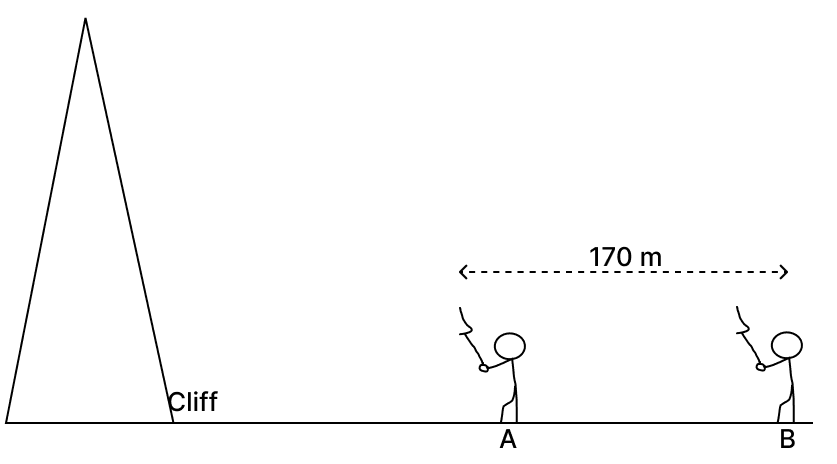
(b) Let, work done by applied force be 'W'.

Then,

W = F x AB = 2 x F

Now,

W = U + Wf

= 200 + 10 = 210 J

⇒ 2 x F = 210

⇒ F = $\frac{210}{2}$

= 105 N

So, the force needed to pull the block from A to B is 105 N.

7(i)Written · 2025 · Section B · 2025 ImprovementFull page

The graph shows load against effort for a lever with load and effort on the same side of the fulcrum.

The graph shows load against effort for a lever with load and effort on the same side of the fulcrum. ICSE 2025 Improvement Physics Solved Question Paper.

(a) Which attribute of the load vs effort graph must be calculated to determine the mechanical advantage?

(b) Which class does this lever belong to? How did you arrive at this conclusion?

Show SolutionHide Solution↓

(a) The slope of the load-effort graph is the key to finding mechanical advantage.

(b) The lever belong to 2nd class because in a linear load-effort graph that passes through the origin, the slope represents the ratio of Load to Effort. So, we just need to calculate the slope of the line to get the mechanical advantage. Choose any point on the line — for instance, (Effort = 10 kgf, Load = 20 kgf) gives M.A. = 2.

Since M.A. > 1, meaning effort arm > load arm. This is characteristic of a class II lever, where the load lies between the fulcrum and the effort.

7(ii)Written · 2025 · Section B · 2025 ImprovementFull page

(a) A man fires a gun and hears its echo after 3 s. The man then moves 80 m towards the hill and fires his gun again. This time he hears the echo after 2.5 s. Calculate the speed of the sound.

(b) State one reason of using ultrasonic waves in SONAR.

Show SolutionHide Solution↓

Given,

  • Time to hear first echo (t1) = 3 s
  • Time to hear second echo (t2) = 2.5 s
  • Distance moved by the man towards the hill (d) = 80 m

(a) Let original distance of the man from the cliff is 'D' and speed of sound be 'v'.

Case 1 : When person hears first echo from initial position.

$$\begin{aligned}\text {Distance of man from cliff} = \frac {\text {Speed of sound} \times \text {Time to hear first echo}}{2}\\[1em] \Rightarrow \text D = \frac {\text v \times \text t_1}{2} = \frac{3\text v}{2}\end{aligned}$$

Case 2 : When person hears second echo after moving 80 m towards the cliff.

New distance between the man and the cliff = D - d = $\frac{3\text v}{2}$ - 80

Then,

$$\begin{aligned}\text {Distance of the man from the cliff} = \frac {\text {Speed of sound} \times \text {Time to hear second echo}}{2}\\[1em] \Rightarrow \frac {3\text v}{2} - 80 = \frac {\text v \times \text t_2}{2} \\[1em] \Rightarrow \frac {3\text v}{2} - 80 = \frac{2.5\text v}{2} \\[1em] \Rightarrow \frac {3\text v}{2} - 80 = \frac{25\text v}{20} \\[1em] \Rightarrow \frac {3\text v}{2} - 80 = \frac{5\text v}{4} \\[1em] \Rightarrow \frac {3\text v}{2} - \frac{5\text v}{4} = 80 \\[1em] \Rightarrow \frac {6\text v - 5\text v}{4} = 80 \\[1em] \Rightarrow \frac {\text v}{4} = 80\end{aligned}$$

⇒ v = 80 x 4 = 320 m s-1

Hence, speed of the sound is 320 m s-1.

(b) Ultrasonic waves can travel undeviated through a long distance and that's why they are used in SONAR.

7(iii)Written · 2025 · Section B · 2025 ImprovementFull page

The diagram below displays four solid plastic balls attached to wires, all mounted on a wooden base. When a person shakes the wooden base back and forth at a steady pace, the balls begin to vibrate as well. It is noted that while all the balls vibrate, only one of them vibrates vigorously.

The diagram below displays four solid plastic balls attached to wires, all mounted on a wooden base. When a person shakes the wooden base back and forth at a steady pace, the balls begin to vibrate as well. It is noted that while all the balls vibrate, only one of them vibrates vigorously. ICSE 2025 Improvement Physics Solved Question Paper.

(a) Explain why only one ball vibrates vigorously.

(b) If fA, fB, fC, and fD are the natural frequencies of vibration of the wires, then arrange them in the increasing order of their frequencies and justify.

Show SolutionHide Solution↓

(a) As the frequency of vibration of the wooden base matches with the natural frequency of only one ball, it starts to vibrate vigorously due to resonance which increases the amplitude of vibration of the ball.

(b) Since frequency of vibration in a wire is inversely proportional to the vibrating length.

Let,

lA, lB, lC and lD are length of the wire A, B, C and D respectively.

From the figure,

lB < lC < lA < lD

Then,

fD < fA < fC < fB

8(i)Written · 2025 · Section B · 2025 ImprovementFull page

The diagram given below shows a bulb connected by dual control switches. Observe the diagrams and answer the questions that follow.

The diagram given below shows a bulb connected by dual control switches. Observe the diagrams and answer the questions that follow. ICSE 2025 Improvement Physics Solved Question Paper. The diagram given below shows a bulb connected by dual control switches. Observe the diagrams and answer the questions that follow. ICSE 2025 Improvement Physics Solved Question Paper.

(a) Which switch can successfully turn the bulbs ON or OFF? (Circuit A, Circuit B, or both)

(b) At present, in which circuit is the bulb glowing?

(c) If the L and N wires are swapped in the circuit (your answer to (b)), will the circuit still function?

Show SolutionHide Solution↓

(a) Both circuits will be able to switch ON and switch OFF the bulb using both switches.

(b) In circuit B the bulb is glowing

(c) Yes, the circuit will function properly.

8(ii)Written · 2025 · Section B · 2025 ImprovementFull page

Study the diagram and answer the questions that follow:

Study the diagram and answer the questions that follow: ICSE 2025 Improvement Physics Solved Question Paper.

(a) Name the nuclear process displayed in the diagram.

(b) Is it possible to conduct this process at room temperature?

(c) Mass of reactants ............... mass of the products.

[Fill in the blank using <, > or =]

Show SolutionHide Solution↓

(a) Nuclear fusion.

(b) No, it is not possible to conduct nuclear fusion at room temperature because when two nuclei approach, each other, due to their positive charge, the electrostatic force of repulsion between them becomes so strong that they do not fuse. Hence to make the fusion possible, a high temperature (≈ 107 K) and high pressure is required.

(c) Mass of reactants > mass of the products.
Reason : The sum of masses of the product nuclei is less than the sum of mass of the parent nucleus because this loss in mass is converted into energy according to Einstein's mass-energy relation.

8(iii)Written · 2025 · Section B · 2025 ImprovementFull page

A cell of e.m.f 1.5 V and internal resistance 1 Ω is connected to two resistors of resistances 6 Ω and 3 Ω in parallel and a resistor of resistance 2 Ω in series as shown in the diagram.

A cell of e.m.f 1.5 V and internal resistance 1 Ω is connected to two resistors of resistances 6 Ω and 3 Ω in parallel and a resistor of resistance 2 Ω in series as shown in the diagram. ICSE 2025 Improvement Physics Solved Question Paper.

Calculate the current through:

(a) 2 Ω resistor

(b) 6 Ω resistor

Show SolutionHide Solution↓

Given,

  • Emf of the cell (ε) = 1.5 V
  • Internal resistance (r) = 1 Ω
  • Resistances in parallel = 6 Ω and 3 Ω
  • Series resistance = 2 Ω

As, 6 Ω and 3 Ω resistances are in parallel then let their net resistance be RP

$$\begin{aligned}\frac{1}{\text{R}_\text{P}} = \frac{1}{\text{R}_1} + \frac{1}{\text{R}_2} \\[1em] \Rightarrow \frac{1}{\text{R}_\text{P}} = \frac{1}{6} + \frac{1}{3} \\[1em] \Rightarrow \frac{1}{\text{R}_\text{P}} = \frac{1 + 2}{6} \\[1em] \Rightarrow \frac{1}{\text{R}_\text{P}} = \frac{3}{6} \\[1em] \Rightarrow \frac{1}{\text{R}_\text{P}} = \frac{1}{2} \\[1em] \Rightarrow \text{R}_\text{P} = 2 Ω\end{aligned}$$

Now, this RP is in series with 2 Ω and internal resistance of the cell.

Then,

Net series resistance (RS) = RP + 2 + r = 2 + 2 + 1 = 5 Ω

(a) Current through 2 Ω resistor = $\frac {\text ε}{\text R_\text S}= \frac{1.5}{5}$ = 0.3 A

So, current through 2 Ω resistor is 0.3 A.

(b) Now, 0.3 A current will split between 3 Ω and 6 Ω resistors.

Let I1 is the current flowing through 6 Ω resistor and 0.3 - I1 is flowing through 3 Ω resistor.

As, 6 Ω and 3 Ω are in parallel then the potential difference across them will be equal i.e.,

Potential difference across 6 Ω = Potential difference across 3 Ω

So, by using Ohm's law (V = IR)

6 x I1 = 3 x (0.3 - I1)

⇒ 6 x I1 = 0.9 - 3 x I1

⇒ 6 x I1 + 3 x I1 = 0.9

⇒ 9 x I1 = 0.9

⇒ I1 = $\frac {0.9}{9}$ = 0.1 A

So, current through 6 Ω resistance is 0.1 A.

9(i)Written · 2025 · Section B · 2025 ImprovementFull page

A spirit lamp supplying heat at a rate of 50 W is used to melt 0.025 kg of ice at 0 °C taken in a container. If all the ice in the container is melted in 168 s, then what is the specific latent heat of fusion of ice?

(The heat capacity of the container is negligible.)

Show SolutionHide Solution↓

Given,

  • Power of spirit lamp (P) = 50 W
  • Mass of ice (m) = 0.025 kg
  • Fixed temperature (Ti) = 0 °C
  • Time Taken (t) = 168 s

Let specific latent heat of ice be Li.

Now,

Heat gained by ice (Q) = P x t = 50 x 168 = 8400 J

Also,

Li = $\frac {\text Q}{\text m} = \frac {8400}{0.025}= \frac{8400000}{25}$ = 336 x 103 J kg-1

Hence, specific latent heat of fusion of ice is 336 x 103 J kg-1.

9(ii)Written · 2025 · Section B · 2025 ImprovementFull page

(a) State the principle of calorimetry.

(b) Why should the surface of the calorimeter be polished?

(c) Why should the calorimeter be made of a material of low specific heat capacity?

Show SolutionHide Solution↓

(a) The principle of calorimetry states that when a hot body is brought in contact with a cold body, then heat lost by the hot body is equal to the heat gained by the cold body, provided there is no heat loss in the environment.
Heat energy lost by the hot body = Heat energy gained by the cold body

(b) The outer and inner surface of the calorimeter should be polished so as to reduce the loss of heat due to radiation.

(c) The calorimeter should be made of a material of low specific heat capacity so that the amount of heat energy taken by the calorimeter from the contents to acquire it's temperature, is very small.

9(iii)Written · 2025 · Section B · 2025 ImprovementFull page

A student wants to design a device to connect a bulb rated 10 W, 22 V, to the mains 220 V, so that the bulb operates at its rated voltage.

(a) Name the device he uses.

(b) State the principle involved in the working of this device.

(c) When the bulb is connected to the output of the device, calculate:

Show SolutionHide Solution↓

(a) Step-down transformer.

(b) Electromagnetic induction, according to this principle a changing current in the primary coil induces a voltage in the secondary coil of a transformer based on the turns ratio.

(c) Given,

  • Power of the bulb (P) = 10 W
  • Voltage of the bulb (V) = 22 V
  1. Current drawn = $\frac{\text P}{\text V} = \frac{10}{22}$ = 0.45 A
  2. Resistance of the bulb = $\frac{\text V^2}{\text P} = \frac{22^2}{10} = \frac{484}{10}$ = 48.4 Ω
1(i)1 Mark · 2025 · Section A · 2025 SpecimenFull page

A moment of couple has a tendency to rotate the body in an anticlockwise direction. Then the moment of couple is taken as :

Show SolutionHide Solution↓

positive

Reason — Conventionally, if the effect on the body is to turn it anticlockwise, the moment of couple is called anticlockwise moment and it is taken positive, while if the effect on the body is to turn it clockwise, the moment of couple is called clockwise moment and it is taken negative.

1(ii)1 Mark · 2025 · Section A · 2025 Specimen · 🔁 also 2024 & 2026Full page

The kinetic energy of a given body depends on the :

Show SolutionHide Solution↓

momentum

Reason — As,

$\text {Kinetic Energy} = \frac{1}{2}\text m \text v^2$

And,

Momentum (p) = mv

Then,

$\text {Kinetic Energy} = \frac{1}{2\text m}\text m^2 \text v^2 = \frac{p^2}{2\text m}$

So, the kinetic energy of a given body depends on its momentum.

1(iii)1 Mark · 2025 · Section A · 2025 Specimen · 🔁 also 2024Full page

For burning of coal in a thermoelectric station, the energy conversion taking place is :

Show SolutionHide Solution↓

chemical to heat to mechanical to electrical

Reason — For burning of coal in a thermoelectric station, the chemical energy of coal on burning changes into the heat energy of steam then in a steam engine, the heat energy of steam changes into the kinetic energy of the turbine in the form of rotational kinetic energy due to which it rotates the armature of the generator connected to it and thus kinetic energy gets transformed into electrical energy.

1(iv)1 Mark · 2025 · Section A · 2025 SpecimenFull page

The adjacent diagram shows the movable block of a block and tackle system with effort in a convenient direction. From the diagram we can conclude that the number of pulleys used in the fixed block are ............... .

The adjacent diagram shows the movable block of a block and tackle system with effort in a convenient direction. From the diagram we can conclude that the number of pulleys used in the fixed block are.ICSE 2025 Specimen Physics Solved Question Paper.
Show SolutionHide Solution↓

2

Reason — The diagram shows that the load is supported by two segment of strings, hence the number of pulleys used in the fixed block are two.

1(v)1 Mark · 2025 · Section A · 2025 SpecimenFull page

White light is dispersed by a prism. Inside the prism, compared to the blue light, the red light

Show SolutionHide Solution↓

slows down less and refracts less

Reason — In a prism, the refractive index of a given transparent medium decreases with the increase in the wavelength of light. Thus, for visible light the refractive index of the material of a prism is greater for blue colour and minimum for red colour i.e., speed of red colour is greater than speed of blue colour. Consequently, a given prism deviates blue light more as compared to red light.

1(vi)1 Mark · 2025 · Section A · 2025 SpecimenFull page

An endoscope uses optic fiber to transmit high resolution images of internal organs without loss of information. The principle of light that is used by the optic fiber is based on :

Show SolutionHide Solution↓

total internal reflection

Reason — Total internal reflection is the principle that allows light to propagate through the core of an optical fiber by continuously reflecting off the inner walls of the fiber due to the angle at which it strikes those walls.

1(vii)1 Mark · 2025 · Section A · 2025 SpecimenFull page

A convex lens has focal length 12 cm with an object at a distance of 20 cm in front of the lens. He obtains a blurred image on the screen placed at a distance of 23 cm in front of the lens. In order to obtain the clear image, he has to move the screen

Show SolutionHide Solution↓

away from the lens.

Reason —

Given,

Focal length (f) = +12 cm

Object distance (u) = -20 cm

Blurred image distance (v') = +23 cm

Let, clear image distance be v.

From lens formula,

$$\begin{aligned}\frac{1}{\text f} = \frac{1}{\text v} – \frac{1}{\text u} \\[1 em] \frac{1}{\text v} = \frac{1}{\text f} + \frac{1}{\text u} \\[1 em] \frac{1}{\text v}=\frac{1}{12} + \frac{1}{(-20)}\\[1 em] \frac{1}{\text v}=\frac{1}{12} - \frac{1}{20}\\[1 em] \frac{1}{\text v}=\frac{5-3}{60 }= \frac{2}{60}\\[1 em] \text v = \frac{60}{2} = +30 \text { cm}\end{aligned}$$

Now,

Clear image distance (v) - Blurred image distance (v') = 30 - 23 = 7 cm

So, in order to obtain the clear image, he has to move the screen 7 cm away from the lens.

1(viii)1 Mark · 2025 · Section A · 2025 SpecimenFull page

Assertion (A) : Infrared radiations travel long distance through a dense fog and mist.

Reason (R) : Infrared radiations undergo minimal scattering in earth's atmosphere.

Show SolutionHide Solution↓

both A and R are true and R is the correct explanation of A.

Explanation:

Assertion (A) is true : Infrared radiations can travel longer distances through fog and mist because they are less affected by scattering compared to visible light.

Reason (R) is true : Infrared radiations have longer wavelengths, and scattering is inversely proportional to the wavelength. Hence, infrared rays undergo minimal scattering.

Since minimal scattering allows infrared rays to penetrate dense fog and mist more effectively, the reason correctly explains the assertion.

1(ix)1 Mark · 2025 · Section A · 2025 Specimen · 🔁 also 2026 & 2027Full page

Two sound waves X and Y have the same amplitude and the same wave pattern but their frequencies are 60 Hz and 120 Hz respectively, then

Show SolutionHide Solution↓

X will be grave and Y will be shriller

Reason — The shrillness of a sound wave is directly proportional to its frequency, meaning that higher frequencies result in shriller sounds and lower frequencies result in grave sound.

1(x)1 Mark · 2025 · Section A · 2025 SpecimenFull page

The graph of voltage vs current for four different materials is shown below.

The graph of voltage vs current for four different materials is shown below. ICSE 2025 Specimen Physics Solved Question Paper.

Which of these four materials would be used for making filament of a bulb?

Show SolutionHide Solution↓

P

Reason — The filament of a bulb should produce a high heating effect so its resistance should be high. From the graph, slope of line for substance P is the greatest hence, resistance of P is highest. So, substance P is most suitable for making the filament of a bulb.

1(xi)1 Mark · 2025 · Section A · 2025 Specimen · 🔁 also 2026 & 2027Full page

According to the old convention, the colour of the earth wire is :

Show SolutionHide Solution↓

green

Reason — In the old colour convention, green colour is used for earth wire.

1(xii)1 Mark · 2025 · Section A · 2025 SpecimenFull page

Current is flowing through a coil as shown in the figure. Which one of the given figures will correctly depict the magnetic polarity and the direction of the lines of force along the axis of the coil.

Current is flowing through a coil as shown in the figure. Which one of the given figures will correctly depict the magnetic polarity and the direction of the lines of force along the axis of the coil.ICSE 2025 Specimen Physics Solved Question Paper.
Show SolutionHide Solution↓
Current is flowing through a coil as shown in the figure. Which one of the given figures will correctly depict the magnetic polarity and the direction of the lines of force along the axis of the coil.ICSE 2025 Specimen Physics Solved Question Paper.

Reason — As current is flowing in clockwise direction in the coil and according to clock rule if the current in wire around that face is in anticlockwise direction, the face has the north polarity, while if the current at that face is in clockwise direction, the face has the south polarity.

1(xiii)1 Mark · 2025 · Section A · 2025 SpecimenFull page

Heat capacity of a body is the :

Show SolutionHide Solution↓

energy needed to raise the temperature of a body by 1°C

Reason — The heat capacity of a body is the amount of heat energy required to raise its temperature by 1°C (or 1 K).

1(xiv)1 Mark · 2025 · Section A · 2025 Specimen · 🔁 also 2026Full page

The amount of heat energy required to melt a given mass of a substance at its melting point without any rise in its temperature is called as the :

Show SolutionHide Solution↓

latent heat of fusion

Reason — Heat energy absorbed in change of phase that is not externally manifested by any rise in temperature is called the latent heat of fusion.

1(xv)1 Mark · 2025 · Section A · 2025 Specimen · 🔁 also 2024 & 2026Full page

A nucleus of an atom consists of 146 neutrons and 95 protons. It decays after emitting an alpha particle. How many protons and neutrons are left in the nucleus after an alpha emission?

Show SolutionHide Solution↓

protons = 93, neutrons = 144

Reason — An alpha particle consists of two protons and two neutrons. Emission of alpha particle reduces the number of protons by 2 and also the number of neutrons by 2. Hence, number of protons = 95 - 2 = 93 and number of neutrons = 146 - 2 = 144.

2(i)1 Mark · 2025 · Section A · 2025 SpecimenFull page

Complete the following by choosing the correct answers from the bracket :

(a) A ............... [class I/class II/Class III] lever will always have M.A. > 1.

(b) In a block and tackle system, increase in the weight of the movable block ............... [decreases/does not affect/increases] the efficiency of the pulley system.

(c) If the mass as well as the velocity of a body is doubled then the kinetic energy of the body ............... [is doubled/becomes eight times/becomes four times] the initial kinetic energy.

(d) Unit of power used in mechanical engineering is ............... . [watt/horse power/erg per second]

(e) Two copper wires can have the different ............... [resistivity/resistance] but will have same ............... .[resistance/resistivity]

Show SolutionHide Solution↓

(a) A class II lever will always have M.A. > 1.

(b) In a block and tackle system, increase in the weight of the movable block decreases the efficiency of the pulley system.

(c) If the mass as well as the velocity of a body is doubled then the kinetic energy of the body becomes eight times the initial kinetic energy.

(d) Unit of power used in mechanical engineering is horse power.

(e) Two copper wires can have the different resistance but will have same resistivity.

2(ii)1 Mark · 2025 · Section A · 2025 SpecimenFull page

Draw a graph of potential energy vs height for a body thrown vertically upwards. [Assume no friction is present.]

Show SolutionHide Solution↓

The graph of potential energy vs height for a body thrown vertically upwards is shown below where u(J) represents potential energy in joules and h(m) refers to height in metres.

Draw a graph of potential energy vs height for a body thrown vertically upwards.ICSE 2025 Specimen Physics Solved Question Paper.
2(iii)1 Mark · 2025 · Section A · 2025 SpecimenFull page

(a) Name the waves used for echo depth sounding.

(b) Give one reason for their use in the above purpose.

Show SolutionHide Solution↓

(a) Ultrasonic waves.

(b) Ultrasonic waves are used for echo depth sounding because they travel long distance without deviation and is not easily absorbed by the medium or can be confined to a narrow beam.

3(i)1 Mark · 2025 · Section A · 2025 Specimen · 🔁 also 2024Full page

(a) Refer to the diagram given below. A lens with two different refractive indices is shown. If the rays are coming from a distant object, then how many images will be seen?

The adjacent diagram shows the movable block of a block and tackle system with effort in a convenient direction. From the diagram we can conclude that the number of pulleys used in the fixed block are.ICSE 2025 Specimen Physics Solved Question Paper.

(b) A glass lens always forms a virtual, erect and diminished image of an object kept in front of it. Identify the lens.

Show SolutionHide Solution↓

(a) The two materials bend the incoming rays by different amounts and produce two focal points. Hence, two images are formed.

(b) Concave lens because irrespective of the position of the object, the image formed by a thin concave (or divergent) lens is always virtual, upright, diminished, and it is situated on the side of the object between the focus and the lens.

Hence, 2 images will be formed.

(b) Concave lens because irrespective of the position of the object, the image formed by a thin concave (or divergent) lens is always virtual, upright, diminished, and it is situated on the side of the object between the focus and the lens.

3(ii)1 Mark · 2025 · Section A · 2025 SpecimenFull page

If live wire makes an accidental contact with the metal case, which circuit (A or B) in the diagram, illustrating an electric iron, is considered safe for the user (Assuming the fuse is present in the live wire in both circuits)? Justify your answer.

The adjacent diagram shows the movable block of a block and tackle system with effort in a convenient direction. From the diagram we can conclude that the number of pulleys used in the fixed block are.ICSE 2025 Specimen Physics Solved Question Paper.
Show SolutionHide Solution↓

The electric iron, is considered safe for the user in circuit A because in this circuit metal case is earthed so the person won't get an electric shock but in circuit B metal case is not earthed so the circuit will be completed through the body of the person giving him a shock.

3(iii)1 Mark · 2025 · Section A · 2025 Specimen · 🔁 also 2024Full page

A transformer is used to change a high alternating e.m.f. to a low alternating e.m.f. of the same frequency.

(a) Identify the type of transformer used for the above purpose.

(b) State whether the turns ratio of the above transformer is = 1 or > 1 or < 1.

Show SolutionHide Solution↓

(a) Step down transformer since it is used to change a high alternating voltage to a low alternating voltage.

(b) Turns ratio is n < 1, i.e., number of turns in the secondary are less than the number of turns in the primary.

3(iv)1 Mark · 2025 · Section A · 2025 SpecimenFull page

A solid of mass 60 g at 100°C is placed in 150 g of water at 20°C. The final steady temperature is 25°C. Calculate the heat capacity of solid.

[Specific heat capacity of water = 4.2 Jg⁻¹K⁻¹]

Show SolutionHide Solution↓

Given,

Mass of solid (ms) = 60 g

Mass of water (mw) = 150 g

Fall in temperature of solid (△ts) = (100 - 25) = 75°C

Rise in temperature of water (△tw) = (25 - 20) = 5°C

Specific heat capacity of water (cw) = 4.2 Jg⁻¹K⁻¹

Let specific heat capacity of solid be cs.

Then,

Heat energy given by solid = mscs△ts = 60 x c x 75 = 4500 x c …..(1)

Heat energy taken by water = mwcw△tw = 150 × 4.2 × 5 = 3150 …..(2)

Assuming that there is no loss of heat energy,

Heat energy given by solid = Heat energy taken by water.

Equating equations 1 & 2, we get,

4500 × cs = 3150

$\text c_\text s = \frac{3150}{4500}$

cs = 0.7 J g⁻¹ K⁻¹

Now,

Heat capacity of solid = mass x specific heat capacity = 60 x 0.7 = 42 J K⁻¹

Hence, Heat capacity of solid = 42 J K⁻¹.

3(v)1 Mark · 2025 · Section A · 2025 SpecimenFull page

(a) Name the principle of AC generator.

(b) State its one use.

Show SolutionHide Solution↓

(a) Faraday's first law or principle of electromagnetic induction.

(b) It is used as a back-up for the lifts in tall buildings in case of electricity failure.

3(vi)1 Mark · 2025 · Section A · 2025 SpecimenFull page

(a) Name the radiations that are emitted during the decay of a nucleus, which has highest penetrating power?

(b) Does the emission of the above-mentioned radiation result in a change in the mass number?

Show SolutionHide Solution↓

(a) Gamma (γ) radiation.

(b) No, the emission of gamma radiation does not result in a change in the mass number as they are a form of electromagnetic radiation, essentially high-energy photons, and they have no mass or charge. Since they are massless, their emission does not affect the number of protons or neutrons in the nucleus, and therefore the mass number remains unchanged.

3(vii)1 Mark · 2025 · Section A · 2025 SpecimenFull page

The graph (fig A) illustrates the correlation between the number of protons (x-axis) and the number of neutrons (y-axis) for elements A, В, C, D, and E in the periodic table. These elements are denoted by the letters rather than their conventional symbols. When the element C, depicted in the graph, undergoes radioactive decay, it releases radioactive rays. When these rays are directed into the plane of the paper in the presence of a magnetic field, as indicated in the fig B, they experience deflection, causing them to move upwards.

The graph fig A illustrates the correlation between the number of protons. ICSE 2025 Specimen Physics Solved Question Paper.

(a) Name the radioactive radiations emitted by the element C.

(b) Identify the daughter element from the graph.

(c) Name the law used to identify the radioactive radiations emitted by the element.

Show SolutionHide Solution↓

(a) Beta radiations.

(b) The daughter element is E because emission of beta particle reduces one neutron from C and increases it's one proton so the element with one neutron less than C and one excess proton will be the daughter element which is clearly E as seen from the graph.

(c) Fleming's left hand rule.

4(ii)Written · 2025 · Section B · 2025 SpecimenFull page

The refractive index of water is 1.33 at a certain temperature. When the temperature of water is increased by 40 °C, the refractive index changes to 'x'.

(a) State whether x < 1.33 or x > 1.33.

(b) State two differences between normal reflection and total internal reflection.

Show SolutionHide Solution↓

(a) AS, the refractive index of a medium decreases with increase in temperature, so when the temperature of water is increased by 40 °C then it refractive index will decreases and hence new refractive index will be smaller than 1.33.

Hence, X < 1.33.

(b)

 Normal reflectionTotal internal reflection
(i)Takes place in any medium, denser or rarer.Takes place only in a denser medium.
(ii)Takes place for any angle of incidence.Takes place only when the angle of incidence is greater than critical angle.
4(iii)Written · 2025 · Section B · 2025 SpecimenFull page

(a) Mixture of red + blue + green is passed through a convex lens as shown in the diagram below. State whether the ray passes through a single point or through different points on the principal axis after refraction.

Mixture of red + blue + green is passed through a convex lens as shown in the diagram below. State whether the ray passes through a single point or through different points on the principal axis after refraction. ICSE 2025 Specimen Physics Solved Question Paper.

(b) Name the invisible radiations which are studied using the quartz prism.

(c) State one use of these radiations.

(d) Name one radiation having the wavelength longer than the wavelength of these radiations.

Show SolutionHide Solution↓

(a) The ray will pass through different points on principal axis after refraction through the convex lens as the refractive index of a medium decreases with the increase in wavelength so red colour will deviate the least, followed by green and then blue will deviate the most.

(b) Ultraviolet radiations.

(c) Ultraviolet radiations are used for sterilizing air, surgical equipment, etc.

(d) Infrared radiation.

5(i)Written · 2025 · Section B · 2025 Specimen · 🔁 also 2024 & 2026Full page

An object is placed at a distance 24 cm in front of a convex lens of focal length 8 cm.

(a) What is the nature of the image so formed?

(b) Calculate the distance of the image from the lens.

Show SolutionHide Solution↓

(a) As, the object distance (= 24 cm) is greater than the focal length (= 8 cm) of the convex lens which means the object placed beyond it's focus so the lens will form a real and inverted image.

(b)

Given,

Object distance (u) = - 24 cm

Focal length (f) = +8 cm

From lens formula,

$$\begin{aligned}\frac{1}{\text f} = \frac{1}{\text v} - \frac{1}{\text u} \\[1 em] \frac{1}{\text v} = \frac{1}{\text f} + \frac{1}{\text u} \\[1 em] \frac{1}{\text v} = \frac{1}{8}+\frac{1}{(-24)} \\ [1 em] \frac{1}{\text v} =\frac{1}{8}-\frac{1}{24} \\[1 em] \frac{1}{\text v} = \frac{3-1}{24}\\[1 em] \frac{1}{\text v} = \frac{2}{24} \\[1 em] \text v = \frac{24}{2} \\[1 em] \text v =12 \text { cm}\end{aligned}$$

∴ The image is formed at a distance of 12 cm behind the lens.

5(ii)Written · 2025 · Section B · 2025 Specimen · 🔁 also 2024Full page

When sunlight passes through water droplets in the atmosphere it gets dispersed into its constituent colours forming a rainbow. A similar phenomenon is observed when white light passes through a prism.

(a) Which colour will show the maximum angle of deviation and which colour will show the minimum angle of deviation?

(b) If Instead of sunlight, a green-coloured ray is passed through a glass prism. What will be the colour of the emergent ray?

Show SolutionHide Solution↓

(a) As the angle of deviation depends directly on the refractive index of a given transparent medium which is itself inversely proportional to the wavelength of light so the angle of deviation decreases with the increase in the wavelength of light. Thus, for visible light the angle of deviation of a prism is maximum for violet colour and minimum for red colour.

(b) A green-coloured ray is a single colour light and hence a prism can not split a single light so the emergent ray will be of green colour.

5(iii)Written · 2025 · Section B · 2025 SpecimenFull page

O is a luminescent particle trapped inside a glass block. A student traces the path of rays coming out of it and reflecting over a plane mirror as shown in the diagram below.

O is a luminescent particle trapped inside a glass block. A student traces the path of rays coming out of it and reflecting over a plane mirror as shown in the diagram below. ICSE 2025 Specimen Physics Solved Question Paper.

Complete the table, using the labels from the figure. The first label is done for you.

S. No.DescriptionLabel
a.an angle of reflection on the mirrora
b.a partially reflected ray in the glass slab
c.a critical angle
d.a refracted ray
e.an angle of refraction of the ray R
Show SolutionHide Solution↓
S. No.DescriptionLabel
a.an angle of reflection on the mirrora
b.a partially reflected ray in the glass slabU
c.a critical anglec
d.a refracted rayQ
e.an angle of refraction of the ray R90° - e
6(i)Written · 2025 · Section B · 2025 SpecimenFull page

A metal rod AB of length 80 cm is balanced at 45 cm from the end A with 100 gf weights suspended from the two ends.

A metal rod AB of length 80 cm is balanced at 45 cm from the end A with 100 gf weights suspended from the two ends. ICSE 2025 Specimen Physics Solved Question Paper.

(a) If this rod is cut at the centre C, then compare the weight of AC to the weight of BC.

(b) Give a reason for your answer in (a)

Show SolutionHide Solution↓

Given,

Weight at the end A (WA) = 100 gf

Weight at the end B (WB) = 100 gf

Length of the rod (L) = 80 cm

Distance of A from the fulcrum (lA) = 45 cm

Distance of B from the fulcrum (lB) = 80 cm - 45 cm = 35 cm

Let,

Weight of the rod AC is (WAC) and distance of centre of gravity of the rod AC from the fulcrum is (lAC).

And

Weight of the rod BC is (WBC) and distance of centre of gravity of the rod BC from the fulcrum is (lBC).

Here,

(lAC) = 45 - 20 = 25 cm,

(lBC) = 60 - 45 = 15 cm,

Now,

Anticlockwise moment (due to weight of 100 gf at end A and weight of rod AC) = lA x WA + lAC x WAC = 45 x 100 + 25 x WAC

Clockwise moment (due to weight of 100 gf at end B and weight of rod BC) = lB x WB + lBC x WBC = 35 x 100 + 15 x WBC

As system is balanced then for equilibrium,

Anticlockwise moment of force about the fulcrum = Clockwise moment of force about the fulcrum

45 x 100 + 25 x WAC = 35 x 100 + 15 x WBC

⇒ 4500 + 25WAC = 3500 + 15WBC

⇒ 15WBC - 25WAC = 4500 - 3500 = 1000

⇒ 3WBC - 5WAC = 200

⇒ 3WBC - 5WAC > 0

⇒ 3WBC > 5WAC

$\Rightarrow \frac{\text W_\text {BC}}{\text W_\text {AC}} \gt \frac{5}{3} \gt 1$

⇒ WBC > WAC

Hence, weight of AC < weight of BC.

(b) Even though the weights present are the same at both ends and the torque arm of B is less than the torque arm of A. This means the moment of the weight of the rod acts from side B and the C.G. lies beyond 45. Thus, more weight is concentrated between C to B.

6(ii)Written · 2025 · Section B · 2025 Specimen · 🔁 also 2026Full page

For each of the following scenarios, state whether the work done by gravity is positive, negative, or zero.

(a) a person walks on a levelled road.

(b) a person climbs a ladder.

(c) a car in neutral gear is coming down the slope.

Show SolutionHide Solution↓

(a) Zero because when a person walks on a levelled, no work is done against the force of gravity as the displacement of the person is normal to the direction of force of gravity which is vertically downwards.

(b) Negative because when a person climbs a ladder (upward), the displacement covered by the person is opposite to the direction of force of gravity (downwards), so the work done on the person by the force of gravity is negative.

(c) Positive because when a car in neutral gear is coming down the slope, the direction of displacement covered by it is parallel to the direction of force of gravity (downwards), so the work done on the car by the force of gravity is positive.

6(iii)Written · 2025 · Section B · 2025 SpecimenFull page

The figure below shows a simple pendulum of mass 200 g. It is displaced from the mean position A to the extreme position B. The potential energy at the position A is zero. At the position B the pendulum bob is raised by 5 m.

The figure below shows a simple pendulum of mass 200 g. It is displaced from the mean position A to the extreme position B. The potential energy at the position A is zero. At the position B the pendulum bob is raised by 5 m. ICSE 2025 Specimen Physics Solved Question Paper.

(a) What is the potential energy of the pendulum at the position В?

(b) What is the total mechanical energy at point C?

(c) What is the speed of the bob at the position A when released from B?

(Take g = 10 ms-2 and given that there is no loss of energy.)

Show SolutionHide Solution↓

Given,

h = 5 m,

m = 200 g = 0.2 kg,

g = 10 ms-2

(a) Potential energy UB at B is given by

UB = m x g x h

Substituting the values we get,

UB = 0.2 x 10 x 5

⇒ UB = 10 J

Hence, the potential energy of the pendulum at the position B = 10 J.
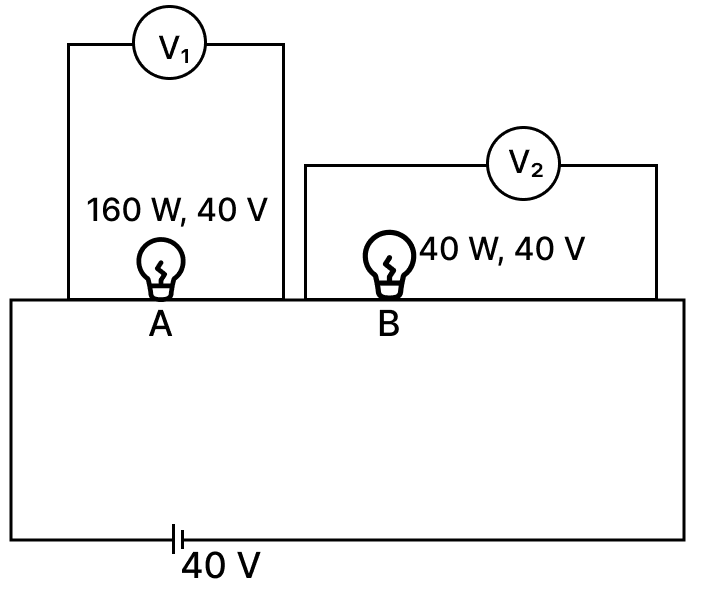
(b) Total mechanical energy at point C = 10 J

The total mechanical energy is same at all points of the path due to conservation of mechanical energy.
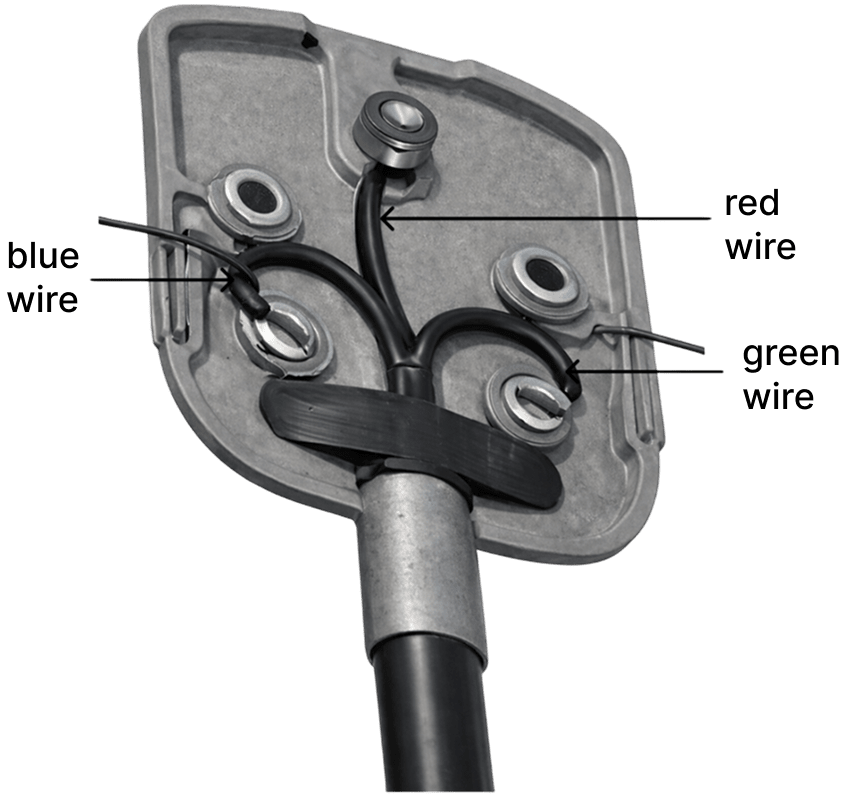
(c) At A, bob has only kinetic energy which is equal to potential energy at B,

Therefore,

$$\begin{aligned}\frac {1}{2}\text m \text v_\text A^2 = \text U_\text B \\[1 em] ⇒ 0.5 \times 0.2 \times \text v_\text A^2 = 10 \\[1 em] ⇒ \text v_\text A^2 = \frac{10}{0.1} \\[1 em] ⇒ \text v_\text A = \sqrt {100} = 10\ \text m \text s^{-1}\end{aligned}$$

7(i)Written · 2025 · Section B · 2025 Specimen · 🔁 also 2026Full page

A block and tackle system of pulleys has velocity ratio 4.

(a) Draw a labelled diagram of the system indicating clearly, the direction of the load and effort.

(b) Calculate the potential energy of the load 100 kgf lifted by this pulley to a height 5 m. (g = 10 ms-2)

Show SolutionHide Solution↓

(a)The labelled diagram of the system indicating clearly, the direction of the load and effort is shown below :

The labelled diagram of the system indicating clearly, the direction of the load and effort is shown below. ICSE 2025 Specimen Physics Solved Question Paper.

(b) Given,

m = 100 kg

h = 5 m

g = 10 ms-2

Then,

Potential Energy (U) = mgh = 100 × 10 × 5 = 5000 J

7(ii)Written · 2025 · Section B · 2025 SpecimenFull page

A person standing in front of a cliff fires a gun and hears its echo after 3s. If the speed of sound in air is 336 ms-1.

(a) Calculate the distance of the person from the cliff.

(b) After moving a certain distance from the cliff, he fires the gun again and this time the echo is heard 1.5 s later than the first. Calculate the distance that the person moved.

Show SolutionHide Solution↓

(a) Given,

Time taken to hear the echo = 3s

Speed of sound = 336 ms-1

So,

$$\begin{aligned}\text {Distance of the person from the cliff} = \frac {\text {Speed of sound} \times \text {Time taken}}{2} \\[1em] =\frac{336 \times 3}{2} = \frac{1008}{2} \\[1em] = 504\ \text m\end{aligned}$$

So, distance of the person from the cliff is 504 m.

(b) Given,

Time taken to hear the new echo = 3 s + 1.5 s = 4.5 s

So,

$$\begin{aligned}\text {New distance of the person from the cliff} = \frac {\text {Speed of sound} \times \text {Time taken}}{2} \\[1em] =\frac{336 \times 4.5}{2} = \frac{1512}{2} \\[1em] = 756\ \text m\end{aligned}$$

Distance moved by the person = 756 - 504 = 252 m

So, distance moved by the person is 252 m.

7(iii)Written · 2025 · Section B · 2025 SpecimenFull page

The below picture shows a mother pushing her daughter sitting on a swing. The swing is going through the positions A, B, C where A and C are extreme positions and B is the mean position.

The below picture shows a mother pushing her daughter sitting on a swing. The swing is going through the positions A, B, C where A and C are extreme positions and B is the mean position. ICSE 2025 Specimen Physics Solved Question Paper.

(a) Which is the right position i.e. at A, B or C, for the mother to give a constant periodic push to the swing every time in the forward direction to increase the amplitude of the swing?

(b) Name the phenomenon involved in this.

(c) Explain with this example how this phenomenon helps to increase the amplitude of the swing.

Show SolutionHide Solution↓

(a) At position A, the mother should give a constant periodic push to the swing every time in the forward direction to increase the amplitude of the swing because it is an extreme position where speed of the swing is zero and direction of motion changes from backward direction to forward so at this position direction of motion and direction of push are in parallel while for C it is opposite and B speed is maximum on either direction which can collide with mother and hurt her.

(b) Resonance phenomenon.

(c) The natural frequency of the swing will match the frequency of the force applied by mother this will increase the amplitude.

8(i)Written · 2025 · Section B · 2025 SpecimenFull page

The circuit depicted in the figure is employed for studying Ohm's Law. Instead of using a standard resistor, a student opts for a glass tube filled with mercury (tube 1), connected to the circuit through two electrodes E1 & E2. He records the readings of the ammeter and voltmeter, thereby calculates the resistance. The student repeats the experiment by substituting tube 1 with tube 2, where the same amount of mercury fills the tube 2.

The circuit depicted in the figure is employed for studying Ohm's Law. ICSE 2025 Specimen Physics Solved Question Paper.

Neglecting internal resistance of the cell use (> or < or =) to compare

(a) the resistance in both the cases.

(b) the voltmeter readings in both the cases.

(c) the specific resistance in both the cases.

Show SolutionHide Solution↓

(a) As the resistance depends directly on length and inversely on area of the resistor and since here tube 2 is thicker and shorter than tube 1 thus, resistance of the tube 2 < resistance of the tube 1.

(b) The voltmeter reading for tube 1 is the same as the voltmeter reading for tube 2 because according to Ohm's law potential difference across a resistor depends only on the current applied not on the resistance of the resistor.

(c) As the specific resistance of a resistor is independent of its dimensions but depends only on the contained material and since here both tubes contain only mercury thus, the specific resistance in both the cases is the same.

8(ii)Written · 2025 · Section B · 2025 SpecimenFull page

A radioactive nucleus X emits an alpha particle followed by two beta particles to form nucleus Y.

(a) With respect to the element X, where would you position the element Y in the periodic table?

(b) What is the general name of the elements X and Y?

(c) If the atomic number of Y is 80 then what is the atomic number of X?

Show SolutionHide Solution↓

(a) $$\begin{aligned}_{\text Z}^{\text A}\text{X} \longrightarrow \\ _{\text Z-2}^{\text A - 4}\text{X}_1 + _{2}^{4}\text{He}\ \longrightarrow \\ _{\text Z-1}^{\text A - 4}\text{X}_2 + \\ _{-1}^{0}\text{e}\ \longrightarrow \\ _{\text Z}^{\text A - 4}\text{Y} + \\ _{-1}^{0}\text{e}\end{aligned}$$

We can see from the above that X and Y have same atomic number. Hence, X and Y will occupy the same position in the periodic table

(b) Isotope.

(c) When the atomic number of Y is 80 and X and Y are isotopes then atomic number of X will also be 80.

8(iii)Written · 2025 · Section B · 2025 Specimen · 🔁 also 2024Full page

Observe the given circuit diagram and answer the questions that follow :

Observe the given circuit diagram and answer the questions that follow. ICSE 2025 Specimen Physics Solved Question Paper.

(a) Calculate the resistance of the circuit when the key K completes the circuit.

(b) Calculate the current through 3 Ω resistance when the circuit is complete.

Show SolutionHide Solution↓

(a) 5Ω and 3Ω are in series so their equivalent resistance (Rs) = 5 + 3 = 8Ω

Now 2Ω and Rs are in parallel.

$$\begin{aligned}\frac{1}{\text R_\text P} = \frac{1}{\text R_\text s} + \frac{1}{2} \\[1 em] ⇒ \frac{1}{\text R_\text P} = \frac{1}{8} + \frac{1}{2} = \frac{1+4}{8}\\[1 em] ⇒ \text R_\text P = \frac{8}{5} = 1.6\ \text Ω\end{aligned}$$

From circuit diagram,

Internal Resistance = 0.4 Ω

Total resistance of circuit = 1.6 + 0.4 = 2 Ω

(b) Current drawn from the battery :

$$\begin{aligned}\text I = \frac{\text {emf}}{\text {Total resistance}} \\[1em] ⇒ \text I = \frac{4}{2} = 2\ \text A\end{aligned}$$

Now, the current I divides in 2 parts.

Let current across 2Ω be I1 and across the series combination of 5Ω and 3Ω be I2.

I = I1 + I2 = 2 A ..............(1)

Terminal Voltage of cell = V = IRp = 2 x 1.6 = 3.2 V

∴ P.d. across 2 Ω resistor = 3.2 V

I1 = $\frac{3.2}{2}$ = 1.6 A

Substituting value of I1 in Eq 1,

2 = 1.6 + I2

⇒ I2 = 2 - 1.6 = 0.4 A

Hence, current across 3Ω = 0.4 A

9(i)Written · 2025 · Section B · 2025 SpecimenFull page

What mass of ice at 0°C added to 2.1 kg water, will cool it down from 75°C to 25°C? Given Specific heat capacity of water = 4.2 J g⁻¹ °C⁻¹, Specific latent heat of ice = 336 J g⁻¹.

Show SolutionHide Solution↓

Given,

For Water

Mass of water (mw) = 2.1 kg = 2100 g

Initial temperature (Ti) = 75°C

Final temperature (Tf) = 25°C

Specific heat capacity of water (cw) = 4.2 J g⁻¹ °C⁻¹

For ice

Initial temperature (Ti) = 0°C

Final temperature (Tf) = 25°C

Specific latent heat of fusion (Li) = 336 J g⁻¹

Let,

Mass of ice = (mi)

Now,

Heat lost by water = mwcw△t

= 2100 × 4.2 × (75 - 25)

= 2100 × 4.2 × 50 = 441000 J = 441 kJ

Heat gained by ice = miLi + micw△t

= mi × 336 + mi × 4.2 × (25-0)

= 336mi + mi × 4.2 × 25

= 336mi + 105mi = 441mi

By principle of calorimetry,

Heat lost by water = Heat gained by ice

⟹ 441000 = 441 mi

⟹ mi = $\frac{441000}{441}$ = 1000 g = 1 kg

So, the mass of required ice is 1 kg.

9(ii)Written · 2025 · Section B · 2025 Specimen · 🔁 also 2024Full page

The diagram below shows a cooling curve for a substance :

The diagram below shows a cooling curve for a substance. ICSE 2025 Specimen Physics Solved Question Paper.

(a) State the temperatures at which the substance condenses.

(b) The temperature range in which the substance is in liquid state.

(c) Why do we prefer ice to ice-cold water for cooling a drink?

Show SolutionHide Solution↓

(a) Substance condenses at 150° C.

(b) 150 to 60°C.

(c) 1 g of ice at 0° C takes 336 J of heat energy from the drink to melt into water at 0° C. Thus, the drink liberates an additional 336 J of heat energy to 1 g ice at 0° C than to 1 g ice-cold water at 0° C. Therefore, cooling produced by 1 g ice at 0° C is much more than that by 1 g water at 0° C.

9(iii)Written · 2025 · Section B · 2025 SpecimenFull page

The diagram below shows a cardboard on which iron filings are kept. A wire bent in the form of a loop is seen passing through the cardboard. When current flows through it the iron filings arrange themselves as shown below with the direction of magnetic field.

The diagram below shows a cardboard on which iron filings are kept. A wire bent in the form of a loop is seen passing through the cardboard. ICSE 2025 Specimen Physics Solved Question Paper.

(a) State the polarities of the battery at A and B.

(b) State the effect on the magnetic field if an iron rod is held along the axis of the coil.

(c) State one way to :

Show SolutionHide Solution↓

(a) Polarity of A is positive and B is negative.

Reason — Since at the left side of the loop, the lines of force are anti-clockwise, so, by right hand thumb rule we find that the current is going out of terminal A hence, it is positive. Similarly, at the right side of the loop, the lines of force are clockwise, so, terminal B is negative.

(b) The strength of the magnetic field increases when an iron rod is held along the axis of the coil.

(c)

  1. By reversing the direction of the current.
  2. By decreasing the current.
1(i)1 Mark · 2024 · Section A · 2024 PaperFull page

When a bell fixed on a cycle rings, then the energy conversion that takes place is:

Show SolutionHide Solution↓

kinetic energy to sound energy

Reason — When you ring a cycle bell, you apply a force (mechanical/kinetic energy) by pressing or rotating the lever. This mechanical movement causes a metal striker to hit the bell, producing sound energy.

1(ii)1 Mark · 2024 · Section A · 2024 PaperFull page

A door lock is opened by turning the lever (handle) of length 0.2 m. If the moment of force produced is 1 Nm, then the minimum force required is:

Show SolutionHide Solution↓

5 N

Reason —

Given,

Length of lever = Perpendicular distance of the line of action of the force = 0.2 m
Moment of force = 1 Nm
As, Moment of force = Force × Perpendicular distance of the line of action of the force

1 = force x 0.2

force = $\frac{1}{0.2}=\frac{10}{2}$ = 5 N

1(iii)1 Mark · 2024 · Section A · 2024 PaperFull page

A force ‘F’ moves a load from A to C as shown in the figure below. For the calculation of the work done, which of these lengths would you use as the displacement?

A force ‘F’ moves a load from A to C as shown in the figure below. For the calculation of the work done, which of these lengths would you use as the displacement. ICSE 2024 Physics Solved Question Paper.
Show SolutionHide Solution↓

5m

Reason — The amount of work done by a force is equal to the product of the force and the displacement of the point of application of the force in the direction of force. In the diagram, the object moves from point A to point C in the direction of force F. The straight-line path from A to C is 5 m, which is the magnitude of the displacement vector. Hence, the correct length to use as displacement is 5 m.

1(iv)1 Mark · 2024 · Section A · 2024 PaperFull page

A radioactive nucleus containing 128 nucleons emits a β – particle. After β – emission the number of nucleons present in the nucleus will be :

Show SolutionHide Solution↓

128

Reason — In β – particle emission, number of nucleons (i.e., sum of number of protons and number of neutrons) remains the same.

1(v)1 Mark · 2024 · Section A · 2024 PaperFull page

Assertion (A) : Ultraviolet radiations are scattered more as compared to the microwave radiations.

Reason (R) : Wavelength of ultraviolet radiation is more than the wavelength of microwave radiation.

Show SolutionHide Solution↓

A is true but R is false.

Explanation

Assertion (A) is true: Scattering of light is inversely proportional to the fourth power of its wavelength (Scattering ∝ $\frac{1}{\text λ^4}$)

Since ultraviolet radiation has shorter wavelength than microwave radiation which implies ultraviolet radiations will be scattered more than microwave radiation.

Reason (R) is false: Ultraviolet radiation has a much shorter wavelength (around 10–400 nm) than microwaves (which have wavelengths in the millimeter to centimeter range, i.e., 1 mm to 1 m).

1(vi)1 Mark · 2024 · Section A · 2024 PaperFull page

When the stem of vibrating tuning fork is pressed on a table, the tabletop starts vibrating. These vibrations are definitely an example of:

Show SolutionHide Solution↓

forced vibrations

Reason — When the stem of a vibrating tuning fork is pressed against the top of a table, the tuning fork produces forced vibrations in the table top as the table top has a much larger vibrating area than the tuning fork, so the forced vibrations of the table top send forth a greater energy and produces a louder (or more intense) sound than that produced by the tuning fork.

1(vii)1 Mark · 2024 · Section A · 2024 PaperFull page

Which of the following is a class III lever?

Show SolutionHide Solution↓

Human forearm

Reason — Human forearm is a class III lever because like class III lever, the elbow joint acts as fulcrum at one end, biceps exerts the effort in the middle and load on the palm is at the other end. Thus, this is an example of class III lever.

1(viii)1 Mark · 2024 · Section A · 2024 PaperFull page

The specific resistance of a conductor depends on its:

Show SolutionHide Solution↓

material

Reason — Specific resistance (also called resistivity, denoted by ρ) is a material property of a conductor and does not depend on its dimensions. It depends on :

  1. The type of material (like copper, aluminium, iron, etc.)
  2. Temperature (resistivity can change with temperature)

But it does not depend on :

  1. Length
  2. Area of cross-section
  3. Radius
1(ix)1 Mark · 2024 · Section A · 2024 PaperFull page

Identify the option that displays the correct wiring with correct colour code :

Identify the option that displays the correct wiring with correct colour code. ICSE 2024 Physics Solved Question Paper.
Show SolutionHide Solution↓
Identify the option that displays the correct wiring with correct colour code. ICSE 2024 Physics Solved Question Paper.

Reason — As colour coding for live wire is brown and for neutral wire it is blue so while connecting mains to an appliance a switch or a key must be connected with the live wire to ensure safety.

1(x)1 Mark · 2024 · Section A · 2024 PaperFull page

The potential difference between terminals of a cell in a closed electric circuit is:

Show SolutionHide Solution↓

terminal voltage

Reason — In a closed electric circuit (i.e., when current is drawn), the potential difference between the terminals of a cell is called the terminal voltage which is less than the electromotive force (emf) of the cell due to the voltage drop across the internal resistance of the cell.

1(xi)1 Mark · 2024 · Section A · 2024 PaperFull page

During melting of ice at 0°C the :

Show SolutionHide Solution↓

energy is absorbed and temperature remains constant.

Reason — When ice melts at 0°C, it absorbs heat energy from the surroundings which is used completely for phase change from solid (ice) to liquid (water) so this energy does not increase the temperature during the process.

1(xii)1 Mark · 2024 · Section A · 2024 PaperFull page

Linear magnification(m) produced by a concave lens is :

Show SolutionHide Solution↓

m < 1

Reason — A concave lens always forms a virtual, erect, and diminished image of an object which means the size of the image is smaller than the size of the object and as magnification is the ratio of the length of image to the length of object so linear magnification of a concave lens is always less than 1.

1(xiii)1 Mark · 2024 · Section A · 2024 PaperFull page

A radioactive element is placed in an evacuated chamber. Then the rate of radioactive decay will:

Show SolutionHide Solution↓

Remain unchanged

Reason — Radioactive decay is a nuclear process as it depends on the nucleus of the atom, not on external physical conditions like pressure, temperature, chemical state and presence of air or vacuum. So, placing a radioactive element in an evacuated chamber (a vacuum) will not affect the rate of its decay.

1(xiv)1 Mark · 2024 · Section A · 2024 PaperFull page

The graph given below shows heat energy supplied against change in temperature when no energy is lost to the surrounding. The slope of this graph will give :

The graph given below shows heat energy supplied against change in temperature when no energy is lost to the surrounding. The slope of this graph will give. ICSE 2024 Physics Solved Question Paper.
Show SolutionHide Solution↓

Heat capacity

Reason — When no energy is lost to the surrounding, the amount of heat energy supplied is directly proportional to the change in temperature △t i.e.

$$\begin{aligned}\text Q ∝ △\text t\\[1em] \text {or} \\[1em] \text Q = \text {mc} △\text t\end{aligned}$$

Where,

m : mass of a substance

c : specific heat capacity of the substance

So,

$$\begin{aligned}\frac {\text Q}{△\text t} = \text {mc} \\[1em] \text {Slope of Q vs △\text t graph} = \frac {\text Q}{△\text t} = \text {mc}\end{aligned}$$

And mc is the heat capacity (C) of the body

Hence, slope of Q vs △t graph gives the value of the heat capacity.

1(xv)1 Mark · 2024 · Section A · 2024 PaperFull page

A block of glass is pushed into the path of the light as shown below. Then the converging point X will :

A block of glass is pushed into the path of the light as shown below. Then the converging point X will. ICSE 2024 Physics Solved Question Paper.
Show SolutionHide Solution↓

Move away from the slab

Reason — When a converging beam of light enters a glass slab, the rays will bend towards the normal within the glass, and then bend away from the normal as they exit the glass back into air. This bending will cause the point of convergence (focus) to shift away from the glass slab.

2(i)1 Mark · 2024 · Section A · 2024 PaperFull page

(a) In the following atoms, which one is a radioisotope? Give one use of this isotope.

O16, C14, N14, He4

(b) Name the class of the lever shown in the picture below :

Name the class of the lever shown in the picture below. ICSE 2024 Physics Solved Question Paper.
Show SolutionHide Solution↓

(a) C14 is radioisotope of C12 and C13 while O16, N14 and He4 are stable nuclei.

C14 is used to determine the age of ancient biological materials, such as fossils, bones, or archaeological samples (up to about 50,000 years old).

(b) CLass II lever.

2(ii)1 Mark · 2024 · Section A · 2024 PaperFull page

Fill in the blanks :

(a) When a stone tied to a string is rotated in a horizontal plane, the tension in the string provides ............... force necessary for circular motion.

(b) Work done by this force at any instant is ............... .

Show SolutionHide Solution↓

(a) When a stone tied to a string is rotated in a horizontal plane, the tension in the string provides centripetal force necessary for circular motion.

(b) Work done by this force at any instant is zero .

2(iii)1 Mark · 2024 · Section A · 2024 PaperFull page

A non uniform beam of weight 120 N pivoted at one end is shown in the diagram below. Calculate the value of F to keep the beam in equilibrium.

A non uniform beam of weight 120 N pivoted at one end is shown in the diagram below. Calculate the value of F to keep the beam in equilibrium. ICSE 2024 Physics Solved Question Paper.
Show SolutionHide Solution↓

Given,

Weight (W) = 120 N

From the figure,

Distance of C.G. from the pivot point O = r = 0.20 m

Distance of F from the pivot point O = R = 0.80 m

Now,

Moment of force about pivot point O due to C.G. = r x W = 0.20 x 120 = 24 Nm (clocKwise direction)

and

Moment of force about pivot point O due to F = R x F = 0.80 x F (anticlocKwise direction)

For equilibrium,

Anticlockwise moment of force due to F about pivot point O = Clockwise moment of force due to C.G. about pivot point O

$$\begin{aligned}0.80 \times \text F = 24 \\[1 em] \Rightarrow \text F = \frac{24}{0.80}= \frac{240}{8} =30\ \text N\end{aligned}$$

So, value of F = 30 N.

2(iv)1 Mark · 2024 · Section A · 2024 PaperFull page

Meera chose to use a block and tackle system of ‘9’ pulleys instead of a single movable pulley to lift a heavy load.

(a) What is the advantage of using a block and tackle system over a single movable pulley?

(b) Why should she connect more number of pulleys in the upper fixed block?

Show SolutionHide Solution↓

(a) A block and tackle system with multiple pulleys provides a higher mechanical advantage, which means less effort is required to lift a heavy load compared to a single movable pulley since in a single movable pulley, mechanical advantage (M.A.) is 2 but in a block and tackle system with 9 pulleys, the M.A. can go up to 9 (ideally), making it much easier to lift heavier loads with the same effort.

(b) To ensure smooth and balanced operation, more pulleys should be in the upper fixed block because :

  1. It reduces the weight of the movable block, making it easier to lift.
  2. It helps in maintaining stability and reduces oscillation during lifting.
  3. It also makes arrangement and threading of ropes more efficient and manageable.
2(v)1 Mark · 2024 · Section A · 2024 PaperFull page

Sumit does 600 J of work in 10 min and Amit does 300 J of work in 20 min. Calculate the ratio of the powers delivered by them.

Show SolutionHide Solution↓

Given,

Work done by Sumit (WS) = 600 J

Time taken by Sumit (tS) = 10 min = 10 x 60 = 600 seconds

Work done by Amit (WA) = 300 J

Time taken by Amit (tA) = 20 min = 20 x 60 = 1200 seconds

Then,

Power delivered by Sumit (PS) = $\frac{\text {Work done by Sumit}\ (\text W_\text S)}{\text {Time taken by Sumit}\ (\text t_\text S)} =\frac{600}{600} = 1\ \text W$

and

Power delivered by Amit (PA) = $\frac{\text {Work done by Amit}\ (\text W_\text A)}{\text {Time taken by Amit}\ (\text t_\text A)} =\frac{300}{1200} = 0.25\ \text W$

So,

$\frac{\text P_\text S}{\text P_\text A}=\frac{1}{0.25} =4$

2(vi)1 Mark · 2024 · Section A · 2024 PaperFull page

5 bulbs are connected in series in a room. One bulb is fused. It is removed and remaining 4 bulbs are again connected in series to the same circuit. What will be the effect on the following physical quantities? (Increases, Decreases, Remain Same)

(a) Resistance

(b) Intensity of light

Show SolutionHide Solution↓

(a) In a series connection, total resistance is the sum of individual resistances.

Let resistance of each bulb be R.

Initially :

Rtotal = 5R

After removing one bulb:

Rtotal = 4R

So, resistance will decrease.

(b) When resistance decreases, total current in the circuit (assuming the same voltage supply) will increase :

$\text I = \frac{\text V}{\text R}$

So, more current → more power delivered to each bulb.

Since,

Power (P) = I2R,

Hence, intensity of light increases for each remaining bulb.

2(vii)1 Mark · 2024 · Section A · 2024 PaperFull page

Rohan conducted experiments on echo in different media. He observed that a minimum distance of ‘x’ meters is required for the echo to be heard in oxygen and ‘y’ meters in benzene. Compare ‘x’ and ‘y’. Justify your answer.

Speed of sound in oxygen: 340 ms-1

Speed of sound in benzene: 200 ms-1

Show SolutionHide Solution↓

Given,

Speed of sound in oxygen = 340 ms-1

Speed of sound in benzene = 200 ms-1

Minimum distance required to hear an echo = distance sound travels in 0.1 s (since the human ear can distinguish sound if the reflected sound reaches after 0.1 s)

So,

$\text {Minimum distance for echo} = \frac{\text {Speed of sound}\times \text {Minimum time to hear an echo}}{2}=\frac{\text v \times \text t_\text{min}}{2}$

and

tmin = 0.1 sec

For medium containing oxygen :

$\text x = \frac{340\times 0.1}{2}=\frac{34}{2} = 17\ \text m$

For medium containing benzene :

$\text y = \frac{200\times 0.1}{2}=\frac{20}{2} = 10\ \text m$

So, from above calculations x > y.

3(i)1 Mark · 2024 · Section A · 2024 PaperFull page

(a) In a reading glass what is the position of the object with respect to the convex lens used?

(b) Why can we not use concave lens for the same purpose?

Show SolutionHide Solution↓

(a) In a reading glass, the object is placed between the optical center and the principal focus of the convex lens to produce a virtual and enlarged image of the object so that a magnified view of the object can be seen.

(b) A concave lens always forms a virtual, erect, but diminished (smaller) image of the object so it cannot magnify the object.

3(ii)1 Mark · 2024 · Section A · 2024 PaperFull page

A fuse is rated 5 A. Can it be used with a geyser rated 1540 W, 220 V. Write Yes or No. Give supporting calculations to justify your answer.

Show SolutionHide Solution↓

Given,

Maximum current passing through the fuse (Imax) = 5 A

Input voltage of the geyser (v) = 220 V

Power rating of the geyser (P) = 1540 W

Let, current passing through geyser be I.

Then,

$$\begin{aligned}\text P = \text {IV} \\[1em] \text I = \frac{\text P}{\text V}=\frac{1540}{220}=7\ \text A\end{aligned}$$

As,

Imax = 5 A < I = 7 A

So if the fuse is used with the geyser then it will draw more current greater than the maximum current and in turn fuse will melt.

No, the fuse can not be used with the geyser

3(iii)1 Mark · 2024 · Section A · 2024 PaperFull page

State two factors affecting the speed of rotation of the coil in a D.C. motor.

Show SolutionHide Solution↓

The speed of rotation of coil can be increased by the following two ways :

  1. by increasing the strength of current in the coil,
  2. by increasing the number of turns in the coil.
3(iv)1 Mark · 2024 · Section A · 2024 PaperFull page

How much heat is required to convert 500 g of ice at 0°C to water at 0°C? The latent heat of fusion of ice is 330 J g⁻¹.

Show SolutionHide Solution↓

Given,

m = 500 g

latent heat of fusion of ice (L) = 330 J g⁻¹

Let, required heat be Q.

Then,

$\text Q = \text {mL} = 500 \times 330 = 165000\ \text J = 165\ \text {kJ}$

3(v)1 Mark · 2024 · Section A · 2024 PaperFull page

Copy and complete the nuclear reaction by filling in the blanks.

$_{92}\text{U}^{235} + _0\text n^1 \longrightarrow _{56}\text {Ba}^{\cdots} + \space _{\cdots}\text {Kr}^{92} + 3 \space _0\text n^1$

Show SolutionHide Solution↓

As only neutrons are involved in the reaction which number of protons and total nucleon number (i.e., number of protons + neutrons) remain constant.

Then,

Initially,

No. of protons (np) = Atomic number of $_{92}\text{U}^{235}$ = 92

No. of nucleons (n) = Mass number of $_{92}\text{U}^{235}$ + mass number of $_0\text n^1$ = 235 + 1 = 236

Now,

Finally,

Let atomic number of Kr is Z and mass number of Ba is A.

No. of protons (np) = Atomic number of $_{56}\text{Ba}^{\text A}$ + Atomic number of $_{\text Z}\text{Kr}^{92}$ = 56 + Z

and

No. of nucleons (n) = mass number of $_{56}\text{Ba}^{\text A}$ + mass number of $_{\text Z}\text{Kr}^{92}$ + 3 x mass number of $_0\text n^1$ = A + 92 + 3 = A + 95

As number of protons are constant :

⇒ 92 = 56 + Z

⇒ Z = 92 - 56 = 36

Also, number of nucleons are constant :

⇒ 236 = A + 95

⇒ A = 236 - 95 = 141

So reaction will be :

$_{92}\text{U}^{235} + _0\text{n}^1 \longrightarrow _{56}\text {Ba}^{141} + \space _{36}\text {Kr}^{92} + 3 \space _0\text n^1$

4(i)Written · 2024 · Section B · 2024 PaperFull page

The image of a candle flame placed at a distance of 36 cm from a spherical lens, is formed on a screen placed at a distance of 72 cm from the lens. Calculate the focal length of the lens and its power.

Show SolutionHide Solution↓

Given,

Object distance (u) = - 36 cm

As, image is formed on a screen then,

Image distance (v) = + 72 cm

Let, focal length be f.

From lens formula,

$$\begin{aligned}\frac{1}{\text f} = \frac{1}{\text v} - \frac{1}{\text u} \\[1 em] \frac{1}{\text f} = \frac{1}{72}-\frac{1}{(-36)}=\frac{1}{72}+\frac{1}{36}= \frac{1+2}{72} \\[1em] \frac{1}{\text f} = \frac{3}{72} \\[1 em] \text f = \frac{72}{3} = + 24 \text { cm}\end{aligned}$$

Now,

$\text {Power} = \frac{1}{\text {f (in metre)}} = \frac{1}{24\times 10^{-2}}=\frac{100}{24} ≈ 4.17\ \text D$

4(ii)Written · 2024 · Section B · 2024 PaperFull page

Below is an incomplete table showing the arrangement of electromagnetic spectrum in the increasing order of their wavelength. Complete the table.

Gamma rayX – rayU V raysVisible raysInfraredARadio waves

(a) Identify the radiation A.

(b) Name the radiation used to detect fracture in bones.

(c) Name one property common to both A and Radio waves.

Show SolutionHide Solution↓
Gamma rayX – rayU V raysVisible raysInfraredMicro WavesRadio waves

(a) Radiation A : Micro Wave

(b) X – rays are used to detect fracture in bones.

(c) Micro waves and radio waves are part of electromagnetic waves.

4(iii)Written · 2024 · Section B · 2024 PaperFull page

(a) Why do we use red colour as a danger signal on the top of a skyscraper?

(b) The diagram below shows the path of a blue ray through the prism :

The diagram below shows the path of a blue ray through the prism. ICSE 2024 Physics Solved Question Paper.
Show SolutionHide Solution↓

(a) Red colour is used as a danger signal on the top of a skyscraper because red light has the longest wavelength among visible light, so it is scattered the least by air molecules and dust and remains visible from a long distance and in low visibility, making it ideal for danger signals.

(b)

The diagram below shows the path of a blue ray through the prism. ICSE 2024 Physics Solved Question Paper.

Here, the refracted ray PQ is normal to the surface AB of the prism (i.e., ∠r = 0°), so the incident ray at the point P should also be normal to the surface AB so that ∠i = 0°.

At point Q, the angle of incidence for the ray PQ = 133° - 90° = 43°

Now, this angle should be equal to the critical angle because ray PQ is refracted at 90°, i.e., it is refracted along QC. Hence, the critical angle of the prism is 43°.

  1. In △AРQ

∠APQ + ∠PQA + ∠PAQ = 180°

⇒ 90° + 47° + ∠PAQ = 180°

⇒ ∠PAQ = 180° - 90° - 47°

⇒ ∠ PAQ = 43°

Hence, ∠A= 43°

  1. As the light used and its wavelength determine the angle of deviation since with a decrease in the light wavelength, the angle of deviation increases so the beam will experience total internal reflection if we swap out the blue light with lower wavelength i.e., indigo.
5(i)Written · 2024 · Section B · 2024 PaperFull page

(a) Refractive index of glass with respect to water is $\frac{9}{8}$. Find the refractive index of water with respect to glass.

(b) Name the principle used to find the value in part (a).

(c) If we change the temperature of water,then will the ratio $\frac{9}{8}$ remain the same? Write yes or no.

Show SolutionHide Solution↓

(a) Given,

Refractive index of glass with respect to water = $\frac{9}{8}$

Then, according to the principle of reversibility of light

Refractive index of water with respect to glass =
$\frac{1}{\text {Refractive index of glass w.r.t water}} = \frac{1}{\frac{9}{8}}=\frac{8}{9}$

(b) Principle of reversibility of light

(c) If temperature is changed of water then the ratio $\frac{9}{8}$ will also change as refractive index of medium is inversely proportional to the temperature i.e., on increasing temperature refractive index of a medium decreases and vice versa.

So, If we change the temperature of water,then the ratio $\frac{9}{8}$ will not remain the same.

5(ii)Written · 2024 · Section B · 2024 PaperFull page

Light travels a distance of ‘10x’ units in time ‘t1’ in vacuum and it travels a distance of ‘x’ units in time ‘t2’ in a denser medium. Using this information answer the question that follows :

(a) ‘Light covers a distance of ‘20x’ units in time ‘t1’ in diamond.’ State true or false.

(b) Calculate the refractive index of the medium in terms of ‘t1’ and ‘t2’.

Show SolutionHide Solution↓

(a) False because speed of light in vacuum is highest and diamond is a denser medium so speed of light will be lower and hence, it can not travel a distance 20x in diamond which is two times of distance travelled by light in vacuum.

(b) Given,

Distance travelled by light in vacuum = 10x

Time taken by light in vacuum = t1

Distance travelled by light in the medium = x

Time taken by light in diamond = t2

As,

$\text {Speed of light in vacuum (c)} = \frac {\text {Distance travelled by light in vacuum}}{\text {Time taken by light in vacuum}}= \frac {10\text x}{\text t_1}$

and

$\text {Speed of light in diamond (v)} = \frac {\text {Distance travelled by light in diamond}}{\text {Time taken by light in diamond}}= \frac {\text x}{\text t_2}$

then,

$$\begin{aligned}\text {The refractive index of diamond} = \frac{\text{Speed of light in vacuum (c)}}{\text {speed of light in diamond (v)}}= \frac{\frac {10\text x}{\text t_1}}{\frac {\text x}{\text t_2}} \\[1em] =\frac{10 \text t_2}{\text t_1}\end{aligned}$$

5(iii)Written · 2024 · Section B · 2024 PaperFull page

A monochromatic ray of light is incident on an equilateral prism placed at minimum deviation position with an angle of incidence 45° as shown in the diagram.

A monochromatic ray of light is incident on an equilateral prism placed at minimum deviation position with an angle of incidence 45° as shown in the diagram. ICSE 2024 Physics Solved Question Paper.

(a) Copy the diagram and complete the path of the ray PQ.

(b) State two factors on which the angle of deviation depends.

Show SolutionHide Solution↓

(a) In below figure, I is the position of source O when seen through the surface RS.

In below figure, I is the position of source O when seen through the surface RS. ICSE 2024 Physics Solved Question Paper.

(b) The angle of deviation depends on the following factors :

  1. the angle of incidence (i),
  2. the material of prism (i.e., on refractive index μ).
6(i)Written · 2024 · Section B · 2024 PaperFull page

(a) Define Centre of Gravity.

(b) A hollow ice cream cone has height 6 cm.

Show SolutionHide Solution↓

(a) The centre of gravity (C.G.) of a body is the point about which the algebraic sum of moments of weights of all the particles constituting the body is zero and the entire weight of the body can be considered to act at this point, howsoever the body is placed.

(b)

  1. As the centre of gravity of a hollow cone is at h/3 from its base on its axis where h is the height of the cone.

Given,

Height of the cone (h) = 6 cm

Centre of gravity of cone = $\frac{\text h}{3} = \frac{6}{3} = 2 \text{ cm}$

  1. Yes, now cone is a solid cone. So, the position of the new center of gravity from the base will be h/4 сm i.e. $=\frac{6}{4} = 1.5\ \text{ cm}$ from the base of the cone.
6(ii)Written · 2024 · Section B · 2024 PaperFull page

Two identical marbles A and B are rolled down along Path 1 and Path 2 respectively. Path 1 is frictionless and Path 2 is rough.

Two identical marbles A and B are rolled down along Path 1 and Path 2 respectively. Path 1 is frictionless and Path 2 is rough. ICSE 2024 Physics Solved Question Paper.

(a) Which marble will surely reach the next peak?

(b) Along which path/s the mechanical energy will be conserved?

(c) Along which path/s is the law of conservation of energy obeyed?

Show SolutionHide Solution↓

(a) As Path 2 is rough and Path 1 is frictionless then marble A will surely reach the top because there will be no energy lost on the frictionless road while some energy will be degraded om rough path.

(b) As total mechanical energy remains constant when there is no frictional force, hence, mechanical energy will be preserved along path 1.

(c) Since energy cannot be created or destroyed, the law of conservation of energy applies to both scenarios.

6(iii)Written · 2024 · Section B · 2024 PaperFull page

Given are two pulleys.

Given are two pulleys. ICSE 2024 Physics Solved Question Paper.

(a) Copy and complete the labelled diagram connecting the two pulleys with a tackle to obtain Velocity Ratio = 2.

(b) If Load = 48 kgf and efficiency is 80% then calculate :

Show SolutionHide Solution↓

(a) The diagram is given below :

The diagram is given below. ICSE 2024 Physics Solved Question Paper.

(b)

  1. Given,

Velocity Ratio = 2

Load = 48 kgf

Efficiency = 80% = 0.8

As,

$$\begin{aligned}\text {Efficiency} = \frac {\text {Mechanical Advantage}}{\text {Velocity Ratio}}\\[1 em] ⇒ \text {Mechanical Advantage} = \text {Efficiency} \times \text {Velocity Ratio}=0.8 \times 2 = 1.6\end{aligned}$$

  1. As,

$$\begin{aligned}\text {Mechanical Advantage} = \frac{\text {Load}}{\text {Effort}}\\[1 em] ⇒ \text {Effort} = \frac{\text {Load}}{\text {Mechanical Advantage}}= \frac{48}{1.6}=30 \text { kgf}\end{aligned}$$

7(i)Written · 2024 · Section B · 2024 PaperFull page

(a) Name the waves used in SONAR.

(b) In the below diagram Lata stands between two cliffs and claps her hands. Determine the time taken by her to hear the first echo. Speed of sound in air = 320 ms-1.

In the below diagram Lata stands between two cliffs and claps her hands. Determine the time taken by her to hear the first echo. Speed of sound in air = 320 ms 1p. ICSE 2024 Physics Solved Question Paper.
Show SolutionHide Solution↓

(a) Ultrasonic Waves.

(b) The closest cliff produces the first echo. However, the first cliff, or cliff A, is only 10 meters away from the Lata, and a minimum of 17 meters is required between the cliff and the listener in order to hear an echo.

Then, echo will be heard from Cliff B

Given,

Speed of sound in air (v) = 320 ms-1

Distance of Lata from cliff B (d) = 160 m

Total distance travelled = 2d = 2 × 160 = 320 m

Time = $\frac{2\text d}{\text v}=\frac {320}{320}$ = 1 sec.

Hence, the first echo will be heard after 1 second.

7(ii)Written · 2024 · Section B · 2024 PaperFull page

(a) Complete the following radioactive reaction :

$_{-}^{-}\text X \rightarrow _{-}^{-}\text Y + _{2}^{4}\text {He} \rightarrow _{91}^{234}\text Z + _{-1}^{0}\text e$

(b) Uranium is available in two forms U-235 and U-238. Which of the two isotopes of Uranium is more fissionable?

Show SolutionHide Solution↓

(a) $_{92}^{238}\text X \rightarrow _{90}^{234}\text Y + _{2}^{4}\text {He} \rightarrow _{91}^{234}\text Z + _{-1}^{0}\text e$

(b) Comparatively speaking, U-235 is easier to fission than U-238 because only fast neutrons can cause the fission of U-238, whereas slow neutrons can even trigger the fission of U-235.

7(iii)Written · 2024 · Section B · 2024 PaperFull page

In the given diagram, a vibrating tuning fork is kept near the mouth of a burette filled with water. The length of the air column is adjusted by opening the tap of the burette. At a length of 5 cm of the air column, a loud sound is heard.

In the given diagram, a vibrating tuning fork is kept near the mouth of a burette filled with water. The length of the air column is adjusted by opening the tap of the burette. At a length of 5 cm of the air column, a loud sound is heard. ICSE 2024 Physics Solved Question Paper.

(a) Name the phenomenon illustrated by the above experiment.

(b) Why is a loud sound heard at this particular length?

(c) If the present tuning fork is replaced with a tuning fork of higher frequency, should the length of the air column increase or decrease to produce a loud sound? Give a reason.

Show SolutionHide Solution↓

(a) Resonance.

(b) The loud sound is audible at this specific length because the tuning fork's frequency and the air column's frequency are equal at that particular length.

(c) Since, frequency of the air column is inversely proportional to the length of the column therefore, in order to create a loud sound, the length of the air column should decrease as the frequency increases.

8(i)Written · 2024 · Section B · 2024 PaperFull page

The voltage - current readings of a certain material are shown in the table given below :

Voltage (V)Current (I)
10 V2 A
20 V3 A
30 V4 A

Study the table.

(a) State whether the conductor used is ohmic or non-ohmic.

(b) Justify your answer.

(c) State Ohm’s law.

Show SolutionHide Solution↓

(a) The conductor is non-ohmic.

(b) As, from Ohm's Law

For V = 10 V and I = 2 A

$\text R = \frac{\text V}{\text I}=\frac{10}{2}= 5\ \text Ω$ ....... Equation 1

For V = 20 V and I = 3 A

$\text R = \frac{\text V}{\text I}=\frac{20}{3}= 6.67\ \text Ω$ ....... Equation 2

For V = 30 V and I = 4 A

$\text R = \frac{\text V}{\text I}=\frac{30}{4}= 7.5\ \text Ω$ ....... Equation 3

From equations 1, 2 and 3

Here, the ratio V/I is not constant and plot of V vs I graph will not be linear but if a conductor is an ohmic conductor then V/I should be constant to follow Ohm's law and V vs I graph should be linear which is not the case here.

Hence, the conductor does not follow Ohm's law and is a non-ohmic conductor.

(iii) Ohm's law states that the current flowing through the conductor is directly proportional to the potential difference across it's ends provided that the physical conditions and the temperature of the conductor remain constant.

8(ii)Written · 2024 · Section B · 2024 PaperFull page

Below is the diagram of a transformer :

Below is the diagram of a transformer. ICSE 2024 Physics Solved Question Paper.

(a) Identify the type of transformer.

(b) In this type of transformer which of the wire is thicker, the primary or the secondary? Give a reason.

Show SolutionHide Solution↓

(a) As from the diagram, the number of turns at primary coil is greater than that at secondary coil so this is a step down transformer.

(b) The secondary wire is more thicker than the primary since this is a step down transformer which reduces the voltage and increases the current at secondary coil so the use of a thicker wire reduces its resistance and therefore reduces the loss of energy as heat in that coil.

8(iii)Written · 2024 · Section B · 2024 PaperFull page

Study the diagram :

Study the diagram. ICSE 2024 Physics Solved Question Paper.

(a) Calculate the total resistance of the circuit.

(b) Calculate the current drawn from the cell.

(c) State whether the current through 10 Ω resistor is greater than, less than or equal to the current through the 12 Ω resistor.

Show SolutionHide Solution↓

Given,

V = 4 V

Let,

R1 = 10 Ω,

R2 = 6 Ω,

R3 = 12 Ω and

R1 = 4 Ω

(a) As, R1 and R2 are in series then

RS = R1 + R2 = 10 + 6 = 16 Ω

Similarly,

R3 and R4 are also in series,

RS' = R3 + R4 = 12 + 4 = 16 Ω

Now, RS and RS' are in parallel combination then

$\frac{1}{\text R_\text{eq}}=\frac{1}{\text R_\text{S}}+\frac{1}{\text R_\text{S'}} = \frac{1}{16}+\frac{1}{16}=\frac{2}{16}$

⟹ ${\text R_\text{eq}} = \frac{16}{2} = 8\ \text Ω$

So, total resistance of the circuit is 8 Ω.

(b) From Ohm's law :

$\text {Current (I)} = \frac{\text V}{\text R_\text{eq}}=\frac{4}{8}=0.5\ \text A$

Current drawn from the cell is 0.5 A.

(c) As potential difference across 10 Ω and 6 Ω resistances is same as potential difference across 12 Ω and 4 Ω resistances which is V = 4 V.

Now,

$\text {Current through 10 Ω resistance} = \frac{\text V}{\text R_\text{S}}=\frac{4}{16}=0.25\ \text A$ .....equation 1

and

$\text {Current through 12 Ω resistance} = \frac{\text V}{\text R_\text{S'}}=\frac{4}{16}=0.25\ \text A$ .....equation 2

From equations 1 and 2

Current through 10 Ω resistance = Current through 12 Ω resistance = 0.25 A

So, the current through 10 Ω resistor is equal to the current through the 12 Ω resistor.

9(i)Written · 2024 · Section B · 2024 PaperFull page

85 g of water at 30°C is cooled to 5°C by adding certain mass of ice. Find the mass of ice required.

[Specific heat capacity of water = 4.2 J g⁻¹ °C⁻¹ , Specific latent heat of fusion = 336 J g⁻¹]

Show SolutionHide Solution↓

Given,

For Water

Mass of water (mw) = 85 g

Initial temperature (Ti) = 30°C

Final temperature (Tf) = 5°C

Specific heat capacity of water (cw) = 4.2 J g⁻¹ °C⁻¹

For ice

Initial temperature (Ti) = 0°C

Final temperature (Tf) = 5°C

Specific latent heat of fusion (Li) = 336 J g⁻¹

Let,

Mass of ice = (mi)

Now,

Heat lost by water = mwcw△t

= 85 × 4.2 × (30 - 5)

= 85 × 4.2 × 25 = 8925 J

Heat gained by ice = miLi + micw△t

= mi × 336 + mi × 4.2 × (5-0)

= 336mi + mi × 4.2 × 5

= 336mi + 21mi = 357mi

By principle of calorimetry,

Heat lost by water = Heat gained by ice

⟹ 8925 = 357 mi

⟹ mi = $\frac{8925}{357}$ = 25 g

So, the mass of required ice is 25 g.

9(ii)Written · 2024 · Section B · 2024 PaperFull page

(a) Why does it become pleasantly warm when the lakes start freezing?

(b) Water freezes to form ice. What change would you expect in the average kinetic energy of the molecules?

(c) Which will contain more heat energy 1 g of ice at 0°C or 1 g water at 0°C ?

Show SolutionHide Solution↓

(a) The surroundings become pleasantly warm when water in a lake starts freezing because the specific latent heat of fusion of ice is very high, hence large quantity of heat is released when the water in the lake freezes. Therefore, the temperature of the surrounding becomes pleasantly warm.

(b) The average kinetic energy of the molecules decreases as water freezes to produce ice because the temperature of the water molecules drops, and they hold to one another to form a crystal.

(c) 1 g of water at 0° C has more heat energy because 1 g of water at 0° C liberates 80 cal heat to form 1 g of ice at 0° C.

9(iii)Written · 2024 · Section B · 2024 PaperFull page

(a) State one factor that affects the magnitude of induced current in an AC generator.

(b) Given below is a circuit to study the magnetic effect of electric current. ABCD is a cardboard kept perpendicular to the conductor XY. A magnetic compass is placed at the point P of the cardboard. P1 and P2 are the positions of the magnetic compass, before and after passing a current through XY respectively.

Given below is a circuit to study the magnetic effect of electric current. ICSE 2024 Physics Solved Question Paper.
Show SolutionHide Solution↓

(a) Magnitude of magnetic field intensity affects the magnitude of induced current in an AC generator.

(b)

  1. Right hand thumb rule.

  2. Since the compass is pointing west, the current will flow from X to Y in an anticlockwise direction.

  3. The amount of current flowing through the circuit will decrease if the resistance increases and the magnetic field then decreases as the magnetic lines of force surrounding the conductor is directly proportional to the current in the circuit.

1(i)1 Mark · 2024 · Section A · 2024 SpecimenFull page

A moment of couple has a tendency to rotate the body in an anticlockwise direction then that moment of couple is taken as:

Show SolutionHide Solution↓

positive

Reason — The anticlockwise moment is taken as positive while the clockwise moment is taken as negative.

1(ii)1 Mark · 2024 · Section A · 2024 Specimen · 🔁 also 2025 & 2026Full page

The kinetic energy of a given body depends on the:

Show SolutionHide Solution↓

momentum

Reason — As kinetic energy = $\frac{1}{2}$ mv 2

If we multiply and divide by m then we get, $\frac{\text{(mv)}^2}{2\text{m}}$

As mv = momentum (p), so

kinetic energy = $\frac{\text{p}^2}{2\text{m}}$

Therefore, kinetic energy of a given body depends on the momentum.

1(iii)1 Mark · 2024 · Section A · 2024 Specimen · 🔁 also 2025Full page

For burning of coal in a thermoelectric station, the energy conversion taking place is:

Show SolutionHide Solution↓

chemical to heat to mechanical to electrical.

Reason — A thermal power station is a type of power station in which heat energy is converted to electrical energy.

Here, the chemical energy of coal is changed into heat energy, which is transferred to steam. Then the heat energy of steam changes into mechanical energy of turbine that is further changed into electrical energy.

1(iv)1 Mark · 2024 · Section A · 2024 Specimen · 🔁 also 2025 & 2026Full page

A nucleus of an atom consists of 146 neutrons and 95 protons. It decays after emitting an alpha particle. How many protons and neutrons are left in the nucleus after an alpha emission?

Show SolutionHide Solution↓

protons = 93, neutrons = 144

Reason — An alpha particle consists of two protons and two neutrons. Emission of alpha particle reduces the number of protons by 2 and also the number of neutrons by 2. Hence, number of protons = 95 - 2 = 93 and number of neutrons = 146 - 2 = 144.

1(v)1 Mark · 2024 · Section A · 2024 SpecimenFull page

Assertion: Infrared radiations travel long distances through dense fog and mist.

Reason: Infrared radiations undergoes minimal scattering in earth's atmosphere

Show SolutionHide Solution↓

both assertion and reason are true.

Reason — Infrared radiations travel long distances through dense fog and mist as they undergo minimal scattering in earth's atmosphere.

1(vi)1 Mark · 2024 · Section A · 2024 SpecimenFull page

For a convex lens, the minimum distance between an object and its real image in terms of focal length (f) of a given lens must be:

Show SolutionHide Solution↓

4f

Reason — When the object is kept at 2F1, then, its image is formed at 2F2. This is the position of minimum distance between object and image (i.e., 2f + 2f = 4f).

1(vii)1 Mark · 2024 · Section A · 2024 SpecimenFull page

Two sound waves X and Y have same amplitude and same wave pattern, but their frequencies are 60 Hz and 120 Hz respectively, then:

Show SolutionHide Solution↓

X will be grave and Y will be shriller.

Reason — The shrillness of a sound wave is directly proportional to its frequency, meaning that higher frequencies result in shriller sounds and lower frequencies result in grave sound.

1(viii)1 Mark · 2024 · Section A · 2024 SpecimenFull page

Vibrations produced in a body under the influence of the periodic force is;

Show SolutionHide Solution↓

forced vibrations

Reason — The vibrations of a body which take place under the influence of an external periodic force acting on it, are called forced vibrations. E.g. the vibrations produced in the diaphragm of a microphone sound box with frequencies corresponding to the speech of the speaker, are the forced vibrations.

1(ix)1 Mark · 2024 · Section A · 2024 SpecimenFull page

The graph of voltage vs current for four different materials is shown below.

The graph of voltage vs current for four different materials is shown below. Which of these four materials would be used for making the coil of a toaster? ICSE 2024 Specimen Physics Solved Question Paper.

Which of these four materials would be used for making the coil of a toaster?

Show SolutionHide Solution↓

P

Reason — The coil of a toaster should produce a high heating effect so its resistance should be high. From the graph, slope of line for substance P is the greatest hence, resistance of P is highest. So, substance P is most suitable for making the coil of a toaster.

1(x)1 Mark · 2024 · Section A · 2024 SpecimenFull page

According to the old convention the color of the earth wire is:

Show SolutionHide Solution↓

green

Reason— In the old colour convention, green colour is used for earth wire.

1(xi)1 Mark · 2024 · Section A · 2024 SpecimenFull page

Lenz’s law is based on the law of conservation of:

Show SolutionHide Solution↓

energy

Reason — Lenz's law is based on the law of conservation of energy. It shows that the mechanical energy is spent in doing work against the opposing force experienced by the moving magnet, and it is transformed into the electrical energy due to which current flows in the solenoid.

1(xii)1 Mark · 2024 · Section A · 2024 SpecimenFull page

Heat capacity of a body is:

Show SolutionHide Solution↓

the energy needed to raise the temperature of the body by 1°C

Reason — The term heat capacity of a body is the amount of heat energy required to raise it's temperature by 1° C (or 1 K). The S.I. unit of heat capacity is joule per kelvin (J K-1)

1(xiii)1 Mark · 2024 · Section A · 2024 SpecimenFull page

The amount of heat energy required to melt a given mass of a substance at its melting point without rise in its temperature is called:

Show SolutionHide Solution↓

latent heat of fusion

Reason — Heat energy absorbed in change of phase that is not externally manifested by any rise in temperature is called the latent heat of fusion.

1(xiv)1 Mark · 2024 · Section A · 2024 SpecimenFull page

When a ray of light enters from a denser medium to a rarer medium then:

Show SolutionHide Solution↓

the speed of light increases

Reason — The speed of light increases when it enters from a denser medium to a rarer medium. Lower density of the rarer medium causes less interaction between photons and particles. This reduces the scattering and results in a higher speed.

1(xv)1 Mark · 2024 · Section A · 2024 SpecimenFull page

An endoscope uses optical fiber to transmit high resolution images of internal organs without loss of information. The phenomenon of light that governs the functioning of the optical fiber is:

Show SolutionHide Solution↓

total internal reflection.

Reason — Total internal reflection is the principle that allows light to propagate through the core of an optical fiber by continuously reflecting off the inner walls of the fiber due to the angle at which it strikes those walls.

2(i)1 Mark · 2024 · Section A · 2024 SpecimenFull page

(a) Name the principle on which a lever works.

(b) Which radiations that are emitted during the decay of a nucleus, having highest penetrating power?

(c) Does the emission of the above-mentioned radiation result in a change in the mass number?

Show SolutionHide Solution↓

(a) A lever works on the principle of moments, according to which in the equilibrium position of levers, moment of load about the fulcrum must be equal to the moment of effort about the fulcrum and the two moments must be in opposite directions.

(b) Gamma radiations emitted during the decay of a nucleus have the highest penetrating power.

(c) When gamma radiations are emitted from the nucleus then there is no change in mass number as gamma radiations have no charge and mass.

2(ii)1 Mark · 2024 · Section A · 2024 SpecimenFull page

A metre rod made of copper and steel as shown in the diagram. Weights of copper and steel are 10 N and 8 N respectively.

(a) On which part does the centre of gravity lie (0 to 50 or 50 to 100).

(b) Justify your answer.

A metre rod made of copper and steel as shown in the diagram. Weights of copper and steel are 10 N and 8 N respectively. On which part does the centre of gravity lie (0 to 50 or 50 to 100). Justify your answer. ICSE 2024 Specimen Physics Solved Question Paper.
Show SolutionHide Solution↓

(a) Centre of gravity of the given rod lie between 0 to 50.

(b) In equilibrium ,

(F1) x distance (l1) = (F2) x distance (l2)

As, F1 > F2

Hence, l1 < l2

Therefore, centre of gravity lies between 0 to 50.

2(iii)1 Mark · 2024 · Section A · 2024 SpecimenFull page

A lever is shown below.

A lever is shown. Identify the type of lever. Calculate its mechanical advantage. ICSE 2024 Specimen Physics Solved Question Paper.

(a) Identify the type of lever.

(b) Calculate its mechanical advantage.

Show SolutionHide Solution↓

(a) It is a class III lever.

(b) Mechanical advantage = $\frac{\text{effort arm}}{\text{load arm}}$ = $\frac{0.1}{0.1 + 0.4}$

$$\begin{aligned}= \frac{0.1}{0.5} \\[1em] = \frac{1}{5} \\[1em] = 0.2\end{aligned}$$

2(iv)1 Mark · 2024 · Section A · 2024 SpecimenFull page

Two bodies A and B have same kinetic energies. Compare their velocities if mass of A is four times the mass of B.

Show SolutionHide Solution↓

Considering Body A:

Let mass of body A = ma = 4m

Let kinetic energy of body A = K

Let velocity of body A = Va

Considering Body B:

Mass of body B = mb = m [∵ mass of A is four times the mass of B]

Kinetic energy of body B = K [∵ A and B have same kinetic energies]

Let velocity of body B = Vb

Given, A and B have same kinetic energies,

∴ $\frac{\text{1}}{\text{2}}$ 4mVa2 = $\frac{\text{1}}{\text{2}}$mVb2

4mVa2 = mVb2

$$\begin{aligned}\frac{\text{V}_a^2}{\text{V}_b^2} = \frac{\text{1}}{\text{4}} \\[1em] \Rightarrow \frac{\text{V}_a}{\text{V}_b} = \sqrt{\frac{\text{1}}{\text{4}}} \\[1em] \Rightarrow \frac{\text{V}_a}{\text{V}_b} = \frac{1}{2}\end{aligned}$$

Hence, Va : Vb = 1 : 2 or velocity of body B is two times the velocity of body A.

2(v)1 Mark · 2024 · Section A · 2024 SpecimenFull page

Draw a graph of potential energy vs height from the ground for a body thrown vertically upwards.

Show SolutionHide Solution↓

Graph of potential energy vs height from the ground for a body thrown vertically upwards is shown below:

Draw a graph of potential energy vs height from the ground for a body thrown vertically upwards. ICSE 2024 Specimen Physics Solved Question Paper.
2(vi)1 Mark · 2024 · Section A · 2024 SpecimenFull page

Two copper wires A and B are of the same thickness and are at the room temperature. If the length of A is twice the length of B then :

(a) Compare their resistances

(b) Compare their resistivity

Show SolutionHide Solution↓

(a) Let the length of wire B be L and that of A be 2L

R= ρ$\frac{\text{length}}{\text{area}}$

As area and specific resistance (ρ) are same for both wires A and B,

Hence,

$\frac{\text{R}_a}{\text{R}_b}$ = $\frac{\text{l}_a}{\text{l}_b}$ = $\frac{\text{2L}}{\text{L}}$ = $\frac{\text{2}}{\text{1}}$

Hence, the ratio between resistances A and B is 2 : 1

(b) Both the wires will have the same specific resistance because the specific resistance is a characteristic property of the material and as both the wires are of copper hence both will have same specific resistance.

2(vii)1 Mark · 2024 · Section A · 2024 SpecimenFull page

(a) Name the waves used for echo depth sounding.

(b) Give one reason for their use in the above application

Show SolutionHide Solution↓

(a) The waves used for echo depth sounding are ultrasonic waves.

(b) Ultrasonic waves can travel undeviated through a long distance and so they are used for echo depth sounding.

3(i)1 Mark · 2024 · Section A · 2024 Specimen · 🔁 also 2025Full page

(a) Refer to the diagram given below. A lens with two different refractive indices is shown. If the rays are coming from a distant object, then how many images will be seen?

Refer to the diagram. A lens with two different refractive indices is shown. If the rays are coming from a distant object, then how many images will be seen? ICSE 2024 Specimen Physics Solved Question Paper.

(b) A glass lens always forms a virtual, erect and diminished image of an object kept in front of it. Identify the lens.

Show SolutionHide Solution↓

(a) The two materials bend the incoming rays by different amounts and produce two focal points. Hence, two images are formed.

(b) Concave lens because irrespective of the position of the object, the image formed by a thin concave (or divergent) lens is always virtual, upright, diminished, and it is situated on the side of the object between the focus and the lens.

(b) Concave lens

3(ii)1 Mark · 2024 · Section A · 2024 SpecimenFull page

It is observed that the house circuits are arranged in a parallel combination. Give two advantages of this arrangement.

Show SolutionHide Solution↓

(a) Two advantages of this arrangement are :

  1. Each appliance operates independently without being affected by the presence or working of the other appliances.
  2. Each appliance gets connected to 220 V supply (= its voltage rating) for its normal working.
3(iii)1 Mark · 2024 · Section A · 2024 Specimen · 🔁 also 2025Full page

A transformer is used to change a high alternating e.m.f. to a low alternating e.m.f. of the same frequency.

(a) Identify the type of transformer used for the above purpose.

(b) State whether the turns ratio of the above transformer is = 1 or >1 or <1.

Show SolutionHide Solution↓

(a) Step down transformer

(b) turns ratio is n < 1, i.e., number of turns in the secondary are less than the number of turns in the primary.

3(iv)1 Mark · 2024 · Section A · 2024 SpecimenFull page

A solid of mass 60 g at 100°C is placed in 150 g of water at 20°C. The final steady temperature is 25°C. Calculate the heat capacity of solid?

[sp. heat capacity of water = 4.2 J g-1 K-1 ]

Show SolutionHide Solution↓

Given,

Mass of solid (m) = 60 g

Fall in temperature of solid = (100 - 25) = 75°C

Rise in temperature of water = (25 - 20) = 5°C

Let specific heat capacity of solid be c.

Heat energy given by solid = mc△t
= 60 x c x 75 = 4500 x c .....(1)

Heat energy taken by water = 150 × 4.2 × 5 = 3150 .....(2)

Assuming that there is no loss of heat energy,

Heat energy given by solid = Heat energy taken by water.

Equating equations 1 & 2, we get,

$$\begin{aligned}4500 \times c = 3150 \\[0.5em] c = \frac{3150}{4500} \\[0.5em] c = 0.7 \text{ J g}^{-1} \text{K}^{-1} \\[0.5em]\end{aligned}$$

specific heat capacity of the solid = 0.7 J g-1 K-1

Heat capacity of solid = mass (m) x specific heat capacity = 60 x 0.7 = 42 J K-1

Hence, Heat capacity of solid = 42 J K-1

3(v)1 Mark · 2024 · Section A · 2024 SpecimenFull page

What is a nuclear waste? State one method to dispose it safely.

Show SolutionHide Solution↓

The radioactive material after its use such as nuclear power generation, nuclear weapons production, and nuclear medicine is known as nuclear waste.

The nuclear waste obtained from laboratories, hospitals, scientific establishments or power plants must be first kept in thick casks and then they must be buried in the specially constructed deep underground stores. These underground stores must be far away from the populated areas.

4(i)Written · 2024 · Section B · 2024 SpecimenFull page

The diagram below shows a fish in the tank and its image seen in the surface of water.

The diagram shows a fish in the tank and its image seen in the surface of water. Name the phenomenon responsible for the formation of this image. ICSE 2024 Specimen Physics Solved Question Paper.

(a) Name the phenomenon responsible for the formation of this image.

(b) Complete the path of the ray through the glass prism of critical angle 42° till it emerges out of the prism.

Complete the path of the ray through the glass prism of critical angle 42° till it emerges out of the prism. ICSE 2024 Specimen Physics Solved Question Paper.
Show SolutionHide Solution↓

(a) Total Internal Reflection

Reason — The image of the fish seen at the surface of water is due to total internal reflection as shown in the ray diagram below:

The diagram shows a fish in the tank and its image seen in the surface of water. Name the phenomenon responsible for the formation of this image. ICSE 2024 Specimen Physics Solved Question Paper.

(b) Below diagram shows the completed path of the ray till it emerges out of the prism:

Complete the path of the ray through the glass prism of critical angle 42° till it emerges out of the prism. ICSE 2024 Specimen Physics Solved Question Paper.
4(ii)Written · 2024 · Section B · 2024 SpecimenFull page

(a) The refractive index of water is 1.33 at a certain temperature. When the temperature of water is increased by 40°C, the refractive index changes to 'x'. State whether x < 1.33 or x > 1.33.

(b) State two differences between normal reflection and total internal reflection.

Show SolutionHide Solution↓

(a) In general, the refractive index of a substance decreases with increasing temperature. Therefore, if the temperature of water is increased by 40°C, the refractive index 'x' is expected to be lesser than 1.33. Hence, we can state that x < 1.33.

(b) Two differences between normal reflection and total internal reflection are:

S.
No.
Normal reflectionTotal internal reflection
1.Normal reflection can occur whenever light encounters a reflective surface, such as a mirror, glass, or water, without any specific conditions related to the angle of incidence.Total internal reflection occurs when light travelling in a denser medium, is incident at the surface of a rarer medium at an angle of incidence greater than the critical angle for the pair of media.
2.In normal reflection, only a part of the light is reflected while rest is refracted and absorbed. So, the reflection is partial.In total internal reflection, the entire incident light is reflected back into the denser medium. So there is no loss of light energy.
4(iii)Written · 2024 · Section B · 2024 SpecimenFull page

The below diagram shows that an observer sees the image of an object O at I.

The diagram shows that an observer sees the image of an object O at I. Name and define the phenomenon responsible for seeing the image at a different position. State the effect on X when Y increases  Y decreases. ICSE 2024 Specimen Physics Solved Question Paper.

(a) Name and define the phenomenon responsible for seeing the image at a different position.

(b) State the effect on X when:

Show SolutionHide Solution↓

(a) Refraction

The change in direction of the path of light when it passes from one transparent medium to another transparent medium, is called refraction.

(b) The shift X,

  1. increases when Y increases
  2. decreases when Y decreases.
5(i)Written · 2024 · Section B · 2024 Specimen · 🔁 also 2025 & 2026Full page

An object is placed at a distance 24 cm in front of a convex lens of focal length 8 cm.

(a) What is the nature of the image so formed?

(b) Calculate the distance of the image from the lens.

Show SolutionHide Solution↓

(a) Real and inverted image is formed.

(b) Given, focal length = 8 cm

Object distance (u) = -24 cm

Image distance (v) = ?

From lens formula —

$$\begin{aligned}\frac{1}{v} - \frac{1}{u} = \frac{1}{f} \\[1em]\end{aligned}$$

Substituting the values in the formula we get,

$$\begin{aligned}\frac{1}{\text{v}} - \frac{1}{-24} = \frac{1}{8} \\[1em] \frac{1}{\text{v}} + \frac{1}{24} = \frac{1}{8} \\[1em] \frac{1}{\text{v}} = \frac{1}{8} - \frac{1}{24}\\[1em] \Rightarrow \frac{1}{\text{v}} = \frac{3 - 1}{24} \\[1em] \Rightarrow \frac{1}{\text{v}} = \frac{2}{24} \\[1em] \Rightarrow \frac{1}{\text{v}} = \frac{1}{12} \\[1em] \Rightarrow v = 12\end{aligned}$$

∴ The image is formed at a distance of 12 cm behind the lens.

5(ii)Written · 2024 · Section B · 2024 Specimen · 🔁 also 2025Full page

When sunlight passes through water droplets in the atmosphere it gets dispersed into its constituent colours forming a rainbow. A similar phenomenon is observed when white light passes through a prism.

(a) Which colour will show the maximum angle of deviation and which colour will show the minimum angle of deviation?

(b) If instead of sunlight, a green-coloured ray is passed through a glass prism. What will be the colour of the emergent ray?

Show SolutionHide Solution↓

(a) When sunlight passes through water droplets in the atmosphere or through a prism, violet light shows the maximum angle of deviation, while red light shows the minimum angle of deviation.

(b) The colour of emergent ray will be green. A prism does not change the colour of light. It just disperses white light into its constituent colours.

5(iii)Written · 2024 · Section B · 2024 SpecimenFull page

(a) Mixture of red + blue + green is passed through a convex lens as shown in the diagram below. State whether the ray passes through a single point or through different points on principle axis after refraction.

Mixture of red + blue + green is passed through a convex lens as shown in the diagram below. State whether the ray passes through a single point or through different points on principle axis after refraction. ICSE 2024 Specimen Physics Solved Question Paper.

(b) Name the invisible radiations which can be obtained using quartz prism? State one use of these radiations.

(c) Name one radiations having wavelength longer than the wavelength of these radiations.

Show SolutionHide Solution↓

(a) The ray will pass through different points on principle axis after refraction through the convex lens. Red colour will deviate the least, followed by green and then blue will deviate the most.

(b) Ultraviolet radiations. Ultraviolet radiations are used for sterilising air, surgical equipment, etc.

(c) Infrared radiation.

6(i)Written · 2024 · Section B · 2024 SpecimenFull page

Sumit and Sachin went for a trek and during the journey they visited a cottage. They suspended their bags to the two ropes hanging from P and Q on a wheel capable of rotating around O. Sumit suspended his bag to the rope Q and Sachin suspended his bag from the rope P. The wheel remained in equilibrium.

Sumit and Sachin went for a trek and during the journey they visited a cottage. They suspended their bags to the two ropes hanging from P and Q on a wheel capable of rotating around O. Sumit suspended his bag to the rope Q and Sachin suspended his bag from the rope P. The wheel remained in equilibrium. State with a reason who is carrying a heavier bag. ICSE 2024 Specimen Physics Solved Question Paper.

(a) State with a reason who is carrying a heavier bag.

(b) Based on the principle of moments, write a mathematical relation that can be used to determine the weight (W) of Sachin's bag, given that the weight of Sumit's bag is 18 kgf.

Show SolutionHide Solution↓

(a) At equilibrium clockwise moment = anticlockwise moment

Moment = force x perpendicular distance

Wt. of Sachin's bag x OP = Wt. of Sumit's bag x OR

As OR < OP. Hence, Wt. of Sumit's bag > Wt. of Sachin's bag.

Hence, Sumit's bag is heavier than Sachin's bag

(b) Given,

Wt. of Sumit's bag = 18 kgf

Let wt. of Sumit's bag be W

At equilibrium,

Clockwise moment = Anticlockwise moment

W x OP = 18 x OR

W = $\frac{18 \times \text{OR}}{\text{OP}}$

6(ii)Written · 2024 · Section B · 2024 SpecimenFull page

The diagram below shows a block and tackle system.

The diagram shows a block and tackle system. Copy and complete the labelled diagram showing the correct connection of the tackle, the direction of the forces involved to obtain maximum V.R. with the convenient direction. Calculate the M.A. of this pulley system if its efficiency is 80%. ICSE 2024 Specimen Physics Solved Question Paper.

(a) Copy and complete the labelled diagram showing the correct connection of the tackle, the direction of the forces involved to obtain maximum V.R. with the convenient direction.

(b) Calculate the M.A. of this pulley system if its efficiency is 80%.

Show SolutionHide Solution↓

(a) The completed diagram is given below:

Draw a diagram to show a block and tackle pulley system having a velocity ratio of 3 marking the direction of load (L), effort (E) and tension (T). ICSE 2024 Specimen Physics Solved Question Paper.

(b) η = 80% given

V.R. = n = 3,

M.A. =?

η = $\frac{\text{M.A.}}{\text{V.R.}}$

$\frac{\text{80}}{\text{100}}$ = $\frac{\text{M.A.}}{\text{3}}$

M.A. = $\frac{\text{80}}{\text{100}}$ x 3= $\frac{\text{240}}{\text{100}}$ = 2.4

6(iii)Written · 2024 · Section B · 2024 SpecimenFull page

The figure below shows a simple pendulum of mass 200 g. It is displaced from the mean position A to the extreme position B. The potential energy at the position A is zero. At the position B the pendulum bob is raised by 5 m.

The figure alongside shows a simple pendulum of mass 200 g. It is displaced from the mean position A to the extreme position B. The potential energy at the position A is zero. At the position B the pendulum bob is raised by 5 m. What is the potential energy of the pendulum at the position B? What is the total mechanical energy at point C? What is the speed of the bob at the position A when released from B? ICSE 2024 Specimen Physics Solved Question Paper.

(a) What is the potential energy of the pendulum at the position B?

(b) What is the total mechanical energy at point C?

(c) What is the speed of the bob at the position A when released from B?

(Take g = 10 ms-2 and given that there is no loss of energy.)

Show SolutionHide Solution↓

Given,

h = 5 m

m = 200 g = 0.2 kg

g = 10 ms-2

(i) Potential energy UB at B is given by

UB = m x g x h

Substituting the values we get,

UB = 0.2 x 10 x 5 = 10 J

Hence, the potential energy of the pendulum at the position B = 10 J

(ii) Total mechanical energy at point C = 10 J

The total mechanical energy is same at all points of the path due to conservation of mechanical energy.

(iii) At A, bob has only kinetic energy which is equal to potential energy at B,

Therefore,

$$\begin{aligned}\frac{1}{2} \times m \times (v_A)^{2} = U_B \\[0.5em] 0.5 \times 0.2 \times (v_A)^{2} = 10 \\[0.5em] (v_A)^{2} = \frac{10}{0.1} \\[0.5em] \Rightarrow v_A = \sqrt{100} \\[0.5em] \Rightarrow v_A = 10 \text{ m s}^{-1}\end{aligned}$$

7(i)Written · 2024 · Section B · 2024 SpecimenFull page

A person standing in front of a cliff fires a gun and hears its echo after 3s. If the speed of sound in air is 336 ms-1

(a) Calculate the distance of the person from the cliff.

(b) After moving a certain distance from the cliff, he fires the gun again and this time the echo is heard 1.5 s later than the first. Calculate distance moved by the person.

Show SolutionHide Solution↓

(a) Let the distance of the cliff from the initial position of the person be x m.

Time after which echo is heard = 3 sec

So, the distance travelled by sound in 3 sec = 2x m

Speed of sound in air = 336 m/s

Distance = speed x time

Substituting the values we get,

$$\begin{aligned}2x = 336 \times 3 \\[1em] \Rightarrow x = \frac{336 \times 3}{2} \\[1em] \Rightarrow x = 168 \times 3 \\[1em] \Rightarrow x = 504 \text{ m}\end{aligned}$$

∴ The initial distance of the person from the cliff is 504 m.

(b) As time taken to hear the echo is increased by 1.5 sec, hence, the person has moved away from the cliff.

Let the distance moved by the person from his initial position be y m.

Time after which echo is heard = 1.5 + 3 = 4.5 sec

New distance = 504 + y

So, the distance travelled by sound in 4.5 sec = 2(504 + y) m

Speed of sound in air = 336 m/s

Distance = speed x time

Substituting the values we get,

$$\begin{aligned}2(504 + y) = 336 \times 4.5 \\[1em] \Rightarrow 504 + y = \frac{336 \times 4.5}{2} \\[1em] \Rightarrow y = (168 \times 4.5) - 504 \\[1em] \Rightarrow y = 756 - 504 \\[1em] \Rightarrow y = 252 \text{ m}\end{aligned}$$

∴ Distance moved by the person = 252 m

7(ii)Written · 2024 · Section B · 2024 SpecimenFull page

A radioactive nucleus X emits an alpha particle followed by two beta particles to form nucleus Y.

(a) With respect to the element X, where would you position the element Y in the periodic table?

(b) What is the general name of the element X and Y.

(c) If the atomic number of Y is 80 then what is the atomic number of X?

Show SolutionHide Solution↓

(a) AZX ⟶ A-4Z-2X1 + 42He ⟶ A-4Z-1X2 + 0-1e ⟶ A-4ZY + 0-1e

We can see from the above that X and Y have same atomic number. Hence, X and Y will occupy the same position in the periodic table.

(b) Isotope.

(c) When the atomic no of Y = 80 and X and Y are isotopes then atomic no. of X will also be 80.

7(iii)Written · 2024 · Section B · 2024 SpecimenFull page

A boy tunes a radio channel to a radio station 93.5 MHz.

(a) Name and define the scientific wave phenomenon involved in tuning the radio channel.

(b) Name the important characteristics of sound that is affected during this phenomenon.

(c) Convert 93.5 MHz to SI unit.

Show SolutionHide Solution↓

(a) Resonance
Definition — When the frequency of the externally applied periodic force on a body is equal to its natural frequency, the body readily begins to vibrate with an increased amplitude. This phenomenon is known as resonance.

(b) Loudness, when resonance occurs the loudness increases as the amplitude of the vibration is increased.

(c) 1 MHz = 106 Hz
93.5 MHz = 93.5 x 10⁶ Hz = 9.35 x 10⁷ Hz

8(i)Written · 2024 · Section B · 2024 SpecimenFull page

Purvi's friend Tim wants to connect a fuse to his oven. He wants to control the oven from two different locations. Shown below is his circuit diagram.

Purvis friend Tim wants to connect a fuse to his oven. He wants to control the oven from two different locations. Shown is his circuit diagram. Which one of the two, A or B should be a live wire? In the event of an overload, will the fuse serve its purpose? What is the meaning of the statement that the bulb is rated 600W, 220 V? ICSE 2024 Specimen Physics Solved Question Paper.

(a) Which one of the two, A or B should be a live wire?

(b) In the event of an overload, will the fuse serve its purpose?

(c) What is the meaning of the statement that the bulb is rated 600W, 220 V?

Show SolutionHide Solution↓

(a) The switch is always connected to the live wire. In above diagram, wire B is connected to switch so wire B must be the live wire.

(b) No, the fuse will not serve its purpose. In the diagram, the fuse is connected to the earth wire and not the live wire. In case of overload, the excess current will first pass through the oven damaging it and after that will flow through the fuse.

(c) It means that if the bulb is operated on a 220 V supply, the electric power consumed by it is 600 W i.e., 600 J of electric energy is consumed by the bulb in 1 s.

8(ii)Written · 2024 · Section B · 2024 SpecimenFull page

(a) Copy and complete the following nuclear reaction.

22286Rn ⟶ 21884Po + _—X

(b) What will be the effect on the radiation X, emitted in the above reaction when it is allowed to pass through an electric field?

Show SolutionHide Solution↓

(a) 22286Rn ⟶ 21884Po + 42X

(b) Radiation X are alpha particles. So, they will be deflected towards the negative plate when passed through an electric field.

8(iii)Written · 2024 · Section B · 2024 Specimen · 🔁 also 2025Full page

Observe the given circuit diagram and answer the questions that follow:

Observe the circuit diagram and answer the questions that follow. Calculate the resistance of the circuit when the key K completes the circuit. Calculate the current through 3Ω resistance when the circuit is complete. ICSE 2024 Specimen Physics Solved Question Paper.

(a) Calculate the resistance of the circuit when the key K completes the circuit.

(b) Calculate the current through 3Ω resistance when the circuit is complete.

Show SolutionHide Solution↓

(a) 5Ω and 3Ω are in series so their equivalent resistance (Rs) = 5 + 3 = 8Ω

Now 2Ω and Rs are in parallel.

$$\begin{aligned}\frac{\text{1}}{\text{R}_\text{p}} = \frac{\text{1}}{\text{R}_\text{s}} + \frac{\text{1}}{\text{2}} \\[1em] \Rightarrow \frac{\text{1}}{\text{R}_\text{p}} = \frac{\text{1}}{\text{2}} + \frac{\text{1}}{\text{8}} \\[1em] \Rightarrow \frac{\text{1}}{\text{R}_\text{p}} = \frac{4+1}{8} \\[1em] \Rightarrow \frac{\text{1}}{\text{R}_\text{p}} = \frac{5}{8} \\[1em] \therefore \text{R}_\text{p} = \frac{8}{5} = 1.6 \space Ω\\[1em]\end{aligned}$$

From circuit diagram,

Internal Resistance = 0.4 Ω

Total resistance of circuit = 1.6 + 0.4 = 2 Ω

(b) Current drawn from the battery

$$\begin{aligned}\text{I} = \frac{\text{e.m.f}}{\text{Total Resistance}} \\[1em] = \frac{4}{2} = 2 \text{ A}\end{aligned}$$

Now, the current I divides in 2 parts.

Let current across 2Ω be I1 and across the series combination of 5Ω and 3Ω be I2

I = I1 + I2 = 2 A .....(1)

Terminal Voltage of cell V = IRp = 2 x 1.6 = 3.2 V

∴ P.d. across 2 Ω resistor = 3.2 V

I1 = $\frac{3.2 \text{ V}}{2 \text{ Ω}}$

= 1.6 A

Substituting value of I1 in Eq 1,

2 = 1.6 + I2

⇒ I2 = 2 - 1.6 = 0.4 A

Hence, current across 3Ω = 0.4 A

9(i)Written · 2024 · Section B · 2024 SpecimenFull page

What mass of ice at 0°C added to 2.1 kg water, will cool it down from 75°C to 25°C?

Given: Specific heat capacity of water = 4.2 Jg-1 C-1

Specific latent heat of ice = 336 Jg-1

Show SolutionHide Solution↓

Given,

mw = 2.1 kg = 2100 g

Specific heat capacity of water = 4.2 Jg-1 C-1

Specific latent heat of ice = 336 Jg-1

mi = ?

Heat energy given out by water in lowering it's temperature from 75° C to 25° C
= m x c x change in temperature
= 2100 x 4.2 x (75 - 25)
= 2100 x 4.2 x 50
= 4,41,000

Heat energy taken by m kg ice to melt into water at 0° C
= mi x L
= mi x 336

Heat energy taken by water at 0° C to raise it's temperature to 25° C
= mi x c x change in temperature
= mi x 4.2 x (25 - 0)
= mi x 4.2 x 25
= mi x 105

heat energy released = heat energy taken

Substituting the values we get,

4,41,000 = (mi x 336) + (mi x 105)

⇒ 4,41,000 = 336mi + 105mi

⇒ 4,41,000 = 441mi

⇒ mi = $\frac{441000}{441}$

⇒ mi = 1000 g or 1 Kg

Hence, the mass of ice added = 1 Kg

9(ii)Written · 2024 · Section B · 2024 Specimen · 🔁 also 2025Full page

The diagram below shows a cooling curve for a substance:

(a) State the temperatures at which the substance condenses.

(b) The temperature range in which the substance is in liquid state.

The diagram shows a cooling curve for a substance. State the temperatures at which the substance condenses. The temperature range in which the substance is in liquid state. ICSE 2024 Specimen Physics Solved Question Paper.

(c) Why do we prefer ice to ice-cold water for cooling a drink?

Show SolutionHide Solution↓

(a) Substance condenses at 150° C

(b) 150 to 60°C

(c) 1 g of ice at 0° C takes 336 J of heat energy from the drink to melt into water at 0° C. Thus, the drink liberates an additional 336 J of heat energy to 1 g ice at 0° C than to 1 g ice-cold water at 0° C. Therefore, cooling produced by 1 g ice at 0° C is much more than that by 1 g water at 0° C.

9(iii)Written · 2024 · Section B · 2024 SpecimenFull page

A magnet is released along the axis of a copper coil as shown in the diagram.

A magnet is released along the axis of a copper coil as shown in the diagram. State the polarity at the top end of the coil when the magnet leaves the coil. The direction of the current is from A to B when magnet enters the coil. What will be the direction of the current when the magnet leaves the coil. Name the law which can be used to determine the direction of the induced current in the coil? State one way to increase the magnitude of the induced current in the coil? ICSE 2024 Specimen Physics Solved Question Paper.

(a) State the polarity at the top end of the coil when the magnet leaves the coil.

(b) The direction of the current is from A to B when magnet enters the coil. What will be the direction of the current when the magnet leaves the coil.

(c) Name the law which can be used to determine the direction of the induced current in the coil?

(d) State one way to increase the magnitude of the induced current in the coil?

Show SolutionHide Solution↓

(a) North pole
Reason — When the magnet leaves the coil, then as per Lenz's law, the bottom end of the coil develops south pole hence top end of the coil develops north pole.

(b) Direction will be from B to A
Reason — When the magnet leaves the coil, then as per Lenz's law, the direction of induced current in the coil will try to oppose it. Hence, it will be in the opposite direction to what it was when the magnet entered the coil. So, direction of induced current will be from B to A.

(c) Lenz's law

(d) Increasing the number of turns in the coil.

1(i)1 Mark · 2023 · Section A · 2023 PaperFull page

Clockwise moment produced by a force about a fulcrum is considered to be:

Show SolutionHide Solution↓

Negative

Reason — If the effect on the body is to turn it clockwise, moment of force is called the clockwise moment and it is taken as negative, while if the effect on the body is to turn it anticlockwise, moment of force is called the anticlockwise moment and it is taken as positive.

1(ii)1 Mark · 2023 · Section A · 2023 PaperFull page

When the speed of a moving object is doubled, then its kinetic energy:

Show SolutionHide Solution↓

becomes four times

Reason — According to the formula :

Kinetic energy = $\frac{1}{2}$mv2

Hence, when speed (v) is doubled the kinetic energy increases by 4 times.

1(iii)1 Mark · 2023 · Section A · 2023 PaperFull page

The energy conversion in a washing machine is from ...............

Show SolutionHide Solution↓

electrical to mechanical

Reason — In a washing machine, electrical energy changes into mechanical energy.

1(iv)1 Mark · 2023 · Section A · 2023 PaperFull page

Which of the following radiations suffer maximum deflection in a magnetic field?

Show SolutionHide Solution↓

Beta radiations

Reason — Beta radiations suffer maximum deflection in a magnetic field.

1(v)1 Mark · 2023 · Section A · 2023 PaperFull page

Speed of blue light in water is:

Show SolutionHide Solution↓

more than violet light

Reason — Speed of violet light is minimum and speed of red light is maximum. Hence, speed of blue light in water is more than violet light.

1(vi)1 Mark · 2023 · Section A · 2023 PaperFull page

A concave lens produces only ............... image.

Show SolutionHide Solution↓

virtual, diminished

Reason — A concave lens always forms a virtual and diminished image.

1(vii)1 Mark · 2023 · Section A · 2023 PaperFull page

When a body vibrates under a periodic force, the vibrations of the body are always:

Show SolutionHide Solution↓

forced vibration

Reason — When a body vibrates under a periodic force, the vibrations of the body are always forced vibration.

1(viii)1 Mark · 2023 · Section A · 2023 PaperFull page

Two notes are produced from two different musical instruments, such that they have same loudness and same pitch. The produced notes differ in their:

Show SolutionHide Solution↓

Waveform

Reason — Different instruments produce different subsidiary notes. A note played on piano has a large number of subsidiary notes, while the same note played on violin does not contain so many subsidiary notes. Hence, they have different waveforms.

1(ix)1 Mark · 2023 · Section A · 2023 PaperFull page

When a current I flows through a wire of resistance R for time t then the electrical energy produced is given by:

Show SolutionHide Solution↓

I2Rt

Reason — When a current I flows through a wire of resistance R for time t then the electrical energy produced is given by I2Rt.

1(x)1 Mark · 2023 · Section A · 2023 PaperFull page

Choose the correct relation for e.m.f. (ε) and terminal voltage V:

Show SolutionHide Solution↓

V < ε [when the cell is in use]

Reason — When a cell is used to send current to an external circuit, it's terminal voltage V is less than it's e.m.f.

Hence, terminal voltage < e.m.f.

1(xi)1 Mark · 2023 · Section A · 2023 PaperFull page

If the strength of the current flowing through a wire is increased, the strength of the magnetic field produced by it:

Show SolutionHide Solution↓

increases

Reason — The strength of magnetic field produced can be increased by increasing the current.

1(xii)1 Mark · 2023 · Section A · 2023 PaperFull page

Specific latent heat of a substance:

Show SolutionHide Solution↓

depends on the material

Reason — Specific latent heat of a substance depends on the material.

1(xiii)1 Mark · 2023 · Section A · 2023 PaperFull page

Specific heat capacity of a substance X is 1900 Jkg-1°C-1 means:

Show SolutionHide Solution↓

1 kg of substance X absorbs 1900 J heat for 1°C rise in temperature

Reason — Specific heat capacity of a substance X is 1900 Jkg-1°C-1 means 1 kg of substance X absorbs 1900 J heat for 1°C rise in temperature

1(xiv)1 Mark · 2023 · Section A · 2023 PaperFull page

When a ray of light travels normal to the given surface, then the angle of refraction is:

Show SolutionHide Solution↓

0°

Reason — The ray of light incident normally on a plane glass slab passes undeviated, ( i.e. such a ray suffers no bending at the surface). Thus, if angle of incidence ∠i = 0°, then the angle of refraction ∠r = 0°.

1(xv)1 Mark · 2023 · Section A · 2023 PaperFull page

Small air bubbles rising up a fish tank appear silvery when viewed from some particular angle is due to the:

Show SolutionHide Solution↓

total internal reflection

Reason — Small air bubbles rising up a fish tank appear silvery when viewed from some particular angle because of the phenomenon of total internal reflection.

2(i)1 Mark · 2023 · Section A · 2023 PaperFull page

(a) When does the nucleus of an atom tend to become radioactive?

(b) Name a single pulley in which displacement of load and effort is not the same.

(c) State one advantage of this pulley.

Show SolutionHide Solution↓

(a) The nucleus of an atom becomes radioactive when number of neutrons in the nucleus exceeds the number of protons in it.

(b) Single movable pulley.

(c) Advantage of this type of pulley is that we can lift a heavier load with a small effort.

2(ii)1 Mark · 2023 · Section A · 2023 PaperFull page

(a) What is the position of centre of gravity of a triangular lamina?

(b) When this triangular lamina is suspended freely from any one vertex, what is the moment of force produced by its own weight in its rest position?

Show SolutionHide Solution↓

(a) The centre of gravity for a triangular lamina is at the point of intersection of the medians.

What is the position of centre of gravity of a triangular lamina? ICSE 2023 Physics Solved Question Paper.

(b) When the triangular lamina is suspended freely from any one vertex, the moment of force produced by its own weight in its rest position is zero. This is because the center of gravity of the triangular lamina is at the point where its medians intersect and the triangle is in rotational equilibrium. Hence, we get zero moment of force.

2(iii)1 Mark · 2023 · Section A · 2023 PaperFull page

The diagram shows wheel O pivoted at point A. Three equal forces F1, F2 and F3 act at point B on the wheel.

The diagram shows wheel O pivoted at point A. Three equal forces F1, F2 and F3 act at point B on the wheel. Which force will produce maximum moment about A? Give a reason for your answer in (a). ICSE 2023 Physics Solved Question Paper.

(a) Which force will produce maximum moment about A?

(b) Give a reason for your answer in (a).

Show SolutionHide Solution↓

(a) Force F1 produces the maximum moment.

(b) Moment of force = force x perpendicular distance from the point of application of the force to the pivot point.

As the three forces are equal in magnitude, the magnitude of moment of force will depend on the perpendicular distance from the point of application of the force to the pivot point.

The perpendicular distance from the line of action of F1 to the pivot point A is equal to the diameter of the wheel, while the perpendicular distance from line of action of F2 and F3 is less than the diameter, therefore, the moment produced by F1 will be greater than the moments produced by F2 and F3.

2(iv)1 Mark · 2023 · Section A · 2023 PaperFull page

(a) What should be the angle between the direction of force and the direction of displacement, for work to be negative?

(b) Name the physical quantity obtained using the formula $\frac{\text{U}}{\text{h}}$, where U is the potential energy and h is the height.

Show SolutionHide Solution↓

(a) 180°

(b) As gravitational potential energy [U] = mgh

Hence, $\frac{U}{h}$ = mg

Therefore, the physical quantity obtained is weight of the object.

2(v)1 Mark · 2023 · Section A · 2023 PaperFull page

Calculate the power spent by a crane while lifting a load of mass 2000 kg, at velocity of 1.5 ms-1. (g = 10 ms-2).

Show SolutionHide Solution↓

Given,

mass = 2000 kg

velocity = 1.5 ms-1

weight or downward force = mg = 2000 x 10 = 20,000 N

From formula, P = F x v

P = 20,000 x 1.5 = 30,000 W = 30 kW

Hence, power spent by the crane = 30 kW.

2(vi)1 Mark · 2023 · Section A · 2023 PaperFull page

A metal foot ruler is held at the edge of a table. It is pressed at its free end and then released. It vibrates.

(a) Name the vibrations produced.

(b) State one way to increase the frequency of these vibrations.

Show SolutionHide Solution↓

(a) The vibrations produced are known as damped vibrations.

(b) If we place the ruler partially off the table then a shorter length of the ruler is free to vibrate, hence the frequency of vibration increases. The shorter the length of the ruler, the higher the frequency of its natural vibrations.

2(vii)1 Mark · 2023 · Section A · 2023 PaperFull page

'A geyser is rated 240 W – 220 V'. Explain the meaning of this statement.

Show SolutionHide Solution↓

It means that if the geyser is operated on a 220 V supply, the electric power consumed by it is 240 W i.e., 240 J of electric energy is consumed by the geyser in 1 s.

3(i)1 Mark · 2023 · Section A · 2023 PaperFull page

(a) Is it possible for a concave lens to form an image of size two times that of the object? Write Yes or No.

(b) What will happen to the focal length of the lens if a part of the lens is covered with an opaque paper?

Show SolutionHide Solution↓

(a) No.

(b) The focal length of the lens will not change.
Reason — The focal length of a lens is a characteristic property of the lens itself and is determined by its shape and refractive index. Covering a portion of the lens with opaque paper will not alter the lens's inherent optical properties.

3(ii)1 Mark · 2023 · Section A · 2023 PaperFull page

(a) Which electrical component protects the electric circuit in case of excess current and which can also be used as a switch?

(b) Name the wire to which this electrical component is connected in an electric circuit.

Show SolutionHide Solution↓

(a) Miniature circuit breaker [MCB] can be used to protect the electric circuit in case of excess current and can also be used as a switch.

(b) The MCB is always connected in series with the live wire in the household circuit.

3(iii)1 Mark · 2023 · Section A · 2023 PaperFull page

A copper conductor is placed over two stretched copper wires whose ends are connected to a D.C. supply as shown in the diagram.

(a) What should be the magnetic poles at the points A and B lying on either side of the conductor to experience the force in the upward direction?

(b) Name the law used to find these polarities.

A copper conductor is placed over two stretched copper wires whose ends are connected to a D.C. supply as shown in the diagram. What should be the magnetic poles at the points A and B lying on either side of the conductor to experience the force in the upward direction? Name the law used to find these polarities. ICSE 2023 Physics Solved Question Paper.
Show SolutionHide Solution↓

(a) The magnetic poles at the points A and B should be of opposite polarity for the conductor to experience the force in the upward direction. So, if point A is North pole then point B should be South pole and vice versa.

(b) Fleming's left hand rule can be used to find these polarities.

3(iv)1 Mark · 2023 · Section A · 2023 PaperFull page

Thermal capacities of substances A and B are same. If mass of A is more than mass of B then:

(a) Which substance will have more specific heat capacity?

(b) Which substance will show greater rise in temperature if the same amount of heat is supplied to both?

Show SolutionHide Solution↓

(a) B will have more specific heat capacity.
Reason —

$$\begin{aligned}\text{Specific heat capacity (c)} = \frac{\text{Heat Capacity of body (C')}}{\text{mass of body (m)}} \\[1em] \therefore \text{Specific heat capacity (c)} ∝ \frac{1}{\text{mass}}\end{aligned}$$

∴ Specific heat capacity of B will be more as its mass is less.

(b) Both substances will show equal rise in temperature as their thermal capacities are the same.

3(v)1 Mark · 2023 · Section A · 2023 PaperFull page

How is the radioactivity of a radio isotope affected if it undergoes a chemical change? Give a reason for your answer.

Show SolutionHide Solution↓

The radioactivity of a radioactive isotope is not affected by chemical changes. This is because radioactivity is a nuclear phenomenon specifically related to the stability of the isotope's nucleus, while chemical changes involve the rearrangement of electrons and the formation or breaking of chemical bonds.

4(i)Written · 2023 · Section B · 2023 PaperFull page

The diagram below shows the ray OP travelling through an equilateral prism of a certain material.

(a) Calculate the value of i2, if the angle of deviation is 43°.

(b) What is the ray QS called?

The diagram shows the ray OP travelling through an equilateral prism of a certain material. Calculate the value of i2, if the angle of deviation is 43°. What is the ray QS called? ICSE 2023 Physics Solved Question Paper.
Show SolutionHide Solution↓

(a) Given,

angle of prism (A) = 60° for an equilateral prism.

angle of incidence (i1) = 65°

Angle of deviation (δ) = 43°

𝑒 = i2 = ?

From formula,

Angle of deviation (δ) = 𝑖 + 𝑒 − 𝐴

Substituting the values we get:

43 = 65 + i2 - 60°

i2 = 43 - 5 = 38°

Hence, i2 = 38°

(b) Emergent ray

4(ii)Written · 2023 · Section B · 2023 PaperFull page

Copy the diagram given below and complete the path of the light ray PQ, as it emerges out of the prism by marking necessary angles. The critical angle of glass is 42°.

Copy the diagram given below and complete the path of the light ray till it emerges out of the prism. The critical angle of glass is 42°. In your diagram mark the angles wherever necessary. Refraction of light at plane surfaces, Concise Physics Class 10 Solutions.
Show SolutionHide Solution↓

Below is the completed diagram showing the path of the light ray till it emerges out of the prism with all angles marked:

Completed diagram showing the path of the light ray till it emerges out of the prism with all angles marked. The critical angle of glass is 42°. Refraction of light at plane surfaces, Concise Physics Class 10 Solutions.
4(iii)Written · 2023 · Section B · 2023 PaperFull page

The diagram below shows two parallel rays A (Orange) & B (Blue) incident from air, on air-glass boundary.

(a) Copy and complete the path of the rays A and B.

(b) How do the speeds of these rays differ in glass?

(c) Are the two refracted rays in glass parallel? Give a reason.

The diagram below shows two parallel rays A (Orange) & B (Blue) incident from  air, on air-glass boundary. Copy and complete the path of the rays A and B. How do the speeds of these rays differ in glass? Are the two refracted rays in glass parallel? Give a reason. ICSE 2023 Physics Solved Question Paper.
Show SolutionHide Solution↓

(a) Ray B (Blue) will bend more than ray A (Orange) as shown in the diagram below:

The diagram below shows two parallel rays A (Orange) & B (Blue) incident from  air, on air-glass boundary. Copy and complete the path of the rays A and B. How do the speeds of these rays differ in glass? Are the two refracted rays in glass parallel? Give a reason. ICSE 2023 Physics Solved Question Paper.

(b) In glass, speed of orange (A) light is more than that of blue light (B).

(c) The two refracted rays are not parallel in glass as orange light with more speed bends less while blue light with slow speed bends more.

5(i)Written · 2023 · Section B · 2023 PaperFull page

A convex lens of focal length 10 cm is placed at a distance of 60 cm from a screen. How far from the lens should an object be placed so as to obtain a real image on the screen?

Show SolutionHide Solution↓

Given, focal length = 10 cm

Image distance (v) = 60 cm

Object distance (u) = ?

From lens formula —

$$\begin{aligned}\frac{1}{v} - \frac{1}{u} = \frac{1}{f} \\[1em]\end{aligned}$$

Substituting the values in the formula we get,

$$\begin{aligned}\frac{1}{60} - \frac{1}{\text{u}} = \frac{1}{10} \\[1em] \Rightarrow \frac{1}{60} - \frac{1}{10} = \frac{1}{\text{u}} \\[1em] \Rightarrow \frac{1 - 6}{60} = \frac{1}{\text{u}} \\[1em] \Rightarrow \frac{-5}{60} = \frac{1}{\text{u}} \\[1em] \Rightarrow \frac{1}{\text{u}} = \frac{-1}{12} \\[1em] \Rightarrow u = -12\end{aligned}$$

∴ The object should be placed at a distance of 12 cm in front of the lens.

5(ii)Written · 2023 · Section B · 2023 PaperFull page

(a) A coin kept inside water [µ=$\frac{4}{3}$] when viewed from air in a vertical direction appears to be raised by 3.0 mm. Find the depth of the coin in water.

(b) How is the critical angle related to the refractive index of a medium?

Show SolutionHide Solution↓

(a) Given, µ=$\frac{4}{3}$

Shift = 3.0 mm

We know,

refractive index = $\frac{\text{real depth}}{\text{apparent depth}}$

$\frac{4}{3}$ = $\frac{\text{x}}{\text{apparent depth}}$

apparent depth = $\frac{\text{3x}}{4}$

Shift = real depth - apparent depth

$$\begin{aligned}3 = \text{x} - \frac{\text{3x}}{4} \\[1em] \Rightarrow 3 = \frac{\text{4x - 3x}}{4} \\[1em] \Rightarrow 3 = \frac{\text{x}}{4} \\[1em] \Rightarrow \text{x} = 4 \times 3 = 12\end{aligned}$$

∴ Depth of coin in water = 12 mm

(b) Critical angle [C] = sin-1 $\frac{1}{μ}$

5(iii)Written · 2023 · Section B · 2023 PaperFull page

(a) Infrared radiations are used in warfare. Explain with reason, why.

(b) A ray of light is incident at 45° on an equilateral prism in the diagram below.

A ray of light is incident at 45° on an equilateral prism. Name the phenomenon exhibited by the ray of light when it enters and emerges out of the prism. State the cause of the above phenomenon mentioned by you. ICSE 2023 Physics Solved Question Paper.
Show SolutionHide Solution↓

(a) Infrared radiations are used for signals during war because they are not visible and they are not absorbed much in the medium.

(b)

  1. Dispersion.
  2. The cause of dispersion of white light is the change in speed of light with wavelength.
    When white light passes through a glass prism, its constituent colours (red, orange, yellow, green, blue, indigo, violet) travel with different speeds in the prism because each colour has different wavelength. This causes the dispersion of light.
6(i)Written · 2023 · Section B · 2023 PaperFull page

A block and tackle system of pulleys has velocity ratio 4.

(a) Draw a labelled diagram of the system indicating clearly, the direction of the load and the effort.

(b) What is the value of the mechanical advantage of the given pulley system if it is an ideal pulley system?

Show SolutionHide Solution↓

(a) Labelled diagram of the block and tackle system of pulleys with velocity ratio 4 is shown below:

A block and tackle system of pulleys has velocity ratio 4. Draw a labelled diagram of the system indicating clearly, the direction of the load and the effort. What is the value of the mechanical advantage of the given pulley system if it is an ideal pulley system? ICSE 2023 Physics Solved Question Paper.

(b) The load is being supported by four segments of the string. Therefore, L = 4T and E = T

∴ M.A. = $\frac{\text{load}}{\text{effort}}$ = $\frac{4\text{T}}{\text{T}}$ = 4

6(ii)Written · 2023 · Section B · 2023 PaperFull page

A metre scale of weight 50 gf can be balanced at 40 cm mark without any weight suspended on it.

(a) If this ruler is cut at its centre then state which part [0 to 50 cm or 50 to 100 cm] of the ruler will weigh more than 25 gf.

A metre scale of weight 50 gf can be balanced at 40 cm mark without any weight suspended on it. If this ruler is cut at its centre then state which part [0 to 50 cm or 50 to  100 cm] of the ruler will weigh more than 25 gf. What minimum weight placed on this metre ruler can balance this ruler when it is pivoted at its centre? ICSE 2023 Physics Solved Question Paper.

(b) What minimum weight placed on this metre ruler can balance this ruler when it is pivoted at its centre?

Show SolutionHide Solution↓

(a) Given, wt of scale = 50 gf

Let wt. from [0 to 40] cm be W1 and [40 to 100] cm be W2

W1 + W2 = 50

⇒ W1 = 50 - W2 .....(1)

In equilibrium,

Anti-clockwise moment = Clockwise moment

(40 - 0) × W1 = (100 - 40)W2

40W1 = 60W2

40 [50 - W2] = 60W2 [.....From (1)]

40 x 50 - 40W2 = 60W2

2000 = 60W2 + 40W2

2000 = 100W2

W2 = $\frac{2000}{100}$

W2 = 20 gf

Now, W1 = 50 - 20 = 30 gf

∴ [0 to 40 cm] part of ruler weighs 30 gf.

Hence, the part [ 0 to 50 cm] of the ruler will weigh more 25 gf.

(b) Given the metre scale balances at 40 cm mark, so its weight of 50 gf acts at 40 cm mark.

Its weight of 50 gf produces anticlockwise moment about the centre.

Let the minimum weight needed be m.

In equilibrium,

Anti-clockwise moment = Clockwise moment

50 x (50 - 40) = m x (100 - 50)

⇒ 50 x 10 = m x 50

⇒ m = $\frac{50 \times 10}{50}$

⇒ m = 10 gf

Hence, minimum weight needed to balance the metre ruler when it is pivoted at its centre = 10 gf.

6(iii)Written · 2023 · Section B · 2023 PaperFull page

A car of mass 120 kg is moving at a speed 18 km/h and it accelerates to attain a speed of 54 km/h in 5 seconds. Calculate:

(a) the work done by the engine.

(b) the power of the engine.

Show SolutionHide Solution↓

(a) Given,

Initial velocity (vi) = 18 km/h

Converting km/h to m/s

18 x $\frac{5}{18}$ = 5 m/s

Final velocity (vf) = 54 km/h

Converting km/h to m/s

54 x $\frac{5}{18}$ = 15 m/s

Work done = Change in kinetic energy = $\frac{1}{2}$m(vf2 - vi2)

= $\frac{1}{2}$ x 120 x (152 - 52)

= $\frac{1}{2}$ x 120 x (225 - 25)

= 60 x 200 = 12000 J

Hence, work done = 12000J

(b) Power = $\frac{\text{work done}}{\text{time}}$ = $\frac{12000}{5}$ = 2400 watt.

Hence, power of engine = 2400 watt.

7(i)Written · 2023 · Section B · 2023 PaperFull page

(a) Which characteristic of sound is affected due to the larger surface of a school bell?

(b) Calculate the distance covered by the Ultrasonic wave having a velocity of 1.5 kms-1 in 14 s, when it is received after reflection by the receiver of the SONAR.

Show SolutionHide Solution↓

(a) Loudness.

(b) Given,

Velocity = 1.5 kms-1

Time = 14 sec

Distance = $\frac{\text{velocity} \times \text{time} }{2}$

(As the wave travels to the target and back so distance covered will be half of the distance travelled by the wave.)

Substituting values in the above formula we get,

Distance covered = $\frac{1.5 \times 14}{2}$

= 1.5 x 7 = 10.5 km

Hence, distance covered by the Ultrasonic wave = 10.5 km.

7(ii)Written · 2023 · Section B · 2023 PaperFull page

(a) Complete the following nuclear changes:

23892P ⟶ Q + 42He ⟶ R + 0-1e

(b) Name the nuclear radiation which has the highest ionizing power.

Show SolutionHide Solution↓

(a) 23892P ⟶ 23490Q + 42He ⟶ 23491R + 0-1e

(b) Alpha (α) radiations have the highest ionizing power.

7(iii)Written · 2023 · Section B · 2023 PaperFull page

We are able to see the T.V. channels clearly when we set T.V. on auto-tuning.

(a) Which phenomenon led to the clear visibility of the channels, due to auto tuning?

(b) Define the above phenomenon mentioned by you.

(c) Give any one more example of this phenomenon.

Show SolutionHide Solution↓

(a) Resonance.

(b) When the frequency of the externally applied periodic force on a body is equal to its natural frequency, the body readily begins to vibrate with an increased amplitude. This phenomenon is known as resonance.

(c) Air in sound box vibrates with higher amplitude due to vibrating string of musical instruments. This is an example of resonance.

8(i)Written · 2023 · Section B · 2023 PaperFull page

(a) Define specific resistance.

(b) What happens to the specific resistance of a conductor if its length is doubled?

(c) Name a substance whose specific resistance remains almost unchanged with the increase in its temperature.

Show SolutionHide Solution↓

(a) Specific resistance of a material is the resistance of a wire of that material of unit length and unit area of cross section.

(b) Specific resistance of the wire remains unchanged since it does not depend on the dimensions of the wire. It is the characteristic property of the substance.

(c) Manganin.

8(ii)Written · 2023 · Section B · 2023 PaperFull page

(a) Which nuclear radiation will travel undeviated in an electric field?

(b) How can one stop the radiations escaping from a nuclear reactor in a nuclear power plant?

(c) Name one internal source of background radiations.

Show SolutionHide Solution↓

(a) γ (Gamma) radiation

(b) The nuclear reactor of the power plant must be shielded with thick lead and steel walls.

(c) Radioactive substances such as potassium (K-40), carbon (C-14) and radium present inside our body.

8(iii)Written · 2023 · Section B · 2023 PaperFull page

Find the value of current I drawn from the cell.

(a) Calculate the current I.

(b) Calculate the terminal voltage.

Find the value of current I drawn from the cell. Calculate the current I. Calculate the terminal voltage. ICSE 2023 Physics Solved Question Paper.
Show SolutionHide Solution↓

(a) As, the two 15Ω resistors are in series

So, Rs = 15 + 15 = 30Ω

Now, Rs (i.e., 30Ω) and 30Ω are in parallel,

$$\begin{aligned}\therefore \frac{1}{\text{R}_p} = \frac{1}{30} + \frac{1}{30} \\[1em] = \frac{2}{30} \\[1em] = \frac{1}{15}\end{aligned}$$

∴ Rp = 15Ω

Now, total resistance of the circuit = 2Ω + 15Ω = 17Ω

$$\begin{aligned}\text{I} = \frac{\text{emf}}{\text{total resistance}} \\[1em] = \frac{3.4}{17} \\[1em] = 0.2 \text{ A}\end{aligned}$$

∴ Current I = 0.2 A

(b) Terminal voltage [V] = emf - Ir
= 3.4 - [0.2 x 2] = 3.4 - 0.4
= 3 V

Hence, terminal voltage = 3 V

9(i)Written · 2023 · Section B · 2023 PaperFull page

Calculate the total amount of heat energy required to melt 200 g of ice at 0°C to water at 100°C.

(Specific latent heat of ice = 336 J g-1, specific heat capacity of water = 4.2 J g-1°C-1)

Show SolutionHide Solution↓

Given,

m = 200 g

specific heat capacity of water = 4.2 J g-1 K-1

specific latent heat of ice = 336 J g-1

total amount of heat energy required = ?

Heat energy taken by ice at 0° C to convert into water at 0° C
= m x L
= 200 × 336
= 67200 J

Heat energy taken by water to raise the temperature from 0° C to 100° C
= m x c x change in temperature
= 200 × 4.2 × (100 - 0)
= 200 × 4.2 × 100
= 84000 J

Total heat energy gained is
= 67200 + 84000
= 1,51,200 J

Hence, total amount of heat energy required = 1,51,200 J

9(ii)Written · 2023 · Section B · 2023 PaperFull page

(a) State the principle of calorimetry.

(b) Name the material used for making a calorimeter.

(c) Write one characteristic property of the material chosen for making a calorimeter.

Show SolutionHide Solution↓

(a) When a hot body is brought in contact with a cold body, then heat lost by the hot body is equal to the heat gained by the cold body, provided there is no heat loss in the environment.

(b) Thin sheets of copper.

(c) The specific heat capacity of the material should be very low.

9(iii)Written · 2023 · Section B · 2023 PaperFull page

The diagram below shows a cardboard on which iron filings are kept. A wire bent in the form of a loop is seen passing through the cardboard. When current flows through it the iron filings arrange themselves as shown below.

(a) State the polarities of the battery at A and B.

(b) State the effect on the magnetic field if an iron rod is held along the axis of the coil.

(c) State one way to:

The diagram shows a cardboard on which iron filings are kept. A wire bent in the form of a loop is seen passing through the cardboard. When current flows through it the iron filings arrange themselves as shown. State the polarities of the battery at A and B. State the effect on the magnetic field if an iron rod is held along the axis of the coil. ICSE 2023 Physics Solved Question Paper.
Show SolutionHide Solution↓

(a) Polarity of A is positive and B is negative.
Reason — Since at the left side of the loop, the lines of force are anti-clockwise, so, by right hand thumb rule we find that the current is going out of terminal A hence, it is positive. Similarly, at the right side of the loop, the lines of force are clockwise, so, terminal B is negative.

(b) The strength of the magnetic field increases when an iron rod is held along the axis of the coil.

(c)

  1. By reversing the direction of the current.
  2. By decreasing the current.
1(i)1 Mark · 2022 · Section A · 2022 Semester 2Full page

Free vibrations are :

Show SolutionHide Solution↓

the vibrations with a constant frequency and constant amplitude

Reason — The periodic vibrations of constant amplitude and frequency of a body in the absence of any external force on it, are called free vibrations.

1(ii)1 Mark · 2022 · Section A · 2022 Semester 2Full page

The diagram below shows four sound waves. Which sound has the highest pitch?

The diagram shows four sound waves. Which sound has the highest pitch? ICSE 2022 Physics Solved Question Paper.
Show SolutionHide Solution↓

Wave B

Reason — Pitch depends on frequency. Wave B has the highest frequency. So, it has the highest pitch.

1(iii)1 Mark · 2022 · Section A · 2022 Semester 2Full page

The graph plotted for potential difference (V) against current (I) for ohmic resistors is :

Show SolutionHide Solution↓

A straight line passing through the origin.

Reason — The relation between potential difference (V) and current (I) is I ∝ V. So, it is an equation of a straight line passing through the origin.

1(iv)1 Mark · 2022 · Section A · 2022 Semester 2Full page

A main switch in the main distribution board is present in :

Show SolutionHide Solution↓

a live as well as neutral wire

Reason — The main switch is connected in both the live wire and neutral wires.

1(v)1 Mark · 2022 · Section A · 2022 Semester 2Full page

A conductor AB is kept along north south direction of the earth above a magnetic needle as shown below. When the key K is closed then:

A conductor AB is kept along north south direction of the earth above a magnetic needle. When the key K is closed then? ICSE 2022 Physics Solved Question Paper.
Show SolutionHide Solution↓

the needle will deflect towards east.

Reason — When key K is closed, electric current flows in the conductor from A to B. The conductor is placed along the north–south direction above the magnetic needle.

A current-carrying conductor produces a magnetic field around it. By applying the right-hand thumb rule, if the thumb points in the direction of current (A to B), the curled fingers give the direction of the magnetic field around the wire.

Since the magnetic needle is placed below the conductor, the magnetic field at the position of the needle is towards the East. Therefore, the magnetic needle deflects towards East.

1(vi)1 Mark · 2022 · Section A · 2022 Semester 2Full page

A coil wound around a piece of soft iron can become an electromagnet only when:

Show SolutionHide Solution↓

a current flows in the circuit.

Reason — When the current flows through the soft iron piece in the form of a closed ring, it becomes magnetised.

1(vii)1 Mark · 2022 · Section A · 2022 Semester 2Full page

If water absorbs 4000 joule heat to increase the temperature of 1 kg water through 1°C then the specific heat capacity of water is :

Show SolutionHide Solution↓

4 Jg-1°C-1

Reason — Specific heat capacity is the amount of heat energy required to raise the temperature of a substance per unit of mass. 4000 J heat is required to raise the temperature of 1 kg of water through 1°C i.e., 4000 J heat is required to raise the temperature of 1000 g of water through 1°C i.e., 4 J heat is required to raise the temperature of 1 g of water through 1°C. So, specific heat capacity of water is 4J g-1°C-1.

1(viii)1 Mark · 2022 · Section A · 2022 Semester 2Full page

Water is used in car radiators because :

Show SolutionHide Solution↓

its specific heat capacity is very high so it can cool the engine without a greater increase in its own temperature.

Reason — Water in car radiators can absorb more heat without much rise in temperature due to it's high specific heat capacity. Hence, it acts as an effective coolant.

1(ix)1 Mark · 2022 · Section A · 2022 Semester 2Full page

The heaviest nuclear radiation is :

Show SolutionHide Solution↓

α-radiation

Reason — Alpha (α) radiation consists of alpha particles, which are composed of two protons and two neutrons. These particles are relatively large and heavy compared to other types of radiation, such as beta (β) and gamma (γ) radiation.

1(x)1 Mark · 2022 · Section A · 2022 Semester 2Full page

To study the age of excavated material of archaeological significance we study the rate of decay of an isotope of :

Show SolutionHide Solution↓

Carbon

Reason — The method of determining the age of archaeological material is known as Radiocarbon dating. It relies on the decay of the radioactive isotope carbon-14 to determine the age of organic materials.

2(i)Written · 2022 · Section B · 2022 Semester 2Full page

The diagram below shows a magnetic compass kept closer to a coil AB wound around a hollow cylindrical cardboard :

The diagram shows a magnetic compass kept closer to a coil AB wound around a hollow cylindrical cardboard. After studying the circuit and the magnetic compass carefully, state whether the switch S1 is open or closed. ICSE 2022 Physics Solved Question Paper.

(a) After studying the circuit and the magnetic compass carefully, state whether the switch S1 is open or closed.

(b) How did you arrive at the conclusion in (a)?

(c) What is the purpose of placing the magnetic compass in the above setup?

Show SolutionHide Solution↓

(a) The switch S1 is closed.

(b) When the key is pressed, a current passes in the wire in the direction from A to B (i.e. from south to north) and the north pole (N) of the needle deflects towards the west. There is a deflection in the magnetic compass. So, it is concluded that the switch S1 is closed and current is flowing through the coil.

(c) The purpose of placing the magnetic compass is to determine the polarity developed at the end A of the solenoid.

2(ii)Written · 2022 · Section B · 2022 Semester 2Full page

(a) Give an important reason for copper to be used as a material for a calorimeter.

(b) Calculate the thermal capacity of 40 g of water.

[Specific heat capacity of water = 4200 JKg-1°C-1]

Show SolutionHide Solution↓

(a) The reasons for using copper is that it has low specific heat capacity so the heat capacity of calorimeter is low and the amount of heat energy taken by the calorimeter from the contents to acquire it's temperature, is very small.

(b) Thermal capacity = specific heat capacity x amount of substance

∴ Thermal capacity of 40 g water = 4200 x $\frac{40}{1000}$ = 168 J° C-1

2(iii)Written · 2022 · Section B · 2022 Semester 2Full page

In the below circuit diagram, calculate:

(a) the external resistance of the circuit.

(b) the current I2.

(c) the current I.

In the circuit diagram, calculate the external resistance of the circuit. ICSE 2022 Physics Solved Question Paper.
Show SolutionHide Solution↓

(a) 12Ω and 8Ω are in parallel.

$\frac{1}{\text{R}}$ = $\frac{1}{12}$ + $\frac{1}{8}$ = $\frac{2+3}{24}$ = $\frac{5}{24}$

So the equivalent resistance = $\frac{24}{5}$ = 4.8Ω

2Ω is in series with this combination.

Hence the total resistance = 2 + 4.8 = 6.8Ω

(b) Potential difference across the 12Ω resistor = potential difference across 8Ω resistor

Or, 12 × 0.4 = 8 × I2

∴ I2 = $\frac{12 × 0.4 }{8}$ = = 0.6 A

(c) Current I = I1 + I2 = 0.4 + 0.6 = 1 A

3(i)Written · 2022 · Section B · 2022 Semester 2Full page

Three wires with proper colour coding are connected to the three terminals of a three-pin socket. Match the colour of the wire with the proper terminals A, B and C of the socket.

Three wires with proper colour coding are connected to the three terminals of a three-pin socket. Match the colour of the wire with the proper terminals A, B and C of the socket. ICSE 2022 Physics Solved Question Paper.

(a) Brown

(b) Green

(c) Light blue

Show SolutionHide Solution↓

(a) Brown → C

(b) Green → A

(c) Light blue → B

3(ii)Written · 2022 · Section B · 2022 Semester 2Full page

(a) Why does it become colder after a hailstorm than during or before the hailstorm?

(b) 'If two bodies have the same specific heat capacities, then they will always absorb the same amount of heat if their temperature increases by the same amount.' State whether the given statement is true or false.

Show SolutionHide Solution↓

(a) It is generally cold after a hail storm than during and before it because after the hail storm, ice absorbs the heat energy required for it's melting from the surroundings, so the temperature of the surrounding falls further down and we feel more cold.

(b) The given statement is false. Heat energy absorbed by a body is directly proportional to the mass of the body i.e., Q ∝ m also. So, if the masses of the two bodies are different then they will absorb different amounts of heat.

3(iii)Written · 2022 · Section B · 2022 Semester 2Full page

A metal piece of mass 420 g present at 80°C is dropped in 80 g of water present at 20°C in a calorimeter of mass 84 g. If the final temperature of the mixture is 30°C, then calculate the specific heat capacity of the metal piece.

[Specific heat capacity of water = 4.2 Jg-1 °C-1, Specific heat capacity of the calorimeter = 200 Jkg-1 °C-1]

Show SolutionHide Solution↓

Given,

Mass of metal = 420 g at temperature = 80°C

Mass of water = 80 g at temperature = 20°C

Sp. Heat of water = 4.2 J g-1 °C-1

Mass of calorimeter = 84 g

Sp. heat of calorimeter = 200 J kg-1 °C-1 = 0.2 J g-1 °C-1

Final temperature of mixture = 30°C

Sp. Heat of metal [S] = ?

Heat energy lost by metal
= mass of metal x specific heat capacity x fall in temperature
= 420 x S x (80-30)
= 420 x S x 50
= 21000 S J

Heat energy gained by water
= mass of water x specific heat capacity x rise in temperature
= 80 x 4.2 x (30-20)
= 80 x 4.2 x 10
= 3360 J

Heat energy gained by calorimeter
= mass of calorimeter x specific heat capacity x rise in temperature
= 84 x 0.2 x (30-20)
= 84 x 0.2 x 10
= 168 J

As, heat energy lost = heat energy gained

∴ 21000S = 3360 + 168

∴ S = $\frac{3528}{21000}$ = 0.168 J g-1 °C-1

Hence, Sp. Heat of metal = 0.168 J g-1 °C-1

4(i)Written · 2022 · Section B · 2022 Semester 2Full page

Rohit playing a flute and Anita playing a piano emit sounds of same pitch and loudness.

(a) Name one characteristic that is different for waves from the two different instruments.

(b) If now the loudness of the sound from flute becomes four times that of the sound from piano, then write the value of the ratio AF : AP (AF – amplitude of sound wave from flute, AP – amplitude of sound wave from piano)

(c) Define 'Pitch' of a sound.

Show SolutionHide Solution↓

(a) The characteristics is quality.

(b) Loudness (L) is proportional to the square of amplitude (A)

So,

$\frac{\text{L}_F}{\text{L}_P}$ = $\frac{\text{A}_F^2}{\text{A}_P^2}$

Or, $\frac{4}{1}$ = $\frac{\text{A}_F^2}{\text{A}_P^2}$

∴ $\frac{\text{A}_F}{\text{A}_P}$ = 2:1

(c) Pitch is that characteristic of sound by which an acute (or shrill) note can be distinguished from a grave (or flat) note of same loudness.

4(ii)Written · 2022 · Section B · 2022 Semester 2Full page

(a) Name two factors on which the force experienced by a conductor carrying current, placed in a magnetic field, depends. Also, state how these factors affect the force.

(b) With the help of which rule you can determine the direction of force acting on a current carrying conductor placed in a magnetic field?

Show SolutionHide Solution↓

(a) Experimentally, it is found that the magnitude of force acting on a current carrying conductor placed in a magnetic field in the direction perpendicular to it's length, depends on the following factors —

  1. The force F is directly proportional to the strength of magnetic field B, i.e., F α B
  2. The force F is directly proportional to the current I flowing in the wire, i.e., F α I

(b) Fleming's left hand rule.

4(iii)Written · 2022 · Section B · 2022 Semester 2Full page

(a) What is nuclear energy?

(b) After emission of a nuclear radiation, the atomic number of the daughter nucleus increases by 1. Identify the nuclear radiation.

(c) Write a nuclear reaction indicating the nuclear change mentioned in (b).

(d) What is the special name given to the parent and daughter nucleus when this radiation is emitted?

Show SolutionHide Solution↓

(a) Nuclear energy arises from radioactive processes like decay, fission, or fusion. During these changes, the combined mass of product nuclei becomes less than that of the reactant nuclei, resulting in a mass loss. This mass loss leads to liberation of energy which is known as nuclear energy.

(b) β-radiation.

(c) The nuclear reaction for β-radiation is given below:

$$\begin{matrix} _{Z}^{A}\text{P} & \longrightarrow & _{Z+1}^{\space \space \space \space \space A}\text{Q} & + & \space _{-1}^{\space \space \space 0}\text{e} \\ \footnotesize{\text{Parent nucleus}} & & \footnotesize{\text{Daughter nucleus}} & & \footnotesize{\text{(Beta-particle)}} \end{matrix}$$

(d) Isobars.

5(i)Written · 2022 · Section B · 2022 Semester 2Full page

An appliance rated 440 W, 220V is connected across 220V supply.

(a) Calculate the maximum current that the appliance can draw.

(b) Calculate the resistance of the appliance.

Show SolutionHide Solution↓

(a) Maximum current drawn = I = $\frac{\text{W}}{\text{V}}$ = $\frac{440}{220}$ = 2A

(b) Resistance of the appliance = R = $\frac{\text{W}}{\text{I}^2}$ = $\frac{440}{4}$ = 110Ω

5(ii)Written · 2022 · Section B · 2022 Semester 2Full page

The diagram below shows a vibrating tuning fork E mounted on a sound box X. When the vibrating tuning forks A, B, C and D are placed on the sound box Y one by one, it is observed that a louder sound is produced when the tuning fork B is place on Y.

The diagram shows a vibrating tuning fork E mounted on a sound box X. When the vibrating  tuning forks A, B, C and D are placed on the sound box Y one by one, it is observed that a louder sound is produced when the tuning fork B is place on Y. What is the frequency of tuning fork E? Why does B produce a louder sound? ICSE 2022 Physics Solved Question Paper.

(a) What is the frequency of tuning fork E?

(b) Why does B produce a louder sound?

Show SolutionHide Solution↓

(a) Frequency of E is 320 Hz.

(b) B produces large sound since the frequency of B matches with the frequency of E and resonance occurs.

5(iii)Written · 2022 · Section B · 2022 Semester 2Full page

(a) From the graph of heating curve given below state the melting point and boiling point of the substance.

From the graph of heating curve state the melting point and boiling point of the substance. ICSE 2022 Physics Solved Question Paper.

(b) Complete and rewrite the following nuclear reaction by filling in the blanks.

235U ⟶ + 90Th + 42He

Show SolutionHide Solution↓

(a) Melting point is 40°C and boiling point is 160°C.

(b) 23592U ⟶ 23190Th + 42He

6(i)Written · 2022 · Section B · 2022 Semester 2Full page

Study the below figure and answer the following :

(a) What type of vibration does the figure represent?

(b) State one reason for which the amplitude of the vibration decreases with time.

(c) Write an example of natural vibrations.

What type of vibration does the figure represent? State one reason for which the amplitude of the vibration decreases with time. ICSE 2022 Physics Solved Question Paper.
Show SolutionHide Solution↓

(a) It is damped vibration.

(b) The surrounding medium offers resistance (or friction) to the motion, so the energy of vibrating body continuously decreases due to which the amplitude of vibration gradually decreases.

(c) A body clamped at one point when disturbed slightly from its rest position, starts vibrating. The vibrations so produced are called the natural or free vibrations of the body.

6(ii)Written · 2022 · Section B · 2022 Semester 2Full page

A certain beam of α particles, β particles and γ radiations travel through a region of electric field produced between two oppositely charged parallel plates A(+) and B(–).

(a) Which of the above three has the maximum speed?

(b) Which one deviates the most from its original path?

(c) Which one does not deviate at all when passing through a region of electric or magnetic field?

Show SolutionHide Solution↓

(a) γ radiation.

(b) β particles.

(c) γ radiation.

6(iii)Written · 2022 · Section B · 2022 Semester 2Full page

If a wire of resistance 2Ω gets stretched to thrice its original length :

(a) Calculate the new resistance of the wire.

(b) What happens to the specific resistance of the wire?

Show SolutionHide Solution↓

(a) Given, R = 2Ω

⇒ ρ$\frac{\text{l}}{\text{A}}$ = 2Ω

Let new resistance be R'.

New length = $3\text{l}$

New Area = $\frac{\text{A}}{3}$

∴ R' = ρ$\frac{\text{3l}}{\frac{\text{A}}{3}}$

= ρ$\frac{\text{9l}}{\text{A}}$

= 9R = 9 × 2 = 18Ω

Hence, new resistance = 18Ω

(b) Specific resistance of the wire remains unchanged since it does not depend on the dimensions of the wire. It is the characteristic property of the substance.

1(a)2 Marks · 2020 · Section I · 2020 PaperFull page

(i) Define moment of force.

(ii) Write the relationship between the S.I. and C.G.S. unit of moment of force.

Show SolutionHide Solution↓

(i) The moment of force is equal to the product of the magnitude of the force and the perpendicular distance of the line of action of force from the axis of rotation.

(ii) The S.I. and C.G.S. unit of moment of force are related as follows —

1 N m = 105 dyne x 102 cm = 107dyne cm

1(c)2 Marks · 2020 · Section I · 2020 PaperFull page

A satellite revolves around a planet in a circular orbit. What is the work done by the satellite at any instant? Give a reason.

Show SolutionHide Solution↓

The work done is zero because the centripetal force on the body at any instant is directed towards the centre of the circular path and the displacement at that instant is along the tangent to the circular path, i.e., normal to the direction of force on the body. Since, θ = 90° , cos 90° = 0. Therefore, work done is zero.

1(d)2 Marks · 2020 · Section I · 2020 PaperFull page

(i) Identify the class of the lever shown in the diagram below:

(ii) How is it possible to increase the M.A. of the above lever without increasing it's length?

Identify the class of the lever shown in the diagram. How is it possible to increase the M.A. of the above lever without increasing its length. ICSE 2020 Physics Solved Question Paper.
Show SolutionHide Solution↓

(i) The class of the lever shown in the diagram is class III.

(ii) By applying effort at a larger distance from the fulcrum i.e., shifting effort E towards load L, thereby increasing the length of effort arm.

1(e)2 Marks · 2020 · Section I · 2020 PaperFull page

Give one example of each when:

(i) Chemical energy changes into electrical energy.

(ii) Electrical energy changes into sound energy.

Show SolutionHide Solution↓

(i) Chemical energy changes into electrical energy — In a battery when current is drawn from it in the external circuit.

(ii) Electrical energy changes into sound energy — In a loud speaker, electrical signals vibrate the diaphragm of loud speaker to produce sound.

2(a)2 Marks · 2020 · Section I · 2020 PaperFull page

A crane 'A' lifts a heavy load in 5 seconds, whereas another crane 'B' does the same work in 2 seconds. Compare the power of crane 'A' to that of crane 'B'.

Show SolutionHide Solution↓

Let the work done by both cranes be 'W'

Given,

Time taken by crane A to do work, t1 = 5 s

Time taken by crane B to do work, t2 = 2 s

Power of crane A, PA = $\frac{W}{t_1}$

Power of crane B, PB = $\frac{W}{t_2}$

$$\begin{aligned}\frac{P_A}{P_B} = \frac{Wt_2}{Wt_1} \\[0.5em] \frac{P_A}{P_B} = \frac{t_2}{t_1} \\[0.5em] \frac{P_A}{P_B} = \frac{2}{5}\end{aligned}$$

PA : PB = 2 : 5

2(b)2 Marks · 2020 · Section I · 2020 PaperFull page

A ray of light falls normally on a rectangular glass slab. Draw a ray diagram showing the path of the ray till it emerges out of the slab.

Show SolutionHide Solution↓

Below is the ray diagram showing the path of the ray till it emerges out of the slab:

A ray of light falls normally on a rectangular glass slab. Draw a ray diagram showing the path of the ray till it emerges out of the slab. ICSE 2020 Physics Solved Question Paper.
2(c)2 Marks · 2020 · Section I · 2020 PaperFull page

Complete the path of the monochromatic light ray AB incident on the surface PQ of the equilateral glass prism PQR till it emerges out of the prism due to refraction.

Complete the path of the monochromatic light ray AB incident on the surface PQ of the equilateral glass prism PQR till it emerges out of the prism due to refraction. ICSE 2020 Physics Solved Question Paper.
Show SolutionHide Solution↓

Below ray diagram shows the path of ray AB till it emerges out of the prism:

Complete the path of the monochromatic light ray AB incident on the surface PQ of the equilateral glass prism PQR till it emerges out of the prism due to refraction. ICSE 2020 Physics Solved Question Paper.
2(d)2 Marks · 2020 · Section I · 2020 PaperFull page

Where should an object be placed in front of a convex lens in order to get:

(i) an enlarged real image,

(ii) enlarged virtual image?

Show SolutionHide Solution↓

(i) In order to get an enlarged real image, the object should be placed between F1 (or f) and 2F1 (or 2f) distance i.e., 2F1 > u > F1.

(ii) In order to get an enlarged virtual image, the object should be placed between F1 and optical centre i.e., u < F1

2(e)2 Marks · 2020 · Section I · 2020 PaperFull page

A pond appears to be 2.7 m deep. If the refractive index of water is 4/3, find the actual depth of the pond.

Show SolutionHide Solution↓

Given,

apparent depth = 2.7 m

Refractive index of the water = $\frac{4}{3}$

Refractive index of the liquid = $\frac{\text{Actual depth}}{\text{Apparent depth}}$

Substituting the values we get,

$$\begin{aligned}\frac{4}{3} = \frac{\text{Actual depth}}{2.7} \\[0.5em] \Rightarrow \text{Actual depth} = \frac{4}{3} \times 2.7 = 3.6 \text{ m}\end{aligned}$$

Hence, actual depth = 3.6 m

3(a)2 Marks · 2020 · Section I · 2020 PaperFull page

The wave lengths for the light of red and blue colours are nearly 7.8 x 10⁻⁷ m and 4.8 x 10⁻⁷ m respectively.

(i) Which colour has the greater speed in a vacuum?

(ii) Which colour has a greater speed in glass?

Show SolutionHide Solution↓

(i) The speed is same for both colours in vacuum because velocity of light of all colors in vacuum or air remains the same and it changes only when the medium changes.

(ii) The light of red colour has greater speed in glass as it has a larger wavelength.

3(b)2 Marks · 2020 · Section I · 2020 PaperFull page

Draw a graph between displacement from mean position and time for a body executing free vibration in a vacuum.

Show SolutionHide Solution↓

Below is the graph between displacement from mean position and time for a body executing free vibration in a vacuum:

Draw a graph between displacement from mean position and time for a body executing free vibration in a vacuum. ICSE 2020 Physics Solved Question Paper.
3(c)2 Marks · 2020 · Section I · 2020 PaperFull page

A sound wave travelling in water has wavelength 0.4 m. Is this wave audible in air? (The speed of sound in water = 1400 ms-1)

Show SolutionHide Solution↓

Given,

wavelength = 0.4 m

speed of sound in water = 1400 m s-1

As we know,

frequency of wave = $\frac{\text{Speed}}{\text{Wavelength}}$

Substituting the values we get,

$$\begin{aligned}\text{frequency of wave} = \frac{1400}{0.4} \\[0.5em] \text{frequency of wave} = 3500 \text{ Hz} = 3.5 \text{ kHz} \\[0.5em]\end{aligned}$$

Hence, we get the frequency of wave = 3500 Hz and this lies in the audible range of frequency (i.e., 20 Hz to 20,000 Hz), hence it is audible.

3(d)2 Marks · 2020 · Section I · 2020 PaperFull page

Why does stone lying in the sun get heated up much more than water lying for the same duration of time?

Show SolutionHide Solution↓

The stone lying in the sun get heated up much more than water lying for the same duration of time because the specific heat capacity of water is much more than that of stone. With the same exposure to sun, stone acquires higher temperature due to it's low specific heat capacity.

3(e)2 Marks · 2020 · Section I · 2020 PaperFull page

Why is it not advisable to use a piece of copper wire as fuse wire in an electric circuit?

Show SolutionHide Solution↓

It is not advisable to use a piece of copper wire as fuse wire in an electric circuit because due to it's high conductivity, low specific resistance and high melting point, copper does not melt when heated up and thus does not break the flow of current in the circuit. Thus, the purpose of fuse wire will not get fulfilled.

4(a)2 Marks · 2020 · Section I · 2020 PaperFull page

Calculate the total resistance across AB:

Calculate the total resistance across AB. ICSE 2020 Physics Solved Question Paper.
Show SolutionHide Solution↓

This circuit consists of two parts. In the first part, the resistances 3 ohm and 6 ohm are connected in parallel. If Rp is the equivalent resistance then

$$\begin{aligned}\frac{1}{R_p} = \frac{1}{3} + \frac{1}{6} \\[0.5em] \frac{1}{R_p} = \frac{2 + 1}{6} \\[0.5em] \frac{1}{R_p} = \frac{3}{6} \\[0.5em] \frac{1}{R_p} = \frac{1}{2} \\[0.5em] \Rightarrow R_p = 2 \space Ω\end{aligned}$$

Therefore, Rp = 2 Ω

In the second part, Rp (i.e., 2 ohm) and 5 ohm are in series. If the equivalent resistance = Rs the we get,

Rs = 2 + 5 = 7 Ω

Hence, equivalent resistance across A and B = 7 Ω

4(b)2 Marks · 2020 · Section I · 2020 PaperFull page

Two metallic blocks P and Q having masses in ratio 2 : 1 are supplied with the same amount of heat. If their temperatures rise by same degree, compare their specific heat capacities.

Show SolutionHide Solution↓

Let mass of block P = mp and mass of block Q = mQ

Given,

$\frac{m_p}{m_Q}$ = $\frac{2}{1}$

Q = m x s x ∆t

Since, heat supplied (∆Q) and rise in temperature (∆t) is same for both block P and Q,

Therefore,

$$\begin{aligned}m_p \times s_p \times ∆t = m_Q \times s_Q \times ∆t \\[0.5em] m_p \times s_p = m_Q \times s_Q \\[0.5em] \frac{s_p}{s_Q} = \frac{m_Q}{m_p} = \frac{1}{2}\end{aligned}$$

Therefore, sP : sQ = 1 : 2

4(c)2 Marks · 2020 · Section I · 2020 PaperFull page

When a current carrying conductor is placed in a magnetic field, it experiences a mechanical force. What should be the angle between the magnetic field and the length of the conductor so that the force experienced is:

(i) Zero

(ii) Maximum?

Show SolutionHide Solution↓

(i) In order to experience zero force, the conductor should be parallel to the magnetic field i.e., the angle between the length of the conductor and the magnetic field should be zero.

(ii) In order to experience maximum force, the conductor should be kept perpendicular to the magnetic field i.e.,the angle between the length of the conductor and the magnetic field should be 90°.

4(d)2 Marks · 2020 · Section I · 2020 PaperFull page

A nucleus 84X202 of an element emits an alpha particle followed by a beta particle. The final nucleus is aYb. Find a and b.

Show SolutionHide Solution↓

The emission of alpha and beta particle is represented below:

$$\begin{aligned}_{84}^{202}\text{X} \longrightarrow \space _{82}^{198}\text{Z} + \space _{2}^{4}\text{He} \text{ (α particle emission)} \\[2em] _{82}^{198}\text{Z} \longrightarrow \space _{83}^{198}\text{Y} + \space _{-1}^{\space \space \space 0}e \text{ (β particle emission)}\end{aligned}$$

∴ a = 83 and b = 198

4(e)2 Marks · 2020 · Section I · 2020 PaperFull page

The diagram alongside shows a loop of wire carrying current I:

The diagram alongside shows a loop of wire carrying current I. What is the magnetic polarity of the loop that faces us? With respect to the diagram how can we increase the strength of the magnetic field produced by this loop? ICSE 2020 Physics Solved Question Paper.

(i) What is the magnetic polarity of the loop that faces us?

(ii) With respect to the diagram how can we increase the strength of the magnetic field produced by this loop?

Show SolutionHide Solution↓

(i) The magnetic polarity of the loop that faces us is south pole as the current is in clockwise direction.

(ii) We can increase the strength of the magnetic field produced by this loop by decreasing the value of variable resistance which in turn will increase the current I in the circuit.

5(a)3 Marks · 2020 · Section II · 2020 PaperFull page

The figure alongside shows a simple pendulum of mass 200 g. It is displaced from the mean position A to the extreme position B. The potential energy at the position A is zero. At the position B the pendulum bob is raised by 5 m.

The figure alongside shows a simple pendulum of mass 200 g. It is displaced from the mean position A to the extreme position B. The potential energy at the position A is zero. At the position B the pendulum bob is raised by 5 m. What is the potential energy of the pendulum at the position B? What is the total mechanical energy at point C? What is the speed of the bob at the position A when released from B? ICSE 2020 Physics Solved Question Paper.

(i) What is the potential energy of the pendulum at the position B?

(ii) What is the total mechanical energy at point C?

(iii) What is the speed of the bob at the position A when released from B?

(Take g = 10 ms-2 and there is no loss of energy.)

Show SolutionHide Solution↓

Given,

h = 5 m, m = 200 g = 0.2 kg, g = 10 ms-2

(i) Potential energy UB at B is given by

UB = m x g x h

Substituting the values we get,

$$\begin{aligned}U_B = 0.2 \times 10 \times 5 \\[0.5em] \Rightarrow U_B = 10 J\end{aligned}$$

Hence, the potential energy of the pendulum at the position B = 10 J

(ii) Total mechanical energy at point C = 10 J

The total mechanical energy is same at all points of the path due to conservation of mechanical energy.

(iii) At A, bob has only kinetic energy which is equal to potential energy at B,

Therefore,

$$\begin{aligned}\frac{1}{2} \times m \times (v_A)^{2} = U_B \\[0.5em] 0.5 \times 0.2 \times (v_A)^{2} = 10 \\[0.5em] (v_A)^{2} = \frac{10}{0.1} \\[0.5em] \Rightarrow v_A = \sqrt{100} \\[0.5em] \Rightarrow v_A = 10 \text{ m s}^{-1}\end{aligned}$$

5(b)3 Marks · 2020 · Section II · 2020 PaperFull page

(i) With reference to the direction of action, how does a centripetal force differ from a centrifugal force during uniform circular motion?

(ii) Is centrifugal force the force of reaction of centripetal force?

(iii) Compare the magnitudes of centripetal and centrifugal force.

Show SolutionHide Solution↓

(i) Centripetal force always acts towards the centre of circle along it's radius. It is this force which compels the body to move along the circular path. A centrifugal force appears to act away (outward) from the centre of circular path. Thus, the two forces act in opposite directions.

(ii) No, the centrifugal force is not the force of reaction of centripetal force.

(iii) Centripetal force and centrifugal force have equal magnitudes.

5(c)4 Marks · 2020 · Section II · 2020 PaperFull page

A block and tackle system of pulleys has velocity ratio 4.

(i) Draw a neat, labelled diagram of the system indicating clearly the points of application and direction of load and effort.

(ii) What will be it's V.R. if the weight of the movable block is doubled?

Show SolutionHide Solution↓

(i) Labelled diagram of the system with direction and points of application of load and effort marked is shown below:

Draw a neat, labelled diagram of the system indicating clearly the points of application and direction of load and effort. What will be it's V.R. if the weight of the movable block is doubled? ICSE 2020 Physics Solved Question Paper.

(ii) Increase in weight of movable block does not affect velocity ratio. Therefore, V.R. = 4.

6(a)3 Marks · 2020 · Section II · 2020 PaperFull page

A diver in water looks obliquely at an object AB in air.

A diver in water looks obliquely at an object AB in air. Does the object appear taller, shorter or of the same size to the diver? Show the path of two rays AC & AD starting from the tip of the object as it travels towards the diver in water and hence obtain the image of the object. ICSE 2020 Physics Solved Question Paper.

(i) Does the object appear taller, shorter or of the same size to the diver?

(ii) Show the path of two rays AC & AD starting from the tip of the object as it travels towards the diver in water and hence obtain the image of the object.

Show SolutionHide Solution↓

(i) The object appears taller to the diver.

(ii) Below diagram shows the path of two rays AC & AD:

A diver in water looks obliquely at an object AB in air. Does the object appear taller, shorter or of the same size to the diver? Show the path of two rays AC & AD starting from the tip of the object as it travels towards the diver in water and hence obtain the image of the object. ICSE 2020 Physics Solved Question Paper.
6(b)3 Marks · 2020 · Section II · 2020 PaperFull page

Complete the path of the ray AB through the glass prism in PQR till it emerges out of the prism. Given the critical angle of the glass as 42°.

Complete the path of the ray AB through the glass prism in PQR till it emerges out of the prism. Given the critical angle of the glass as 42°. ICSE 2020 Physics Solved Question Paper.
Show SolutionHide Solution↓

The path of the ray AB through the glass prism in PQR till it emerges out of the prism is shown below:

Complete the path of the ray AB through the glass prism in PQR till it emerges out of the prism. Given the critical angle of the glass as 42°. ICSE 2020 Physics Solved Question Paper.

Note that the total internal reflection takes place at C.

6(c)4 Marks · 2020 · Section II · 2020 PaperFull page

A lens of focal length 20 cm forms an inverted image at a distance 60 cm from the lens.

(i) Identify the lens.

(ii) How far is the lens present in front of the object?

(iii) Calculate the magnification of the image.

Show SolutionHide Solution↓

(i) The lens used is convex lens.

(ii) Given, f = +20 cm, v = +60 cm, u = ?

From lens formula,

$\frac{1}{f}$ = $\frac{1}{v}$ - $\frac{1}{u}$

Substituting the values in the formula,

$$\begin{aligned}\frac{1}{20} = \frac{1}{60} - \frac{1}{u} \\[0.5em] \Rightarrow \frac{1}{u} = \frac{1}{60} - \frac{1}{20} \\[0.5em] \Rightarrow \frac{1}{u} = \frac{1 - 3}{60} \\[0.5em] \Rightarrow \frac{1}{u} = \frac{- 2}{60} \\[0.5em] \Rightarrow u = - 30 cm \\[0.5em]\end{aligned}$$

Hence, the lens is 30 cm in front of the object

(iii) Magnification m = $\frac{v}{u}$

Substituting the values in the formula above we get,

$m = \frac{60}{- 30} = -2$

Thus, magnification = 2 times

7(a)3 Marks · 2020 · Section II · 2020 PaperFull page

Give reasons for the following:

During the day:

(i) Clouds appear white.

(ii) Sky appears blue.

Show SolutionHide Solution↓

(i) Clouds are dust particles and water molecules suspended in the atmosphere near the earth of size bigger than the wavelength of visible light. Thus, they scatter all colours of incident white light from the sun to the same extent and hence when scattered light reaches our eyes, the clouds appear white.

(ii) The air molecules in the atmosphere scatter the blue end of spectrum having shorter wavelengths much more than colours on the red end. In the absence of direct light from sun, the light reaching our eyes is the scattered light which is rich in blue colour. Hence, light from all directions of sky being rich in blue colour makes the sky appear blue.

7(b)3 Marks · 2020 · Section II · 2020 PaperFull page

(i) Name the system which enables us to locate underwater objects by transmitting ultrasonic waves and detecting the reflecting impulse.

(ii) What are acoustically measurable quantities related to pitch and loudness?

Show SolutionHide Solution↓

(i) The system which enables us to locate underwater objects by transmitting ultrasonic waves and detecting the reflecting impulse is called sound navigation and ranging or SONAR. Here, ultrasonic waves from a ship are transmitted in all directions. The reflected waves received in the receiver gives the distance and position of the object (e,g, submarine etc.) in water.

(ii) The acoustically measurable quantity related to pitch is frequency and to loudness is intensity of sound.

7(c)4 Marks · 2020 · Section II · 2020 PaperFull page

(i) When a tuning fork [vibrating] is held close to ear, one hears a faint hum. The same [vibrating tuning fork] is held such that it's stem is in contact with the table surface, then one hears a loud sound. Explain.

(ii) A man standing in front of a vertical cliff fires a gun. He hears the echo after 3.5 seconds. On moving closer to the cliff by 84 m, he hears the echo after 3 seconds. Calculate the distance of the cliff from the initial position of the man.

Show SolutionHide Solution↓

(i) When the stem of the tuning fork is placed in contact with a table top, it sets the table surface in small vibrations but the large number of air molecules in contact with the table surface also start vibrating, thereby producing a loud sound.

(ii) Let the man be standing at distance d from the cliff and v be the speed of sound in air.

A man standing in front of a vertical cliff fires a gun. He hears the echo after 3.5 seconds. On moving closer to the cliff by 84 m, he hears the echo after 3 seconds. Calculate the distance of the cliff from the initial position of the man. ICSE 2020 Physics Solved Question Paper.

For first echo, t1 = $\frac{2d}{v}$ = 3.5 s    [Eqn i ]

and for second echo, t2 = $\frac{2(d - 84)}{v}$ = 3 s    [Eqn ii]

Dividing eqn (ii) by eqn (i)

$$\begin{aligned}\frac{\frac{2(d - 84)}{v}}{\frac{2d}{v}} = \frac{3}{3.5} \\[0.5em] \Rightarrow \frac{d - 84}{d} = \frac{3}{3.5} \\[0.5em] \Rightarrow 3.5 (d - 84) = 3d \\[0.5em] \Rightarrow (3.5d) - (3.5 \times 84) = 3d \\[0.5em] \Rightarrow (3.5d) - 3d = 294 \\[0.5em] \Rightarrow 0.5 d = 294 \\[0.5em] \Rightarrow d = \frac{294}{0.5} \\[0.5em] \Rightarrow d = 588 m\end{aligned}$$

Hence, the distance of the cliff from the initial position of the man = 588 m

8(a)3 Marks · 2020 · Section II · 2020 PaperFull page

The diagram below shows the core of a transformer and it's input and output connections

The diagram below shows the core of a transformer and it's input and output connections. State the material used for the core. Copy and complete the diagram of the transformer by drawing input and output coils. ICSE 2020 Physics Solved Question Paper.

(i) State the material used for the core.

(ii) Copy and complete the diagram of the transformer by drawing input and output coils.

Show SolutionHide Solution↓

(i) The core is made up of soft iron.

(ii) The completed diagram of the transformer is shown below:

The diagram below shows the core of a transformer and it's input and output connections. State the material used for the core. Copy and complete the diagram of the transformer by drawing input and output coils. ICSE 2020 Physics Solved Question Paper.
8(b)3 Marks · 2020 · Section II · 2020 PaperFull page

(i) What are superconductors?

(ii) Calculate the current drawn by an appliance rated 110 W, 220 V when connected across 220 V supply.

(iii) Name a substance whose resistance decreases with the increase in temperature.

Show SolutionHide Solution↓

(i) A superconductor is a substance of zero resistance (or infinite conductance) at a very low temperature.

(ii) For the given appliance, W = 110 W, V = 220 V

$\therefore \text{Current I} = \frac{W}{V} = \frac{110}{220} = 0.5 \text{ A}$

Hence, current drawn by the appliance = 0.5 A

(iii) The resistance of semi conductors such as carbon, silicon, etc., decreases with increase in temperature.

8(c)4 Marks · 2020 · Section II · 2020 PaperFull page

The diagram alongside shows three resistors connected across a cell of e.m.f. 1.8 V and internal resistance r. Calculate:

The diagram alongside shows three resistors connected across a cell of e.m.f. 1.8 V and internal resistance r. Calculate Current through 3 Ω resistor and internal resistance r. ICSE 2020 Physics Solved Question Paper.

(i) Current through 3 Ω resistor.

(ii) The internal resistance r.

Show SolutionHide Solution↓

(i) The equivalent resistance Rp of resistances 3 Ω and 1.5 Ω joined in parallel is given by

$$\begin{aligned}\frac{1}{R_p} = \frac{1}{3} + \frac{2}{3} \space \space \big[\because 1.5 Ω = \frac{3}{2} Ω\big] \\[0.5em] \Rightarrow \frac{1}{R_p} = \frac{3}{3} \\[0.5em] \Rightarrow R_p = 1 Ω\end{aligned}$$

From, V = IR

the potential drop across this combination = 0.3 x 1 = 0.3 V

$$\begin{aligned}\therefore \text{Current through 3 Ω resistance} = \frac{\text{Voltage}}{\text{Resistance}} \\[0.5em] = \frac{0.3}{3} = 0.1 \text{ A}\end{aligned}$$

(ii) Total resistance of the circuit = Rp + 4 + r = (5 + r) Ω

Current in the circuit,

$$\begin{aligned}0.3 = \frac{1.8}{5 + r} \\[0.5em] 0.3 \times (5 + r) = 1.8 \\[0.5em] (0.3 \times 5) + (0.3 \times r) = 1.8 \\[0.5em] 1.5 + (0.3 \times r) = 1.8 \\[0.5em] 0.3 \times r = 1.8 - 1.5 \\[0.5em] r = \frac{0.3}{0.3} = 1 Ω\end{aligned}$$

∴ Internal resistance r = 1 Ω

9(a)3 Marks · 2020 · Section II · 2020 PaperFull page

(i) Define heat capacity of a substance.

(ii) Write the SI unit of heat capacity.

(iii) What is the relationship between heat capacity and specific heat capacity of a substance?

Show SolutionHide Solution↓

(i) The heat required to raise the temperature of a substance or body through 1 °C (or 1 K) is called it's heat capacity.

(ii) S.I. unit of heat capacity is J °C-1 or J K-1

(iii) Specific heat capacity = $\frac{\text{Heat capacity}}{\text{Mass of body or substance}}$

9(b)3 Marks · 2020 · Section II · 2020 PaperFull page

The diagram below shows the change of phases of a substance on a temperature vs time graph on heating the substance at a constant rate.

The diagram below shows the change of phases of a substance on a temperature vs time graph on heating the substance at a constant rate. Why is the slope of CD less than slope of AB? What is the boiling and melting point of the substance? ICSE 2020 Physics Solved Question Paper.

(i) Why is the slope of CD less than slope of AB?

(ii) What is the boiling and melting point of the substance?

Show SolutionHide Solution↓

(i) In part CD, the rate of rise in temperature is slow as the substance in this phase has high specific heat capacity while temperature rises rapidly in part AB (so higher slope) as the substance has lower specific heat capacity in this phase. The different specific heat capacities are attributed to different phases of state (i.e. solid and liquid phase).

(ii) Boiling point of substance is t2 and melting point of substance is t1

9(c)4 Marks · 2020 · Section II · 2020 PaperFull page

A piece of ice of mass 60 g is dropped into 140 g of water at 50 °C.
Calculate the final temperature of water when all the ice has melted. (Assume no heat is lost to the surrounding).
Specific heat capacity of water (c) = 4.2 Jg-1k-1,
Specific latent heat of fusion of ice (L) = 336 Jg-1

Show SolutionHide Solution↓

Let final temperature of water be T °C.

Heat energy taken by the ice to melt at 0 °C

Q1 = mass of ice x specific latent heat of fusion of ice
= 60 x 336 = 20,160 J

Heat energy taken by the melted ice to raise it's temperature from 0 °C to T °C.

Q2 = mass of ice x specific heat capacity of water x rise in temperature
= 60 x 4.2 x (T - 0) = 252T J

Total heat energy taken by ice = Q1 + Q2
= (20,160 + 252 T) J

Heat energy given by water in fall of it's temperature from 50 °C to T °C
= mass of water x specific heat capacity of water x fall in temperature
= 140 x 4.2 x (50 - T)
= 588 (50 - T) J

If there is no heat loss,

heat energy given by water = total heat energy taken by ice

Substituting the values we get,

$$\begin{aligned}588 (50 - T) = 20,160 + 252 T \\[0.5em] (588 \times 50) - 588 T = 20,160 + 252 T \\[0.5em] 29,400 - 588 T = 20,160 + 252 T \\[0.5em] 29,400 - 20,160 = 588 T + 252 T \\[0.5em] 9240 = 840 T \\[0.5em] \Rightarrow T = \frac{9240}{840} \\[0.5em] \Rightarrow T = 11 °C\end{aligned}$$

Hence, T = 11 °C

10(a)3 Marks · 2020 · Section II · 2020 PaperFull page

(i) Draw a neat labeled diagram of a d.c. motor.

(ii) Write any one use of a d.c. motor.

Show SolutionHide Solution↓

(i) Below is the labeled diagram of a d.c. motor:

Draw a neat labeled diagram of a d.c. motor. ICSE 2020 Physics Solved Question Paper.

(ii) It is used to produce rotational motion in appliances like fan, mixer, grinder, washing machine etc.

10(b)3 Marks · 2020 · Section II · 2020 PaperFull page

(i) Differentiate between nuclear fusion and nuclear fission.

(ii) State one safety precaution in the disposal of nuclear waste.

Show SolutionHide Solution↓

(i) The difference between nuclear fusion and nuclear fission is as follows :

Nuclear fusionNuclear fission
Nuclear fusion is the process of combining light nuclei to form a larger nuclei at a very high temperature and pressure with the release of energyNuclear fission is the process of breaking of a heavy nucleus in two nearly equal fragments with the release of energy.
This reaction is possible only at a very high temperature (≈ 107 K) and a very pressure.This reaction is possible at ordinary temperature and ordinary pressure.

(ii) The nuclear waste should be enclosed in thick casks and buried in deep underground places far from populated areas as they can be harmful.

10(c)4 Marks · 2020 · Section II · 2020 PaperFull page

An atomic nucleus A is composed of 84 protons and 128 neutrons. The nucleus A emits an alpha particle and is transformed into a nucleus B.

(i) What is the composition of B?

(ii) The nucleus B emits a beta particle and is transformed into a nucleus C. What is the composition of C?

(iii) What is mass number of the nucleus A?

(iv) Does the composition of C change if it emits gamma radiations?

Show SolutionHide Solution↓

(i) After the emission of an alpha particle from A, the resulting nucleus B has 2 protons and 2 neutrons less than the part nucleus (i.e., A), therefore, the nucleus B has :
No. of proton = 82
No of neutron = 126

(ii) After the emission of a beta particle from B, the resulting nucleus C 1 proton more and 1 neutron less than the part nucleus (i.e., B) therefore, the nucleus C has :
No. of proton = 83
No. of neutron = 125

(iii) Mass number of the nucleus A = (84 + 128 ) = 212.

(iv) No, the composition of a nucleus does not change if it emits gamma radiation.

1(a)2 Marks · 2019 · Section I · 2019 PaperFull page

The diagram below shows a claw hammer used to remove a nail:

The diagram below shows a claw hammer used to remove a nail. To which class of lever does it belong? Give one more example of the same class of lever mentioned by you in (i) for which the mechanical advantage is greater than one. ICSE 2019 Physics Solved Question Paper.

(i) To which class of lever does it belong ?

(ii) Give one more example of the same class of lever mentioned by you in (i) for which the mechanical advantage is greater than one.

Show SolutionHide Solution↓

(i) A claw hammer belongs to class I lever.

(ii) Another example of class I lever is shears (used to cut metal sheets)

1(b)2 Marks · 2019 · Section I · 2019 PaperFull page

Two bodies A and B have masses in the ratio 5:1 and their kinetic energies are in the ratio 125:9. Find the ratio of their velocities.

Show SolutionHide Solution↓

Given,

$$\begin{aligned}\frac{m_A}{m_B} = \frac{5}{1} \\[0.5em] \frac{K_A}{K_B} = \frac{125}{9}\end{aligned}$$

Since,

$$\begin{aligned}\frac{K_A}{K_B} = \frac{\frac{1}{2}m_Av_A^2}{\frac{1}{2}m_Bv_B^2} \\[0.5em] = \Big(\frac{m_A}{m_B}\Big) \times \Big(\frac{v_A^2}{v_B^2}\Big)\end{aligned}$$

Substituting the values we get,

$$\begin{aligned}\frac{125}{9} = \frac{5}{1} \times \frac{v_A^2}{v_B^2} \\[0.5em] \Rightarrow \frac{v_A^2}{v_B^2} = \frac{125 \times 1}{9 \times 5} \\[0.5em] \Rightarrow \frac{v_A}{v_B} = \sqrt{\frac{25}{9}} = \frac{5}{3} \\[0.5em]\end{aligned}$$

Hence, ratio between velocities of A and B is 5 : 3

1(c)2 Marks · 2019 · Section I · 2019 PaperFull page

(i) Name the physical quantity which is measured in calories.

(ii) How is calorie related to the S.I. unit of that quantity?

Show SolutionHide Solution↓

(i) Heat energy is measured in calories.

(ii) 1 cal = 4.2 J where joule is the S.I. unit of heat energy.

1(d)2 Marks · 2019 · Section I · 2019 PaperFull page

(i) Define couple.

(ii) State the S.I. unit of moment of couple.

Show SolutionHide Solution↓

(i) Two equal and opposite parallel forces, not acting along the same line, form a couple.

(ii) The S.I. unit of moment of couple is Newton x meter or Nm.

1(e)2 Marks · 2019 · Section I · 2019 PaperFull page

(i) Define critical angle.

(ii) State one important factor which affects the critical angle of a given medium.

Show SolutionHide Solution↓

(i) Critical angle is the angle of incidence in the denser medium corresponding to which the angle of refraction in the rarer medium is 90°.

(ii) The refractive index of the medium affects the critical angle of a given medium.

2(a)2 Marks · 2019 · Section I · 2019 PaperFull page

An electromagnetic radiation is used for photography in fog.

(i) Identify the radiation.

(ii) Why is this radiation mentioned by you, ideal for this purpose?

Show SolutionHide Solution↓

(i) Infra-Red radiation.

(ii) Infra-Red radiation has larger wavelength hence, it is scattered least among visible radiations and thus have deep penetration even in fog.

2(b)2 Marks · 2019 · Section I · 2019 PaperFull page

(i) What is the relation between the refractive index of water with respect to air (aμw) and the refractive index of air with respect to water (wμa)

(ii) If the refractive index of water with respect to air (aμw) is $\frac{5}{3}$. Calculate the refractive index of air with respect to water (wμa).

Show SolutionHide Solution↓

(i) aμw = $\frac{1}{_wμ_a}$ i.e., they are inverse of each other.

(ii) Given, aμw = $\frac{5}{3}$

Therefore, wμa = $\frac{3}{5}$ = 0.6

2(c)2 Marks · 2019 · Section I · 2019 PaperFull page

The specific heat capacity of a substance A is 3,800 J kg-1K-1 and that of a substance B is 400 J kg-1K-1. Which of the two substances is a good conductor of heat? Give a reason for your answer.

Show SolutionHide Solution↓

Substance B is a good conductor of heat energy. For the same heat energy and same mass, the rise in temperature of B will be more hence, B is a good conductor of heat.

2(d)2 Marks · 2019 · Section I · 2019 PaperFull page

A man playing a flute is able to produce notes of different frequencies. If he closes the holes near his mouth, will the pitch of the note produced, increase or decrease? Give a reason.

Show SolutionHide Solution↓

When the holes near the mouth are closed, the effective length of air column increases so the pitch of sound decreases as the frequency of note produced is inversely proportional to the length of air column.

2(e)2 Marks · 2019 · Section I · 2019 PaperFull page

The diagram below shows a light source P embedded in a rectangular glass block ABCD of critical angle 42°. Complete the path of the ray PQ till it emerges out of the block. [Write necessary angles.]

The diagram below shows a light source P embedded in a rectangular glass block ABCD of critical angle 42°. Complete the path of the ray PQ till it emerges out of the block. [Write necessary angles.] ICSE 2019 Physics Solved Question Paper.
Show SolutionHide Solution↓

The path of ray is as shown:

The diagram below shows a light source P embedded in a rectangular glass block ABCD of critical angle 42°. Complete the path of the ray PQ till it emerges out of the block. [Write necessary angles]. ICSE 2019 Physics Solved Question Paper.
3(a)2 Marks · 2019 · Section I · 2019 PaperFull page

(i) If the lens is placed in water instead of air, how does it's focal length change?

(ii) Which lens, thick or thin has greater focal length?

Show SolutionHide Solution↓

(i) Focal length of lens increases.

(ii) A thin lens has greater focal length as compared to a thick lens.

3(b)2 Marks · 2019 · Section I · 2019 PaperFull page

Two waves of the same pitch have amplitudes in the ratio 1:3. What will be the ratio of their:

(i) intensities and

(ii) frequencies?

Show SolutionHide Solution↓

(i) Intensity is the measure of loudness.
Loudness ∝ (amplitude) 2

$$\begin{aligned}\therefore \frac{L_1}{L_2} = \Big(\frac{a_1}{a_2}\Big)^2 \\[0.5em] \Rightarrow \frac{L_1}{L_2} = \Big(\frac{1}{3}\Big)^2 \\[0.5em] \Rightarrow \frac{L_1}{L_2} = \frac{1}{9}\end{aligned}$$

Therefore, Ratio of intensities is 1:9

(ii) Ratio of frequencies is 1:1 (same frequency as pitch is same for both waves).

3(c)2 Marks · 2019 · Section I · 2019 PaperFull page

How does an increase in the temperature affect the specific resistance of a :

(i) Metal and

(ii) Semiconductor?

Show SolutionHide Solution↓

(i) On increasing the temperature of a metal it's specific resistance increases.

(ii) On increasing the temperature of a semiconductor, it's specific resistance decreases.

3(d)2 Marks · 2019 · Section I · 2019 PaperFull page

(i) Define resonant vibrations.

(ii) Which characteristic of sound, makes it possible to recognize a person by his voice without seeing him ?

Show SolutionHide Solution↓

(i) Resonant vibrations are vibrations of high amplitude which are produced when the natural frequency of vibrations of the vibrating body is equal to the frequency of forced vibration imposed on it.

(ii) Quality (or timbre) is the characteristic of sound that makes it possible to recognize a person by his voice without seeing him.

3(e)2 Marks · 2019 · Section I · 2019 PaperFull page

Is it possible for a hydrogen ($_1^1\text{H}$) nucleus to emit an alpha particle? Give a reason for your answer.

Show SolutionHide Solution↓

No, hydrogen nucleus is just a proton which obviously cannot give out an alpha particle made of two protons and two neutrons.

4(a)2 Marks · 2019 · Section I · 2019 PaperFull page

Calculate the effective resistance across AB :

Calculate the effective resistance across AB. ICSE 2019 Physics Solved Question Paper.
Show SolutionHide Solution↓

The given circuit consists of three parts.

In the first part 5 Ω and 4 Ω are in series and if the equivalent resistance is given by Rs then,

Rs = 5 + 4 = 9 Ω

Then, in second part there is parallel combination of 3 Ω and Rs (9 Ω ), if equivalent resistance is Rp

$$\begin{aligned}\frac{1}{R_p} = \frac{1}{3} + \frac{1}{9} \\[0.5em] \Rightarrow \frac{1}{R_p} = \frac{3 + 1}{9} \\[0.5em] \Rightarrow \frac{1}{R_p} = \frac{4}{9} \\[0.5em] \Rightarrow R_p = \frac{9}{4} \\[0.5em] \Rightarrow R_p = 2.25 Ω\end{aligned}$$

In the third part, 8 Ω and Rp ( 2.25 Ω ) are in series. Therefore, the equivalent resistance between AB i.e., RAB is

8 + 2.25 = 10.25 Ω .

Hence, Total resistance between A and B is 10.25 Ω

4(b)2 Marks · 2019 · Section I · 2019 PaperFull page

(i) State whether the specific heat capacity of a substance remains the same when it's state changes from solid to liquid.

(ii) Give one example to support your answer.

Show SolutionHide Solution↓

(i) The specific heat capacity of a substance changes when it's state changes.

(ii) The specific heat capacity of water is 4.2 J g-1°C-1 while that of ice (frozen water) is 2.1 J g-1°C-1

4(c)2 Marks · 2019 · Section I · 2019 PaperFull page

A magnet kept at the centre of two coils A and B is moved to and fro as shown in the diagram. The two galvanometers show deflection.

A magnet kept at the centre of two coils A and B is moved to and fro as shown in the diagram. The two galvanometers show deflection. State with a reason whether x > y or x < y [x and y are magnitudes of deflection]. ICSE 2019 Physics Solved Question Paper.

State with a reason whether :

x > y

or

x < y [x and y are magnitudes of deflection]

Show SolutionHide Solution↓

x < y

Since, the coil A has less number of turns, therefore the e.m.f. generated in this coil will be less, hence the galvanometer x connected to this coil shows less deflection i.e., x < y.

4(d)2 Marks · 2019 · Section I · 2019 PaperFull page

(i) Why is a nuclear fusion reaction called a thermo nuclear reaction?

(ii) Complete the reaction:

3He2 + 2H1 ⟶ 4He2 + .......... + Energy

Show SolutionHide Solution↓

(i) A nuclear fusion reaction is called a thermo nuclear reaction because it takes place at a temperature of nearly 107 K (10 million).

(ii) 3He2 + 2H1 ⟶ 4He2 + 1H1 + Energy

4(e)2 Marks · 2019 · Section I · 2019 PaperFull page

State two ways to increase the speed of rotation of a D.C. motor.

Show SolutionHide Solution↓

The two ways of increasing the speed of a D.C. motor are

  1. By increasing the strength of current through the coil.
  2. By increasing the number of turns in the coil.
5(a)3 Marks · 2019 · Section II · 2019 PaperFull page

A body of mass 10 kg is kept at a height of 5 m. It is allowed to fall and reach the ground.

(i) What is the total mechanical energy possessed by the body at the height of 2 m assuming it is a frictionless medium?

(ii) What is the kinetic energy possessed by the body just before hitting the ground? Take g = 10 m s-2.

Show SolutionHide Solution↓

(i) The speed of the body when at a height of 2m above the ground i.e., after falling through 3 m is :

V2 = U2 + 2gh = (0) + (2 x 10 x 3)
= 60

∴ V = √(60) m s-1

Mechanical energy at 2m height = P.E. + K.E. = mgh + $\frac{1}{2}$ mv2
= (10 x 10 x 2) + ($\frac{1}{2}$ x 10 x 60)
= 200 + 300
= 500 J

Hence, total mechanical energy possessed by the body at the height of 2 m = 500 J

(ii) The kinetic energy on reaching the ground will be same as the potential energy at it's highest point from which it started falling.

Mechanical energy = Initial potential energy

= m x g x h = 10 x 10 x 5 = 500 J

Hence, kinetic energy possessed by the body just before hitting the ground = 500 J

5(b)3 Marks · 2019 · Section II · 2019 PaperFull page

A uniform metre scale is in equilibrium as shown in the diagram :

A uniform metre scale is in equilibrium as shown in the diagram. Calculate the weight of the metre scale. Which of the following options is correct to keep the ruler in equilibrium when 40 gf wt is shifted to 0 cm mark? F is shifted towards 0 cm or F is shifted towards 100 cm. ICSE 2019 Physics Solved Question Paper.

(i) Calculate the weight of the metre scale.

(ii) Which of the following options is correct to keep the ruler in equilibrium when 40 gf wt is shifted to 0 cm mark?

F is shifted towards 0 cm

or

F is shifted towards 100 cm.

Show SolutionHide Solution↓

(i) Let W gf be the weight of metre rule which acts downwards from 50 cm mark.

In equilibrium position, taking moments about fulcrum.

Anticlockwise moment = 40 x (30 - 5) = 1000 gf cm

Clockwise moment = W (50 - 30) = 20 W gf cm

∴ Using principle of moments:
20 W = 1000

⇒ W = $\frac{1000}{20}$ = 50 gf

∴ Weight of the metre scale = 50 gf

(ii) In order to keep the ruler in equilibrium, F is shifted towards 0 cm mark.

5(c)4 Marks · 2019 · Section II · 2019 PaperFull page

The diagram below shows a pulley arrangement :

The diagram below shows a pulley arrangement. Copy the diagram and mark the direction of tension on each strand of the string. What is the velocity ratio of the arrangement? If the tension acting on the string is T, then what is the relationship between T and effort E? If the free end of the string moves through a distance x, find the distance by which the load is raised. ICSE 2019 Physics Solved Question Paper.

(i) Copy the diagram and mark the direction of tension on each strand of the string.

(ii) What is the velocity ratio of the arrangement?

(iii) If the tension acting on the string is T, then what is the relationship between T and effort E?

(iv) If the free end of the string moves through a distance x, find the distance by which the load is raised.

Show SolutionHide Solution↓

(i) The direction of tension (T) is marked in the diagram:

The diagram below shows a pulley arrangement. Copy the diagram and mark the direction of tension on each strand of the string. What is the velocity ratio of the arrangement? If the tension acting on the string is T, then what is the relationship between T and effort E? If the free end of the string moves through a distance x, find the distance by which the load is raised. ICSE 2019 Physics Solved Question Paper.

(ii) V.R. = $\frac{\text{Distance moved by effort}}{\text{Distance moved by load}}$ = 2

(iii) Effort E balances the tensions therefore, T = E

(iv) From the relation,

V.R. = $\frac{\text{Distance moved by effort}}{\text{Distance moved by load}}$ = 2

If the free end of the string moves through a distance x then distance moved by load = ?

Substituting the values we get,

$$\begin{aligned}2 = \frac{\text{x}}{\text{Distance moved by load}} \\[0.5em] \Rightarrow \text{Distance moved by load} = \frac{x}{2}\end{aligned}$$

6(a)3 Marks · 2019 · Section II · 2019 PaperFull page

How does the angle of deviation formed by a prism change with the increase in the angle of incidence? Draw a graph showing the variation in the angle of deviation with the angle of incidence at a prism surface.

Show SolutionHide Solution↓

The angle of deviation (δ) produced by a prism first decreases with the increase in angle of incidence (i) and reaches to a minimum value at a certain angle of incidence. With further increase in angle of incidence, angle of deviation also increases.

The graph below shows the variation of angle of deviation with the angle of incidence:

How does the angle of deviation formed by a prism change with the increase in the angle of incidence? Draw a graph showing the variation in the angle of deviation with the angle of incidence at a prism surface. ICSE 2019 Physics Solved Question Paper.
6(b)3 Marks · 2019 · Section II · 2019 PaperFull page

A virtual, diminished image is formed when an object is placed between the optical centre and the principal focus of a lens.

(i) Name the type of lens which forms the above image.

(ii) Draw a ray diagram to show the formation of the image with the above stated characteristics.

Show SolutionHide Solution↓

(i) The lens is concave in nature.

(ii) Ray diagram showing the formation of the image is given below:

A virtual, diminished image is formed when an object is placed between the optical centre and the principal focus of a lens. Name the type of lens which forms the above image. Draw a ray diagram to show the formation of the image with the above stated characteristics. ICSE 2019 Physics Solved Question Paper.
6(c)4 Marks · 2019 · Section II · 2019 PaperFull page

An object is placed at a distance 24 cm in front of a convex lens of focal length 8 cm.

(i) What is the nature of the image so formed ?

(ii) Calculate the distance of the image from the lens.

(iii) Calculate the magnification of the image.

Show SolutionHide Solution↓

Given u = 24 cm (-ve), f = 8 cm (+ve)

(i) Image formed is real, inverted and diminished.

(ii) Let v be the distance of image from optical centre. From the relation,

$$\begin{aligned}\frac{1}{v} - \frac{1}{u} = \frac{1}{f} \\[0.5em]\end{aligned}$$

Substituting the values we get,

$$\begin{aligned}\frac{1}{v} + \frac{1}{24} = \frac{1}{8} \\[0.5em] \frac{1}{v} = \frac{1}{8} - \frac{1}{24} \\[0.5em] \frac{1}{v} = \frac{3 - 1}{24} \\[0.5em] \frac{1}{v} = \frac{2}{24} \\[0.5em] \frac{1}{v} = \frac{1}{12} \\[0.5em] \Rightarrow v = 12 \text{cm}\end{aligned}$$

Hence, the distance of the image from the lens = 12 cm

(iii) From relation, m = $\frac{v}{u}$

Substituting the values we get,

$$\begin{aligned}m = \frac{12}{-24} \\[0.5em] \Rightarrow m = -0.5\end{aligned}$$

-ve sign of magnification tells us that the image is inverted.

Hence, magnification = -0.5

7(a)3 Marks · 2019 · Section II · 2019 PaperFull page

It is observed that during march-past we hear a base drum distinctly from a distance compared to the side drums.

(i) Name the characteristic of sound associated with the above observation.

(ii) Give a reason for the above observation.

Show SolutionHide Solution↓

(i) Loudness

(ii) Base drum has a greater surface area compared to the side drums so amplitude of vibration of base drum is greater than amplitude of vibration of side drums. Hence Loudness of base drum is increased compared to the side drums and it can be distinctly heard from a distance.

7(b)3 Marks · 2019 · Section II · 2019 PaperFull page

A pendulum has a frequency of 4 vibrations per second. An observer starts the pendulum and fires a gun simultaneously. He hears the echo from the cliff after 6 vibrations of the pendulum. If the velocity of sound in air is 340 m s-1, find the distance between the cliff and the observer.

Show SolutionHide Solution↓

Echo is heard after 6 vibrations of pendulum. Since frequency of pendulum is 4 vib per sec, so the time taken for the echo to be heard is t = $\frac{6}{4}$ = 1.5 s.

If d is the distance between the cliff and the observer, then velocity of sound V = $\frac{2d}{t}$

Substituting the values in the equation above:

$$\begin{aligned}340 = \frac{2d}{1.5} \\[0.5em] \Rightarrow d = \frac{340 \times 1.5}{2} = 255 \text{ cm}\end{aligned}$$

Hence, distance between the cliff and the observer = 255 cm

7(c)4 Marks · 2019 · Section II · 2019 PaperFull page

Two pendulums C and D are suspended from a wire as shown in the given figure. Pendulum C is made to oscillate by displacing it from it's mean position. It is seen that D also starts oscillating.

Two pendulums C and D are suspended from a wire as shown in the given figure. Pendulum C is made to oscillate by displacing it from it's mean position. It is seen that D also starts oscillating. Name the type of oscillation, C will execute. Name the type of oscillation, D will execute. If the length of D is made equal to C, then what difference will you notice in the oscillations of D? What is the name of the phenomenon when the length of D is made equal to C? ICSE 2019 Physics Solved Question Paper.

(i) Name the type of oscillation, C will execute.

(ii) Name the type of oscillation, D will execute.

(iii) If the length of D is made equal to C, then what difference will you notice in the oscillations of D?

(iv) What is the name of the phenomenon when the length of D is made equal to C?

Show SolutionHide Solution↓

(i) C executes free vibrations (damped if medium is present).

(ii) D executes forced oscillation.

(iii) If the length of D is made equal to C, then the amplitude of vibration of pendulum D increases substantially.

(iv) The phenomenon is called resonance.

8(a)3 Marks · 2019 · Section II · 2019 PaperFull page

(i) Write one advantage of connecting electrical appliances in parallel combination.

(ii) What characteristics should a fuse wire have?

(iii) Which wire in a power circuit is connected to the metallic body of the appliance?

Show SolutionHide Solution↓

(i) The advantage of connecting electrical appliances in parallel combination is that each appliance works independently i.e., any change in one appliance does not affect the other appliance(s).

(ii) The fuse wire should have high specific resistance and low melting point.

(iii) The earth wire in a power circuit is connected to the metallic body of the appliance

8(b)3 Marks · 2019 · Section II · 2019 PaperFull page

The diagram below shows a dual control switch circuit connected to a bulb.

The diagram below shows a dual control switch circuit connected to a bulb. Copy the diagram and complete it so that the bulb is switched ON. Out of A & B which one is the live wire and which one is the neutral wire? ICSE 2019 Physics Solved Question Paper.

(i) Copy the diagram and complete it so that the bulb is switched ON.

(ii) Out of A & B which one is the live wire and which one is the neutral wire?

Show SolutionHide Solution↓

(i) The following figure shows the completed diagram:

The diagram below shows a dual control switch circuit connected to a bulb. Copy the diagram and complete it so that the bulb is switched ON. Out of A & B which one is the live wire and which one is the neutral wire? ICSE 2019 Physics Solved Question Paper.

(ii) Wire A is the live wire and wire B is the neutral wire.

8(c)4 Marks · 2019 · Section II · 2019 PaperFull page

The diagram shows a circuit with the key k open. Calculate:

The diagram shows a circuit with the key k open. Calculate the resistance of the circuit when the key k is open. the current drawn from the cell when the key k is open. the resistance of the circuit when the key k is closed. the current drawn from the cell when the key k is closed. ICSE 2019 Physics Solved Question Paper.

(i) the resistance of the circuit when the key k is open.

(ii) the current drawn from the cell when the key k is open.

(iii) the resistance of the circuit when the key k is closed.

(iv) the current drawn from the cell when the key k is closed.

Show SolutionHide Solution↓

(i) When k is open, resistance is 5 + 0.5 = 5.5 Ω

(ii) From relation, V = IR

Substituting the values in the formula we get,

$$\begin{aligned}3.3 = \text{I} \times 5.5 \\[0.5em] \Rightarrow \text{I} = \frac{3.3}{5.5} \\[0.5em] \Rightarrow \text{I} = 0.6 \text{ A}\end{aligned}$$

Hence, current drawn from the cell when the key k is open = 0.6 A.

(iii) When k is closed, the resistance 2 Ω and 3 Ω are in series, therefore their total resistance is 2 Ω + 3 Ω = 5 Ω . Now since, 5 Ω resistance is in parallel to it,

Therefore,

$$\begin{aligned}\frac{1}{R_p} = \frac{1}{5} + \frac{1}{5} \\[0.5em] \frac{1}{R_p} = \frac{1 + 1}{5} \\[0.5em] \Rightarrow \frac{1}{R_p} = \frac{2}{5} \\[0.5em] \Rightarrow R_p = 2.5 Ω\end{aligned}$$

So now the resistance of circuit is 2.5 + 0.5 = 3 Ω

(iv) Current drawn I = $\frac{\text{V}}{\text{R}}$

Substituting the values we get,

$$\begin{aligned}\text{I} = \frac{3.3}{3} \\[0.5em] \Rightarrow \text{I} = 1.1 \text{ A}\end{aligned}$$

9(a)3 Marks · 2019 · Section II · 2019 PaperFull page

(i) Define Calorimetry.

(ii) Name the material used for making a Calorimeter.

(iii) Why is a Calorimeter made-up of thin sheets of the above material answered in (ii) ?

Show SolutionHide Solution↓

(i) The science of measuring the amount of heat exchanged by the system with it's surrounding is called calorimetry.

(ii) A copper sheet is used to make a calorimeter.

(iii) It is because Copper is a good conductor of heat so it soon acquires the temperature of it's contents and a thin Copper sheet has low heat capacity, so it takes only a small amount of heat from it's contents. Hence, a Calorimeter is made-up of thin sheets of Copper.

9(b)3 Marks · 2019 · Section II · 2019 PaperFull page

The melting point of naphthalene is 80°C and the room temperature is 30°C. A sample of liquid naphthalene at 100°C is cooled down to the room temperature. Draw a temperature time graph to represent this cooling. In the graph, mark the region which corresponds to the freezing process.

Show SolutionHide Solution↓

The temperature-time graph representing the cooling of naphthalene is shown below:

The melting point of naphthalene is 80°C and the room temperature is 30°C. A sample of liquid naphthalene at 100°C is cooled down to the room temperature. Draw a temperature time graph to represent this cooling. In the graph, mark the region which corresponds to the freezing process. ICSE 2019 Physics Solved Question Paper.
9(c)4 Marks · 2019 · Section II · 2019 PaperFull page

104 g of water at 30°C is taken in a calorimeter made of copper of mass 42 g. When a certain mass of ice at 0°C is added to it, the final steady temperature of the mixture after the ice has melted, was found to be 10°C. Find the mass of ice added.
[Specific heat capacity of water = 4.2 J g-1 °C-1; Specific latent heat of fusion of ice = 336 J g-1; Specific heat capacity of copper = 0.4 J g-1 °C-1 ]

Show SolutionHide Solution↓

Given,

Mass of water = 104 g

Temperature of water = 30°C

Final temperature = 10°C

Mass of calorimeter = 42 g

Temperature of ice = 0°C

The heat given by water = m x s x t

Substituting the values we get,

The heat given by water = 104 x 4.2 x (30 - 10) = 8736 J

The heat given by calorimeter = m x s x t

Substituting the values we get,

The heat given by calorimeter = 42 x 0.4 x (30 - 10) = 336 J

Let mass of ice added be m gm

Heat taken by ice to melt = mL = 336m J

Heat taken by ice-water to reach the mixture temperature = mst = m x 4.2 x (10 - 0) = 42m J

Therefore, from principle of calorimetry, heat taken = heat given.

i.e., 336 m + 42 m = 8736 + 336

Therefore, m = $\frac{9072}{378}$ = 24 g

Hence, mass of ice added = 24 g

10(a)3 Marks · 2019 · Section II · 2019 PaperFull page

Draw a neat labelled diagram of an AC generator.

Show SolutionHide Solution↓

Labelled diagram of an AC generator is as shown:

Draw a neat labelled diagram of an AC generator. ICSE 2019 Physics Solved Question Paper.
10(b)3 Marks · 2019 · Section II · 2019 PaperFull page

(i) Define nuclear fission.

(ii) Rewrite and complete the following nuclear reaction by filling in the atomic number of Ba and mass number of Kr :

$_{92}^{235}\text{U}$ + $_{0}^{1}\text{n}$ ⟶ $_{...}^{144}\text{Ba}$ + $_{36}^{...}\text{Kr}$ + 3 $_{0}^{1}\text{n}$ + Energy

Show SolutionHide Solution↓

(i) The process of splitting of a heavy nucleus into two lighter nuclei of nearly same mass, when bombarded with slow neutrons, is called nuclear fission.

(ii) $_{92}^{235}\text{U}$ + $_{0}^{1}\text{n}$ ⟶ $_{56}^{144}\text{Ba}$ + $_{36}^{89}\text{Kr}$ + 3 $_{0}^{1}\text{n}$ + Energy

10(c)4 Marks · 2019 · Section II · 2019 PaperFull page

The diagram below shows a magnetic needle kept just below the conductor AB which is kept in North South direction.

The diagram below shows a magnetic needle kept just below the conductor AB which is kept in North South direction. In which direction does the needle deflect when the key is closed? Why is the deflection produced? What will be the change in the deflection if the magnetic needle is taken just above the conductor AB? Name one device which works on this principle. ICSE 2019 Physics Solved Question Paper.

(i) In which direction does the needle deflect when the key is closed ?

(ii) Why is the deflection produced?

(iii) What will be the change in the deflection if the magnetic needle is taken just above the conductor AB ?

(iv) Name one device which works on this principle.

Show SolutionHide Solution↓

(i) North pole of needle deflects towards east.

(ii) On passing current through the wire AB, a magnetic field is produced around the wire which aligns the magnetic needle in it's direction.

(iii) The direction of deflection gets reversed i.e., now it deflects towards west.

(iv) An electric bell works on this principle.

1(a)2 Marks · 2018 · Section I · 2018 PaperFull page

(i) State and define the S.I. unit of power.

(ii) How is the unit horse power related to the S.I. unit of power ?

Show SolutionHide Solution↓

(i) The S.I. unit of power is watt

It is defined as the power spent when 1 joule of work is done for 1 second.

(ii) 1 horse power = 746 watt.

1(b)2 Marks · 2018 · Section I · 2018 PaperFull page

State the energy changes in the following cases while in use:

(i) An electric iron.

(ii) A ceiling fan.

Show SolutionHide Solution↓

(i) In an electric iron, the electrical energy changes into heat energy.

(ii) In a ceiling fan, the electrical energy changes into mechanical energy.

1(c)2 Marks · 2018 · Section I · 2018 PaperFull page

The diagram below shows a lever in use:

The diagram below shows a lever in use. To which class of levers does it belong? Without changing the dimensions of the lever, if the load is shifted towards the fulcrum what happens to the mechanical advantage of the lever? ICSE 2018 Physics Solved Question Paper.

(i) To which class of levers does it belong?

(ii) Without changing the dimensions of the lever, if the load is shifted towards the fulcrum what happens to the mechanical advantage of the lever?

Show SolutionHide Solution↓

(i) It belongs to second class lever.

(ii) The mechanical advantage of the lever will increase when load is shifted towards the fulcrum.

1(d)2 Marks · 2018 · Section I · 2018 PaperFull page

(i) Why is the ratio of the velocities of light of wavelengths 4000 Å and 8000 Å in vacuum 1 : 1 ?

(ii) Which of the above wavelengths has a higher frequency?

Show SolutionHide Solution↓

(i) In vacuum the light of each wavelength travels with the same speed i.e., the speed of light of wavelength of 4000 Å is same as that of light of wavelength 8000 Å.

(ii) The light of wavelength 4000 Å will have higher frequency.

1(e)2 Marks · 2018 · Section I · 2018 PaperFull page

(i) Why is the motion of a body moving with a constant speed around a circular path said to be accelerated?

(ii) Name the unit of physical quantity obtained by the formula $\frac{2K}{V^2}$.
Where K: kinetic energy, V: Linear Velocity.

Show SolutionHide Solution↓

(i) The motion of a body moving with a constant speed around a circular path is said to be accelerated because as the direction keeps changing the velocity changes and therefore it's an accelerated motion.

(ii) $\frac{2K}{V^2}$ = $\frac{2 \times (\frac{1}{2} \times mV^2)}{V^2}$ = m.

Therefore, the quantity, $\frac{2K}{V^2}$ will have the unit of mass m which is kilogram (kg).

2(a)2 Marks · 2018 · Section I · 2018 PaperFull page

The power of a lens is –5D.

(i) Find it's focal length.

(ii) Name the type of lens.

Show SolutionHide Solution↓

(i) Given, P = -5D

Focal length f = $\frac{1}{P}$ = $\frac{1}{-5}$ = -0.2 m = -20 cm

(ii) The lens is concave.

2(b)2 Marks · 2018 · Section I · 2018 PaperFull page

State the position of the object in front of a converging lens if:

(i) It produces a real and same size image of the object.

(ii) It is used as a magnifying lens.

Show SolutionHide Solution↓

(i) The object is placed at a distance of 2f in front of the lens.

(ii) The object is placed between optical centre and focus of the lens.

2(c)2 Marks · 2018 · Section I · 2018 PaperFull page

(i) State the relation between the critical angle and the absolute refractive index of a medium.

(ii) Which colour of light has a higher critical angle? Red light or Green light.

Show SolutionHide Solution↓

(i) μ = $\frac{1}{\text{sin C}}$ where μ is the refractive index of the medium and C is the critical angle.

(ii) The critical angle of Red light is higher than that of green light.

2(d)2 Marks · 2018 · Section I · 2018 PaperFull page

(i) Define scattering.

(ii) The smoke from a fire looks white.

Which of the following statements is true?

Show SolutionHide Solution↓

(i) Scattering of light is the process of absorption and remission of light energy by the dust particles and air molecules present in the atmosphere.

(ii) Statement 1 is correct, i.e., molecules of the smoke are bigger than the wavelength of light.

2(e)2 Marks · 2018 · Section I · 2018 PaperFull page

The following diagram shows a 60°, 30°, 90° glass prism of critical angle 42°. Copy the diagram and complete the path of incident ray AB emerging out of the prism marking the angle of incidence on each surface.

The following diagram shows a 60°, 30°, 90° glass prism of critical angle 42°. Copy the diagram and complete the path of incident ray AB emerging out of the prism marking the angle of incidence on each surface. ICSE 2018 Physics Solved Question Paper.
Show SolutionHide Solution↓

The completed diagram is given below:

The following diagram shows a 60°, 30°, 90° glass prism of critical angle 42°. Copy the diagram and complete the path of incident ray AB emerging out of the prism marking the angle of incidence on each surface. ICSE 2018 Physics Solved Question Paper.
3(a)2 Marks · 2018 · Section I · 2018 PaperFull page

Displacement distance graph of two sound waves A and B, travelling in a medium, are as shown in the diagram below.

Displacement distance graph of two sound waves A and B, travelling in a medium, are as shown in the diagram below. Study the two sound waves and compare their Amplitudes, Wavelengths. ICSE 2018 Physics Solved Question Paper.

Study the two sound waves and compare their:

(i) Amplitudes

(ii) Wavelengths

Show SolutionHide Solution↓

(i) From figure, amplitude of wave A = 20 cm and

amplitude of wave B = 10 cm.

$\frac{\text{Amplitude of wave A}}{\text{Amplitude of wave B}} = \frac{20}{10} = 2 : 1$

(ii) Wavelength of A = x and wavelength of B = 2x

$\frac{\text{Wavelength of wave A}}{\text{Wavelength of wave B}} = \frac{x}{2x} = 1 : 2$

3(b)2 Marks · 2018 · Section I · 2018 PaperFull page

You have three resistors of values 2 Ω, 3 Ω and 5 Ω. How will you join them so that the total resistance is more than 7 Ω?

(i) Draw a diagram for the arrangement.

(ii) Calculate the equivalent resistance.

Show SolutionHide Solution↓

(i) The three resistors are joined in series as shown in the diagram below:

You have three resistors of values 2 Ω, 3 Ω and 5 Ω. How will you join them so that the total resistance is more than 7 Ω? Draw a diagram for the arrangement. Calculate the equivalent resistance. ICSE 2018 Physics Solved Question Paper.

(ii) The equivalent resistance R = R1 + R2 + R3

R = 2 + 3 + 5 = 10 Ω

3(c)2 Marks · 2018 · Section I · 2018 PaperFull page

(i) What do you understand by the term nuclear fusion?

(ii) Nuclear power plants use the nuclear fission reaction to produce electricity. What is the advantage of producing electricity by fusion reaction?

Show SolutionHide Solution↓

(i) The combining of two or more light nuclei at very high temperature and pressure, to form a heavy nucleus is called nuclear fusion. In this process, huge amount of energy is released.

(ii) The energy released in nuclear fusion will be more than in nuclear fission for the same mass.

3(d)2 Marks · 2018 · Section I · 2018 PaperFull page

(i) What do you understand by free vibrations of a body?

(ii) Why does the amplitude of a vibrating body continuously decrease during damped vibrations?

Show SolutionHide Solution↓

(i) The periodic vibrations of constant amplitude and frequency of a body in the absence of any external force on it, are called free vibrations.

(ii) The amplitude of a vibrating body continuously decrease during damped vibrations. It is due to loss of energy against the damping forces such as air, friction etc.

3(e)2 Marks · 2018 · Section I · 2018 PaperFull page

(i) How is the e.m.f. across primary and secondary coils of a transformer related with the number of turns of coil in them?

(ii) On which type of current do transformers work?

Show SolutionHide Solution↓

(i) Relation between e.m.f. across primary and secondary coils of a transformer is given below:

$\frac{\text{emf across primary coil}}{\text{emf across secondary coil}} = \frac{\text{no. of turns in primary coil}}{\text{no. of turns in secondary coil}}$

(ii) Transformers work only with alternating current.

4(a)2 Marks · 2018 · Section I · 2018 PaperFull page

(i) How can a temperature in degree Celsius be converted into S.I. unit of temperature?

(ii) A liquid X has the maximum specific heat capacity and is used as a coolant in Car radiators. Name the liquid X.

Show SolutionHide Solution↓

(i) The temperature in degree Celsius (t) can be converted to S.I. unit Kelvin (T) by adding 273 to it.

T(K) = 273 + (t °C).

(ii) The liquid X is Water.

4(b)2 Marks · 2018 · Section I · 2018 PaperFull page

A solid metal weighing 150 g melts at it's melting point of 800 °C by providing heat at the rate of 100 W. The time taken for it to completely melt at the same temperature is 4 min. What is the specific latent heat of fusion of the metal?

Show SolutionHide Solution↓

Given,

mass m = 150 g = 0.15 kg,

power P = 100 W

time t = 4 min = 4 x 60 = 240 s

energy supplied Q = power x time = 100 x 240 = 24000 J

specific latent heat L = $\frac{Q}{m}$ = $\frac{24000}{0.15}$ = 1.6 x 10 5 J kg-1

4(c)2 Marks · 2018 · Section I · 2018 PaperFull page

Identify the following wires used in a household circuit:

(i) The wire is also called as the phase wire.

(ii) The wire is connected to the top terminal of a three-pin socket.

Show SolutionHide Solution↓

(i) The wire which is also called the phase wire is the live wire.

(ii) The wire which is connected to the top terminal of a three-pin socket is the earth wire.

4(d)2 Marks · 2018 · Section I · 2018 PaperFull page

(i) What are isobars?

(ii) Give one example of isobars.

Show SolutionHide Solution↓

(i) Isobars are the atoms of same mass number but different atomic number.

(ii) $_{11}^{23}\text{Na}$ and $_{12}^{23}\text{Mg}$ are isobars.

4(e)2 Marks · 2018 · Section I · 2018 PaperFull page

State any two advantages of electromagnets over permanent magnets.

Show SolutionHide Solution↓

The two advantages of electromagnets over permanent magnets are :

  1. An electromagnet can be made to produce a strong magnetic field (increasing the number of turns in the coil).
  2. The polarity of the electromagnet can be reversed.
5(a)3 Marks · 2018 · Section II · 2018 PaperFull page

(i) Derive a relationship between S.I. and C.G.S. unit of work.

(ii) A force acts on a body and displaces it by a distance S in a direction at an angle θ with the direction of force. What should be the value of θ to get the maximum positive work?

Show SolutionHide Solution↓

S.I. unit of work is joule and C.G.S. unit of work is erg.

Since, work = Force x displacement

1 joule = 1 newton x 1 metre

= 105 dyne x 100 cm

= 107 dyne x cm

= 107 erg

1 joule = 107 erg

(ii) Work W = F.S. cos θ

For maximum work, cos θ = 1 or θ = 0°

5(b)3 Marks · 2018 · Section II · 2018 PaperFull page

A half metre rod is pivoted at the centre with two weights of 20 gf and 12 gf suspended at a perpendicular distance of 6 cm and 10 cm from the pivot respectively as shown below.

A half metre rod is pivoted at the centre with two weights of 20 gf and 12 gf suspended at a perpendicular distance of 6 cm and 10 cm from the pivot respectively as shown below. Which of the two forces acting on the rigid rod causes clockwise moment? Is the rod in equilibrium? The direction of 20 gf force is reversed. What is the magnitude of the resultant moment of the forces on the rod? ICSE 2018 Physics Solved Question Paper.

(i) Which of the two forces acting on the rigid rod causes clockwise moment?

(ii) Is the rod in equilibrium?

(iii) The direction of 20 gf force is reversed. What is the magnitude of the resultant moment of the forces on the rod?

Show SolutionHide Solution↓

(i) The force 12 gf rotates the rod clockwise.

(ii) Since, the clockwise moment (= 20 gf x 6 cm = 120 gf cm) is equal to the anticlockwise moment (= 12 gf x 10 cm = 120 gf cm), hence the rod is in equilibrium.

(iii) On reversing the direction of force, 20 gf will also produce clockwise moment, total clockwise moment will then be (20 gf x 6 cm + 12 gf x 10 cm) = 240 gf cm

5(c)4 Marks · 2018 · Section II · 2018 PaperFull page

(i) Draw a diagram to show a block and tackle pulley system having a velocity ratio of 3 marking the direction of load (L), effort (E) and tension (T).

(ii) The pulley system drawn lifts a load of 150 N when an effort of 60 N is applied. Find it's mechanical advantage.

(iii) Is the above pulley system an ideal machine or not?

Show SolutionHide Solution↓

(i) The block and tackle pulley system with velocity ratio 3 is shown below in which the direction of load (L), effort (E) and tension (T) has been marked:

Draw a diagram to show a block and tackle pulley system having a velocity ratio of 3 marking the direction of load (L), effort (E) and tension (T). ICSE 2018 Physics Solved Question Paper.

(ii) Given,

L = 150 N,

E = 60 N

Mechanical advantage M.A. = $\frac{𝐿}{E}$ = $\frac{150}{60}$ = 2.5

(iii) This pulley system is not ideal.

6(a)3 Marks · 2018 · Section II · 2018 PaperFull page

A ray of light XY passes through a right angled isosceles prism as shown below.

A ray of light XY passes through a right angled isosceles prism as shown below. What is the angle through which the incident ray deviates and emerges out of the prism? Name the instrument where this action of prism is put into use. Which prism surface will behave as a mirror? ICSE 2018 Physics Solved Question Paper.

(i) What is the angle through which the incident ray deviates and emerges out of the prism?

(ii) Name the instrument where this action of prism is put into use.

(iii) Which prism surface will behave as a mirror?

Show SolutionHide Solution↓

(i) Angle of deviation = the angle which the emergent ray makes with the incident ray XY = 90°.

(ii) Periscope

(iii) The surface AB of the prism behaves as the mirror.

6(b)3 Marks · 2018 · Section II · 2018 PaperFull page

An object AB is placed between O and F1 on the principal axis of a converging lens as shown in the diagram.

An object AB is placed between O and F1 on the principal axis of a converging lens as shown in the diagram. Copy the diagram and by using three standard rays starting from point A, obtain an image of the object AB. ICSE 2018 Physics Solved Question Paper.

Copy the diagram and by using three standard rays starting from point A, obtain an image of the object AB.

Show SolutionHide Solution↓

The completed diagram is given below :

Figure unavailable in the source: An object AB is placed between O and F1 on the principal axis of a converging lens as shown in the diagram. Copy the diagram and by using three standard rays starting from point A, obtain an image of the object AB. ICSE 2018 Physics Solved…
6(c)4 Marks · 2018 · Section II · 2018 PaperFull page

An object is placed at a distance of 12 cm from a convex lens of focal length 8 cm.

Find:

(i) the position of the image

(ii) nature of the image

Show SolutionHide Solution↓

(i) Given,

u = 12 cm (negative),

f = 8 cm (positive)

From lens formula

$\frac{1}{v} - \frac{1}{u} = \frac{1}{f}$

Substituting the values we get,

$$\begin{aligned}\frac{1}{v} - \frac{1}{-12} = \frac{1}{8} \\[0.5em] \Rightarrow \frac{1}{v} + \frac{1}{12} = \frac{1}{8} \\[0.5em] \Rightarrow \frac{1}{v} = \frac{1}{8} - \frac{1}{12} \\[0.5em] \Rightarrow \frac{1}{v} = \frac{3 - 2}{24} \\[0.5em] \Rightarrow \frac{1}{v} = \frac{1}{24} \\[0.5em] \Rightarrow v = 24 \text{ cm}\\[0.5em]\end{aligned}$$

The image will be formed at a distance 24 cm behind the lens.

(iii) The image will be real, inverted and magnified.

7(a)3 Marks · 2018 · Section II · 2018 PaperFull page

Draw the diagram of a right angled isosceles prism which is used to make an inverted image erect.

Show SolutionHide Solution↓

Below is the diagram of a right angled isosceles prism which is used to make an inverted image erect:

Draw the diagram of a right angled isosceles prism which is used to make an inverted image erect. ICSE 2018 Physics Solved Question Paper.
7(b)3 Marks · 2018 · Section II · 2018 PaperFull page

The diagram below shows a wire stretched over a sonometer. Stems of two vibrating tuning forks A and B are touched to the wooden box of the sonometer. It is observed that the paper rider (a small piece of paper folded at the centre) present on the wire flies off when the stem of vibrating tuning fork B is touched to the wooden box but the paper just vibrates when the stem of vibrating tuning fork A is touched to the wooden box.

The diagram below shows a wire stretched over a sonometer. Stems of two vibrating tuning forks A and B are touched to the wooden box of the sonometer. It is observed that the paper rider (a small piece of paper folded at the centre) present on the wire flies off when the stem of vibrating tuning fork B is touched to the wooden box but the paper just vibrates when the stem of vibrating tuning fork A is touched to the wooden box. Name the phenomenon when the paper rider just vibrates. Name the phenomenon when the paper rider flies off. Why does the paper rider fly off when the stem of tuning fork B is touched to the box? ICSE 2018 Physics Solved Question Paper.

(i) Name the phenomenon when the paper rider just vibrates.

(ii) Name the phenomenon when the paper rider flies off.

(iii) Why does the paper rider fly off when the stem of tuning fork B is touched to the box?

Show SolutionHide Solution↓

(i) The tuning fork A produces forced vibrations in the wire due to which the rider vibrates.

(ii) The tuning fork B produces resonant vibrations in the wire due to which the rider flies off.

(iii) The frequency of tuning fork B is equal to the natural frequency of wire, so resonance occurs and the wire vibrates with a large amplitude and rider flies off.

7(c)4 Marks · 2018 · Section II · 2018 PaperFull page

A person is standing at the sea shore. An observer on the ship which is anchored in between a vertical cliff and the person on the shore fires a gun. The person on the shore hears two sounds, 2 seconds and 3 seconds after seeing the smoke of the fired gun. If the speed of sound in the air is 320 ms-1 then calculate:

(i) the distance between the observer on the ship and the person on the shore.

(ii) the distance between the cliff and the observer on the ship.

A person is standing at the sea shore. An observer on the ship which is anchored in between a vertical cliff and the person on the shore fires a gun. The person on the shore hears two sounds, 2 seconds and 3 seconds after seeing the smoke of the fired gun. If the speed of sound in the air is 320 m/s then calculate: the distance between the observer on the ship and the person on the shore, the distance between the cliff and the observer on the ship. ICSE 2018 Physics Solved Question Paper.
Show SolutionHide Solution↓

Let d1 be the distance between the observer on ship and person on shore. The first sound heard by the person at shore after t1 = 2 s will be the direct sound of fire.

From relation v = $\frac{d}{t}$,

320 = $\frac{d_1}{2}$ or d1 = 640 m.

(ii) The second sound heard by the person at shore will be the echo heard after reflection from the cliff. Since, sound takes 2 s to reach from the observer to the person, so the time taken by the echo of fire to reach the observer will be t2 = 3 - 2 = 1 s.

Let d2 be the distance between the observer and the cliff. Then $\frac{2d_2}{t_2}$ = v

Or d2 = $\frac{vt_2}{2}$ = $\frac{320 \times 1}{2}$ = 160 m.

8(a)3 Marks · 2018 · Section II · 2018 PaperFull page

(i) A fuse is rated 8A. Can it be used with an electrical appliance rated 5 KW, 200 V? Give a reason.

(ii) Name two safety devices which are connected to the live wire of a household electric circuit.

Show SolutionHide Solution↓

Given,

P = 5 KW = 5000 W,

V = 200 V

Current drawn i = $\frac{P}{V}$ = $\frac{5000 W}{200 V}$ = 25 A

Since, the appliance when in use will draw 25 A current, the fuse rated 8 A cannot be used because it will blow off as the current will exceed 8 A and the circuit wil break.

(ii) Safety devices which are connected to the live wire of a household electric circuit are switch and fuse.

8(b)3 Marks · 2018 · Section II · 2018 PaperFull page

(i) Find the equivalent resistance between A and B.

Find the equivalent resistance between A and B. ICSE 2018 Physics Solved Question Paper.

(ii) State whether the resistivity of a wire changes with the change in the thickness of the wire.

Show SolutionHide Solution↓

(i) In figure, a parallel combination of resistors 6 Ω and 3 Ω are connected in series with another parallel combination of resistors 4 Ω and 12 Ω between the terminals A and B.

In the first part, let the equivalent resistance of parallel combination of resistors 3 Ω and 6 Ω be R1.

$$\begin{aligned}\frac{1}{R_1} = \frac{1}{3} + \frac{1}{6} \\[0.5em] \Rightarrow \frac{1}{R_1} = \frac{2 + 1}{6} \\[0.5em] \Rightarrow \frac{1}{R_1} = \frac{3}{6} \\[0.5em] \Rightarrow \frac{1}{R_1} = \frac{1}{2} \\[0.5em] \Rightarrow R_1 = 2 Ω\end{aligned}$$

In the second part, 4 Ω and 12 Ω are in parallel connection. If the equivalent resistance is R2 then

$$\begin{aligned}\frac{1}{R_2} = \frac{1}{4} + \frac{1}{12} \\[0.5em] \Rightarrow \frac{1}{R_2} = \frac{3 + 1}{12} \\[0.5em] \Rightarrow \frac{1}{R_2} = \frac{4}{12} \\[0.5em] \Rightarrow \frac{1}{R_2} = \frac{1}{3} \\[0.5em] \Rightarrow R_2 = 3 Ω\end{aligned}$$

In the third part R1 and R2 are in series. Therefore we get,

2 + 3 = 5 Ω

Hence, equivalent resistance between A and B = 5 Ω.

(ii) The resistivity of wire does not change with the change in the thickness of the wire.

8(c)4 Marks · 2018 · Section II · 2018 PaperFull page

An electric iron is rated 220V, 2 kW.

(i) If the iron is used for 2h daily, find the cost of running it for one week if it costs ₹4.25 per kWh.

(ii) Why is the fuse absolutely necessary in a power circuit?

Show SolutionHide Solution↓

Given,

power P = 2 kW,

time t = 2h,

number of days = 7 and cost = ₹4.25 per kWh

Electrical energy consumed = Power x total time
= 2 kW x (2 x 7) h
= 28 kWh

Cost = 28 x 4.25 = ₹119

∴ Cost of running the iron for a week is ₹119

(ii) The appliances connected to the power circuit like air conditioner, geyser, washing machine, etc. consume heavy current. The fuse is absolutely necessary in a power circuit because if somehow the circuit is overloaded (i.e., the total power of appliances connected in the circuit exceeds the power limit of the circuit) an excessive current will flow in the circuit and the line wire or appliances may get damaged. Moreover, due to the excessive heat produced by such high current, the wires may get overheated causing a fire. The use of fuse in power circuit will safe guard against any such mishap.

9(a)3 Marks · 2018 · Section II · 2018 PaperFull page

(i) Heat supplied to a solid change it into liquid. What is this change in phase called?

(ii) During the phase change does the average kinetic energy of the molecules of the substance increase?

(iii) What is the energy absorbed during the phase change called?

Show SolutionHide Solution↓

(i) The change of phase from solid to liquid on heating is called melting.

(ii) No, the average kinetic energy of the molecules does not change during the change of phase.

(iii) The energy absorbed during the phase change is called latent heat.

9(b)3 Marks · 2018 · Section II · 2018 PaperFull page

(i) State two differences between "Heat Capacity" and "Specific Heat Capacity".

(ii) Give a mathematical relation between Heat Capacity and Specific Heat Capacity.

Show SolutionHide Solution↓

(i) Difference between "Heat Capacity" and "Specific Heat Capacity" are as follows :

Heat CapacitySpecific Heat Capacity
It is the amount of heat energy required to raise the temperature of entire body by 1 °C.It is the amount of heat energy required to raise the temperature of unit mass of the body by 1 °C.
The S.I. unit is JK-1S.I. unit is J kg-1K-1.

(ii) Heat Capacity = Mass x Specific Heat Capacity

9(c)4 Marks · 2018 · Section II · 2018 PaperFull page

The temperature of 170 g of water at 50°C is lowered to 5°C by adding a certain amount of ice to it. Find the mass of ice added.

Given: Specific heat capacity of water = 4200 J kg-1 ⁰C-1 and Specific latent heat of ice = 336000 J kg-1

Show SolutionHide Solution↓

Given,

mass of water m = 170 g = 0.17 kg

initial temperature = 50°C

final temperature = 5°C

fall in temperature = (50 - 5) = 45°C = 45 K

Heat lost by water = m x c x Δt
= 0.17 x 4200 x 45
= 3.213 x 10⁴

If m' kg ice is added, heat gained by it to melt to 0°C = m'L
= m' x 3.36 x 10⁵

Heat gained by it to raise temperature by 5°C = m' x C x Δt
= m' x 4200 x 5
= m' x 2.1 x 10⁴ J

Total heat gained by ice = (m' x 3.36 x 10⁵) + (m' x 2.1 x 10⁴)

= m' x 3.57 x 10⁵ J

By the principle of method of mixtures:
heat lost by water = heat gained by ice

$$\begin{aligned}3.213 \times 10^4 = \text{m}' \times 3.57 \times 10^5 \\[0.5em] \text{m}' = \frac{3.213 \times 10^4}{3.57 \times 10^5} \\[0.5em] \text{m}' = 0.09 \text{ kg} = 90 \text{ g}\end{aligned}$$

Hence, mass of ice added = 90 g

10(a)3 Marks · 2018 · Section II · 2018 PaperFull page

The diagram shows a coil wound around a U shape soft iron bar AB.

The diagram shows a coil wound around a U shape soft iron bar AB. What is the polarity induced at the ends A and B when the switch is pressed? Suggest one way to strengthen the magnetic field in the electromagnet. What will be the polarities at A & B if the direction of current is reversed in the circuit? ICSE 2018 Physics Solved Question Paper.

(i) What is the polarity induced at the ends A and B when the switch is pressed?

(ii) Suggest one way to strengthen the magnetic field in the electromagnet.

(iii) What will be the polarities at A & B if the direction of current is reversed in the circuit?

Show SolutionHide Solution↓

(i) The polarity induced at the end A is North and at the end B is South.

(ii) To strengthen the magnetic field in the electromagnet, the current flowing in it is increased.

(iii) On reversing the direction of current, the end A will be south pole and the end B will be the north pole.

10(b)3 Marks · 2018 · Section II · 2018 PaperFull page

The ore of Uranium found in nature contains $_{92}^{238}\text{U}$ and $_{92}^{235}\text{U}$. Although both the isotopes are fissionable, it is found out experimentally that one of the two isotopes is more easily fissionable.

(i) Name the isotope of Uranium which is easily fissionable.

(ii) Give a reason for your answer.

(iii) Write a nuclear reaction when Uranium 238 emits an alpha particle to form a Thorium (Th) nucleus.

Show SolutionHide Solution↓

(i) $_{92}^{235}\text{U}$ is easily fissionable.

(ii) The reason is that the fission of $_{92}^{238}\text{U}$ nucleus is possible only by the fast neutrons, while the fission of $_{92}^{235}\text{U}$ nucleus can be done by both slow as well as fast neutrons.

(iii) $_{92}^{238}\text{U}$ ⟶ $_{90}^{234}\text{Th}$ + $_{2}^{4}\text{He}$

10(c)4 Marks · 2018 · Section II · 2018 PaperFull page

Radiations given out from a source when subjected to an electric field in a direction perpendicular to their path are shown in the diagram. The arrows show the path of the radiation A, B and C. Answer the following question in terms of A, B and C.

Radiations given out from a source when subjected to an electric field in a direction perpendicular to their path are shown in the diagram. The arrows show the path of the radiation A, B and C. Answer the following question in terms of A, B and C. Name the radiation B which is unaffected by the electrostatic field. Why does the radiation C deflect more than A? Which among the three causes the least biological damage externally. Name the radiation which is used in carbon dating. ICSE 2018 Physics Solved Question Paper.

(i) Name the radiation B which is unaffected by the electrostatic field.

(ii) Why does the radiation C deflect more than A?

(iii) Which among the three causes the least biological damage externally.

(iv) Name the radiation which is used in carbon dating.

Show SolutionHide Solution↓

(i) The radiation B i.e., γ radiation is unaffected by the electrostatic field.

(ii) The radiation C is the β radiation which is lighter than radiation A (α radiation).

(iii) The radiation A (i.e., α) causes the least biological damage.

(iv) The radiation C (i.e., β radiation) is used in carbon dating.

1(a)2 Marks · 2017 · Section I · 2017 PaperFull page

A brass ball is hanging from a stiff cotton thread. Draw a neat labelled diagram showing the forces acting on the brass ball and the cotton thread.

Show SolutionHide Solution↓

In the figure below, the force on the ball is the weight W acting vertically downwards and the force on the thread is the tension T acting upwards.

A brass ball is hanging from a stiff cotton thread. Draw a neat labelled diagram showing the forces acting on the brass ball and the cotton thread. ICSE 2017 Physics Solved Question Paper.
1(b)2 Marks · 2017 · Section I · 2017 PaperFull page

The distance between two bodies is doubled. How is the magnitude of gravitational force between them affected?

Show SolutionHide Solution↓

The gravitational force becomes one-fourth since it is inversely proportional to the square of the distance of separation (i.e., F ∝ $\frac{1}{d^2}$ where F is the force and d is the distance between centers)

1(c)2 Marks · 2017 · Section I · 2017 PaperFull page

Why is a jack screw provided with a long arm?

Show SolutionHide Solution↓

When the effort arm is longer than the load arm then the machine acts as a force multiplier i.e., less effort is needed to overcome a large load.

For the same reason, jack screw is provided with a long arm so that a less force ( or effort) may provide the sufficient moment of force to rotate it.

1(d)2 Marks · 2017 · Section I · 2017 PaperFull page

If the power of a motor be 100 kW, at what speed can it raise a load of 50,000 N?

Show SolutionHide Solution↓

Given, power P = 100 kW = 100 x 103 W, force F = 50,000 N

Power P = Force (F) x Speed (v)

Substituting the values we get,

$$\begin{aligned}100 \times 10^3 = 50,000 \times v \\[0.5em] \Rightarrow v = \frac{100 \times 10^3 }{50,000} \\[0.5em] \Rightarrow v = 2 m s^{-1}\end{aligned}$$

1(e)2 Marks · 2017 · Section I · 2017 PaperFull page

Which class of lever will always have M.A. > 1 and why?

Show SolutionHide Solution↓

From relation,

M.A. = $\frac{\text{Effort arm}}{\text{Load arm}}$

When effort arm > load arm then M.A. > 1.

Hence, we can say that class II lever always has M.A. > 1 because it has the effort arm always longer than the load arm.

2(a)2 Marks · 2017 · Section I · 2017 PaperFull page

Define heat capacity and state it's S.I. unit.

Show SolutionHide Solution↓

Heat capacity of a body is the amount of heat energy required to raise it's temperature by 1 K.

It's S.I. unit is J K-1 (joule per kelvin).

2(b)2 Marks · 2017 · Section I · 2017 PaperFull page

Why is the base of a cooking pan generally made thick?

Show SolutionHide Solution↓

By making base of a cooking pan thick, it's heat capacity becomes large due to which it gets heated slowly and it imparts sufficient heat energy at a slow rate to the food for it's proper cooking and after cooking it keeps the food warm for a long time.

2(c)2 Marks · 2017 · Section I · 2017 PaperFull page

A solid of mass 50 g at 150°C is placed in 100 g of water at 11°C, when the final temperature recorded is 20°C. Find the specific heat capacity of the solid. (Specific heat capacity of water = 4.2 J/g°C).

Show SolutionHide Solution↓

Given,

Mass of solid m1 = 50 g,

temperature of solid t1 = 150°C,

mass of water m2 = 100 g

temperature of water t2 = 11°C ,

temperature of mixture t = 20°C

Let specific heat capacity of the solid be c1

Heat lost by the solid Q1 = m1 c1 (t1 - t)

= 50 x c1 x (150 - 20) = 6500 c1 J

Heat gained by water = m2 c2 (t - t2 )

= 100 x 4.2 x (20 - 11) = 3780 J

If there is no loss of heat, by the principle of calorimetry

Heat lost by the solid = Heat gained by the water

6500 c1 = 3780

c1 = $\frac{3780}{6500}$ = 0.582 Jg-1° C-1

2(e)2 Marks · 2017 · Section I · 2017 PaperFull page

State the conditions required for total internal reflection of light to take place.

Show SolutionHide Solution↓

The conditions required for total internal reflection are:

  1. The light must travel from a denser medium to a rarer medium.
  2. The angle of incidence of light in the denser medium must be greater than the critical angle for that pair of media.
3(a)2 Marks · 2017 · Section I · 2017 PaperFull page

Draw a ray diagram to show the refraction of a monochromatic ray through a prism when it suffers minimum deviation.

Show SolutionHide Solution↓

The ray diagram below shows the refraction of a monochromatic ray of light through a prism in the position of minimum deviation. The refracted ray QR is parallel to the base BC of the prism or angle of incidence (i) = angle of emergence (e).

Draw a ray diagram to show the refraction of a monochromatic ray through a prism when it suffers minimum deviation. ICSE 2017 Physics Solved Question Paper.
3(b)2 Marks · 2017 · Section I · 2017 PaperFull page

The human ear can detect continuous sounds in the frequency range from 20 Hz to 20,000 Hz. Assuming that the speed of sound in air is 330 ms-1 for all frequencies, calculate the wavelengths corresponding to the given extreme frequencies of the audible range.

Show SolutionHide Solution↓

Given,

V = 330 m s-1

fmin = 20 Hz,

fmax = 20,000 Hz

From relation, V = fλ

λmin = $\frac{V}{f_{max}}$ = $\frac{330}{20,000}$ = 1.65 x 10⁻² m or 16.5 mm

and

λmax = $\frac{V}{f_{min}}$ = $\frac{330}{20}$ = 16.5 m

Thus, audible range of wavelength is from 16.5 mm to 16.5 m.

3(c)2 Marks · 2017 · Section I · 2017 PaperFull page

An enemy plane is at a distance of 300 km from a radar. In how much time the radar will be able to detect the plane? Take velocity of radio waves as 3 x 10⁸ m s-1.

Show SolutionHide Solution↓

Given,

Distance d = 300 km,

Velocity V = 3 x 10⁸ m s-1

If it takes time t for the signal to go up to the enemy plane and come back, then

$$\begin{aligned}V = \frac{2d}{t} \\[0.5em] \Rightarrow t = \frac{2d}{V} \\[0.5em] = \frac{2 \times (300 \times 10^3 m)}{3 \times 10^8 m s ^{-1}} \\[0.5em] = 2 \times 10^{-3} \text{ s}\end{aligned}$$

Hence, the radar will detect the enemy plane in 2 x 10⁻³ s

3(e)2 Marks · 2017 · Section I · 2017 PaperFull page

Define specific resistance and state it's S.I. unit.

Show SolutionHide Solution↓

Specific resistance of a material is the resistance of a wire of that material of unit length and unit area of cross section.

The S.I. unit of specific resistance is ohm × metre or (Ω m)

4(a)2 Marks · 2017 · Section I · 2017 PaperFull page

An electric bulb of resistance 500 Ω, draws a current of 0.4 A. Calculate the power of the bulb and the potential difference at it's end.

Show SolutionHide Solution↓

Given,

R = 500 Ω,

I = 0.4 A

Power of bulb P = I2 R
= (0.4)2 x 500 = 80 W

Potential difference at the ends of the bulb V = IR = 0.4 x 500 = 200 V

4(b)2 Marks · 2017 · Section I · 2017 PaperFull page

State two causes of energy loss in a transformer.

Show SolutionHide Solution↓

The two causes of energy loss in a transformer are :

  1. Heating loss in the wire of primary and secondary coils.
  2. Hysteresis loss in the core of the transformer due to it's magnetization and demagnetization in each cycle.
4(c)2 Marks · 2017 · Section I · 2017 PaperFull page

State two characteristics of a good thermion emitter.

Show SolutionHide Solution↓

The two characteristics of a good thermion emitter are :

  1. It's melting point must be high.
  2. It's work function must be low.
4(d)2 Marks · 2017 · Section I · 2017 PaperFull page

State two factors upon which the rate of emission of thermions depends.

Show SolutionHide Solution↓

The two factors upon which the rate of emission of thermions depends are :

  1. The temperature of the emitter.
  2. The surface area of the emitter.
4(e)2 Marks · 2017 · Section I · 2017 PaperFull page

When does the nucleus of an atom tend to be radioactive?

Show SolutionHide Solution↓

The nucleus of an atom tends to be radioactive when the number of neutrons inside it becomes more than the number of protons in it.

5(a)3 Marks · 2017 · Section II · 2017 PaperFull page

A uniform half metre rule balances horizontally on a knife edge at 29 cm mark when a weight of 20 gf is suspended from one end.

(i) Draw a diagram of the arrangement.

(ii) What is the weight of the half metre rule?

Show SolutionHide Solution↓

(i) Diagram of the arrangement is shown below:

A uniform half metre rule balances horizontally on a knife edge at 29 cm mark when a weight of 20 gf is suspended from one end. Draw a diagram of the arrangement. What is the weight of the half metre rule? ICSE 2017 Physics Solved Question Paper.

(ii) If W gf is the weight of half meter rule, by the principle of moments,

$$\begin{aligned}W \times (29 - 25) = 20 \times (50 - 29) \\[0.5em] \Rightarrow W \times 4 = 20 \times 21 \\[0.5em] \Rightarrow W = \frac{20 \times 21}{4} \\[0.5em] \Rightarrow W = 105 \text{ gf}\end{aligned}$$

5(b)3 Marks · 2017 · Section II · 2017 PaperFull page

(i) A boy uses a single fixed pulley to lift a load of 50 kgf to some height. Another boy uses a single movable pulley to lift the same load to the same height. Compare the effort applied by them. Give a reason to support your answer.

(ii) How does uniform circular motion differs from uniform linear motion?

(iii) Name the process used for producing electricity using nuclear energy.

Show SolutionHide Solution↓

(i) From relation,

$\text{M.A.} = \frac{\text{L}}{\text{E}}$

we can say that M.A. and effort are inversely related.

Therefore, we get,

$\frac{\text{Single Fixed Pulley Effort}}{\text{Single Movable Pulley Effort}} = \frac{2}{1}$

The reason is that the mechanical advantage of a single movable pulley is 2 while that of a single fixed pulley is 1.

(ii) The difference between uniform circular motion and uniform linear motion is as follows:

Uniform circular motionUniform linear motion
In a uniform circular motion the velocity is variable (although the speed is uniform), so it is an accelerated motion.In uniform linear motion the speed and velocity are constant and acceleration is zero i.e., the uniform linear motion is an unaccelerated motion.

(ii) Nuclear fission

5(c)4 Marks · 2017 · Section II · 2017 PaperFull page

A pulley system with V.R. = 4 is used to lift a load of 175 kgf through a vertical height of 15 m. The effort required is 50 kgf in the downward direction. (g = 10 N kg-1)

Calculate:

(i) Distance moved by the effort.

(ii) Work done by the effort.

(iii) M.A. of the pulley system.

(iv) Efficiency of the pulley system.

Show SolutionHide Solution↓

Given,

V.R. = 4

L = 175 kgf

dL = 15 m

E = 50 kgf

(i) V.R. = $\frac{d_E}{d_L}$

Substituting the values we get,

$$\begin{aligned}4 = \frac{d_E}{15} \\[0.5em] \Rightarrow d_E = 15 \times 4 \\[0.5em] \Rightarrow d_E = 60 \text{ m}\end{aligned}$$

(ii) Work done by the effort = E x dE
     = 50 x 10 x 60
     = 3 x 10⁴

(iii) M.A. = $\frac{L}{E}$

Substituting the values we get,

$\text {M.A.} = \frac{175}{50} = 3.5$

(iv) Efficiency η = $\frac{M.A.}{V.R.}$

Substituting the values we get,

$$\begin{aligned}η = \frac{3.5}{4} = 0.875 \\[0.5em] \therefore η = 87.5 %\end{aligned}$$

6(a)3 Marks · 2017 · Section II · 2017 PaperFull page

(i) How is the transference of heat energy by radiation prevented in a calorimeter?

(ii) You have a choice of three metals A, B and C, of specific heat capacities 900 Jkg-1°C-1, 380 Jkg-1°C-1 and 460 Jkg-1°C-1 respectively, to make a calorimeter. Which material will you select? Justify your answer.

Show SolutionHide Solution↓

(i) To prevent heat transference by radiation, the outer and inner surfaces of calorimeter are polished.

(ii) For calorimeter, metal B will be used.
The reason is, it's specific heat capacity is lowest, so it will take least heat from its contents to acquire the temperature of contents.

6(b)3 Marks · 2017 · Section II · 2017 PaperFull page

Calculate the mass of ice needed to cool 150 g of water contained in a calorimeter of mass 50 g at 32°C such that the final temperature is 5°C.

Specific heat capacity of calorimeter = 0.4 J g-1 °C-1

Specific heat capacity of water = 4.2 Jg-1°C-1

Latent heat capacity of ice = 330 Jg-1

Show SolutionHide Solution↓

Given,

Mass of water m1 = 150 g

Mass of calorimeter m2 = 50 g

Temperature of water t1 = 32°C

Final temperature t = 5°C

Let m be the mass of ice added

Heat given by calorimeter Q1 = m2 c2 x (t1 - t)

= 50 x 0.4 x (32 - 5) = 540 J

Heat given by water Q2 = m1 c1 x (t1 - t)

= 150 x 4.2 x (32 - 5) = 17010 J

Heat taken by ice to melt at 0°C = m L

= m x 330 Jg-1

Heat energy taken by the melted ice to to raise it's temperature from 0°C to 5 °C

= m x 4.2 x (5 - 0) = 21m J

Total heat taken by ice = 330m + 21m = 351 m J

By principle of calorimeter, if there is no loss of heat.

351 m = 540 + 17010

m = $\frac{17550}{351}$ = 50 g

6(c)4 Marks · 2017 · Section II · 2017 PaperFull page

(i) Name the radiations which are absorbed by greenhouse gases in the earth’s atmosphere.

(ii) A radiation X is focused by a particular device on the bulb of a thermometer and mercury in the thermometer shows a rapid increase. Name the radiation X.

(iii) Name two factors on which the heat energy liberated by a body depends.

Show SolutionHide Solution↓

(i) The green house gases in the earth's atmosphere absorb the low energy infrared radiations.

(ii) The radiation X is Infrared radiation.

(iii) The two factors are :

  1. Material of the body
  2. Temperature of the body.
7(a)3 Marks · 2017 · Section II · 2017 PaperFull page

A lens forms an upright and diminished image of an object when the object is placed at the focal point of the given lens.

(i) Name the lens.

(ii) Draw a ray diagram to show the image formation.

Show SolutionHide Solution↓

(i) The lens is concave

(ii) The ray diagram is shown below :

A Lens forms an upright and diminished image of an object when the object is placed at the focal point of the given lens. Name the lens. Draw a ray diagram to show the image formation. ICSE 2017 Physics Solved Question Paper.
7(b)3 Marks · 2017 · Section II · 2017 PaperFull page

A ray of light travels from water to air as shown in the diagram given below:

A ray of light travels from water to air as shown in the diagram given below. Copy the diagram and complete the path of the ray. Given the critical angle for water is 48°. State the condition so that total internal reflection occurs in the above diagram. ICSE 2017 Physics Solved Question Paper.

(i) Copy the diagram and complete the path of the ray. Given the critical angle for water is 48°.

(ii) State the condition so that total internal reflection occurs in the above diagram.

Show SolutionHide Solution↓

(i) Below diagram shows the path of the ray AO after reflection as OB:

A ray of light travels from water to air as shown in the diagram given below. Copy the diagram and complete the path of the ray. Given the critical angle for water is 48°. State the condition so that total internal reflection occurs in the above diagram. ICSE 2017 Physics Solved Question Paper.

(ii) For total internal reflection to occur, the angle of incidence i of incident ray AO must be more than 48° (i.e., angle i > 48 °)

7(c)4 Marks · 2017 · Section II · 2017 PaperFull page

The diagram below shows a point source P inside a water container. Four rays A, B, C, D starting from the source P are shown up to the water surface.

The diagram below shows a point source P inside a water container. Four rays A, B, C, D starting from the source P are shown up to the water surface. Show in the diagram the path of these rays after striking the water surface. The critical angle for water air surface is 48°. Name the phenomenon which the rays B and D exhibit. ICSE 2017 Physics Solved Question Paper.

(i) Show in the diagram the path of these rays after striking the water surface. The critical angle for water air surface is 48°.

(ii) Name the phenomenon which the rays B and D exhibit.

Show SolutionHide Solution↓

(i) The ray diagram is shown below :

The diagram below shows a point source P inside a water container. Four rays A, B, C, D starting from the source P are shown up to the water surface. Show in the diagram the path of these rays after striking the water surface. The critical angle for water air surface is 48°. Name the phenomenon which the rays B and D exhibit. ICSE 2017 Physics Solved Question Paper.

(ii) The ray B exhibits refraction while the ray D exhibits total internal reflection.

8(a)3 Marks · 2017 · Section II · 2017 PaperFull page

Name the factor that determines:

(i) Loudness of the sound heard.

(ii) Quality of the note.

(iii) Pitch of the note.

Show SolutionHide Solution↓

(i) The amplitude of wave determines the loudness of the sound heard.

(ii) The wave form determines the quality of the note.

(ii) The frequency of wave determines the pitch of the note.

8(b)3 Marks · 2017 · Section II · 2017 PaperFull page

(i) What are damped vibrations?

(ii) Give one example of damped vibrations.

(iii) Name the phenomenon that causes a loud sound when the stem of a vibrating tuning fork is kept pressed on the surface of a table.

Show SolutionHide Solution↓

(i) The periodic vibrations of a body of decreasing amplitude in presence of a resistive force are called damped vibrations.

(ii) When a slim branch of a tree is pulled and then released, it makes the damped vibrations.

(iii) Resonance

8(c)4 Marks · 2017 · Section II · 2017 PaperFull page

(i) A wire of length 80 cm has a frequency of 256 Hz. Calculate the length of a similar wire under similar tension, which will have frequency 1024 Hz.

(ii) A certain sound has a frequency of 256 hertz and a wavelength of 1.3 m.

Show SolutionHide Solution↓

(i) Given,

l1 = 80 cm, f1 = 256 Hz, f2 = 1024 Hz, l2 = ?

Since, f ∝ $\frac{1}{l}$

Therefore, f1l1 = f2l2

or

$$\begin{aligned}f_2 = \frac{f_1l_1}{f_2} \\[0.5em] = \frac{256 \times 80}{1024} \\[0.5em] = 20 \text{ cm}\end{aligned}$$

(ii) Given, f = 256 Hz, λ = 1.3 m

(a) V = fλ = 256 x 1.3 = 332.8 m s-1

(b) Speed of second sound (V') = 332.8 m s-1

Wavelength of second sound (λ') = 2.6 m

$$\begin{aligned}\text{f} = \frac{V'}{λ'} \\[0.5em] = \frac{332.8}{2.6} \\[0.5em] = 128 \text{ Hz}\end{aligned}$$

As frequency of second sound is less as compared to the first sound, hence, to the listener, the first sound of wavelength 1.3 m will appear to be shriller than the second sound of wavelength 2.6 m.

9(a)3 Marks · 2017 · Section II · 2017 PaperFull page

(i) Name the colour code of the wire which is connected to the metallic body of an appliance.

(ii) Draw the diagram of a dual control switch when the appliance is switched 'ON'.

Show SolutionHide Solution↓

(i) Green is the colour code of the wire which is connected to the metallic body of an appliance.

(ii) Below diagram shows the dual control switch in ON condition:

Draw the diagram of a dual control switch when the appliance is switched ON. ICSE 2017 Physics Solved Question Paper.
9(b)3 Marks · 2017 · Section II · 2017 Paper · 🔁 also 2016Full page

(i) Which particles are responsible for current in conductors ?

(ii) To which wire of a cable in a power circuit should the metal case of a geyser be connected?

(iii) To which wire should the fuse be connected?

Show SolutionHide Solution↓

(i) Free electrons are responsible for flow of current in conductors.

(ii) Earth wire (green) is connected to the metal case of a geyser.

(iii) The fuse is connected to the live wire (red or brown).

9(c)4 Marks · 2017 · Section II · 2017 PaperFull page

(i) Explain the meaning of the statement 'current rating of a fuse is 5A'.

(ii) In the transmission of power, the voltage of power generated at the generating stations is stepped up from 11 kV to 132 kV before it is transmitted. Why?

Show SolutionHide Solution↓

(i) Current rating of a fuse is 5A, implies that if the current in a circuit having this fuse in the live wire exceeds 5A, it blows off and the circuit becomes incomplete without damaging the appliance connected in that circuit.

(ii) The power generated at the generating station is stepped up from 11 kV to 132 kV before transmission so as to reduce the magnitude of current to $\frac{1}{12}$th of it's value so that the heating loss of power in the line wires used for transmission are reduced [since heat produced ∝ (current)2]

10(a)3 Marks · 2017 · Section II · 2017 PaperFull page

Answer the following questions based on a hot cathode ray tube.

(i) Name the charged particles.

(ii) State the approximate voltage used to heat the filament.

(iii) What will happen to the beam when it passes through the electric field?

Show SolutionHide Solution↓

(i) Cathode ray (or electrons)

(ii) 6 volt.

(iii) The beam will deflect towards the positive plate.

10(b)3 Marks · 2017 · Section II · 2017 PaperFull page

State three factors on which the rate of emission of electrons from a metal surface depends.

Show SolutionHide Solution↓

The three factors on which the rate of emission of electrons from a metal surface depends are :

  1. Work function of the metal.
  2. The temperature of metal surface.
  3. The surface area of the metal.
10(c)4 Marks · 2017 · Section II · 2017 PaperFull page

(i) What are free electrons?

(ii) Why do they not leave the metal surface on their own?

(iii) How can they be made to leave the metal surface? (State any two ways)

Show SolutionHide Solution↓

(i) The loosely bound outer most electrons of atoms in a metal which leave their atoms and become free to move inside the metal are called the free electrons.

(ii) The free electrons can move in a random manner inside the metal but they do not have sufficient kinetic energy to leave the metal surface.

(iii) The free electrons can be made to leave the metal surface by imparting energy from outside either :

  1. by heating in thermionic emission.
  2. by making the ultraviolet radiation incident on it in photoelectric effect.
1(a)2 Marks · 2016 · Section I · 2016 PaperFull page

(i) Give an example of a non-contact force which is always of attractive nature.

(ii) How does the magnitude of this non-contact force on the two bodies depend on the distance of separation between them?

Show SolutionHide Solution↓

(i) A non-contact force which is always of attractive nature is gravitational force.

(ii) Magnitude of non-contact forces on the two bodies is inversely proportional to the square of the distance of separation between them.

1(b)2 Marks · 2016 · Section I · 2016 PaperFull page

A boy weighing 40 kgf climbs up a stair of 30 steps each 20 cm high in 4 minute and a girl weighing 30 kgf does the same in 3 minutes. Compare :-

(i) The work done by them.

(ii) The power developed by them.

Show SolutionHide Solution↓

(i) The work done by them = ?

While climbing both the girl and boy have to do work against the force of gravity.

Force of gravity on boy = F1 = m1g = 40 x 10 = 400

Force of gravity on girl = F2 = m2g = 30 x 10 = 300

Total height climbed up

h = number of steps x height of each step

= 30 x 20 = 600 cm = 6 m

Work done by the boy = W1 = F1 x h = 400 x 6 = 2400 J

Work done by the girl = W2 = F2 x h = 300 x 6 = 1800 J

Therefore, W1 : W2 = 2400 : 1800 = 4 : 3

(ii) The power developed by them = ?

$$\begin{aligned}\frac{P_1}{P_2} = \frac{\frac{W_1}{t_1}}{{\frac{W_2}{t_2}}} \\[0.5em] = \frac{W_1}{W_2} \times \frac{t_2}{t_1} \\[0.5em] = \frac{4}{3} \times \frac{3}{4} \\[0.5em] = 1 : 1\end{aligned}$$

1(c)2 Marks · 2016 · Section I · 2016 PaperFull page

With reference to the terms Mechanical Advantage, Velocity Ratio and efficiency of a machine, name and define the term that will not change for a machine of a given design.

Show SolutionHide Solution↓

The velocity ratio will not change.

Velocity ratio is defined as the ratio of the velocity of effort to the velocity of the load i.e.,

$$\begin{aligned}\text {Velocity Ratio} = \frac{\text {Velocity of effort}}{\text {Velocity of load}} \\[0.5em]\end{aligned}$$

1(d)2 Marks · 2016 · Section I · 2016 PaperFull page

Calculate the mass of ice required to lower the temperature of 300 g of water at 40°C to water at 0°C. (Specific latent heat of ice = 336 J g-1, Specific heat capacity of water = 4.2 J g-1 °C-1)

Show SolutionHide Solution↓

Given,

mass of water m = 300 g

initial temperature = 40°C

final temperature = 0°C

Therefore, fall in temperature = 40 - 0 = 40 °C

Heat lost by water = m x c x Δt

= 300 x 4.2 x 40 = 5.04 x 10⁴ J

If m' g ice is added, heat gained by it to melt to 0 °C = m'L = m' x 336 J

By the principle of method of mixture,

heat lost by water = heat gained by ice

Therefore, 5.04 x 104 = m' x 336

m' = $\frac{5.04 \times 10^{4}}{336}$ = 150 g

1(e)2 Marks · 2016 · Section I · 2016 PaperFull page

What do you understand by the following statements :

(i) The heat capacity of the body is 60 J K-1.

(ii) The specific heat capacity of lead is 130 J kg-1 K-1

Show SolutionHide Solution↓

(i) Heat energy required to raise the temperature of a body by 1 K is 60 J.
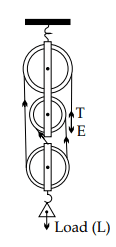
(ii) Heat energy required to raise the temperature of 1 Kg of lead by 1 K is 130 J.

2(a)2 Marks · 2016 · Section I · 2016 PaperFull page

State two factors upon which the heat absorbed by a body depends.
Show SolutionHide Solution↓

The factors on which the quantity of heat absorbed by a body depend are :

  1. The mass of the body,
  2. The increase in temperature of the body.
2(b)2 Marks · 2016 · Section I · 2016 PaperFull page

A boy uses blue colour of light to find the refractive index of glass. He then repeats the experiment using red colour of light. Will the refractive index be the same or different in the two cases? Give a reason to support your answer.

Show SolutionHide Solution↓

The speed of blue light in glass is less that of red light.

i.e. cb < cr

We know that,

$$\begin{aligned}μ = \frac{\text{Speed of light in vacuum or air (c) }}{\text {Speed of light in glass (V)}} \\[0.5em]\end{aligned}$$

Hence, the refractive index of blue light is greater than that of red light.

i.e. μb > μr.

Hence, the refractive index of red and blue light in glass will be different.

2(c)2 Marks · 2016 · Section I · 2016 PaperFull page

Copy the diagram given below and complete the path of light ray till it emerges out of the prism. The critical angle of glass is 42°. In your diagram mark the angles wherever necessary.

Copy the diagram given below and complete the path of light ray till it emerges out of the prism. The critical angle of glass is 42°. In your diagram mark the angles wherever necessary. ICSE 2016 Physics Solved Question Paper.
Show SolutionHide Solution↓

Below diagram shows the complete path of light ray till it emerges out of the prism:

Copy the diagram given below and complete the path of light ray till it emerges out of the prism. The critical angle of glass is 42°. In your diagram mark the angles wherever necessary. ICSE 2016 Physics Solved Question Paper.
2(d)2 Marks · 2016 · Section I · 2016 PaperFull page

State the dependence of angle of deviation :

(i) On the refractive index of the material of the prism.

(ii) On the wavelength of light.

Show SolutionHide Solution↓

(i) For a given angle of incidence, the prism with a higher refractive index produces greater deviation than the prism which has a lower refractive index. Thus, the angle of deviation increases with an increase in the refractive index of the material of the prism.

(ii) Angle of deviation decreases with the increases in the wavelength of light.
Angle of Deviation (δ) ∝ $\frac{1}{\text{wavelength}}$

2(e)2 Marks · 2016 · Section I · 2016 PaperFull page

The ratio of amplitude of two waves is 3 : 4. What is the ratio of their :

(i) loudness?

(ii) frequencies?

Show SolutionHide Solution↓

Given, a1 : a2 = 3 : 4

(i) Since, loudness ∝ (amplitude)2

Therefore,

$\frac{L_1}{L_2} = \Big(\frac{a_1}{a_2}\Big)^2 = \Big(\frac{3}{4}\Big)^2 = \frac{9}{16}$

(ii) The frequency of sound does not depend on it's amplitude, so the ratio of frequency f1 : f2 = 1 : 1

3(a)2 Marks · 2016 · Section I · 2016 PaperFull page

State two ways by which the frequency of transverse vibrations of a stretched string can be increased.

Show SolutionHide Solution↓

The frequency of transverse vibrations of a stretched string can be increased :

  1. Increasing the tension in the string.
  2. Decreasing the length of the string.
3(b)2 Marks · 2016 · Section I · 2016 PaperFull page

What is meant by noise pollution? Name one source of sound causing noise pollution.

Show SolutionHide Solution↓

Disturbances produced in the environment due to undesirable loud and harsh sound, of level above 120 dB is called noise pollution.

Examples of sources of noise pollution are — loudspeaker, siren, moving vehicles etc.

3(c)2 Marks · 2016 · Section I · 2016 PaperFull page

The V-I graph for a series combination and for a parallel combination of two resistors is shown in the figure below. Which of the two A or B, represents the parallel combination? Give a reason for your answer.

The V-I graph for a series combination and for a parallel combination of two resistors is shown in the figure below. Which of the two A or B, represents the parallel combination? Give a reason for your answer. ICSE 2016 Physics Solved Question Paper.
Show SolutionHide Solution↓

The slope of V-I graph gives the resistance. Since the straight line A is less steeper than B, so the straight line A represents small resistance. In parallel combination, the equivalent resistance is less than in series combination so A represents the parallel combination.

3(d)2 Marks · 2016 · Section I · 2016 PaperFull page

A music system draws a current of 400 mA when connected to a 12 V battery.

(i) What is the resistance of the music system?

(ii) The music system is left playing for several hours and finally the battery voltage drops and the music system stops playing when the current drops to 320 mA. At what battery voltage does the music system stop playing?

Show SolutionHide Solution↓

Given,

I = 400 mA = 400 x 10-3 = 0.4 A

V = 12 V

From Ohm's law,

V = IR

Substituting the values in the formula we get,

$$\begin{aligned}12 = 0.4 \times R \\[0.5em] \Rightarrow R = \frac{12}{0.4} \\[0.5em] \Rightarrow R = 30 Ω\end{aligned}$$

Hence, the resistance of the music system = 30 Ω

(b) Given,

I = 320 mA = 320 x 10-3 A = 0.32 A

R = 30 Ω

From Ohm's law,

V = IR

Substituting the values in the formula we get,

V = 0.32 x 30 = 9.6V

Hence, the battery voltage when the music system stops playing = 9.6 V

3(e)2 Marks · 2016 · Section I · 2016 PaperFull page

Calculate the quantity of heat produced in a 20 Ω resistor carrying 2.5 A current in 5 minutes.

Show SolutionHide Solution↓

Given, R = 20 Ω, I = 2.5 A, t = 5 min = 5 x 60 = 300 s

From relation H = I2Rt

Substituting the values we get,

H = (2.5)2 x 20 x 300 = 37500 J

4(a)2 Marks · 2016 · Section I · 2016 PaperFull page

State the characteristics required of a good thermion emitter.

Show SolutionHide Solution↓

The characteristics required of a good thermion emitter are :

  1. The work function of the substance should be low so that the electrons may be emitted from it even when it is not related to a high temperature.
  2. The melting point of the substance should be high so that it may not melt when it is heated to the temperature required for thermionic emitter.
4(b)2 Marks · 2016 · Section I · 2016 PaperFull page

An element ZSA decays to 85R222 after emitting 2 α particles and 1 β particle. Find the atomic number and atomic mass of the element S.

Show SolutionHide Solution↓

$_{85}\text{R}^{222}$ before the emission of β particle, would have atomic number 84, and before 2 α emissions, atomic number would have been 88. Hence, atomic number of X = 88.

$_{85}\text{R}^{222}$ before the emission of β particle, would have mass number 222, and before 2 α emissions, mass number would have been 230. Hence, mass number of X = 230.

4(c)2 Marks · 2016 · Section I · 2016 PaperFull page

A radioactive substance is oxidized. Will there be any change in the nature of it's radioactivity? Give a reason for your answer.

Show SolutionHide Solution↓

There is no change in the nature of the radioactivity of the substance on being oxidized. It is so because radioactivity is a nuclear phenomenon so any physical change like oxidation does not affect the nature of radioactivity of the substance.

4(d)2 Marks · 2016 · Section I · 2016 PaperFull page

State the characteristics required in a material to be used as an effective fuse wire.

Show SolutionHide Solution↓

The characteristics required in a material to be used as an effective fuse wire are :

  1. The melting point should be low,
  2. The specific resistance should be high.
4(e)2 Marks · 2016 · Section I · 2016 PaperFull page

Which coil of a step up transformer is made thicker and why?

Show SolutionHide Solution↓

Primary Coil is made thicker than the secondary coil in a step up transformer. As current in primary coil is more than in the secondary coil so the wire in the primary coil is kept thicker.
The use of thicker wire in a coil reduces it's resistance and therefore, reduces the loss of energy as heat in that coil.

5(a)3 Marks · 2016 · Section II · 2016 PaperFull page

A stone of mass 'm' is rotated in a circular path with a uniform speed by tying a strong string with the help of your hand. Answer the following questions:

(i) Is the stone moving with a uniform or variable speed?

(ii) Is the stone moving with a uniform acceleration? In which direction does the acceleration act?

(iii) What kind of force acts on the hand and state it's direction?

Show SolutionHide Solution↓

(i) The stone is moving with uniform speed.

(ii) Yes, the stone is moving with a uniform acceleration. The acceleration acts towards the centre.

(iii) Centrifugal force acts on the hand. It is directed radially outwards away from the centre.

5(b)3 Marks · 2016 · Section II · 2016 PaperFull page

From the diagram given below, answer the questions that follow:

From the diagram given below, answer the questions that follow. What kind of pulleys are A and B? State the purpose of pulley B. What effort has to be applied at C to just raise the load L = 20 kgf? ICSE 2016 Physics Solved Question Paper.

(i) What kind of pulleys are A and B?

(ii) State the purpose of pulley B.

(iii) What effort has to be applied at C to just raise the load L = 20 kgf?

(Neglect the weight of pulley A and friction).

Show SolutionHide Solution↓

(i) A is a movable pulley and B is a fixed pulley.

(ii) The purpose of pulley B is to change the direction of effort (i.e., in downward direction).

(iii) Given, Load = 20 kgf , M.A. = 2

From relation,

$\text{M.A.} = \frac{\text{L}}{\text{E}}$

Substituting the values in the formula above we get,

$$\begin{aligned}2 = \frac{20}{\text{E}} \\[0.5em] \Rightarrow \text{E} = \frac{20}{2} \\[0.5em] \Rightarrow \text{E} = 10 \text{ kgf}\end{aligned}$$

5(c)4 Marks · 2016 · Section II · 2016 PaperFull page

(i) An effort is applied on the bigger wheel of a gear having 32 teeth. It is used to turn a wheel of 8 teeth. Where is it used?

(ii) A pulley system has three pulleys. A load of 120 N is overcome by applying an effort of 50 N. Calculate the Mechanical Advantage and Efficiency of this system.

Show SolutionHide Solution↓

(i) In a gear system, the wheel on which effort is applied is called driving gear and other one is called driven gear. If number of teeth are more in driving gear than the driven gear, then we gain in speed.

(ii) Given, Load = 120 N and E = 50 N,

From relation,

$\text{M.A.} = \frac{\text{L}}{\text{E}}$

Substituting the values in the formula above we get,

$$\begin{aligned}\text{M.A.} = \frac{120}{50} \\[0.5em] \Rightarrow \text{M.A.}= 2.4\end{aligned}$$

V.R. = 3

$\text{Efficiency (η)} = \frac{\text{M.A.}}{\text{V.R.}} \times 100%$

Substituting the values in the formula above we get,

$$\begin{aligned}\text{η} = \frac{2.4}{3}\% \\[0.5em] \text{η} = 80\%\end{aligned}$$

6(a)3 Marks · 2016 · Section II · 2016 PaperFull page

(i) What is the principle of method of mixtures?

(ii) What is the other name given to it?

(iii) Name the law on which the principle is based.

Show SolutionHide Solution↓

(i) According to principle of mixtures, heat lost by a hot body is always equal to the heat gained by a cold body provided no heat is lost to the surroundings.

(ii) The principle of method of mixtures is also called the principle of calorimetry.

(iii) It is based on the law of conservation of energy.

6(b)3 Marks · 2016 · Section II · 2016 PaperFull page

Some ice is heated at a constant rate, and it's temperature is recorded after every few seconds, till steam is formed at 100°C. Draw a temperature time graph to represent the change. Label the two phase changes in your graph.

Show SolutionHide Solution↓

Temperature-time graph representing the change of ice to steam is shown below:

Some ice is heated at a constant rate, and it's temperature is recorded after every few seconds, till steam is formed at 100°C. Draw a temperature time graph to represent the change. Label the two phase changes in your graph. ICSE 2016 Physics Solved Question Paper.
6(c)4 Marks · 2016 · Section II · 2016 PaperFull page

A copper vessel of mass 100 g contains 150 g of water at 50 °C. How much ice is needed to cool it to 5 °C?

Given : Specific heat capacity of copper = 0.4 J g-1 ⁰C-1

Specific heat capacity of water = 4.2 J g-1 ⁰C-1

Specific latent heat of fusion of ice = 336 J g-1

Show SolutionHide Solution↓

Heat energy imparted by vessel = 100 x 0.4 x (50 - 5) = 1800 J

Heat energy imparted by water = 150 x 4.2 x (50 - 5) = 28,350 J

Let m g of ice be used, then

Heat energy taken by ice to melt = m x 336 J

Heat energy taken by melted ice to raise it's temperature from 0 °C to 5 °C = m x 4.2 x (5 - 0) = 21m J

By law of conservation of energy

heat energy imparted by vessel and water = heat energy taken by ice and melted ice

1800 + 28,350 = 336m + 21m

357 m = 30,150

m = $\frac{30150}{357}$ = 84.45 g

7(a)3 Marks · 2016 · Section II · 2016 PaperFull page

(i) Write a relationship between angle of incidence and angle of refraction for a given pair of media.

(ii) When a ray of light enters from one medium to another having different optical densities it bends. Why does this phenomenon occur?

(iii) Write one condition where it does not bend when entering a medium of different optical density.

Show SolutionHide Solution↓

(i) The ratio of the sine of angle of incidence 'i' to the sine of angle of refraction 'r' is constant for the pair of given media. This constant is called the refractive index.
1μ2 = $\frac{\text{sin i}}{\text{sin r}}$

(ii) It occurs due to change in speed of light as it enters from one medium to other medium having different optical density. If light slows down in the second medium, it bends towards the normal and if light speeds up, it bends away from the normal.

(iii) When the ray of light is incident normally on the surface of second medium, it does not bend and passes undeviated.

7(b)3 Marks · 2016 · Section II · 2016 PaperFull page

A lens produces a virtual image between the object and the lens.

(i) Name the lens.

(ii) Draw a ray diagram to show the formation of this image.

Show SolutionHide Solution↓

(i) The lens is concave.

(ii) Below ray diagram shows the formation of this image:

A lens produces a virtual image between the object and the lens. Name the lens. Draw a ray diagram to show the formation of this image. ICSE 2016 Physics Solved Question Paper.
7(c)4 Marks · 2016 · Section II · 2016 PaperFull page

What do you understand by the term 'Scattering of light'? Which colour of white light is scattered the least and why?

Show SolutionHide Solution↓

Scattering is the process of absorption and then re-emission of light energy by the dust particles and air molecules present in the atmosphere.

Red colour of white light is scattered the least because wavelength of red light (λ = 8000 Å) is longest and intensity of scattered light (I) ∝ $\frac{1}{λ^4}$.

8(a)3 Marks · 2016 · Section II · 2016 PaperFull page

(i) Name the waves used for echo depth sounding.

(ii) Give one reason for their use for the above purpose.

(iii) Why are the waves mentioned by you not audible to us?

Show SolutionHide Solution↓

(i) The waves used for echo depth sounding are ultrasonic waves.

(ii) They can travel undeviated through long distances.

(iii) Ultrasonic waves are not audible to us because they are of frequency above 20 kHz and the audible frequency range is 20 Hz to 20,000 Hz. Hence, we cannot hear ultrasonic waves.

8(b)3 Marks · 2016 · Section II · 2016 PaperFull page

(i) What is an echo?

(ii) State two conditions for an echo to take place.

Show SolutionHide Solution↓

(i) The sound heard after reflection from a distinct obstacle (such as a cliff, a hillside etc.) after the original sound has ceased is called an echo.

(ii) Conditions for an echo to take place are :

  1. The size of the reflector must be large enough as compared to the wavelength of the sound wave.
  2. The intensity of sound should be such that the reflected sound reaching the ear is sufficiently loud to be audible.
8(c)4 Marks · 2016 · Section II · 2016 PaperFull page

(i) Name the phenomenon involved in tuning a radio set to a particular station.

(ii) Define the phenomenon named by you in part (i) above.

(iii) What do you understand by loudness of sound?

(iv) In which units is the loudness of sound measured?

Show SolutionHide Solution↓

(i) Resonance.

(ii) Resonance is a special case of forced vibration. When the frequency of the externally applied periodic force on a body is equal to it's natural frequency, the body begins to vibrate with an increased amplitude. This phenomenon is known as resonance.

(iii) Loudness is the characteristic by virtue of which a loud sound can be distinguished from a faint one, both having the same pitch and quality.

(iv) The unit of loudness is phon. The level of sound is expressed in decibel (dB).

9(a)3 Marks · 2016 · Section II · 2016 Paper · 🔁 also 2017Full page

(i) Which particles are responsible for current in conductors?

(ii) To which wire of a cable in a power circuit should the metal case of a geyser be connected?

(iii) To which wire should the fuse be connected?

Show SolutionHide Solution↓

(i) Electrons

(ii) Earth Wire

(iii) Live wire

9(b)3 Marks · 2016 · Section II · 2016 PaperFull page

(i) Name the transformer used in the power transmitting station of a power plant.

(ii) What type of current is transmitted from the power station?

(iii) At what voltage is this current available to our household?

Show SolutionHide Solution↓

(i) Step-up transformer

(ii) Alternating current

(iii) 220 V

9(c)4 Marks · 2016 · Section II · 2016 PaperFull page

A battery of e.m.f. 12 V and internal resistance 2 Ω is connected with two resistors A and B of resistance 4 Ω and 6 Ω respectively joined in series.

A battery of e.m.f. 12 V and internal resistance 2 Ω is connected with two resistors A and B of resistance 4 Ω and 6 Ω respectively joined in series. Find (i) Current in the circuit (ii) The terminal voltage of the cell (iii) The potential difference across 6 Ω Resistor (iv) Electrical energy spent per minute in 4 Ω Resistor. ICSE 2016 Physics Solved Question Paper.

Find:

(i) Current in the circuit.

(ii) The terminal voltage of the cell.

(iii) The potential difference across 6 Ω Resistor.

(iv) Electrical energy spent per minute in 4 Ω Resistor.

Show SolutionHide Solution↓

Given,

RA = 4 Ω

RB = 6 Ω

e.m.f. = 12 V

r = 2 Ω

(i) Two resistors ( 4 Ω and 6 Ω) are connected in series, so Rs = 4 + 6 = 10 Ω

From relation,

I = $\frac{𝐸}{𝑅 + 𝑟}$

Substituting the values we get,

$$\begin{aligned}I = \frac{12}{10 + 2} \\[0.5em] I = \frac{12}{12} \\[0.5em] \Rightarrow I = 1 A\end{aligned}$$

(ii) Terminal voltage of cell V = ε - Ir

Substituting the values we get,

$$\begin{aligned}V = 12 - (1 \times 2) \\[0.5em] V = 12 - 2 \\[0.5em] \Rightarrow V = 10 V\end{aligned}$$

(iii) P.d. across 6 Ω resistor = I R6Ω

Substituting the values we get,

V6Ω = 1 x 6 = 6 V

(iv) Electrical energy spent per minute (60 s) in 4 Ω Resistor = I2RAt = 1 x 4 x 60 = 240 J

10(a)3 Marks · 2016 · Section II · 2016 PaperFull page

Arrange α, β and γ rays in ascending order with respect to their

(i) Penetrating power.

(ii) Ionising power.

(iii) Biological effect.

Show SolutionHide Solution↓

(I) Increasing order of penetrating power of α, β and γ rays is α<β<γ.

(ii) Increasing order of ionising power of α, β and γ rays is γ<β<α.

(iii) Increasing order of biological effect of α, β and γ rays is α<β<γ.

10(b)3 Marks · 2016 · Section II · 2016 PaperFull page

(i) In a cathode ray tube what is the function of anode?

(ii) State the energy conversion taking place in a cathode ray tube.

(iii) Write one use of cathode ray tube.

Show SolutionHide Solution↓

(i) In a cathode ray tube, the anode accelerates the electrons and also focuses them in a fine energetic beam.

(ii) In a cathode ray tube, electric energy is converted into heat energy and then into light energy.

(iii) Cathode ray tube is used in oscilloscopes, which find their application in physics laboratories.

10(c)4 Marks · 2016 · Section II · 2016 PaperFull page

(i) Represent the change in the nucleus of a radioactive element when a β particle is emitted.

(ii) What is the name given to elements with same mass number and different atomic number?

(iii) Under which conditions does the nucleus of an atom tend to be radioactive?

Show SolutionHide Solution↓

(i) If a radioactive nucleus P with mass number A and atomic number Z emits a β particle to form a daughter nucleus Q with mass number A and atomic number Z + 1, the change can be represented as follows:

$$\begin{matrix} _{Z}^{A}\text{P} & \longrightarrow & _{Z+1}^{\space \space \space \space \space A}\text{Q} & + & \space _{-1}^{\space \space \space 0}\text{e} \\ \footnotesize{\text{Parent}} & & \footnotesize{\text{Daughter}} & & \footnotesize{\text{Beta}} \\ \footnotesize{\text{nucleus}} & & \footnotesize{\text{nucleus}} & & \footnotesize{\text{particle}} \end{matrix}$$

ii) Elements with same mass number A, but different atomic number Z are called isobars.

iii) The nucleus of an atom tend to be radioactive when the number of neutrons is more than the number of protons. The nucleus thus becomes unstable and in order to gain stability it tends to emit α, β, γ radiations.

Use ↑ ↓ to move between questions. Press ↓ once to reveal a solution.

Free sample bank