In the diagram given below, a concave (L1) and a convex (L2) lens of focal lengths 20 cm and 12 cm respectively are placed parallel to each other such that they have a common principal axis. Study the path of the ray through the lenses.
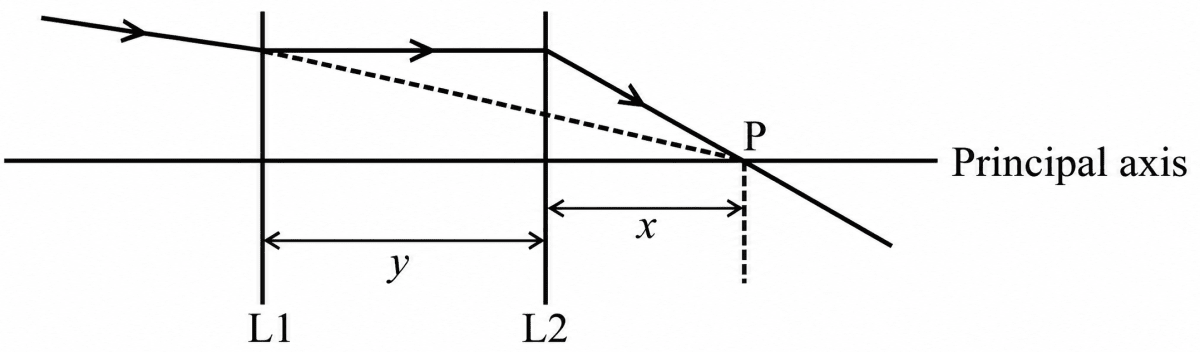
(a) Calculate the lengths of 'x' and 'y'.
(b) Define point P with respect to the concave lens (L1).
Show SolutionHide Solution↓
Given,
- Focal length of the concave lens L1 = 20 cm
- Focal length of the convex lens L2 = 12 cm
(a) Length x :
From the diagram, the ray travelling between the two lenses is parallel to the principal axis. A ray of light incident parallel to the principal axis of a convex lens passes, after refraction, through its second focal point.
Hence P is the second focal point of the convex lens L2, so
x = focal length of L2 = 12 cm
Length y :
The dotted line in the diagram shows that the ray incident on the concave lens L1 is directed towards the point P. After refraction through L1 this ray becomes parallel to the principal axis. This happens only when the incident ray is directed towards the first focal point of the concave lens.
Hence P is the first focal point of L1, so
Distance of P from L1 = focal length of L1 = 20 cm
Then,
y + x = 20
⇒ y = 20 - x = 20 - 12 = 8 cm
Hence, x = 12 cm and y = 8 cm.
(b) With respect to the concave lens L1, the point P is its first focal point (first focus) i.e., the point on the principal axis of the lens such that the incident rays of light appearing to meet at it become parallel to the principal axis after refraction through the lens.