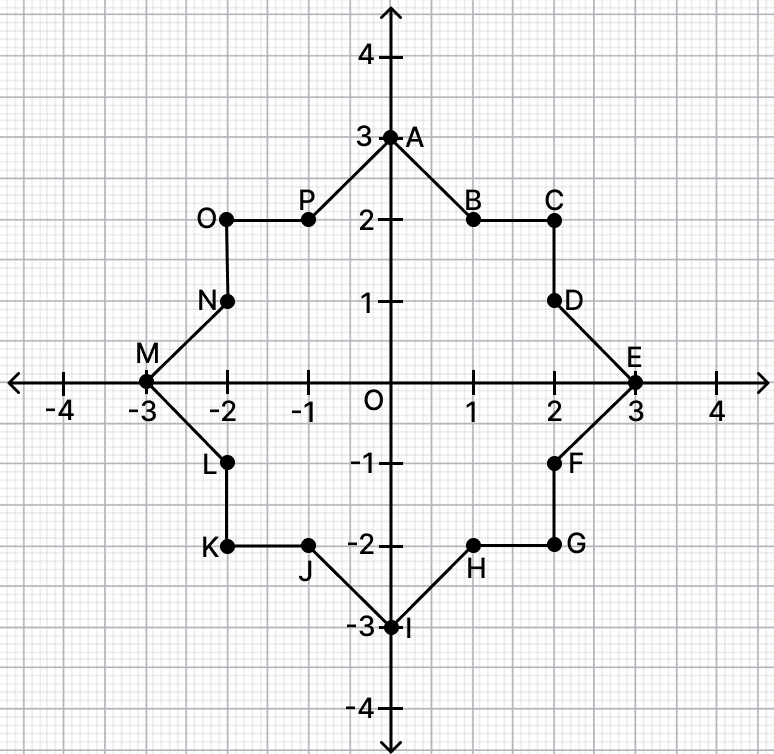
(a) From the graph,
The coordinates of the points are A(0, 3), B(1, 2), C(2, 2), D(2, 1) and E(3, 0).
(b) We know that,
The image of a point $(x, y)$ under reflection on the y-axis is $(-x, y)$.
∴ Image of A(0, 3) on reflection in y-axis is (0, 3).
Since, A lies on the y-axis, it remains invariant under reflection on the y-axis.
Hence, the image of A under reflection on the y-axis is A(0, 3).
(c) We know that,
The image of a point $(x, y)$ under reflection through the origin is $(-x, -y)$.
∴ Image of C(2, 2) on reflection in origin is (−2, −2).
From the graph, the point (−2, −2) is the point K.
Hence, the image of C under reflection through the origin is K(−2, −2).
(d) We know that,
The image of a point $(x, y)$ under reflection on the y-axis is $(-x, y)$.
So, on reflecting the polygon ABCDEFGHI on the y-axis, each vertex is mapped to the point lying at the same distance from the y-axis but on the opposite side of it.
Since, the vertices A and I lie on the y-axis, they remain invariant under reflection on the y-axis.
From the graph, the images of the vertices of the polygon under reflection in y-axis are :
A → A, B → P, C → O, D → N, E → M, F → L, G → K, H → J and I → I
Thus, on joining these image points in order, we get the polygon APONMLKJI, which is the mirror image of the polygon ABCDEFGHI in the y-axis.
Hence, the image of the polygon ABCDEFGHI under reflection on the y-axis is the polygon APONMLKJI.
(e) From the graph,
N = (−2, 1) and D = (2, 1)
Since, both the points have the same ordinate (y-coordinate) equal to 1, the line joining them is parallel to the x-axis.
Hence, the equation of the line joining the points N and D is $\bm{y}$ = 1.