In the given diagram, AD ∥ GE ∥ BC, DE = 18 cm, EC = 3 cm, AD = 35 cm. Find :
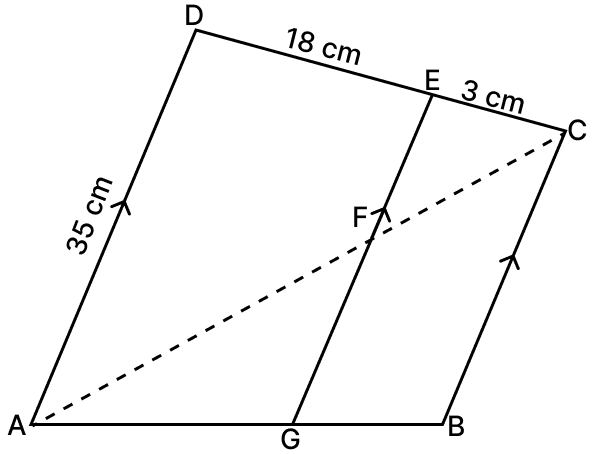
(a) AF : FC and AG : GB
(b) length of EF
(c) area (trapezium ADEF) : area (∆ EFC)
Show SolutionHide Solution↓
Given,
AD ∥ GE ∥ BC, DE = 18 cm, EC = 3 cm and AD = 35 cm
(a) In ∆ADC,
Since, GE ∥ AD, we have FE ∥ AD.
By Basic Proportionality Theorem (B.P.T.),
$$\begin{aligned}\Rightarrow \frac{AF}{FC} = \frac{DE}{EC} \\[1em] \Rightarrow \frac{AF}{FC} = \frac{18}{3} \\[1em] \Rightarrow \frac{AF}{FC} = \frac{6}{1}.\end{aligned}$$
∴ AF : FC = 6 : 1
In ∆ABC,
Since, GE ∥ BC, we have GF ∥ BC.
By Basic Proportionality Theorem (B.P.T.),
$\frac{AG}{GB} = \frac{AF}{FC} = \frac{6}{1}$
∴ AG : GB = 6 : 1.
Hence, AF : FC = 6 : 1 and AG : GB = 6 : 1.
(b) In ∆ADC and ∆FEC,
⇒ ∠ADC = ∠FEC [Corresponding angles as AD ∥ FE]
⇒ ∠ACD = ∠FCE [Common angle]
∴ ∆ADC ~ ∆FEC (By A.A. axiom)
We know that,
Corresponding sides of similar triangles are proportional.
$$\begin{aligned}\therefore \frac{EF}{AD} = \frac{EC}{DC} \\[1em] \Rightarrow \frac{EF}{35} = \frac{3}{18 + 3} \\[1em] \Rightarrow \frac{EF}{35} = \frac{3}{21} \\[1em] \Rightarrow EF = \frac{35 \times 3}{21} \\[1em] \Rightarrow EF = 5 \text{ cm}.\end{aligned}$$
Hence, length of EF = 5 cm.
(c) We know that,
The ratio of the areas of two similar triangles is equal to the ratio of the squares of their corresponding sides.
⇒ $\frac{\text{Area of ∆ADC}}{\text{Area of ∆EFC}} = \frac{AD^2}{EF^2}$
From the figure,
Area of trapezium ADEF = Area of ∆ADC − Area of ∆EFC
Dividing each side by Area of ∆EFC,
$$\begin{aligned}\therefore \frac{\text{Area of trapezium ADEF}}{\text{Area of ∆EFC}} = \frac{\text{Area of ∆ADC} - \text{Area of ∆EFC}}{\text{Area of ∆EFC}} \\[1em] = \frac{\text{Area of ∆ADC}}{\text{Area of ∆EFC}} - \frac{\text{Area of ∆EFC}}{\text{Area of ∆EFC}}\\[1em] = \frac{AD^2}{EF^2} - 1 \\[1em] = \frac{35^2}{5^2} - 1 \\[1em] = \frac{1225}{25} - 1 \\[1em] = \frac{1225 - 25}{25} \\[1em] = \frac{1200}{25} \\[1em] = \frac{48}{1}.\end{aligned}$$
Hence, area (trapezium ADEF) : area (∆ EFC) = 48 : 1.