Covalent Reason — As compound X consists of molecules, it means that compound X is a covalent compound. Electrovalent compounds consist of ions. Hence, bonding in X is covalent.
2(2008)Previous Questions — Short Answer
State what is the term defined in:- a bond formed by shared pair of electrons each bonding atom contributing one electron to the pair.
Show SolutionHide Solution↓
Single covalent bond
3(2014)Previous Questions — Short Answer
The molecule which contains a triple covalent bond is:
A: ammonia B: methane C: water D: nitrogen
Show SolutionHide Solution↓
Nitrogen Reason — As the electronic configuration of N is [2,5] so when two nitrogen atoms come closer, each contributes three electrons and they have three shared pair of electrons between them. Therefore, it forms triple covalent bond [N ≡ N].
1(2006)Previous Questions — Long Answer
State what is a lone pair of electrons.
Show SolutionHide Solution↓
Lone pair of electrons are valence electrons that in a covalent bond are not shared with another atom.
2(2007)Previous Questions — Long Answer
The electronic configuration of nitrogen is 2,5. How many electrons in the outer shell of a nitrogen atom are not involved in the formation of a nitrogen molecule.
Show SolutionHide Solution↓
Nitrogen has 5 electrons in its valence shell. In the formation of a nitrogen molecule, each nitrogen atom shares three electrons to complete its octet. Hence, 2 electrons in the outer shell of each nitrogen atom are not involved in bond formation. Formation of a nitrogen molecule from nitrogen atoms is shown in the diagram below:
3(2009)Previous Questions — Long Answer
Draw the atomic orbit structure of carbon tetrachloride and state the type of bond present in it.
Show SolutionHide Solution↓
Atomic orbit structure of carbon tetrachloride is shown below:
Type of bond present in carbon tetrachloride is Covalent Bond
(ii) Carbon tetrachloride — covalent bond/ionic bond/covalent and coordinate bond.
Show SolutionHide Solution↓
(i) Sodium chloride — ionic bond.
(ii) Carbon tetrachloride — covalent bond.
5(2011)Previous Questions — Long Answer
(i) In covalent compounds, the bond is formed due to ............... [sharing/transfer] of electrons.
(ii) A molecule of ............... contains a triple bond. [hydrogen/ammonia/nitrogen]
Show SolutionHide Solution↓
(i) In covalent compounds, the bond is formed due to sharing of electrons.
(ii) A molecule of nitrogen contains a triple bond.
6(2015)Previous Questions — Long Answer
State the bonding in methane molecule.
Show SolutionHide Solution↓
Methane consists of one carbon atom [2,4] and four hydrogen atoms [1]. Carbon needs four electrons to attain a stable electronic configuration of nearest noble gas - Ne, whereas, hydrogen needs one electron to attain stable electronic configuration of nearest noble gas - He.
Therefore, one atom of carbon shares four electron pairs one with each of the four hydrogen atoms, resulting in formation of methane molecule.
The atomic orbit structure diagram of the formation of methane molecule is shown below:
1Additional Questions — Short Answer
Name -
(a) an atom with electronic configuration 2, 8, 6
(b) A gaseous covalent molecule with four covalent bonds.
Show SolutionHide Solution↓
(a) An atom with electronic configuration 2, 8, 6 is Sulphur.
(b) A gaseous covalent molecule with four covalent bonds is Methane
1Additional Questions — Long Answer
Define the term 'chemical bond' and 'chemical bonding'.
Show SolutionHide Solution↓
The force which acts between two or more atoms to hold them together as a stable molecule is called a chemical bond and the concept is called chemical bonding.
2Additional Questions — Long Answer
Give a reason why noble gases have stable electronic configuration while atoms of other elements have unstable electronic configuration.
Show SolutionHide Solution↓
Octet and duplet structures seem to represent stability and are said to be stable electronic configuration.
Noble gases have their outermost or valence shell complete i.e., they have 2 electrons in outermost shell e.g., helium [electronic configuration 2] or they have 8 electrons in outermost shell e.g., neon [electronic configuration 2,8] or argon [electronic configuration 2,8,8 ]. Hence, they have stable electronic configuration. They do not gain, lose or share electrons and are unreactive or inert.
Atoms of other elements have incomplete valence shell, hence they have unstable electronic configuration. So, they can gain, lose or share electrons to attain the stable electronic configuration of the nearest noble gas.
3Additional Questions — Long Answer
State how atoms of other elements other than noble gases, attain stable electronic configuration of the nearest noble gas.
Show SolutionHide Solution↓
Atoms of elements other than noble gases, attain stable electronic configuration of the nearest noble gas by:
Transfer of valence electrons from a metallic atom to a non-metallic atom.
Mutual sharing of electrons between two pairs of atoms of non-metallic elements.
4Additional Questions — Long Answer
Define each of the following terms -
(a) electrovalent bond
(b) electrovalent compound
(c) covalent bond
(d) covalent compound
with suitable examples wherever required.
Show SolutionHide Solution↓
(a) The chemical bond formed between the two atoms by transfer of one or more electrons from the atom of a metallic element to an atom of a non-metallic element is called an electrovalent bond.
(b) The chemical compound formed as a result of transfer of one or more electrons from the atom of a metallic element to an atom of a non-metallic element is called an electrovalent compound. e.g., NaCl, CaO
(c) The chemical bond formed due to mutual sharing of electrons between the given pairs of atoms of non-metallic elements is called a covalent bond.
(d) The chemical compound formed due to mutual sharing of electrons between the given pair of non-metallic elements is called a covalent compound. e.g., Chlorine molecule, Oxygen molecule.
5Additional Questions — Long Answer
State what is meant by - (a) duplet rule (b) octet rule.
Show SolutionHide Solution↓
(a) Duplet Rule — For an atom to achieve stable electronic configuration it must have 2 electrons in the first shell [outermost] like that of noble gas Helium.
(b) Octet Rule — For an atom to achieve stable electronic configuration it must have 8 electrons in outermost orbit like that of noble gases other than Helium.
6Additional Questions — Long Answer
Sodium chloride is formed as a result of - transfer of electrons from metallic sodium atom to non-metallic chlorine atom. With the help of atomic orbit structure diagram - show the formation of sodium chloride [Atomic numbers: Na = 11, Cl = 17].
Show SolutionHide Solution↓
Atomic orbit structure diagram of the formation of sodium chloride by transfer of electrons from metallic sodium atom to non-metallic chlorine atom is shown below:
7Additional Questions — Long Answer
Atomic number of calcium is 20 and of oxygen is 8. State the number of electrons - calcium loses and oxygen gains to attain stable electronic configuration of the nearest noble gas - during formation of electrovalent molecule, calcium oxide.
Show SolutionHide Solution↓
Calcium oxide is formed as a result of transfer of two valence electrons
from metallic calcium atom 4020Ca; electronic configuration - 2,8,8,2 ; Nearest noble gas = Argon [2,8,8]
to non-metallic oxygen atom 168O - electronic configuration - 2,6 ; Nearest noble gas = Neon [2,8]
calcium loses two electrons - from its outer shell to attain stability of nearest noble gas - argon and becomes a calcium ion [cation] : Ca2+
oxygen accepts two electrons - in outer shell to attain stability of nearest noble gas - neon and becomes an oxide ion [anion] : O2-
8Additional Questions — Long Answer
Explain with the help of atomic orbit structure diagram the formation of calcium oxide.
Show SolutionHide Solution↓
Atomic orbit structure diagram of the formation of calcium oxide is shown below:
Calcium oxide is formed as a result of transfer of two valence electrons
from metallic calcium atom 4020Ca; electronic configuration - 2,8,8,2 ; Nearest noble gas = Argon [2,8,8]
to non-metallic oxygen atom 168O - electronic configuration - 2,6 ; Nearest noble gas = Neon [2,8]
calcium loses two electrons - from its outer shell to attain stability of nearest noble gas - argon and becomes a calcium ion [cation] : Ca2+
oxygen accepts two electrons - in outer shell to attain stability of nearest noble gas - neon and becomes an oxide ion [anion] : O2-
9Additional Questions — Long Answer
Give a reason why - in the formation of electrovalent compound - magnesium chloride, one magnesium atom combines with two chlorine atoms to give magnesium chloride. [at. no. Mg=12, Cl=17, ]
Show SolutionHide Solution↓
Magnesium [At. no. 12 and electronic configuration 2,8,2] loses two electrons from it's outer shell in order to attain stability of nearest noble gas Neon [2,8] and becomes a magnesium ion [cation] : Mg2+.
Chlorine [At. no. 17 and electronic configuration 2,8,7] accepts one electron in it's outer shell to attain stability of nearest noble gas Argon [2,8,8] and becomes a chloride ion [anion] : Cl1-.
Magnesium atom donates two electrons, whereas chlorine accepts one electron to give - chloride ion. Therefore, to accept the other electron donated by magnesium atom there must be another chlorine atom. Thus, one magnesium atom combines with two chlorine atoms to give MgCl2
10Additional Questions — Long Answer
'Formation of hydrogen molecule takes place by sharing of electrons'. Give a reason why the molecule of hydrogen is not formed by transfer of electrons.
Show SolutionHide Solution↓
Hydrogen is a non-metal and has 1 valence electron. To attain a stable duplet electronic configuration, each hydrogen atom needs one more electron. As both the combining atoms are one electron short, none of them can donate an electron. Hence, they share one pair of electrons and attain a stable duplet configuration.
11Additional Questions — Long Answer
Draw the atomic orbit structure diagram for formation of -
(a) hydrogen molecule
(b) chlorine molecule
(c) oxygen molecule
(d) nitrogen molecule
[at. no. H=1, Cl=17, O=8, N=7]
Show SolutionHide Solution↓
(a) Atomic orbit structure diagram for formation of hydrogen molecule is shown below:
(b) Atomic orbit structure diagram for formation of chlorine molecule is shown below:
(c) Atomic orbit structure diagram for formation of oxygen molecule is shown below:
(d) Atomic orbit structure diagram for formation of nitrogen molecule is shown below:
12Additional Questions — Long Answer
Give reasons for formation of single covalent bond between two chlorine atoms and a double covalent bond between two oxygen atoms - during formation of respective covalent molecules.
Show SolutionHide Solution↓
Atomic number of Cl is 17 and elect. config. is [2,8,7]. As both the Cl atoms require one electron to complete it's octet, hence, they both will share 1 electron and will attain a stable electronic configuration of the nearest noble gas — argon. Therefore, single covalent bond is formed during formation of a chlorine molecule.
Atomic number of O is 8 and elect. config. is [2,6]. As both the O atoms require two electrons to complete their octet, hence, they both will share 2 electrons and will attain a stable electronic configuration of the nearest noble gas — neon. Therefore, double covalent bond is formed during formation of a oxygen molecule.
13Additional Questions — Long Answer
Draw the atomic orbit structure diagram for formation of a -
(a) water molecule
(b) ammonia molecule
[at. no. H=1, O=8, N=7]
Show SolutionHide Solution↓
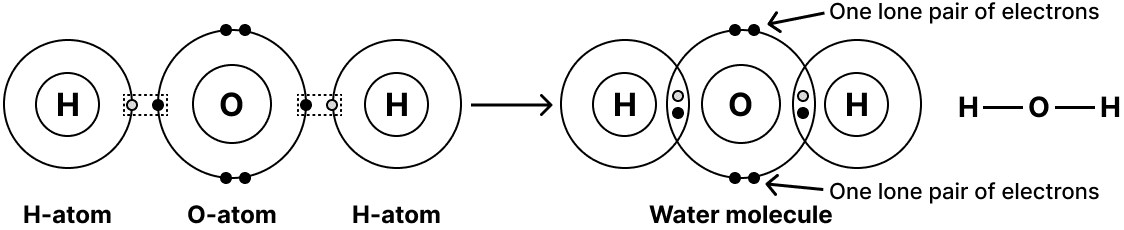
(a) Atomic orbit structure diagram for formation of water molecule is shown below:
(b) Atomic orbit structure diagram for formation of ammonia molecule is shown below:
14Additional Questions — Long Answer
With the help of an atomic orbit structure diagram - explain the formation of :
(a) carbon tetrachloride
(b) methane
[at. no. : C=6, Cl=17, H=1]
Show SolutionHide Solution↓
(a) Atomic orbit structure diagram for formation of carbon tetrachloride molecule is shown below:
(b) Atomic orbit structure diagram for formation of methane molecule is shown below:
15Additional Questions — Long Answer
Explain the formation of a radical from a covalent bond with an example.
Show SolutionHide Solution↓
Radical formation occurs when a covalent bond breaks symmetrically, with each atom retaining one electron of the shared pair. This results in the formation of two radicals. The process is called bond fission and is initiated by light, heat or certain chemicals.
A—B $\xrightarrow{\text{light energy}}$ A● + B●
11 Mark · Multiple Choice Questions
Assertion: Noble gases have stable electronic configuration.
Reason: Atoms of elements other than noble gases have incomplete valence shell.
(a)Both A and R are true and R is the correct explanation of A.
(b)Both A and R are true but R is not the correct explanation of A.
(c)A is true and R is false.
(d)A is false and R is true.
Show SolutionHide Solution↓
Both A and R are true but R is not the correct explanation of A.
Reason — A is true as noble gases have completely filled valence shells making them chemically stable. R is true as except noble gases, other elements do not have completely filled outermost shells.
Therefore, Both A and R are true but R is not the correct explanation of A is the correct option.
21 Mark · Multiple Choice Questions
An element 'X' has same number of electrons in its first & in its outermost shell. The electronic configuration of X2+ is :
(a)2, 8, 1
(b)2, 8
(c)2, 8, 2
(d)2, 8, 8
Show SolutionHide Solution↓
Both 2,8 and 2,8,8 can be correct.
Reason — The first shell can have a maximum of 2 electrons. Since element X has the same number of electrons in its first shell and in its outermost shell, its outermost shell also contains 2 electrons.
Thus, X may have electronic configuration:
2,8,2 — on losing 2 electrons, X2+ becomes 2,8
2,8,8,2 — on losing 2 electrons, X2+ becomes 2,8,8
Hence, both 2,8 and 2,8,8 are possible electronic configurations of X2+. Therefore, the question has two correct options unless the atomic number or period of element X is specified.
31 Mark · Multiple Choice Questions
An element 'A' needs 4 electrons to attain stable electronic configuration of the nearest noble gas — Neon. An element 'B' needs 1 electron to attain stable electronic configuration of the nearest noble gas — Argon. The covalent compound formed between A & B is :
(a)AB3
(b)A4B
(c)A2B4
(d)AB4
Show SolutionHide Solution↓
AB4
Reason — Electronic configuration of A = 2, 4 Element A needs 4 electrons to attain Neon configuration as it has 4 valence electrons. Therefore, valency of A = 4.
Electronic configuration of B = 2, 8, 7 Element B needs 1 electron to attain Argon configuration as it has 7 valence electrons. Therefore, valency of B = 1.
State why water has two lone pairs of electrons in it's covalent molecule, ammonia has one lone pair & methane has no lone pairs in its molecule.
Show SolutionHide Solution↓
Water contains two hydrogen atoms and one oxygen atom. The hydrogen atom [1] has one electron in it's valence shell while the oxygen atom [2,6] has 6 electrons in it's valence shell. Two hydrogen atom share one electron each and two unshared pairs of electrons are left as lone pairs as shown in the diagram below :
In the case of ammonia, it contains three hydrogen atoms and one nitrogen atom. Nitrogen atom [2,5] has five valence electrons and hydrogen atom [1] has one valence electron. In ammonia, each of the three hydrogen atoms are bonded to the nitrogen atom by a pair of shared electrons. Thus, the nitrogen atom in ammonia is left with one lone pair of electrons as shown in the diagram below:
In methane, carbon has 4 valence electrons. All four electrons are used in forming four covalent bonds with hydrogen atoms, so no electrons remain unshared. Hence, methane has no lone pairs.
1Unit Test Paper 4 - Chemical Bonding
Name the following:
(a)An electrovalent compound formed by transfer of one electron from a metallic atom to a non-metallic atom.
(b)A covalent hydrocarbon molecule, having four single covalent bonds.
(c)A covalent molecule, having two lone pair of electrons.
(d)A covalent molecule having a triple covalent bond.
(e)A covalent molecule having two shared pairs of electrons in its molecule.
Show SolutionHide Solution↓
Sodium chloride [NaCl]
Methane [CH4]
Water [H2O]
Nitrogen [N ≡ N]
Oxygen [O = O]
2Unit Test Paper 4 - Chemical Bonding
Give reasons for the following :
To attain stable electronic configuration of the nearest noble gas —
(a)Hydrogen atom 11H — needs one electron.
(b)Oxygen atom 168O — needs two electrons.
(c)Nitrogen atom 147N — needs three electrons.
(d)Carbon atom 126C — needs four electrons.
(e)Chlorine atom 3517Cl — needs one electron.
Show SolutionHide Solution↓
As the atomic number of H is 1 and its electronic configuration is 1, it needs one electron to attain the nearest noble gas He configuration, i.e. 2 electrons in the first shell (duplet rule).
As the atomic number of O is 8 and its electronic configuration is 2,6, it needs two electrons to attain the nearest noble gas Ne configuration, i.e. 8 electrons in the valence shell (octet rule).
As the atomic number of N is 7 and its electronic configuration is 2,5, it needs three electrons to attain the nearest noble gas Ne configuration, i.e. 8 electrons in the valence shell (octet rule).
As the atomic number of C is 6 and its electronic configuration is 2,4, it needs four electrons to attain the nearest noble gas Ne configuration, i.e. 8 electrons in the valence shell (octet rule).
As the atomic number of Cl is 17 and its electronic configuration is 2,8,7, it needs one electron to attain the nearest noble gas Ar configuration, i.e. 8 electrons in the valence shell (octet rule).
3Unit Test Paper 4 - Chemical Bonding
Complete the table given below, pertaining to formation of covalent compounds :
Formation of a covalent compound between
Atomic number
No. of covalent bonds in molecule
(a) Two atoms of 'A'
9
(b) Two atoms of 'B'
7
(c) Two atoms of 'C'
8
(d) Two atoms of 'D'
1
(e) Two atoms of 'E'
17
Show SolutionHide Solution↓
Formation of a covalent compound between
Atomic number
No. of covalent bonds in molecule
(a) Two atoms of 'A'
9
1 covalent bond
(b) Two atoms of 'B'
7
3 covalent bonds
(c) Two atoms of 'C'
8
2 covalent bonds
(d) Two atoms of 'D'
1
1 covalent bond
(e) Two atoms of 'E'
17
1 covalent bond
4(1)Unit Test Paper 4 - Chemical Bonding
Differentiate between the following with a suitable example :
Lone pair & shared pair of electrons.
Show SolutionHide Solution↓
Lone Pair
Shared Pair
Lone pair of electrons are valence electrons that in a covalent bond are not exchanged with another atom and is often called an unshared pair or non-bonding pair.
Shared pair of electrons are valence electrons shared by two atoms to form covalent bond.
Example: Ammonia molecule has one lone pairs of electrons
Example: Water has two shared pair of electrons.
4(2)Unit Test Paper 4 - Chemical Bonding
Differentiate between the following with a suitable example :
Duplet rule & octet rule.
Show SolutionHide Solution↓
Duplet Rule
Octet Rule
For an atom to achieve stable electronic configuration, it must have 2 electrons in the first shell [outermost], like that of noble gas helium.
For an atom to achieve stable electronic configuration, it must have 8 electrons in the outermost shell, like that of noble gases other than helium.
Example: Hydrogen atom attains duplet in H2.
Example: Oxygen atom attains octet in O2.
4(3)Unit Test Paper 4 - Chemical Bonding
Differentiate between the following with a suitable example :
Atoms having their valence shell completely filled are said to have Stable Electronic Configuration.
Atoms which do not have their valence shells completely filled are said to have Unstable Electronic Configuration.
Atoms of noble gases have Stable Electronic Configuration.
Atoms of elements other than noble gases have Unstable Electronic Configuration.
In atoms with Stable Electronic Configuration, electrons are arranged as per Duplet or Octet rule.
In atoms with Unstable Electronic Configuration, arrangement of electrons does not follow Duplet or Octet rule.
4(4)Unit Test Paper 4 - Chemical Bonding
Differentiate between the following with a suitable example :
Electrovalent bond & covalent bond
Show SolutionHide Solution↓
Electrovalent bond
Covalent bond
The chemical bond formed between the two atoms by transfer of one or more electrons from the atom of a metallic element to an atom of a non-metallic element is called an electrovalent bond.
The chemical bond formed due to mutual sharing of electrons between the given pair of atoms of non-metallic elements is called a covalent bond.
e.g., NaCl, CaO
e.g., Chlorine molecule, oxygen molecule
4(5)Unit Test Paper 4 - Chemical Bonding
Differentiate between the following with a suitable example :
Single covalent bond & triple covalent bond.
Show SolutionHide Solution↓
Single Covalent Bond
Triple Covalent Bond
The chemical bond formed due to mutual sharing of one pair of electrons between the given pair of atoms of non-metallic elements is called a Single Covalent Bond.
The chemical bond formed due to mutual sharing of three pairs of electrons between the given pair of atoms of non-metallic elements is called a Triple Covalent Bond.
E.g., Hydrogen [H - H]
E.g., Nitrogen [N ≡ N]
5Unit Test Paper 4 - Chemical Bonding
Atomic numbers of the following elements are given below:
A = 8; B = 7; C = 17; D = 11; E = 20
(a)State which of the above is a divalent metal.
(b)State which of the above is a non-metal.
(c)State the type of bonding between two atoms of 'A'.
(d)State the type of bonding between 'D' & 'C'.
(e)State the number of covalent bonds formed in a molecule of 'B2'.
Show SolutionHide Solution↓
E is a divalent metal as it has 2 electrons in the valence shell [electronic configuration 2,8,8,2] and it tends to lose two electrons in order to gain a stable octet configuration.
C is a non-metal as it's electronic configuration is 2,8,7 and it tends to gain one electron to attain a stable state.
Double covalent bond as the electronic configuration of A is 2,6 [non-metal], both A atoms will try to gain 2 electrons to attain a stable octet and none of the combining atoms are in a position to donate. Hence, they form the bond by sharing of 2 valence electrons and form a double covalent bond.
Electrovalent bond as the elect. configuration of D = [2,8,1] and C = [2,8,7], hence, D donates one electron and becomes a cation whereas C takes up one electron and becomes an anion. The attractive force between a cation and anion results in formation of an electrovalent bond.
Triple covalent bond as the electronic configuration of B is [2,5], hence, B needs 3 electrons to attain a stable octet configuration and hence forms a triple covalent bond.
6Unit Test Paper 4 - Chemical Bonding
The representation below shows the outline formation of an electrovalent compound.
If the atomic number of element 'X' is 11 and of element 'Y' is 17 —
(a)State why an electron is transferred from 'X' to 'Y' during the formation of 'X Y'
(b)Give a reason why electrons are not shared between 'X' & 'Y' — during the formation of 'XY'
(c)State the difference between 'X' and 'X1+'
(d)Does 'Y1-' have a stable or an unstable electronic configuration.
(e)If a compound is formed from atom A [at. no.19] and an atom Y [at. no. 17], would the compound 'AY' be an electrovalent or covalent compound. Give reasons.
Show SolutionHide Solution↓
As the electronic configuration of X is [2,8,1] and Y is [2,8,7], hence X donates one electron and Y accepts one electron in order to attain stable octet configuration. Hence, electron is transferred from X to Y.
Sharing of electrons mainly takes place between a pair of non-metals and as X [2,8,1] is a metal and Y is a non-metal [2,8,7]. Hence, electrons are not shared between 'X' & 'Y' during the formation of 'XY'
X is an atom and has no charge, whereas X1+ is a cation and has a unit positive charge.
Y1- has a stable electronic configuration [i.e., 2,8,8] as there are 8 electrons in the valence shell.
Electronic configuration of A is [2,8,8,1] and Y is [2,8,7], Hence, A is a metal and Y is a non-metal. Therefore, there will be transfer of 1 valence electron from A to Y and the compound formed will be an electrovalent compound.
We use essential cookies for sign-in and cookieless traffic measurement. Optional analytics help us improve the question bank; nothing optional loads until you allow it.