Specimen Paper2027

ICSE Class 10 Chemistry — 2027 Specimen

41 solved questions from Solved 2027 Specimen Paper ICSE Class 10 Chemistry. Every answer follows the ICSE marking scheme.

Section
Marks
Insight
1(i)1 Mark · 2027 · Section A · 2027 SpecimenFull page

X and Y are diatomic elements. X is less reactive than Y.

What are elements X and Y?

Show SolutionHide Solution↓

X - iodine, Y - bromine

Reason — Halogens exist as diatomic molecules and their chemical reactivity decreases on moving down the group. As iodine lies below bromine in Group 17, iodine is less reactive than bromine. Hence, X is iodine and Y is bromine.

1(ii)1 Mark · 2027 · Section A · 2027 SpecimenFull page

The diagram given below represents the industrial process for the manufacture of concentrated sulphuric acid by the Contact process.

The diagram given below represents the industrial process for the manufacture of concentrated sulphuric acid. ICSE 2027 Specimen Chemistry Solved Question Paper.

What is used in step R to obtain sulphuric acid from sulphur trioxide?

Show SolutionHide Solution↓

concentrated sulphuric acid followed by water

Reason — Sulphur trioxide is not dissolved directly in water as the reaction is highly exothermic and forms a dense mist of sulphuric acid. So, SO3 is first absorbed in concentrated sulphuric acid to form oleum (H2S2O7), which is then diluted with water to obtain sulphuric acid.

1(iii)1 Mark · 2027 · Section A · 2027 SpecimenFull page

Which statement given below is correct with reference to the flow of electric current?

Show SolutionHide Solution↓

In acidic solutions, current is carried by ions.

Reason — In metallic conductors, current is carried by free electrons, whereas in electrolytes (acidic solutions, molten electrolytes and aqueous ionic solutions) current is carried by free ions. Hence, in acidic solutions current is carried by ions.

1(v)1 Mark · 2027 · Section A · 2027 SpecimenFull page

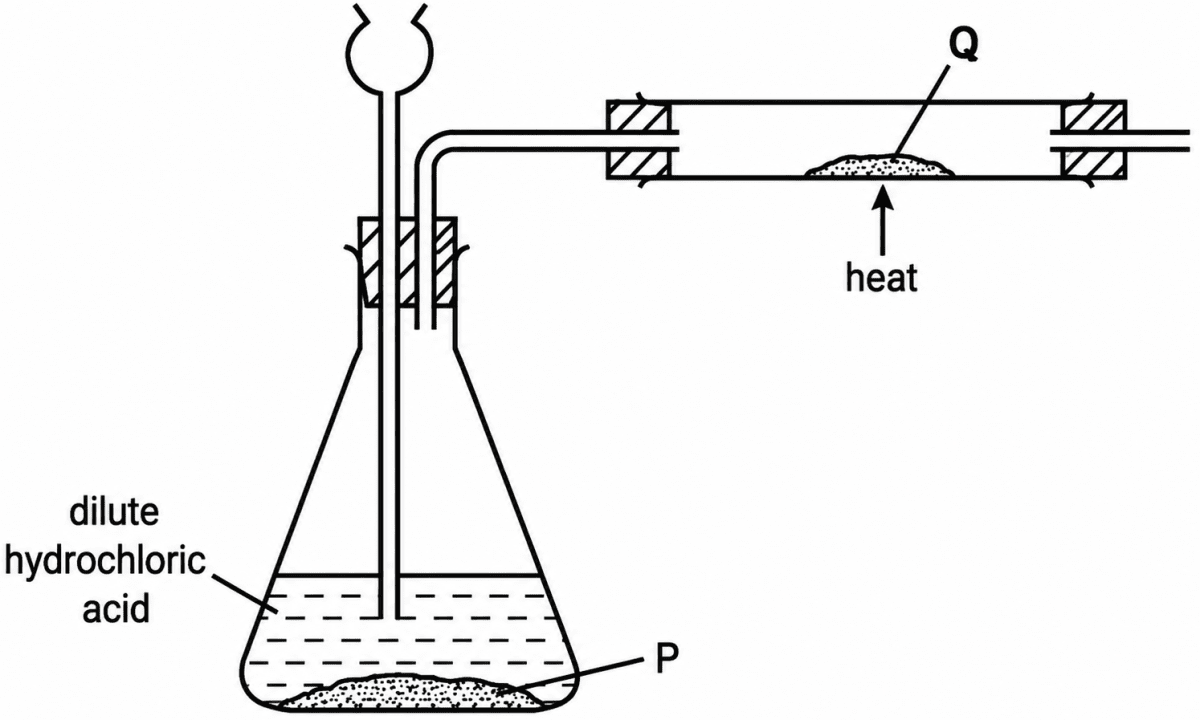
The diagram given below shows that P reacts with dilute hydrochloric acid to produce a gas which when passed through substance Q, reduces it.

The diagram given below shows that P reacts with dilute hydrochloric acid to produce a gas which when passed through substance Q, reduces it. ICSE 2027 Specimen Chemistry Solved Question Paper.

What are substances P and Q?

Show SolutionHide Solution↓

P - zinc, Q - copper (II) oxide

Reason — Zinc reacts with dilute hydrochloric acid to liberate hydrogen gas. Hydrogen is a reducing agent, so on passing over heated copper(II) oxide it reduces the black oxide to reddish-brown copper.

Zn + 2HCl ⟶ ZnCl2 + H2

CuO + H2 ⟶ Cu + H2O

1(vi)1 Mark · 2027 · Section A · 2027 SpecimenFull page

Non-metals like chlorine and iodine on reaction with hydrogen give:

Show SolutionHide Solution↓

acid

Reason — Chlorine and iodine react with hydrogen to form the hydrogen halides hydrogen chloride and hydrogen iodide. These dissolve in water to form hydrochloric acid and hydroiodic acid respectively.

1(vii)1 Mark · 2027 · Section A · 2027 SpecimenFull page

Statement I: Halogens are very reactive.

Statement II: Halogens have high electron affinity.

Show SolutionHide Solution↓

Both the statements are true.

Reason — Halogens have seven electrons in their valence shell and need only one electron to complete their octet. This gives them a very high electron affinity, which makes them very reactive. Hence, both statements are true.

1(viii)1 Mark · 2027 · Section A · 2027 SpecimenFull page

Assertion (A): Ionic compounds have high melting points.

Reason (R): A strong electrostatic force of attraction exists between the oppositely charged ions.

Show SolutionHide Solution↓

Both (A) and (R) are true, and (R) is the correct explanation of (A).

Reason — In ionic compounds, the oppositely charged ions are held together by strong electrostatic forces of attraction. A large amount of heat energy is required to break these forces, so ionic compounds have high melting points. Thus, (R) correctly explains (A).

1(ix)1 Mark · 2027 · Section A · 2027 SpecimenFull page

A student tested the nature of four different solutions P, Q, R, and S using pH paper. He noted the following observations:

 PQRS
Colour of the pH paper after testingBlueGreenRedViolet

Which of the above solutions is neutral in nature?

Show SolutionHide Solution↓

Q

Reason — On the pH scale, a neutral solution (pH 7) turns pH paper green. Red indicates an acidic solution, while blue and violet indicate basic (alkaline) solutions. Hence, solution Q (green) is neutral.

1(x)1 Mark · 2027 · Section A · 2027 SpecimenFull page

Identify the organic compound(s) with the molecular formula C3H8O.

1. propanol
2. propanal
3. propanoic acid

Show SolutionHide Solution↓

Only 1

Reason — Propanol (C3H7OH) has the molecular formula C3H8O. Propanal (C2H5CHO) is C3H6O and propanoic acid (C2H5COOH) is C3H6O2. Hence, only propanol has the formula C3H8O.

1(xi)1 Mark · 2027 · Section A · 2027 SpecimenFull page

An organic compound X containing carbon and hydrogen only has Vapour Density (V.D.) 14. The molecular formula of X is ............... (At. wt. of C=12, H=1)

Show SolutionHide Solution↓

C2H4

Reason — Molecular mass = 2 × Vapour Density = 2 × 14 = 28.

The molecular mass of C2H4 = 2(12) + 4(1) = 24 + 4 = 28, which matches. Hence, the molecular formula of X is C2H4.

1(xii)1 Mark · 2027 · Section A · 2027 SpecimenFull page

Identify the ion that contains one lone pair of electrons.

Show SolutionHide Solution↓

H3O+

Reason — A pair of electrons that is not shared in bond formation is called a lone pair of electrons. H3O+ has one lone pair of electrons. OH1- has three lone pairs, whereas NH4+ and H+ have no lone pairs of electrons.

1(xiii)1 Mark · 2027 · Section A · 2027 SpecimenFull page

When compound X reacts with dilute hydrochloric acid, it releases a gas that turns moist lead acetate paper black and decolourises acidified potassium permanganate solution. Which of the following is compound X?

Show SolutionHide Solution↓

Sodium sulphide

Reason — Sodium sulphide reacts with dilute hydrochloric acid to release hydrogen sulphide gas. H2S turns moist lead acetate paper black (due to the formation of black lead sulphide) and being a reducing gas, it also decolourises acidified potassium permanganate solution.

Na2S + 2HCl ⟶ 2NaCl + H2S ↑

1(xiv)1 Mark · 2027 · Section A · 2027 SpecimenFull page

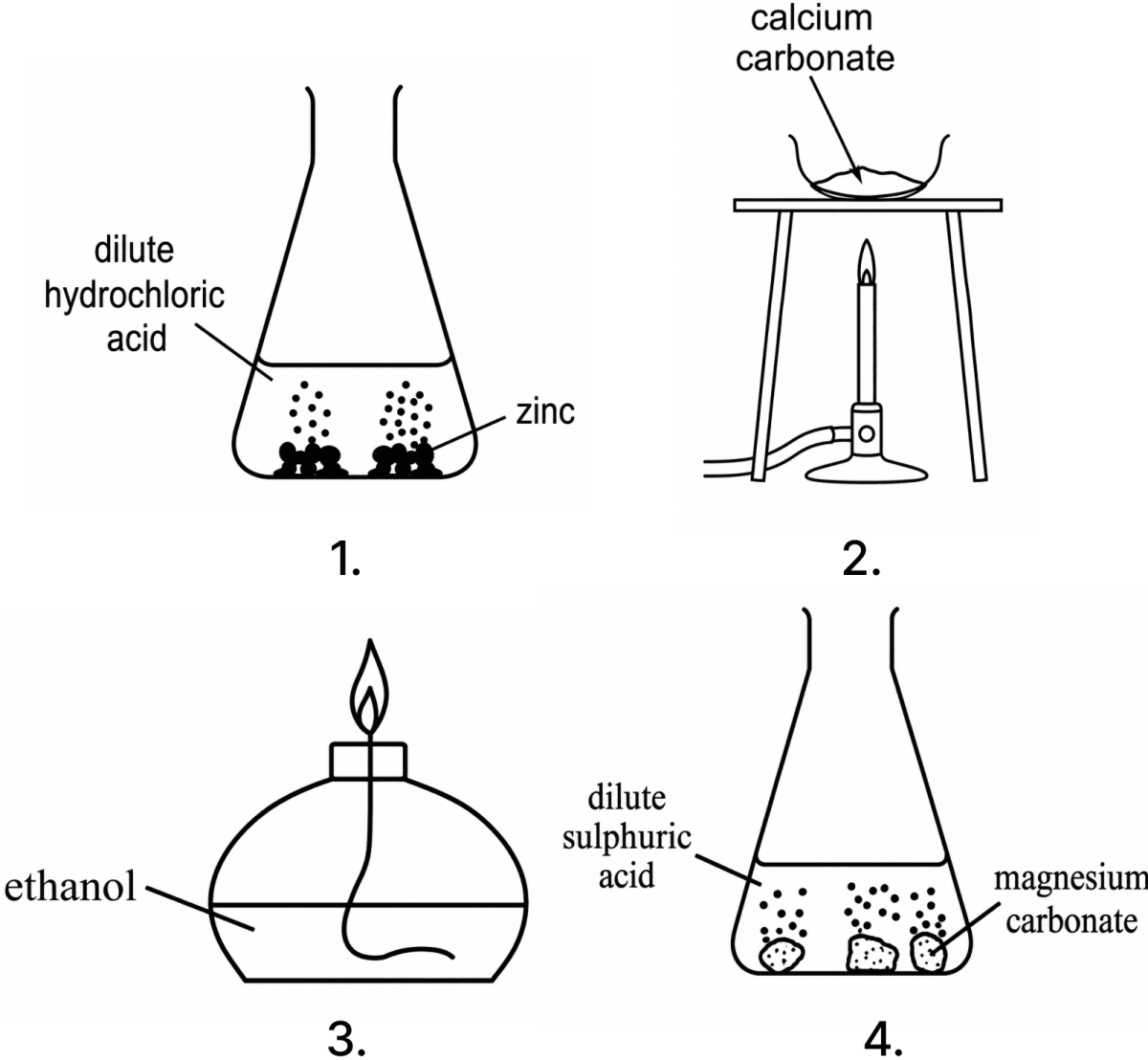
A teacher demonstrated four different reactions as shown in the diagram below:

A teacher demonstrated four different reactions as shown in the diagram below: ICSE 2027 Specimen Chemistry Solved Question Paper.

Which reactions will produce water?

Show SolutionHide Solution↓

3 and 4

Reason — Reaction 3 is the combustion of ethanol, which produces carbon dioxide and water. Reaction 4 is dilute sulphuric acid reacting with magnesium carbonate, which produces a salt, water and carbon dioxide. Hence, reactions 3 and 4 produce water.

1(xv)1 Mark · 2027 · Section A · 2027 SpecimenFull page

The volume occupied by 0.2 moles of a gas at S.T.P. is:

Show SolutionHide Solution↓

4.48 litres

Reason — One mole of any gas occupies 22.4 litres at S.T.P.

∴ Volume of 0.2 mole of gas = 0.2 × 22.4 = 4.48 litres.

2(i)1 Mark · 2027 · Section A · 2027 SpecimenFull page

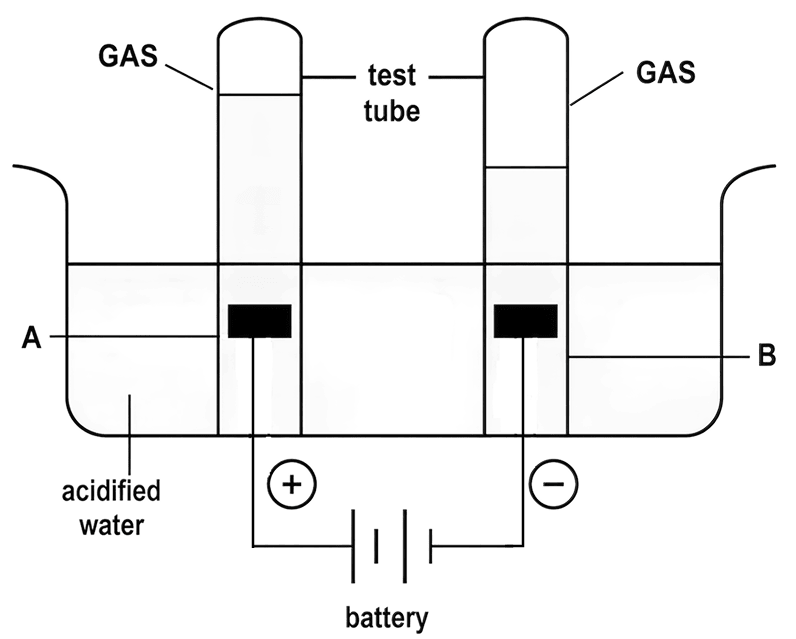
The diagram given below shows the electrolysis of acidulated water. With reference to the diagram, answer the following questions:

The diagram given below shows the electrolysis of acidulated water. With reference to the diagram, answer the following questions: ICSE 2027 Specimen Chemistry Solved Question Paper.

(a) Write an equation for the reaction that takes place at A.

(b) Give a test to confirm the product formed at A.

(c) Which gas is liberated at B?

(d) Why is water acidified for electrolysis?

(e) What is the ratio by volume of the gases liberated at A and B?

Show SolutionHide Solution↓

(a) A is the anode (positive electrode) where oxygen gas is liberated.

4OH- - 4e- ⟶ 2H2O + O2

(b) The gas at A is oxygen. It rekindles a glowing splinter brought near it.

(c) Hydrogen gas is liberated at B.

(d) Pure water is a very poor conductor of electricity as it has very few ions. Water is acidified by adding a little dilute sulphuric acid to provide ions, which makes it a good conductor so that electrolysis can take place.

(e) The ratio by volume of gases at A (oxygen) and B (hydrogen) is 1 : 2.

2(ii)1 Mark · 2027 · Section A · 2027 SpecimenFull page

Write balanced chemical equations for the following:

(a) Chlorination of chloroform in the presence of diffused sunlight.

(b) Hydrated aluminium oxide is treated with caustic soda.

(c) Zinc oxide is treated with caustic alkali.

(d) Copper reacts with cold dilute nitric acid.

(e) Laboratory preparation of nitric acid using sodium nitrate.

Show SolutionHide Solution↓

(a) CHCl3 + Cl2 $\xrightarrow{\text{diffused sunlight}}$ CCl4 + HCl

(b) Al2O3.2H2O + 2NaOH ⟶ 2NaAlO2 + 3H2O

(c) ZnO + 2NaOH ⟶ Na2ZnO2 + H2O

(d) 3Cu + 8HNO3 (dilute) ⟶ 3Cu(NO3)2 + 4H2O + 2NO

(e) NaNO3 + H2SO4 $\xrightarrow{\text{below 200°C}}$ NaHSO4 + HNO3

2(iii)1 Mark · 2027 · Section A · 2027 SpecimenFull page

Complete the following sentences by choosing the correct option from the brackets:

(a) The general formula of an alkyl group is ............... (CnH2n+1/CnH2n-1).

(b) The aqueous solution of ............... (zinc chloride/ sodium sulphate) gives white precipitate with barium nitrate.

(c) The gas liberated when alkalis are heated with ammonium salts is ............... (N2/NH3).

(d) The alloy that contains a non-metal as one of its constituents is ............... (bronze/steel).

(e) A salt prepared by neutralization in which titration is involved is ............... (CaCl2/ NH4Cl).

Show SolutionHide Solution↓

(a) The general formula of an alkyl group is CnH2n+1.

(b) The aqueous solution of sodium sulphate gives white precipitate with barium nitrate.

(c) The gas liberated when alkalis are heated with ammonium salts is NH3.

(d) The alloy that contains a non-metal as one of its constituents is steel.

(e) A salt prepared by neutralization in which titration is involved is NH4Cl.

Note: In part (b), the chemically correct answer is sodium sulphate, since barium nitrate reacts with the sulphate ion of sodium sulphate to give a white precipitate of barium sulphate (Na2SO4 + Ba(NO3)2 ⟶ BaSO4 ↓ + 2NaNO3). Zinc chloride would not give any precipitate with barium nitrate as both products would be soluble.

2(iv)1 Mark · 2027 · Section A · 2027 SpecimenFull page

Match Column A with Column B:

Column AColumn B
(a) CuO + C ⟶ Cu + CO1. Oxidation
(b) Al3+ + 3e- ⟶ Al2. Ionization
(c) PbBr2 ⟶ Pb2+ + 2Br1-3. Reduction
(d) 2O2- - 4e- ⟶ O24. Redox
(e) HCl ⟶ H+ + Cl1-5. Electrolytic dissociation
Show SolutionHide Solution↓
Column AColumn B
(a) CuO + C ⟶ Cu + CO4. Redox
(b) Al3+ + 3e- ⟶ Al3. Reduction
(c) PbBr2 ⟶ Pb2+ + 2Br1-5. Electrolytic dissociation
(d) 2O2- - 4e- ⟶ O21. Oxidation
(e) HCl ⟶ H+ + Cl1-2. Ionization
2(v)1 Mark · 2027 · Section A · 2027 Specimen · 🔁 also 2026Full page

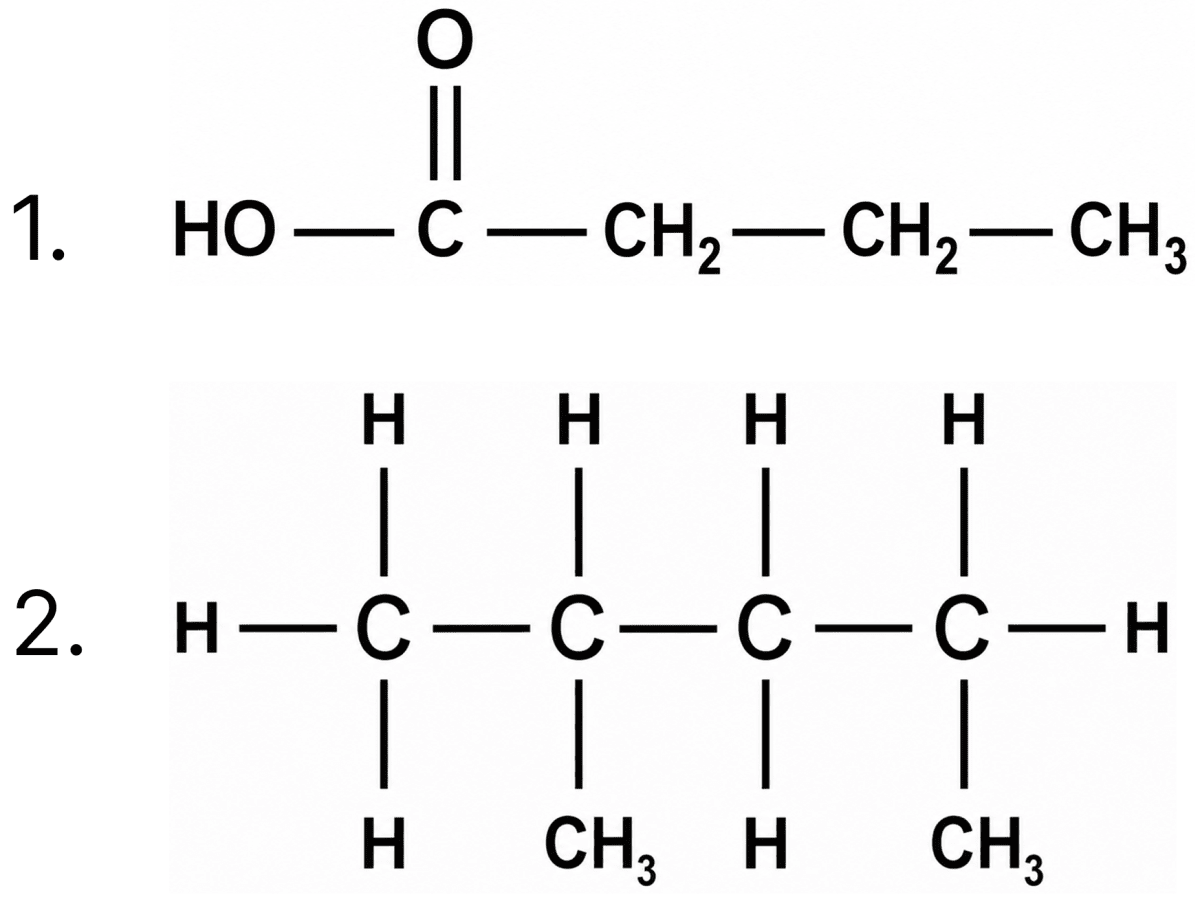
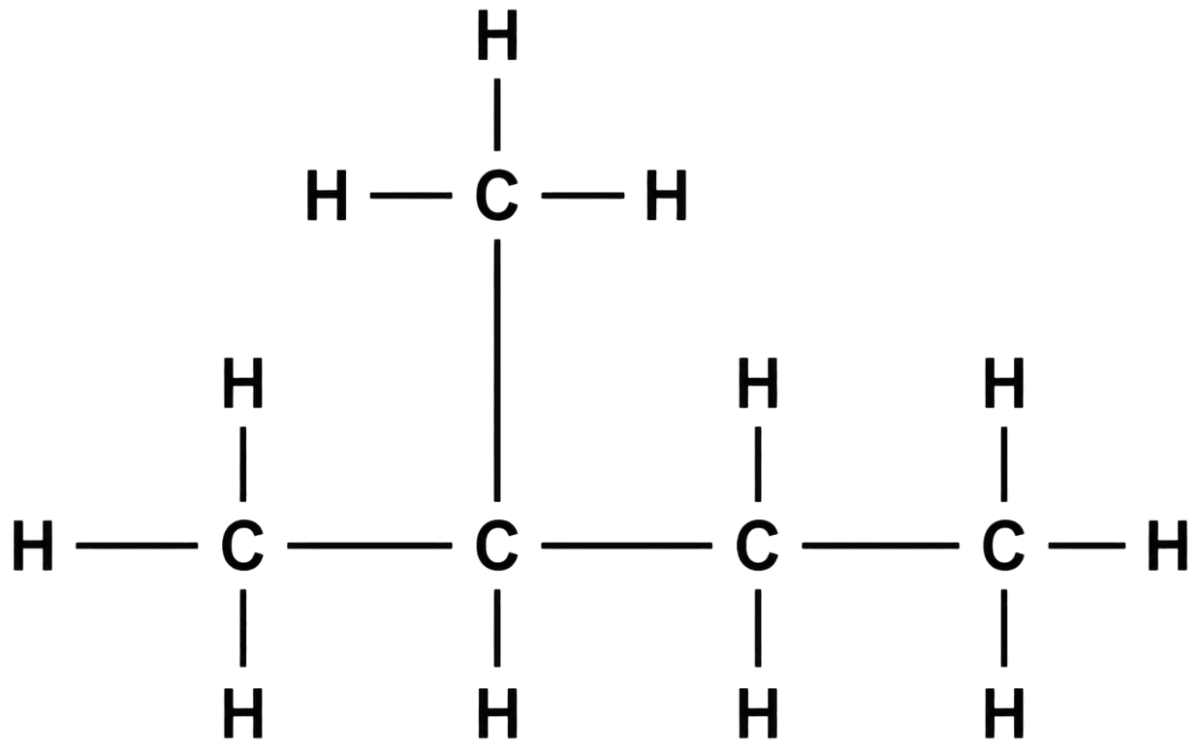
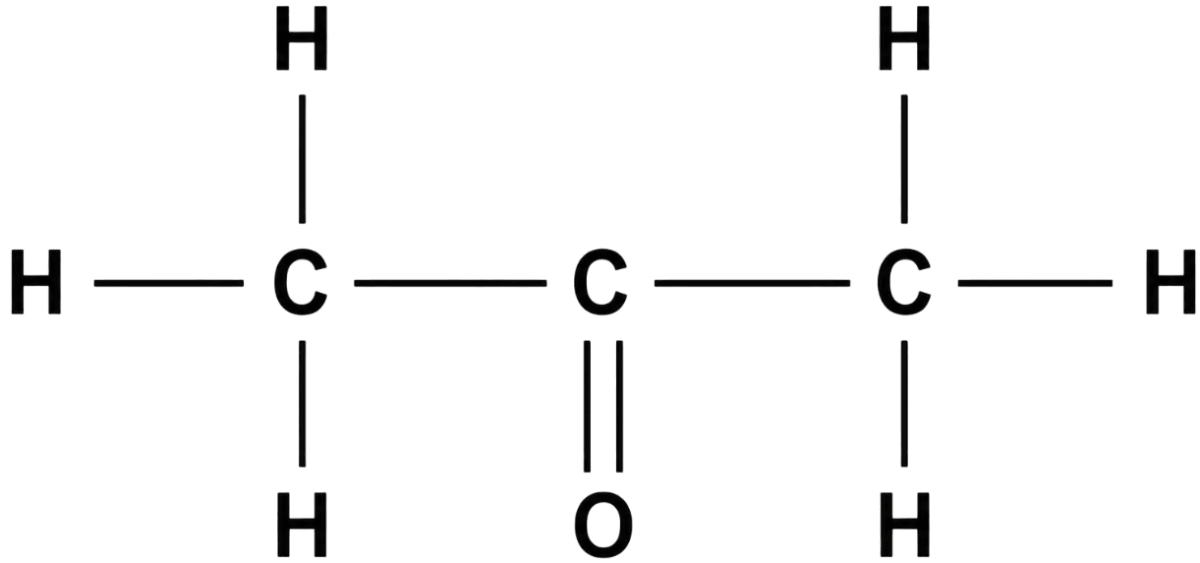
(a) Give the IUPAC name of the following organic compounds:

Give the IUPAC name of the following organic compounds: ICSE 2027 Specimen Chemistry Solved Question Paper.

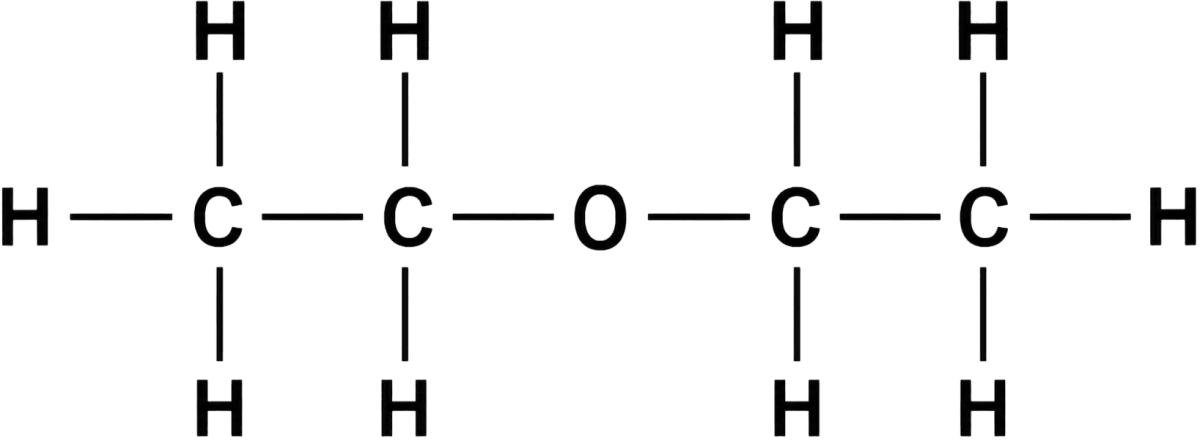
(b) Draw the structural diagram for the following compounds:

Show SolutionHide Solution↓

(a) IUPAC names of the given organic compounds are:

  1. butanoic acid
  2. 2-methylpentane

(b) Structural diagrams:

1. diethyl ether

Draw the structural diagram for the following compounds ICSE 2027 Specimen Chemistry Solved Question Paper.

2. isopentane

Draw the structural diagram for the following compounds ICSE 2027 Specimen Chemistry Solved Question Paper.

3. propanone

Draw the structural diagram for the following compounds ICSE 2027 Specimen Chemistry Solved Question Paper.
3(i)Written · 2027 · Section B · 2027 SpecimenFull page

A compound commonly used in the laboratory has formula H2P.

H represents hydrogen, P represents a non-metal.

Draw a dot and cross structure for the formation of the compound H2P.

Show SolutionHide Solution↓

P is a divalent non-metal having six electrons in its valence shell. Each of the two hydrogen atoms shares one electron with P to form two covalent bonds, so that P completes its octet while each H completes its duplet. The dot and cross structure for the formation of H2P is shown below:

A compound commonly used in the laboratory has formula H. ICSE 2027 Specimen Chemistry Solved Question Paper.
3(ii)Written · 2027 · Section B · 2027 Specimen · 🔁 also 2026Full page

Give one significant observation when:

(a) Excess of chlorine gas reacts with ammonia.

(b) Zinc nitrate is strongly heated in a test tube.

Show SolutionHide Solution↓

(a) Colourless ammonia gas reacts with excess greenish-yellow chlorine to form a yellow, explosive liquid (nitrogen trichloride).
NH3 + 3Cl2 [excess] ⟶ 3HCl + NCl3

(b) Reddish-brown nitrogen dioxide gas is evolved on heating zinc nitrate crystals.
$2\text{Zn(NO}_3)_2 \xrightarrow{\Delta} 2\text{ZnO} + \text{O}_2 + 4\text{NO}_2$

3(iii)Written · 2027 · Section B · 2027 SpecimenFull page

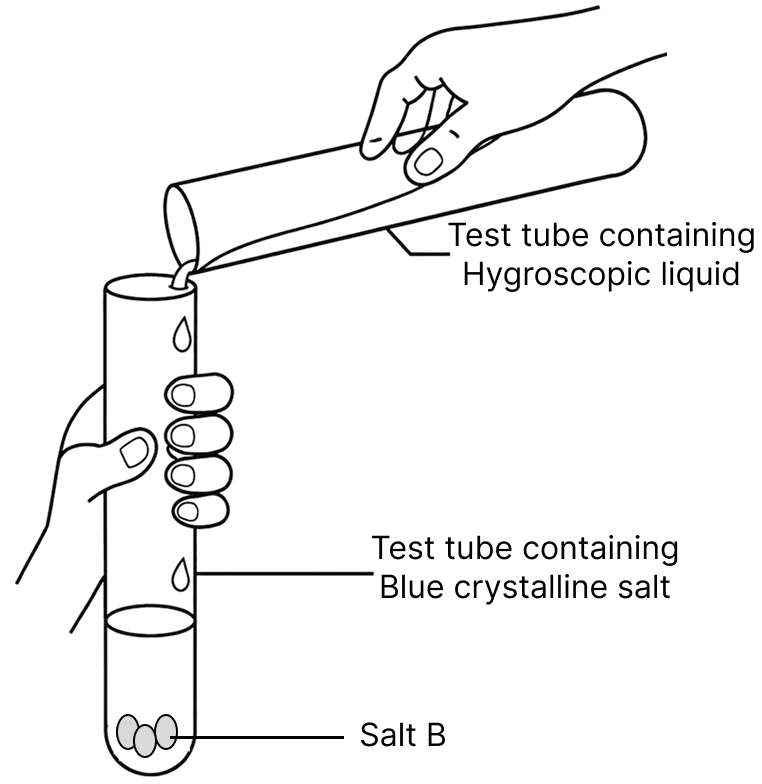
A student was given a crystalline salt 'B' for analysis which was blue in colour. He added a few drops of dense oily hygroscopic liquid to it and observed a colourless neutral gas/vapour being released and the salt turning white.

A student was given a crystalline salt. ICSE 2027 Specimen Chemistry Solved Question Paper.

(a) Identify the blue crystalline salt B.

(b) Which property of the hygroscopic liquid is demonstrated in this reaction?

(c) Write a balanced chemical equation for the above reaction.

Show SolutionHide Solution↓

(a) The blue crystalline salt B is copper(II) sulphate pentahydrate, CuSO4·5H2O.

(b) The dehydrating property of the hygroscopic liquid (concentrated sulphuric acid) is demonstrated, as it removes the water of crystallisation from the blue salt, leaving behind white anhydrous copper sulphate.

(c) CuSO4·5H2O $\xrightarrow{\text{conc. H}_2\text{SO}_4}$ CuSO4 + 5H2O

3(iv)Written · 2027 · Section B · 2027 SpecimenFull page

N is a metal which forms a basic oxide.

N has atomic no. 11.

(a) What is the molecular formula of the oxide of N?

(b) Write the balanced equation for the reaction that takes place when the oxide of N is treated with water.

(c) State the formula of the product obtained other than water when sulphuric acid is added to the product obtained in (b) above.

Show SolutionHide Solution↓

N has atomic number 11, so its electronic configuration is 2, 8, 1 and its valency is 1.

(a) The molecular formula of the oxide is N2O (i.e., Na2O).

(b) N2O + H2O ⟶ 2NOH

(c) The formula of the product other than water is N2SO4.

4(i)Written · 2027 · Section B · 2027 SpecimenFull page

Name the following:

(a) The non-metallic element which is used as the anode during electrolytic reduction of fused alumina in Hall Heroult's process.

(b) An alloy which is made up of aluminium and magnesium only.

(c) The process of heating the concentrated ore in a limited supply of air or in the absence of air.

Show SolutionHide Solution↓

(a) Carbon (graphite)

(b) Magnalium

(c) Calcination

4(ii)Written · 2027 · Section B · 2027 SpecimenFull page

Rohit has three solutions X, Y and Z that have pH 2, 7 and 13 respectively. Which solution out of X, Y or Z will:

(a) liberate sulphur dioxide gas when heated with sodium sulphite?

(b) liberate ammonia gas when reacted with ammonium chloride?

(c) not have any effect on litmus paper?

Show SolutionHide Solution↓

(a) X

Reason — Sodium sulphite reacts with an acid to liberate sulphur dioxide gas. Hence, solution X with pH 2 is acidic and will liberate sulphur dioxide.

SO32- + 2H+ ⟶ SO2 + H2O

(b) Z

Reason — Ammonium salts liberate ammonia gas on reaction with an alkali. Hence, solution Z with pH 13 is alkaline and will liberate ammonia from ammonium chloride.

NH4+ + OH- ⟶ NH3 + H2O

(c) Y

Reason — The solution Y with pH 7 will not have any effect on litmus paper as it is neither acidic nor basic.

4(iii)Written · 2027 · Section B · 2027 SpecimenFull page

A chloride of iron 'R', when treated with sodium hydroxide gives P and Q as a product. Q is a reddish-brown precipitate.

(a) Identify R.

(b) State the formula of the compounds P and Q formed after the reaction.

(c) What do you observe when excess NaOH is added to Q?

Show SolutionHide Solution↓

(a) R is ferric chloride (iron(III) chloride), FeCl3.

(b) P is NaCl and Q is Fe(OH)3.

FeCl3 + 3NaOH ⟶ Fe(OH)3 ↓ + 3NaCl

(c) On adding excess sodium hydroxide, the reddish-brown precipitate of Fe(OH)3 remains insoluble, i.e., there is no change.

5(i)Written · 2027 · Section B · 2027 SpecimenFull page

20 grams of a gas M2P has lesser number of moles than 20 grams of the gas MP.

Justify the above statement using mathematical calculations.

[At.wt. M=14, P=16]

Show SolutionHide Solution↓

Molecular mass of M2P = 2(14) + 16 = 44 g/mol

Molecular mass of MP = 14 + 16 = 30 g/mol

Number of moles = $\frac{\text{Mass}}{\text{Molecular mass}}$

∴ Moles in 20 g of M2P = $\frac{20}{44}$ = 0.45 mol

∴ Moles in 20 g of MP = $\frac{20}{30}$ = 0.67 mol

Since 0.45 < 0.67, 20 grams of M2P has a lesser number of moles than 20 grams of MP. Hence, the statement is justified.

5(ii)Written · 2027 · Section B · 2027 SpecimenFull page

State giving reasons if:

(a) Zinc metal and aluminium metal can be distinguished by heating the metal powders separately in two different test tubes with concentrated sodium hydroxide solution.

(b) Zinc nitrate and lead nitrate can be distinguished by adding ammonium hydroxide solution to the salt solution.

Show SolutionHide Solution↓

(a) No, zinc and aluminium cannot be distinguished by this method. Both metals react with concentrated sodium hydroxide solution to form soluble sodium salts and liberate hydrogen gas, which burns with a pop sound.

Zn + 2NaOH ⟶ Na2ZnO2 + H2

2Al + 2NaOH + 2H2O ⟶ 2NaAlO2 + 3H2

(b) Yes, they can be distinguished. With zinc nitrate, ammonium hydroxide gives a white precipitate of Zn(OH)2 which is soluble in excess of ammonium hydroxide. With lead nitrate, a white precipitate of Pb(OH)2 is formed which is insoluble in excess of ammonium hydroxide.

5(iii)Written · 2027 · Section B · 2027 SpecimenFull page

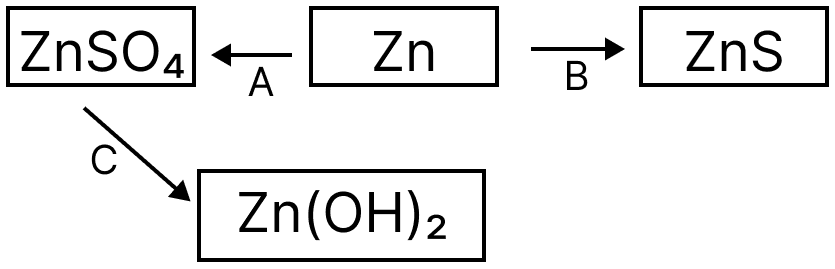
Write balanced chemical equations for the following conversions (A to C):

Write balanced chemical equations for the following conversions (A to C): ICSE 2027 Specimen Chemistry Solved Question Paper.
Show SolutionHide Solution↓

A: Zn + H2SO4 ⟶ ZnSO4 + H2

B: Zn + S ⟶ ZnS

C: ZnSO4 + 2NaOH ⟶ Zn(OH)2 + Na2SO4

5(iv)Written · 2027 · Section B · 2027 SpecimenFull page

An element 'P' has 3 valence electrons in its L - shell and an element 'Q' has 7 valence electrons in its M - shell. Using this information, answer the following questions:

(a) Identify the exact position of element 'Q' in terms of group and period in the Modern Periodic Table.

(b) The atomic radius of P is ............... (more/less) than that of Q.

Show SolutionHide Solution↓

Element P has the L shell as its outermost shell with 3 valence electrons, so its configuration is 2, 3 (period 2). Element Q has the M shell as its outermost shell with 7 valence electrons, so its configuration is 2, 8, 7 (period 3).

(a) Element Q has 7 valence electrons, so it belongs to Group 17, and its outermost shell is the M (third) shell, so it belongs to Period 3.

Position of Q: Group 17, Period 3.

(b) The atomic radius of P is less than that of Q.

Element P has only two shells whereas Q has three shells. As the number of shells increases, the atomic radius increases. Hence, P (fewer shells) has a smaller atomic radius than Q.

6(i)Written · 2027 · Section B · 2027 SpecimenFull page

Identify the reactants P, Q and R in the following reactions:

(a) Copper (II) oxide + P ⟶ Copper + Water + Nitrogen

(b) Iron pyrite + Q ⟶ Iron oxide + Sulphur dioxide

(c) Ammonia + R ⟶ Nitrogen + Water

Show SolutionHide Solution↓

(a) P is Ammonia (NH3).

3CuO + 2NH3 ⟶ 3Cu + 3H2O + N2

(b) Q is Oxygen (O2).

4FeS2 + 11O2 ⟶ 2Fe2O3 + 8SO2

(c) R is Oxygen (O2).

4NH3 + 3O2 ⟶ 2N2 + 6H2O

6(ii)Written · 2027 · Section B · 2027 Specimen · 🔁 also 2026Full page

Solid ammonium dichromate decomposes as under:

(NH4)2Cr2O7 ⟶ N2 + Cr2O3 + 4H2O

If 126 g of ammonium dichromate decomposes, calculate:

(a) the number of moles of ammonium dichromate that undergoes decomposition.

(b) the mass of chromic oxide formed at the same time.

(c) the volume of nitrogen gas evolved at STP.

[At. Wt: N=14, Cr=52, O=16, H=1]

Show SolutionHide Solution↓

$$\begin{matrix} (\text{NH}_4)_2\text{Cr}_2\text{O}_7 & \xrightarrow{\Delta} & \text{N}_2 & + & 4\text{H}_2\text{O} & + & \text{Cr}_2\text{O}_3 \\ 2[14 + 4(1)] & & & & & & 2(52) \\ + 2(52) + 7(16) & & & & & & + 3(16) \\ = 36 + 104 & & & & & & = 104 + 48 \\ + 112 = 252 \text{ g} & & & & & & = 152 \text{ g} \\ \end{matrix}$$

(a) 252 g of (NH4)2Cr2O7 = 1 mole

∴ 126 g of (NH4)2Cr2O7 = $\frac{1}{252}$ x 126 = 0.5 moles

Hence, no. of moles = 0.5 moles

(b) 252 g of (NH4)2Cr2O7 gives 152 g of Cr2O3

126 g of (NH4)2Cr2O7 will give $\frac{152 \times 126}{252}$ = 76 g of Cr2O3

Hence, mass in gms of Cr2O3 formed = 76 g.

(c) 252 g of (NH4)2Cr2O7 produces 22.4 lit of N2

126 g of (NH4)2Cr2O7 will produce $\frac{22.4 \times 126}{252}$ = 11.2 lit of N2

Hence, volume of N₂ evolved at s.t.p = 11.2 lit.

6(iii)Written · 2027 · Section B · 2027 SpecimenFull page

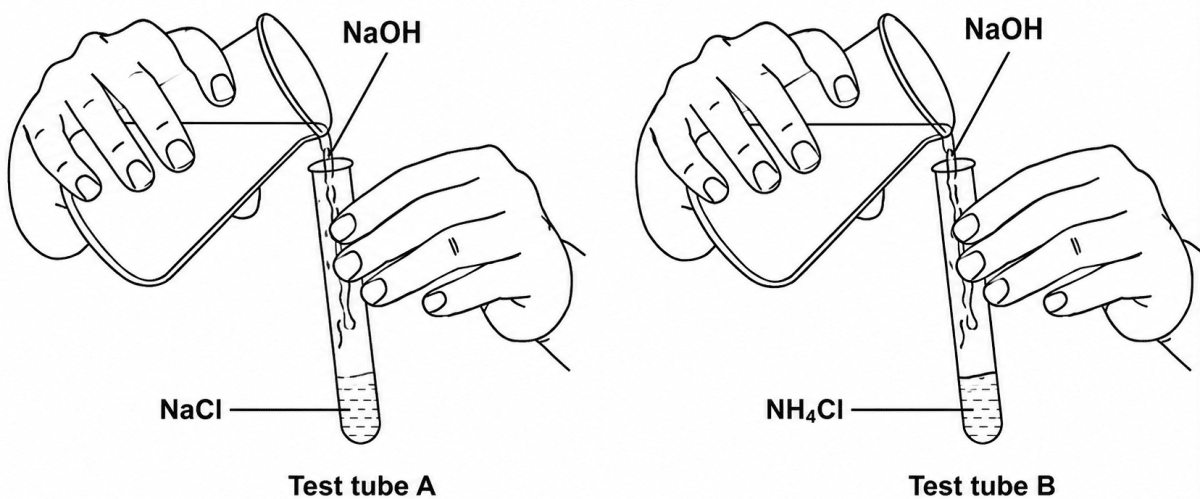
Rohan has two test tubes, A containing sodium chloride and B containing ammonium chloride as shown in the diagram below. He adds sodium hydroxide solution to both the test tubes and warms them gently.

Rohan has two test tubes, A containing sodium chloride and B containing ammonium chloride as shown in the diagram below. He adds sodium hydroxide solution to both the test tubes and warms them gently. ICSE 2027 Specimen Chemistry Solved Question Paper.

Answer the following questions:

(a) In which test tube (A or B) will Rohan observe the evolution of a gas?

(b) Name the gas that is evolved.

(c) What will be the colour of the flame when this gas burns in oxygen?

(d) Write an equation for the reaction that occurs in the test tube in which the gas has evolved.

Show SolutionHide Solution↓

(a) The gas is evolved in test tube B (containing ammonium chloride).

(b) The gas evolved is ammonia (NH3).

(c) Ammonia burns in oxygen with a greenish-yellow flame.

(d) NH4Cl + NaOH ⟶ NaCl + NH3 + H2O

7(i)Written · 2027 · Section B · 2027 SpecimenFull page

What is the ratio of methane to the acidic gaseous product obtained when methane undergoes complete combustion? Give a balanced equation for the above reaction.

Show SolutionHide Solution↓

On complete combustion, the acidic gaseous product is carbon dioxide.

CH4 + 2O2 ⟶ CO2 + 2H2O

The ratio of methane (CH4) to carbon dioxide (CO2) is 1 : 1.

7(ii)Written · 2027 · Section B · 2027 SpecimenFull page

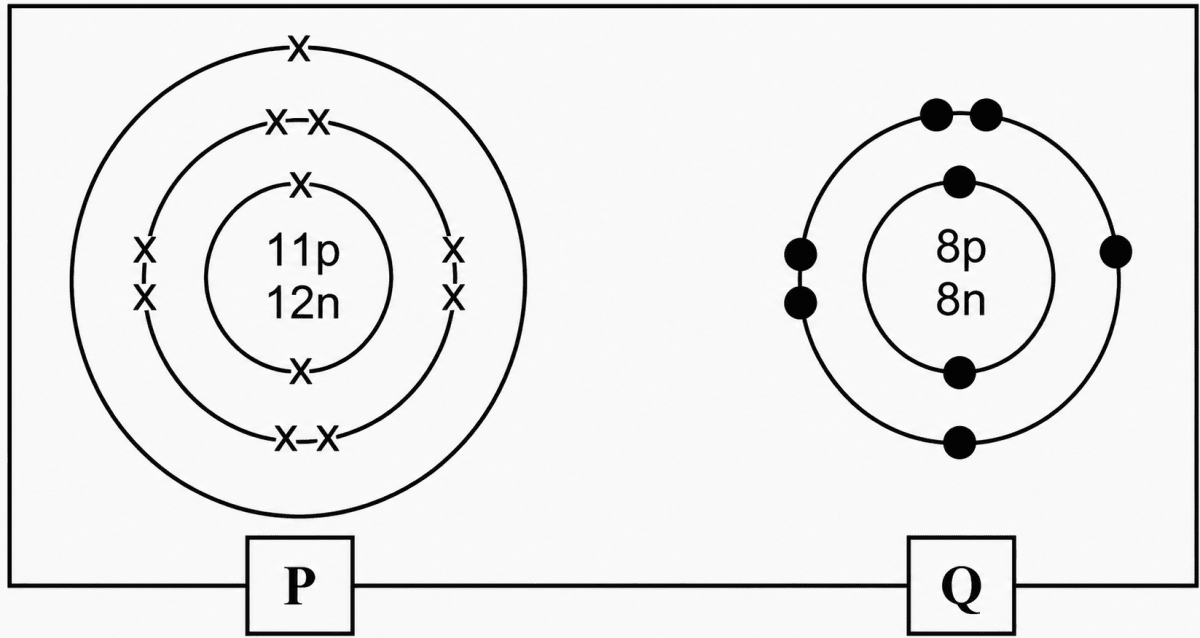
The diagram below illustrates the structures of two atoms P and Q.

The diagram below illustrates the structures of two atoms P and Q. ICSE 2027 Specimen Chemistry Solved Question Paper.

What is the formula and mass of one mole of the compound formed when P and Q react together?

[At. wt of P is 23 and Q is 16]

Show SolutionHide Solution↓

From the diagram, P has 11 protons (2, 8, 1) and is a monovalent metal, while Q has 8 protons (2, 6) and is a divalent non-metal. When they react, P loses one electron and Q gains two electrons, so two atoms of P combine with one atom of Q.

Formula of the compound = P2Q

Mass of one mole = 2 × (At. wt of P) + (At. wt of Q)

= 2 × 23 + 16

= 46 + 16

= 62 g

∴ The formula is P2Q and one mole has a mass of 62 g.

7(iii)Written · 2027 · Section B · 2027 SpecimenFull page

Give balanced equations for each of the following:

(a) Action of warm water on calcium carbide.

(b) Oxidation of sulphur with conc. nitric acid.

(c) Laboratory preparation of ethane by using sodium propionate and soda lime.

Show SolutionHide Solution↓

(a) CaC2 + 2H2O ⟶ Ca(OH)2 + C2H2

(b) S + 6HNO3 (conc.) ⟶ H2SO4 + 6NO2 + 2H2O

(c) C2H5COONa + NaOH $\xrightarrow{\text{CaO}}$ C2H6 + Na2CO3

7(iv)Written · 2027 · Section B · 2027 SpecimenFull page

In a round bottom flask, a mixture of ethanol, acetic acid and concentrated sulphuric acid was heated.

Answer the following questions:

(a) Name the type of reaction occurring in the above set up.

(b) What is the role of sulphuric acid in this reaction?

(c) State one observation that takes place during the reaction.

Show SolutionHide Solution↓

(a) Esterification reaction

$\underset{\text{ethyl alcohol}}{\text{C}_2\text{H}_5\text{OH}} + \text{CH}_3\text{COOH} \xrightarrow{\text{conc. H}_2\text{SO}_4} \underset{\text{ethyl acetate}}{{\text{CH}_3\text{COOC}_2\text{H}_5}} + \text{H}_2\text{O}$

(b) Dehydrating agent

(c) Fruity smell is observed due to the formation of ester by the reaction of ethanol and acetic acid.

8(i)Written · 2027 · Section B · 2027 SpecimenFull page

In the reactivity series of metals, Z is a metal above hydrogen and its oxide has the formula ZO. It was found that ZO reacted with water and formed a hydroxide as the product. With reference to the above context, answer the following questions:

(a) State the number of valence electrons present in element Z.

(b) Name the group which Z belongs to.

(c) What will be the formula of the hydroxide of Z?

Show SolutionHide Solution↓

(a) The oxide has the formula ZO, so Z is divalent. Hence, Z has 2 valence electrons.

(b) Z belongs to Group 2 (alkaline earth metals).

(c) The formula of the hydroxide of Z is Z(OH)2.

8(ii)Written · 2027 · Section B · 2027 SpecimenFull page

Draw the electron dot structure of:

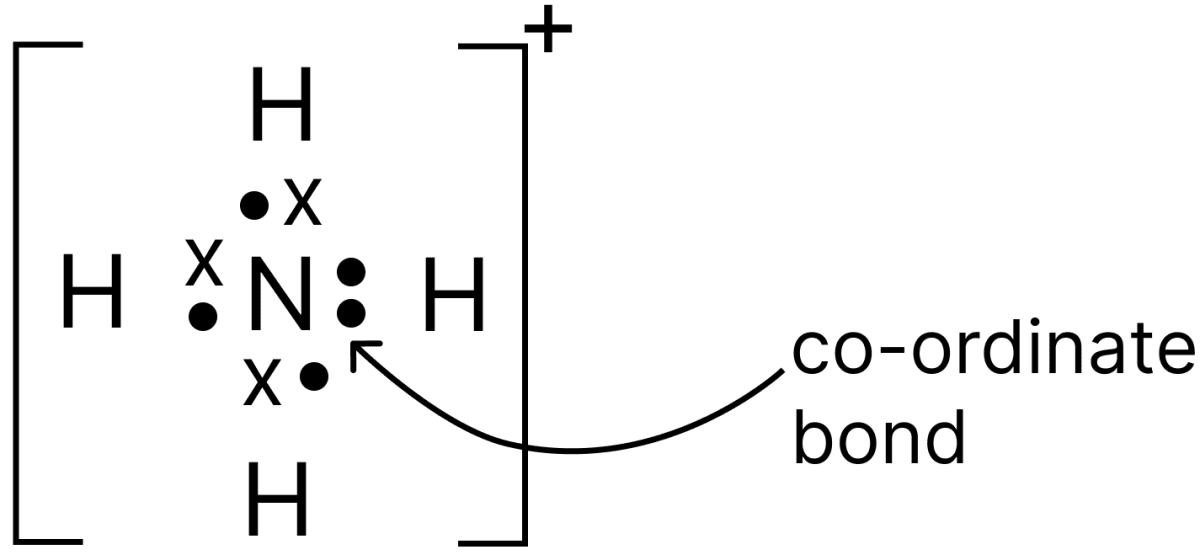
(a) ammonium ion (also label the co-ordinate bond)

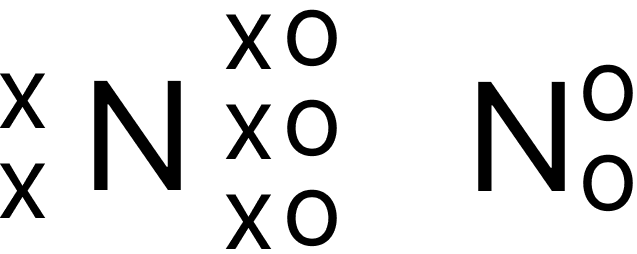
(b) nitrogen molecule

[Atomic No.: N = 7, H = 1]

Show SolutionHide Solution↓

(a) Electron dot structure of the ammonium ion (with the co-ordinate bond labelled):

In the reactivity series of metals, Z is a metal above hydrogen and its oxide has the formula ZO. It was found that ZO reacted with water and formed a hydroxide as the product. With reference to the above context, answer the following questions: ICSE 2027 Specimen Chemistry Solved Question Paper.

(b) Electron dot structure of the nitrogen molecule (which contains a triple bond between the two nitrogen atoms):

In the reactivity series of metals, Z is a metal above hydrogen and its oxide has the formula ZO. It was found that ZO reacted with water and formed a hydroxide as the product. With reference to the above context, answer the following questions: ICSE 2027 Specimen Chemistry Solved Question Paper.
8(iii)Written · 2027 · Section B · 2027 SpecimenFull page

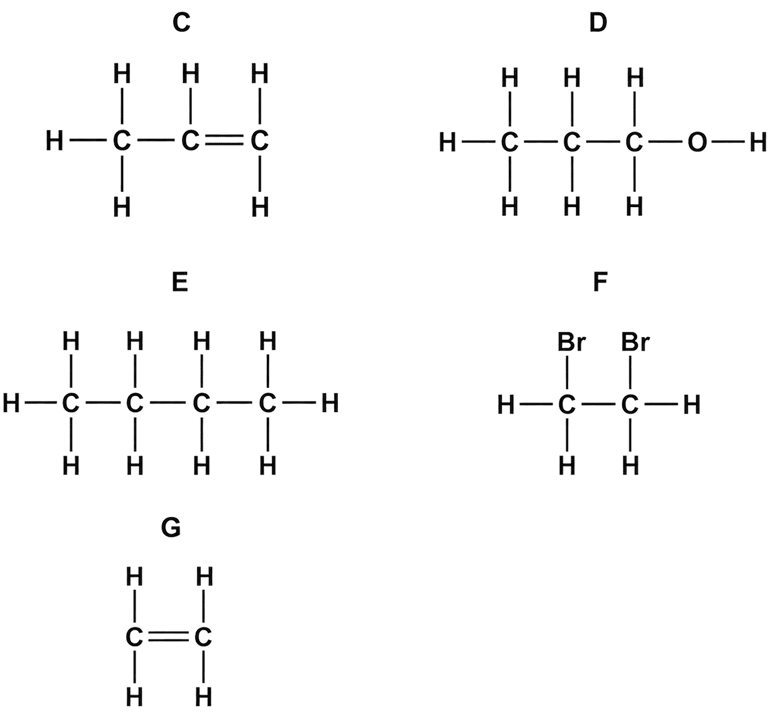
The structures of five organic compounds, C, D, E, F and G are shown.

The structures of five organic compounds. ICSE 2027 Specimen Chemistry Solved Question Paper.

Answer the following questions about these compounds.

(Each compound may be used once, more than once or not at all.)

State which compound, C, D, E, F or G:

(a) on halogenation will form F.

(b) is an alcohol.

(c) is an isomer of 2-methyl propane.

(d) is in the same homologous series as ethene.

Show SolutionHide Solution↓

(a) G — ethene (G) on halogenation, i.e., addition of bromine, forms 1,2-dibromoethane (F).

(b) D — it contains the –OH (hydroxyl) functional group, so it is an alcohol.

(c) E — 2-methyl propane has the formula C4H10. Compound E (n-butane) is a saturated hydrocarbon with the same molecular formula C4H10, so it is an isomer of 2-methyl propane.

(d) C — ethene belongs to the alkene series (contains a C=C double bond). Compound C also contains a carbon-carbon double bond, so it belongs to the same homologous series as ethene.

Press ↓ to reveal a solution and move to the next question. Browse the free sample bank.

All 611 Chemistry questions