4(c)
Name the following organic compounds:
(i) The compound with 3 carbon atoms whose functional group is a carboxyl.
(ii) The first homologue whose general formula is CnH2n
(iii) The compound that reacts with acetic acid to form ethyl ethanoate.
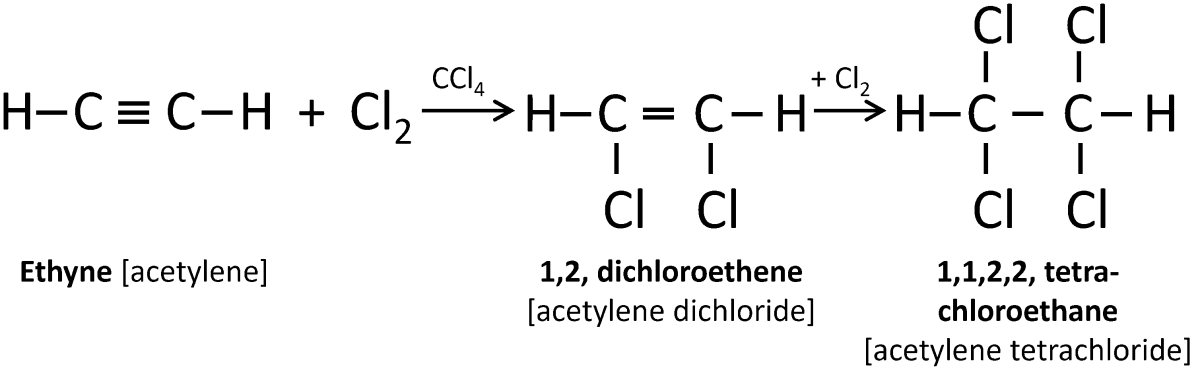
(iv) The compound formed by complete chlorination of ethyne.
Show SolutionHide Solution↓
(i) Propanoic acid [C3H7CHO]
(ii) Ethene [C2H4]
(iii) Ethyl alcohol
$\underset{\text{ethyl alcohol}}{\text{C}_2\text{H}_5\text{OH}} + \underset{\text{acetic acid}}{\text{CH}_3\text{COOH}} \xrightarrow{\text{Conc. H}_2\text{SO}_4} \underset{\text{ethyl ethanoate}}{\text{CH}_3-\text{COO}-\text{C}_2\text{H}_5} + \text{H}_2\text{O}$
(iv) 1,1,2,2 tetrachloroethane