Question Paper2017

ICSE Class 10 Chemistry — 2017 Paper

31 solved questions from Solved 2017 Question Paper ICSE Class 10 Chemistry. Every answer follows the ICSE marking scheme.

Section
Marks
Insight
1(a)Written · 2017 · Section I · 2017 PaperFull page

Fill in the blanks from the choices given in brackets:

(i) The energy required to remove an electron from a neutral isolated gaseous atom and convert it into a positively charged gaseous ion is called .............. (electron affinity, ionisation potential, electronegativity)

(ii) The compound that does not have a lone pair of electrons is .............. (water, ammonia, carbon tetra chloride)

(iii) When a metallic oxide is dissolved in water, the solution formed has a high concentration of .............. ions. (H+, H3O+, OH-)

(iv) Potassium sulphite on reacting with hydrochloric acid releases .............. gas. (Cl2, SO2, H2S)

(v) The compound formed when ethene reacts with Hydrogen is .............. (CH4, C2H6, C3H8)

Show SolutionHide Solution↓

(i) The energy required to remove an electron from a neutral isolated gaseous atom and convert it into a positively charged gaseous ion is called Ionization Potential

(ii) The compound that does not have a lone pair of electrons is carbon tetrachloride.

(iii) When a metallic oxide is dissolved in water, the solution formed has a high concentration of OH- ions.

(iv) Potassium sulphite on reacting with hydrochloric acid releases SO2 gas.

(v) The compound formed when ethene reacts with Hydrogen is C2H6.
1(b-i)Written · 2017 · Section I · 2017 PaperFull page

A chloride which forms a precipitate that is soluble in excess of ammonium hydroxide, is:

Show SolutionHide Solution↓

Copper chloride.

Reason — Copper chloride forms a precipitate that is soluble in excess of ammonium hydroxide.

1(b-ii)Written · 2017 · Section I · 2017 PaperFull page

If the molecular formula of an organic compound is C10H18 it is:

Show SolutionHide Solution↓

Alkyne

Reason — As the general formula for alkyne is CnH2n-2. Hence, when C is 10 then H is 18.

1(b-iii)Written · 2017 · Section I · 2017 PaperFull page

Which of the following is a common characteristic of a covalent compound?

Show SolutionHide Solution↓

Consists of molecules

Reason — In covalent compound, valence shell electrons are mutually shared by atom of each element to achieve a stable electronic configuration. As there is no transfer of electrons between the atoms so the atoms remain electrically neutral. Hence they don't form ions and covalent compounds consists of molecules.

1(b-iv)Written · 2017 · Section I · 2017 PaperFull page

To increase the pH value of a neutral solution, we should add:

Show SolutionHide Solution↓

An alkali

Reason — The pH of alkali solutions is more than 7 therefore in order to increase the pH value of a neutral solution, an alkali should be added.

1(b-v)Written · 2017 · Section I · 2017 PaperFull page

Anhydrous iron (III) chloride is prepared by:

Show SolutionHide Solution↓

direct combination

Reason — Anhydrous iron [III] chloride is prepared by direct combination of iron and chloride as follows:
2Fe + 3Cl2 ⟶ 2FeCl3

1(c)Written · 2017 · Section I · 2017 PaperFull page

Identify the substance underlined, in each of the following cases:

(i) Cation that does not form a precipitate with ammonium hydroxide but forms one with sodium hydroxide.

(ii) The electrolyte used for electroplating an article with silver.

(iii) The particles present in a liquid such as kerosene, that is a non electrolyte.

(iv) An organic compound containing -- COOH functional group.

(v) A solid formed by reaction of two gases, one of which is acidic and the other basic in nature.

Show SolutionHide Solution↓

(i) Calcium [Ca2+] ions

(ii) sodium argentocyanide solution

(iii) Molecules only

(iv) Carboxylic acids

(v) Ammonium chloride.

1(d)Written · 2017 · Section I · 2017 PaperFull page

Write a balanced chemical equation for each of the following:

(i) Action of cold and dilute Nitric acid on Copper.

(ii) Reaction of Ammonia with heated copper oxide.

(iii) Preparation of methane from iodomethane.

(iv) Action of concentrated sulphuric acid on Sulphur.

(v) Laboratory preparation of ammonia from ammonium chloride.

Show SolutionHide Solution↓

(i) 3Cu + 8HNO3 [dil.] ⟶ 3Cu(NO3)2 + 4H2O + 2NO [g]

(ii) 2NH3 + 3CuO ⟶ 3Cu + 3H2O + N2 [g]

(iii)
$\underset{\text{methyl iodide}}{\text{CH}_3\text{I}} + \underset{\text{nascent hydrogen}}{2\text{[H]}} \xrightarrow[\text{alcohol}]{\text{Zn/Cu couple}} \underset{\text{methane}}{\text{CH}_4} +\text{HI}$

(iv) S + 2H2SO4 (conc.) ⟶ 3SO2 + 2H2O

(v) 2NH4Cl + Ca(OH)2 ⟶ CaCl2 + 2H2O + 2NH3

1(e)Written · 2017 · Section I · 2017 PaperFull page

State one relevant observation for each of the following reactions:

(i) Addition of ethyl alcohol to acetic acid in the presence of concentrated Sulphuric acid.

(ii) Action of dilute Hydrochloric acid on iron (II) sulphide.

(iii) Action of Sodium hydroxide solution on ferrous sulphate solution.

(iv) Burning of ammonia in air.

(v) Action of concentrated Sulphuric acid on hydrated copper sulphate.

Show SolutionHide Solution↓

(i) On warming, the mixture gives fruity smell. Acetic acid on heating with an alcohol and a dehydrating agent [conc. H2SO4] forms an ester — ethyl acetate.

$\underset{\text{ethyl alcohol}}{\text{C}_2\text{H}_5\text{OH}} + \underset{\text{acetic acid}}{\text{CH}_3\text{COOH}} \xrightarrow{\text{Conc. H}_2\text{SO}_4} \underset{\text{ethyl ethanoate}}{\text{CH}_3-\text{COO}-\text{C}_2\text{H}_5} + \text{H}_2\text{O}$

(ii) H2S gas is evolved. It has a foul smell like rotten eggs.
FeS + 2HCl [g] ⟶ FeCl2 + H2S

(iii) A dirty green precipitate is formed which is insoluble in excess of sodium hydroxide solution.
FeSO4 + 2NaOH ⟶ Fe(OH)2↓ (dirty green ppt.) + Na2SO4

(iv) Ammonia burns in the atmosphere of excess oxygen with a green or greenish yellow flame, forming nitrogen and water vapour.
4NH3 + 3O2 ⟶ 2N2 + 6H2O

(v) The blue coloured hydrous copper sulphate changes to white anhydrous copper sulphate as the water of crystallization is removed.

$\text{CuSO}_4\text{.5H}_2\text{O} \xrightarrow{\text{Conc. H}_2\text{SO}_4} \text{CuSO}_4 \text{ [White Anhydrous]} + 5\text{H}_2\text{O}$

1(f)Written · 2017 · Section I · 2017 PaperFull page

(i) Draw the structural formula for each of the following:

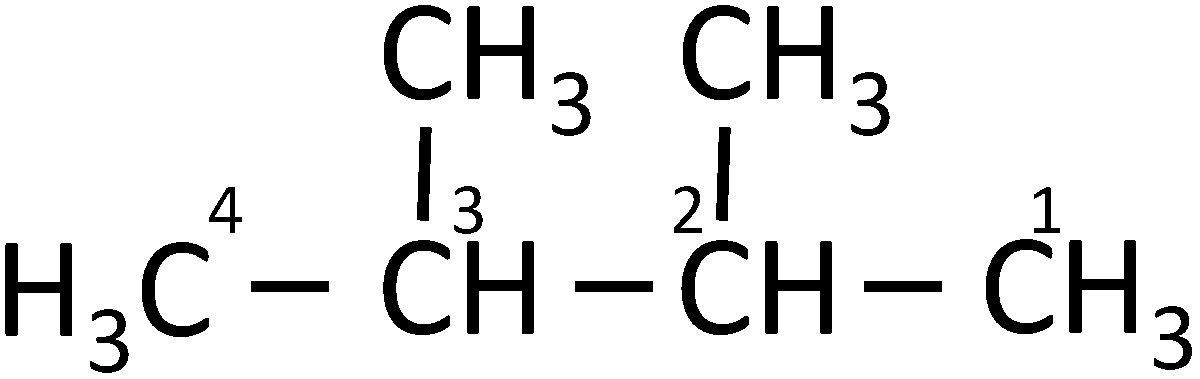
  1. 2, 3 – dimethyl butane
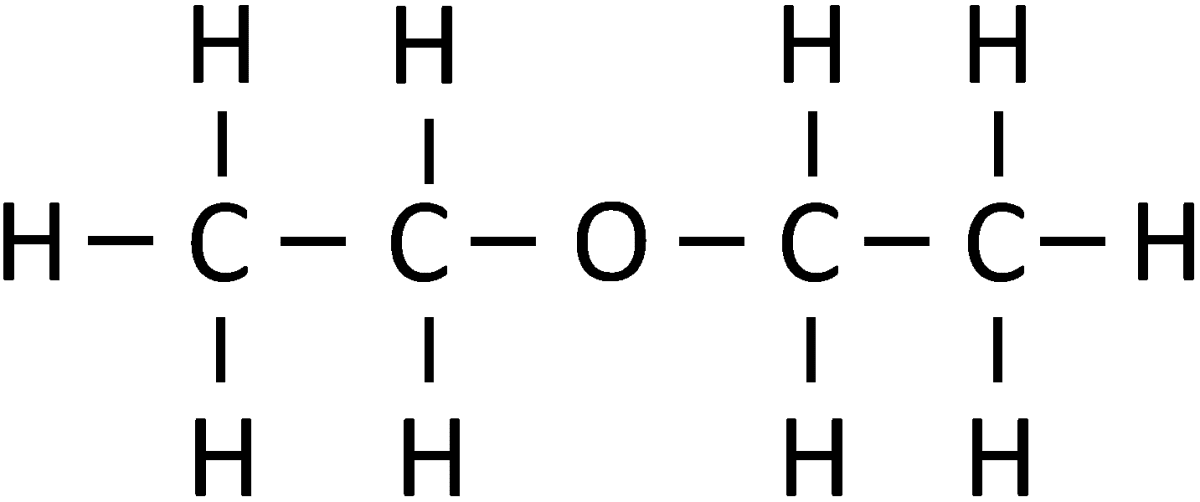
  2. Diethyl ether
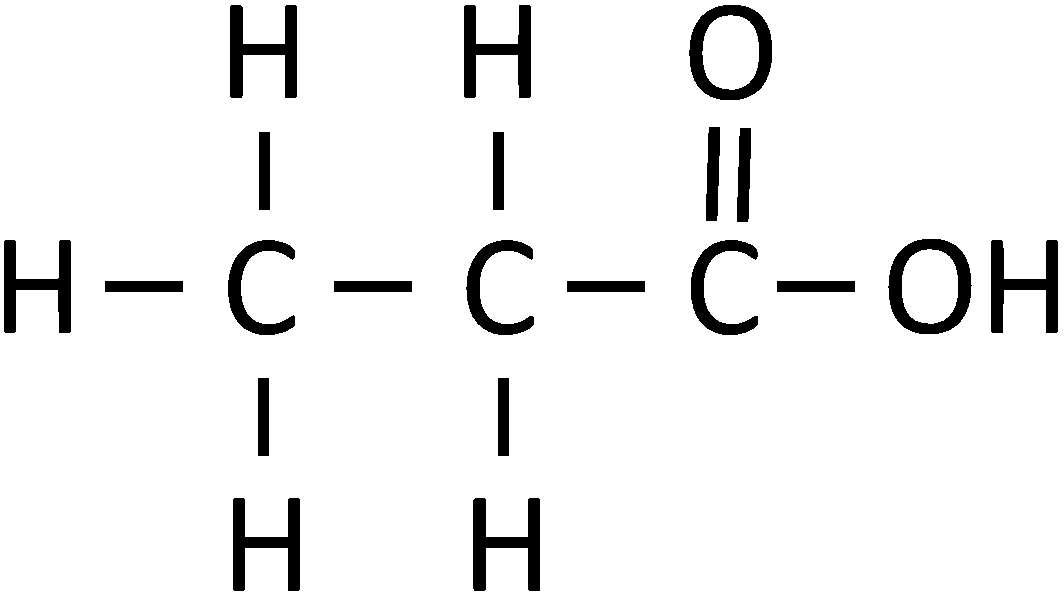
  3. Propanoic acid

(ii) From the list of terms given, choose the most appropriate term to match the given description.

(calcination, roasting, pulverisation, smelting)

Show SolutionHide Solution↓

1. 2, 3 – dimethyl butane :

Draw the structural formula for 2, 3 – dimethyl butane. Organic Chemistry, Simplified Chemistry Dalal Solutions ICSE Class 10

2. Diethyl ether :

Draw the structural formula for Diethyl ether. Organic Chemistry, Simplified Chemistry Dalal Solutions ICSE Class 10

3. Propanoic acid :

Draw the structural formula for Propanoic acid. Organic Chemistry, Simplified Chemistry Dalal Solutions ICSE Class 10

(ii) The matching terms are:

  1. Crushing of the ore into a fine powder — Pulverisation
  2. Heating of the ore in the absence of air to a high temperature — Calcination
1(g)5 Marks · 2017 · Section I · 2017 PaperFull page

(i) Calculate the number of gram atoms in 4.6 grams of sodium (Na = 23).

(ii) Calculate the percentage of water of crystallization in CuSO4.5H2O (H = 1, O = 16, S = 32, Cu = 64)

(iii) A compound of X and Y has the empirical formula XY2. Its vapour density is equal to its empirical formula weight. Determine its molecular formula.

Show SolutionHide Solution↓

(i) 23 g of Na = 1 g. atom

∴ 4.6 g. of Na = $\frac{1}{23}$ x 4.6 = 0.2 g

Hence, 0.2 g. atoms

(ii) Molecular weight of hydrated copper sulphate CuSO4.5H2O = 64 + 32 + 4(16) + 5[2(1) + 16]

= 64 + 32 + 64 + 5[18]

= 64 + 32 + 64 + 90

= 250 g

250 g of CuSO4.5H2O contains 90 g of water of crystallization.

∴ Percentage of water of crystallization = $\frac{90}{250}$ x 100 = 36%

Hence, percentage of water of crystallization is 36%

(iii) Empirical formula = XY2

Empirical formula weight = V.D.

Molecular weight = 2 x V.D.

$$\begin{aligned}\text{n} = \frac{\text{Molecular weight}}{\text{Empirical formula weight}} \\[0.5em] \text{n} = \frac{\text{2 x V.D.}}{\text{V.D.}} \\[0.5em] \text{n} = 2\end{aligned}$$

∴ Molecular formula = n[E.F.] = 2[XY2] = X2Y4

1(h)Written · 2017 · Section I · 2017 PaperFull page

Match the atomic number 2, 4, 8, 15, and 19 with each of the following:

(i) A solid non metal belonging to the third period.

(ii) A metal of valency 1.

(iii) A gaseous element with valency 2.

(iv) An element belonging to Group 2.

(v) A rare gas.

Show SolutionHide Solution↓

(i) 15

(ii) 19

(iii) 8

(iv) 4

(v) 2

2(a)Written · 2017 · Section II · 2017 PaperFull page

Arrange the following as per the instruction given in the brackets:

(i) He, Ar, Ne (Increasing order of the number of electron shells)

(ii) Na, Li, K (Increasing Ionisation Energy)

(iii) F, Cl, Br (Increasing electronegativity)

(iv) Na, K, Li (Increasing atomic size)

Show SolutionHide Solution↓

(i) He < Ne < Ar
Reason — Number of electron shells increases as we move down the group.

(ii) K < Na < Li
Reason — Ionization Potential decreases as we move down the group.

(iii) Br < Cl < F
Reason — Electronegativity decreases as we move down the group.

(iv) Li < Na < K
Reason — Atomic Size increases as we move down the group.

2(b)Written · 2017 · Section II · 2017 PaperFull page

State the type of Bonding in the following molecules:

(i) Water

(ii) Calcium oxide

Show SolutionHide Solution↓

(i) Covalent bonding
Reason — The valency of hydrogen element is 1 and that of oxygen is 2. Hydrogen needs one electrons to attain stable duplet structure of nearest noble gas - He [2] and oxygen needs two electrons to attain stable octet structure of nearest noble gas - Ne [2,8]
Each of the two hydrogen atoms shares an electron pair with the oxygen atom such that hydrogen acquires a duplet configuration and oxygen an octet configuration resulting in the formation of two single covalent bonds [H-O-H] in the molecule of water.

State the type of bonding in water molecules. Chemical Bonding, Simplified Chemistry Dalal Solutions ICSE Class 10

(ii) Electrovalent bonding
Reason — The valency of calcium (2,8,8,2) element and that of oxygen (2,6) is 2. Calcium donates two electrons and oxygen takes up those two electrons and electrovalent bond is formed.

2(c)Written · 2017 · Section II · 2017 PaperFull page

Answer the following questions:

(i) How will you distinguish between Ammonium hydroxide and Sodium hydroxide using copper sulphate solution?

(ii) How will you distinguish between dilute hydrochloric acid and dilute sulphuric acid using lead nitrate solution?

Show SolutionHide Solution↓

(i) With Sodium hydroxide, copper sulphate (CuSO4) solution forms a pale blue precipitate which is insoluble in excess of sodium hydroxide and with ammonium hydroxide it forms a pale blue precipitate which dissolves in excess of ammonium hydroxide and forms a deep/inky blue solution.

(ii) Sulphuric acid forms a white precipitate with lead nitrate solution. This precipitate does not dissolve on warming the reaction mixture.

H2SO4 (dil.) + Pb(NO3)2 ⟶ 2HNO3 + PbSO4 ↓ [white ppt. formed which does not dissolve on warming the mixture].

Hydrochloric acid forms a white precipitate with lead nitrate solution. This precipitate dissolves on warming the reaction mixture so as to form clear solution.

2HCl (dil.) + Pb(NO3)2 ⟶ 2HNO3 + PbCl2 ↓ [white ppt. formed which dissolves on warming the mixture].

Hence, dilute hydrochloric acid and dilute sulphuric acid can be distinguished using lead nitrate solution.

2(d)Written · 2017 · Section II · 2017 PaperFull page

Identify the salts P and Q from the observations given below:

(i) On performing the flame test salt P produces a lilac coloured flame and its solution gives a white precipitate with silver nitrate solution, which is soluble in Ammonium hydroxide solution.

(ii) When dilute HCl is added to a salt Q, a brisk effervescence is produced and the gas turns lime water milky. When NH4OH solution is added to the above mixture (after adding dilute HCl), it produces a white precipitate which is soluble in excess NH4OH solution.

Show SolutionHide Solution↓

(i) P is potassium chloride.

Reason — K+ ions produces lilac coloured flame and Cl- ions react with silver nitrate to form silver chloride ppt. (soluble in excess of ammonium hydroxide).

(ii) Q is zinc carbonate.

Reason — CO32- ions produces carbon dioxide with HCl. Zinc chloride forms white ppt. with ammonium hydroxide ( soluble in excess of ammonium hydroxide).

3(a)Written · 2017 · Section II · 2017 PaperFull page

Draw an electron dot diagram to show the formation of each of the following compounds:

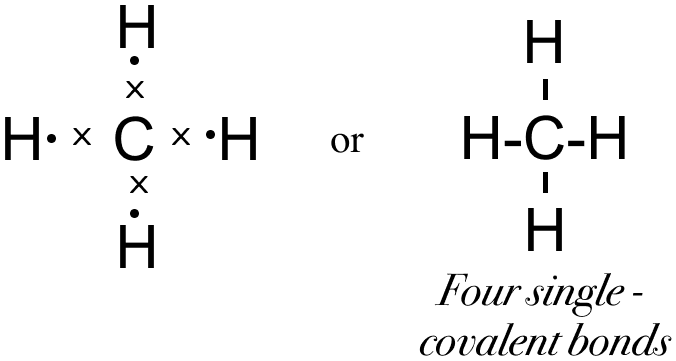
(i) Methane

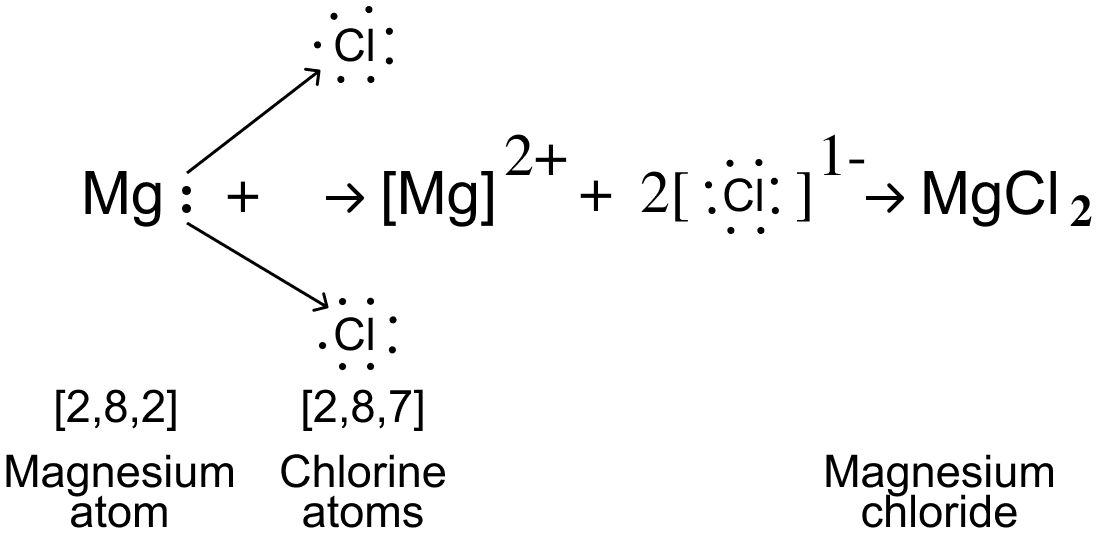
(ii) Magnesium Chloride

[H = 1, C = 6, Mg = 12, Cl = 17]

Show SolutionHide Solution↓

(i) Electron dot diagram showing the formation of Methane is given below:

Draw an electron dot diagram to show the formation of Methane. Chemical Bonding, Simplified Chemistry Dalal Solutions ICSE Class 10

(ii) Electron dot diagram showing the formation of Magnesium chloride is given below:

Draw an electron dot diagram to show the formation of Magnesium chloride. Chemical Bonding, Simplified Chemistry Dalal Solutions ICSE Class 10
3(b)Written · 2017 · Section II · 2017 PaperFull page

State the observations at the anode and at the cathode during the electrolysis of :

(i) fused lead bromide using graphite electrodes.

(ii) copper sulphate solution using copper electrodes.

Show SolutionHide Solution↓

(i) The observations at the anode & at the cathode are:
At cathode — silvery grey deposit of lead metal.
At anode — reddish brown fumes of bromine vapours.

(ii) The observations at the anode & at the cathode are:
At cathode — Brownish pink copper metal is deposited at cathode during electrolysis of copper sulphate.
At anode — Copper ions are formed. Copper anode diminishes in mass.

Blue colour of CuSO4 remains unchanged.

3(c)Written · 2017 · Section II · 2017 PaperFull page

Select the ion in each case, that would get selectively discharged from the aqueous mixture of the ions listed below:

(i) SO42-, NO3- and OH- ;

(ii) Pb2+, Ag+ and Cu2+.

Show SolutionHide Solution↓

(i) OH- ion will get discharged in preference to SO42- or NO3- ions.

(ii) Ag+ ions will get discharged in preference to Pb2+ or Cu2+ ions.

4(a)Written · 2017 · Section II · 2017 PaperFull page

Certain blank spaces are left in the following table and these are labelled as A, B, C, D and E. Identify each of them.

Lab preparation ofReactants usedProducts formedDrying agentMethod of collection
HCl gasNaCl + H2SO4AConc. H2SO4B
NH3 gasCMg(OH)2, NH3DE
Show SolutionHide Solution↓

A : Sodium hydrogen sulphate (NaHSO4) and HCl gas.

B : Upward displacement of air.

C : Magnesium nitride (Mg3N2) and water (H2O).

D : Quick lime [CaO]

E : Downward displacement of air.

4(b)Written · 2017 · Section II · 2017 PaperFull page

Write balanced chemical equations to show:

(i) The oxidizing action of conc. Sulphuric acid on Carbon.

(ii) The behavior of H2SO4 as an acid when it reacts with Magnesium.

(iii) The dehydrating property of conc. Sulphuric acid with sugar.

Show SolutionHide Solution↓

(i) C + 2H2SO4 (conc.) ⟶ CO2 + 2SO2 + 2H2O

(ii) Mg + H2SO4 (dil.) ⟶ MgSO4 + H2 (g)

(iii) $\text{C}_{12}\text{H}_{22}\text{O}_{11}\xrightarrow{\text{Conc. H}_2\text{SO}_4} \text{12C} \small{\space[sugar\space charcoal]} + \text{11H}_2\text{O}$

4(c)Written · 2017 · Section II · 2017 PaperFull page

Write balanced chemical equations to show how SO3 is converted to Sulphuric acid in the contact process.

Show SolutionHide Solution↓

SO3 + H2SO4 (conc.) ⟶ H2S2O7 (oleum)
H2S2O7 + H2O ⟶ 2H2SO4 (conc.)

5(a)Written · 2017 · Section II · 2017 PaperFull page

(i) Propane burns in air according to the following equation :

C3H8 + 5O2 ⟶ 3CO2 + 4H2O.

What volume of propane is consumed on using 1000 cm3 of air, considering only 20% of air contains oxygen.

(ii) The mass of 11.2 litres of a certain gas at s.t.p. is 24 g. Find the gram molecular mass of the gas.

Show SolutionHide Solution↓

(i) Given, 20% of air contains oxygen

∴ 20% of 1000 cm3 = $\frac{20}{100}$ x 1000 = 200 cm3

[By Lussac's law]

$$\begin{matrix} \text{C}_3\text{H}_8 & + & 5\text{O}_2 &\longrightarrow & 3\text{CO}_2 & + & 4\text{H}_2\text{O} \\ 1 \text{ vol.} & : & 5 \text{ vol.} & \longrightarrow & 3\text{ vol.} & : & 4\text{ vol.} \end{matrix}$$

To calculate the volume of propane consumed :

$$\begin{matrix}\text{O}_2 & : & \text{C}_3\text{H}_8 \\ 5 \text{ vol.} & : & 1 \text{ vol.} \\ 200 \text{ cm.}^3 & : & \text{x} \end{matrix}$$

$\therefore x = \frac{1}{5} \times 200 = 40 \text{ cm.}^3$

Hence, volume of propane is consumed is 40 cm3

(ii) 11.2 lit. weighs 24 g

∴ 22.4 lit. will weigh = $\frac{24}{11.2}$ x 22.4 = 48 g

Hence, gram molecular mass of the gas = 48 g.

5(b)Written · 2017 · Section II · 2017 PaperFull page

A gas cylinder can hold 1 kg of hydrogen at room temperature and pressure:

(i) Find the number of moles of hydrogen present.

(ii) What weight of CO2 can the cylinder hold under similar conditions of temperature and pressure? (H= 1, C = 12, O = 16)

(iii) If the number of molecules of hydrogen in the cylinder is X, calculate the number of CO2 molecules in the cylinder under the same conditions of temperature and pressure.

(iv) State the law that helped you to arrive at the above result.

Show SolutionHide Solution↓

(i) 2 g of hydrogen gas = 1 mole

∴ 1000 g of hydrogen gas = $\frac{1000}{2}$ = 500 moles.

(ii) Molar mass of CO2 = C + 2(O) = 12 + 2(16) = 44 g

1 mole of carbon dioxide = 44 g

∴ 500 moles of carbon dioxide = 44 x 500 = 22,000 g = 22 kg.

Hence, Weight of carbon dioxide in cylinder = 22 kg

(iii) According to Avogadro's law — Equal volumes of all gases under similar conditions of temperature and pressure contain equal number of molecules.

∴ molecules in the cylinder of carbon dioxide = X.

(iv) Avogadro's law — Equal volume of all gases under similar conditions of temperature and pressure contain equal number of molecules.

5(c)Written · 2017 · Section II · 2017 PaperFull page

Write a balanced chemical equation for the preparation of each of the following salts:

(i) Copper carbonate

(ii) Ammonium sulphate crystals

Show SolutionHide Solution↓

(i) CuSO4 + Na2CO3 ⟶ Na2SO4 + CuCO3

(ii) 2NH4OH + H2SO4 ⟶ (NH4)2SO4 + 2H2O

6(a)Written · 2017 · Section II · 2017 PaperFull page

Give a balanced chemical equation for each of the following:

(i) Action of conc. Nitric acid on Sulphur.

(ii) Catalytic oxidation of Ammonia.

(iii) Laboratory preparation of Nitric acid.

(iv) Reaction of Ammonia with Nitric acid.

Show SolutionHide Solution↓

(i) S + 6HNO3 [conc.] ⟶ H2SO4 + 2H2O + 6NO2

(ii) $4\text{NH}_3 + 5\text{O}_2 \xrightarrow[800 ^{\circ} \text{C}]{\text{Pt.}} \text{4NO} + \text{6H}_\text{2}\text{O} + \Delta$

(iii) KNO3 + H2SO4 [conc.] $\xrightarrow{\lt 200 ^{\circ}\text{C}}$ KHSO4 + HNO3

(iv) NH3 + HNO3 ⟶ NH4NO3

6(b)Written · 2017 · Section II · 2017 PaperFull page

Identify the term or substance based on the descriptions given below:

(i) Ice like crystals formed on cooling an organic acid sufficiently.

(ii) Hydrocarbon containing a triple bond used for welding purposes.

(iii) The property by virtue of which the compound has the same molecular formula but different structural formulae.

(iv) The compound formed where two alkyl groups are linked by $\overset{\underset{\text{||}}{\text{O}}}{\text{-C-}}$ group.

Show SolutionHide Solution↓

(i) Glacial acetic acid

(ii) Ethyne or acetylene

(iii) Isomerism

(iv) Ketone or Alkanone

6(c)Written · 2017 · Section II · 2017 PaperFull page

Give a balanced chemical equation for each of the following:

(i) Preparation of ethane from Sodium propionate

(ii) Action of alcoholic KOH on bromoethane.

Show SolutionHide Solution↓

(i) Preparation of ethane from Sodium propionate:

$\underset{\text{sodium propionate}}{\text{C}_2\text{H}_5\text{COONa}} + \underset{\text{sodalime}}{\text{NaOH}} \xrightarrow[\Delta]{\text{CaO}} \underset{\text{ethane}}{\text{C}_2\text{H}_6} + \text{Na}_2\text{CO}_3$

(ii) Action of alcoholic KOH on bromoethane:

$\underset{\text{ Bromoethane [ethyl bromide]}}{\text{C}_2\text{H}_5\text{-Br}} + \underset{\text{ alcoholic KOH}}{\text{KOH [aq.]}} \xrightarrow{\text{boil}} \underset{ \text{ ethyl alcohol}} {\text{C}_2\text{H}_5\text{OH}} + \text{KBr}$

7(a)Written · 2017 · Section II · 2017 PaperFull page

Name the following:

(i) The process of coating of iron with zinc.

(ii) An alloy of lead and tin that is used in electrical circuits.

(iii) An ore of zinc containing its sulphide.

(iv) A metal oxide that can be reduced by hydrogen.

Show SolutionHide Solution↓

(i) Galvanization

(ii) Solder [fuse metal]

(iii) Zinc blende [ZnS]

(iv) Copper oxide [CuO]

7(b)Written · 2017 · Section II · 2017 PaperFull page

Answer the following questions with respect to the electrolytic process in the extraction of aluminum:

(i) Identify the components of the electrolyte other than pure alumina and the role played by each.

(ii) Explain why powdered coke is sprinkled over the electrolytic mixture.

Show SolutionHide Solution↓

(i) Cryolite and fluorspar are components of the electrolyte. Addition of cryolite enhances the conductivity of the mixture since, pure alumina is almost a non-conductor of electricity. Addition of both cryolite & fluorspar lowers the fusion point of the mixture i.e., mixture fuses around 950°C instead of 2050°C.

(ii) The layer of powdered coke is sprinkled over the electrolytic mixture as :

  1. it prevents burning of carbon electrodes in air at the emergence point from the bath.
  2. it minimizes or prevents heat loss by radiation.
7(c)Written · 2017 · Section II · 2017 PaperFull page

Complete the following by selecting the correct option from the choices given:

(i) The metal which does not react with water or dilute H2SO4 but reacts with concentrated H2SO4 is ............... (Al/Cu/Zn/Fe)

(ii) The metal whose oxide, which is amphoteric, is reduced to metal by carbon reduction ............... (Fe/Mg/Pb/Al)

(iii) The divalent metal whose oxide is reduced to metal by electrolysis of its fused salt is ............... (Al/Na/Mg/K)

Show SolutionHide Solution↓

(i) The metal which does not react with water or dilute H2SO4 but reacts with concentrated H2SO4 is Cu.

(ii) The metal whose oxide, which is amphoteric, is reduced to metal by carbon reduction — Pb.

(iii) The divalent metal whose oxide is reduced to metal by electrolysis of it's fused salt is — Mg.

Press ↓ to reveal a solution and move to the next question. Browse the free sample bank.

All 611 Chemistry questions