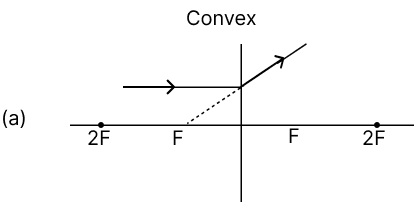
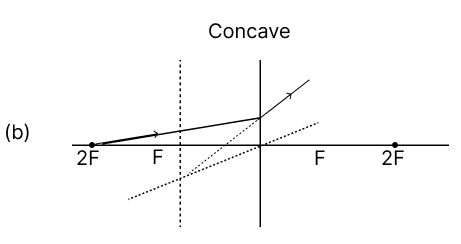
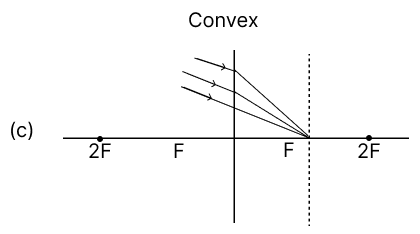
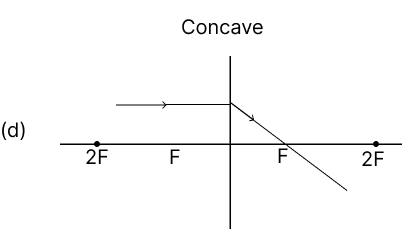
There are two pulley systems with V.R. = 2 and two pulley system with V.R. = 3
Reason — The velocity ratio is always equal to the number of strands of the tackle (or number of sections of the strings)
Velocity Ratio (V.R.) = $\frac{\text{displacement of effort}}{\text{displacement of load}}$
In Figure 1:

Number of sections of the strings = 3
So, the effort must move 3 units of distance to raise the load by 1 unit.
Velocity ratio = $\frac{\text{displacement of effort}}{\text{displacement of load}}$
Velocity ratio = $\frac{3\text{d}}{\text{d}}=3$
In Figure 2:
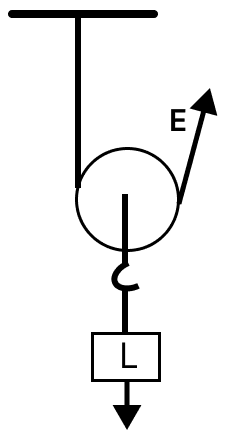
Number of sections of the strings = 2
So, the effort must move 2 units of distance to raise the load by 1 unit.
Velocity ratio = $\frac{\text{displacement of effort}}{\text{displacement of load}}$
velocity ratio = $\frac{2\text{d}}{\text{d}}=2$
In Figure 3:
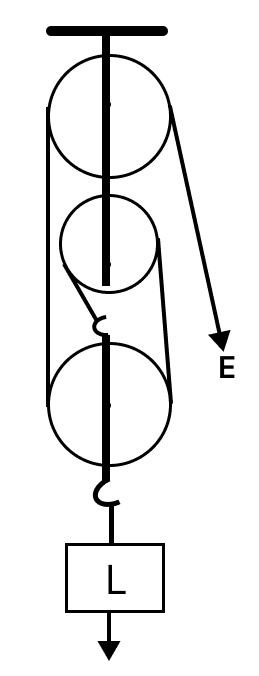
Number of sections of the strings = 3,
So, the effort must move 3 units of distance to raise the load by 1 unit.
Velocity ratio = $\frac{\text{displacement of effort}}{\text{displacement of load}}$
Velocity ratio $= \frac{3\text{d}}{\text{d}}=3$
In Figure 4:
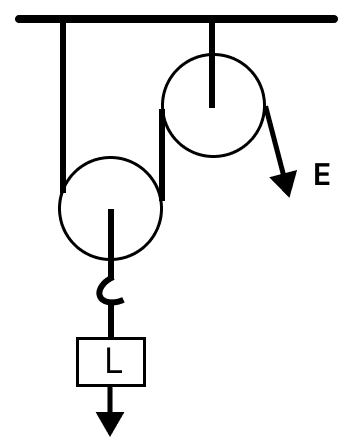
Number of sections of the strings = 2,
So, the effort must move 2 units of distance to raise the load by 1 unit.
Velocity ratio = $\frac{\text{displacement of effort}}{\text{displacement of load}}$
Velocity ratio = $\frac{2\text{d}}{\text{d}}=2$