Linear Inequations

ICSE Class 10 Mathematics · Selina Concise Mathematics · 56 solved questions

Exercise
1(a)Exercise 4(A)

If x ∈ W, then solution set of inequation -x > -7, is :

Show SolutionHide Solution↓

Given,

-x > -7

x < 7

Since x ∈ W and x < 7:

The solution set is: {0, 1, 2, 3, 4, 5, 6}

Hence, Option 2 is the correct option.

1(b)Exercise 4(A)

The value of x, for 4(2x - 5) < 2x + 28, x ∈ R, is :

Show SolutionHide Solution↓

Given,

⇒ 4(2x - 5) < 2x + 28

⇒ 8x - 20 < 2x + 28

⇒ 8x - 2x < 28 + 20

⇒ 6x < 48

⇒ x < $\frac{48}{6}$

⇒ x < 8.

Hence, Option 2 is the correct option.

1(c)Exercise 4(A)

The solution set for the inequation -2x + 7 ≤ 3, x ∈ R is :

Show SolutionHide Solution↓

Given,

⇒ -2x + 7 ≤ 3

⇒ 2x ≥ 7 - 3

⇒ 2x ≥ 4

⇒ x ≥ $\frac{4}{2}$

⇒ x ≥ 2.

Since, x ∈ R.

Solution set = {x : x ∈ R, x ≥ 2}

Hence, Option 4 is the correct option.

1(d)Exercise 4(A)

For 7 - 3x < x - 5, the solution set is :

Show SolutionHide Solution↓

Given,

⇒ 7 - 3x < x - 5

⇒ x + 3x > 7 + 5

⇒ 4x > 12

⇒ x > $\frac{12}{4}$

⇒ x > 3.

Hence, Option 1 is the correct option.

1(e)Exercise 4(A)

x(8 - x) > 0 and x ∈ N gives :

Show SolutionHide Solution↓

For x(8 - x) > 0

Either,

⇒ x > 0 and (8 - x) > 0

⇒ x > 0 and x < 8 ...........(1)

or,

⇒ x < 0 and (8 - x) < 0

⇒ x < 0 and x > 8 .............(2)

But both conditions of equation (2) are not possible simultaneously.

From equation (1),

Solution set = {0 < x < 8}.

Hence, Option 3 is the correct option.

2Exercise 4(A)

State, true or false :

(i) x < -y ⇒ -x > y

(ii) -5x ≥ 15 ⇒ x ≥ -3

(iii) 2x ≤ -7 ⇒ $\frac{2x}{-4} \ge \frac{-7}{-4}$

(iv) 7 > 5 ⇒ $\frac{1}{7} \lt \frac{1}{5}$

Show SolutionHide Solution↓

(i) Given,

x < -y

∴ -x > y [Using rule 5]

Hence, the statement is True.

(ii) Given,

-5x ≥ 15

Dividing both sides of the above inequation by -5,

⇒ x ≤ -3 [Using rule 4]

Hence, the statement is False.

(iii) Given,

2x ≤ -7

Dividing both sides of the above inequation by -4,

⇒ $\frac{2x}{-4} \ge \frac{-7}{-4}$ [Using rule 4]

Hence, the statement is True.

(iv) Given,

7 > 5

Taking reciprocals,

$\frac{1}{7} \lt \frac{1}{5}$ [Using rule 6]

Hence, the statement is True.

3Exercise 4(A)

State, whether the following statements are true or false.

(i) If a < b, then a - c < b - c

(ii) If a > b, then a + c > b + c

(iii) If a < b, then ac > bc

(iv) If a > b, then $\frac{a}{c} \lt \frac{b}{c}$

(v) If a - c > b - d; then a + d > b + c

(vi) If a < b, and c > 0, then a - c > b - c

where a, b, c, and d are real numbers c ≠ 0.

Show SolutionHide Solution↓

(i) Given,

a < b

Subtracting both sides by c,

a - c < b - c.

Hence, the statement is True.

(ii) Given,

a > b

Adding both sides by c,

a + c > b + c.

Hence, the statement is True.

(iii) Given,

a < b

If c is a positive number,

Multiplying both sides by c we get,

ac < bc

If c is a negative number,

Multiplying both sides by c we get,

ac > bc [Using rule 4]

Hence, the statement is False.

(iv) Given,

a > b

If c is a positive number,

Dividing both sides by c we get,

$\frac{a}{c} \gt \frac{b}{c}$

If c is a negative number,

Dividing both sides by c we get,

$\frac{a}{c} \lt \frac{b}{c}$ [Using rule 4]

Hence, the statement is False.

(v) Given,

a - c > b - d

Adding both sides by (c + d) we get,

⇒ a - c + (c + d) > b - d + (c + d)

⇒ a - c + c + d > b + c - d + d

⇒ a + d > b + c

Hence, the statement is True.

(vi) Given,

a < b and c > 0

Subtracting both sides by c we get,

a - c < b - c [As c is a positive number.]

Hence, the statement is False.

4Exercise 4(A)

Solve the inequation :

3 - 2x ≥ x - 12 given that x ∈ N.

Show SolutionHide Solution↓

Given,

⇒ 3 - 2x ≥ x - 12

⇒ x + 2x ≤ 3 + 12

⇒ 3x ≤ 15

Dividing both sides by 3 we get,

⇒ x ≤ 5

Since, x ∈ N

∴ Solution set = {1, 2, 3, 4, 5}.

5Exercise 4(A)

If 25 - 4x ≤ 16, find :

(i) the smallest value of x when x is a real number,

(ii) the smallest value of x when x is an integer.

Show SolutionHide Solution↓

Given,

⇒ 25 - 4x ≤ 16

⇒ -4x ≤ 16 - 25

⇒ -4x ≤ -9

Multiplying both sides by -1 we get,

⇒ 4x ≥ 9 (As on multiplying by negative no. the sign reverses.)

Dividing both sides by 4 we get,

⇒ x ≥ $\frac{9}{4}$

⇒ x ≥ 2.25

(i) Given,

x ≥ 2.25

Hence, smallest value of x when x is a real number is 2.25

(ii) Given,

x ≥ 2.25

Hence, smallest value of x when x is an integer is 3.

6Exercise 4(A)

If the replacement set is the set of real numbers, solve :

(i) -4x ≥ -16

(ii) 8 - 3x ≤ 20

Show SolutionHide Solution↓

(i) -4x ≥ -16

$$\begin{aligned}\Rightarrow \frac{-4x}{-4} \le \frac{-16}{-4} \\[1em] \Rightarrow x \le 4\end{aligned}$$

∴ Solution set = {x : x ∈ R and x ≤ 4}

(ii) 8 - 3x ≤ 20

⇒ -3x ≤ 20 - 8

⇒ -3x ≤ 12

Dividing both sides by -3 we get.

⇒ x ≥ -4 (As on dividing by negative no. the sign reverses.)

∴ Solution set = {x : x ∈ R and x ≥ -4}.

7Exercise 4(A)

Find the smallest value of x for which 5 - 2x < $5\frac{1}{2} - \frac{5}{3}x$, where x is an integer.

Show SolutionHide Solution↓

Given,

$$\begin{aligned}\Rightarrow 5 - 2x \lt 5\frac{1}{2} - \frac{5}{3}x \\[1em] \Rightarrow 5 - 2x \lt \frac{11}{2} - \frac{5}{3}x \\[1em] \Rightarrow 5 - \frac{11}{2} \lt -\frac{5}{3}x + 2x \\[1em] \Rightarrow \frac{10 - 11}{2} \lt \frac{-5x + 6x}{3} \\[1em] \Rightarrow -\frac{1}{2} \lt \frac{x}{3} \\[1em] \Rightarrow \frac{x}{3} \times 3 \gt -\frac{1}{2} \times 3 \\[1em] \Rightarrow x \gt -\frac{3}{2} \\[1em] \Rightarrow x \gt -1.5\end{aligned}$$

Since, x is an integer.

Hence, smallest value of x = -1.

8Exercise 4(A)

Find the largest value of x for which

2(x - 1) ≤ 9 - x and x ∈ W.

Show SolutionHide Solution↓

Given,

⇒ 2(x - 1) ≤ 9 - x

⇒ 2x - 2 ≤ 9 - x

⇒ 2x + x ≤ 9 + 2

⇒ 3x ≤ 11

⇒ x ≤ $\frac{11}{3}$

⇒ x ≤ 3.67

Since, x ∈ W

Hence, largest value of x for which 2(x - 1) ≤ 9 - x is 3.

1(a)Exercise 4(B)

For the following real number line, the solution set is :

For the following real number line, the solution set is : Linear Inequations, Concise Mathematics Solutions ICSE Class 10.
Show SolutionHide Solution↓

From real number line, we get :

x ∈ R, x > -2 and x ≤ 4.

∴ Solution set = {x : x ∈ R and -2 < x ≤ 4}.

Hence, Option 3 is the correct option.

1(b)Exercise 4(B)

The solution set for the following number line is :

The solution set for the following number line is : Linear Inequations, Concise Mathematics Solutions ICSE Class 10.
Show SolutionHide Solution↓

From number line :

x ∈ Integers (Z) and x ≥ -3.

Solution set = {x : x ∈ Z and -3 ≤ x}.

Hence, Option 2 is the correct option.

1(c)Exercise 4(B)

The following number line represents :

The following number line represents : Linear Inequations, Concise Mathematics Solutions ICSE Class 10.
Show SolutionHide Solution↓

From the number line, we get :

Solution set = {{(x < 10) ∪ (x > 10)}}

Hence, Option 2 is the correct option.

1(d)Exercise 4(B)

The solution set for the following number line is :

The solution set for the following number line is : Linear Inequations, Concise Mathematics Solutions ICSE Class 10.
Show SolutionHide Solution↓

From number line, we get :

x ∈ R, x ≤ -2 or x ≥ 3.

∴ Solution set = {x : x ∈ R, x ≤ -2 or x ≥ 3}

Hence, Option 4 is the correct option.

1(e)Exercise 4(B)

The number line for the solution of inequation x > 5 and x < 10 (x ∈ R) is :

The number line for the solution of inequation x &gt; 5 and x &lt; 10 (x ∈ R) is : Linear Inequations, Concise Mathematics Solutions ICSE Class 10.
Show SolutionHide Solution↓

For x > 5, x < 10 and x ∈ R.

Solution set = {x : x ∈ R and 5 < x < 10}.

Hence, Option 2 is the correct option.

2Exercise 4(B)

For each graph given alongside, write an inequation taking x as the variable :

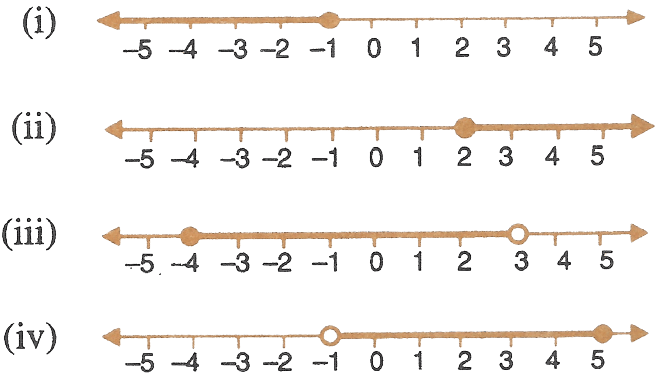
For each graph given alongside, write an inequation taking x as the variable. Linear Inequations, Concise Mathematics Solutions ICSE Class 10.
Show SolutionHide Solution↓

(i) From graph we get,

x ≤ -1 and x ∈ R.

(ii) From graph we get,

x ≥ 2 and x ∈ R.

(iii) From graph we get,

-4 ≤ x < 3 and x ∈ R.

(iv) From graph we get,

-1 < x ≤ 5 and x ∈ R.

3(i)Exercise 4(B)

For the following inequations, graph the solution set on the real number line :

-4 ≤ 3x - 1 < 8

Show SolutionHide Solution↓

-4 ≤ 3x - 1 < 8

Solving L.H.S. of the equation,

⇒ -4 ≤ 3x - 1

⇒ 3x ≥ -4 + 1

⇒ 3x ≥ -3

⇒ x ≥ -1 .........(i)

Solving R.H.S. of the equation,

⇒ 3x - 1 < 8

⇒ 3x < 8 + 1

⇒ 3x < 9

⇒ x < 3 .........(ii)

From (i) and (ii) we get,

-1 ≤ x < 3.

∴ Solution set = {-1 ≤ x < 3 : x ∈ R }

Solution on the number line is :

-4 ≤ 3x - 1 < 8. Graph the solution set on the real number line. Linear Inequations, Concise Mathematics Solutions ICSE Class 10.
3(ii)Exercise 4(B)

For the following inequations, graph the solution set on the real number line :

-1 < 3 - 2x ≤ 7

Show SolutionHide Solution↓

Given,

-1 < 3 - 2x ≤ 7

Solving L.H.S. of the equation,

⇒ -1 < 3 - 2x

⇒ -1 - 3 < -2x

⇒ -4 < -2x

Dividing both sides by -2 we get,

⇒ 2 > x (As sign reverses on dividing by negative no.)

⇒ x < 2 .........(i)

Solving R.H.S. of the equation,

⇒ 3 - 2x ≤ 7

⇒ 3 - 7 ≤ 2x

⇒ -4 ≤ 2x

Dividing both sides by 2 we get,

⇒ -2 ≤ x

⇒ x ≥ -2 .........(ii)

From (i) and (ii) we get,

-2 ≤ x < 2

∴ Solution set = {x : x ∈ R and -2 ≤ x < 2}

Solution on the number line is :

x ∈ {real numbers} and -1 < 3 - 2x ≤ 7, evaluate x and represent it on a number line. Linear Inequations, Concise Mathematics Solutions ICSE Class 10.
3(iii)Exercise 4(B)

For the following inequations, graph the solution set on the real number line :

x - 1 < 3 - x ≤ 5

Show SolutionHide Solution↓

x - 1 < 3 - x ≤ 5

Solving L.H.S. of the equation,

⇒ x - 1 < 3 - x

⇒ x + x < 3 + 1

⇒ 2x < 4

⇒ x < 2 .........(i)

Solving R.H.S. of the equation,

⇒ 3 - x ≤ 5

⇒ x ≥ 3 - 5

⇒ x ≥ -2 .........(ii)

From (i) and (ii) we get,

-2 ≤ x < 2.

∴ Solution set = {-2 ≤ x < 2 : x ∈ R}

Solution on the number line is :

x - 1 < 3 - x ≤ 5. Graph the solution set on the real number line. Linear Inequations, Concise Mathematics Solutions ICSE Class 10.
4Exercise 4(B)

List the elements of the solution set of inequation -3 < x - 2 ≤ 9 - 2x; x ∈ N.

Show SolutionHide Solution↓

Given,

⇒ -3 < x - 2 ≤ 9 - 2x

Solving L.H.S. of the equation,

⇒ -3 < x - 2

⇒ x > -3 + 2

⇒ x > -1 .......(i)

Solving R.H.S. of the equation,

⇒ x - 2 ≤ 9 - 2x

⇒ x + 2x ≤ 9 + 2

⇒ 3x ≤ 11

⇒ x ≤ $\frac{11}{3}$ .........(ii)

From (i) and (ii) we get,

⇒ -1 < x ≤ $\frac{11}{3}$.

Since, x ∈ N

∴ Solution set = {1, 2, 3}.

5Exercise 4(B)

Find the range of values of x which satisfies

$-2\frac{2}{3} \le x + \frac{1}{3} \lt 3\frac{1}{3}$, x ∈ R.

Graph these values on number line.

Show SolutionHide Solution↓

Given,

$$\begin{aligned}\Rightarrow -2\frac{2}{3} \le x + \frac{1}{3} \lt 3\frac{1}{3} \\[1em] \Rightarrow -\frac{8}{3} \le x + \frac{1}{3} \lt \frac{10}{3} \\[1em]\end{aligned}$$

Solving L.H.S. of the equation,

$$\begin{aligned}\Rightarrow -\frac{8}{3} \le x + \frac{1}{3} \\[1em] \Rightarrow x \ge -\frac{8}{3} - \frac{1}{3} \\[1em] \Rightarrow x \ge -\frac{9}{3} \\[1em] \Rightarrow x \ge -3 ........(i)\end{aligned}$$

Solving R.H.S. of the equation,

$$\begin{aligned}\Rightarrow x + \frac{1}{3} \lt \frac{10}{3} \\[1em] \Rightarrow x \lt \frac{10}{3} - \frac{1}{3} \\[1em] \Rightarrow x \lt \frac{9}{3} \\[1em] \Rightarrow x \lt 3 ..........(ii)\end{aligned}$$

From (i) and (ii) we get,

-3 ≤ x < 3.

Solution set = {x : x ∈ R and -3 ≤ x < 3}.

Solution on the number line is :

Find the range of values of x which satisfies -2(2/3) ≤ x + 1/3 < 3(1/3), x ∈ R. Graph these values on number line. Linear Inequations, Concise Mathematics Solutions ICSE Class 10.
6Exercise 4(B)

Find the values of x, which satisfy the inequation :

$-2 \le \frac{1}{2} - \frac{2x}{3} \le 1\frac{5}{6}$, x ∈ N.

Graph the solution on the number line.

Show SolutionHide Solution↓

Given,

$$\begin{aligned}\Rightarrow -2 \le \frac{1}{2} - \frac{2x}{3} \le 1\frac{5}{6} \\[1em] \Rightarrow -2 \le \frac{3 - 4x}{6} \le \frac{11}{6} \\[1em]\end{aligned}$$

Solving L.H.S. of the equation,

$$\begin{aligned}\Rightarrow -2 \le \frac{3 - 4x}{6} \\[1em] \Rightarrow -12 \le 3 - 4x \\[1em] \Rightarrow 4x \le 3 + 12 \\[1em] \Rightarrow x \le \frac{15}{4} ........(i)\end{aligned}$$

Solving R.H.S. of the equation,

$$\begin{aligned}\Rightarrow \frac{1}{2} - \frac{2x}{3} \le \frac{11}{6} \\[1em] \Rightarrow \frac{2x}{3} \ge \frac{1}{2} - \frac{11}{6} \\[1em] \Rightarrow \frac{2x}{3} \ge \frac{3 - 11}{6} \\[1em] \Rightarrow \frac{2x}{3} \ge -\frac{8}{6} \\[1em] \Rightarrow x \ge -\frac{8}{6} \times \frac{3}{2} \\[1em] \Rightarrow x \ge -2 .........(ii)\end{aligned}$$

From (i) and (ii) we get,

$-2 \le x \le \frac{15}{4}$

Since, x ∈ N,

∴ Solution set = {1, 2, 3}.

Solution on the number line is :

Find the values of x, which satisfy the inequation -2 ≤ 1/2 - 2x/3 ≤ 1(5/6), x ∈ N. Graph the solution on the number line. Linear Inequations, Concise Mathematics Solutions ICSE Class 10.
7Exercise 4(B)

Given x ∈ {real numbers}, find the range of values of x for which -5 ≤ 2x - 3 < x + 2 and represent it on a real number line.

Show SolutionHide Solution↓

Given,

-5 ≤ 2x - 3 < x + 2

Solving L.H.S. of the equation,

⇒ -5 ≤ 2x - 3

⇒ 2x ≥ -5 + 3

⇒ 2x ≥ -2

Dividing both sides by 2 we get,

⇒ x ≥ -1 ........(i)

Solving R.H.S. of the equation,

⇒ 2x - 3 < x + 2

⇒ 2x - x < 2 + 3

⇒ x < 5 ........(ii)

From (i) and (ii) we get,

-1 ≤ x < 5.

∴ Solution set = {x : x ∈ R and -1 ≤ x < 5}.

Solution on the number line is :

Given x ∈ {real numbers}, find the range of values of x for which -5 ≤ 2x - 3 < x + 2 and represent it on a real number line. Linear Inequations, Concise Mathematics Solutions ICSE Class 10.
8Exercise 4(B)

If 5x - 3 ≤ 5 + 3x ≤ 4x + 2, express it as a ≤ x ≤ b and then state the values of a and b.

Show SolutionHide Solution↓

Given,

⇒ 5x - 3 ≤ 5 + 3x ≤ 4x + 2

Solving L.H.S. of the equation,

⇒ 5x - 3 ≤ 5 + 3x

⇒ 5x - 3x ≤ 5 + 3

⇒ 2x ≤ 8

⇒ x ≤ 4 ........(i)

Solving R.H.S. of the equation,

⇒ 5 + 3x ≤ 4x + 2

⇒ 3x - 4x ≤ 2 - 5

⇒ -x ≤ -3

⇒ x ≥ 3 .......(ii)

From (i) and (ii) we get,

3 ≤ x ≤ 4

Comparing above equation with a ≤ x ≤ b we get,

a = 3 and b = 4.

Hence, a = 3 and b = 4.

9Exercise 4(B)

Solve the following inequation and graph the solution set on the number line :

2x - 3 < x + 2 ≤ 3x + 5; x ∈ R.

Show SolutionHide Solution↓

Given,

2x - 3 < x + 2 ≤ 3x + 5

Solving L.H.S. of the equation,

⇒ 2x - 3 < x + 2

⇒ 2x - x < 2 + 3

⇒ x < 5 ...........(i)

Solving R.H.S. of the equation,

⇒ x + 2 ≤ 3x + 5

⇒ x - 3x ≤ 5 - 2

⇒ -2x ≤ 3

⇒ 2x ≥ -3

Dividing both sides by 2 we get,

⇒ x ≥ -1.5 .........(ii)

From (i) and (ii) we get,

-1.5 ≤ x < 5

∴ Solution set = {x : x ∈ R and -1.5 ≤ x < 5}.

Solution on the number line is :

2x - 3 < x + 2 ≤ 3x + 5; x ∈ R. Solve the inequation and graph the solution set on the number line. Linear Inequations, Concise Mathematics Solutions ICSE Class 10.
10(i)Exercise 4(B)

Solve and graph the solution set of :

2x - 9 < 7 and 3x + 9 ≤ 25; x ∈ R.

Show SolutionHide Solution↓

Given,

2x - 9 < 7 and 3x + 9 ≤ 25

Solving, 2x - 9 < 7

⇒ 2x < 7 + 9

⇒ 2x < 16

⇒ x < 8 .........(i)

Solving, 3x + 9 ≤ 25

⇒ 3x ≤ 25 - 9

⇒ 3x ≤ 16

⇒ x ≤ $\frac{16}{3}$

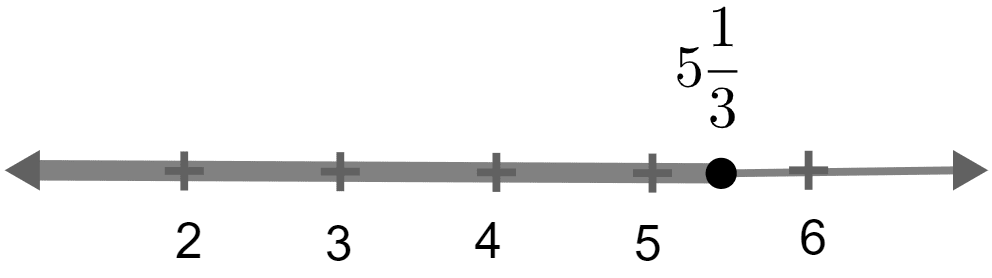
⇒ x ≤ $5\frac{1}{3}$ ........(ii)

From (i) and (ii) we get,

⇒ x ≤ $5\frac{1}{3}$

∴ Solution set = {x : x ≤ $5\frac{1}{3}$ and x ∈ R}.

Solution on the number line is :

2x - 9 < 7 and 3x + 9 ≤ 25; x ∈ R. Solve and graph the solution set. Linear Inequations, Concise Mathematics Solutions ICSE Class 10.
10(ii)Exercise 4(B)

Solve and graph the solution set of :

2x - 9 ≤ 7 and 3x + 9 > 25; x ∈ I

Show SolutionHide Solution↓

Given,

2x - 9 ≤ 7 and 3x + 9 > 25

Solving, 2x - 9 ≤ 7

⇒ 2x ≤ 7 + 9

⇒ 2x ≤ 16

⇒ x ≤ 8 .........(i)

Solving, 3x + 9 > 25

⇒ 3x > 25 - 9

⇒ 3x > 16

⇒ x > $\frac{16}{3}$

⇒ x > $5\frac{1}{3}$ ........(ii)

From (i) and (ii) we get,

⇒ $5\frac{1}{3} \lt x \le 8$

Since, x ∈ I,

∴ Solution set = {6, 7, 8}.

Solution on the number line is :

2x - 9 ≤ 7 and 3x + 9 > 25; x ∈ I. Solve and graph the solution set. Linear Inequations, Concise Mathematics Solutions ICSE Class 10.
10(iii)Exercise 4(B)

Solve and graph the solution set of :

x + 5 ≥ 4(x - 1) and 3 - 2x < -7; x ∈ R.

Show SolutionHide Solution↓

Given,

x + 5 ≥ 4(x - 1) and 3 - 2x < -7

Solving, x + 5 ≥ 4(x - 1)

⇒ x + 5 ≥ 4x - 4

⇒ 4x - x ≤ 5 + 4

⇒ 3x ≤ 9

Dividing both sides by 3 we get,

⇒ x ≤ 3 .......(i)

Solving, 3 - 2x < -7

⇒ 2x > 3 + 7

⇒ 2x > 10

⇒ x > 5 .......(ii)

From (i) and (ii) we get,

x ≤ 3 and x > 5

There is no number possible which is less than or equal to 3 and greater than 5 hence, no solution.

Hence, solution set is an empty set.

11Exercise 4(B)

Solve and graph the solution set of :

3x - 2 > 19 or 3 - 2x ≥ -7; x ∈ R

Show SolutionHide Solution↓

Given,

3x - 2 > 19 or 3 - 2x ≥ -7

Solving, 3x - 2 > 19

⇒ 3x > 19 + 2

⇒ 3x > 21

⇒ x > 7

Solving, 3 - 2x ≥ -7

⇒ 2x ≤ 3 + 7

⇒ 2x ≤ 10

⇒ x ≤ 5.

Hence, x > 7 or x ≤ 5.

Solution on the number line is :

3x - 2 > 19 or 3 - 2x ≥ -7; x ∈ R. Solve and graph the solution set. Linear Inequations, Concise Mathematics Solutions ICSE Class 10.
12Exercise 4(B)

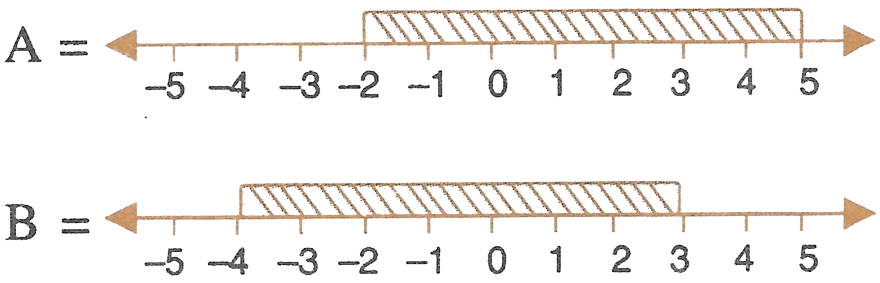
The diagram represents two inequations A and B on a real number lines :

The diagram represents two inequations A and B on a real number lines. Write down A and B in set builder notation. Linear Inequations, Concise Mathematics Solutions ICSE Class 10.

(i) Write down A and B in set builder notation.

(ii) Represent A ∩ B and A ∩ B' on two different number lines.

Show SolutionHide Solution↓

(i) A = {x : -2 ≤ x < 5 and x ∈ R}

B = {x : -4 ≤ x < 3 and x ∈ R}

(ii) A ∩ B = Numbers common to both A and B

= {x : -2 ≤ x < 3}

A ∩ B' = Numbers which belong to A but do not belong to B

= {x : 3 ≤ x < 5}

Represent A ∩ B and A ∩ B' on two different number lines. Linear Inequations, Concise Mathematics Solutions ICSE Class 10.
13Exercise 4(B)

Given A = {x : -1 < x ≤ 5, x ∈ R} and B = {x : -4 ≤ x < 3, x ∈ R}

Represent on different number lines :

(i) A ∩ B

(ii) A' ∩ B

(iii) A - B

Show SolutionHide Solution↓

A = {x : -1 < x ≤ 5, x ∈ R} and B = {x : -4 ≤ x < 3, x ∈ R}

(i) A ∩ B = Numbers common to both A and B.

= {x : -1 < x < 3, x ∈ R}

Solution on the number line is :

Given A = {x : -1 < x ≤ 5, x ∈ R} and B = {x : -4 ≤ x < 3, x ∈ R}. Represent A ∩ B on number line. Linear Inequations, Concise Mathematics Solutions ICSE Class 10.

(ii) A' ∩ B = Numbers which do not belong to A but belong to B

= {x : -4 ≤ x ≤ -1, x ∈ R}

Solution on the number line is :

Given A = {x : -1 < x ≤ 5, x ∈ R} and B = {x : -4 ≤ x < 3, x ∈ R}. Represent A' ∩ B on number line. Linear Inequations, Concise Mathematics Solutions ICSE Class 10.

(iii) A - B = Numbers which belong to A but do not belong to B

= {x : 3 ≤ x ≤ 5}

Given A = {x : -1 < x ≤ 5, x ∈ R} and B = {x : -4 ≤ x < 3, x ∈ R}. Represent A - B on number line. Linear Inequations, Concise Mathematics Solutions ICSE Class 10.
14Exercise 4(B)

Find the range of values of x, which satisfy :

$-\frac{1}{3} \le \frac{x}{2} + 1\frac{2}{3} \lt 5\frac{1}{6}$

Graph, in each of the following cases, the values of x on different real number lines:

(i) x ∈ W

(ii) x ∈ Z

(iii) x ∈ R

Show SolutionHide Solution↓

Given,

$\Rightarrow -\frac{1}{3} \le \frac{x}{2} + 1\frac{2}{3} \lt 5\frac{1}{6}$

Solving L.H.S of the above equation,

$$\begin{aligned}\Rightarrow -\frac{1}{3} \le \frac{x}{2} + 1\frac{2}{3} \\[1em] \Rightarrow -\frac{1}{3} \le \frac{x}{2} + \frac{5}{3} \\[1em] \Rightarrow \frac{x}{2} \ge -\frac{1}{3} - \frac{5}{3} \\[1em] \Rightarrow \frac{x}{2} \ge -\frac{6}{3} \\[1em] \Rightarrow \frac{x}{2} \ge -2 \\[1em] \Rightarrow x \ge -2 \times 2 \\[1em] \Rightarrow x \ge -4 \space .......(i)\end{aligned}$$

Solving R.H.S of the above equation,

$$\begin{aligned}\Rightarrow \frac{x}{2} + 1\frac{2}{3} \lt 5\frac{1}{6} \\[1em] \Rightarrow \frac{x}{2} + \frac{5}{3} \lt \frac{31}{6} \\[1em] \Rightarrow \frac{x}{2} \lt \frac{31}{6} - \frac{5}{3} \\[1em] \Rightarrow \frac{x}{2} \lt \frac{31 - 10}{6} \\[1em] \Rightarrow \frac{x}{2} \lt \frac{21}{6} \\[1em] \Rightarrow x \lt 2 \times \frac{21}{6} \\[1em] \Rightarrow x \lt \frac{42}{6} \\[1em] \Rightarrow x \lt 7 \space .......(ii)\end{aligned}$$

From (i) and (ii) we get,

⇒ -4 ≤ x < 7

(i) In this case x ∈ W

∴ Solution set = {0, 1, 2, 3, 4, 5, 6}

Solution on the number line is :

-(1/3) ≤ (x/2) + 1(2/3) < 5(1/6), x ∈ W. Linear Inequations, Concise Mathematics Solutions ICSE Class 10.

(ii) In this case x ∈ Z

∴ Solution set = {-4, -3, -2, -1, 0, 1, 2, 3, 4, 5, 6}

Solution on the number line is :

-(1/3) ≤ (x/2) + 1(2/3) < 5(1/6), x ∈ Z. Linear Inequations, Concise Mathematics Solutions ICSE Class 10.

(iii) In this case x ∈ R

∴ Solution set = {x : -4 ≤ x < 7, x ∈ R}

Solution on the number line is :

-(1/3) ≤ (x/2) + 1(2/3) < 5(1/6), x ∈ R. Linear Inequations, Concise Mathematics Solutions ICSE Class 10.
15Exercise 4(B)

Given : A = {x : -8 < 5x + 2 ≤ 17, x ∈ I}

B = {x : -2 ≤ 7 + 3x < 17, x ∈ R}

Where R = {real numbers} and I = {integers}

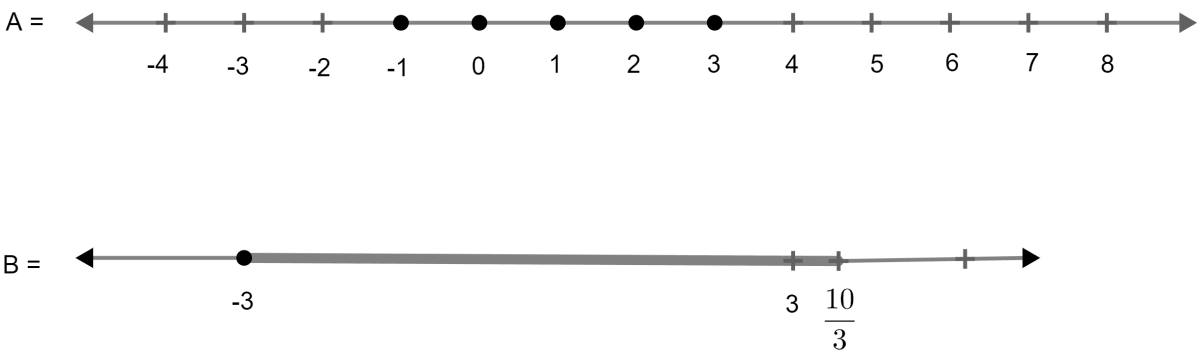
Represent A and B on two different numbers lines. Write down elements of A ∩ B.

Show SolutionHide Solution↓

Given,

A = {x : -8 < 5x + 2 ≤ 17, x ∈ I}

Solving L.H.S. of the equation,

⇒ -8 < 5x + 2

⇒ 5x > -8 - 2

⇒ 5x > -10

⇒ x > -2 ......(i)

Solving R.H.S. of the equation,

⇒ 5x + 2 ≤ 17

⇒ 5x ≤ 17 - 2

⇒ 5x ≤ 15

⇒ x ≤ 3 .......(ii)

From (i) and (ii) we get,

-2 < x ≤ 3

Since, x ∈ I

∴ Solution set = {-1, 0, 1, 2, 3}

Given,

B = {x : -2 ≤ 7 + 3x < 17, x ∈ R}

Solving L.H.S. of the equation,

⇒ -2 ≤ 7 + 3x

⇒ 3x ≥ -2 - 7

⇒ 3x ≥ -9

⇒ x ≥ -3 .......(iii)

Solving R.H.S. of the equation,

⇒ 7 + 3x < 17

⇒ 3x < 17 - 7

⇒ 3x < 10

⇒ x < $\frac{10}{3}$ ........(iv)

From (iii) and (iv) we get,

-3 ≤ x < $\frac{10}{3}$

A ∩ B = Elements common to both A and B,

Hence, A ∩ B ={-1, 0, 1, 2, 3}.

Given : A = {x : -8 < 5x + 2 ≤ 17, x ∈ I} B = {x : -2 ≤ 7 + 3x < 17, x ∈ R} Where R = {real numbers} and I = {integers}. Represent A and B on two different numbers lines. Write down elements of A ∩ B. Linear Inequations, Concise Mathematics Solutions ICSE Class 10.
16Exercise 4(B)

Solve the following inequation and represent the solution set on the number line 2x - 5 ≤ 5x + 4 < 11, where x ∈ I.

Show SolutionHide Solution↓

Given,

2x - 5 ≤ 5x + 4 < 11

Solving L.H.S. of the equation,

⇒ 2x - 5 ≤ 5x + 4

⇒ 5x - 2x ≥ -5 - 4

⇒ 3x ≥ -9

⇒ x ≥ -3 .......(i)

Solving R.H.S. of the equation,

⇒ 5x + 4 < 11

⇒ 5x < 11 - 4

⇒ 5x < 7

⇒ x < $\frac{7}{5}$ .......(ii)

From (i) and (ii) we get,

-3 ≤ x < $\frac{7}{5}$

Since, x ∈ I

∴ Solution set = {-3, -2, -1, 0, 1}.

Solution on the number line is :

Solve the following inequation and represent the solution set on the number line 2x - 5 ≤ 5x + 4 < 11, where x ∈ I. Linear Inequations, Concise Mathematics Solutions ICSE Class 10.
1(a)Test Yourself

The maximum value of x for the inequation 4x ≤ 12 + x is :

Show SolutionHide Solution↓

Given,

⇒ 4x ≤ 12 + x

⇒ 4x - x ≤ 12

⇒ 3x ≤ 12

⇒ x ≤ $\frac{12}{3}$

⇒ x ≤ 4

∴ Maximum value of x will be 4.

Hence, Option 2 is the correct option.

1(b)Test Yourself

The minimum value of x for the inequation 5x - 4 ≥ 18 - 6x is :

Show SolutionHide Solution↓

Given,

⇒ 5x - 4 ≥ 18 - 6x

⇒ 5x + 6x ≥ 18 + 4

⇒ 11x ≥ 22

⇒ x ≥ $\frac{22}{11}$

⇒ x ≥ 2

∴ Minimum value of x will be 2.

Hence, Option 1 is the correct option.

1(c)Test Yourself

If 1 ≤ -x < 5, x is an integer then the sum of smallest and greatest values of x is :

Show SolutionHide Solution↓

Given,

⇒ 1 ≤ -x < 5

⇒ -5 < x ≤ -1

Since, x is an integer

The possible integer values are: {-4, -3, -2, -1}

The sum of smallest and greatest values = -4 + (-1) = -5

Hence, Option 1 is the correct option.

1(d)Test Yourself

The value of x for the inequation 3x + 15 < 5x + 13, x ∈ Z is :

Show SolutionHide Solution↓

Given,

⇒ 3x + 15 < 5x + 13

⇒ 5x + 13 > 3x + 15

⇒ 5x - 3x > 15 - 13

⇒ 2x > 2

⇒ x > 1

Hence, Option 1 is the correct option.

1(e)Test Yourself

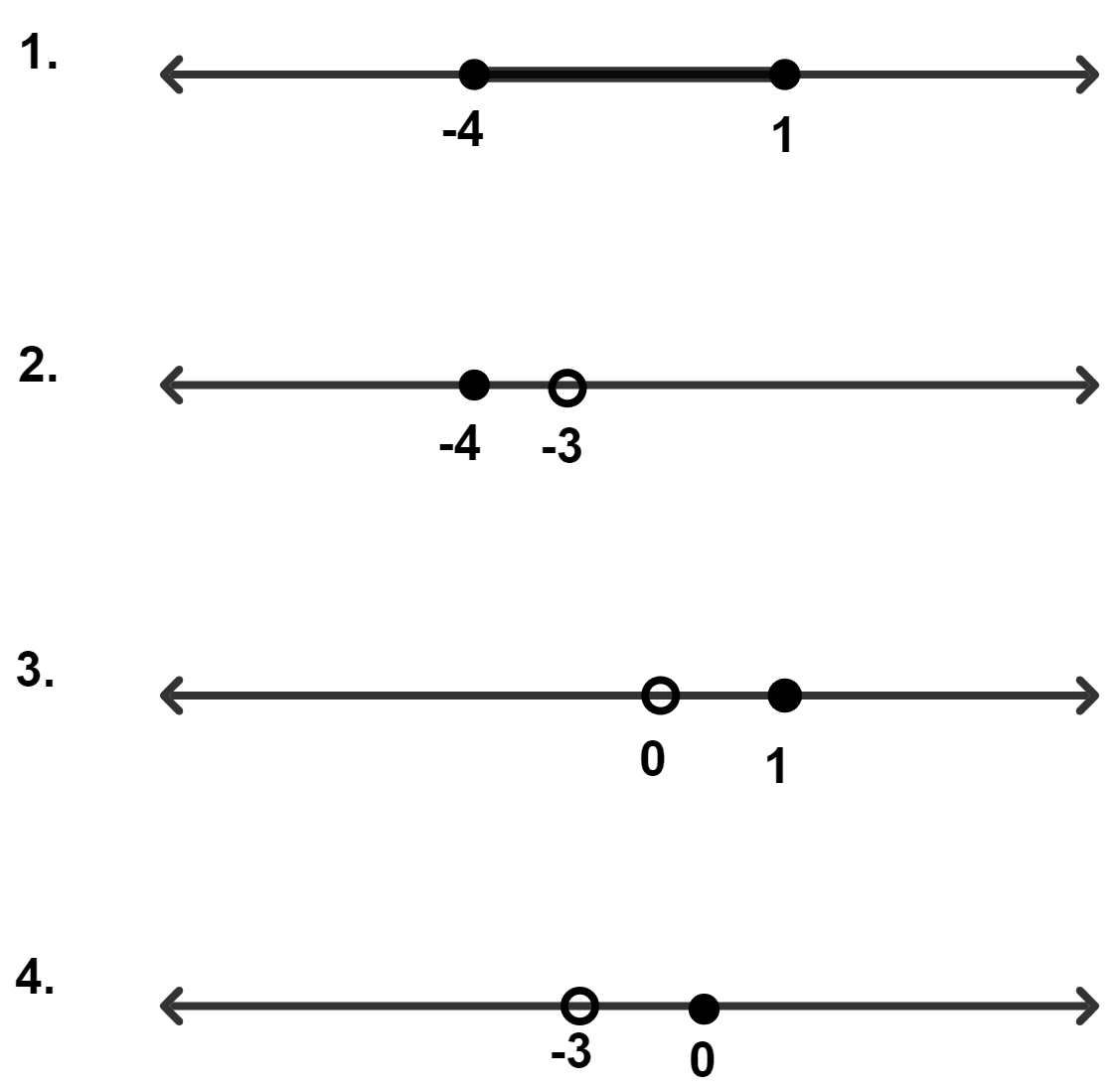
The real number lines for two inequations A and B are as given below, A ∩ B is :

The real number lines for two inequations A and B are as given below, A ∩ B is : Linear Inequations, Concise Mathematics Solutions ICSE Class 10.
Show SolutionHide Solution↓

A = {x : x ∈ R and -3 < x ≤ 1}

B = {x : x ∈ R and -4 ≤ x < 0}

A ∩ B = {x : x ∈ R and -3 < x < 0}

Hence, Option 1 is the correct option.

1(f)Test Yourself

For the inequations A and B [as given above in part (d)], A ∪ B is :

For the inequations A and B [as given above in part (d)], A ∪ B is : Linear Inequations, Concise Mathematics Solutions ICSE Class 10.
Show SolutionHide Solution↓

A = {x : x ∈ R and -3 < x ≤ 1}

B = {x : x ∈ R and -4 ≤ x < 0}

A ∪ B = {x : x ∈ R and -4 ≤ x ≤ 1}

Hence, Option 1 is the correct option.

1(g)Test Yourself

$-\frac{3}{2} \le -\frac{2x}{3}$ where x ∈ R.

Assertion (A): The largest value of x is $\frac{9}{4}$.

Reason (R): When the signs of both the sides of an inequalities are changed, the sign of inequality reverses.

Show SolutionHide Solution↓

Both A and R are true and R is the correct reason for A.

Reason

According to the assertion:

$$\begin{aligned}\Rightarrow -\frac{3}{2} \le -\frac{2x}{3}\\[1em] \Rightarrow \frac{3}{2} \ge \frac{2x}{3}\\[1em] \Rightarrow x \le \frac{3 \times 3}{2 \times 2}\\[1em] \Rightarrow x \le \frac{9}{4}\end{aligned}$$

So, Assertion (A) is true.

According to the reason:

When you multiply or divide both sides of an inequality by a negative number, the direction of the inequality sign must be reversed to maintain the validity of the inequality

So, Reason (R) is true.

Hence, option 3 is correct.

1(h)Test Yourself

Inequation 5 - 2x ≥ x - 10, where x ∈ N (Natural numbers)

Assertion (A): 5 - 2x ≥ x - 10 ⇒ -3x ≥ -15 ⇒ x ≥ 5

∴ Solution set = {5, 6, 7, 8, ..........}

Reason (R): 5 - 2x ≥ x - 10 ⇒ 5 + 10 ≥ 3x ⇒ x ≤ 5

∴ Solution set = {1, 2, 3, 4, 5}

Show SolutionHide Solution↓

A is false, R is true.

Reason

According to Assertion: 5 - 2x ≥ x - 10

⇒ 5 - 2x + 10 ≥ x

⇒ -2x + 15 ≥ x

⇒ 15 ≥ x + 2x

⇒ 15 ≥ 3x

⇒ x ≤ $\frac{15}{3}$

⇒ x ≤ 5

∴ Solution set = {1, 2, 3, 4, 5}

So, Assertion (A) is false.

According to Reason:

Solution set = {1, 2, 3, 4, 5}

So, Reason (R) is true.

Hence, A is false, R is true.

1(i)Test Yourself

x ∈ W, x ≥ -3 and x < 5.

Statement (1) : There will be no solution for the given inequalities.

Statement (2) : The real number line for the given inequations is :

x ∈ W, x &ge; -3 and x < 5. Linear Inequations, Concise Mathematics Solutions ICSE Class 10.
Show SolutionHide Solution↓

Statement 1 is false, and statement 2 is true.

Reason

x ≥ -3

Solution set of x = {-3, -2, -1, 0, 1, 2, ..........} .......... (1)

And, x < 5

Solution set of x = {.........., 1, 2, 3, 4} .......... (2)

From (1) and (2), we get

Solution set = {-3, -2, -1, 0, 1, 2, 3, 4}

So, statement 1 is false.

The real number line for the given inequations is :

x ∈ W, x &ge; -3 and x < 5. Linear Inequations, Concise Mathematics Solutions ICSE Class 10.

So, statement 2 is true.

Hence, option 4 is correct.

1(j)Test Yourself

5 + x ≤ 2x < x - 2, x ∈ R.

Statement (1) : There is no value of x ∈ R that satisfies the given inequation.

Statement (2) : 5 + x - x ≤ 2x - x < x - 2 - x ⇒ 5 ≤ x < -2

Show SolutionHide Solution↓

Both the statements are true.

Reason

Given,

Equation : 5 + x ≤ 2x < x - 2

⇒ 5 + x ≤ 2x

⇒ 5 ≤ 2x - x

⇒ 5 ≤ x .......... (1)

And, 2x < x - 2

⇒ 2x - x < -2

⇒ x < -2 .......... (2)

There can be no real number which is greater than or equal to 5 and less than -2 at the same time.

∴ Both the statements are true.

Hence, option 1 is correct.

2Test Yourself

Solve the inequation :

$12 + 1\frac{5}{6}x \le 5 + 3x$ and x ∈ R.

Show SolutionHide Solution↓

Given,

$$\begin{aligned}\Rightarrow 12 + 1\frac{5}{6}x \le 5 + 3x \\[1em] \Rightarrow 12 + \frac{11}{6}x \le 5 + 3x \\[1em] \Rightarrow 3x - \frac{11}{6}x \ge 12 - 5 \\[1em] \Rightarrow \frac{18x - 11x}{6} \ge 7 \\[1em] \Rightarrow \frac{7x}{6} \ge 7 \\[1em] \Rightarrow x \ge \frac{7 \times 6}{7} \\[1em] \Rightarrow x \ge 6.\end{aligned}$$

∴ Solution set = {x : x ∈ R and x ≥ 6}.

3Test Yourself

Given x ∈ {whole numbers}, find the solution set of :

-1 ≤ 3 + 4x < 23

Show SolutionHide Solution↓

Given,

-1 ≤ 3 + 4x < 23

Solving L.H.S. of the equation,

⇒ -1 ≤ 3 + 4x

⇒ 4x ≥ -1 - 3

⇒ 4x ≥ -4

⇒ x ≥ -1 ........(i)

Solving R.H.S. of the equation,

⇒ 3 + 4x < 23

⇒ 4x < 23 - 3

⇒ 4x < 20

⇒ x < 5 .........(ii)

From (i) and (ii) we get,

-1 ≤ x < 5

Since, x ∈ {whole numbers},

∴ Solution set = {0, 1, 2, 3, 4}.

4Test Yourself

Find the set of values of x, satisfying :

7x + 3 ≥ 3x - 5 and $\frac{x}{4} - 5 \le \frac{5}{4} - x$, where x ∈ N.

Show SolutionHide Solution↓

Solving,

⇒ 7x + 3 ≥ 3x - 5

⇒ 7x - 3x ≥ -5 - 3

⇒ 4x ≥ -8

⇒ x ≥ -2 .......(i)

Solving,

$$\begin{aligned}\Rightarrow \frac{x}{4} - 5 \le \frac{5}{4} - x \\[1em] \Rightarrow \frac{x}{4} + x \le \frac{5}{4} + 5 \\[1em] \frac{x + 4x}{4} \le \frac{25}{4} \\[1em] \frac{5x}{4} \le \frac{25}{4} \\[1em] x \le \frac{25}{4} \times \frac{4}{5} \\[1em] x \le 5 ........(ii)\end{aligned}$$

From (i) and (ii) we get,

-2 ≤ x ≤ 5

Since, x ∈ N

∴ Solution set = {1, 2, 3, 4, 5}.

5Test Yourself

Solve :

(i) $\frac{x}{2} + 5 \le \frac{x}{3} + 6$, where x is a positive odd integer

(ii) $\frac{2x + 3}{3} \ge \frac{3x - 1}{4}$, where x is a positive even integer

Show SolutionHide Solution↓

(i) Solving,

$$\begin{aligned}\Rightarrow \frac{x}{2} + 5 \le \frac{x}{3} + 6 \\[1em] \Rightarrow \frac{x}{2} - \frac{x}{3} \le 6 - 5 \\[1em] \Rightarrow \frac{3x - 2x}{6} \le 1 \\[1em] \Rightarrow \frac{x}{6} \le 1 \\[1em] \Rightarrow x \le 6.\end{aligned}$$

Since, x is a positive odd integer

∴ Solution set = {1, 3, 5}.

(ii) Solving,

$$\begin{aligned}\Rightarrow \frac{2x + 3}{3} \ge \frac{3x - 1}{4} \\[1em] \Rightarrow \frac{2x + 3}{3} - \frac{3x - 1}{4} \ge 0 \\[1em] \Rightarrow \frac{4(2x + 3) - 3(3x - 1)}{12} \ge 0 \\[1em] \Rightarrow 8x + 12 - 9x + 3 \ge 0 \\[1em] \Rightarrow -x + 15 \ge 0 \\[1em] \Rightarrow x \le 15.\end{aligned}$$

Since, x is a positive even integer

∴ Solution set = {2, 4, 6, 8, 10, 12, 14}.

6Test Yourself

Solve the inequation :

$-2\frac{1}{2} + 2x \le \frac{4x}{5} \le \frac{4}{3} + 2x$, x ∈ W.

Graph the solution set on the number line.

Show SolutionHide Solution↓

Given,

$-2\frac{1}{2} + 2x \le \frac{4x}{5} \le \frac{4}{3} + 2x$

Solving L.H.S. of the equation,

$$\begin{aligned}\Rightarrow -2\frac{1}{2} + 2x \le \frac{4x}{5} \\[1em] \Rightarrow -\frac{5}{2} + 2x \le \frac{4x}{5} \\[1em] \Rightarrow 2x - \frac{4x}{5} \le \frac{5}{2} \\[1em] \Rightarrow \frac{10x - 4x}{5} \le \frac{5}{2} \\[1em] \Rightarrow \frac{6x}{5} \le \frac{5}{2} \\[1em] \Rightarrow x \le \frac{5}{2} \times \frac{5}{6} \\[1em] \Rightarrow x \le \frac{25}{12} \\[1em] \Rightarrow x \le 2\frac{1}{12} ........(i)\end{aligned}$$

Solving R.H.S. of the equation,

$$\begin{aligned}\Rightarrow \frac{4x}{5} \le \frac{4}{3} + 2x \\[1em] \Rightarrow \frac{4x}{5} - 2x \le \frac{4}{3} \\[1em] \Rightarrow \frac{4x - 10x}{5} \le \frac{4}{3} \\[1em] \Rightarrow -\frac{6x}{5} \le \frac{4}{3} \\[1em] \Rightarrow \frac{6x}{5} \ge -\frac{4}{3} \\[1em] \Rightarrow x \ge -\frac{4}{3} \times \frac{5}{6} \\[1em] \Rightarrow x \ge -\frac{10}{9} \\[1em] \Rightarrow x \ge -1\frac{1}{9} .......(ii)\end{aligned}$$

From (i) and (ii) we get,

$-1\frac{1}{9} \le x \le 2\frac{1}{12}$

Since, x ∈ W

∴ Solution set = {0, 1, 2}.

Solution on the number line is :

Solve the inequation -2(1/2) + 2x ≤ (4x/5) ≤ 4/3 + 2x, x ∈ W. Graph the solution set on the number line. Linear Inequations, Concise Mathematics Solutions ICSE Class 10.
7Test Yourself

Find three consecutive largest positive integers such that the sum of one-third of first, one-fourth of second and one-fifth of third is at most 20.

Show SolutionHide Solution↓

Let three consecutive positive integers be x, x + 1 and x + 2.

Given, sum of one-third of first, one-fourth of second and one-fifth of third is at most 20

$$\begin{aligned}\therefore \frac{1}{3}x + \frac{1}{4}(x + 1) + \frac{1}{5}(x + 2) \le 20 \\[1em] \Rightarrow \frac{x}{3} + \frac{x + 1}{4} + \frac{x + 2}{5} \le 20 \\[1em] \Rightarrow \frac{20x + 15(x + 1) + 12(x + 2)}{60} \le 20 \\[1em] \Rightarrow \frac{20x + 15x + 15 + 12x + 24}{60} \le 20 \\[1em] \Rightarrow 47x + 39 \le 1200 \\[1em] \Rightarrow 47x \le 1161 \\[1em] \Rightarrow x \le \frac{1161}{47} \\[1em] \Rightarrow x \le 24.702\end{aligned}$$

∴ x = 24, x + 1 = 25, x + 2 = 26.

Hence, three consecutive numbers are 24, 25 and 26.

8Test Yourself

Solve the following inequation and represent the solution set on the number line :

4x - 19 < $\frac{3x}{5} - 2 \le -\frac{2}{5} + x$, x ∈ R

Show SolutionHide Solution↓

Given,

4x - 19 < $\frac{3x}{5} - 2 \le -\frac{2}{5} + x$

Solving L.H.S. of the equation,

$$\begin{aligned}\Rightarrow 4x - 19 \lt \frac{3x}{5} - 2 \\[1em] \Rightarrow 4x - 19 \lt \frac{3x - 10}{5} \\[1em] \Rightarrow 5(4x - 19) \lt 3x - 10 \\[1em] \Rightarrow 20x - 95 \lt 3x - 10 \\[1em] \Rightarrow 20x - 3x \lt 95 - 10 \\[1em] \Rightarrow 17x \lt 85 \\[1em] \Rightarrow x \lt 5 ........(i)\end{aligned}$$

Solving R.H.S. of the equation,

$$\begin{aligned}\Rightarrow \frac{3x}{5} - 2 \le -\frac{2}{5} + x \\[1em] \Rightarrow x - \frac{3x}{5} \ge -2 + \frac{2}{5} \\[1em] \Rightarrow \frac{5x - 3x}{5} \ge \frac{-10 + 2}{5} \\[1em] \Rightarrow \frac{2x}{5} \ge \frac{-8}{5} \\[1em] \Rightarrow x \ge -\frac{8}{5} \times \frac{5}{2} \\[1em] \Rightarrow x \ge -4 ........(ii)\end{aligned}$$

From (i) and (ii) we get,

-4 ≤ x < 5

∴ Solution set = {x : -4 ≤ x < 5, x ∈ R}.

Solution on the number line is :

Solve 4x - 19 < 3x/5 - 2 ≤ -2/5 + x, x ∈ R and represent the solution set on the number line. Linear Inequations, Concise Mathematics Solutions ICSE Class 10.
9(i)Test Yourself

Find the greatest value of x ∈ Z, so that :

-1 ≤ 3 + 4x < 23

Show SolutionHide Solution↓

Given,

-1 ≤ 3 + 4x < 23

Solving L.H.S. of the inequation,

⇒ -1 ≤ 3 + 4x

⇒ -1 - 3 ≤ 4x

⇒ -4 ≤ 4x

⇒ $\frac{-4}{4}$ ≤ x

⇒ -1 ≤ x

⇒ x ≥ -1 ....(1)

Solving R.H.S. of the inequation,

⇒ 3 + 4x < 23

⇒ 4x < 23 - 3

⇒ 4x < 20

⇒ x < $\frac{20}{4}$

⇒ x < 5 ....(2)

From (1) and (2) we get,

-1 ≤ x < 5

Since x ∈ Z,

x = {-1, 0, 1, 2, 3, 4}

Hence, greatest value of x is 4.

9(ii)Test Yourself

If 7 ≥ -2x + 1 > -7 ; find the sum of greatest and smallest values of x ∈ I.

Show SolutionHide Solution↓

Given,

7 ≥ -2x + 1 > -7

Solving L.H.S. of the inequation,

⇒ 7 ≥ -2x + 1

⇒ 7 - 1 ≥ -2x

⇒ 6 ≥ -2x

⇒ 2x ≥ -6

⇒ x ≥ $\frac{-6}{2}$

⇒ x ≥ -3 ....(1)

Solving R.H.S. of the inequation,

⇒ -2x + 1 > -7

⇒ -2x > -7 - 1

⇒ -2x > -8

⇒ 2x < 8

⇒ x < $\frac{8}{2}$

⇒ x < 4 ....(2)

From (1) and (2) we get,

-3 ≤ x < 4

Since x ∈ I,

x = {-3, -2, -1, 0, 1, 2, 3}

Greatest value of x is 3 and smallest value of x is -3

The sum of greatest and smallest values of x = -3 + 3 = 0

Hence, sum of greatest and smallest values of x = 0.

1Case-Study Based Question

Case study :
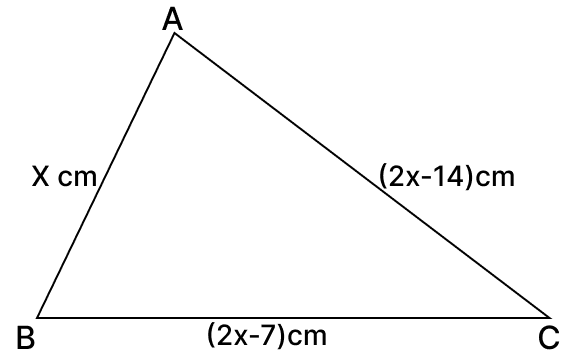
A teacher asked to Rohan to draw a triangle with following condition: The longest side of the triangle is 7 cm less than twice the shortest side and third side is 7 cm shorter than longest side. The perimeter of the triangle is atleast 84 cm.

A teacher asked to Rohan to draw a triangle with following condition: The longest side of the triangle is 7 cm less than twice the shortest side and third side is 7 cm shorter than longest side. The perimeter of the triangle is atleast 84 cm. Linear Inequations, Concise Mathematics Solutions ICSE Class 10.

Based on the above information, form a linear inequation and answer the following questions :

(i) What is the minimum length of the shortest side ?

(ii) What is the minimum length of the longest side ?

(iii) Identify the type of triangle that Rohan has drawn along with the length possible sides he got.

(iv) What is the least area of the triangle drawn ?

Show SolutionHide Solution↓

Let the shortest side of triangle be x cm.

Given,

Longest side of triangle = 2x - 7

Third side of triangle = (2x - 7) - 7 = 2x - 14

(i) Given,

Perimeter of triangle is atleast 84 cm.

⇒ x + (2x - 7) + (2x - 14) ≥ 84

⇒ 5x - 21 ≥ 84

⇒ 5x ≥ 84 + 21

⇒ 5x ≥ 105

⇒ x ≥ $\frac{105}{5}$

⇒ x ≥ 21.

Hence, minimum length of the shortest side of triangle = 21 cm.

(ii) Length of the longest side of triangle = 2x - 7

Minimum length of longest side will be when x = 21, substituting value we get :

⇒ 2(21) - 7

⇒ 42 - 7

⇒ 35 cm.

Hence, minimum length of the longest side of triangle = 35 cm.

(iii) Minimum length of third side :

Third side of triangle = 2x - 14

= 2(21) - 14

= 42 - 14

= 28 cm.

Three sides of triangle = 21 cm, 28 cm and 35 cm.

⇒ 212 + 282 = 441 + 784 = 1225

⇒ 352 = 1225.

Thus, we can say that 212 + 282 = 352.

Thus, it is a right angled triangle with hypotenuse 35 cm and other two sides are 21 cm and 28 cm.

Hence, the triangle is right-angled triangle.

(iv) By formula,

Area of right angled triangle = $\frac{1}{2}$ × product of sides containing right angle

Least area of the triangle = $\frac{1}{2}$ × 21 × 28

= 294 cm2.

Hence, the least area of the triangle = 294 cm2.

Press ↓ to reveal a solution and move to the next question. Back to Selina Concise Mathematics.

Free sample bank