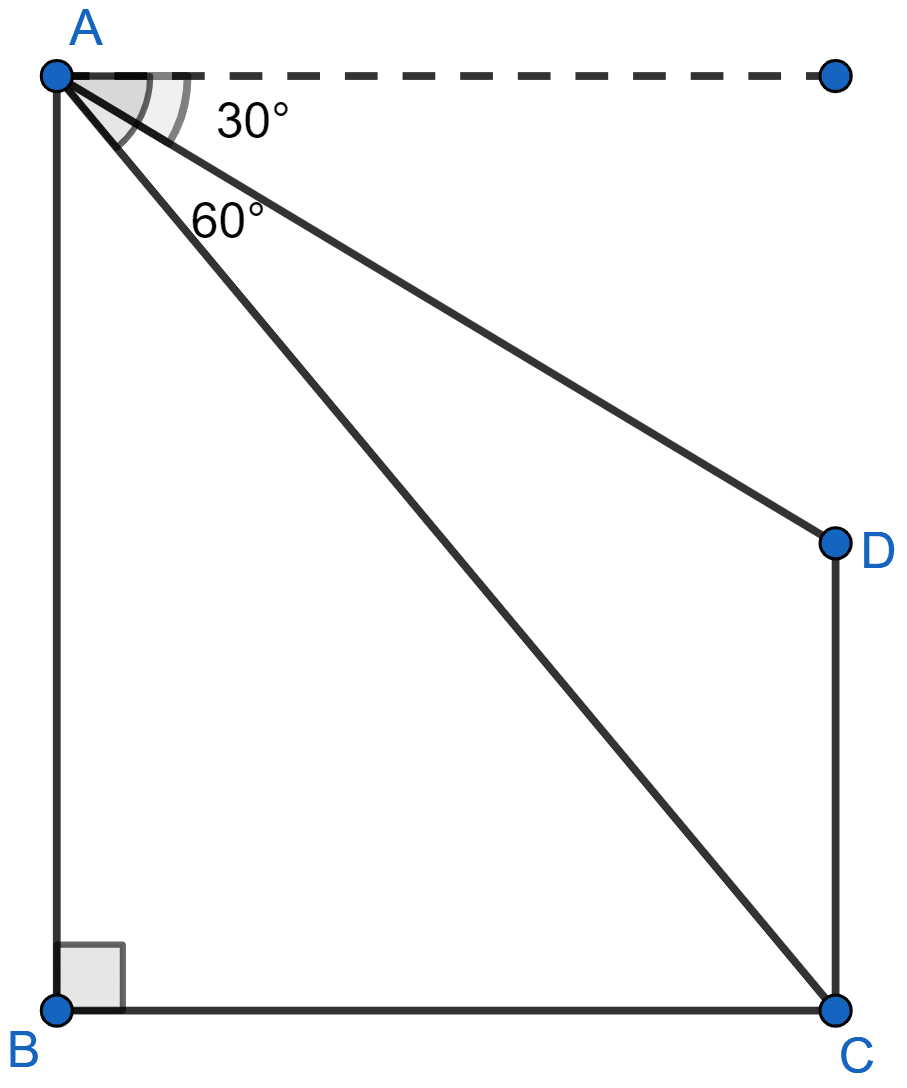
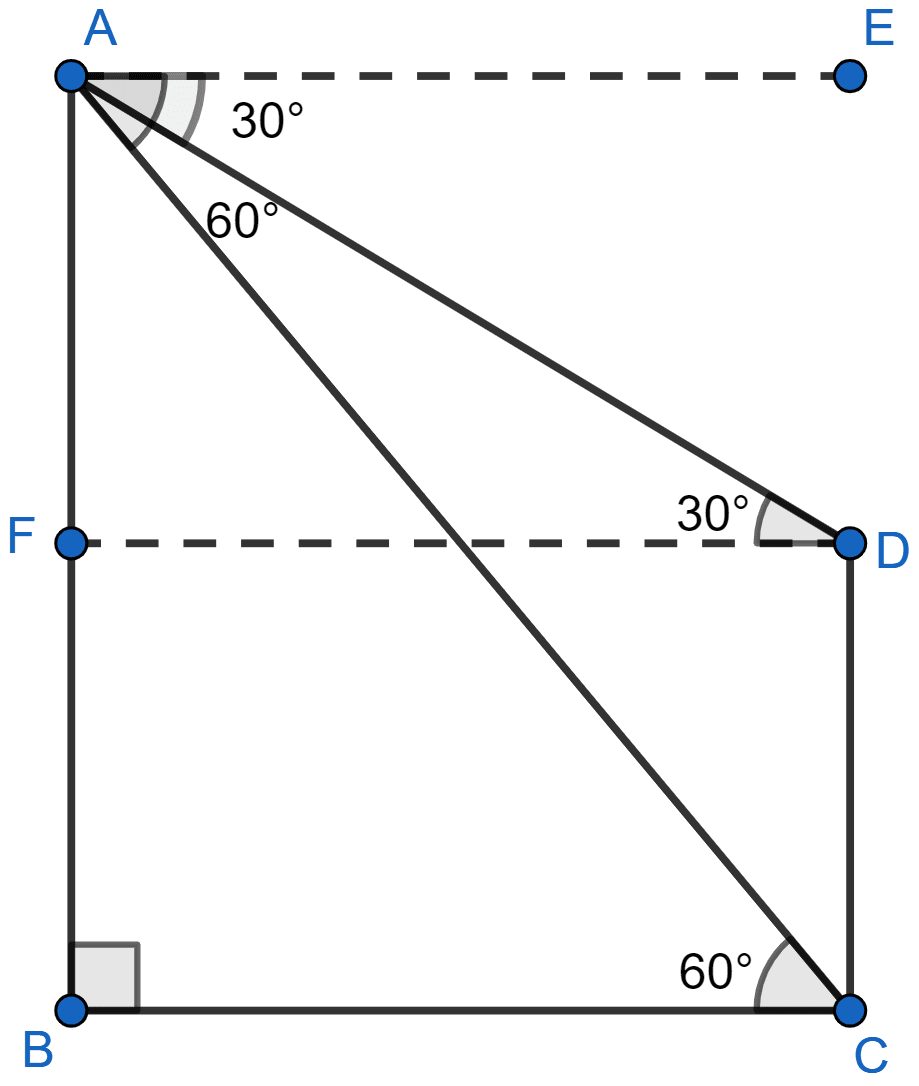
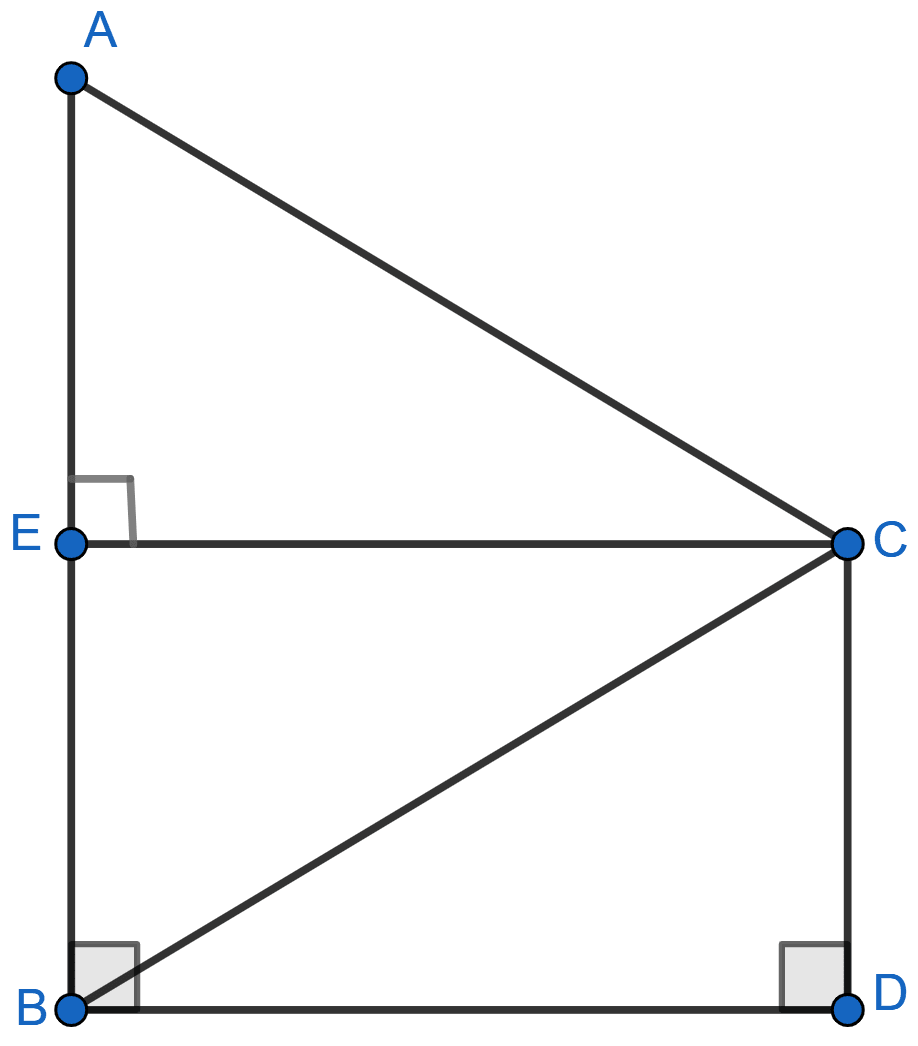
Heights & Distances

ICSE Class 10 Mathematics · Selina Concise Mathematics · 61 solved questions

Exercise
1(a)Exercise 22(A)

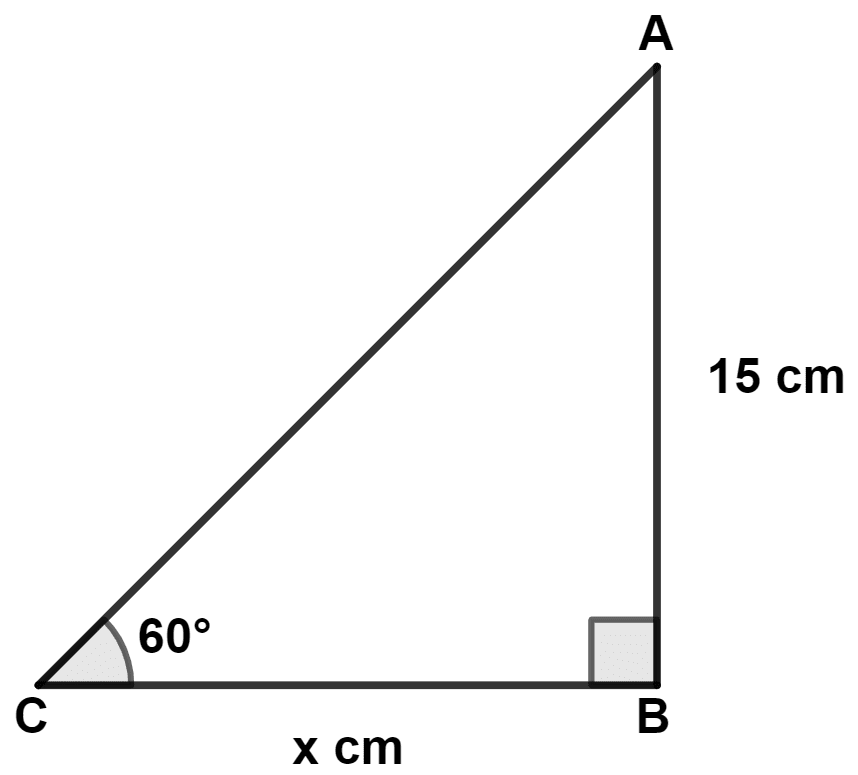
The measure of x is :

The measure of x is : Heights and Distances, Concise Mathematics Solutions ICSE Class 10.
Show SolutionHide Solution↓

We know that,

tan θ = $\frac{\text{Perpendicular}}{\text{Base}}$

From figure,

The measure of x is : Heights and Distances, Concise Mathematics Solutions ICSE Class 10.

In △ ABC,

⇒ tan 60° = $\frac{AB}{BC}$

⇒ $\sqrt{3} = \frac{15}{x}$

⇒ x = $\frac{15}{\sqrt{3}}$

Rationalizing the denominator,

$$\begin{aligned}\Rightarrow x = \frac{15}{\sqrt{3}} \times \frac{\sqrt{3}}{\sqrt{3}} \\[1em] \Rightarrow x = \frac{15\sqrt{3}}{3} \\[1em] \Rightarrow x = 5\sqrt{3}.\end{aligned}$$

Hence, Option 3 is the correct option.

1(b)Exercise 22(A)

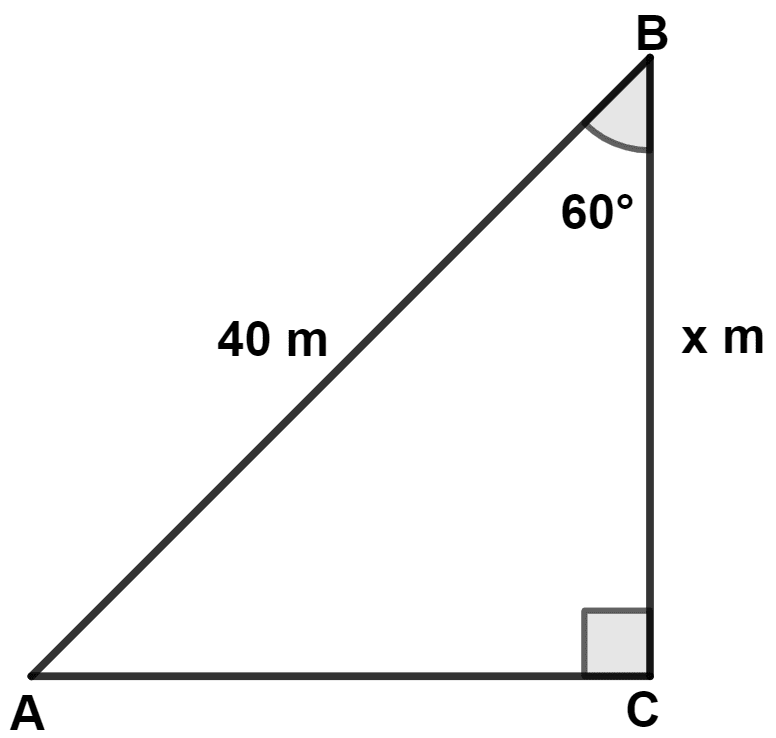
The value of x is :

The value of x is : Heights and Distances, Concise Mathematics Solutions ICSE Class 10.
Show SolutionHide Solution↓

We know that,

cos θ = $\frac{\text{Base}}{\text{Hypotenuse}}$

From figure,

The value of x is : Heights and Distances, Concise Mathematics Solutions ICSE Class 10.

In △ ABC,

⇒ cos 60° = $\frac{BC}{AB}$

⇒ $\frac{1}{2} = \frac{x}{40}$

⇒ x = $\frac{40}{2}$ = 20 m.

Hence, Option 3 is the correct option.

1(c)Exercise 22(A)

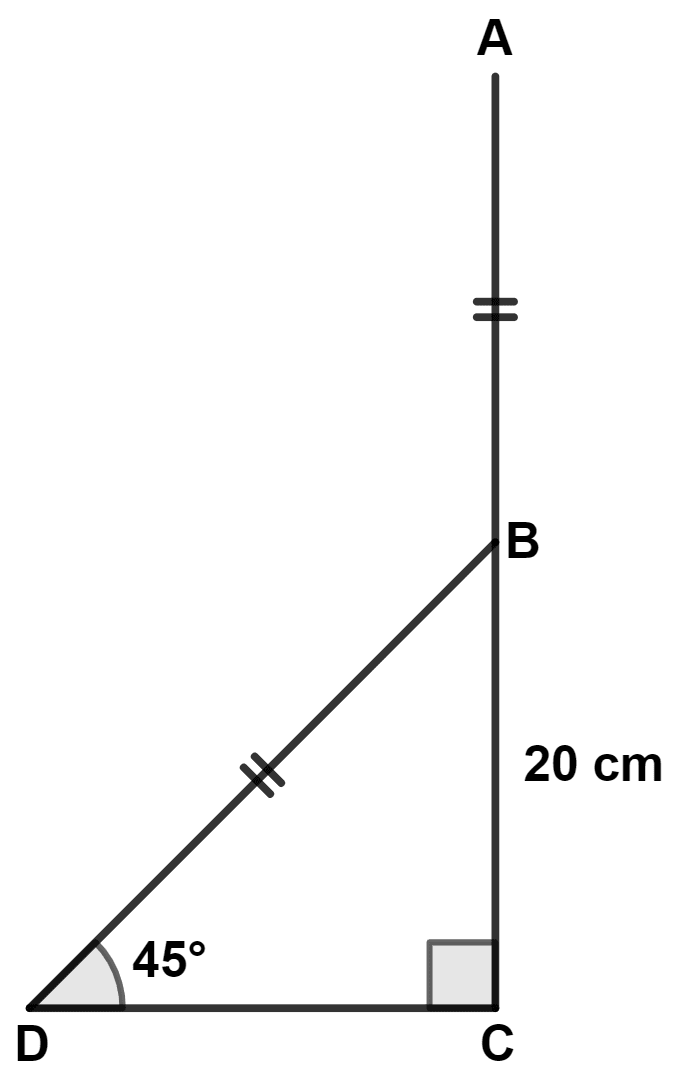
In the given figure, AB = BD, BC = 20 cm and ∠D = 45°, the length of AC is :

In the given figure, AB = BD, BC = 20 cm and ∠D = 45°, the length of AC is : Heights and Distances, Concise Mathematics Solutions ICSE Class 10.
Show SolutionHide Solution↓

We know that,

sin θ = $\frac{\text{Perpendicular}}{\text{Hypotenuse}}$

From figure,

In △ BCD,

⇒ sin 45° = $\frac{BC}{BD}$

⇒ $\frac{1}{\sqrt{2}} = \frac{20}{BD}$

⇒ BD = $20\sqrt{2}$ m.

From figure,

⇒ AB = BD = $20\sqrt{2}$ m

⇒ AC = AB + BC = $20\sqrt{2} + 20$ = 28.28 + 20 = 48.28 cm.

Hence, Option 2 is the correct option.

1(d)Exercise 22(A)

The measure of x correct to the nearest metre is :

The measure of x correct to the nearest metre is : Heights and Distances, Concise Mathematics Solutions ICSE Class 10.
Show SolutionHide Solution↓

We know that,

cos θ = $\frac{\text{Base}}{\text{Hypotenuse}}$

From figure,

The measure of x correct to the nearest metre is : Heights and Distances, Concise Mathematics Solutions ICSE Class 10.

In △ ABC,

⇒ cos 30° = $\frac{BC}{AB}$

⇒ $\frac{\sqrt{3}}{2} = \frac{x}{70}$

⇒ x = $\frac{70\sqrt{3}}{2} = 35\sqrt{3} = 60.62 \approx 61$ m.

Hence, Option 3 is the correct option.

1(e)Exercise 22(A)

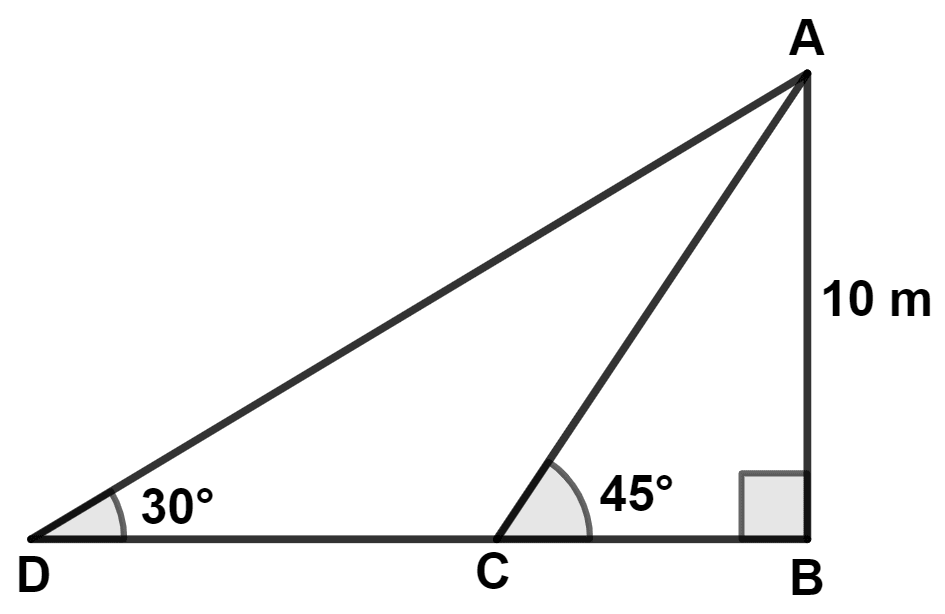
The length of DC is :

The length of DC is : Heights and Distances, Concise Mathematics Solutions ICSE Class 10.
Show SolutionHide Solution↓

We know that,

tan θ = $\frac{\text{Perpendicular}}{\text{Base}}$

From figure,

In △ ABC,

⇒ tan 45° = $\frac{AB}{BC}$

⇒ $1 = \frac{10}{BC}$

⇒ BC = 10 m.

In △ ABD,

⇒ tan 30° = $\frac{AB}{BD}$

⇒ $\frac{1}{\sqrt{3}} = \frac{10}{BD}$

⇒ BD = $10\sqrt{3}$ m.

From figure,

DC = BD - BC = $10\sqrt{3} - 10 = 10(\sqrt{3} - 1)$ m.

Hence, Option 4 is the correct option.

2Exercise 22(A)

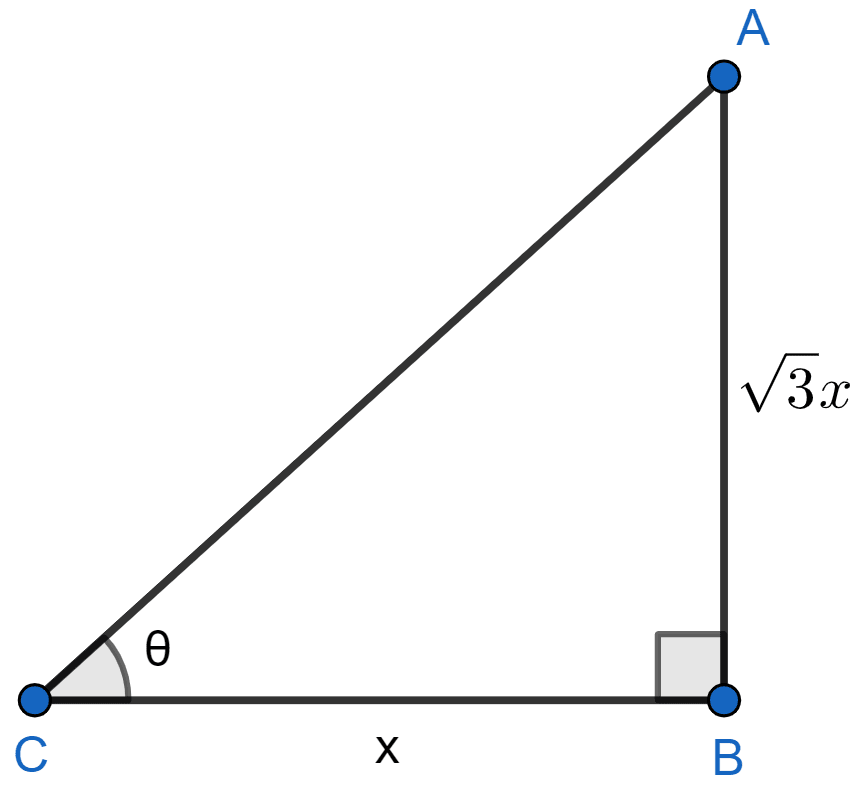
The height of a tree is $\sqrt{3}$ times the length of its shadow. Find the angle of elevation of the sun.

Show SolutionHide Solution↓

Let AB be the tree and BC be the shadow of tree.

The height of a tree is times the length of its shadow. Find the angle of elevation of the sun. Heights and Distances, Concise Mathematics Solutions ICSE Class 10.

Let the length of the shadow (BC) of the tree be x meters.

So, the height of the tree (AB) = $\sqrt{3}x$ meters.

If θ is the angle of elevation of the sun, then we have :

In △ABC,

$$\begin{aligned}\Rightarrow \text{tan θ} = \frac{\text{Perpendicular}}{\text{Base}} \\[1em] \Rightarrow \text{tan θ} = \frac{AB}{BC} \\[1em] \Rightarrow \text{tan θ} = \frac{\sqrt{3}x}{x} \\[1em] \Rightarrow \text{tan θ} = \sqrt{3} \\[1em] \Rightarrow \text{tan θ} = \text{tan 60°} \\[1em] \Rightarrow θ = 60°.\end{aligned}$$

Hence, angle of elevation of sun is 60°.

3Exercise 22(A)

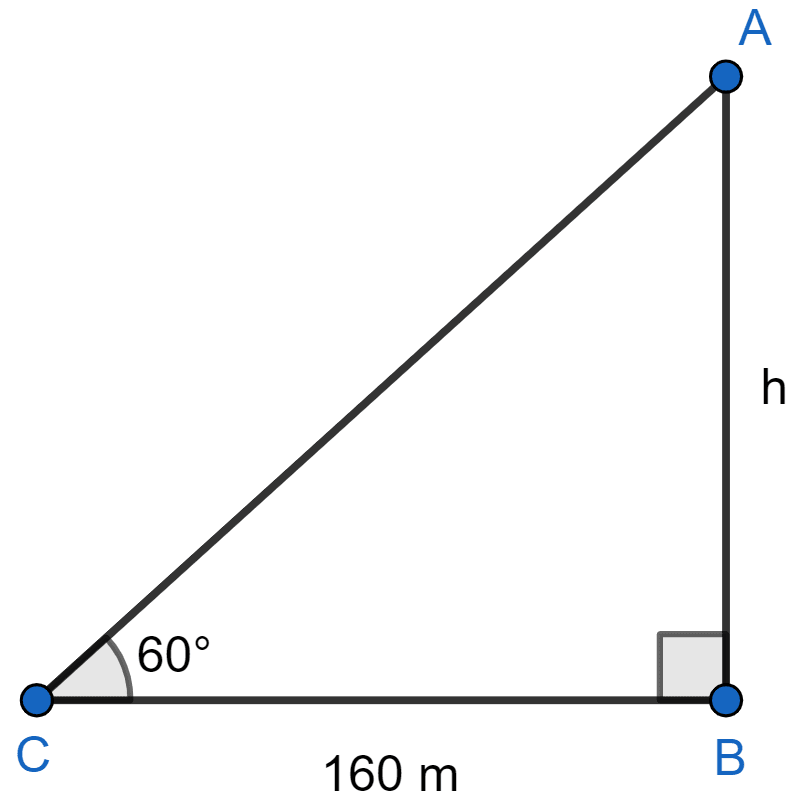
The angle of elevation of the top of a tower from a point on the ground and at a distance of 160 m from its foot, is found to be 60°. Find the height of the tower.

Show SolutionHide Solution↓

Let AB be the tower and C be the point at a distance of 160 m from foot of tower.

The angle of elevation of the top of a tower from a point on the ground and at a distance of 160 m from its foot, is found to be 60°. Find the height of the tower. Heights and Distances, Concise Mathematics Solutions ICSE Class 10.

Let,

AB = h meters.

From figure,

In △ABC,

$$\begin{aligned}\Rightarrow \text{tan θ} = \frac{\text{Perpendicular}}{\text{Base}} \\[1em] \Rightarrow \text{tan 60°} = \frac{AB}{BC} \\[1em] \Rightarrow \sqrt{3} = \frac{h}{160} \\[1em] \Rightarrow h = 160\sqrt{3} \\[1em] \Rightarrow h = 160 \times 1.732 = 277.12 \text{ m}.\end{aligned}$$

Hence, the height of the tower is 277.12 m.

4Exercise 22(A)

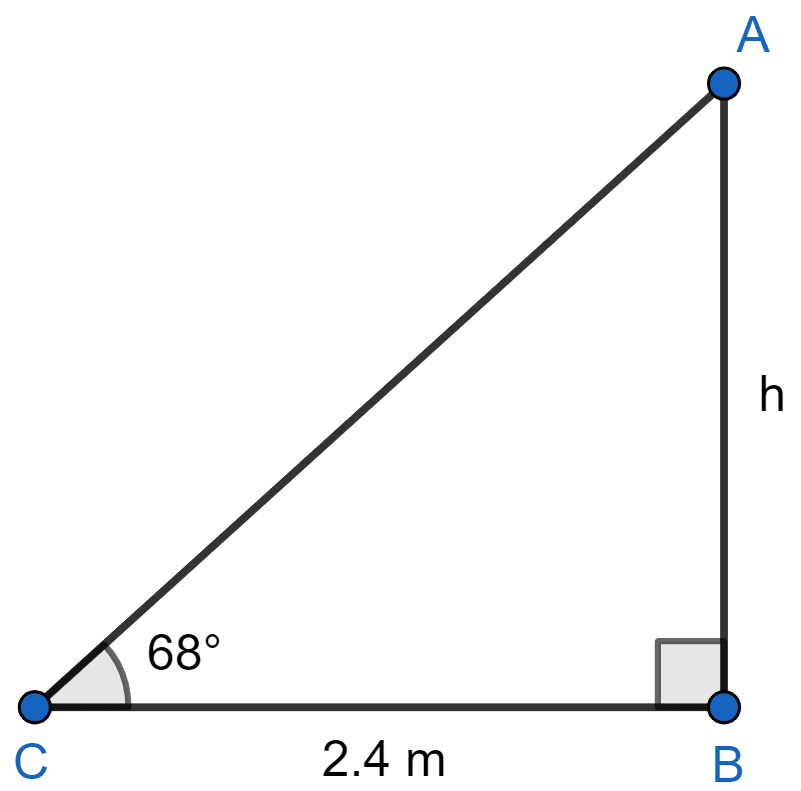
A ladder is placed along a wall such that its upper end is resting against a vertical wall. The foot of the ladder is 2.4 m from the wall and the ladder is making an angle of 68° with the ground. Find the height, up to which the ladder reaches.

Show SolutionHide Solution↓

Let AC be the ladder and height of wall upto which ladder reaches be h meters.

∴ AB = h meters and BC = 2.4 meters.

A ladder is placed along a wall such that its upper end is resting against a vertical wall. The foot of the ladder is 2.4 m from the wall and the ladder is making an angle of 68° with the ground. Find the height, up to which the ladder reaches. Heights and Distances, Concise Mathematics Solutions ICSE Class 10.

Given,

Ladder is making an angle of 68° with the ground.

From figure,

In △ABC,

$$\begin{aligned}\Rightarrow \text{tan θ} = \frac{\text{Perpendicular}}{\text{Base}} \\[1em] \Rightarrow \text{tan 68°} = \frac{AB}{BC} \\[1em] \Rightarrow 2.475 = \frac{h}{2.4} \\[1em] \Rightarrow h = 2.4 \times 2.475 \\[1em] \Rightarrow h = 5.94 \text{ m}.\end{aligned}$$

Hence, the ladder reaches upto a height of 5.94 m.

5Exercise 22(A)

Two persons are standing on the opposite sides of a tower. They observe the angles of elevation of the top of the tower to be 30° and 38° respectively. Find the distance between them, if the height of the tower is 50 m.

Show SolutionHide Solution↓

Let PQ be the tower.

Let one of the persons, A be at a distance of x meters and the second person B be at a distance of y metres from the foot of the tower (Q).

Two persons are standing on the opposite sides of a tower. They observe the angles of elevation of the top of the tower to be 30° and 38° respectively. Find the distance between them, if the height of the tower is 50 m. Heights and Distances, Concise Mathematics Solutions ICSE Class 10.

Given, that angle of elevation of A is 30°.

From figure,

In △PQA,

$$\begin{aligned}\Rightarrow \text{tan 30°} = \frac{\text{Perpendicular}}{\text{Base}} \\[1em] \Rightarrow \frac{1}{\sqrt{3}} = \frac{PQ}{AQ} \\[1em] \Rightarrow AQ = PQ\sqrt{3} = 50\sqrt{3} \\[1em] \Rightarrow x = 50 \times 1.732 \\[1em] \Rightarrow x = 86.6 \text{ meters}.\end{aligned}$$

Given, that angle of elevation of B is 38°.

In △PBQ,

$$\begin{aligned}\Rightarrow \text{tan 38°} = \frac{\text{Perpendicular}}{\text{Base}} \\[1em] \Rightarrow 0.7813 = \frac{PQ}{BQ} \\[1em] \Rightarrow BQ = \frac{50}{0.7813} \\[1em] \Rightarrow y = 64 \text{ meters}.\end{aligned}$$

AB = x + y = 86.6 + 64 = 150.6 meters.

Hence, the distance between two persons = 150.6 meters.

6Exercise 22(A)

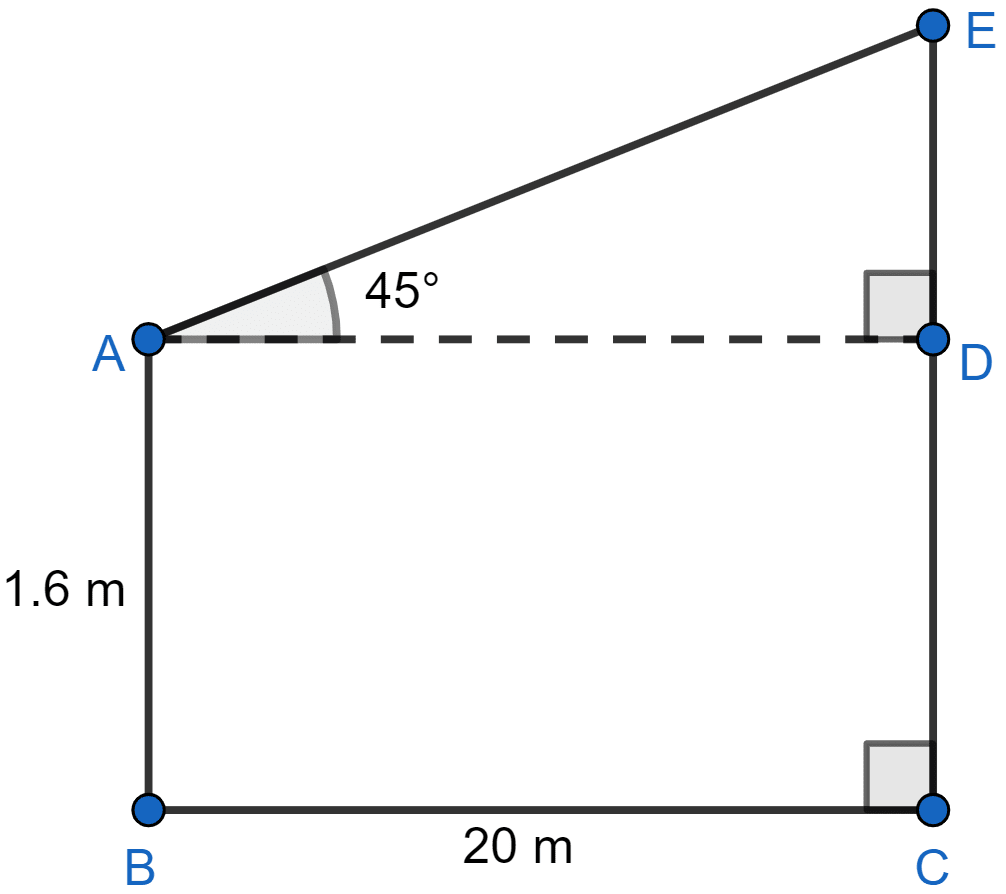
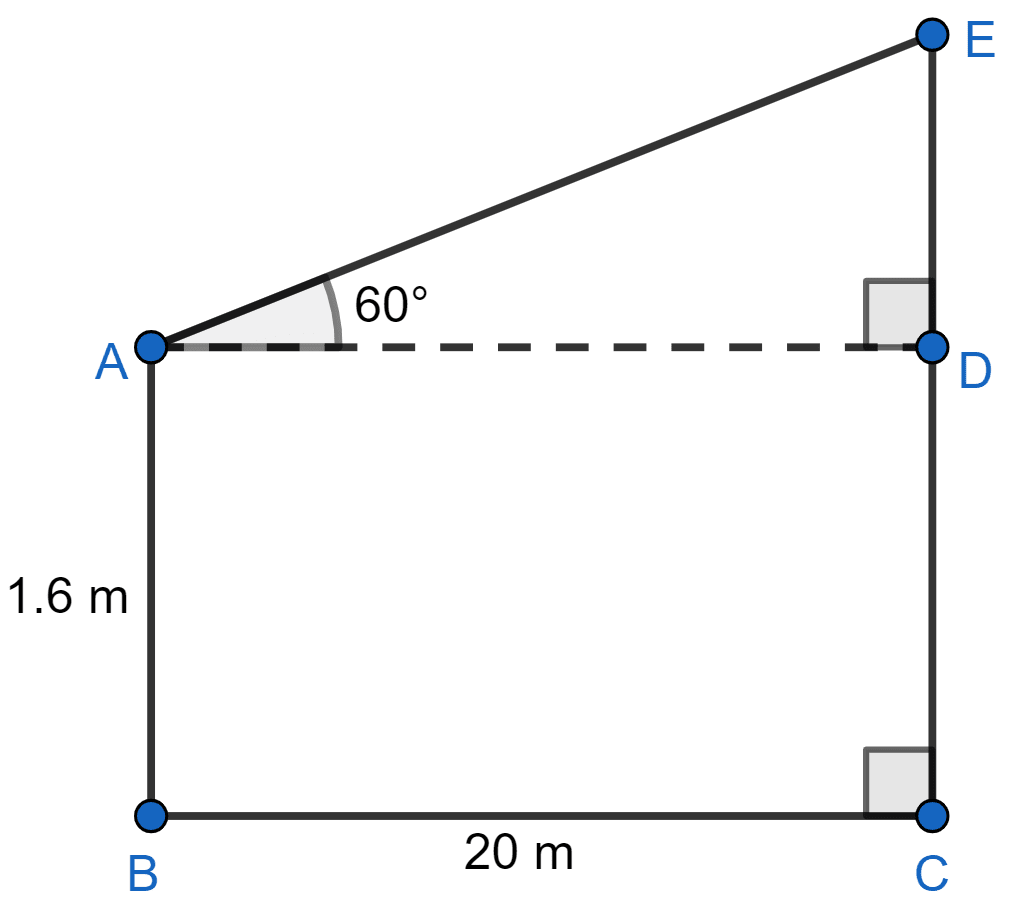
A boy, 1.6 m tall, is 20 m away from a tower and observes the angle of elevation of the top of the tower to be (i) 45° (ii) 60°. Find the height of the tower in each case.

Show SolutionHide Solution↓

(i) From figure,

A boy, 1.6 m tall, is 20 m away from a tower and observes the angle of elevation of the top of the tower to be (i) 45° (ii) 60°. Find the height of the tower in each case. Heights and Distances, Concise Mathematics Solutions ICSE Class 10.

When angle of elevation is 45°, then CE is the tower.

In △ADE,

$$\begin{aligned}\Rightarrow \text{tan 45°} = \frac{\text{Perpendicular}}{\text{Base}} \\[1em] \Rightarrow 1 = \frac{DE}{AD} \\[1em] \Rightarrow AD = DE \\[1em] \Rightarrow DE = 20 \text{ meters}.\end{aligned}$$

From figure,

CD = AB.

CE = CD + DE = 1.6 + 20 = 21.6 meters.

Hence, height of tower when angle of elevation is 45° is 21.6 meters.

(ii) From figure,

A boy, 1.6 m tall, is 20 m away from a tower and observes the angle of elevation of the top of the tower to be (i) 45° (ii) 60°. Find the height of the tower in each case. Heights and Distances, Concise Mathematics Solutions ICSE Class 10.

When angle of elevation is 60°.

In △ADF,

$$\begin{aligned}\Rightarrow \text{tan 60°} = \frac{\text{Perpendicular}}{\text{Base}} \\[1em] \Rightarrow \sqrt{3} = \frac{DF}{AD} \\[1em] \Rightarrow DF = AD\sqrt{3} \\[1em] \Rightarrow DF = 20 \times 1.732 = 34.64 \text{ meters}.\end{aligned}$$

From figure,

CD = AB.

CF = CD + DF = 1.6 + 34.64 = 36.24 meters.

Hence, height of tower when angle of elevation is 60° is 36.24 meters.

7Exercise 22(A)

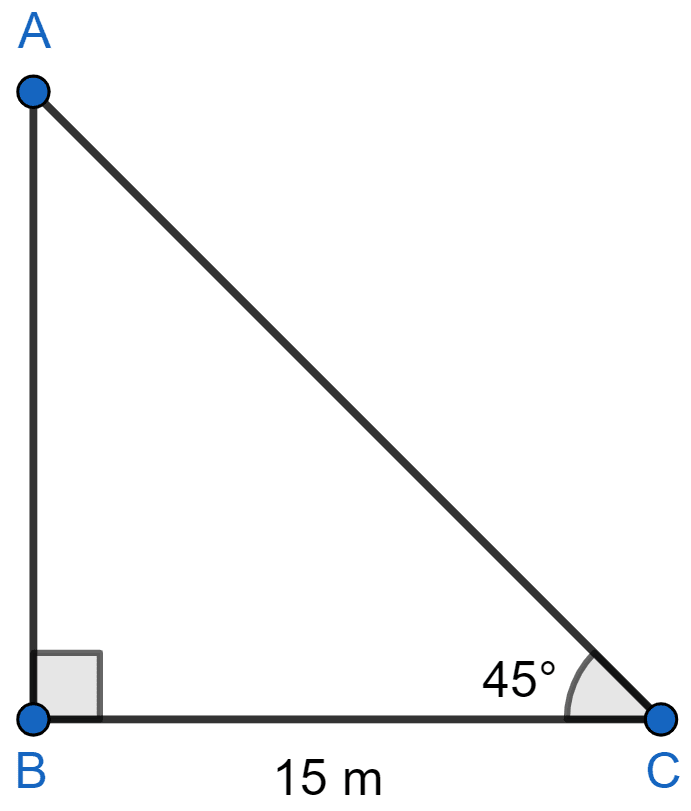
The upper part of a tree, broken over by the wind, makes an angle of 45° with the ground; and the distance from the root to the point where the top of the tree touches the ground, is 15 m. What was the height of the tree before it was broken?

Show SolutionHide Solution↓

Let A be the point from where tree breaks and C be the point where above part of tree touches the ground.

The upper part of a tree, broken over by the wind, makes an angle of 45° with the ground; and the distance from the root to the point where the top of the tree touches the ground, is 15 m. What was the height of the tree before it was broken? Heights and Distances, Concise Mathematics Solutions ICSE Class 10.

From figure,

In △ABC,

$$\begin{aligned}\text{tan 45°} = \frac{\text{Perpendicular}}{\text{Base}} \\[1em] \Rightarrow 1 = \frac{AB}{BC} \\[1em] \Rightarrow AB = BC = 15 \text{ meters}.\end{aligned}$$

In right angle triangle ABC,

⇒ AC2 = AB2 + BC2

⇒ AC2 = 152 + 152

⇒ AC2 = 225 + 225

⇒ AC2 = 450

⇒ AC = $\sqrt{450} = 15\sqrt{2}$ meters.

Height of tree = AB + AC = 15 + $15\sqrt{2}$

= 15 + 21.21

= 36.21 meters.

Hence, height of tree before it was broken = 36.21 meters.

8Exercise 22(A)

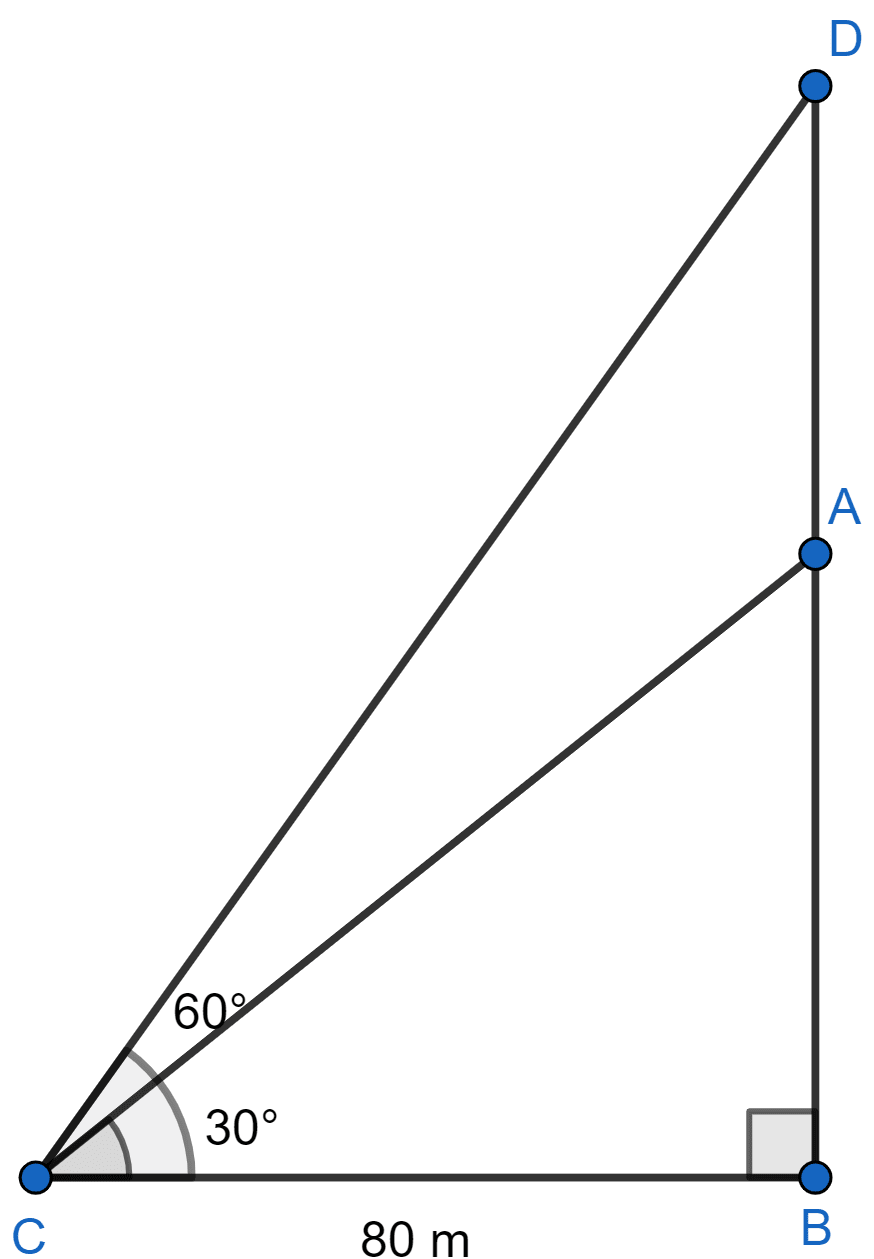
The angle of elevation of the top of an unfinished tower from a point at a distance of 80 m from its base is 30°. How much higher must the tower be raised so that its angle of elevation at the same point may be 60° ?

Show SolutionHide Solution↓

Let AB be the unfinished tower and C be the point 80 m from base of tower.

The angle of elevation of the top of an unfinished tower from a point at a distance of 80 m from its base is 30°. How much higher must the tower be raised so that its angle of elevation at the same point may be 60° ? Heights and Distances, Concise Mathematics Solutions ICSE Class 10.

From figure,

In △ABC,

$$\begin{aligned}\Rightarrow \text{tan 30°} = \frac{\text{Perpendicular}}{\text{Base}} \\[1em] \Rightarrow \frac{1}{\sqrt{3}} = \frac{AB}{BC} \\[1em] \Rightarrow AB = \frac{BC}{\sqrt{3}} \\[1em] \Rightarrow AB = \frac{80}{\sqrt{3}} \\[1em] \Rightarrow AB = \frac{80}{1.732} \\[1em] \Rightarrow AB = 46.19\text{ meters}.\end{aligned}$$

Let tower be raised to point D in order to make angle of elevation 60°.

From figure,

In △DBC,

$$\begin{aligned}\Rightarrow \text{tan 60°} = \frac{\text{Perpendicular}}{\text{Base}} \\[1em] \Rightarrow \sqrt{3} = \frac{BD}{BC} \\[1em] \Rightarrow BD = BC\sqrt{3} \\[1em] \Rightarrow BD = 80\sqrt{3} \\[1em] \Rightarrow BD = 138.56\text{ metres}.\end{aligned}$$

AD = BD - AB = 138.56 - 46.19 = 92.37 meters.

Hence, the tower must be raised by 92.37 meters.

9Exercise 22(A)

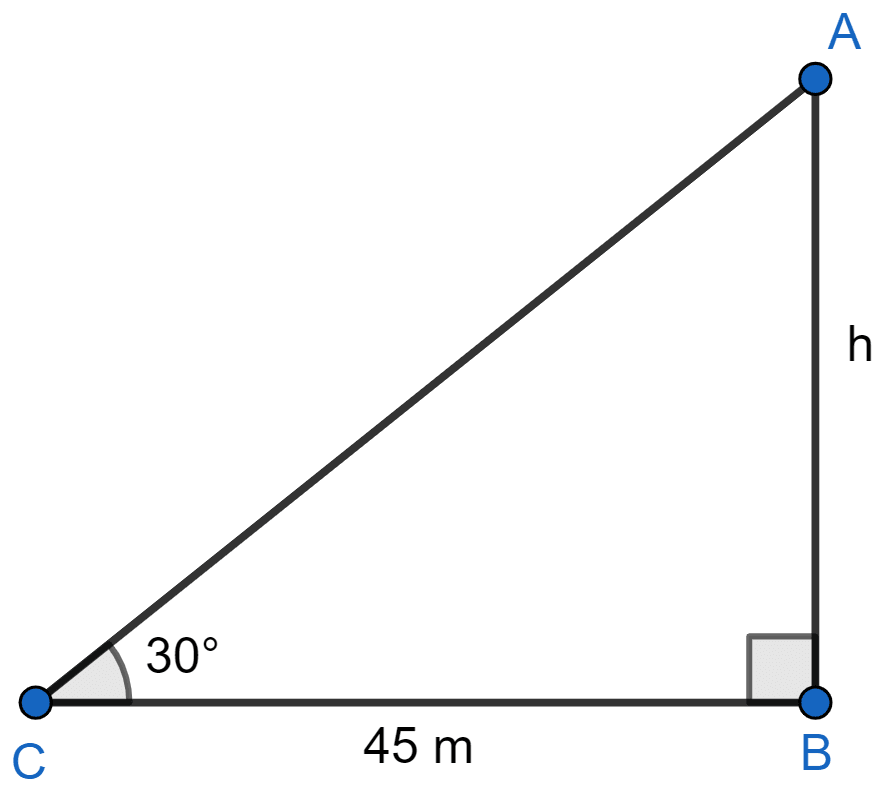
At a particular time, when the sun's altitude is 30°, the length of the shadow of a vertical tower is 45 m. Calculate :

(i) the height of the tower,

(ii) the length of the shadow of the same tower, when the sun's altitude is :

(a) 45° (b) 60°.

Show SolutionHide Solution↓

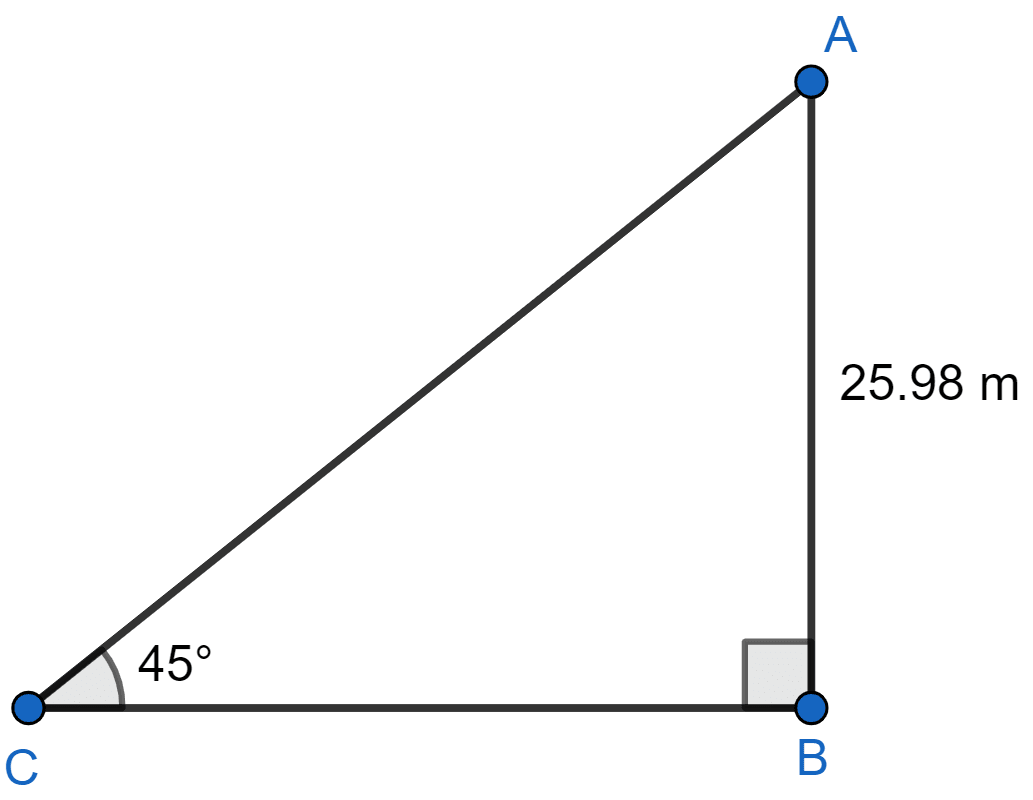
(i) Let AB be the tower.

At a particular time, when the sun's altitude is 30°, the length of the shadow of a vertical tower is 45 m. Calculate : (i) the height of the tower, (ii) the length of the shadow of the same tower, when the sun's altitude is : (a) 45° (b) 60°. Heights and Distances, Concise Mathematics Solutions ICSE Class 10.

From figure,

In △ABC,

$$\begin{aligned}\text{tan 30°} = \frac{\text{Perpendicular}}{\text{Base}} \\[1em] \Rightarrow \frac{1}{\sqrt{3}} = \frac{AB}{BC} \\[1em] \Rightarrow \frac{h}{45} = \frac{1}{\sqrt{3}} \\[1em] \Rightarrow h = \frac{45}{\sqrt{3}} \\[1em] \Rightarrow h = \frac{45}{1.732} \\[1em] \Rightarrow h = 25.98 \text{ meters}.\end{aligned}$$

Hence, the height of tower = 25.98 meters.

(ii) When sun's altitude is

(a) 45°

At a particular time, when the sun's altitude is 30°, the length of the shadow of a vertical tower is 45 m. Calculate : (i) the height of the tower, (ii) the length of the shadow of the same tower, when the sun's altitude is : (a) 45° (b) 60°. Heights and Distances, Concise Mathematics Solutions ICSE Class 10.

$$\begin{aligned}\Rightarrow \text{tan 45°} = \frac{AB}{BC} \\[1em] \Rightarrow 1 = \frac{h}{BC} \\[1em] \Rightarrow BC = h = 25.98 \text{ meters}.\end{aligned}$$

Hence, length of shadow of tower when the sun's altitude is 45° = 25.98 meters.

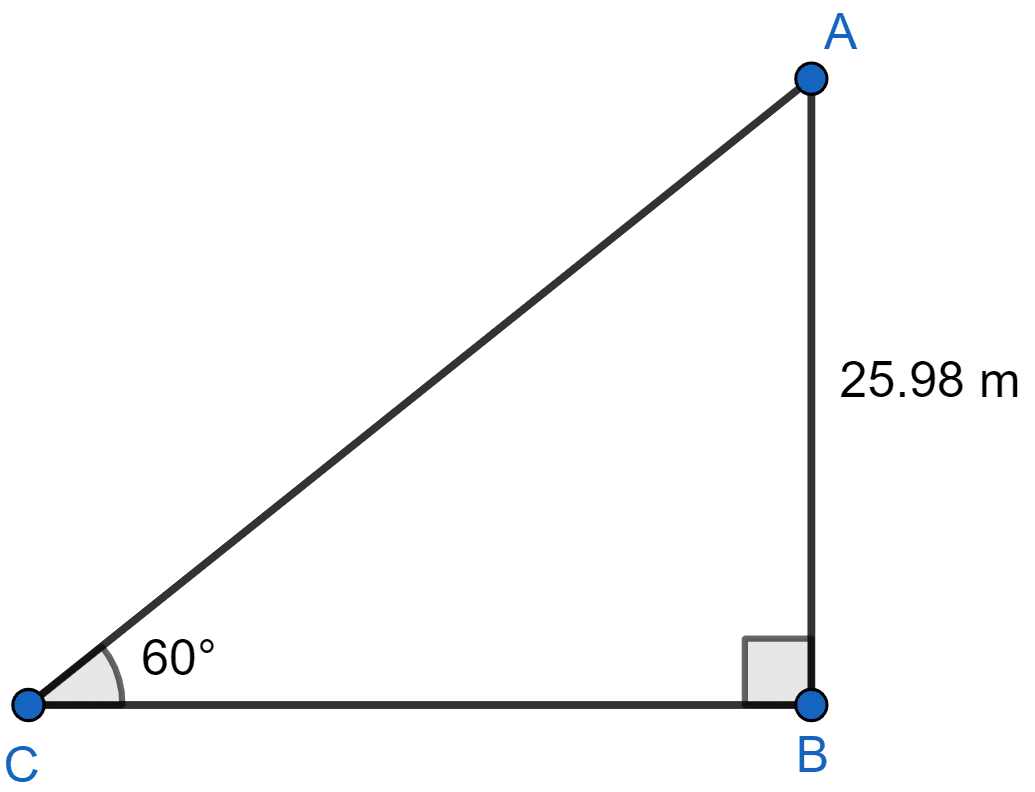
(b) 60°

At a particular time, when the sun's altitude is 30°, the length of the shadow of a vertical tower is 45 m. Calculate : (i) the height of the tower, (ii) the length of the shadow of the same tower, when the sun's altitude is : (a) 45° (b) 60°. Heights and Distances, Concise Mathematics Solutions ICSE Class 10.

$$\begin{aligned}\Rightarrow \text{tan 60°} = \frac{AB}{BC} \\[1em] \Rightarrow \sqrt{3} = \frac{h}{BC} \\[1em] \Rightarrow BC = \frac{h}{\sqrt{3}} \\[1em] \Rightarrow BC = \frac{25.98}{1.732} \\[1em] \Rightarrow BC = 15\text{ meters}.\end{aligned}$$

Hence, length of shadow of tower when the sun's altitude is 60° = 15 meters.

10Exercise 22(A)

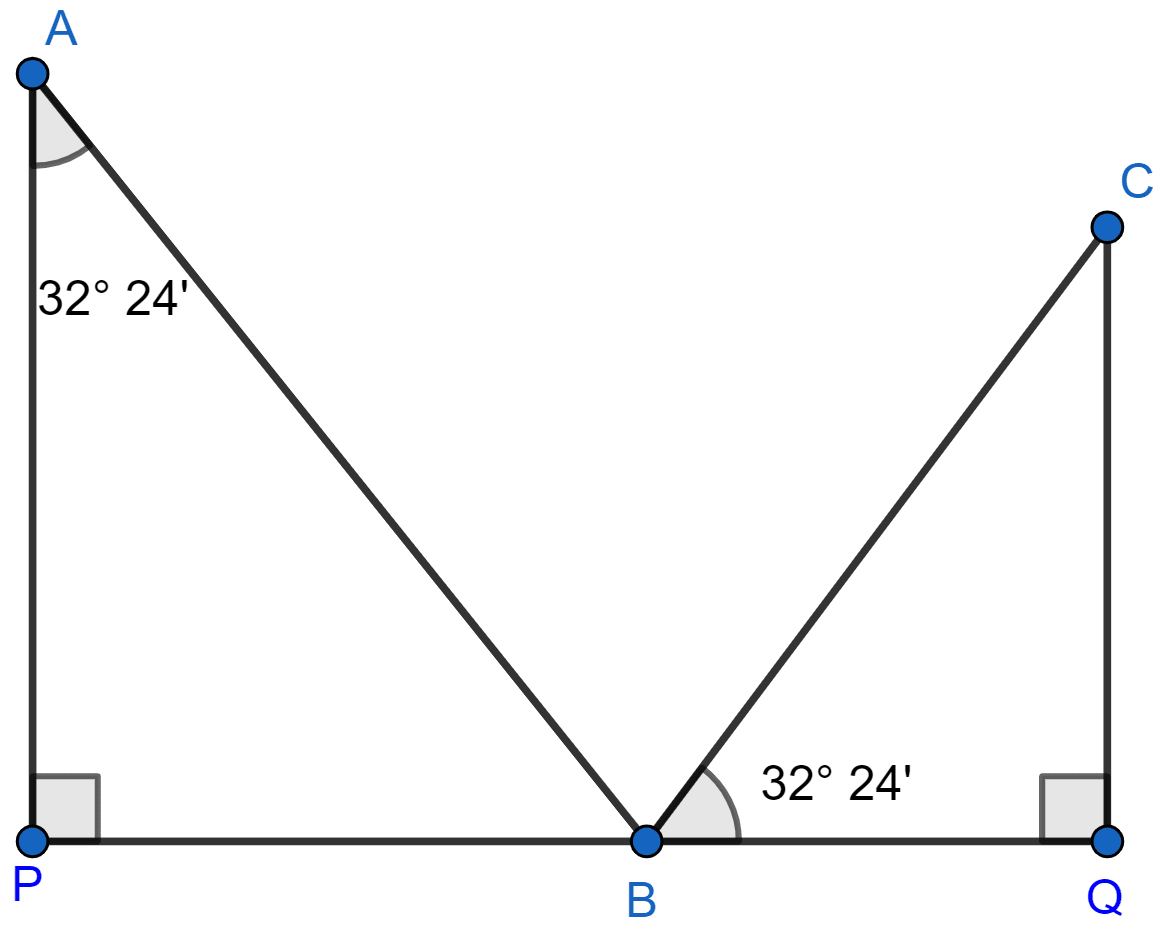
Two vertical poles are on either side of a road. A 30 m long ladder is placed between the two poles. When the ladder rests against one pole, it makes angle 32° 24' with the pole and when it is turned to rest against another pole, it makes angle 32° 24' with the road. Calculate the width of the road.

Show SolutionHide Solution↓

Let AP and CQ be two poles.

Two vertical poles are on either side of a road. A 30 m long ladder is placed between the two poles. When the ladder rests against one pole, it makes angle 32° 24' with the pole and when it is turned to rest against another pole, it makes angle 32° 24' with the road. Calculate the width of the road. Heights and Distances, Concise Mathematics Solutions ICSE Class 10.

When ladder is at position AB resting on pole AP.

Then, ∠BAP = 32° 24'

From figure,

In △ABP,

$$\begin{aligned}\text{sin 32° 24}' = \frac{\text{Perpendicular}}{\text{Hypotenuse}} \\[1em] \Rightarrow 0.536 = \frac{BP}{AB} \\[1em] \Rightarrow BP = AB \times 0.536 \\[1em] \Rightarrow BP = 30 \times 0.536 \\[1em] \Rightarrow BP = 16.08 \text{ meters}.\end{aligned}$$

When ladder is at position BC resting on pole CQ.

Then it makes angle 32° 24' with road.

∴ ∠CBQ = 32° 24'

From figure,

In △BQC,

$$\begin{aligned}\text{cos 32° 24}' = \frac{\text{Base}}{\text{Hypotenuse}} \\[1em] \Rightarrow 0.844 = \frac{BQ}{BC} \\[1em] \Rightarrow BQ = BC \times 0.844 \\[1em] \Rightarrow BQ = 30 \times 0.844 \\[1em] \Rightarrow BQ = 25.32\text{ meters}.\end{aligned}$$

Width of road = BP + BQ = 16.08 + 25.32 = 41.4 meters.

Hence, width of road = 41.4 meters.

11Exercise 22(A)

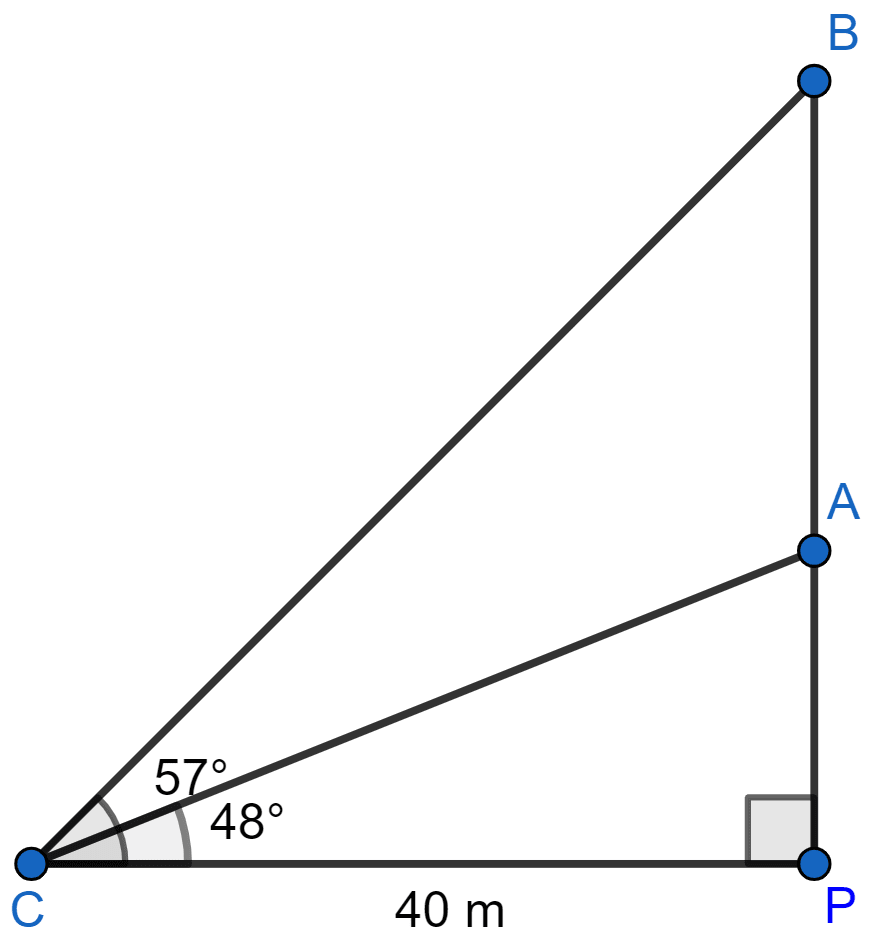
Two climbers are at points A and B on a vertical cliff face. To an observer C, 40 m from the foot of the cliff, on the level ground, A is at an elevation of 48° and B of 57°. What is the distance between the climbers?

Show SolutionHide Solution↓

Let P be the foot of cliff.

Two climbers are at points A and B on a vertical cliff face. To an observer C, 40 m from the foot of the cliff, on the level ground, A is at an elevation of 48° and B of 57°. What is the distance between the climbers? Heights and Distances, Concise Mathematics Solutions ICSE Class 10.

From figure,

In △BCP,

$$\begin{aligned}\text{tan 57°} = \frac{\text{Perpendicular}}{\text{Base}} \\[1em] \Rightarrow 1.539 = \frac{BP}{PC} \\[1em] \Rightarrow BP = PC \times 1.539 \\[1em] \Rightarrow BP = 40 \times 1.539 \\[1em] \Rightarrow BP = 61.57 \text{ meters}.\end{aligned}$$

In △ACP,

$$\begin{aligned}\text{tan 48°} = \frac{\text{Perpendicular}}{\text{Base}} \\[1em] \Rightarrow 1.110 = \frac{AP}{PC} \\[1em] \Rightarrow AP = PC \times 1.110 \\[1em] \Rightarrow AP = 40 \times 1.110 \\[1em] \Rightarrow AP = 44.40 \text{ meters}.\end{aligned}$$

Distance between climbers (BA) = BP - AP

= 61.57 - 44.40

= 17.17 meters.

Hence, distance between two climbers = 17.17 meters.

12Exercise 22(A)

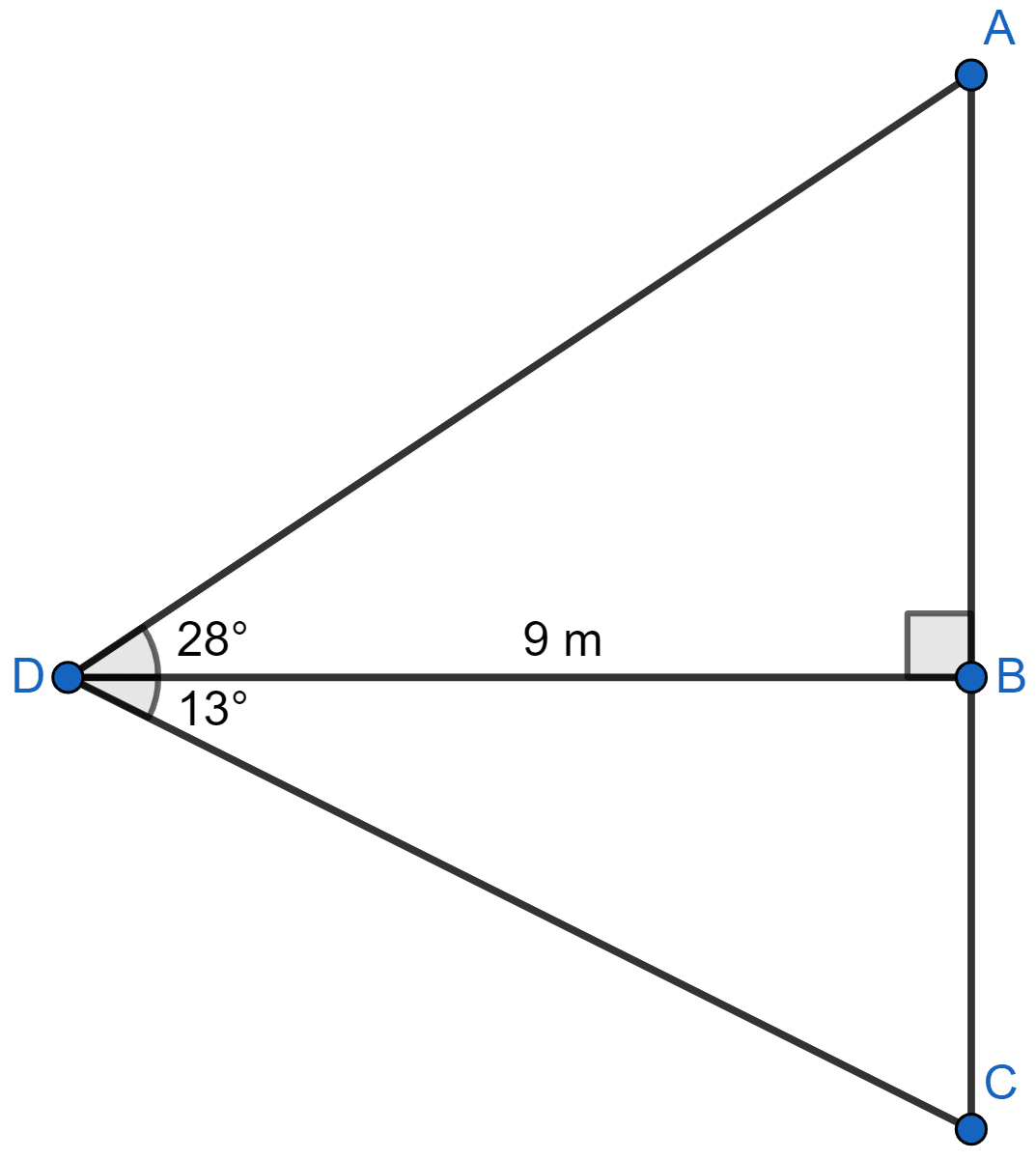
A man stands 9 m away from a flag-pole. He observes that angle of elevation of the top of the pole is 28° and the angle of depression of the bottom of the pole is 13°. Calculate the height of pole.

Show SolutionHide Solution↓

Let AC be the pole and D be the point where man stands.

A man stands 9 m away from a flag-pole. He observes that angle of elevation of the top of the pole is 28° and the angle of depression of the bottom of the pole is 13°. Calculate the height of pole. Heights and Distances, Concise Mathematics Solutions ICSE Class 10.

From figure,

In △ADB,

$$\begin{aligned}\Rightarrow \text{tan 28°} = \frac{\text{Perpendicular}}{\text{Base}} \\[1em] \Rightarrow 0.532 = \frac{AB}{BD} \\[1em] \Rightarrow AB = BD \times 0.532 \\[1em] \Rightarrow AB = 9 \times 0.532 = 4.788 \text{ m}.\end{aligned}$$

In △BDC,

$$\begin{aligned}\Rightarrow \text{tan 13°} = \frac{\text{Perpendicular}}{\text{Base}} \\[1em] \Rightarrow 0.231 = \frac{BC}{BD} \\[1em] \Rightarrow BC = BD \times 0.231 \\[1em] \Rightarrow BC = 9 \times 0.231 = 2.079 \text{ m}.\end{aligned}$$

AC = AB + BC = 4.788 + 2.079 = 6.867 meters.

Hence, the height of pole = 6.867 meters.

13Exercise 22(A)

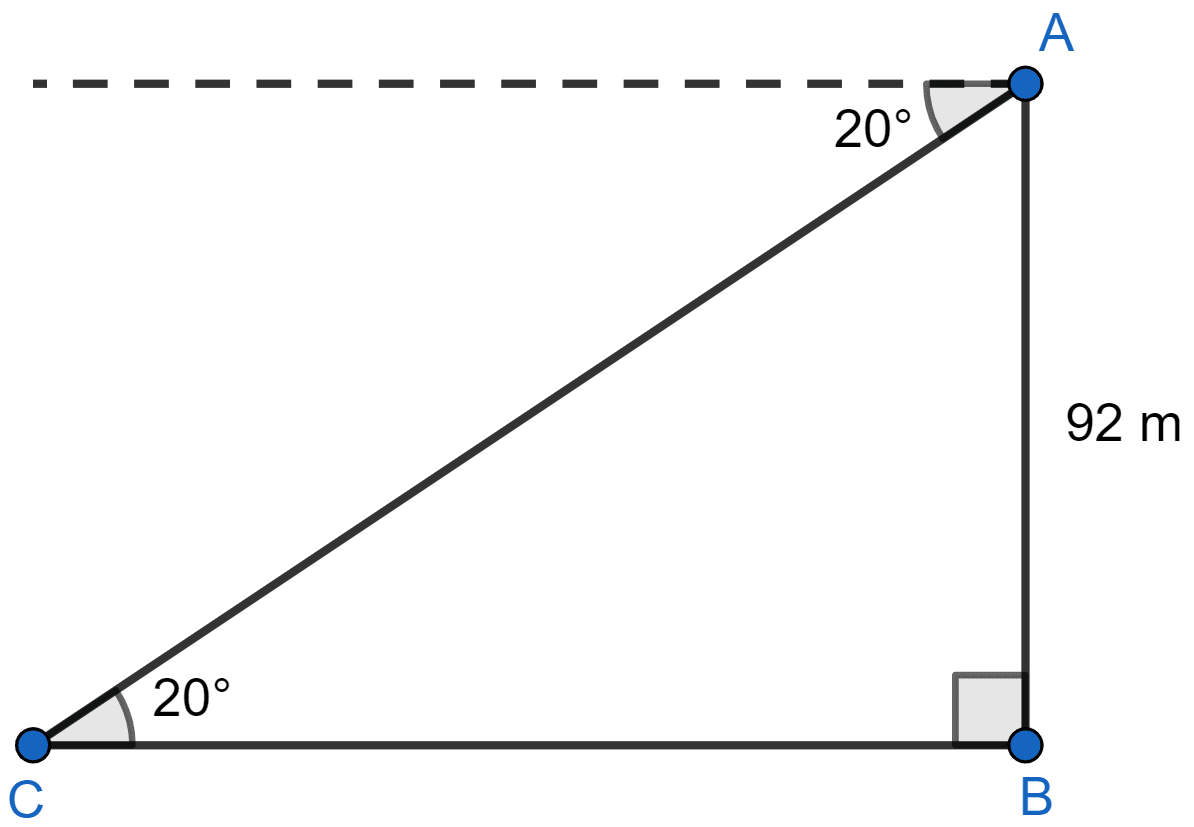
From the top of a cliff 92 m high, the angle of depression of a buoy is 20°. Calculate, to the nearest metre, the distance of the buoy from the foot of the cliff.

Show SolutionHide Solution↓

Let AB be the cliff and C be the buoy.

A man stands 9 m away from a flag-pole. He observes that angle of elevation of the top of the pole is 28° and the angle of depression of the bottom of the pole is 13°. Calculate the height of pole. Heights and Distances, Concise Mathematics Solutions ICSE Class 10.

Given,

AB = 92 m

From figure,

In △ACB,

$$\begin{aligned}\text{tan 20°} = \frac{\text{Perpendicular}}{\text{Base}} \\[1em] \Rightarrow \text{tan 20°} = \frac{AB}{BC} \\[1em] \Rightarrow 0.364 = \frac{92}{BC}\\[1em] \Rightarrow BC = \frac{92}{0.364} \\[1em] \Rightarrow BC = 252.7 ≈ 253 \text{ meters}.\end{aligned}$$

Hence, the distance of the buoy from the foot of the cliff is 253 meters.

1(a)Exercise 22(B)

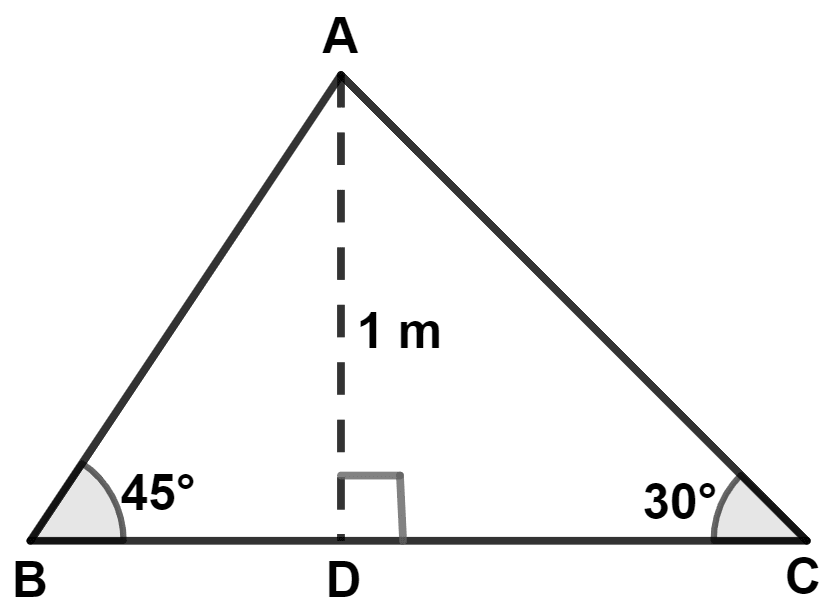
According to the information given in the following figure, the length of BC is :

According to the information given in the following figure, the length of BC is : Heights and Distances, Concise Mathematics Solutions ICSE Class 10.
Show SolutionHide Solution↓

We know that,

tan θ = $\frac{\text{Perpendicular}}{\text{Base}}$

From figure,

In △ ABD,

⇒ tan 45° = $\frac{AD}{BD}$

⇒ $1 = \frac{1}{BD}$

⇒ BD = 1 m.

In △ ACD,

⇒ tan 30° = $\frac{AD}{CD}$

⇒ $\frac{1}{\sqrt{3}} = \frac{1}{CD}$

⇒ CD = $\sqrt{3}$ m.

From figure,

BC = BD + CD = $(1 + \sqrt{3})$ m.

Hence, Option 3 is the correct option.

1(b)Exercise 22(B)

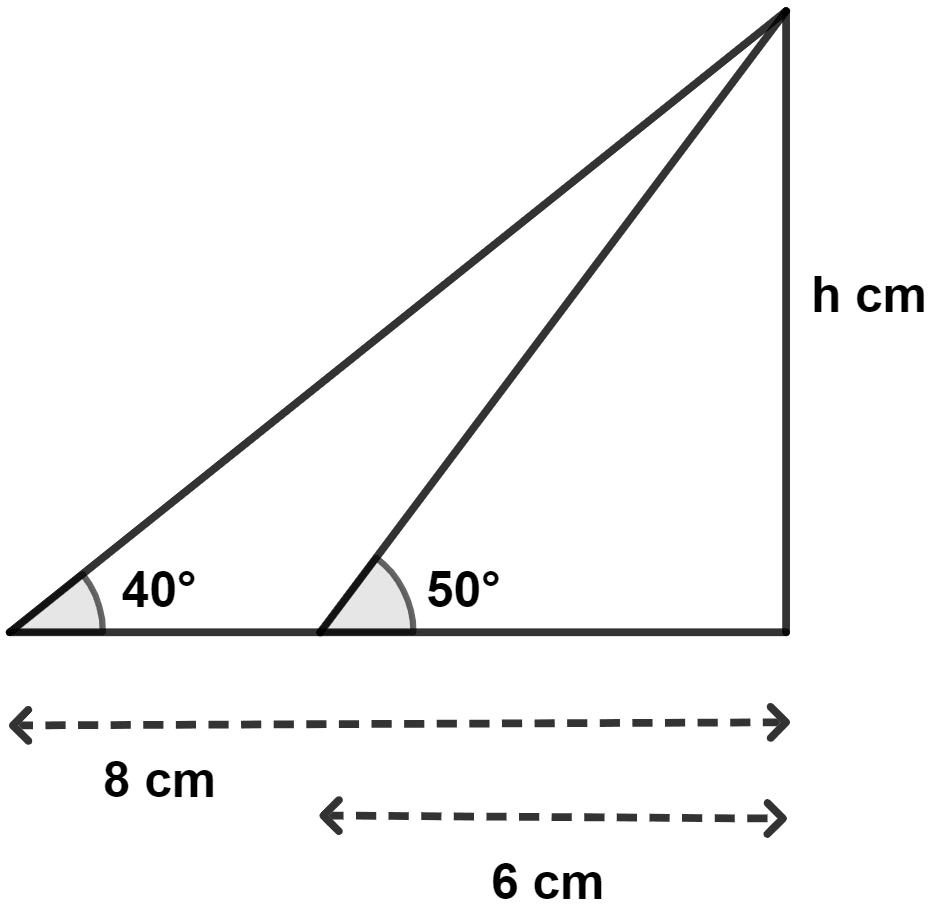
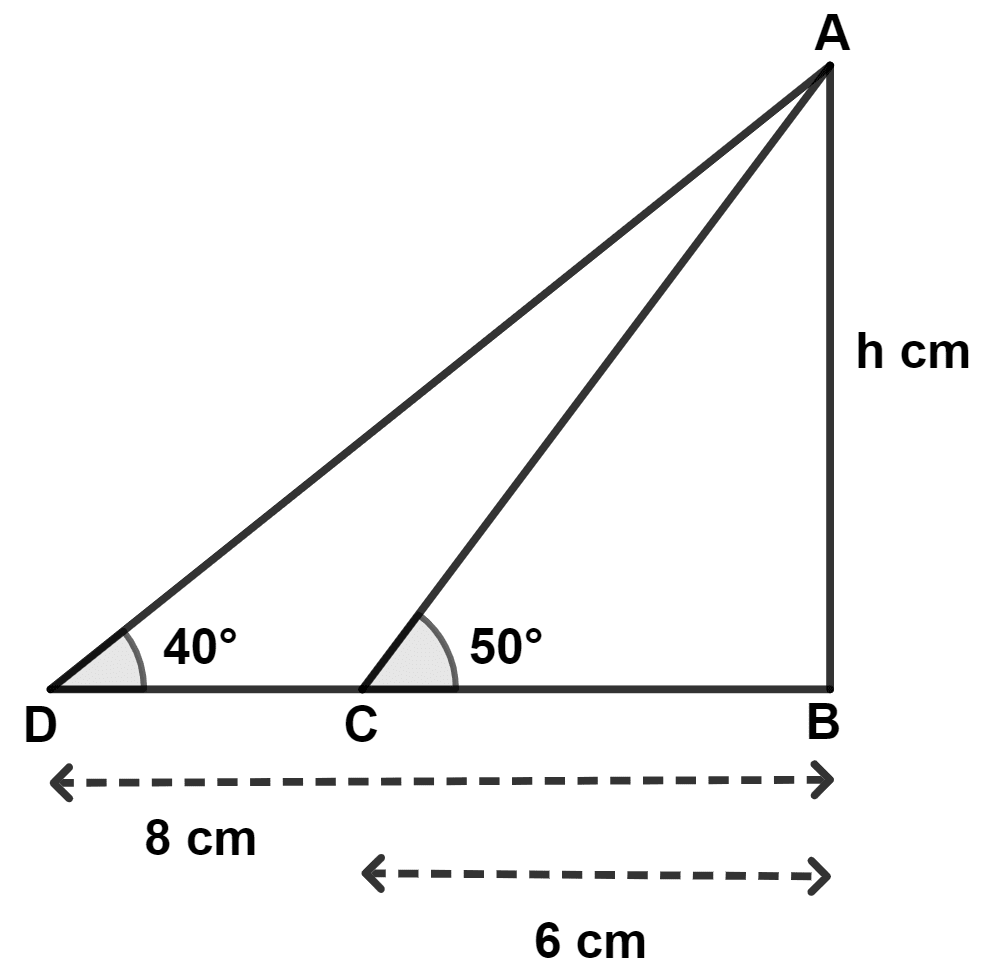
The measurement of h is :

The measurement of h is : Heights and Distances, Concise Mathematics Solutions ICSE Class 10.
Show SolutionHide Solution↓

We know that,

tan θ = $\frac{\text{Perpendicular}}{\text{Base}}$

From figure,

The measurement of h is : Heights and Distances, Concise Mathematics Solutions ICSE Class 10.

In △ ABC,

⇒ tan 50° = $\frac{AB}{BC}$

⇒ tan 50° = $\frac{h}{6}$

⇒ h = 6 tan 50°

⇒ h = 6 tan (90° - 40°)

⇒ h = 6 cot 40° ........(1)

In △ ABD,

⇒ tan 40° = $\frac{AB}{BD}$

⇒ tan 40° = $\frac{h}{8}$

⇒ h = 8 tan 40° ........(2)

Multiplying equation (1) and (2), we get :

⇒ h × h = 6 cot 40° × 8 tan 40°

⇒ h2 = 8 × 6 × cot 40° $\times \frac{1}{\text{cot 40°}}$

⇒ h2 = 8 × 6

⇒ h = $\sqrt{8 \times 6}$.

Hence, Option 1 is the correct option.

1(c)Exercise 22(B)

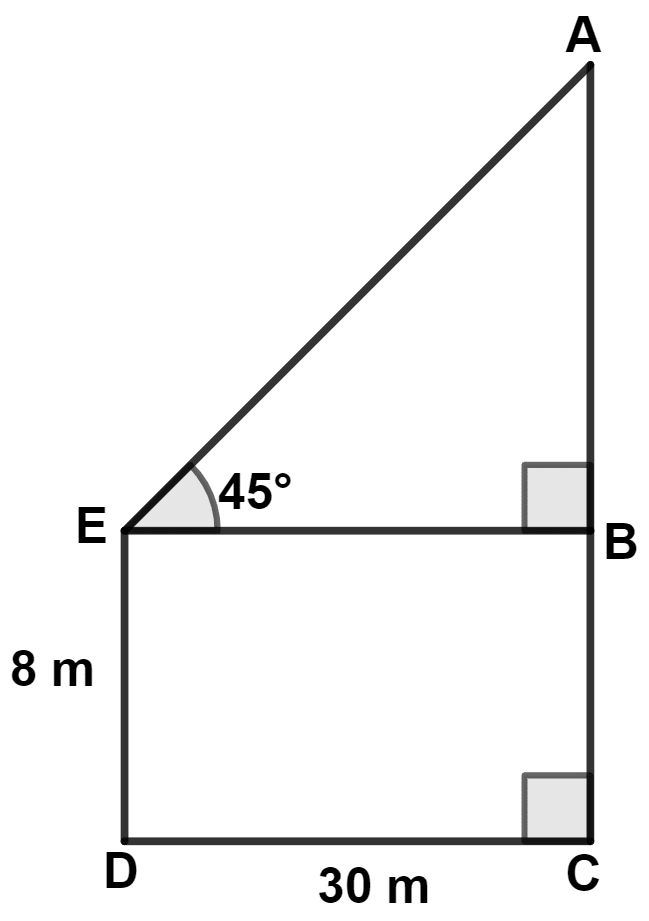
The length of AC is :

The length of AC is : Heights and Distances, Concise Mathematics Solutions ICSE Class 10.
Show SolutionHide Solution↓

From figure,

BCDE is a rectangle.

∴ BC = DE = 8 m and BE = DC = 30 m.

We know that,

tan θ = $\frac{\text{Perpendicular}}{\text{Base}}$

From figure,

In △ ABE,

⇒ tan 45° = $\frac{AB}{BE}$

⇒ $1 = \frac{AB}{30}$

⇒ AB = 30 m.

From figure,

AC = AB + BC = 30 + 8 = 38 m.

Hence, Option 2 is the correct option.

1(d)Exercise 22(B)

Using the information given in the following figure, the measurement of AE is :

Using the information given in the following figure, the measurement of AE is : Heights and Distances, Concise Mathematics Solutions ICSE Class 10.
Show SolutionHide Solution↓

We know that,

tan θ = $\frac{\text{Perpendicular}}{\text{Base}}$

From figure,

In △ ABC,

⇒ tan 60° = $\frac{AB}{BC}$

⇒ $\sqrt{3} = \frac{20}{BC}$

⇒ BC = $\frac{20}{\sqrt{3}}$ cm.

In rectangle BCDE,

Opposite sides of rectangle are equal.

∴ DE = BC = $\frac{20}{\sqrt{3}}$ cm

From figure,

In △ AED,

⇒ tan 30° = $\frac{AE}{DE}$

⇒ $\frac{1}{\sqrt{3}} = \frac{AE}{\frac{20}{\sqrt{3}}}$

⇒ AE = $\frac{1}{\sqrt{3}} \times \frac{20}{\sqrt{3}} = \frac{20}{3} = 6\frac{2}{3}$ cm.

Hence, Option 3 is the correct option.

1(e)Exercise 22(B)

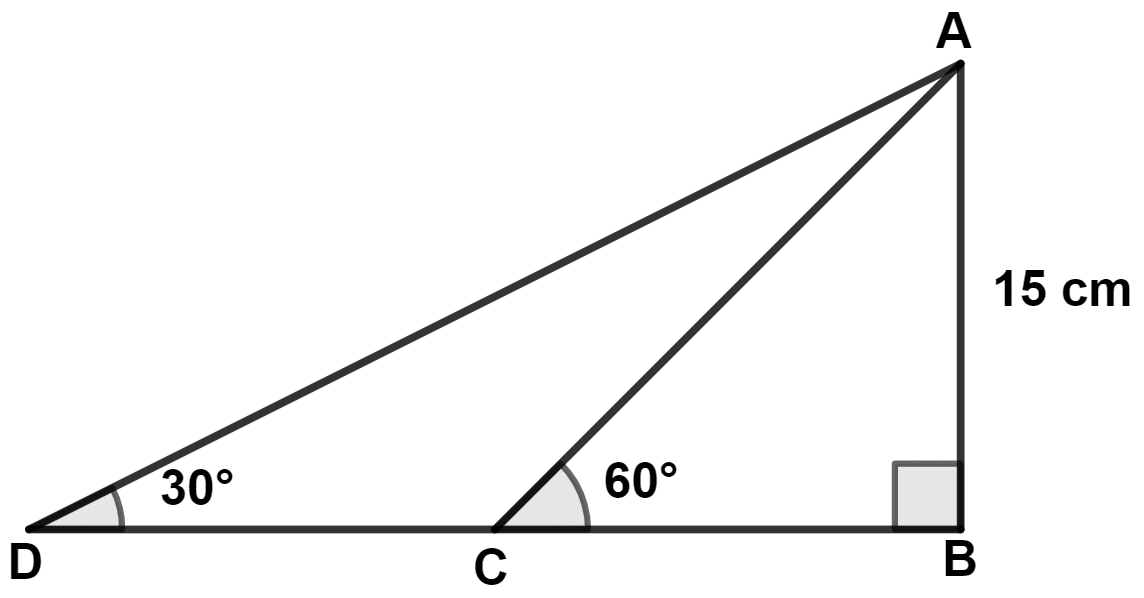
The length of DC is :

The length of DC is : Heights and Distances, Concise Mathematics Solutions ICSE Class 10.
Show SolutionHide Solution↓

We know that,

tan θ = $\frac{\text{Perpendicular}}{\text{Base}}$

From figure,

In △ ABC,

⇒ tan 60° = $\frac{AB}{BC}$

⇒ $\sqrt{3} = \frac{15}{BC}$

⇒ BC = $\frac{15}{\sqrt{3}}$

Rationalizing the denominator,

$$\begin{aligned}\Rightarrow \text{BC } = \frac{15}{\sqrt{3}} \times \frac{\sqrt{3}}{\sqrt{3}} \\[1em] \Rightarrow \text{BC } = \frac{15\sqrt{3}}{3} \\[1em] \Rightarrow \text{BC } = 5\sqrt{3}.\end{aligned}$$

In △ ABD,

⇒ tan 30° = $\frac{AB}{BD}$

⇒ $\frac{1}{\sqrt{3}} = \frac{15}{BD}$

⇒ BD = $15\sqrt{3}$ cm.

From figure,

DC = BD - BC = $15\sqrt{3} - 5\sqrt{3} = 10\sqrt{3}$ cm.

Hence, Option 4 is the correct option.

2Exercise 22(B)

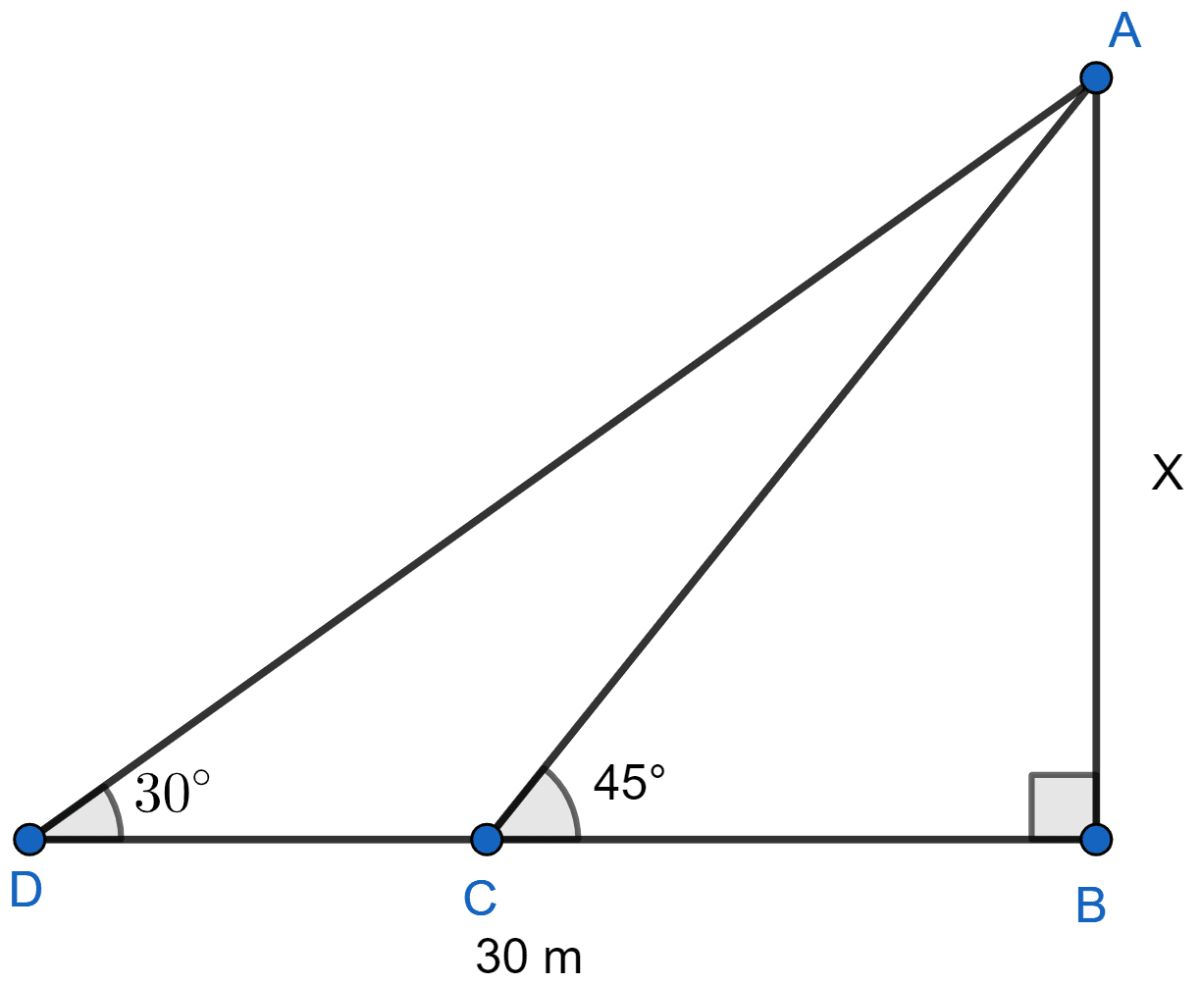
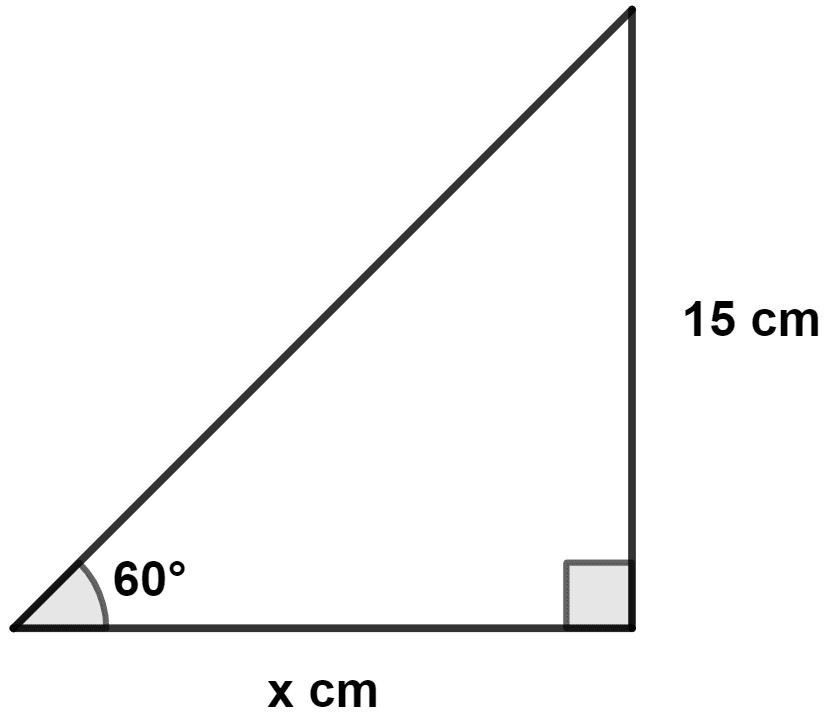
In the figure, given below, it is given that AB is perpendicular to BD and is of length X metres. DC = 30 m, ∠ADB = 30° and ∠ACB = 45°. Find X.

In the figure, given below, it is given that AB is perpendicular to BD and is of length X metres. DC = 30 m, ∠ADB = 30° and ∠ACB = 45°. Find X. Heights and Distances, Concise Mathematics Solutions ICSE Class 10.
Show SolutionHide Solution↓

From figure,

In △ABD,

$$\begin{aligned}\Rightarrow \text{tan 30°} = \frac{\text{Perpendicular}}{\text{Base}} \\[1em] \Rightarrow \frac{1}{\sqrt{3}} = \frac{AB}{BD} \\[1em] \Rightarrow AB = \frac{BD}{\sqrt{3}} ........(1)\end{aligned}$$

In △ABC,

$$\begin{aligned}\Rightarrow \text{tan 45°} = \frac{\text{Perpendicular}}{\text{Base}} \\[1em] \Rightarrow 1 = \frac{AB}{BC} \\[1em] \Rightarrow AB = BC ..........(2)\end{aligned}$$

From (1) and (2),

$$\begin{aligned}\Rightarrow BC = \frac{BD}{\sqrt{3}} \\[1em] \Rightarrow \sqrt{3}BC = BD \\[1em] \Rightarrow \sqrt{3}BC = BC + CD \\[1em] \Rightarrow \sqrt{3}BC - BC = 30 \\[1em] \Rightarrow BC(\sqrt{3} - 1) = 30 \\[1em] \Rightarrow BC = \frac{30}{\sqrt{3} - 1} \\[1em] \Rightarrow BC = \frac{30}{1.732 - 1} \\[1em] \Rightarrow BC = \frac{30}{0.732} \\[1em] \Rightarrow BC = 40.98 \text{ meters}.\end{aligned}$$

∴ AB = X = 40.98 meters .....[From (2)]

Hence, X = 40.98 meters.

3Exercise 22(B)

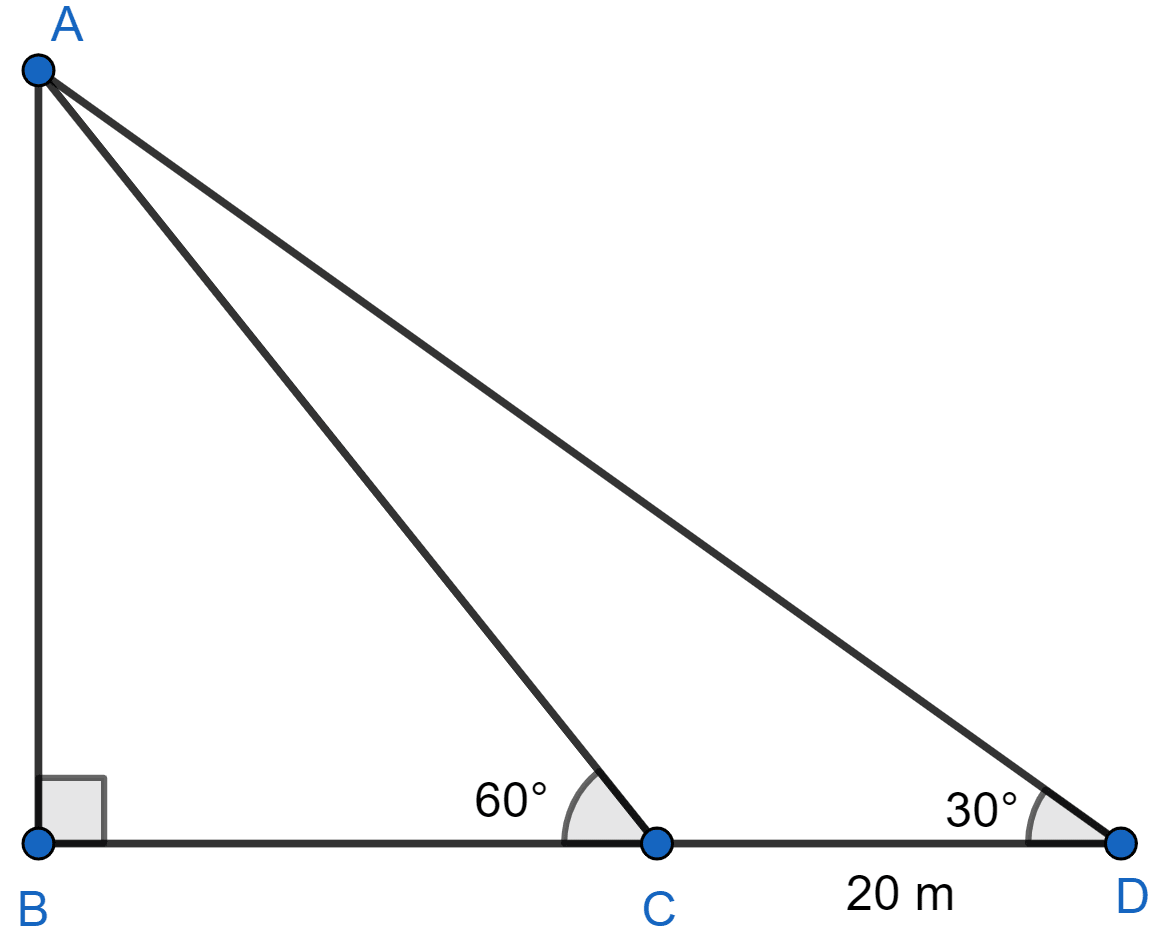
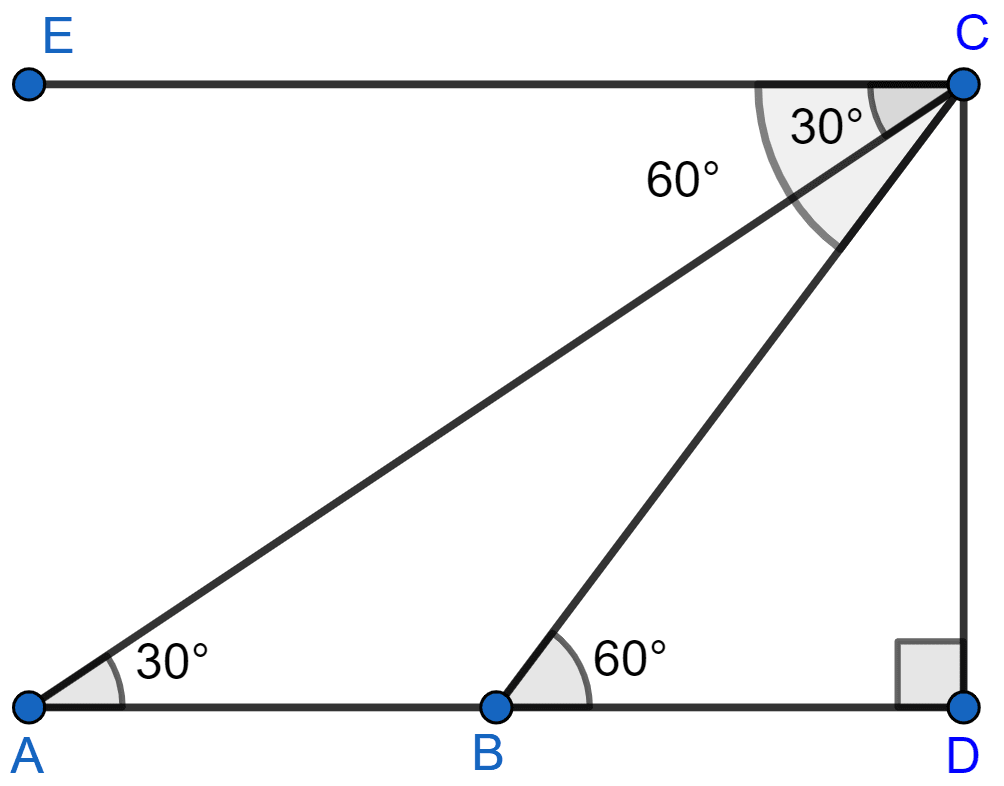
Find the height of a tree when it is found that on walking away from it 20 m, in a horizontal line through its base, the elevation of its top changes from 60° to 30°.

Show SolutionHide Solution↓

Let AB be the tree.

Let the two points be C and D such that CD = 20 m, ∠ADB = 30° and ∠ACB = 60°.

Find the height of a tree when it is found that on walking away from it 20 m, in a horizontal line through its base, the elevation of its top changes from 60° to 30°. Heights and Distances, Concise Mathematics Solutions ICSE Class 10.

In ∆ABC,

$$\begin{aligned}\Rightarrow \text{tan 60°} = \frac{\text{Perpendicular}}{\text{Base}} \\[1em] \Rightarrow \sqrt{3} = \frac{AB}{BC} \\[1em] \Rightarrow AB = BC\sqrt{3} ..........(1)\end{aligned}$$

In ∆ABD,

$$\begin{aligned}\Rightarrow \text{tan 30°} = \frac{\text{Perpendicular}}{\text{Base}} \\[1em] \Rightarrow \frac{1}{\sqrt{3}} = \frac{AB}{BD} \\[1em] \Rightarrow AB = \frac{BD}{\sqrt{3}} ..........(2)\end{aligned}$$

From (1) and (2), we get :

$$\begin{aligned}\Rightarrow BC\sqrt{3} = \frac{BD}{\sqrt{3}} \\[1em] \Rightarrow BD = 3BC \\[1em] \Rightarrow BC + CD = 3BC \\[1em] \Rightarrow CD = 2BC \\[1em] \Rightarrow BC = \frac{CD}{2} \\[1em] \Rightarrow BC = \frac{20}{2} \\[1em] \Rightarrow BC = 10 \text{ meters}.\end{aligned}$$

AB = $BC \times \sqrt{3}$ = BC × 1.732 = 17.32 meters.

Hence, the height of the tree is 17.32 metres.

4Exercise 22(B)

From the top of a light house 100 m high, the angles of depression of two ships are observed as 48° and 36° respectively. Find the distance between the two ships (in the nearest metre) if:

(i) the ships are on the same side of the light house.

(ii) the ships are on the opposite sides of the light house.

Show SolutionHide Solution↓

(i) Let's consider AB to be the lighthouse.
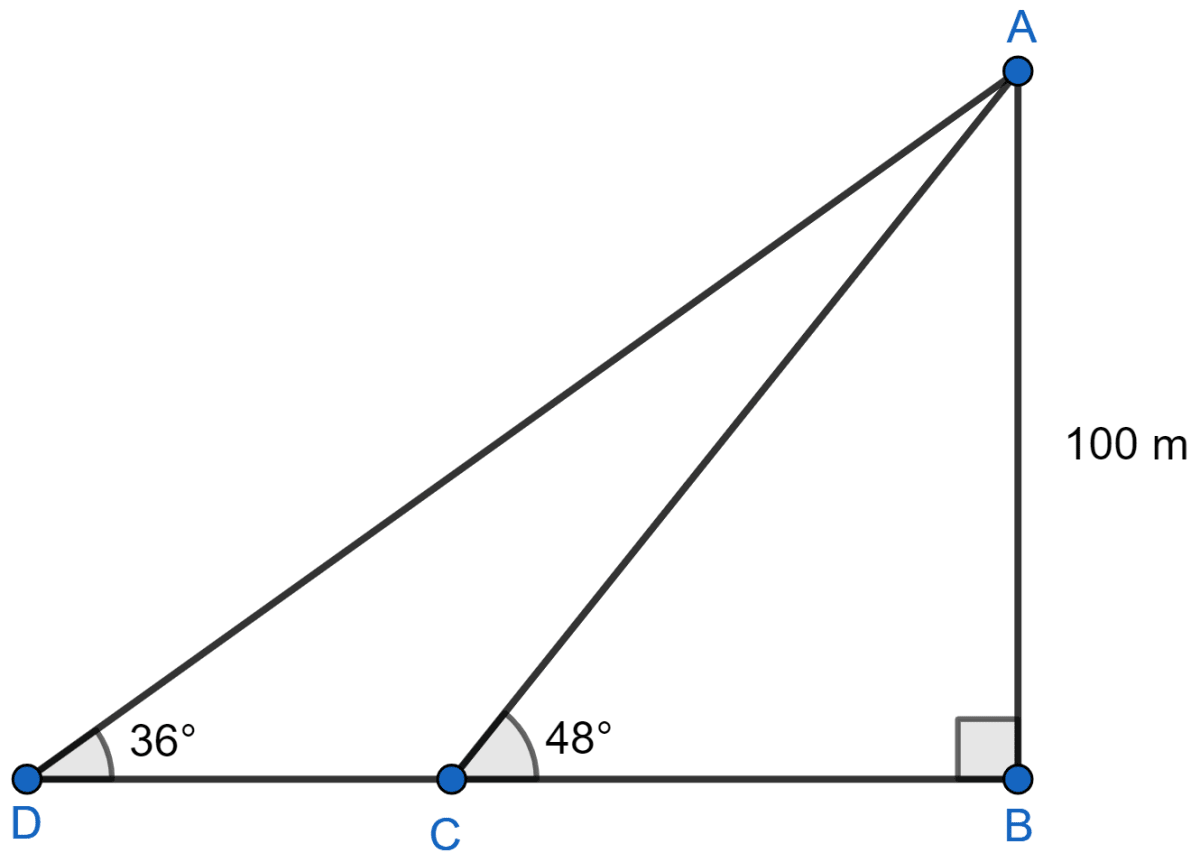
From the top of a light house 100 m high, the angles of depression of two ships are observed as 48° and 36° respectively. Find the distance between the two ships (in the nearest metre) if: (i) the ships are on the same side of the light house. (ii) the ships are on the opposite sides of the light house. Heights and Distances, Concise Mathematics Solutions ICSE Class 10.

Given, depression angles are 48° and 36°.

When ships are on the same side,

In ∆ABC,

$$\begin{aligned}\text{tan 48°} = \frac{\text{Perpendicular}}{\text{Base}} \\[1em] \Rightarrow 1.1106 = \frac{AB}{BC} \\[1em] \Rightarrow 1.1106 = \frac{100}{BC} \\[1em] \Rightarrow BC = \frac{100}{1.1106} \\[1em] \Rightarrow BC = 90.04 \text{ meters}.\end{aligned}$$

In ∆ABD,

$$\begin{aligned}\text{tan 36°} = \frac{\text{Perpendicular}}{\text{Base}} \\[1em] \Rightarrow 0.7265 = \frac{AB}{BD} \\[1em] \Rightarrow 0.7265 = \frac{100}{BD} \\[1em] \Rightarrow BD = \frac{100}{0.7265} \\[1em] \Rightarrow BD = 137.64 \text{ meters}.\end{aligned}$$

Distance between the two ships (CD) = BD – BC = 137.64 - 90.04

= 47.6 ≈ 48 m.

Hence, distance between ships when on the same side = 48 m.

(ii) Let's consider AB to be the lighthouse.

Given, depression angles are 48° and 36°.
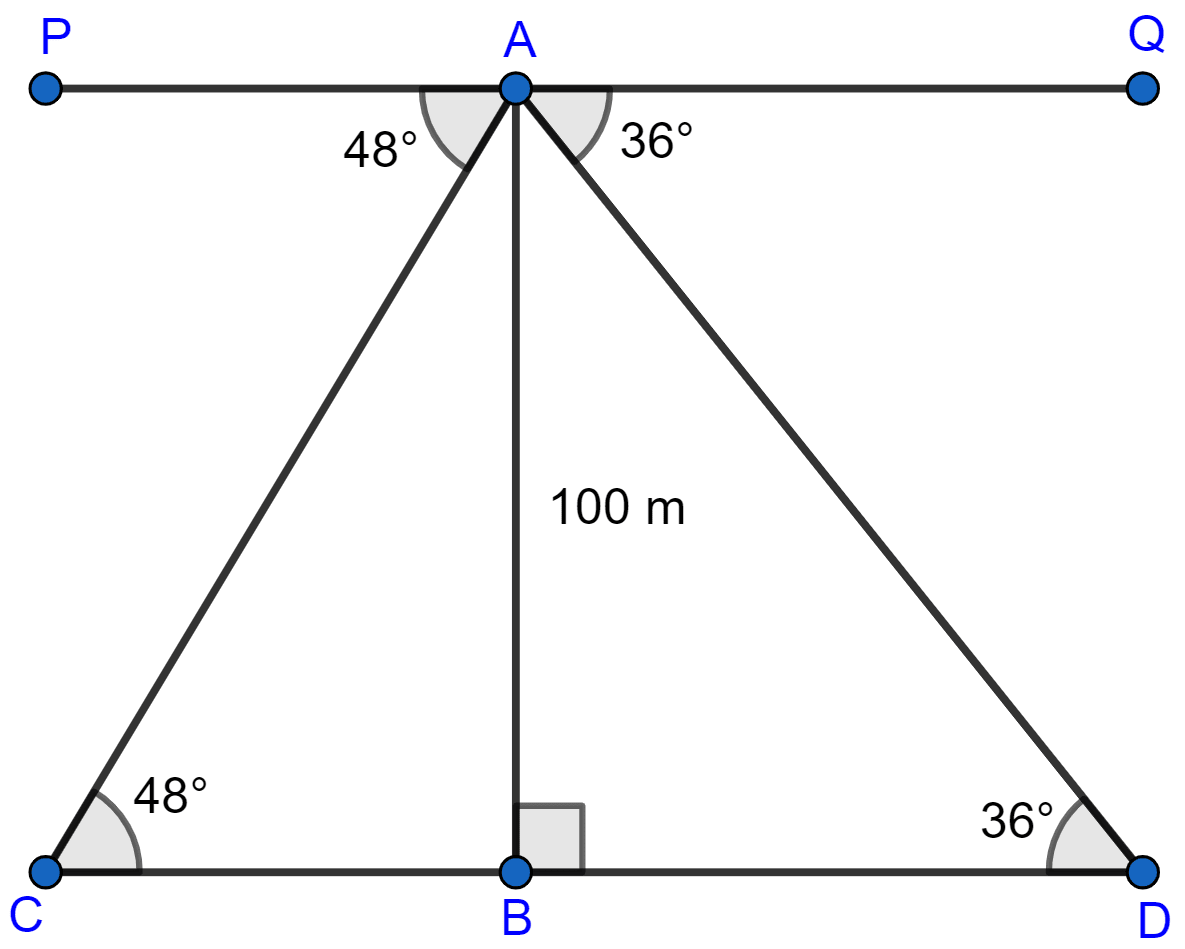
From the top of a light house 100 m high, the angles of depression of two ships are observed as 48° and 36° respectively. Find the distance between the two ships (in the nearest metre) if: (i) the ships are on the same side of the light house. (ii) the ships are on the opposite sides of the light house. Heights and Distances, Concise Mathematics Solutions ICSE Class 10.

As, alternate angles are equal.

∴ ∠ADB = ∠QAD = 36° and ∠ACB = ∠PAC = 48°.

When ships are on the opposite side,

In ∆ABC,

$$\begin{aligned}\text{tan 48°} = \frac{\text{Perpendicular}}{\text{Base}} \\[1em] \Rightarrow 1.1106 = \frac{AB}{BC} \\[1em] \Rightarrow 1.1106 = \frac{100}{BC} \\[1em] \Rightarrow BC = \frac{100}{1.1106} \\[1em] \Rightarrow BC = 90.04 \text{ meters}.\end{aligned}$$

In ∆ABD,

$$\begin{aligned}\text{tan 36°} = \frac{\text{Perpendicular}}{\text{Base}} \\[1em] \Rightarrow 0.7265 = \frac{AB}{BD} \\[1em] \Rightarrow 0.7265 = \frac{100}{BD} \\[1em] \Rightarrow BD = \frac{100}{0.7265} \\[1em] \Rightarrow BD = 137.64 \text{ meters}.\end{aligned}$$

Distance between the two ships (CD) = BD + BC = 137.64 + 90.04

= 227.68 ≈ 228 m.

Hence, the distance between two ships, when on opposite side = 228 m.
5Exercise 22(B)

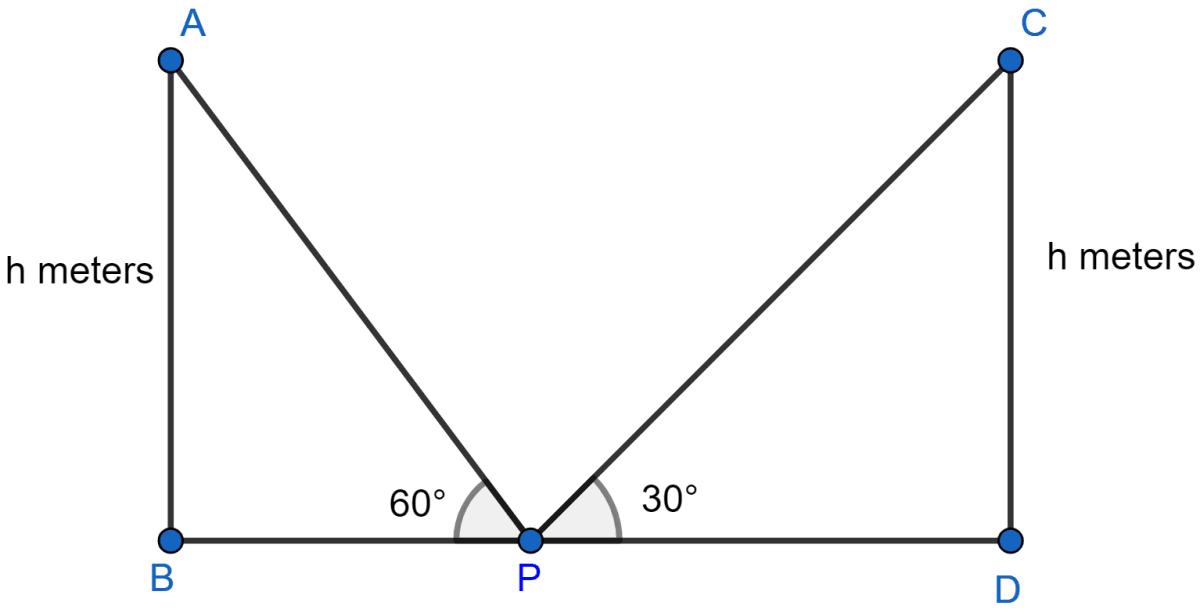
Two pillars of equal heights stand on either side of a roadway, which is 150 m wide. At a point in the roadway between the pillars the elevations of the tops of the pillars are 60° and 30°; find the height of the pillars and the position of the point.

Show SolutionHide Solution↓

Let AB and CD be the two towers of height h meters. Let P be a point in the roadway BD such that BD = 150 m, ∠APB = 60° and ∠CPD = 30°.

Two pillars of equal heights stand on either side of a roadway, which is 150 m wide. At a point in the roadway between the pillars the elevations of the tops of the pillars are 60° and 30°; find the height of the pillars and the position of the point. Heights and Distances, Concise Mathematics Solutions ICSE Class 10.

In ∆ABP,

$$\begin{aligned}\text{tan 60°} = \frac{\text{Perpendicular}}{\text{Base}} \\[1em] \Rightarrow \sqrt{3} = \frac{AB}{BP} \\[1em] \Rightarrow BP = \frac{AB}{\sqrt{3}} \\[1em] \Rightarrow BP = \frac{h}{\sqrt{3}}\space ............(1)\end{aligned}$$

In ∆CDP,

$$\begin{aligned}\text{tan 30°} = \frac{\text{Perpendicular}}{\text{Base}} \\[1em] \Rightarrow \frac{1}{\sqrt{3}} = \frac{CD}{PD} \\[1em] \Rightarrow PD = \sqrt{3}CD \\[1em] \Rightarrow PD = \sqrt{3}h\space ............(2)\end{aligned}$$

We know that,

⇒ BD = 150 m

⇒ BP + PD = 150 m

From (1) and (2), we get :

$$\begin{aligned}\Rightarrow \frac{h}{\sqrt{3}} + \sqrt{3}h = 150 \\[1em] \Rightarrow \frac{h + 3h}{\sqrt{3}} = 150 \\[1em] \Rightarrow \frac{4h}{\sqrt{3}} = 150 \\[1em] \Rightarrow 4h = 150 \times \sqrt{3} \\[1em] \Rightarrow h = \frac{150 \times 1.732}{4} \\[1em] \Rightarrow h = 37.5 \times 1.732 \\[1em] \Rightarrow h = 64.95 \text{ meters}.\end{aligned}$$

From equation (1),

BP = $\frac{h}{\sqrt{3}} = \frac{64.95}{1.732}$ = 37.5 meters.

Hence, height of each pillar is 64.95 m and the point P is 37.5 m from the pillar AB.

6Exercise 22(B)

From the figure, given below, calculate the length of CD.

From the figure, given below, calculate the length of CD. Heights and Distances, Concise Mathematics Solutions ICSE Class 10.
Show SolutionHide Solution↓

From figure,

DE = CB = 15 m.

In ∆AED,

$$\begin{aligned}\text{tan 22°} = \frac{\text{Perpendicular}}{\text{Base}} \\[1em] \Rightarrow 0.404 = \frac{AE}{DE} \\[1em] \Rightarrow 0.404 = \frac{AE}{15} \\[1em] \Rightarrow AE = 15 \times 0.404 \\[1em] \Rightarrow AE = 6.06 \text{ meters}.\end{aligned}$$

In ∆ABC,

$$\begin{aligned}\text{tan 47°} = \frac{\text{Perpendicular}}{\text{Base}} \\[1em] \Rightarrow 1.0724 = \frac{AB}{BC} \\[1em] \Rightarrow 1.0724 = \frac{AB}{15} \\[1em] \Rightarrow AB = 15 \times 1.0724 \\[1em] \Rightarrow AB = 16.086 \text{ meters}.\end{aligned}$$

From figure,

CD = BE = AB - AE

= 16.086 - 6.06

= 10.03 meters.

Hence, CD = 10.03 meters.

7Exercise 22(B)

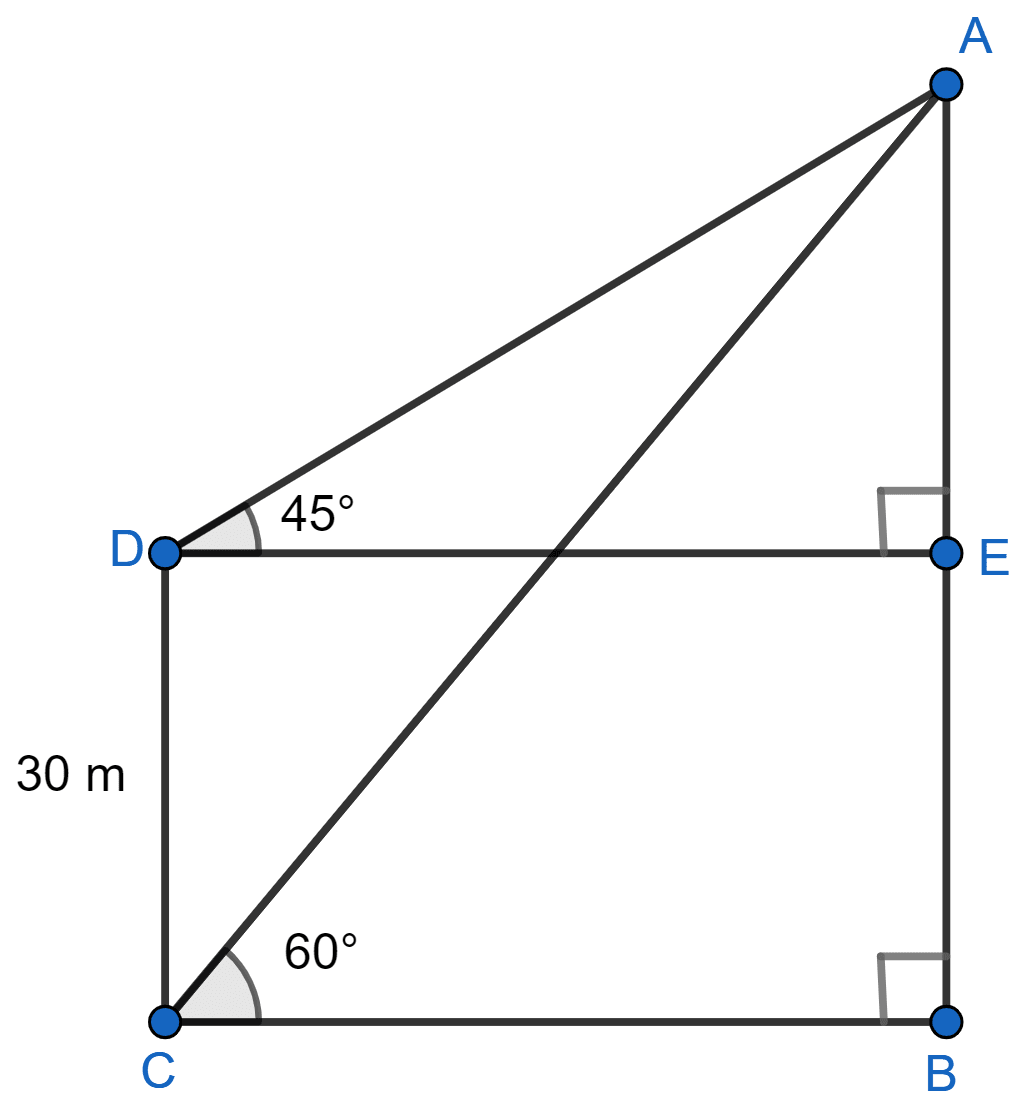
The angle of elevation of the top of a tower is observed to be 60°. At a point, 30 m vertically above the first point of observation, the elevation is found to be 45°. Find:

(i) the height of the tower,

(ii) its horizontal distance from the points of observation.

Show SolutionHide Solution↓

(i) Let AB be the the tower, C be the first point of observation and D be the second point.

The angle of elevation of the top of a tower is observed to be 60°. At a point, 30 m vertically above the first point of observation, the elevation is found to be 45°. Find: (i) the height of the tower, (ii) its horizontal distance from the points of observation. Heights and Distances, Concise Mathematics Solutions ICSE Class 10.

From figure,

BC = ED = a (let) and BE = CD = 30 m.

In △ABC,

$$\begin{aligned}\text{tan 60°} = \frac{\text{Perpendicular}}{\text{Base}} \\[1em] \Rightarrow \sqrt{3} = \frac{AB}{BC}\\[1em] \Rightarrow AB = \sqrt{3}BC \\[1em] \Rightarrow AB = \sqrt{3}a ..........(1)\end{aligned}$$

In △AED,

$$\begin{aligned}\text{tan 45°} = \frac{\text{Perpendicular}}{\text{Base}} \\[1em] \Rightarrow 1 = \frac{AE}{ED}\\[1em] \Rightarrow AE = ED \\[1em] \Rightarrow AE = a ..........(2)\end{aligned}$$

We know that,

⇒ CD = AB - AE

⇒ 30 = $\sqrt{3}a - a$

⇒ 30 = $a(\sqrt{3} - 1)$

⇒ a = $\frac{30}{\sqrt{3} - 1} = \frac{30}{1.732 - 1} = \frac{30}{0.732}$ = 40.98 metres.

From equation (1),

AB = $\sqrt{3}a = 1.732 \times$ 40.98 = 70.98 meters.

Hence, height of tower = 70.98 meters.

(ii) From part (i),

ED = a = 40.98 meters.

Hence, horizontal distance from the points of observation is 40.98 meters.

8Exercise 22(B)

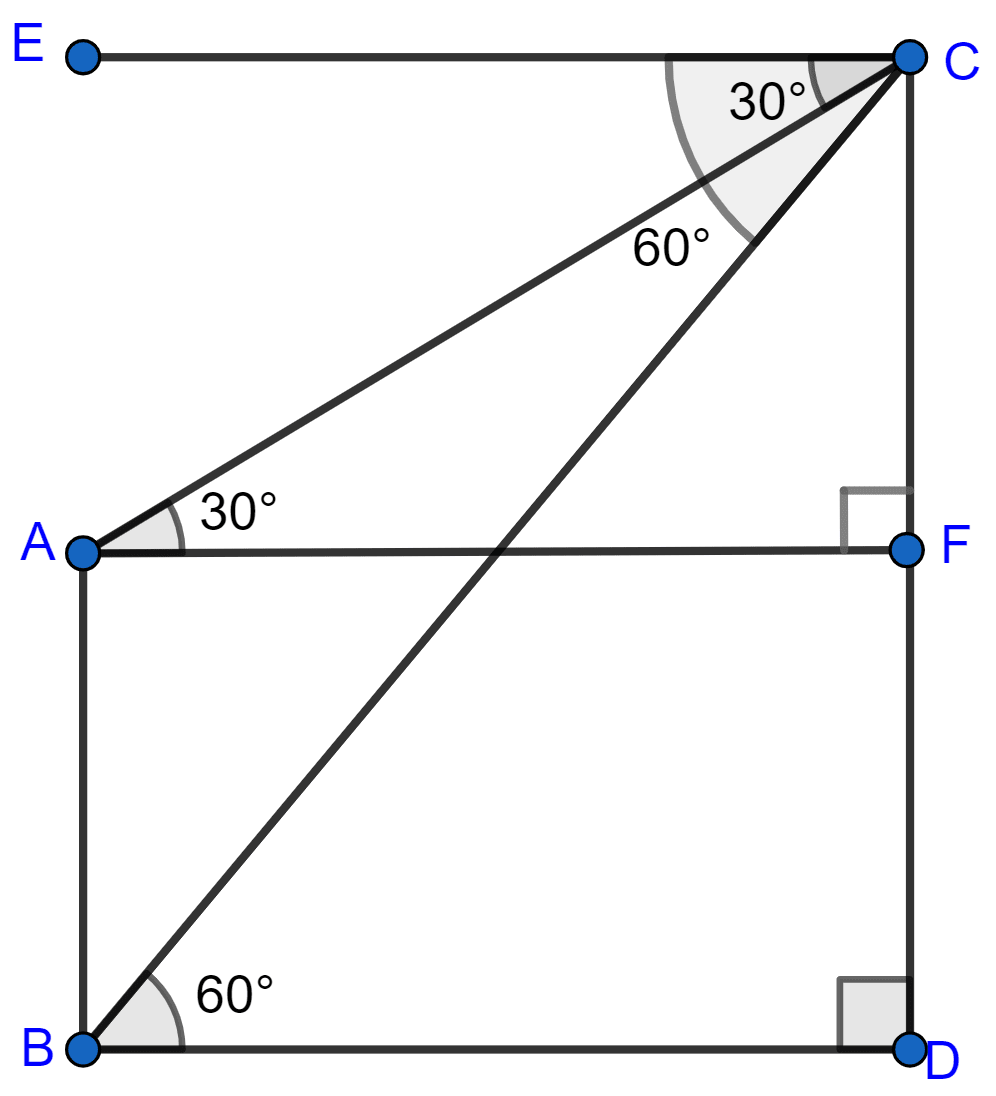
From the top of a cliff, 60 meters high, the angles of depression of the top and bottom of a tower are observed to be 30° and 60°. Find the height of the tower.

Show SolutionHide Solution↓

Let CD be the cliff so CD = 60 meters and AB be the tower.

From the top of a cliff, 60 meters high, the angles of depression of the top and bottom of a tower are observed to be 30° and 60°. Find the height of the tower. Heights and Distances, Concise Mathematics Solutions ICSE Class 10.

Since, alternate angles are equal,

∴ ∠ECA = ∠CAF = 30° and ∠ECB = ∠CBD = 60°.

Let AF = BD = a meters.

In △BCD,

$$\begin{aligned}\text{tan 60°} = \frac{\text{Perpendicular}}{\text{Base}} \\[1em] \Rightarrow \sqrt{3} = \frac{CD}{BD}\\[1em] \Rightarrow CD = \sqrt{3}BD \\[1em] \Rightarrow CD = \sqrt{3}a \\[1em] \Rightarrow 60 = \sqrt{3}a \\[1em] \Rightarrow a = \frac{60}{\sqrt{3}} \\[1em] \Rightarrow a = \frac{60}{\sqrt{3}} \times \frac{\sqrt{3}}{\sqrt{3}} \\[1em] \Rightarrow a = \frac{60\sqrt{3}}{3} \\[1em] \Rightarrow a = 20\sqrt{3} \text{ meters}.\end{aligned}$$

In △AFC,

$$\begin{aligned}\text{tan 30°} = \frac{\text{Perpendicular}}{\text{Base}} \\[1em] \Rightarrow \frac{1}{\sqrt{3}} = \frac{CF}{AF}\\[1em] \Rightarrow CF = \frac{AF}{\sqrt{3}} \\[1em] \Rightarrow CF = \frac{a}{\sqrt{3}} \\[1em] \Rightarrow CF = \frac{20\sqrt{3}}{\sqrt{3}} \\[1em] \Rightarrow CF = 20 \text{ meters}.\end{aligned}$$

From figure,

⇒ AB = DF = CD - CF

⇒ AB = CD - CF

⇒ AB = 60 - 20 = 40 meters.

Hence, the height of tower = 40 meters.

9Exercise 22(B)

A man on a cliff observes a boat, at an angle of depression 30°, which is sailing towards the shore to the point immediately beneath him. Three minutes later, the angle of depression of the boat is found to be 60°. Assuming that the boat sails at a uniform speed, determine :

(i) how much more time it will take to reach the shore ?

(ii) the speed of the boat in metre per second, if the height of the cliff is 500 m.

Show SolutionHide Solution↓

Let CD be the cliff and A be the position of the ship when angle of elevation is 30° and B be the position when angle of elevation is 60°.

A man on a cliff observes a boat, at an angle of depression 30°, which is sailing towards the shore to the point immediately beneath him. Three minutes later, the angle of depression of the boat is found to be 60°. Assuming that the boat sails at a uniform speed, determine : (i) how much more time it will take to reach the shore ? (ii) the speed of the boat in metre per second, if the height of the cliff is 500 m. Heights and Distances, Concise Mathematics Solutions ICSE Class 10.

(i) From figure,

$$\begin{aligned}\text{tan 60°} = \frac{\text{Perpendicular}}{\text{Base}} \\[1em] \Rightarrow \sqrt{3} = \frac{CD}{BD} \space .............(1) \\[1em] \text{tan 30°} = \frac{\text{Perpendicular}}{\text{Base}} \\[1em] \Rightarrow \frac{1}{\sqrt{3}} = \frac{CD}{AD} \space .............(2)\end{aligned}$$

Dividing equation (1) by (2), we get :

$$\begin{aligned}\Rightarrow \frac{\sqrt{3}}{\frac{1}{\sqrt{3}}} = \frac{\frac{CD}{BD}}{\frac{CD}{AD}} \\[1em] \Rightarrow \sqrt{3} \times \sqrt{3} = \frac{AD}{BD} \\[1em] \Rightarrow \frac{AD}{BD} = 3 \\[1em] \Rightarrow AD = 3BD \\[1em] \Rightarrow AB + BD = 3BD \\[1em] \Rightarrow AB = 2BD.\end{aligned}$$

Boat reaches from point A to B in 3 minutes.

Thus, boat covers distance AB in 3 minutes or it covers distance

⇒ 2 BD in 3 minutes

⇒ BD in $\frac{3}{2}$ = 1.5 minutes.

Hence, it will takes 1.5 minutes more to reach the shore.

(ii) In △ADC,

$$\begin{aligned}\text{tan 30°} = \frac{\text{Perpendicular}}{\text{Base}} \\[1em] \Rightarrow \frac{1}{\sqrt{3}} = \frac{CD}{AD} \\[1em] \Rightarrow AD = \sqrt{3}CD\end{aligned}$$

In △BDC,

$$\begin{aligned}\text{tan 60°} = \frac{\text{Perpendicular}}{\text{Base}} \\[1em] \Rightarrow \sqrt{3} = \frac{CD}{BD} \\[1em] \Rightarrow BD = \frac{CD}{\sqrt{3}}\end{aligned}$$

From figure,

$$\begin{aligned}\Rightarrow AB = AD - BD \\[1em] \Rightarrow AB = \sqrt{3}CD - \frac{CD}{\sqrt{3}} \\[1em] \Rightarrow AB = \frac{3CD - CD}{\sqrt{3}} \\[1em] \Rightarrow AB = \frac{2CD}{\sqrt{3}} .........(1)\end{aligned}$$

Let speed of boat be a meter/second so in 3 minutes boat will travel :

Distance (AB) = Speed × Time

AB = a × 3 × 60

AB = 180a meters .........(2)

From (1) and (2) we get,

$$\begin{aligned}\Rightarrow \frac{2CD}{\sqrt{3}} = 180a \\[1em] \Rightarrow \frac{2 \times 500}{\sqrt{3}} = 180a \\[1em] \Rightarrow \frac{1000}{1.732} = 180a \\[1em] \Rightarrow a = \frac{1000}{180 \times 1.732} \\[1em] \Rightarrow a = \frac{1000}{311.76} = 3.21 \text{ m/s}.\end{aligned}$$

Hence, speed of boat = 3.21 m/s.

10Exercise 22(B)

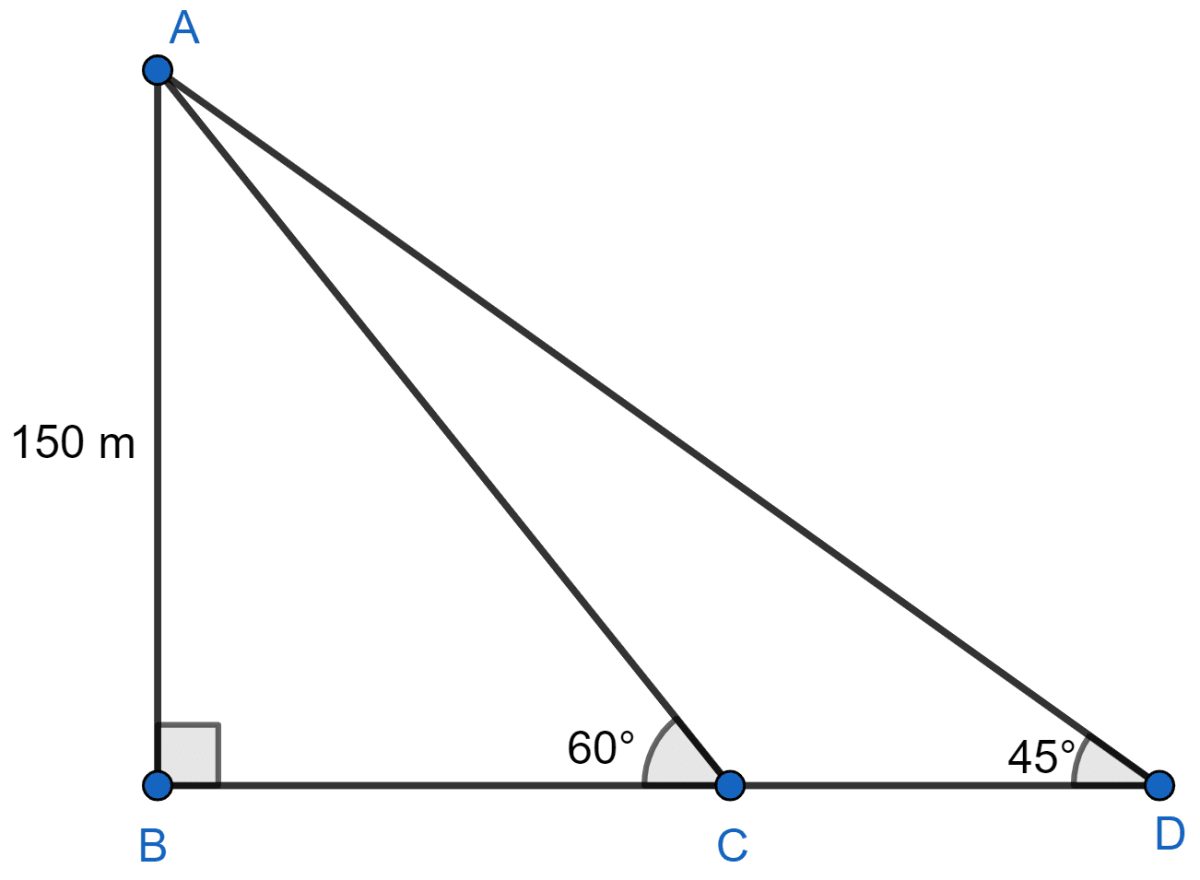
A man in a boat rowing away from a lighthouse 150 m high, takes 2 minutes to change the angle of elevation of the top of the lighthouse from 60° to 45°. Find the speed of the boat.

Show SolutionHide Solution↓

Let man in the boat be originally at point C and after 2 minutes it reaches the point D and AB be the lighthouse.

A man in a boat rowing away from a lighthouse 150 m high, takes 2 minutes to change the angle of elevation of the top of the lighthouse from 60° to 45°. Find the speed of the boat. Heights and Distances, Concise Mathematics Solutions ICSE Class 10.

AB = 150 meters.

In △ABC,

$$\begin{aligned}\text{tan 60°} = \frac{\text{Perpendicular}}{\text{Base}} \\[1em] \Rightarrow \sqrt{3} = \frac{AB}{BC} \\[1em] \Rightarrow AB = \sqrt{3} BC \\[1em] \Rightarrow BC = \frac{AB}{\sqrt{3}} \\[1em] \Rightarrow BC = \frac{150}{\sqrt{3}} \\[1em] \Rightarrow BC = \frac{150}{\sqrt{3}} \times \frac{\sqrt{3}}{\sqrt{3}} \\[1em] \Rightarrow BC = \frac{150\sqrt{3}}{3} \\[1em] \Rightarrow BC = 50\sqrt{3} \text{ meters}.\end{aligned}$$

In △ABD,

$$\begin{aligned}\text{tan 45°} = \frac{\text{Perpendicular}}{\text{Base}} \\[1em] \Rightarrow 1 = \frac{AB}{BD} \\[1em] \Rightarrow AB = BD \\[1em] \Rightarrow BD = 150 \text{ metres}.\end{aligned}$$

CD = BD - BC = 150 - $50\sqrt{3}$

= 150 - 86.6

= 63.4 meters.

In 2 minutes boat covers 63.4 meters or boat covers 63.4 meters in 120 seconds.

Speed = $\frac{\text{Distance}}{\text{Time}} = \frac{63.4}{120}$ = 0.53 m/sec.

Hence, the speed of boat = 0.53 m/sec.

11Exercise 22(B)

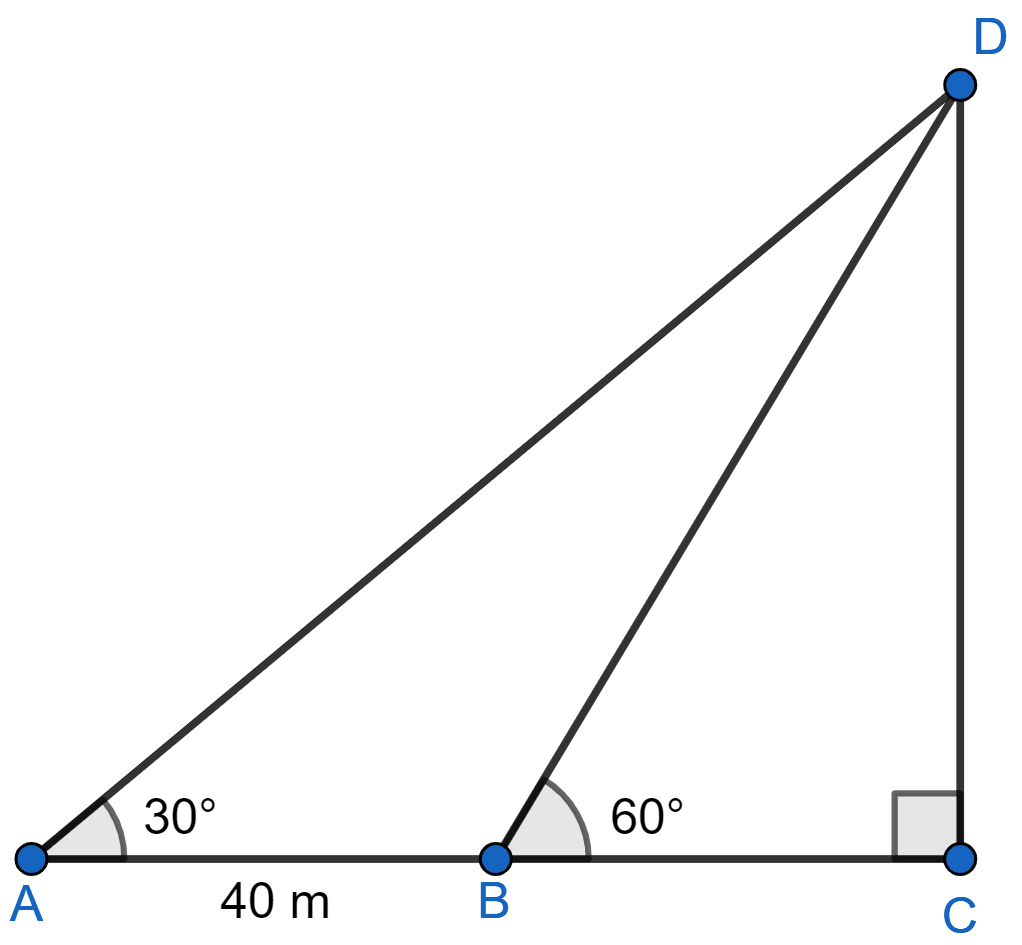
A person standing on the bank of a river observes that the angle of elevation of the top of a tree standing on the opposite bank is 60°. When he moves 40 m away from the bank, he finds the angle of elevation to be 30°. Find :

(i) the height of the tree, correct to 2 decimal places.

(ii) the width of the river.

Show SolutionHide Solution↓

Let CD be the tree and B be the position of the person when angle of elevation is 60° and A be the position when angle of elevation is 30°.

A person standing on the bank of a river observes that the angle of elevation of the top of a tree standing on the opposite bank is 60°. When he moves 40 m away from the bank, he finds the angle of elevation to be 30°. Find : (i) the height of the tree, correct to 2 decimal places. (ii) the width of the river. Heights and Distances, Concise Mathematics Solutions ICSE Class 10.

(i) In △BCD,

$$\begin{aligned}\text{tan 60°} = \frac{\text{Perpendicular}}{\text{Base}} \\[1em] \Rightarrow \sqrt{3} = \frac{CD}{BC} \\[1em] \Rightarrow BC = \frac{CD}{\sqrt{3}}.\end{aligned}$$

In △ACD,

$$\begin{aligned}\text{tan 30°} = \frac{\text{Perpendicular}}{\text{Base}} \\[1em] \Rightarrow \frac{1}{\sqrt{3}} = \frac{CD}{AC} \\[1em] \Rightarrow AC = CD\sqrt{3}.\end{aligned}$$

From figure,

AB = AC - BC

$$\begin{aligned}\Rightarrow 40 = CD\sqrt{3} - \frac{CD}{\sqrt{3}} \\[1em] \Rightarrow \frac{3CD - CD}{\sqrt{3}} = 40 \\[1em] \Rightarrow \frac{2CD}{\sqrt{3}} = 40 \\[1em] \Rightarrow CD = \frac{40\sqrt{3}}{2} = 20\sqrt{3} \\[1em] \Rightarrow CD = 20 \times 1.732 = 34.64 \text{ m}.\end{aligned}$$

Hence, height of tree = 34.64 meters.

(ii) From part (i), we get :

BC = $\frac{CD}{\sqrt{3}} = \frac{20\sqrt{3}}{\sqrt{3}}$

= 20 meters.

Hence, width of river = 20 meters.

12Exercise 22(B)

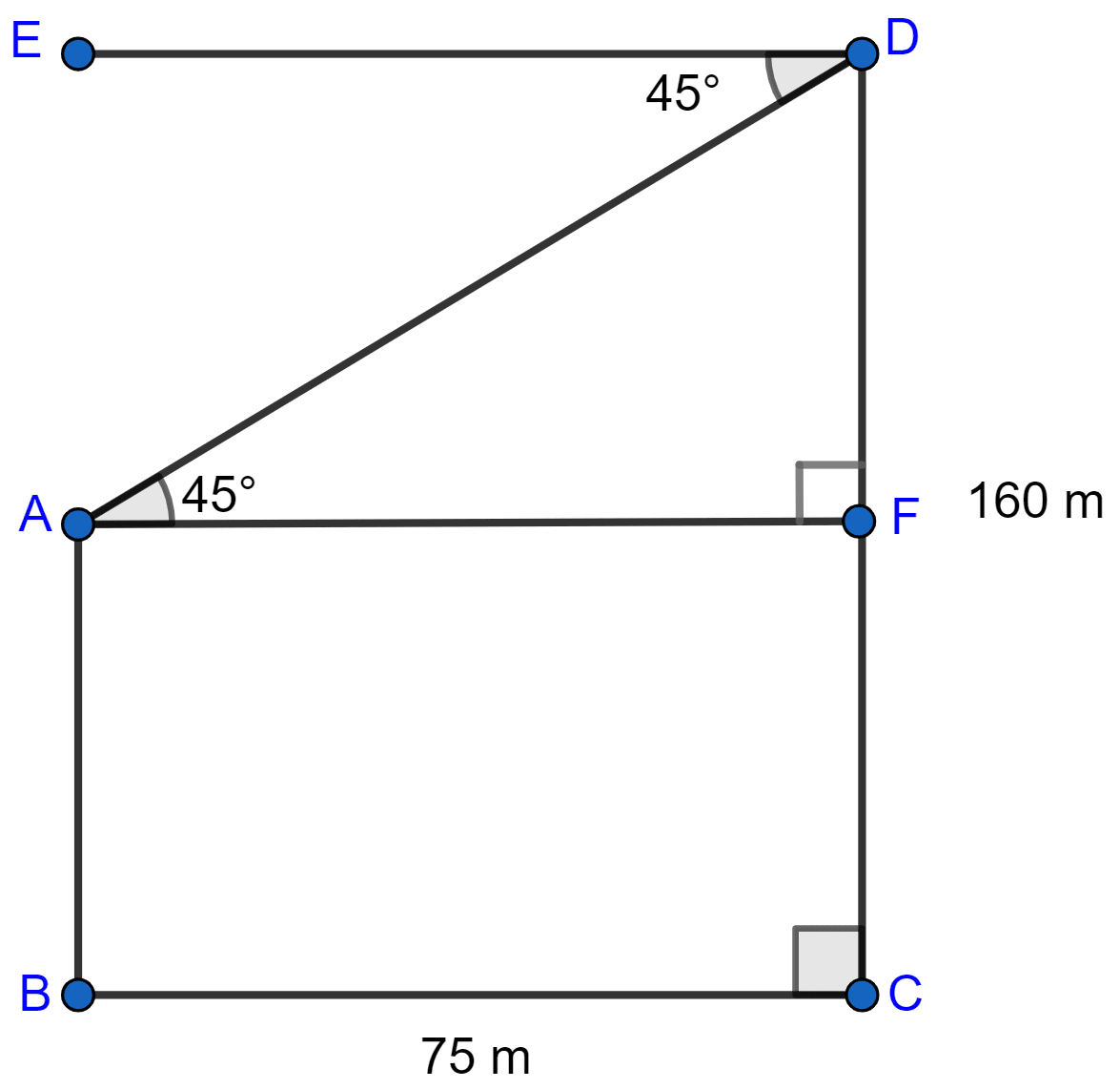
The horizontal distance between two towers is 75 m and the angular depression of the top of the first tower as seen from the top of the second, which is 160 m high, is 45°. Find the height of the first tower.

Show SolutionHide Solution↓

Let AB be the first tower and CD be the second tower and ∠EDA = 45° is the angle of depression.

Given, angle of depression of the top of the first tower as seen from the top of the second tower is 45°.

The horizontal distance between two towers is 75 m and the angular depression of the top of the first tower as seen from the top of the second, which is 160 m high, is 45°. Find the height of the first tower. Heights and Distances, Concise Mathematics Solutions ICSE Class 10.

We know that,

Alternate angles are equal.

∴ ∠DAF = ∠EDA = 45°.

From figure,

AF = BC = 75 m.

In △ADF,

$$\begin{aligned}\text{tan 45°}= \frac{\text{Perpendicular}}{\text{Base}} \\[1em] \Rightarrow 1 = \frac{DF}{AF} \\[1em] \Rightarrow DF = AF = 75 \text{ m}.\end{aligned}$$

From figure,

AB = FC = CD - DF = 160 - 75 = 85 m.

Hence, height of first tower = 85 m.

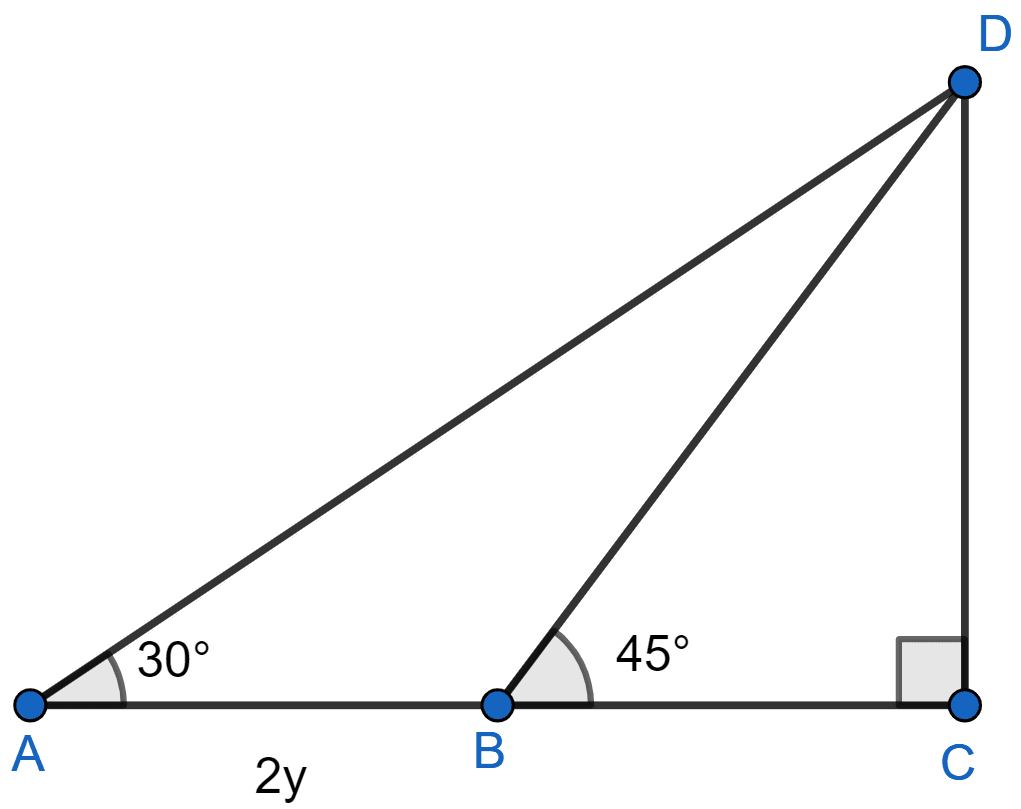
13Exercise 22(B)

The length of the shadow of a tower standing on level plane is found to be 2y meters longer when the sun's altitude is 30° than when it was 45°. Prove that the height of the tower is $y(\sqrt{3} + 1)$ meters.

Show SolutionHide Solution↓

Let CD be the tower of height h meters and BC be shadow when angle of elevation is 45° and AC be the shadow when angle of elevation is 30°.

The length of the shadow of a tower standing on level plane is found to be 2y meters longer when the sun's altitude is 30° than when it was 45°. Prove that the height of the tower is meters. Heights and Distances, Concise Mathematics Solutions ICSE Class 10.

In △ACD,

$$\begin{aligned}\text{tan 30°} = \frac{\text{Perpendicular}}{\text{Base}} \\[1em] \Rightarrow \frac{1}{\sqrt{3}} = \frac{CD}{AC} \\[1em] \Rightarrow \frac{1}{\sqrt{3}} = \frac{h}{AC} \\[1em] \Rightarrow h = \frac{AC}{\sqrt{3}} \text{ m} .........(1)\end{aligned}$$

In △BCD,

$$\begin{aligned}\text{tan 45°} = \frac{\text{Perpendicular}}{\text{Base}} \\[1em] \Rightarrow 1 = \frac{CD}{BC} \\[1em] \Rightarrow BC = CD = h\end{aligned}$$

AC = AB + BC = (2y + h) meters.

Substituting value of AC in equation 1, we get :

$$\begin{aligned}\Rightarrow h = \frac{2y + h}{\sqrt{3}} \\[1em] \Rightarrow \sqrt{3}h = 2y + h \\[1em] \Rightarrow \sqrt{3}h - h = 2y \\[1em] \Rightarrow h(\sqrt{3} - 1) = 2y \\[1em] \Rightarrow h = \frac{2y}{\sqrt{3} - 1}.\end{aligned}$$

Multiplying numerator and denominator by $(\sqrt{3} + 1)$.

$$\begin{aligned}\Rightarrow h = \frac{2y}{\sqrt{3} - 1} \times \frac{\sqrt{3} + 1}{\sqrt{3} + 1} \\[1em] \Rightarrow h = \frac{2y(\sqrt{3} + 1)}{(\sqrt{3} - 1)(\sqrt{3} + 1)} \\[1em] \Rightarrow h = \frac{2y(\sqrt{3} + 1)}{(\sqrt{3})^2 - 1^2} \\[1em] \Rightarrow h = \frac{2y(\sqrt{3} + 1)}{3 - 1} \\[1em] \Rightarrow h = \frac{2y(\sqrt{3} + 1)}{2} \\[1em] \Rightarrow h = y(\sqrt{3} + 1).\end{aligned}$$

Hence, proved that the height of tower = $y(\sqrt{3} + 1)$ meters.

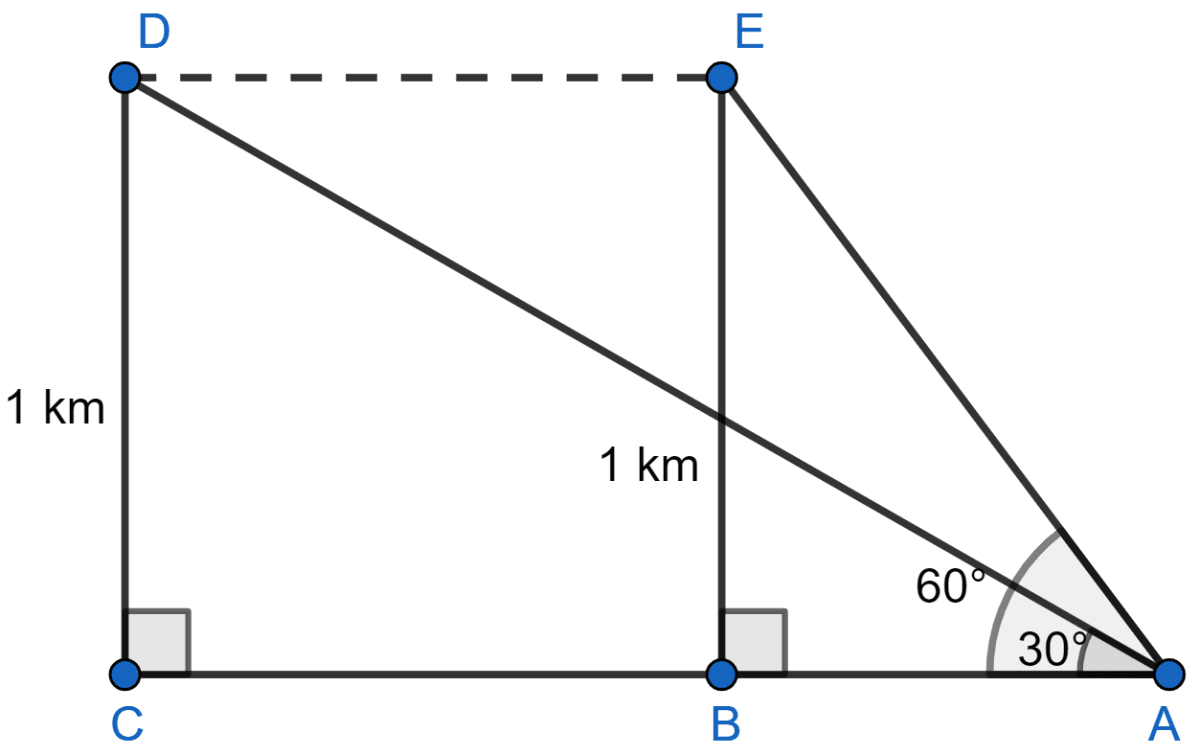
14Exercise 22(B)

An aeroplane flying horizontally 1 km above the ground and going away from the observer is observed at an elevation of 60°. After 10 seconds, its elevation is observed to be 30°; find the uniform speed of the aeroplane in km per hour.

Show SolutionHide Solution↓

Let aeroplane be originally at point E and after 10 seconds it reaches point D.

An aeroplane flying horizontally 1 km above the ground and going away from the observer is observed at an elevation of 60°. After 10 seconds, its elevation is observed to be 30°; find the uniform speed of the aeroplane in km per hour. Heights and Distances, Concise Mathematics Solutions ICSE Class 10.

In △ABE,

$$\begin{aligned}\text{tan 60°} = \frac{\text{Perpendicular}}{\text{Base}} \\[1em] \Rightarrow \sqrt{3} = \frac{BE}{AB} \\[1em] \Rightarrow \sqrt{3} = \frac{1}{AB}\\[1em] \Rightarrow AB = \frac{1}{\sqrt{3}} \text{ km}.\end{aligned}$$

In △ACD,

$$\begin{aligned}\text{tan 30°} = \frac{\text{Perpendicular}}{\text{Base}} \\[1em] \Rightarrow \frac{1}{\sqrt{3}} = \frac{CD}{AC} \\[1em] \Rightarrow AC = \sqrt{3}CD \\[1em] \Rightarrow AC = \sqrt{3} \times 1 = \sqrt{3} \text{ km}.\end{aligned}$$

From figure,

DE = BC.

BC = AC - AB = $\sqrt{3} - \frac{1}{\sqrt{3}}$

= $\frac{3 - 1}{\sqrt{3}}$

= $\frac{2}{1.732}$

= 1.1547 km.

∴ DE = 1.1547 km.

∴ Aeroplane travels 1.1547 km in 10 seconds.

Time = 10 seconds = $\frac{10}{3600} = \frac{1}{360}$ hours.

Speed = $\frac{\text{Distance}}{\text{Time}} = \frac{1.1547}{\frac{1}{360}}$

= 1.1547 × 360

= 415.69 km/hr.

Hence, speed of aeroplane = 415.69 km/hr.

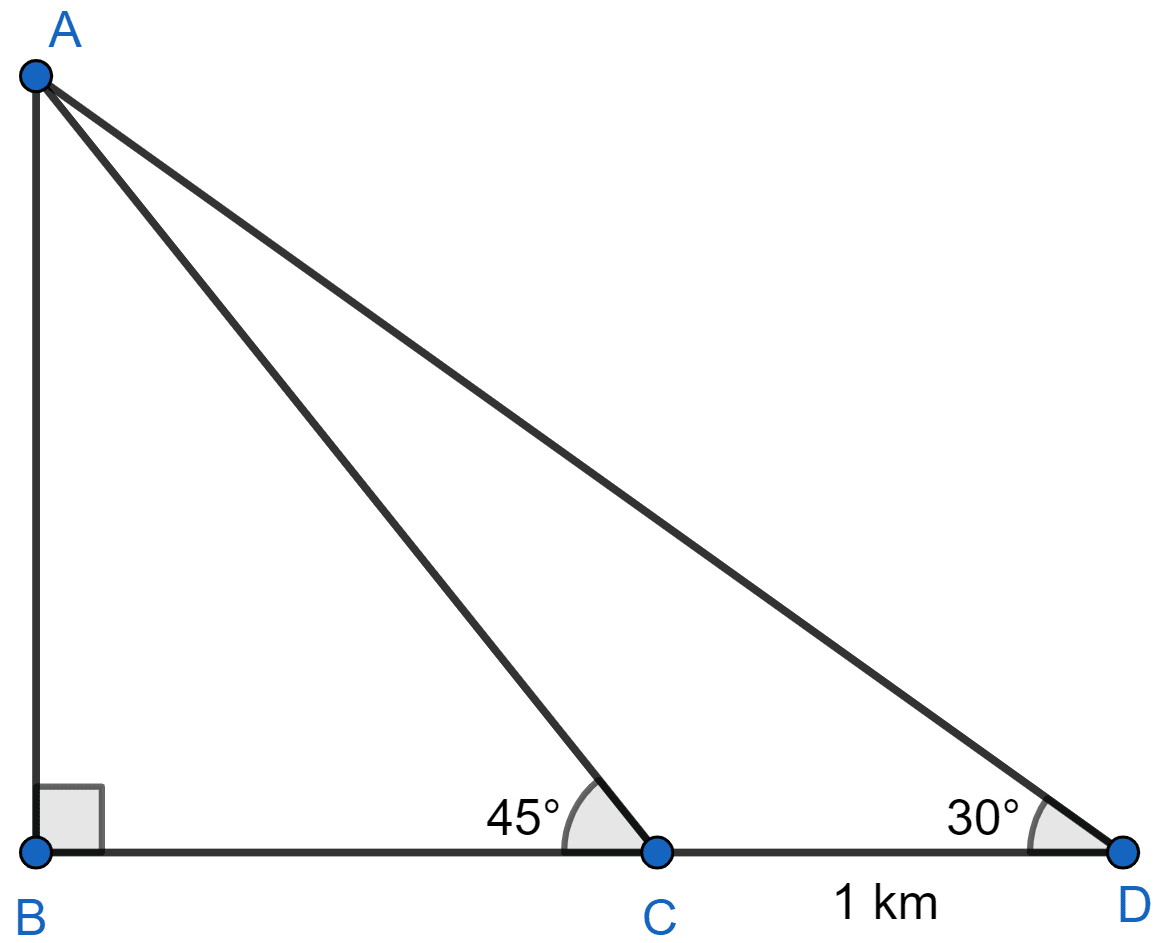
15Exercise 22(B)

From the top of a hill, the angles of depression of two consecutive kilometer stones, due east are found to be 30° and 45° respectively. Find the distances of the two stones from the foot of hill.

Show SolutionHide Solution↓

Let C and D be the position of two kilometer stones and AB be the hill.

From the top of a hill, the angles of depression of two consecutive kilometer stones, due east are found to be 30° and 45° respectively. Find the distances of the two stones from the foot of hill. Heights and Distances, Concise Mathematics Solutions ICSE Class 10.

In △ABD,

$$\begin{aligned}\text{tan 30°} = \frac{\text{Perpendicular}}{\text{Base}} \\[1em] \Rightarrow \frac{1}{\sqrt{3}} = \frac{AB}{BD} \\[1em] \Rightarrow BD = \sqrt{3} AB .........(1)\end{aligned}$$

In △ABC,

$$\begin{aligned}\text{tan 45°} = \frac{\text{Perpendicular}}{\text{Base}} \\[1em] \Rightarrow 1 = \frac{AB}{BC} \\[1em] \Rightarrow BC = AB ............(2)\end{aligned}$$

From figure,

⇒ CD = BD - BC

⇒ 1 = $\sqrt{3}AB - AB$

⇒ 1 = $AB(\sqrt{3} - 1)$

⇒ AB = $\frac{1}{\sqrt{3} - 1} = \frac{1}{0.732}$ = 1.366 km.

From equation (2),

BC = AB = 1.366 km

BD = BC + CD = 1.366 + 1 = 2.366 km.

Hence, kilometer stones are at a distance of 1.366 and 2.366 km.

1(a)Test Yourself

If CD = 10 m, the length of AB is :

If CD = 10 m, the length of AB is : Heights and Distances, Concise Mathematics Solutions ICSE Class 10.
Show SolutionHide Solution↓

We know that,

tan θ = $\frac{\text{Perpendicular}}{\text{Base}}$

From figure,

In △ BCD,

⇒ tan 30° = $\frac{BD}{CD}$

⇒ $\frac{1}{\sqrt{3}} = \frac{BD}{10}$

⇒ BD = $\frac{10}{\sqrt{3}}$ m.

In △ ACD,

⇒ tan 60° = $\frac{AD}{CD}$

⇒ $\sqrt{3} = \frac{AD}{10}$

⇒ AD = $10\sqrt{3}$ cm.

From figure,

AB = AD + BD = $10\sqrt{3} + \frac{10}{\sqrt{3}}$

$= \frac{10\sqrt{3} \times \sqrt{3} + 10}{\sqrt{3}} = \frac{30 + 10}{\sqrt{3}} = \frac{40}{\sqrt{3}}$ m.

Hence, Option 1 is the correct option.

1(b)Test Yourself

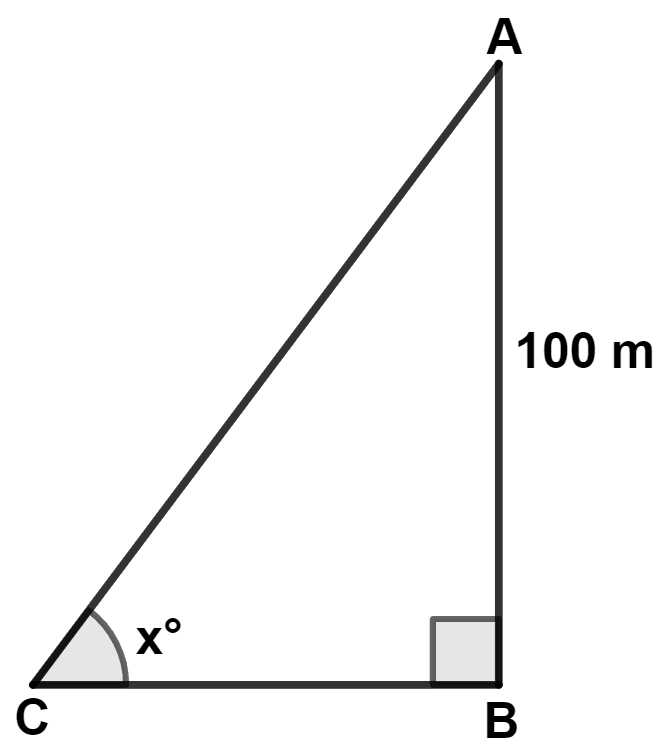
If tan x° = $\frac{5}{2}$, the length of CB is :

If tan x° = 5/2, the length of CB is : Heights and Distances, Concise Mathematics Solutions ICSE Class 10.
Show SolutionHide Solution↓

We know that,

tan θ = $\frac{\text{Perpendicular}}{\text{Base}}$

From figure,

In △ ABC,

⇒ tan x° = $\frac{AB}{CB}$

⇒ $\frac{5}{2} = \frac{100}{CB}$

⇒ CB = $\frac{2 \times 100}{5} = \frac{200}{5}$ = 40 m.

Hence, Option 2 is the correct option.

1(c)Test Yourself

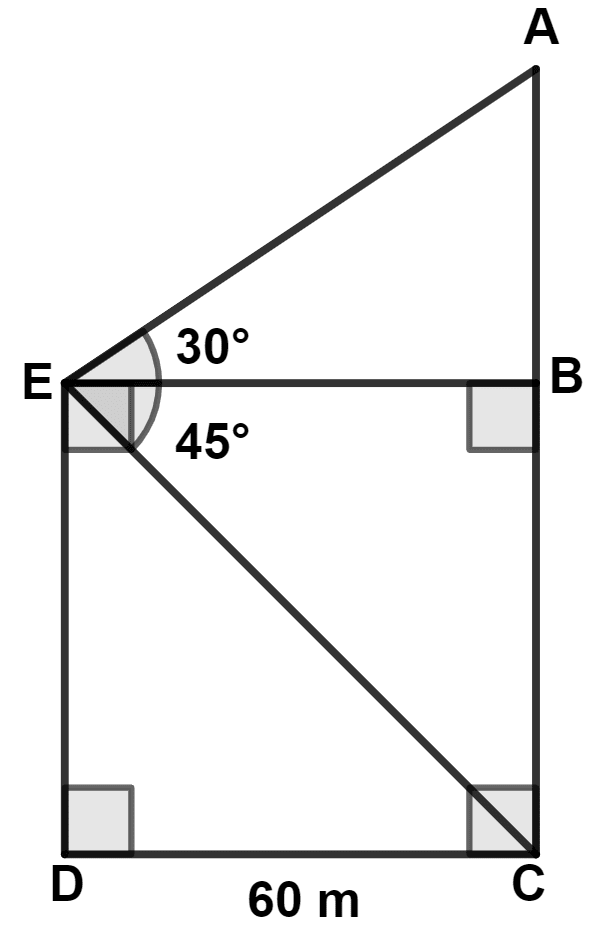
The length of AC is :

The length of AC is : Heights and Distances, Concise Mathematics Solutions ICSE Class 10.
Show SolutionHide Solution↓

In rectangle BCDE,

Opposite sides of rectangle are equal.

∴ BE = DC = 60 m

We know that,

tan θ = $\frac{\text{Perpendicular}}{\text{Base}}$

From figure,

In △ ABE,

⇒ tan 30° = $\frac{AB}{BE}$

⇒ $\frac{1}{\sqrt{3}} = \frac{AB}{60}$

⇒ AB = $\frac{60}{\sqrt{3}} = 20\sqrt{3}$ m.

In △ EBC,

⇒ tan 45° = $\frac{BC}{BE}$

⇒ $1 = \frac{BC}{60}$

⇒ BC = 60 m.

From figure,

AC = AB + BC = $(20\sqrt{3} + 60)$ m.

Hence, Option 3 is the correct option.

1(d)Test Yourself

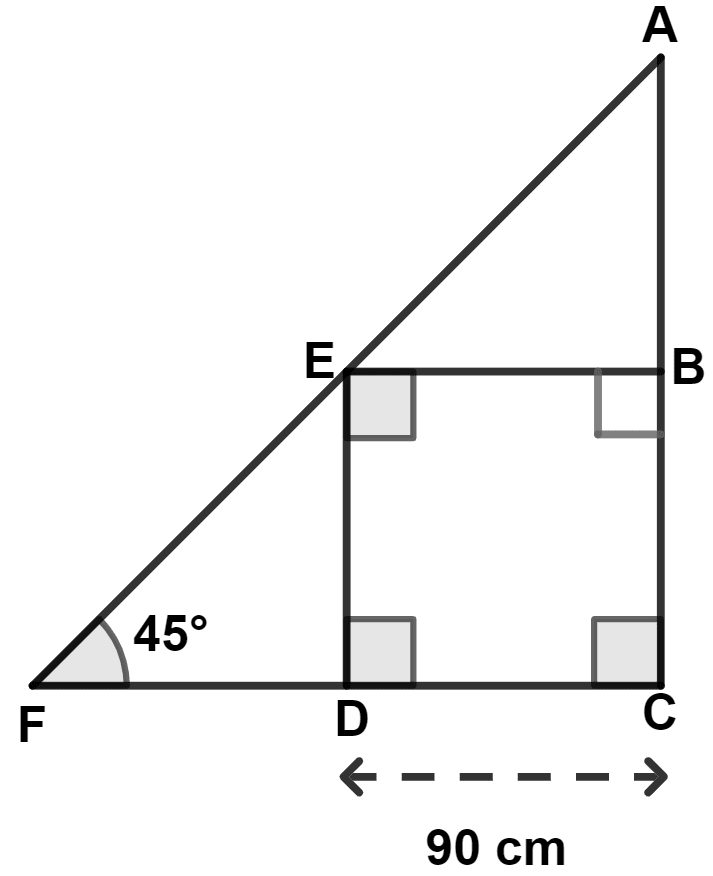
BCDE is a square with side 90 cm and ∠F = 45°. The length of AF is :

BCDE is a square with side 90 cm and ∠F = 45°. The length of AF is : Heights and Distances, Concise Mathematics Solutions ICSE Class 10.
Show SolutionHide Solution↓

Since, BCDE is a square.

∴ BE = CD = 90 cm.

We know that,

tan θ = $\frac{\text{Perpendicular}}{\text{Base}}$

From figure,

∠AEB = ∠EFD = 45° (Corresponding angles are equal)

In △ ABE,

⇒ tan 45° = $\frac{AB}{BE}$

⇒ $1 = \frac{AB}{90}$

⇒ AB = 90 cm.

From figure,

AC = AB + BC = 90 + 90 = 180 cm.

We know that,

sin θ = $\frac{\text{Perpendicular}}{\text{Hypotenuse}}$

In △ ACF,

⇒ sin 45° = $\frac{AC}{AF}$

⇒ $\frac{1}{\sqrt{2}} = \frac{180}{AF}$

⇒ AF = $180\sqrt{2}$ cm.

Hence, Option 4 is the correct option.

1(e)Test Yourself

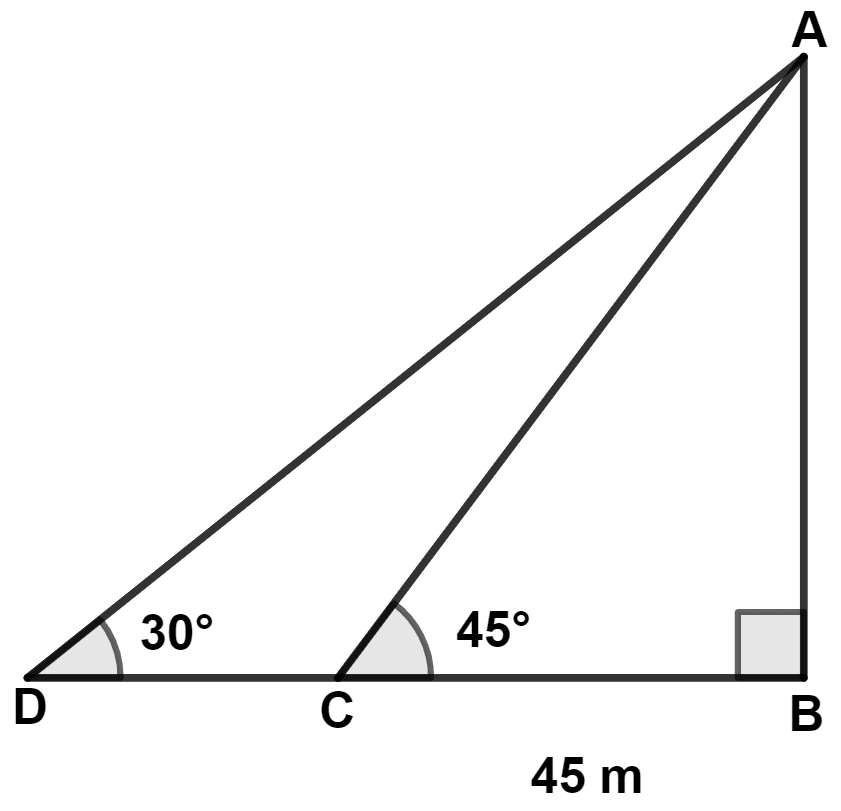
The length of DC is :

The length of DC is : Heights and Distances, Concise Mathematics Solutions ICSE Class 10.
Show SolutionHide Solution↓

We know that,

tan θ = $\frac{\text{Perpendicular}}{\text{Base}}$

From figure,

In △ ABC,

⇒ tan 45° = $\frac{AB}{BC}$

⇒ $1 = \frac{AB}{45}$

⇒ AB = 45 m.

In △ ABD,

⇒ tan 30° = $\frac{AB}{BD}$

⇒ $\frac{1}{\sqrt{3}} = \frac{45}{BD}$

⇒ BD = $45\sqrt{3}$ m.

From figure,

DC = BD - BC = $45\sqrt{3} - 45 = 45(\sqrt{3} - 1)$ m.

Hence, Option 3 is the correct option.

1(f)Test Yourself

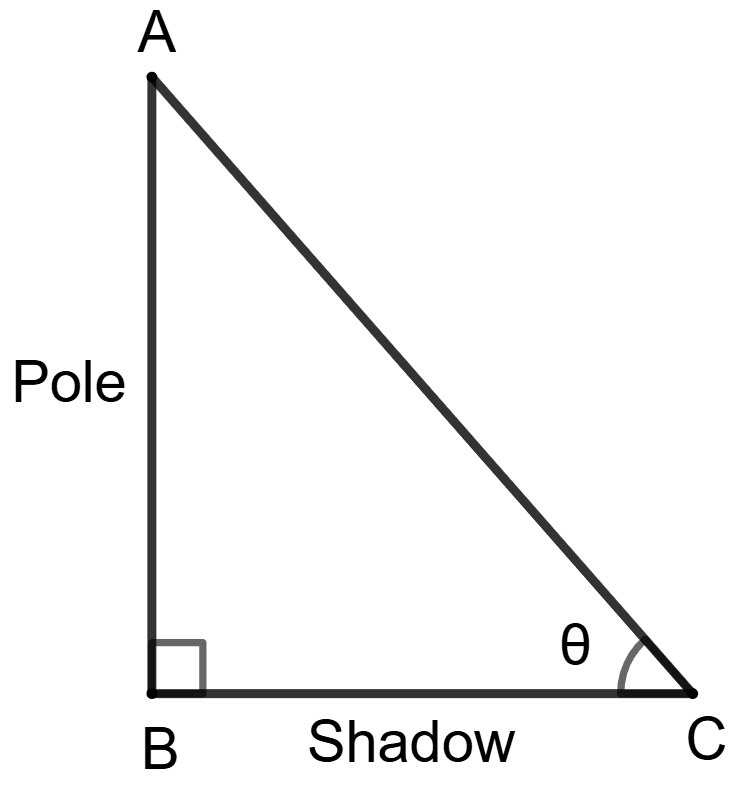
The ratio of the length of a vertical pole and length of its shadow on the horizontal surface is 3 : $\sqrt{3}$

Assertion(A): The angle of elevation of the sun is 60°.

Reason(R): If angle of elevation of the sun is θ, tan θ = $\frac{3}{\sqrt{3}} = \sqrt{3}$ = tan 60°.

Show SolutionHide Solution↓

Given, the ratio of the height of a vertical pole to the length of its shadow is 3 : $\sqrt{3}$.

The ratio of the length of a vertical pole and length of its shadow on the horizontal surface is 3 : square root of 3. Concise Mathematics Solutions ICSE Class 10.

Let AB be the pole and BC be the shadow and angle of elevation of Sun be θ.

$$\begin{aligned}\Rightarrow \frac{\text{Height of a vertical pole}}{\text{Height of shadow}} = \frac{3}{\sqrt{3}}\\[1em] \Rightarrow \frac{\text{AB}}{\text{BC}} = \sqrt{3}\\[1em] \Rightarrow \text{tan θ} = \sqrt{3}\\[1em] \Rightarrow \text{tan θ} = \text{tan 60°} \\[1em] \Rightarrow θ = 60°\end{aligned}$$

∴ Both A and R are true and R is correct reason for A.

Hence, option 3 is the correct option.

1(g)Test Yourself

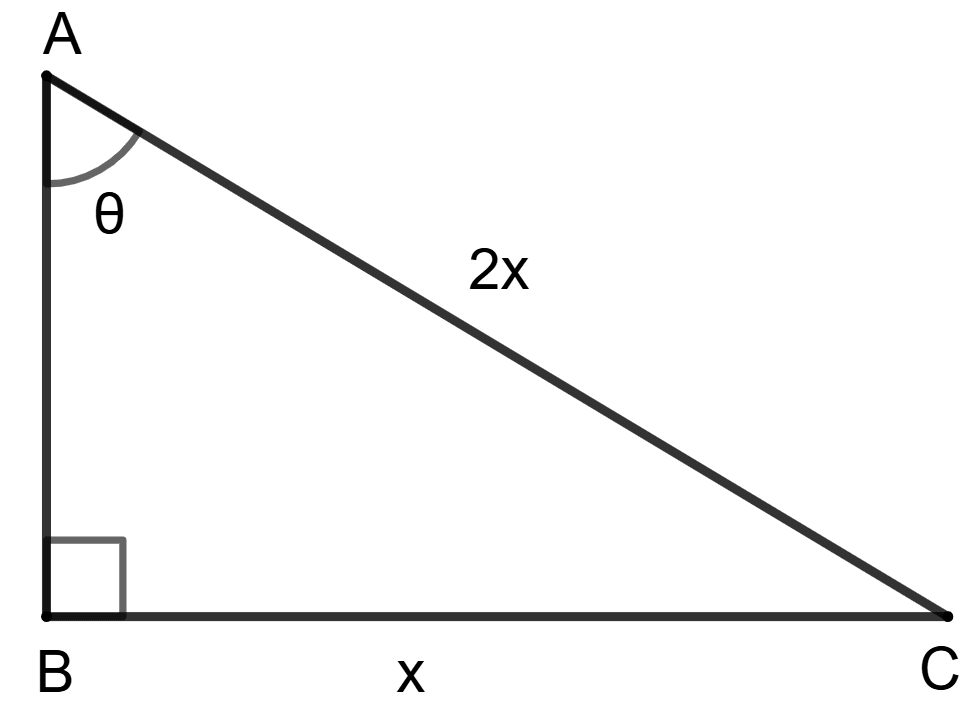
The length of the ladder placed against a vertical wall is twice the distance between the foot of the ladder and the wall.

Assertion(A): The angle that the ladder makes with the wall is 60°.

Reason(R): If ladder makes angle θ with the wall then sin θ = $\frac{\text{base}}{\text{hypotenuse}} = \frac{x}{2x} = \frac{1}{2}$.

Show SolutionHide Solution↓
The length of the ladder placed against a vertical wall is twice the distance between the foot of the ladder and the wall. Concise Mathematics Solutions ICSE Class 10.

Let AB be the wall and AC be the ladder. Let distance between foot of ladder and wall be x.

So, length of ladder (AC) = 2x.

According to the Pythagoras theorem :

⇒ Hypotenuse2 = Base2 + Height2

⇒ AC2 = BC2 + AB2

⇒ (2x)2 = x2 + AB2

⇒ 4x2 = x2 + AB2

⇒ AB2 = 4x2 - x2

⇒ AB2 = 3x2

⇒ AB = $\sqrt{3x^2}$

⇒ AB = $\sqrt{3}x$.

Let angle between ladder and wall be θ.

We know that,

$$\begin{aligned}\Rightarrow \text{sin θ} = \frac{\text{Perpendicular side}}{\text{Hypotenuse}} \\[1em] \Rightarrow \text{sin θ} = \frac{BC}{AC} \\[1em] \Rightarrow \text{sin θ} = \frac{x}{2x} \\[1em] \Rightarrow \text{sin θ} = \frac{1}{2} \\[1em]\end{aligned}$$

⇒ sin θ = sin 30°

⇒ θ = 30°.

Assertion (A) is false.

If ladder makes angle θ with the wall then sin θ = $\frac{\text{base}}{\text{hypotenuse}} = \frac{x}{2x} = \frac{1}{2}$.

Here base refers side opposite to angle θ i.e. BC.

Reason (R) is true.

Hence, option 2 is the correct option.

1(h)Test Yourself

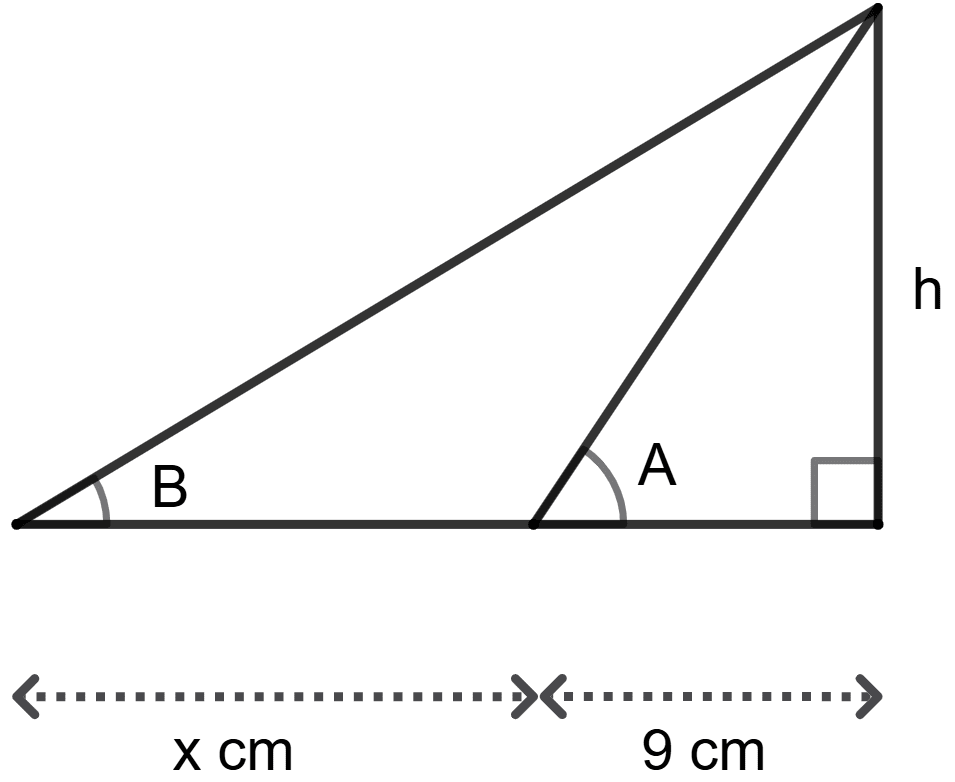
For the following figure, tan A = $1\frac{2}{3}$ and tan B = $\frac{1}{3}$

For the following figure, tan A =1 2/3 and tan B = 1/3. Concise Mathematics Solutions ICSE Class 10.

Statement (1): x = 36 cm

Statement (2): tan A = $\frac{5}{3} = \frac{h}{9}$ ⇒ h = 15

tan B = $\frac{h}{x + 9} \Rightarrow \frac{1}{3} = \frac{15}{x + 9}$

Show SolutionHide Solution↓

Given,

tan A = $1\frac{2}{3} = \frac{5}{3}$ and tan B = $\frac{1}{3}$.

From figure,

$$\begin{aligned}\Rightarrow \text{tan A} = \frac{h}{9} \\[1em] \Rightarrow \frac{5}{3} = \frac{h}{9} \\[1em] \Rightarrow h = \frac{5 \times 9}{3} \\[1em] \Rightarrow h = 5 \times 3 \\[1em] \Rightarrow h = 15\text{ cm} \\[1em] \Rightarrow \text{tan B} = \frac{h}{x + 9}\\[1em] \Rightarrow \frac{1}{3} = \frac{15}{x + 9}\\[1em] \Rightarrow x + 9 = 15 \times 3 \Rightarrow x + 9 = 45 \Rightarrow x = 45 - 9 \Rightarrow x = 36 \text{ cm}.\end{aligned}$$

∴ Both the statements are true.

Hence, option 1 is the correct option.

1(i)Test Yourself

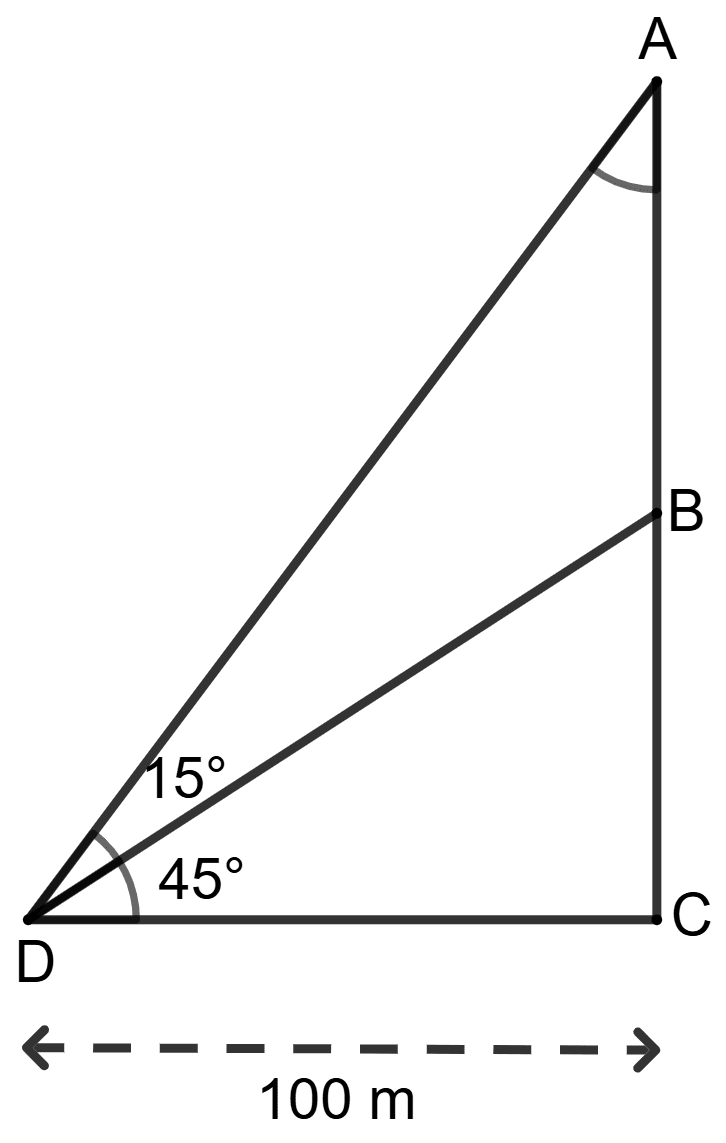
CD = 100 m, ∠ADB = 15° and ∠BDC = 45°

CD = 100 m, ∠ADB = 15° and ∠BDC = 45°. Concise Mathematics Solutions ICSE Class 10.

Statement (1): AB = $\frac{\text{tan 60° - tan 45°}}{100}$

Statement (2): AB = (100 tan 60° - 100 tan 45°) m.

Show SolutionHide Solution↓

From figure,

In triangle BDC,

$$\begin{aligned}\Rightarrow \text{tan 45°} = \frac{BC}{DC}\\[1em] \Rightarrow \text{tan 45°} = \frac{BC}{100}\\[1em] \Rightarrow BC = 100\text{ tan 45°}\\[1em] \text{In triangle ADC,}\\[1em] \Rightarrow \text{tan 60°} = \frac{AC}{DC}\\[1em] \Rightarrow \text{tan 60°} = \frac{AB + BC}{DC}\\[1em] \Rightarrow \text{tan 60°} = \frac{AB + 100\text{ tan 45°}}{100}\\[1em] \Rightarrow 100\text{ tan 60°} = AB + 100\text{ tan 45°}\\[1em] \Rightarrow AB = 100\text{ tan 60°} - 100\text{ tan 45°}\end{aligned}$$

∴ Statement 1 is false, and statement 2 is true.

Hence, option 4 is the correct option.

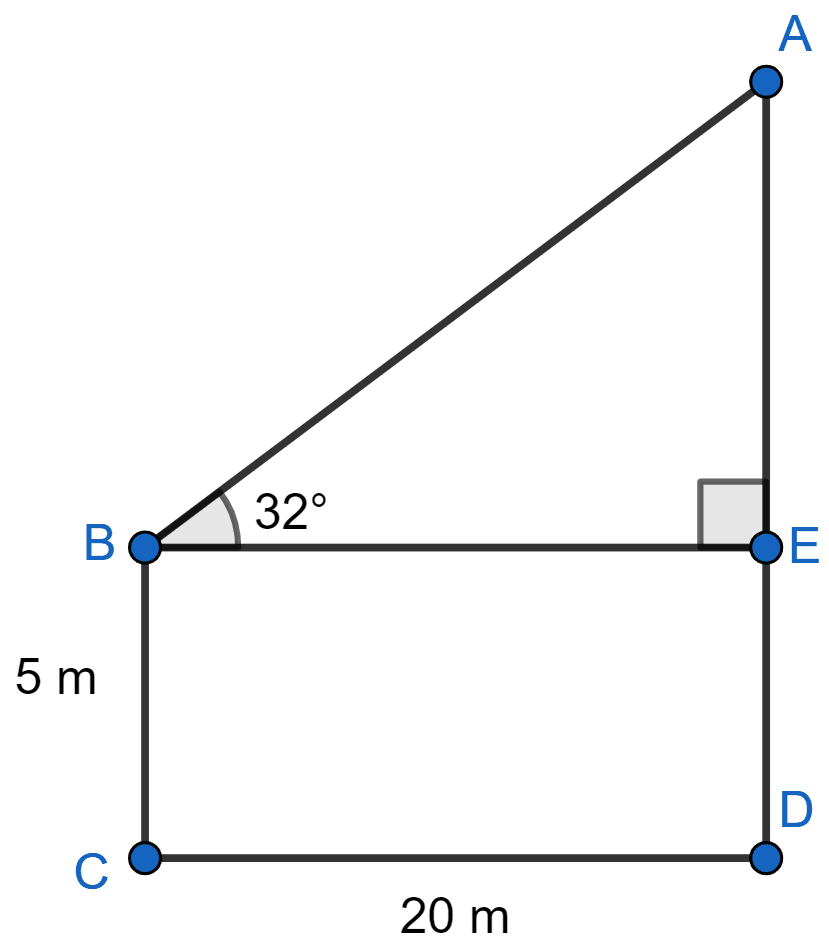
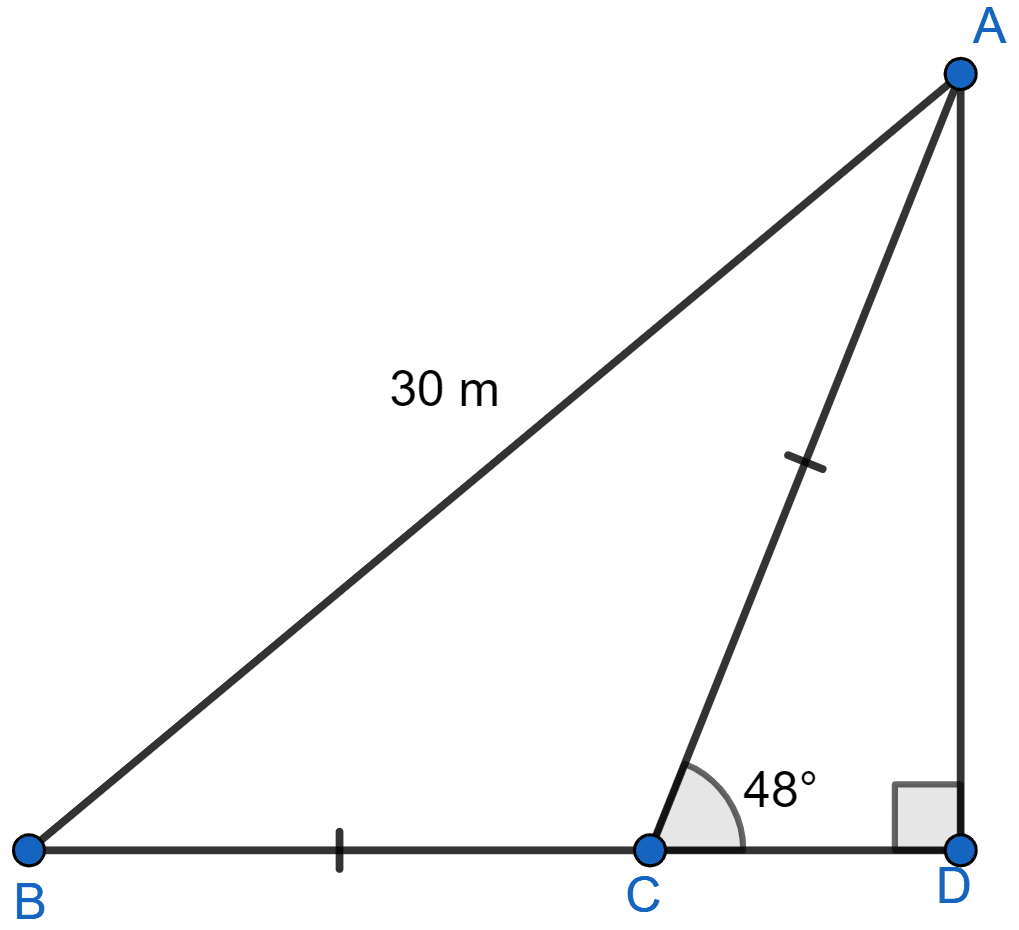
2Test Yourself

Find AD.

(i)

Find AD. Heights and Distances, Concise Mathematics Solutions ICSE Class 10.

(ii)

Find AD. Heights and Distances, Concise Mathematics Solutions ICSE Class 10.
Show SolutionHide Solution↓

(i) From figure,

BE = CD = 20 m and DE = CB = 5 m.

In △ABE,

$$\begin{aligned}\text{tan 32°} = \frac{\text{Perpendicular}}{\text{Base}} \\[1em] \Rightarrow 0.6249 = \frac{AE}{BE} \\[1em] \Rightarrow AE = 0.6249 \times BE \\[1em] \Rightarrow AE = 0.6249 \times 20 \\[1em] \Rightarrow AE = 12.498 \text{ m}.\end{aligned}$$

AD = AE + DE = 12.498 + 5 = 17.498 ≈ 17.5 m.

Hence, AD = 17.5 meters.

(ii) We know that,

An exterior angle is equal to the sum of two opposite interior angles.

∴ ∠ACD = ∠ABC + ∠BAC

Also, ∠ABC = ∠BAC (As, angles opposite to equal sides are equal)

∴ ∠ACD = 2∠ABC

⇒ 2∠ABC = 48°

⇒ ∠ABC = 24°.

In △ABD,

$$\begin{aligned}\text{sin 24°} = \frac{\text{Perpendicular}}{\text{Hypotenuse}} \\[1em] \Rightarrow 0.4067 = \frac{AD}{AB} \\[1em] \Rightarrow AD = 0.4067 \times AB \\[1em] \Rightarrow AD = 0.4067 \times 30 \\[1em] \Rightarrow AD = 12.20 \text{ m}.\end{aligned}$$

Hence, AD = 12.20 meters.

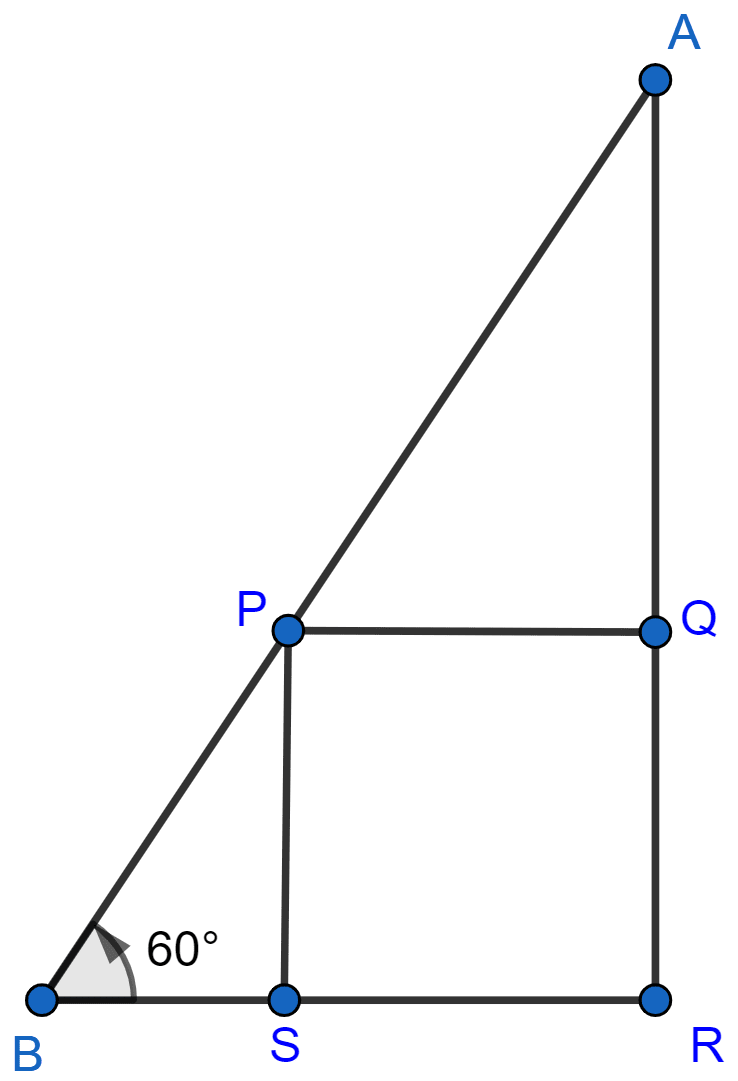
3Test Yourself

In the following diagram, AB is a floor-board; PQRS is a cubical box with each edge = 1 m and ∠B = 60°. Calculate the length of the board AB.

In the following diagram, AB is a floor-board; PQRS is a cubical box with each edge = 1 m and ∠B = 60°. Calculate the length of the board AB. Heights and Distances, Concise Mathematics Solutions ICSE Class 10.
Show SolutionHide Solution↓

In ∆PSB,

$$\begin{aligned}\text{sin 60°} = \frac{\text{Perpendicular}}{\text{Hypotenuse}} \\[1em] \Rightarrow \frac{\sqrt{3}}{2} = \frac{PS}{PB} \\[1em] \Rightarrow PB = \frac{2PS}{\sqrt{3}} \\[1em] \Rightarrow PB = \frac{2 \times 1}{1.732} = 1.155 \text{ m}.\end{aligned}$$

In ∆APQ,

∠APQ = ∠ABR = 60° (Corresponding angles are equal.)

$$\begin{aligned}\text{cos 60°} = \frac{\text{Base}}{\text{Hypotenuse}} \\[1em] \Rightarrow \frac{1}{2} = \frac{PQ}{AP} \\[1em] \Rightarrow AP = 2PQ \\[1em] \Rightarrow AP = 2 \text{ m}.\end{aligned}$$

From figure,

AB = AP + PB = 2 + 1.155 = 3.155 m.

Hence, AB = 3.155 meters.

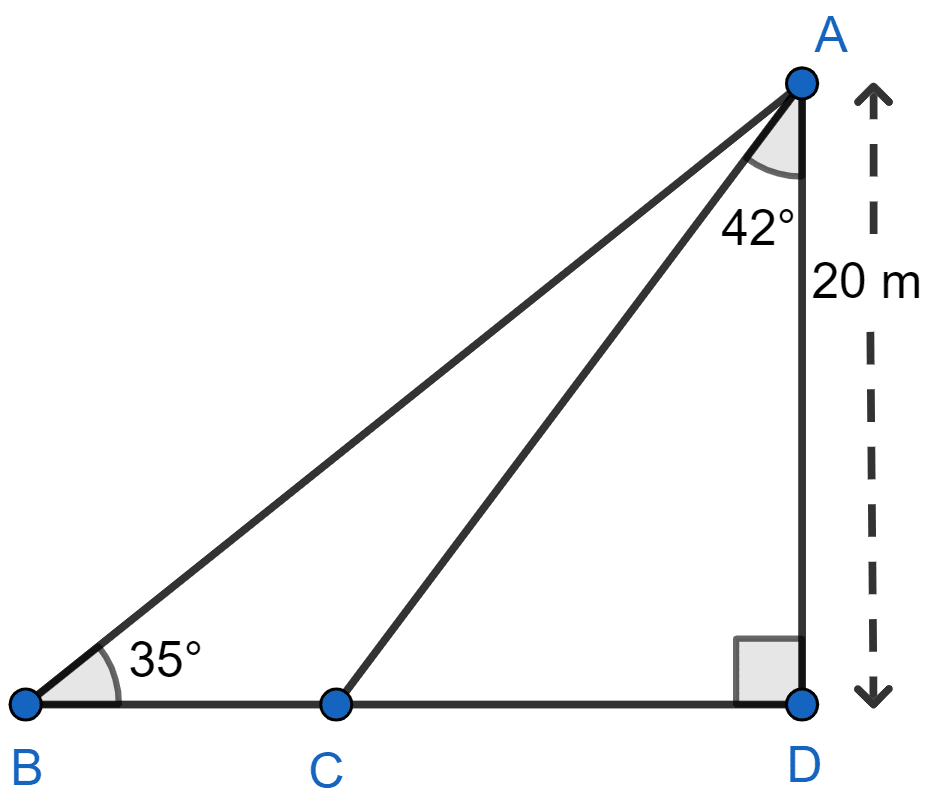
4Test Yourself

Calculate BC.

Calculate BC. Heights and Distances, Concise Mathematics Solutions ICSE Class 10.
Show SolutionHide Solution↓

In ∆ABD,

$$\begin{aligned}\text{tan 35°} = \frac{\text{Perpendicular}}{\text{Base}} \\[1em] \Rightarrow 0.7002 = \frac{AD}{BD} \\[1em] \Rightarrow BD = \frac{AD}{0.7002} \\[1em] \Rightarrow BD = \frac{20}{0.7002} \\[1em] \Rightarrow BD = 28.563 \text{ m}.\end{aligned}$$

In ∆ACD,

$$\begin{aligned}\text{tan 42°} = \frac{\text{Perpendicular}}{Base} \\[1em] \Rightarrow 0.9004 = \frac{CD}{AD} \\[1em] \Rightarrow CD = AD \times 0.9004 \\[1em] \Rightarrow CD = 20 \times 0.9004 \\[1em] \Rightarrow CD = 18.008 \text{ m}.\end{aligned}$$

From figure,

BC = BD - CD = 28.563 - 18.008 = 10.55 meters.

Hence, BC = 10.55 meters.

5Test Yourself

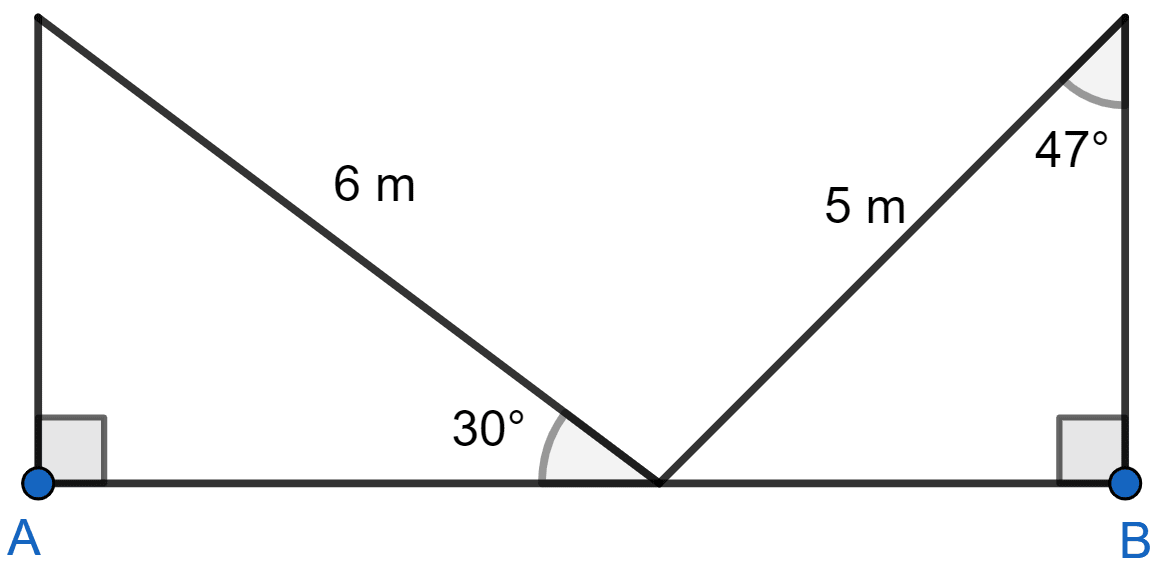
Calculate AB.

Calculate AB. Heights and Distances, Concise Mathematics Solutions ICSE Class 10.
Show SolutionHide Solution↓

In △ACD,

Calculate AB. Heights and Distances, Concise Mathematics Solutions ICSE Class 10.

$$\begin{aligned}\text{cos 30°} = \frac{\text{Base}}{\text{Hypotenuse}} \\[1em] \Rightarrow \frac{\sqrt{3}}{2} = \frac{AD}{CD} \\[1em] \Rightarrow AD = \frac{\sqrt{3}}{2} \times CD \\[1em] \Rightarrow AD = \frac{\sqrt{3}}{2} \times 6 \\[1em] \Rightarrow AD = 3\sqrt{3} \\[1em] \Rightarrow AD = 5.196 \text{ m}.\end{aligned}$$

In △BDE,

$$\begin{aligned}\text{sin 47°} = \frac{\text{Perpendicular}}{\text{Hypotenuse}} \\[1em] \Rightarrow 0.73 = \frac{BD}{DE} \\[1em] \Rightarrow BD = 0.73 \times DE \\[1em] \Rightarrow BD = 0.73 \times 5 = 3.65 \text{ m}.\end{aligned}$$

From figure,

AB = AD + BD = 5.196 + 3.65 = 8.846 = 8.85 meters.

Hence, AB = 8.85 meters.

6Test Yourself

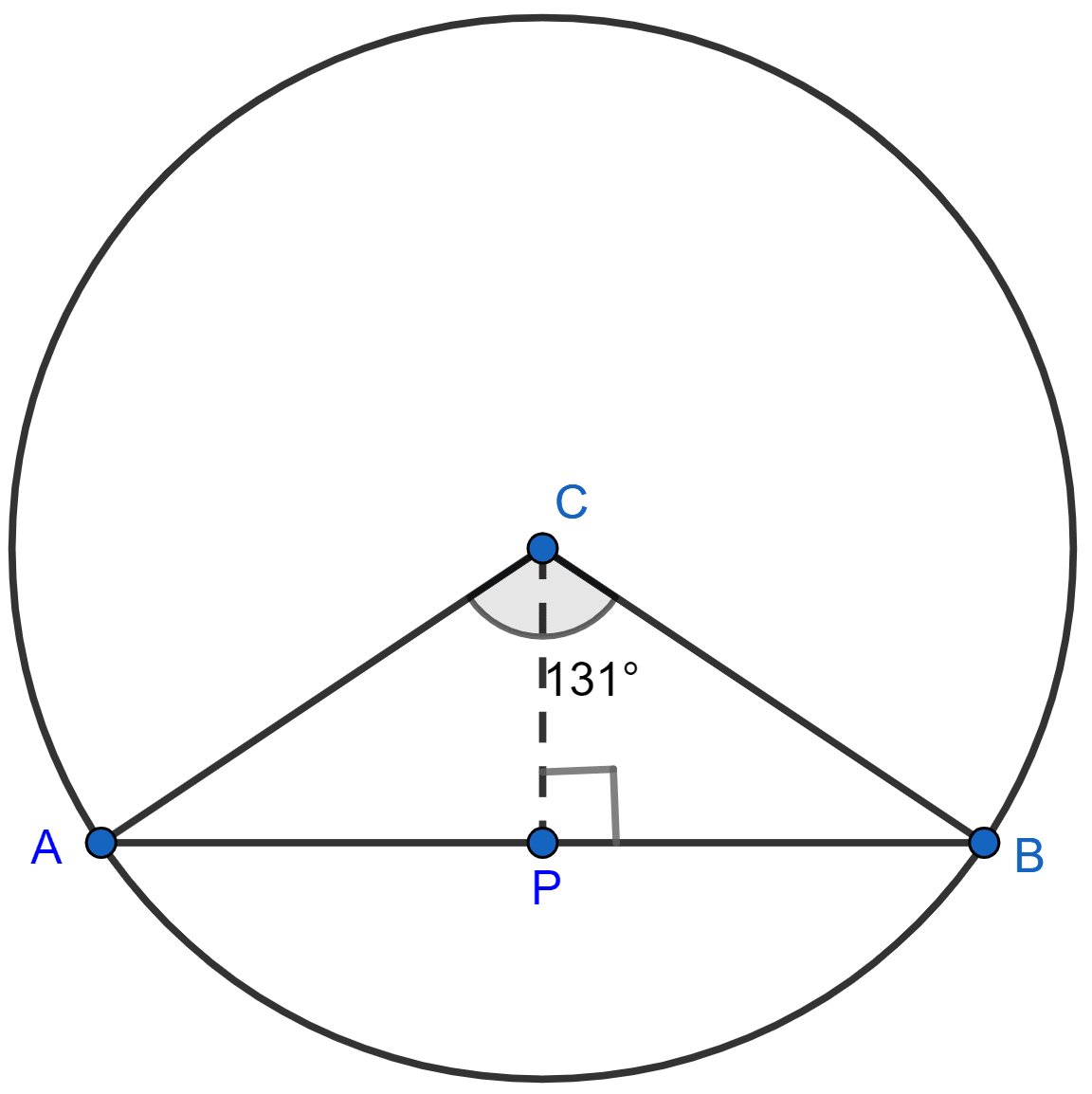
The radius of a circle is given as 15 cm and chord AB subtends an angle of 131° at the centre C of the circle. Using trigonometry, calculate :

(i) the length of AB;

(ii) the distance of AB from the centre C.

Show SolutionHide Solution↓

Given,

CA = CB = 15 cm and ∠ACB = 131°.

Construct a perpendicular CP from center C to the chord AB.

The radius of a circle is given as 15 cm and chord AB subtends an angle of 131° at the centre C of the circle. Using trigonometry, calculate : (i) the length of AB; (ii) the distance of AB from the centre C. Heights and Distances, Concise Mathematics Solutions ICSE Class 10.

We know that perpendicular form center to the chord bisects the chord.

Then, CP bisects AB.

In △ACP and △BCP,

∠APC = ∠BPC = 90°

CP = CP [∵ Common Side]

AP = PB [∵ CP bisects AB]

∴ △ACP ≅ △BCP by SAS axiom.

∴ ∠ACP = ∠BCP = $\frac{131°}{2}$ = 65.5° [By C.P.C.T.]

In △ACP,

$$\begin{aligned}\text{sin 65.5°} = \frac{\text{Perpendicular}}{\text{Hypotenuse}} \\[1em] \Rightarrow 0.91 = \frac{AP}{AC} \\[1em] \Rightarrow AP = 0.91 \times AC \\[1em] \Rightarrow AP = 0.91 \times 15 = 13.65 \text{ cm}.\end{aligned}$$

(i) From figure,

AB = AP + PB = 2AP

= 2 × 13.65

= 27.30 cm

Hence, AB = 27.30 cm.

(ii) In △ACP,

$$\begin{aligned}\text{cos 65.5°} = \frac{\text{Base}}{\text{Hypotenuse}} \\[1em] \Rightarrow 0.415 = \frac{CP}{AC} \\[1em] \Rightarrow CP = 0.415 \times 15 \\[1em] \Rightarrow CP = 6.225 \text{ cm}.\end{aligned}$$

Hence, CP = 6.225 cm.

7Test Yourself

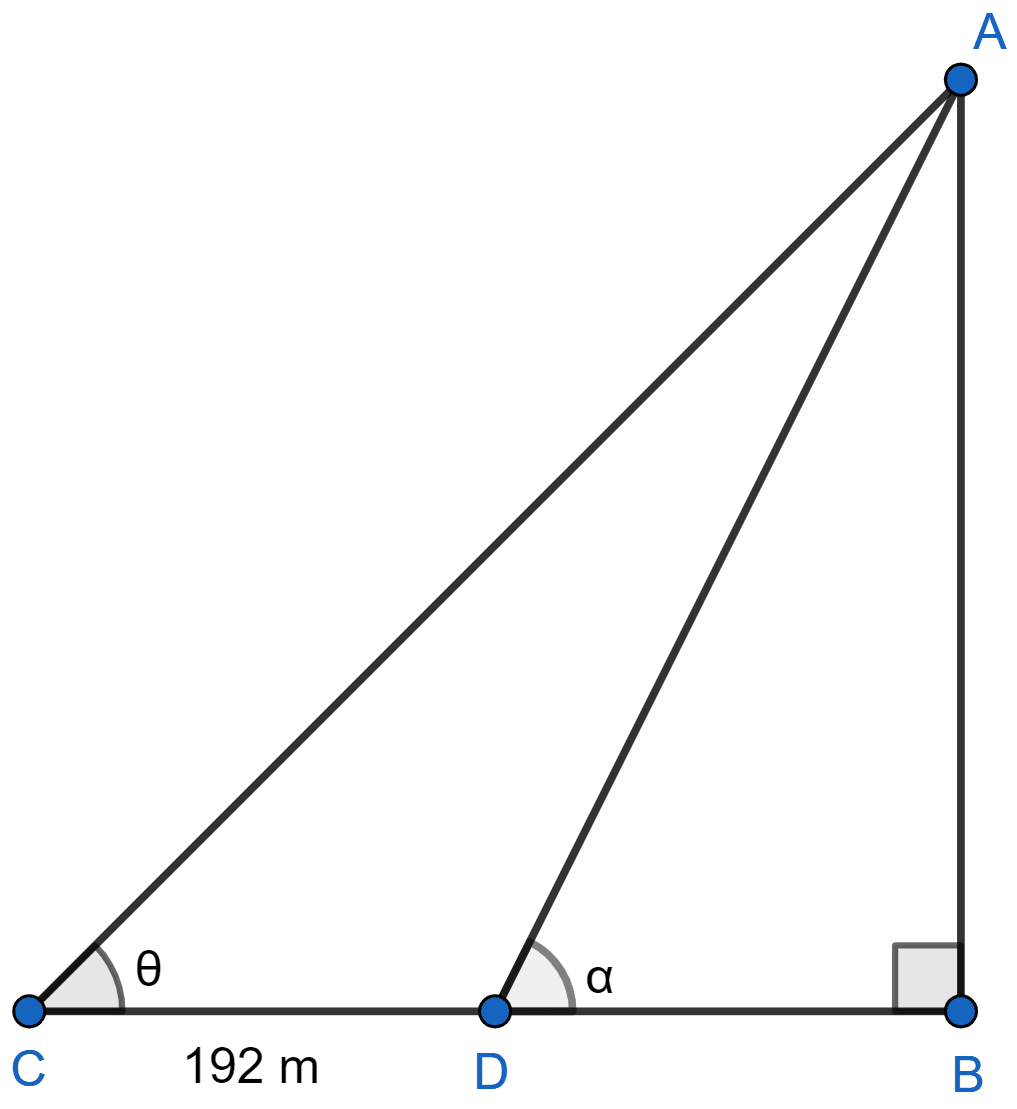
At a point on level ground, the angle of elevation of a vertical tower is found to be such that its tangent is $\frac{5}{12}$. On walking 192 meters towards the tower; the tangent of the angle is found to be $\frac{3}{4}$. Find the height of the tower.

Show SolutionHide Solution↓

Let's assume AB to be the vertical tower and C and D be the two points such that CD = 192 m.

Let ∠ACB = θ and ∠ADB = α

At a point on level ground, the angle of elevation of a vertical tower is found to be such that its tangent is. On walking 192 meters towards the tower; the tangent of the angle is found to be. Find the height of the tower. Heights and Distances, Concise Mathematics Solutions ICSE Class 10.

Given,

$$\begin{aligned}\Rightarrow \text{tan θ} = \frac{5}{12} \\[1em] \Rightarrow \frac{\text{Perpendicular}}{\text{Base}} = \frac{5}{12} \\[1em] \Rightarrow \frac{AB}{BC} = \frac{5}{12} \\[1em] \Rightarrow AB = \frac{5}{12}BC .........(1)\end{aligned}$$

Also given,

$$\begin{aligned}\Rightarrow \text{tan α} = \frac{3}{4} \\[1em] \Rightarrow \frac{\text{Perpendicular}}{\text{Base}} = \frac{3}{4} \\[1em] \Rightarrow \frac{AB}{BD} = \frac{3}{4} \\[1em] \Rightarrow AB = \frac{3}{4}BD .........(2)\end{aligned}$$

From equations (1) and (2), we get :

$$\begin{aligned}\Rightarrow \frac{5}{12}BC = \frac{3}{4}BD \\[1em] \Rightarrow \frac{BC}{BD} = \frac{3 \times 12}{4 \times 5} \\[1em] \Rightarrow \frac{BD + CD}{BD} = \frac{36}{20} \\[1em] \Rightarrow \frac{BD + CD}{BD} = \frac{9}{5} \\[1em] \Rightarrow 5(BD + CD) = 9BD \\[1em] \Rightarrow 5BD + 5CD = 9BD \\[1em] \Rightarrow 9BD - 5BD = 5CD \\[1em] \Rightarrow 4BD = 5CD \\[1em] \Rightarrow BD = \frac{5 \times 192}{4} \\[1em] \Rightarrow BD = \frac{960}{4} \\[1em] \Rightarrow BD = 240 \text{ m}.\end{aligned}$$

BC = BD + DC = 240 + 192 = 432 m.

From equation (1),

AB = $\frac{5}{12} \times BC = \frac{5}{12} \times 432$

= 5 × 36

= 180 m.

Hence, the height of the tower is 180 m.

8Test Yourself

A vertical tower stands on a horizontal plane and is surmounted by a vertical flagstaff of height h meter. At a point on the plane, the angle of elevation of the bottom of the flagstaff is α and at the top of the flagstaff is β. Prove that the height of the tower is $\frac{\text{h tan α}}{\text{tan β} - \text{tan α}}$.

Show SolutionHide Solution↓

Let AB be the tower of height x meters, surmounted by a vertical flagstaff AD of height h meters (given). Let C be a point on the plane such that ∠ACB = α, ∠DCB = β and AD = h.

A vertical tower stands on a horizontal plane and is surmounted by a vertical flagstaff of height h meter. At a point on the plane, the angle of elevation of the bottom of the flagstaff is α and at the top of the flagstaff is β. Prove that the height of the tower is. Heights and Distances, Concise Mathematics Solutions ICSE Class 10.

In ∆ABC,

$$\begin{aligned}\Rightarrow \text{tan α} = \frac{\text{Perpendicular}}{\text{Base}} \\[1em] \Rightarrow \text{tan α}= \frac{AB}{BC} \\[1em] \Rightarrow BC = \frac{AB}{\text{tan α}} \\[1em] \Rightarrow BC = \frac{x}{\text{tan α}} ..........(1)\end{aligned}$$

In ∆DBC,

$$\begin{aligned}\Rightarrow \text{tan β} = \frac{\text{Perpendicular}}{\text{Base}} \\[1em] \Rightarrow \text{tan β} = \frac{BD}{BC} \\[1em]\end{aligned}$$

Substituting value of BC from (1) in above equation :

$$\begin{aligned}\Rightarrow \text{tan β} = \frac{BD}{\frac{x}{\text{tan α}}} \\[1em] \Rightarrow \text{tan β} = \frac{BA + AD}{\frac{x}{\text{tan α}}} \\[1em] \Rightarrow \text{tan β} \times \frac{x}{\text{tan α}} = x + h \\[1em] \Rightarrow x \text{tan β} = \text{tan α}(x + h) \\[1em] \Rightarrow x \text{tan β} = x \text{tan α} + h \text{tan α} \\[1em] \Rightarrow x \text{tan β} - x \text{tan α} = h \text{tan α} \\[1em] \Rightarrow x(\text{tan β} - \text{tan α}) = h \text{tan α} \\[1em] \Rightarrow x = \frac{\text{h tan α}}{\text{tan β} - \text{tan α}}.\end{aligned}$$

Hence, proved that the height of the tower = $\frac{\text{h tan α}}{\text{tan β} - \text{tan α}}.$

9Test Yourself

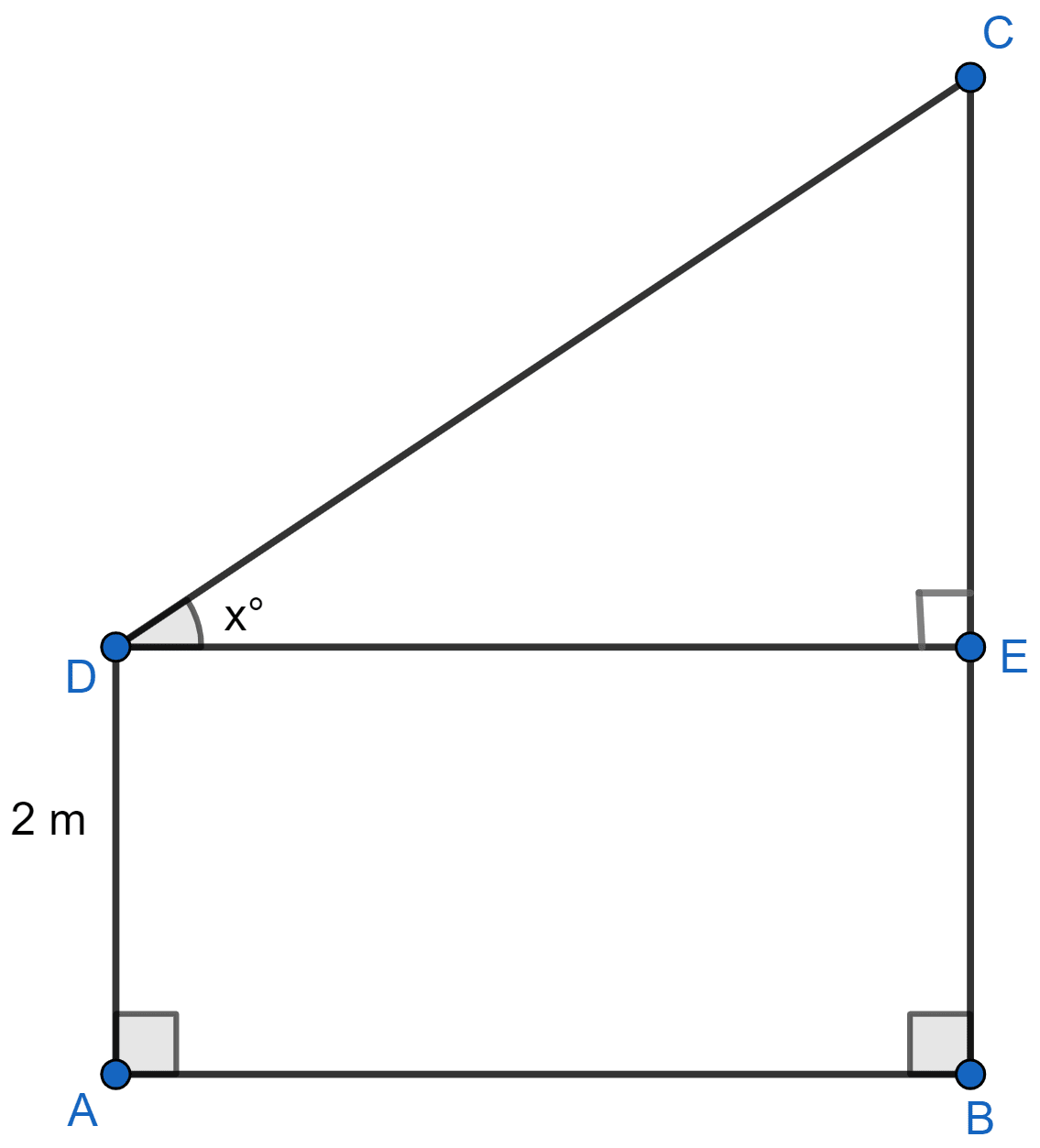
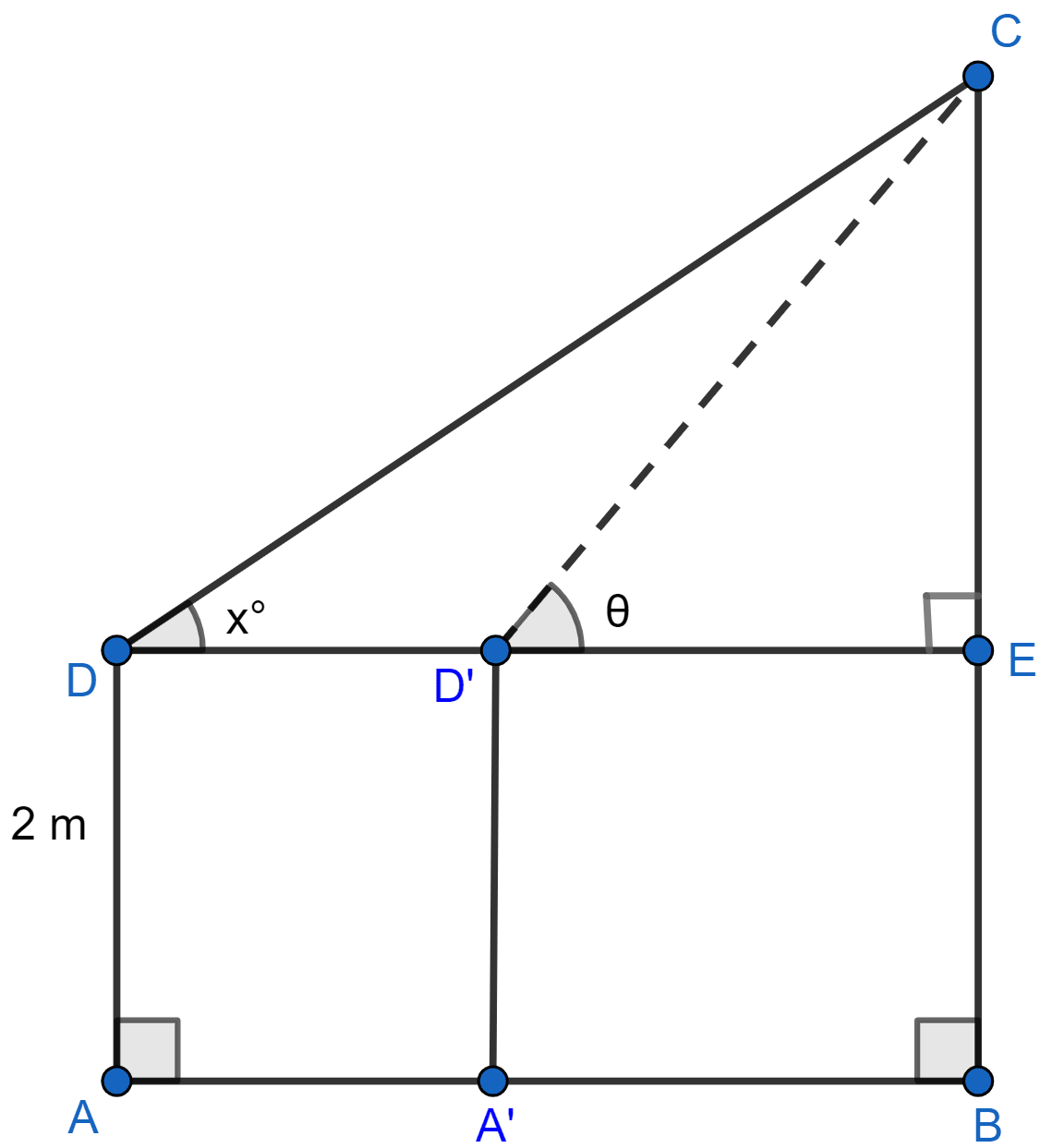
With reference to the given figure, a man stands on the ground at point A, which is on the same horizontal plane as B, the foot of the vertical pole BC. The height of the pole is 10 m. The man's eye is 2 m above the ground. He observes the angle of elevation of C, the top of the pole, as x°, where tan x° = $\frac{2}{5}$. Calculate:

(i) the distance AB in metres;

(ii) angle of elevation of the top of the pole when he is standing 15 metres from the pole. Give your answer to the nearest degree.

With reference to the given figure, a man stands on the ground at point A, which is on the same horizontal plane as B, the foot of the vertical pole BC. The height of the pole is 10 m. The man's eye is 2 m above the ground. He observes the angle of elevation of C, the top of the pole, as x°, where tan x° =. Calculate: (i) the distance AB in metres; (ii) angle of elevation of the top of the pole when he is standing 15 metres from the pole. Give your answer to the nearest degree. Heights and Distances, Concise Mathematics Solutions ICSE Class 10.
Show SolutionHide Solution↓

Let's take AD to be the height of the man, AD = 2 m.

From figure, BE = AD = 2 m.

Also,

CE = BC - BE = (10 - 2) = 8 m.
(i) In ∆CED,

$$\begin{aligned}\Rightarrow \text{tan x} ^{\circ} = \frac{\text{Perpendicular}}{\text{Base}} \\[1em] \Rightarrow \text{tan x} ^{\circ} = \frac{CE}{DE} \\[1em] \Rightarrow \frac{2}{5} = \frac{8}{DE} \\[1em] \Rightarrow DE = \frac{8 \times 5}{2} \\[1em] \Rightarrow DE = \frac{40}{2} = 20 \text{ m}.\end{aligned}$$

From figure,

AB = DE = 20 m.
Hence, AB = 20 m.
(ii) Let A'D' be the new position of the man and θ be the angle of elevation of the top of the tower.
With reference to the given figure, a man stands on the ground at point A, which is on the same horizontal plane as B, the foot of the vertical pole BC. The height of the pole is 10 m. The man's eye is 2 m above the ground. He observes the angle of elevation of C, the top of the pole, as x°, where tan x° =. Calculate: (i) the distance AB in metres; (ii) angle of elevation of the top of the pole when he is standing 15 metres from the pole. Give your answer to the nearest degree. Heights and Distances, Concise Mathematics Solutions ICSE Class 10.

Such that, D'E = 15 m

In ∆CED',

$$\begin{aligned}\text{tan θ} = \frac{\text{Perpendicular}}{\text{Base}} \\[1em] \Rightarrow \text{tan θ} = \frac{CE}{D'E} \\[1em] \Rightarrow \text{tan θ} = \frac{8}{15} \\[1em] \Rightarrow \text{tan θ} = 0.533 \\[1em] \Rightarrow \text{tan θ} = \text{tan } 28° \\[1em] \Rightarrow \text{θ} = 28°.\end{aligned}$$

Hence, angle of elevation of the top of the pole when the man is standing 15 metres from the pole is 28°.

10Test Yourself

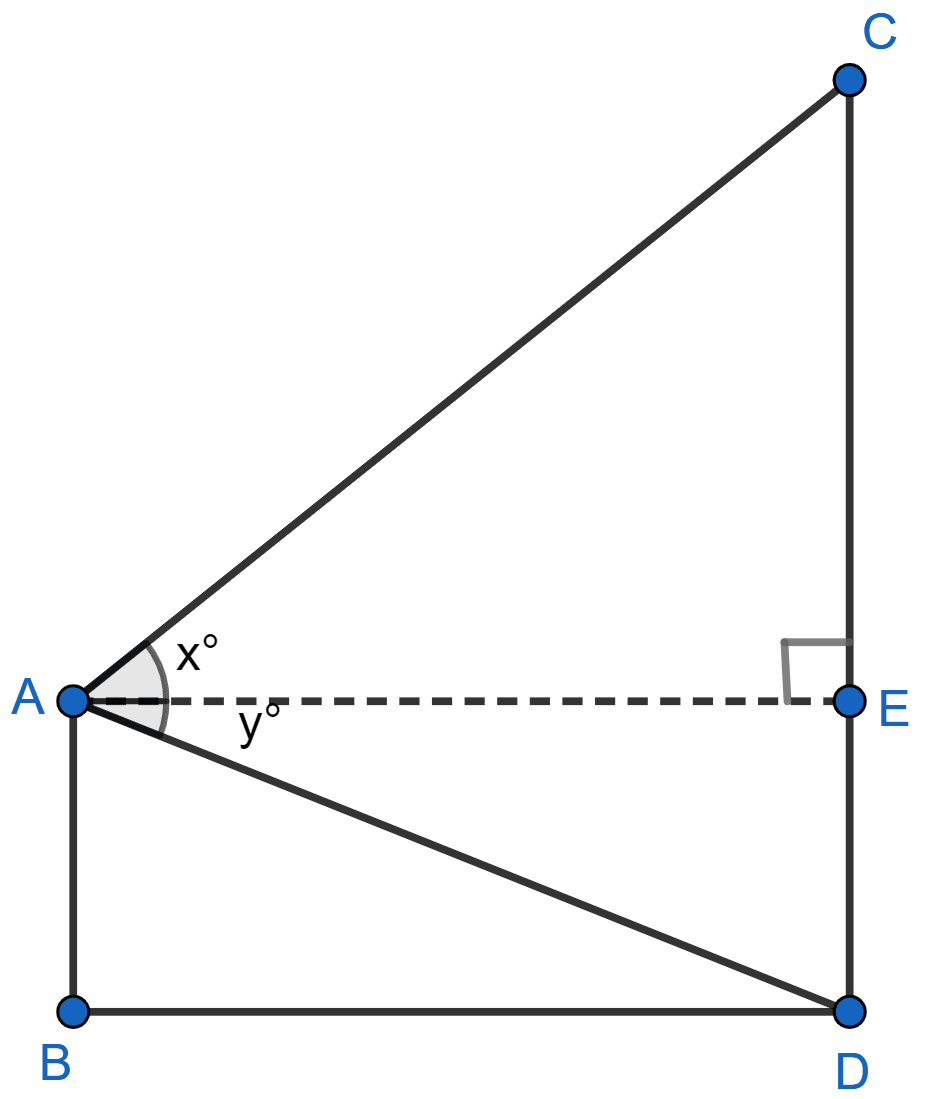
From a window A, 10 m above the ground the angle of elevation of the top C of a tower is x°, where tan x° = $\frac{5}{2}$ and the angle of depression of the foot D of the tower is y°, where tan y° = $\frac{1}{4}$. Calculate the height CD of the tower in metres.

From a window A, 10 m above the ground the angle of elevation of the top C of a tower is x°, where tan x° and the angle of depression of the foot D of the tower is y°, where tan y°. Calculate the height CD of the tower in metres. Heights and Distances, Concise Mathematics Solutions ICSE Class 10.
Show SolutionHide Solution↓

From figure,

From a window A, 10 m above the ground the angle of elevation of the top C of a tower is x°, where tan x° and the angle of depression of the foot D of the tower is y°, where tan y°. Calculate the height CD of the tower in metres. Heights and Distances, Concise Mathematics Solutions ICSE Class 10.

⇒ AB = DE = 10 m.

In ∆AED

$$\begin{aligned}\Rightarrow \text{tan y°} = \frac{\text{Perpendicular}}{\text{Base}} \\[1em] \Rightarrow \text{tan y°} = \frac{DE}{AE} \\[1em] \Rightarrow \frac{1}{4} = \frac{DE}{AE} \\[1em] \Rightarrow AE = 4DE = 4 \times 10 = 40 \text{ m}.\end{aligned}$$

In ∆AEC,

$$\begin{aligned}\Rightarrow \text{tan x°} = \frac{\text{Perpendicular}}{\text{Base}} \\[1em] \Rightarrow \text{tan x°} = \frac{CE}{AE} \\[1em] \Rightarrow \frac{5}{2} = \frac{CE}{AE} \\[1em] \Rightarrow CE = AE \times \frac{5}{2} = 40 \times \frac{5}{2} = 100 \text{ m}.\end{aligned}$$

From figure,

CD = DE + CE = 10 + 100 = 110 m.

Hence, height of tower (CD) = 110 m.

11Test Yourself

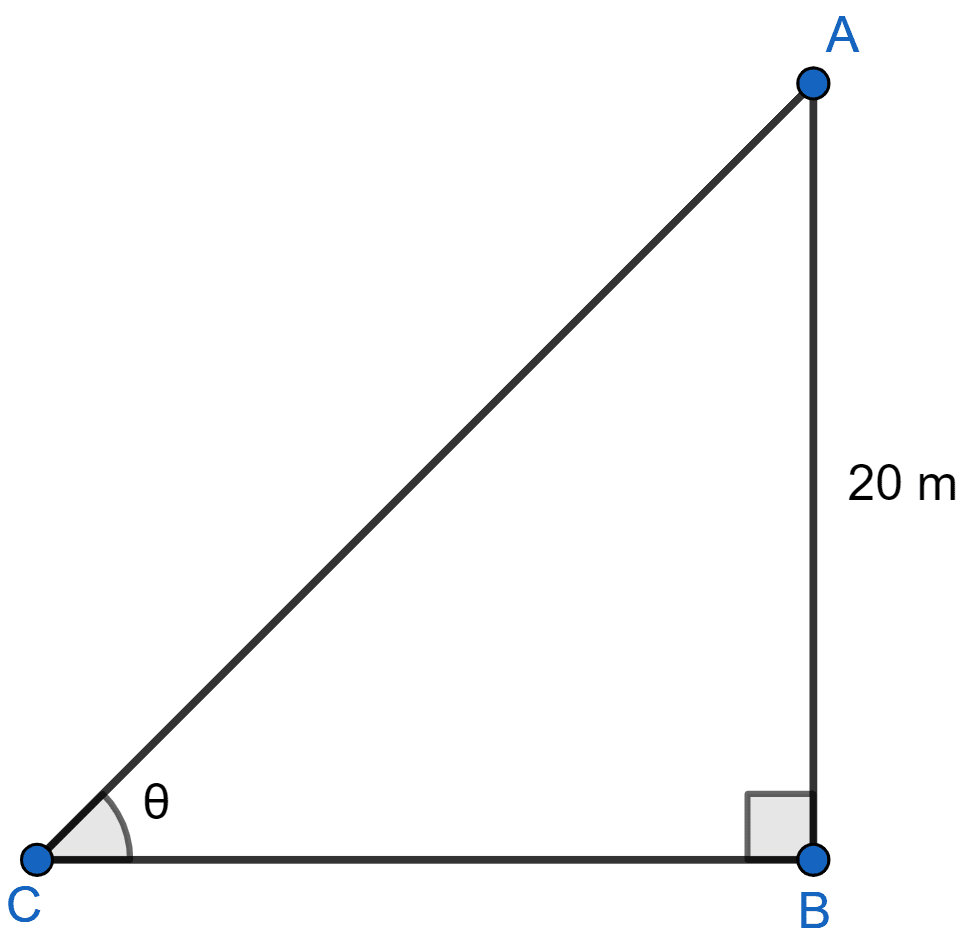
A vertical tower is 20 m high. A man standing at some distance from the tower knows that the cosine of the angle of elevation of the top of the tower is 0.53. How far is he standing from the foot of the tower ?

Show SolutionHide Solution↓

Let angle of elevation be θ.

A vertical tower is 20 m high. A man standing at some distance from the tower knows that the cosine of the angle of elevation of the top of the tower is 0.53. How far is he standing from the foot of the tower ?  Heights and Distances, Concise Mathematics Solutions ICSE Class 10.

According to question,

⇒ cos θ = 0.53

⇒ cos θ = cos 58°

⇒ θ = 58°.

⇒ cos2 θ = 0.2809

⇒ 1 - sin2 θ = 0.2809

⇒ sin2 θ = 1 - 0.2809

⇒ sin2 θ = 0.7191

⇒ sin θ = $\sqrt{0.7191}$

⇒ sin θ = 0.848

⇒ tan θ = $\frac{\text{sin θ}}{\text{cos θ}} = \frac{0.848}{0.53}$ = 1.6

$$\begin{aligned}\therefore \frac{\text{Perpendicular}}{\text{Base}} = 1.6 \\[1em] \Rightarrow \frac{AB}{BC} = 1.6 \\[1em] \Rightarrow \frac{20}{BC} = 1.6 \\[1em] \Rightarrow BC = \frac{20}{1.6} = 12.5 \text{ m}.\end{aligned}$$

The man is standing at a distance of 12.5 meters.

12Test Yourself

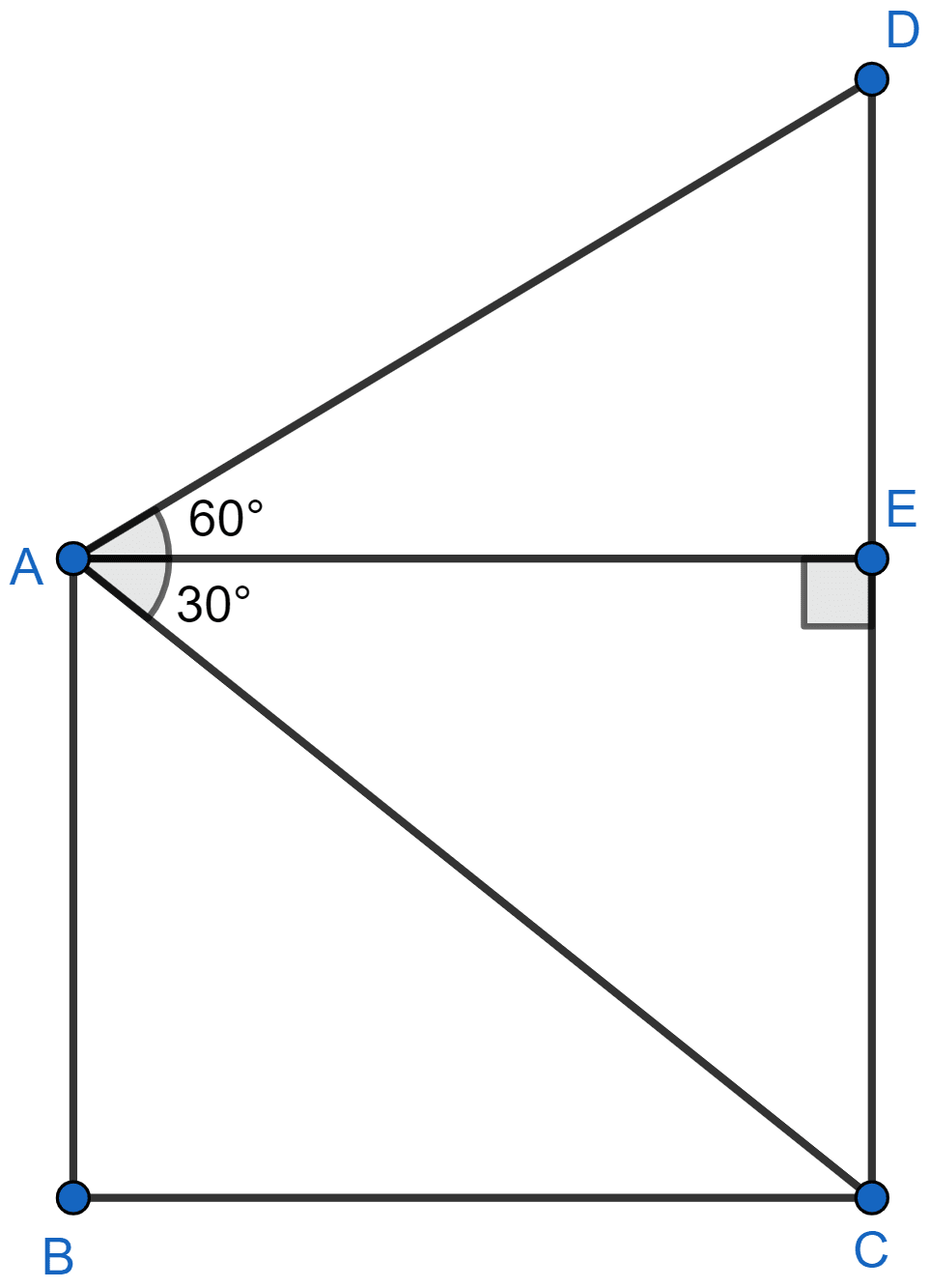
A vertical pole and a vertical tower are on the same level ground in such a way that from the top of the pole the angle of elevation of the top of the tower is 60° and the angle of depression of the bottom of the tower is 30°. Find :

(i) the height of the tower, if the height of the pole is 20 m;

(ii) the height of the pole, if the height of the tower is 75 m

Show SolutionHide Solution↓

(i) Let AB be the pole and CD be the tower.

Given,

Length of pole (AB) = 20 m.

From figure,

CE = AB = 20 m.

A vertical pole and a vertical tower are on the same level ground in such a way that from the top of the pole the angle of elevation of the top of the tower is 60° and the angle of depression of the bottom of the tower is 30°. Find : (i) the height of the tower, if the height of the pole is 20 m; (ii) the height of the pole, if the height of the tower is 75 m  Heights and Distances, Concise Mathematics Solutions ICSE Class 10.

In △AEC,

$$\begin{aligned}\text{tan 30°} = \frac{\text{Perpendicular}}{\text{Base}} \\[1em] \Rightarrow \frac{1}{\sqrt{3}} = \frac{CE}{AE} \\[1em] \Rightarrow AE = \sqrt{3} CE \\[1em] \Rightarrow AE = 20\sqrt{3} \text{ m}.\end{aligned}$$

In △AED,

$$\begin{aligned}\text{tan 60°} = \frac{\text{Perpendicular}}{\text{Base}} \\[1em] \Rightarrow \sqrt{3} = \frac{DE}{AE} \\[1em] \Rightarrow DE = AE\sqrt{3} \\[1em] \Rightarrow DE = 20\sqrt{3} \times \sqrt{3} = 20 \times 3 = 60 \text{ m}.\end{aligned}$$

From figure,

CD = DE + CE = 60 + 20 = 80 m.

Hence, the height of the tower = 80 m.

(ii) Given,

Length of tower (CD) = 75 m

From figure,

AE = BC = y (let)

In △AEC,

$$\begin{aligned}\text{tan 30°} = \frac{\text{Perpendicular}}{\text{Base}} \\[1em] \Rightarrow \frac{1}{\sqrt{3}} = \frac{CE}{AE} \\[1em] \Rightarrow CE = \frac{AE}{\sqrt{3}} \\[1em] \Rightarrow CE = \frac{y}{\sqrt{3}} \text{ m}.\end{aligned}$$

In △AED,

$$\begin{aligned}\text{tan 60°} = \frac{\text{Perpendicular}}{\text{Base}} \\[1em] \Rightarrow \sqrt{3} = \frac{DE}{AE} \\[1em] \Rightarrow DE = AE\sqrt{3} \\[1em] \Rightarrow DE = y\sqrt{3} \text{ m}.\end{aligned}$$

From figure,

⇒ CD = CE + DE

$$\begin{aligned}\Rightarrow \frac{y}{\sqrt{3}} + \sqrt{3}y = 75 \\[1em] \Rightarrow \frac{y + 3y}{\sqrt{3}} = 75 \\[1em] \Rightarrow \frac{4y}{\sqrt{3}} = 75 \\[1em] \Rightarrow y = \frac{75\sqrt{3}}{4} \text{ m}.\end{aligned}$$

We know that,

CE = $\frac{y}{\sqrt{3}} = \frac{\frac{75\sqrt{3}}{4}}{\sqrt{3}} = \frac{75}{4}$ = 18.75 meters.

Hence, height of pole = 18.75 meters.

13Test Yourself

In the given figure, from the top of a building AB = 60 m high, the angles of depression of the top and bottom of a vertical lamp post CD are observed to be 30° and 60° respectively. Find :

(i) the horizontal distance between AB and CD.

(ii) the height of the lamp post.

In the given figure, from the top of a building AB = 60 m high, the angles of depression of the top and bottom of a vertical lamp post CD are observed to be 30° and 60° respectively. Find : (i) the horizontal distance between AB and CD. (ii) the height of the lamp post. Heights and Distances, Concise Mathematics Solutions ICSE Class 10.
Show SolutionHide Solution↓

(i) We know that,

Alternate angles are equal.

∴ ∠ACB = ∠EAC = 60°

In the given figure, from the top of a building AB = 60 m high, the angles of depression of the top and bottom of a vertical lamp post CD are observed to be 30° and 60° respectively. Find : (i) the horizontal distance between AB and CD. (ii) the height of the lamp post. Heights and Distances, Concise Mathematics Solutions ICSE Class 10.

In △ABC,

$$\begin{aligned}\text{tan 60°} = \frac{\text{Perpendicular}}{\text{Base}} \\[1em] \Rightarrow \sqrt{3} = \frac{AB}{BC} \\[1em] \Rightarrow BC = \frac{AB}{\sqrt{3}} = \frac{60}{1.732} = 34.64 \text{ m}.\end{aligned}$$

Hence, horizontal distance between AB and CD = 34.64 meters.

(ii) We know that,

From figure,

FD = BC = 34.64 m

As, alternate angles are equal.

∴ ∠ADF = ∠EAD = 30°

In △AFD,

$$\begin{aligned}\text{tan 30°} = \frac{\text{Perpendicular}}{\text{Base}} \\[1em] \Rightarrow \frac{1}{\sqrt{3}} = \frac{AF}{FD} \\[1em] \Rightarrow AF = \frac{FD}{\sqrt{3}} \\[1em] \Rightarrow AF = \frac{34.64}{1.732} = 20 \text{ m}.\end{aligned}$$

From figure,

BF = AB - AF = 60 - 20 = 40 m.

∴ CD = 40 m.

Hence, height of lamp post = 40 m.

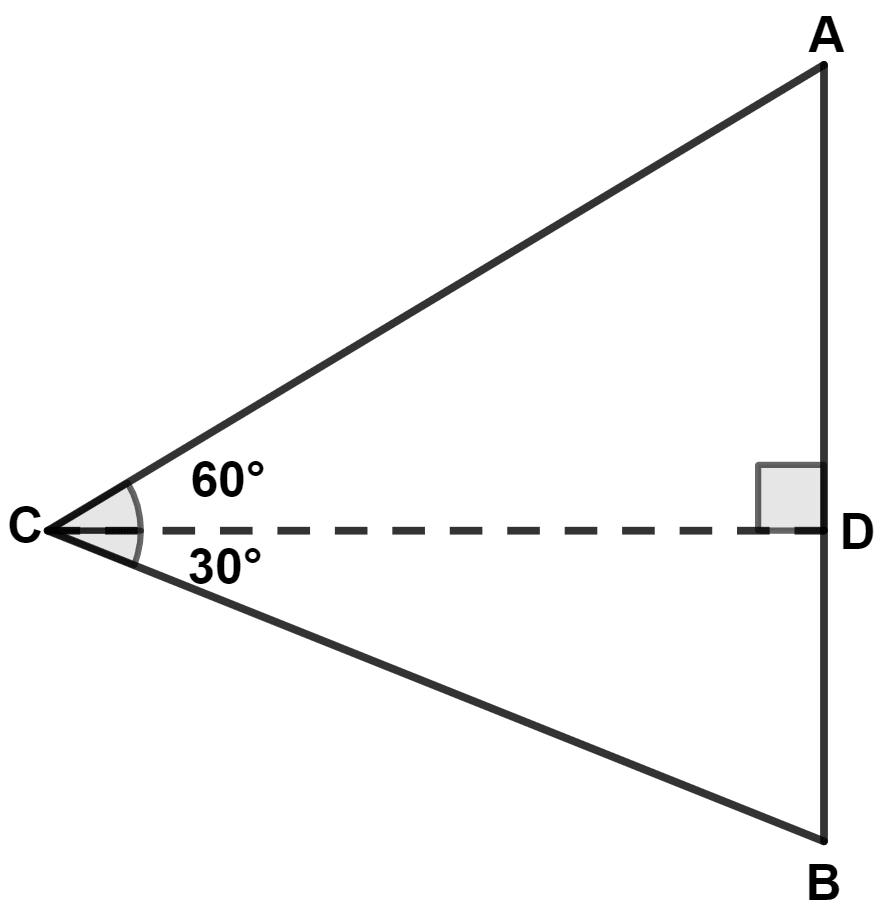
14Test Yourself

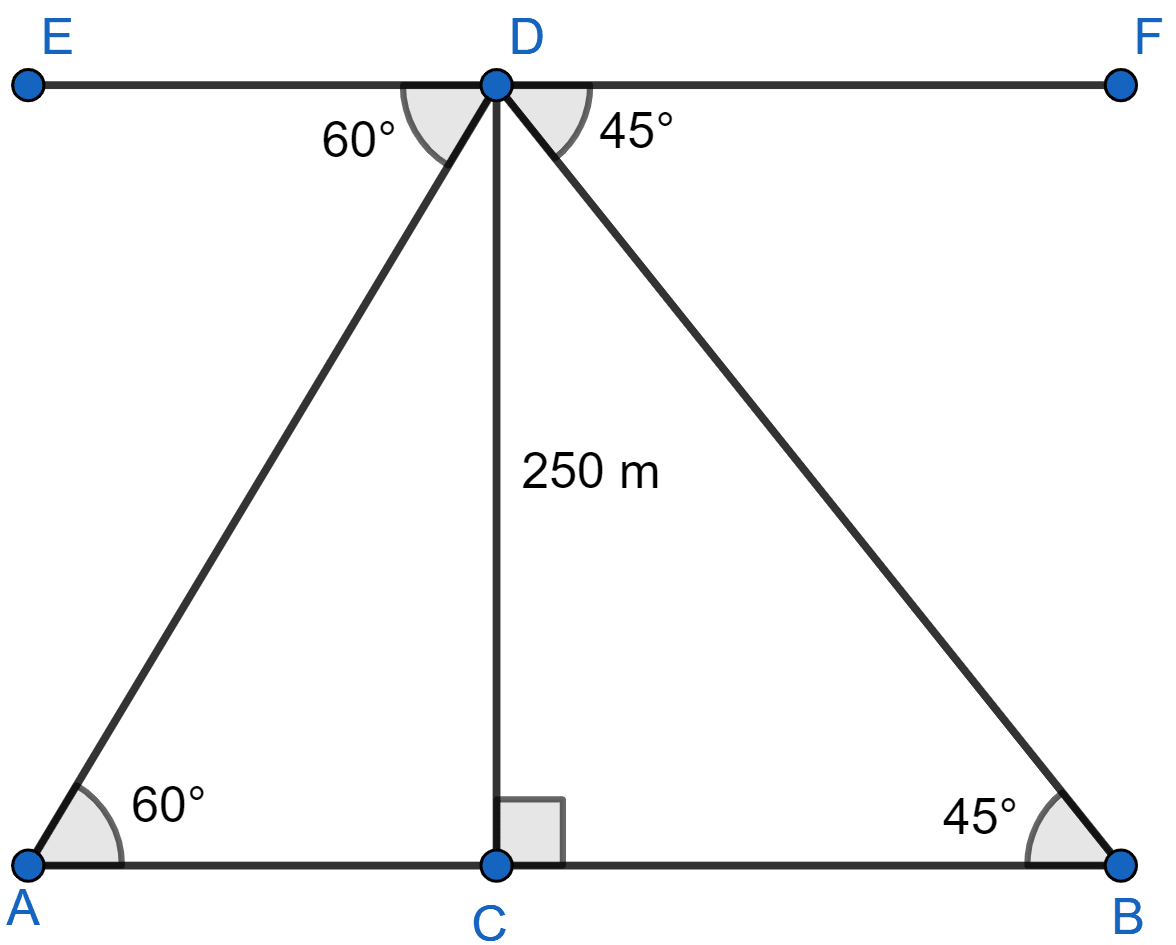
An aeroplane, at an altitude of 250 m, observes the angle of depression of two boats on the opposite banks of a river to be 45° and 60° respectively. If the boats are on the opposite sides of the aeroplane, find the width of the river. Write the answer correct to the nearest whole number.

Show SolutionHide Solution↓

Let D be the position of aeroplane and A and B be the positions of boat.

As, angle of depression are 60° and 45°.

Since, alternate angles are equal.

∴ ∠DAC = EDA = 60° and ∠DBC = FDB = 45°.

An aeroplane, at an altitude of 250 m, observes the angle of depression of two boats on the opposite banks of a river to be 45° and 60° respectively. If the boats are on the opposite sides of the aeroplane, find the width of the river. Write the answer correct to the nearest whole number. Heights and Distances, Concise Mathematics Solutions ICSE Class 10.

In △ACD,

$$\begin{aligned}\text{tan 60°} = \frac{\text{Perpendicular}}{\text{Base}} \\[1em] \Rightarrow \sqrt{3} = \frac{CD}{AC} \\[1em] \Rightarrow AC = \frac{CD}{\sqrt{3}} \\[1em] \Rightarrow AC = \frac{250}{1.732} \\[1em] \Rightarrow AC = 144.34 \text{ m}.\end{aligned}$$

In △BCD,

$$\begin{aligned}\text{tan 45°} = \frac{\text{Perpendicular}}{\text{Base}} \\[1em] \Rightarrow 1 = \frac{CD}{BC} \\[1em] \Rightarrow BC = CD = 250 \text{ m}.\end{aligned}$$

AB = AC + BC = 144.34 + 250 = 394.34 ≈ 394 m.

Hence, width of river = 394 m.

15Test Yourself

The horizontal distance between two towers is 120 m. The angle of elevation of the top and angle of depression of the bottom of the first tower as observed from the top of the second tower is 30° and 24°, respectively. Find the height of the two towers. Give your answer correct to 3 significant figures.

The horizontal distance between two towers is 120 m. The angle of elevation of the top and angle of depression of the bottom of the first tower as observed from the top of the second tower is 30° and 24°, respectively. Find the height of the two towers. Give your answer correct to 3 significant figures. Heights and Distances, Concise Mathematics Solutions ICSE Class 10.
Show SolutionHide Solution↓

From figure,

AB is the first tower and CD is the second tower.

The horizontal distance between two towers is 120 m. The angle of elevation of the top and angle of depression of the bottom of the first tower as observed from the top of the second tower is 30° and 24°, respectively. Find the height of the two towers. Give your answer correct to 3 significant figures. Heights and Distances, Concise Mathematics Solutions ICSE Class 10.

From figure,

EC = BD = 120 m.

In △AEC,

$$\begin{aligned}\text{tan 30°} = \frac{\text{Perpendicular}}{\text{Base}} \\[1em] \Rightarrow \frac{1}{\sqrt{3}} = \frac{AE}{EC} \\[1em] \Rightarrow AE = \frac{EC}{\sqrt{3}} \\[1em] \Rightarrow AE = \frac{120}{\sqrt{3}} \\[1em] \Rightarrow AE = \frac{120}{1.732} = 69.28 \text{ m}.\end{aligned}$$

In △EBC,

$$\begin{aligned}\text{tan 24°} = \frac{\text{Perpendicular}}{\text{Base}} \\[1em] \Rightarrow 0.445 = \frac{EB}{EC} \\[1em] \Rightarrow EB = EC \times 0.445 \\[1em] \Rightarrow EB = 120 \times 0.445 = 53.4 \text{ m}.\end{aligned}$$

From figure,

⇒ CD = EB = 53.4 meters.

⇒ AB = AE + EB = 69.28 + 53.4 = 122.68 ≈ 123 meters.

Hence, height of two towers = 123 meters and 53.4 meters.

16Test Yourself

The angles of depression of two ships A and B as observed from the top of a lighthouse 60 m high are 60° and 45° respectively. If the two ships are on the opposite sides of the lighthouse, find the distance between the two ships. Give your answer correct to nearest whole number.

Show SolutionHide Solution↓

Let CD be the lighthouse.

The angles of depression of two ships A and B as observed from the top of a lighthouse 60 m high are 60° and 45° respectively. If the two ships are on the opposite sides of the lighthouse, find the distance between the two ships. Give your answer correct to nearest whole number. Heights and Distances, Concise Mathematics Solutions ICSE Class 10.

As, angle of depression are 60° and 45°.

Since, alternate angles are equal.

∴ ∠DAC = ∠EDA = 60° and ∠DBC = ∠FDB = 45°.

In △ACD,

$$\begin{aligned}\text{tan 60°} = \frac{\text{Perpendicular}}{\text{Base}} \\[1em] \Rightarrow \sqrt{3} = \frac{CD}{AC} \\[1em] \Rightarrow AC = \frac{CD}{\sqrt{3}} \\[1em] \Rightarrow AC = \frac{60}{1.732} \\[1em] \Rightarrow AC = 34.64 \text{ m}.\end{aligned}$$

In △BCD,

$$\begin{aligned}\text{tan 45°} = \frac{\text{Perpendicular}}{\text{Base}} \\[1em] \Rightarrow 1 = \frac{CD}{BC} \\[1em] \Rightarrow BC = CD = 60 \text{ m}.\end{aligned}$$

AB = AC + BC = 34.64 + 60 = 94.64 ≈ 95 m.

Hence, the distance between two ships = 95 m.

17Test Yourself

Two ships are approaching a light house from the opposite directions. The angles of depression of the two ships from the top of the light house are 30° and 45°. If the distance between the two ships is 100 metre, find the height of the light house correct to one decimal place.

Show SolutionHide Solution↓
Two ships are approaching a light house from the opposite directions. The angles of depression of the two ships from the top of the light house are 30° and 45°. If the distance between the two ships is 100 metre, find the height of the light house correct to one decimal place. Concise Mathematics Solutions ICSE Class 10.

Let height of lighthouse (CD) be h meters.

Let A and B be the boats approaching lighthouse.

From figure,

∠CAD = ∠ACX = 30° and ∠CBD = ∠BCY = 45°

In triangle ACD,

$$\begin{aligned}\Rightarrow \tan 30^\circ = \frac{h}{x} \\[1em] \Rightarrow \frac{1}{\sqrt3} = \frac{h}{x} \\[1em] \Rightarrow x = h\sqrt3.\end{aligned}$$

In triangle BCD,

$$\begin{aligned}\Rightarrow \tan 45^\circ = \frac{h}{y} \\[1em] \Rightarrow 1 = \frac{h}{y} \\[1em] \Rightarrow h = y.\end{aligned}$$

Given,

Distance between the two boats is 100 m.

x + y = 100

$$\begin{aligned}\Rightarrow h\sqrt3 + h = 100 \\[1em] \Rightarrow h(\sqrt{3} + 1) = 100 \\[1em] \Rightarrow h =\frac{100}{\sqrt3 + 1} \\[1em] \Rightarrow h = \frac{100(\sqrt{3} - 1)}{(\sqrt{3} + 1)(\sqrt{3} - 1)} \\[1em] \Rightarrow h = \frac{100(\sqrt{3} - 1)}{3 - 1} \\[1em] \Rightarrow h = \frac{100(\sqrt{3} - 1)}{2} \\[1em] \Rightarrow h = 50(\sqrt{3} - 1) \\[1em] \Rightarrow h = 50(1.732 - 1) \\[1em] \Rightarrow h = 50(0.732) \\[1em] \Rightarrow h = 36.6 \text{ m}.\end{aligned}$$

Hence, option 1 is the correct option.

Press ↓ to reveal a solution and move to the next question. Back to Selina Concise Mathematics.

Free sample bank