By formula,
Volume of sphere = $\frac{4}{3} \pi r^3$
Given,
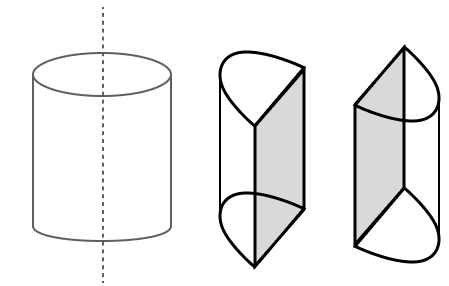
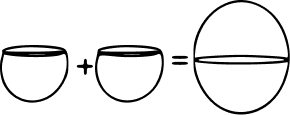
A solid sphere is cut into two identical hemispheres.
Volume of hemisphere = $\frac{2}{3} \pi r^3$
Volume of two identical hemispheres = $2 \times \frac{2}{3} \pi r^3$
= $\frac{4}{3} \pi r^3$
Thus, volume of a sphere = volume of two identical hemispheres.
∴ Statement 1 is true.
We know that,
Surface area of sphere = 4πr2
When a sphere is cut into two hemispheres, two new flat circular surfaces are created,
Surface area of a single hemisphere = Curved surface area + Area of its flat circular face
= 2πr2 + πr2
= 3πr2
Total surface area of two hemispheres = 2 × 3πr2 = 6πr2.
Thus, the surface area of the original sphere ≠ the total surface area of the two hemispheres.
∴ Statement 2 is false.
Hence, option 3 is the correct option.
Directions:
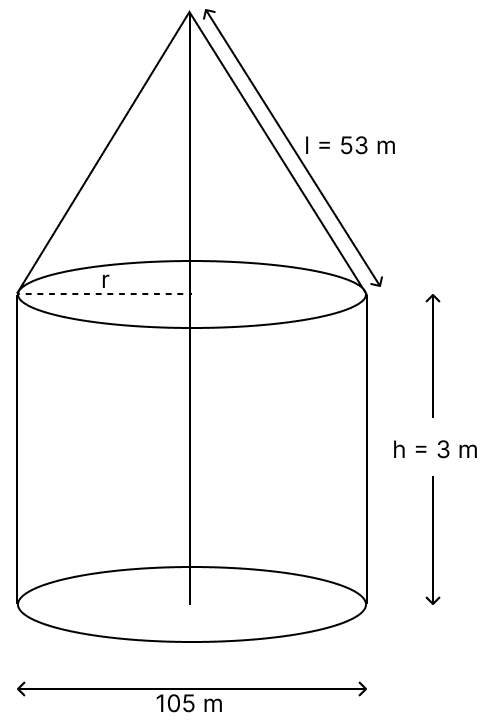
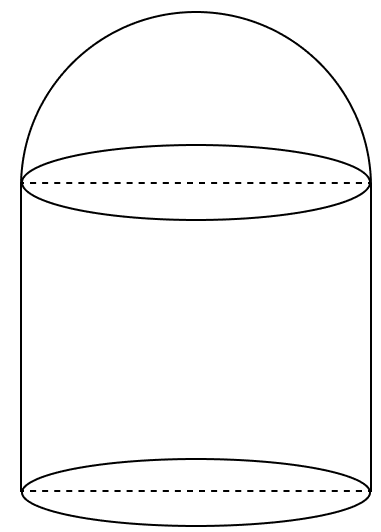
At an NCC camp, several tents were installed. Each tent is cylindrical to a height of 3 m and conical above it. The total height of the tent is 13.5 m and the radius of its base is 14 m.
Based on this information, answer the following questions:
- The slant height of the conical portion of the tent is :
(a) 16.5 m
(b) 17.5 m
(c) 18.5 m
(d) 19.5 m
- The cost of cloth required to make each tent at the rate of ₹ 80 per square meter is :
(a) ₹ 76560
(b) ₹ 80140
(c) ₹ 82720
(d) ₹ 85960
- If each cadet requires 8 m2 of floor space and there are 15 tents in all how many cadets can be accommodated in the camp?
(a) 960
(b) 1155
(c) 1320
(d) 1440
- If a tent has maximum number of cadets that it can accommodate as calculated in the above questions, what is the volume of air available to each cadet to breathe?
(a) 48 m3
(b) 52 m3
(c) 55 m3
(d) 77 m3
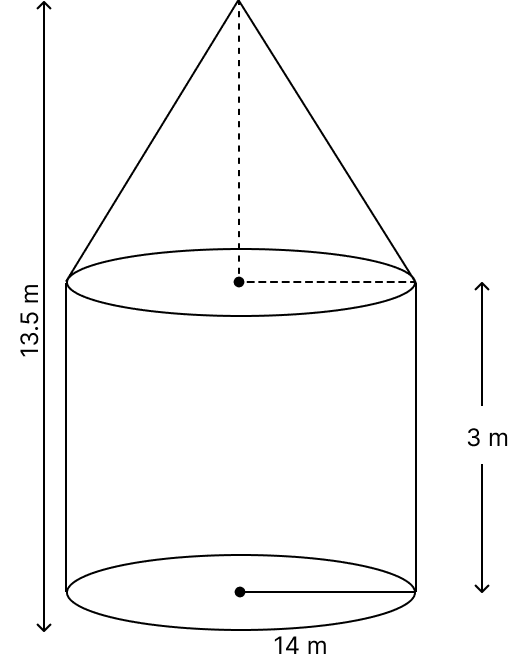
67. Given,
Height of cylinder, h = 3 m
Total height of tent, T = 13.5 m
Height of cone, H = T - h = 13.5 - 3 = 10.5 m
Radius of base of cylinder = Radius of cone = r = 14 m
Slant height of cone be l m.
l2 = r2 + H2
⇒ l2 = 142 + 10.52
⇒ l2 = 196 + 110.25
⇒ l2 = 306.25
⇒ l = $\sqrt{306.25}$ = 17.5 m
Hence, Option (b) is the correct option.
68. Curved surface area of tent = Curved surface area of cone + Curved surface area of cylinder
= 2πrh + πrl
= πr(2h + l)
$$\begin{aligned}= \frac{22}{7} \times 14 (2 \times 3 + 17.5) \\[1em] = 22 \times 2(6 + 17.5) \\[1em] = 44 \times 23.5 \\[1em] = 1034 \text{ m}^2.\end{aligned}$$
Given, cost of cloth required to make each tent is ₹ 80 per square meter.
⇒ Total cost = 80 × 1034 = ₹ 82720
Hence, Option (c) is the correct option.
69. The floor space of a tent is base area of cylinder.
∴ Area of base = πr2
= $\frac{22}{7}$ × 14 × 14
= 22 × 2 × 14
= 616 m2
Given each cadet requires 8 m2 of floor space.
The number of cadets per tent = $\frac{\text{Area of base}}{\text{space required per cadet}} = \frac{616}{8}$ = 77 cadets.
Given, there are 15 tents.
∴ Total number of cadets = 77 × 15 = 1155 cadets.
Hence, Option (b) is the correct option.
70. Volume of air in each tent = Volume of air in cylinder + Volume of air in cone
$$\begin{aligned}= π\text{r}^2\text{h} + \frac{1}{3}π\text{r}^2\text{H} \\[1em] = π\text{r}^2 (\text{h} + \frac{1}{3}\text{H}) \\[1em] = \frac{22}{7} \times 14^2 (3 + \frac{1}{3} \times 10.5) \\[1em] = \frac{22}{7} \times 196 (3 + 3.5) \\[1em] = 22 \times 28 \times 6.5 \\[1em] = 4004 \text{ m}^3.\end{aligned}$$
Volume of air available to each cadet to breathe = $\frac{\text{Volume of air per tent}}{\text{Cadets per tent}} = \frac{4004}{77}$ = 52 m3.
Hence, Option (b) is the correct option.
Directions:
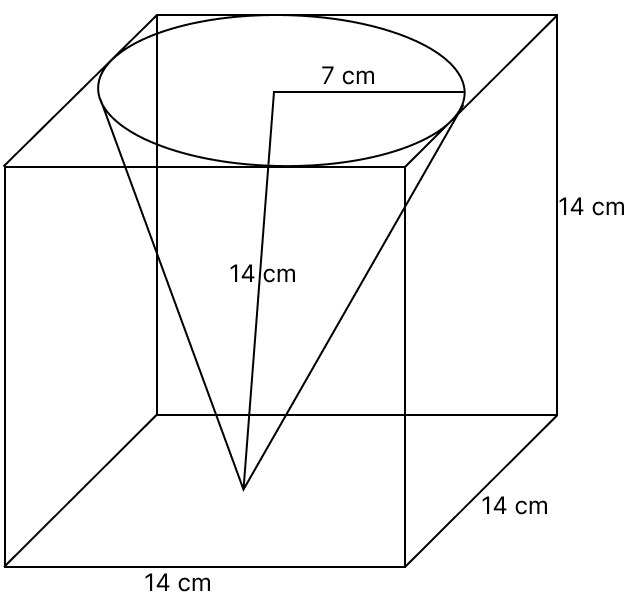
From a solid cylinder of height 30 cm and radius 7 cm, a conical cavity of height 24 cm and of base radius 7 cm is drilled out.
Based on this information, answer the following questions:
- The volume of the remaining solid is :
(a) 2856 cm3
(b) 3388 cm3
(c) 3672 cm3
(d) 4620 cm3
- The total surface area of the remaining solid is :
(a) 1870 cm2
(b) 2024 cm2
(c) 2178 cm2
(d) 2332 cm2
- The slant height of the cut out cone is :
(a) 18 cm
(b) 25 cm
(c) 26 cm
(d) 32 cm
- The total surface area of the cut out cone is :
(a) 550 cm2
(b) 704 cm2
(c) 858 cm2
(d) 616 cm2

71. Radius of solid cylinder = Radius of cone = r = 7 cm
Height of the cylinder, H = 30 cm
Height of cone, h = 24 cm
Volume of remaining solid = Volume of cylinder - Volume of cone
$$\begin{aligned}= π\text{r}^2\text{H} - \frac{1}{3}π\text{r}^2\text{h} \\[1em] = π\text{r}^2(\text{H} - \frac{\text{h}}{3}) \\[1em] = \frac{22}{7} \times 7^2 \times (30 - \frac{24}{3}) \\[1em] = \frac{22}{7} \times 49 \times (30 - 8) \\[1em] = 22 \times 7 \times 22 \\[1em] = 3388 \text{ cm}^3.\end{aligned}$$
Hence, Option (b) is the correct option.
72. Slant height of cone, l = $\sqrt{\text{h}^2 + \text{r}^2} = \sqrt{24^2 + 7^2} = \sqrt{576 + 49} = \sqrt{625}$ = 25 cm
Total surface area of reamining solid = Curved surface area of cylinder + Area of base of cylinder + Curved surface area of cone
= 2πrH + πr2 + πrl
= πr(2H + r + l)
= $\frac{22}{7}$ × 7 (2 × 30 + 7 + 25)
= 22 × (60 + 32)
= 22 × 92
= 2024 cm2.
Hence, Option (b) is the correct option.
73. Slant height of cone, l = $\sqrt{\text{h}^2 + \text{r}^2} = \sqrt{24^2 + 7^2} = \sqrt{576 + 49} = \sqrt{625}$ = 25 cm
Hence, Option (b) is the correct option.
74. Total surface area of cut out cone = πr2 + πrl
= πr(r + l)
= $\frac{22}{7}$ × 7 × (7 + 25)
= 22 × 32
= 704 cm2
Hence, Option (b) is the correct option.
Directions:
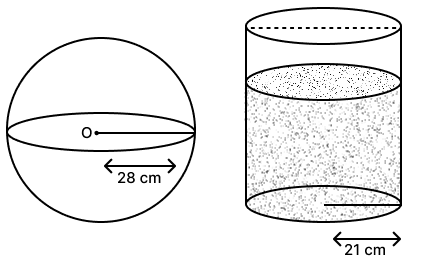
The surface area of a solid metallic sphere is 900 π cm2.
Based on this information, answer the following questions:
- If the given sphere is melted and recast into 3 smaller spheres of equal volumes, then the radius of each smaller sphere is :
(a) 5 cm
(b) 5 $\sqrt{3}$ cm
(c) 5 $\sqrt[3]{3}$ cm
(d) 5 $\sqrt[3]{9}$ cm
- If the given sphere is cut into two hemispheres, then how much does the total surface area get increased? (Take π = 3.14) :
(a) no change
(b) 706.5 cm2
(c) 1015 cm2
(d) 1413 cm2
- If the given sphere is melted and recast into solid right cones, each of radius 2.5 cm and height 8 cm, how many cones are formed?
(a) 135
(b) 270
(c) 405
(d) 540
- If the given sphere is melted and recast into small spheres each of radius 0.5 cm, then the number of spheres formed is :
(a) 1350
(b) 2700
(c) 13500
(d) 27000
75. Given,
Let radius of sphere be R cm.
Surface area of a solid metallic sphere = 900 π cm2
∴ 4πR2 = 900 π
⇒ 4R2 = 900
⇒ R2 = $\frac{900}{4}$
⇒ R2 = 225
⇒ R = $\sqrt{225}$
⇒ R = 15 cm
Let radius of small spheres be r cm.
Since, the given sphere is melted and recast into 3 smaller spheres of equal volumes.
Volume of sphere = 3 × Volume of small spheres
$$\begin{aligned}\therefore \frac{4}{3}π\text{R}^3 = 3 \times \frac{4}{3}π\text{r}^3 \\[1em] \Rightarrow \text{R}^3 = 3 \times \text{r}^3 \\[1em] \Rightarrow 15^3 = 3 \times \text{r}^3 \\[1em] \Rightarrow 3375 = 3 \times \text{r}^3 \\[1em] \Rightarrow \text{r}^3 = \frac{3375}{3} \\[1em] \Rightarrow \text{r}^3 = 1125 \\[1em] \Rightarrow \text{r} = \sqrt[3]{1125} \\[1em] \Rightarrow \text{r} = \sqrt[3]{125 \times 9} \\[1em] \Rightarrow \text{r} = 5\sqrt[3]{9} \text{ cm.}\end{aligned}$$
Hence, Option (d) is the correct option.
76. When a sphere is cut into two hemispheres, two new circular faces are exposed.
∴ Radius of hemisphere = R = 15 cm.
The increase in total surface area = Area of two circular faces
= 2 × πR2
= 2 × 3.14 × 152
= 2 × 3.14 × 225
= 1413 cm2
Hence, Option (d) is the correct option.
77. Let, radius of cone be a = 2.5 cm
Height of cone, h = 8 cm
Let solid right cones formed be n.
Since, the given sphere is melted and recast into solid right cones.
∴ Volume of sphere = n × Volume of cone
$$\begin{aligned}\therefore \frac{4}{3}π \text{R}^3 = \text{n} \times \frac{1}{3}π\text{a}^2 \text{h} \\[1em] \Rightarrow 4 \text{R}^3 = \text{n} \times \text{a}^2 \text{h} \\[1em] \Rightarrow \text{n} = \frac{4 \text{R}^3}{\text{a}^2 \text{h}} \\[1em] \Rightarrow \text{n} = \frac{4 \times 15^3}{2.5^2 \times 8} \\[1em] \Rightarrow \text{n} = \frac{4 \times 3375}{6.25 \times 8} \\[1em] \Rightarrow \text{n} = \frac{13500}{50} \\[1em] \Rightarrow \text{n} = 270.\end{aligned}$$
Hence, Option (b) is the correct option.
78. Let radius of small spheres be b = 0.5 cm.
Let number of small spheres formed be n.
Since, the given sphere is melted and recast into small spheres.
∴ Volume of sphere = n × Volume of small spheres
$$\begin{aligned}\therefore \frac{4}{3}π \text{R}^3 = \text{n} \times \frac{4}{3}π \text{b}^3 \\[1em] \Rightarrow \text{R}^3 = \text{n} \times \text{b}^3 \\[1em] \Rightarrow \text{n} = \frac{\text{R}^3}{\text{b}^3} \\[1em] \Rightarrow \text{n} = \frac{15^3}{0.5^3} \\[1em] \Rightarrow \text{n} = \frac{3375}{0.125} \\[1em] \Rightarrow \text{n} = 27000.\end{aligned}$$
Hence, Option (d) is the correct option.