Arithmetic Progression

ICSE Class 10 Mathematics · RS Aggarwal Mathematics · 97 solved questions

Exercise
Marks
1Exercise 10A

Show that the progression 11, 13, 15, 17, 19,........is an A.P. Write down its :

(i) first term

(ii) common difference

(iii) 20th term.

Show SolutionHide Solution↓

Since, 13 - 11 = 2, 15 - 13 = 2, 17 - 15 = 2 and 19 - 17 = 2.

Hence, the series is an A.P. with common difference = 2.

We know that nth term of an A.P. is given by,

⇒ an = a + (n - 1)d, where a is the first term.

⇒ a20 = 11 + (20 - 1)2

= 11 + (19)2

= 11 + 38

= 49.

Hence, a = 11, d = 2 and a20 = 49.

2Exercise 10A

Show that the progression 13, 20, 27, 34, ........ is an A.P.

Write down its :

(i) first term

(ii) common difference

(iii) 16th term.

Show SolutionHide Solution↓

Since, 20 - 13 = 7, 27 - 20 = 7, and 34 - 27 = 7.

Hence, the series is an A.P. with common difference = 7.

We know that,

nth term of an A.P. is given by,

⇒ an = a + (n - 1)d, where a is the first term.

⇒ a16 = 13 + (16 - 1)7

= 13 + (15) × 7

= 13 + 105

= 118.

Hence, a = 13, d = 7 and a16 = 118.

3Exercise 10A

Show that the progression 10, 6, 2, -2, -6,........is an A.P. Write down its

(i) first term

(ii) common difference

(iii) 10th term.

Show SolutionHide Solution↓

Since, 6 - 10 = -4, 2 - 6 = -4, -2 - 2 = -4 and -6 - (-2) = -4.

Hence, the series is an A.P. with common difference = -4.

We know that nth term of an A.P. is given by,

⇒ an = a + (n - 1)d, where a is the first term.

⇒ a10 = 10 + (10 - 1).(-4)

= 10 + (9)-4

= 10 - 36

= -26.

Hence, a = 10, d = -4 and a20 = -26.

4Exercise 10A

Show that the progression 11, 5, -1, -7, -13,........is an A.P. Write down its

(i) first term

(ii) common difference

(iii) 12th term.

Show SolutionHide Solution↓

Since, 5 - 11 = -6, -1 - 5 = -6, -7 - (-1) = -6 and -13 - (-7) = -6.

Hence, the series is an A.P. with common difference = -6.

We know that nth term of an A.P. is given by,

⇒ an = a + (n - 1)d, where a is the first term.

⇒ a12 = 11 + (12 - 1).(-6)

= 11 + 11(-6)

= 11 - 66

= -55.

Hence, a = 11, d = -6 and a12 = -55.

5Exercise 10A

Show that the progression 6, $7\frac{3}{4}, 9\frac{1}{2}, 11\frac{1}{4}$,........is an A.P. Write down its

(i) first term

(ii) common difference

(iii) 17th term.

Show SolutionHide Solution↓

$$\begin{aligned}7\frac{3}{4} = \frac{31}{4} = 7.75 \\[1em] 9\frac{1}{2} = \frac{19}{2} = 9.5 \\[1em] 11\frac{1}{4} = \frac{45}{4} = 11.25 \\[1em]\end{aligned}$$

Since, 7.75 - 6 = 1.75, 9.5 - 7.75= 1.75 and 11.25 - 9.5 = 1.75.

Hence, the series is an A.P. with common difference = 1.75.

We know that nth term of an A.P. is given by,

⇒ an = a + (n - 1)d, where a is the first term.

⇒ a17 = 6 + (17 - 1)1.75

= 6 + (16)1.75

= 6 + 28

= 34.

Hence, a = 6, d = $\frac{7}{4}$ and a17 = 34.

6Exercise 10A

Show that the progression 6, $5\frac{1}{2}, 5, 4\frac{1}{2}, 4$,........is an A.P. Write down its

(i) first term

(ii) common difference

(iii) 9th term.

Show SolutionHide Solution↓

Series :

$\Rightarrow 6, 5\frac{1}{2}, 5, 4\frac{1}{2}, 4$

⇒ 6, 5.5, 5, 4.5, 4

Since, 5.5 - 6 = -0.5, 5 - 5.5 = -0.5, 4.5 - 5 = -0.5 and 4.0 - 4.5 = -0.5.

Hence, the series is an A.P. with common difference (d) = -0.5

We know that nth term of an A.P. is given by,

⇒ an = a + (n - 1)d, where a is the first term.

⇒ a9 = 6 + (9 - 1)(-0.5)

= 6 + 8(-0.5)

= 6 - 4

= 2.

Hence, a = 6, d = -0.5 and a9 = 2.

7Exercise 10A

Find the nth term of the A.P. 5, 11, 17, 23,....... Using it, find its

(i) 11th term

(ii) 21st term.

Show SolutionHide Solution↓

Given,

a = 5

d = 11 - 5 = 6

nth term of an A.P. is given by,

an = a + (n - 1)d

an = 5 + (n - 1)6

= 5 + 6n - 6

= 6n - 1.

(i) 11th term:

⇒ a11 = 5 + (11 - 1)6

= 5 + 10(6)

= 5 + 60

= 65.

(ii) 21st term

⇒ a21 = 5 + (21 - 1)6

= 5 + (20)6

= 5 + 120

= 125.

Hence, nth term = 6n - 1, 11th term = 65 and 21st term = 125.

8Exercise 10A

Find the nth term of the A.P. 13, 7, 1, -5, -11, ....... Using it, find its

(i) 9th term

(ii) 16th term.

Show SolutionHide Solution↓

Given,

a = 13

d = 7 - 13 = -6

nth term of an A.P. is given by,

an = a + (n - 1)d

an = 13 + (n - 1)(-6)

= 13 - 6n + 6

= 19 - 6n.

(i) 9th term

⇒ a9 = 13 + (9 - 1).(-6)

= 13 + 8(-6)

= 13 - 48

= -35.

(ii) 16th term

⇒ a16 = 13 + (16 - 1).(-6)

= 13 + (15).(-6)

= 13 - 90

= -77.

Hence, nth term = 19 - 6n, 9th term = -35 and 16th term = -77.

9Exercise 10A

How many terms are there in the A.P. 6, 10, 14, 18, ...., 174 ?

Show SolutionHide Solution↓

nth term of an A.P. is given by,

an = a + (n - 1)d

Given,

⇒ a = 6

⇒ d = 10 - 6 = 4

⇒ an = 174

⇒ 174 = 6 + (n - 1)4

⇒ 174 - 6 = (n - 1)4

⇒ 168 = (n - 1)4

⇒ $\frac{168}{4}$ = n - 1

⇒ 42 = n - 1

⇒ n = 42 + 1

⇒ n = 43.

Hence, there are 43 terms in the A.P.

10Exercise 10A

How many terms are there in the A.P. 41, 38, 35 ,...., -1 ?

Show SolutionHide Solution↓

nth term of an A.P. is given by,

an = a + (n - 1)d

Given,

a = 41

d = 38 - 41 = -3

Let nth term be -1.

⇒ an = -1

⇒ a + (n - 1)d = -1

⇒ -1 = 41 + (n - 1)(-3)

⇒ - 1 - 41 = (n - 1)(-3)

⇒ -42 = (n - 1)(-3)

⇒ $\frac{-42}{-3}$ = n - 1

⇒ 14 = n - 1

⇒ n = 14 + 1

⇒ n = 15.

Hence, there are 15 terms in the A.P.

11Exercise 10A

Which term of A.P. 3, 8, 13, 18, 23,...., is 98?

Show SolutionHide Solution↓

In the A.P. 3, 8, 13, 18, 23,...., a = 3 and d = 8 - 3 = 5.

Let nth term be 98.

∴ an = 98

nth term of an A.P. is given by,

an = a + (n - 1)d

⇒ 98 = 3 + (n - 1)5

⇒ 98 - 3 = (n - 1)5

⇒ 95 = (n - 1)5

⇒ (n - 1) = $\frac{95}{5}$

⇒ n - 1 = 19

⇒ n = 19 + 1

⇒ n = 20.

Hence, 20th term of A.P. is 98.

12Exercise 10A

Which term of A.P. 72, 68, 64, 60, ...., is 0 ?

Show SolutionHide Solution↓

In the A.P. 72, 68, 64, 60,...., a = 72 and d = 68 - 72 = -4.

Let nth term be 0.

∴ an = 0

nth term of an A.P. is given by,

an = a + (n - 1)d

⇒ 0 = 72 + (n - 1)(-4)

⇒ -72 = (n - 1)(-4)

⇒ n - 1 = $\frac{-72}{-4}$

⇒ n - 1 = 18

⇒ n = 18 + 1

⇒ n = 19.

Hence, 19th term of A.P. is 0.

13Exercise 10A

Which term of A.P. 1, $1\frac{1}{6}, 1\frac{1}{3}$,....,is 3?

Show SolutionHide Solution↓

Series :

$\Rightarrow 1, 1\frac{1}{6}, 1\frac{1}{3}, ......$

$\Rightarrow 1, \frac{7}{6}, \frac{4}{3}, ......$

In the A.P. 1, $1\frac{1}{6}, 1\frac{1}{3}$,...., a = 1 and d = $\frac{7}{6} - 1 = \frac{1}{6}$

Let nth term be 3.

∴ an = 3

nth term of an A.P. is given by,

an = a + (n - 1)d

$$\begin{aligned}\Rightarrow 3 = 1 + (n - 1)\frac{1}{6} \\[1em] \Rightarrow 3 = 1 + (n - 1)\frac{1}{6} \\[1em] \Rightarrow 3 - 1 = (n - 1)\frac{1}{6} \\[1em] \Rightarrow 2 = (n - 1)\frac{1}{6} \\[1em] \Rightarrow 2 \times 6 = (n - 1) \\[1em] \Rightarrow 12 = (n - 1) \\[1em] \Rightarrow n = 12 + 1 \\[1em] \Rightarrow n = 13.\end{aligned}$$

Hence, 13th term of A.P. is 3.

14Exercise 10A

The 4th and 10th terms of A.P. are 13 and 25 respectively. Find its (i) first term (ii) common difference (iii) 17th term.

Show SolutionHide Solution↓

We know that,

nth term of an A.P. is given by,

an = a + (n - 1)d

Given, 4th term is 13.

∴ a4 = a + (4 - 1)d

⇒ 13 = a + 3d

⇒ a + 3d = 13 .......(1)

Given, 10th term is 25

∴ a10 = a + (10 - 1)d

⇒ 25 = a + 9d

⇒ a + 9d = 25 ......(2)

Subtracting equation (1) from (2) we get,

⇒ a + 9d - (a + 3d) = 25 - 13

⇒ a + 9d - a - 3d = 12

⇒ 6d = 12

⇒ d = $\frac{12}{6}$

⇒ d = 2.

Substituting value of d in (1) we get,

⇒ a + 3(2) = 13

⇒ a + 6 = 13

⇒ a = 13 - 6

⇒ a = 7.

∴ a17 = 7 + (17 - 1)2

= 7 + (16)2

= 7 + 32

= 39.

Hence, a = 7, d = 2 and a17 = 39.

15Exercise 10A

The 7th term of an A.P. is -4 and its 13th term is -16. Find its (i) first term (ii) common difference (iii) nth term.

Show SolutionHide Solution↓

Let first term be a and common difference be d.

We know that,

nth term of an A.P. is given by,

an = a + (n - 1)d

Given, 7th term is -4.

∴ a7 = a + (7 - 1)d

⇒ -4 = a + 6d

⇒ a + 6d = -4 ....(1)

Given,

13th term is -16

∴ a13 = a + (13 - 1)d

⇒ -16 = a + 12d

⇒ a + 12d = -16 ....(2)

Subtracting (1) from (2) we get,

⇒ a + 12d - (a + 6d) = -16 - (-4)

⇒ a + 12d - a - 6d = -16 + 4

⇒ 6d = -12

⇒ d = $\frac{-12}{6}$

⇒ d = -2.

Substituting value of d in (1) we get,

⇒ a + 6(-2) = -4

⇒ a - 12 = -4

⇒ a = -4 + 12

⇒ a = 8.

∴ an = 8 + (n - 1)(-2)

= 8 - 2n + 2

= 10 - 2n.

Hence, a = 8, d = -2 and an = 10 - 2n.

16Exercise 10A

Find the 8th term from end of the A.P. 7, 10, 13,....., 184.

Show SolutionHide Solution↓

We know that,

nth term of an A.P. is given by,

an = a + (n - 1)d

Given,

a = 7

d = 10 - 7 = 3

⇒ an = 184

⇒ an = 7 + (n - 1)3

⇒ 184 = 7 + (n - 1)3

⇒ 184 - 7 = (n -1)3

⇒ 177 = (n - 1)3

⇒ $\frac{177}{3}$ = (n - 1)

⇒ (n - 1) = 59

⇒ n = 59 + 1

⇒ n = 60.

There are 60 terms in the A.P.

The 8th term from end of the A.P. is 53rd (60 - 7) term from the starting.

⇒ a53 = 7 + (53 - 1)3

= 7 + (52)3

= 7 + 156

= 163.

Hence, the 8th term from end of the A.P is 163.

17Exercise 10A

Find the 6th term from end of the A.P. 17, 14, 11,....., (-40).

Show SolutionHide Solution↓

We know that,

nth term of an A.P. is given by,

an = a + (n - 1)d

Given,

a = 17

d = 14 - 17 = -3

Let no. of terms be n.

⇒ an = -40

By formula,

⇒ an = a + (n - 1)d

⇒ -40 = 17 + (n - 1)(-3)

⇒ -40 - 17 = (n - 1)(-3)

⇒ -57 = (n - 1)(-3)

⇒ $\frac{-57}{-3}$ = n - 1

⇒ 19 = n - 1

⇒ n = 19 + 1

⇒ n = 20.

There are 20 terms in the A.P.

The 8th term from end of the A.P. = 20 - 5 = 15

⇒ a15 = 17 + (15 - 1)-3

= 17 + (14)-3

= 17 - 42

= -25

Hence, the 6th term from end of the A.P is -25.

18(i)Exercise 10A

Find the value of x for which the numbers (5x + 2), (4x - 1) and (x + 2) are in A.P.

Show SolutionHide Solution↓

Since, (5x + 2), (4x - 1) and (x + 2) are in A.P.

Hence, difference between consecutive terms are equal.

∴ (4x - 1) - (5x + 2) = (x + 2) - (4x - 1)

⇒ 4x - 1 - 5x - 2 = x + 2 - 4x + 1

⇒ -3 - x = 3 - 3x

⇒ -3 - 3 = -3x + x

⇒ -6 = -2x

⇒ x = $\frac{-6}{-2}$

⇒ x = 3.

Hence, the value of x = 3.

18(ii)Exercise 10A

If (k - 3), (2k + 1) and (4k + 3) are three consecutive terms of an A.P., find the value of k.

Show SolutionHide Solution↓

Since, (k - 3), (2k + 1) and (4k + 3) are in A.P.

Hence, difference between consecutive terms are equal.

∴ 2k + 1 - (k - 3) = 4k + 3 - (2k + 1)

⇒ 2k + 1 - k + 3 = 4k + 3 - 2k - 1

⇒ k + 4 = 2k + 2

⇒ 4 - 2 = 2k - k

⇒ k = 2.

Hence, the value of k = 2.

19Exercise 10A

Find three numbers in A.P., whose sum is 15 and the product is 80.

Show SolutionHide Solution↓

Let the three numbers in the Arithmetic Progression (A.P.) be a - d, a, a + d.

Given,

The sum of the three numbers is 15.

⇒ a - d + a + a + d = 15

⇒ 3a = 15

⇒ a = $\frac{15}{3}$

⇒ a = 5.

The middle term of the A.P. is 5.

Given,

The product of the three numbers is 80.

⇒ (a - d)(a)(a + d) = 80

⇒ (5 - d)(5)(5 + d) = 80

⇒ (5 - d)(5 + d) = $\frac{80}{5}$

⇒ (5 - d)(5 + d) = 16

⇒ 52 - d2 = 16

⇒ 25 - d2 = 16

⇒ d2 = 25 - 16

⇒ d2 = 9

⇒ d = $\sqrt{9}$

⇒ d = 3 or d = -3.

Case 1 : If a = 5 and d = 3

⇒ a - d = 5 - 3 = 2

⇒ a = 5

⇒ a + d = 5 + 3 = 8.

Case 2 : If a = 5 and d = -3

⇒ a - d = 5 - (-3) = 8

⇒ a = 5

⇒ a + d = 5 + (-3) = 2.

Hence, the numbers are 2, 5, 8.

20Exercise 10A

The angles of quadrilateral are in A.P., whose common difference is 10°. Find the angles.

Show SolutionHide Solution↓

Let the four angles of the quadrilateral be in A.P. with common difference 10° be:

a, a + 10°, a + 20°, a + 30°

The sum of the interior angles of any quadrilateral is always 360°.

⇒ a + a + 10° + a + 20° + a + 30° = 360°

⇒ 4a + 60° = 360°

⇒ 4a = 360° - 60°

⇒ 4a = 300°

⇒ a = $\frac{300°}{4}$

⇒ a = 75°

⇒ a + 10° = 75° + 10° = 85°

⇒ a + 20° = 75° + 20° = 95°

⇒ a + 30° = 75° + 30° = 105°.

Hence, the angles of quadrilateral are 75°, 85°, 95°, 105°.

21Exercise 10A

The angles of triangle are in A.P. whose common difference is 20°. Find angles.

Show SolutionHide Solution↓

Let the three angles of triangle in A.P. be represented as : a - d, a, a + d.

The sum of the interior angles of any triangle is always 180°.

⇒ a - d + a + a + d = 180°

⇒ 3a = 180

⇒ a = $\frac{180}{3}$

⇒ a = 60°.

Given,

The common difference is 20°

⇒ a - 20° = 60° - 20° = 40°

⇒ a + 20° = 60° + 20° = 80°.

Hence, the angles of triangle are 40°, 60°, 80°.

22Exercise 10A

-11, -7, -3, .......,49, 53 are the terms of a progression.

Answer the following:

(i) What is the type of progression?

(ii) How many terms are there in all?

(iii) Calculate the value of middle most term.

Show SolutionHide Solution↓

(i) Given,

-11, -7, -3, ......,49, 53

Second term - First term : −7 − (−11) = 4

Third term - Second term : −3 − (−7) = 4

Last term - Second last term : 53 − 49 = 4

Since the difference between consecutive terms is constant, the progression is an Arithmetic Progression (AP) with first term (a) = -11 and common difference (d) = 4.

Hence, the progression is an Arithmetic Progression.

(ii) Let 53 be the nth term.

By formula,

⇒ tn = a + (n - 1)d

⇒ 53 = -11 + (n - 1)4

⇒ 53 = -11 + 4n - 4

⇒ 53 = -15 + 4n

⇒ 4n = 53 + 15

⇒ 4n = 68

⇒ n = $\frac{68}{4}$

⇒ n = 17.

Hence, there are a total of 17 terms in the progression.

(iii) Since, n = 17, is odd.

By formula,

Middle term = $\frac{n + 1}{2}$

= $\frac{17 + 1}{2}$

= $\frac{18}{2}$

= 9.

Thus, 9th term is middle term.

By formula,

⇒ t9 = a + (n - 1)d

= -11 + (9 - 1) × 4

= -11 + 8 × 4

= -11 + 32

= 21.

Hence, the value of the middle most term is 21.

1Exercise 10B

Find the sum :

2 + 7 + 12 + 17 + ..... to 19 terms.

Show SolutionHide Solution↓

The above sequence is an A.P. with common difference = 12 - 7 = 5.

We know that,

Sum of n terms of an A.P. is given by,

∴ Sn = $\frac{n}{2}$ [2a + (n - 1)d]

⇒ S19 = $\frac{19}{2}$ [2(2) + (19 - 1)5]

= 9.5 [4 + (18)5]

= 9.5 [4 + 90]

= 9.5 (94)

= 893.

Hence, S19 = 893.

2Exercise 10B

Find the sum :

9 + 7 + 5 + 3 +......to 14 terms.

Show SolutionHide Solution↓

The above sequence is an A.P. with common difference = 5 - 7 = -2.

We know that,

Sum of n terms of an A.P. is given by,

∴ Sn = $\frac{n}{2}$ [2a + (n - 1)d]

⇒ S14 = $\frac{14}{2}$ [2(9) + (14 - 1)(-2)]

= 7[18 + (13)(-2)]

= 7[18 - 26]

= 7.(-8)

= -56.

Hence, S14 = -56.

3Exercise 10B

Find the sum :

(-11) + (-7) + (-3) + 1 +......to 12 terms.

Show SolutionHide Solution↓

The above sequence is an A.P. with common difference = -7 - (-11) = 4.

We know that,

Sum of n terms of an A.P. is given by,

∴ Sn = $\frac{n}{2}$ [2a + (n - 1)d]

⇒ S12 = $\frac{12}{2}$ [2(-11) + (12 - 1)4]

= 6.[-22 + (11)4]

= 6.[-22 + 44]

= 6.(22)

= 132.

Hence, S12 = 132.

4Exercise 10B

Find the sum :

$\frac{1}{15}, \frac{1}{12}, \frac{1}{10}$, ......to 11 terms.

Show SolutionHide Solution↓

We know that,

Sum of n terms of an A.P. is given by,

∴ Sn = $\frac{n}{2}$ [2a + (n - 1)d]

Given,

a = $\frac{1}{15}$

d = $\frac{1}{12} - \frac{1}{15} = \frac{5 - 4}{60} = \frac{1}{60}$

n = 11

$$\begin{aligned}\Rightarrow S_{11} = \frac{11}{2} \Big[2\Big(\frac{1}{15}\Big) + (11 - 1)\Big(\frac{1}{60}\Big)\Big] \\[1em] = \frac{11}{2} \Big[\Big(\frac{2}{15}\Big) + \Big(\frac{10}{60}\Big)\Big] \\[1em] = \frac{11}{2} \Big[\frac{2 \times 2 + 1 \times 5 }{30}\Big] \\[1em] = \frac{11}{2} \Big[\frac{4 + 5}{30}\Big] \\[1em] = \frac{11}{2} \Big[\frac{9}{30}\Big] \\[1em] = \frac{11}{2} \Big[\frac{3}{10}\Big] \\[1em] = \frac{33}{20}.\end{aligned}$$

Hence, S11 = $\frac{33}{20}$.

5Exercise 10B

Find the sum :

0.6 + 1.7 + 2.8 +..... to 100 terms.

Show SolutionHide Solution↓

We know that,

Sum of n terms of an A.P. is given by,

∴ Sn = $\frac{n}{2}$ [2a + (n - 1)d]

Given,

a = 0.6

d = 1.7 - 0.6 = 1.1

n = 100

⇒ S100 = $\frac{100}{2}$ [2(0.6) + (100 - 1)1.1]

= 50 [1.2 + (99)1.1]

= 50 [1.2 + 108.9]

= 50 (110.1)

= 5505.

Hence, S100 = 5505.

6Exercise 10B

Find the sum :

7 + $10\frac{1}{2}$ + 14 +......+ 84.

Show SolutionHide Solution↓

Series :

7 + 10.5 + 14 + ....... + 84

The above series is an A.P. with common difference = 3.5

Let 84 be nth term in the A.P.

We know that,

∴ an = a + (n - 1)d

⇒ 84 = 7 + (n - 1) × 3.5

⇒ 84 - 7 = (n - 1) × 3.5

⇒ 77 = (n - 1) × 3.5

⇒ $\frac{77}{3.5}$ = (n - 1)

⇒ 22 = (n - 1)

⇒ n = 22 + 1

⇒ n = 23.

We know that,

Sum of n terms of an A.P. is given by,

∴ Sn = $\frac{n}{2}$ (a + l)

⇒ S23 = $\frac{23}{2}$ (7 + 84)

= $\frac{23}{2}$ (91)

= $\frac{2093}{2} = 1046\frac{1}{2}$

Hence, S23 = $1046\frac{1}{2}$.

7Exercise 10B

Find the sum :

32 + 30 + 28 +........+ 10.

Show SolutionHide Solution↓

Let total number of terms in the A.P. be n.

We know that,

∴ an = a + (n - 1)d

⇒ 10 = 32 + (n - 1).(-2)

⇒ 10 - 32 = (n - 1).(-2)

⇒ -22 = (n - 1).(-2)

⇒ $\frac{-22}{-2}$ = (n - 1)

⇒ 11 = n - 1

⇒ n = 11 + 1

⇒ n = 12.

We know that,

Sum of n terms of an A.P. is given by,

∴ Sn = $\frac{n}{2}$ (a + l)

⇒ S12 = $\frac{12}{2}$ (32 + 10)

= 6 × 42

= 252.

Hence, S12 = 252.

8Exercise 10B

Find the sum :

(-5) + (-8) + (-11) +....... + (-62).

Show SolutionHide Solution↓

Let total number of terms in an A.P. be n.

We know that,

∴ an = a + (n - 1)d

Given,

a = -5

d = -8 - (-5) = -3

⇒ an = -5 + (n - 1)-3

⇒ -62 = -5 + (n - 1)-3

⇒ -62 - (-5) = (n - 1)-3

⇒ -62 - (-5) = (n - 1)-3

⇒ -57 = (n - 1)-3

⇒ $\frac{-57}{-3}$ = (n - 1)

⇒ 19 = (n - 1)

⇒ n = 19 + 1

⇒ n = 20

We know that,

Sum of n terms of an A.P. is given by,

∴ Sn = $\frac{n}{2}$ (a + l)

⇒ S20 = $\frac{20}{2}$ [-5 + (-62)]

= 10 [-5 + (-62)]

= 10(-67)

= -670.

Hence, S20 = -670.

9Exercise 10B

Find the sum of all 2-digit natural numbers divisible by 5.

Show SolutionHide Solution↓

The 2-digit natural numbers divisible by 5 form an A.P., with common difference = 5.

10, 15, 20,.....,95

Let total number of terms in an A.P. be n.

We know that,

∴ an = a + (n - 1)d

⇒ 95 = 10 + (n - 1)5

⇒ 95 - 10 = (n - 1)5

⇒ 85 = (n - 1)5

⇒ $\frac{85}{5}$ = (n - 1)

⇒ 17 = (n - 1)

⇒ n = 17 + 1

⇒ n = 18.

We know that,

Sum of n terms of an A.P. is given by,

∴ Sn = $\frac{n}{2}$ (a + l)

⇒ S18 = $\frac{18}{2} \times (10 + 95)$

= 9(105)

= 945.

Hence, S18 = 945.

10(i)Exercise 10B

Find the sum of all even numbers between 10 and 100.

Show SolutionHide Solution↓

Even numbers between 10 and 100 are :

12, 14, 16, ....., 98

Let total number of terms in A.P. be n.

Given,

a = 12

d = 14 - 12 = 2

We know that,

∴ an = a + (n - 1)d

⇒ 98 = 12 + (n - 1)2

⇒ 98 - 12 = (n - 1)2

⇒ 86 = (n - 1)2

⇒ $\frac{86}{2}$ = (n - 1)

⇒ n - 1 = 43

⇒ n = 43 + 1

⇒ n = 44

We know that,

Sum of n terms of an A.P. is given by,

∴ Sn = $\frac{n}{2}$ (a + l)

⇒ S44 = $\frac{44}{2}$ (12 + 98)

= 22 (110)

= 2420.

Hence, S44 = 2420.

10(ii)Exercise 10B

Find the sum of all odd numbers between 100 and 150.

Show SolutionHide Solution↓

The odd numbers between 100 and 150 are :

101, 103, 105,…….., 149.

Let total number of terms in A.P. be n.

We know that,

∴ an = a + (n - 1)d

Given,

a = 101

an = 149

d = 103 - 101 = 2

⇒ 149 = 101 + (n - 1)2

⇒ 149 - 101 = (n - 1)2

⇒ 48 = (n - 1)2

⇒ $\frac{48}{2}$ = (n - 1)

⇒ 24 = (n - 1)

⇒ n = 24 + 1

⇒ n = 25.

We know that,

Sum of n terms of an A.P. is given by,

Sn = $\frac{n}{2}$ (a + l)

⇒ S25 = $\frac{25}{2}$ (101 + 149)

⇒ $\frac{25}{2}$ ×(250)

= 25 × 125

= 3125.

Hence, S25 = 3125.

11Exercise 10B

Find the sum of first fifteen multiples of 8.

Show SolutionHide Solution↓

8, 16, 24,......,(upto 15th term).

The above is an A.P. with common difference equal to 8.

We know that,

Sum of n terms of an A.P. is given by,

∴ Sn = $\frac{n}{2}$ [2a + (n - 1)d]

Given,

a = 8

d = 16 - 8 = 8

n = 15

S15 = $\frac{15}{2}$ [2(8) + (15 - 1)8]

= $\frac{15}{2} \times$ [16 + (14)8]

= $\frac{15}{2} \times$ [16 + 112]

= $\frac{15}{2} \times$ (128)

= 15 × 64

= 960.

Hence, S15 = 960.

12Exercise 10B

The nth term of an Arithmetic Progression (A.P.) is given by the relation Tn = 6(7 - n). Find ∶

(i) its first term and common difference

(ii) sum of its first 25 terms

Show SolutionHide Solution↓

Tn = 6(7 - n)

Substituting n = 1, we get :

T1 = 6(7 - 1) = 6 × 6 = 36.

Substituting n = 2, we get :

T2 = 6(7 - 2) = 6 × 5 = 30.

Common difference (d) = T2 - T1

= 30 - 36 = -6.

Hence, common difference (d) = -6 and first term = 36.

(b) By formula,

∴ Sn = $\frac{n}{2}$ [2a + (n - 1)d]

= $\frac{25}{2}$ [2 × 36 + (25 − 1) × −6]

= 12.5 × [72 + 24× − 6]

= 12.5 × [72 − 144]

= 12.5 × −72

= −900.

Hence, sum of its first 25 terms = -900.

13Exercise 10B

The 4th term of an A.P. is 22 and 15th term is 66. Find the first term and the common difference. Hence, find the sum of the series upto 8 terms.

Show SolutionHide Solution↓

Let a be the first term and d be the common difference.

We know that,

∴ an = a + (n - 1)d

Given,

The 4th term of an A.P. is 22.

⇒ a4 = a + (4 - 1)d

⇒ 22 = a + 3d

⇒ a + 3d = 22 .....(1)

Given,

The 15th term of an A.P. is 66.

⇒ a15 = a + (15 - 1)d

⇒ 66 = a + 14d

⇒ a + 14d = 66 .....(2)

Subtracting Equation 1 from Equation 2, we get:

⇒ a + 14d - (a + 3d) = 66 - 22

⇒ a + 14 d - a - 3d = 44

⇒ 11d = 44

⇒ d = $\frac{44}{11}$

⇒ d = 4.

Substituting value of d in equation (1), we get :

⇒ a + 3(4) = 22

⇒ a + 12 = 22

⇒ a = 22 - 12

⇒ a = 10.

We know that,

Sum of n terms of an A.P. is given by,

∴ Sn = $\frac{n}{2}$ [2a + (n - 1)d]

⇒ S8 = $\frac{8}{2}$ [2(10) + (8 - 1)4]

= 4[20 + (7)4]

= 4[20 + 28]

= 4 × (48)

= 192.

Hence, a = 10, d = 4, S8 = 192.

14Exercise 10B

In an Arithmetic Progression (A.P.), the fourth and sixth terms are 8 and 14 respectively. Find the :

(i) first term

(ii) common difference

(iii) sum of the first 20 terms.

Show SolutionHide Solution↓

Let a be the first term and d be the common difference.

We know that,

∴ an = a + (n - 1)d

Given,

The 4th term of an A.P. is 8.

⇒ a4 = a + (4 - 1)d

⇒ 8 = a + 3d

⇒ a + 3d = 8 ....(1)

Given,

The 6th term of an A.P. is 14.

⇒ a6 = a + (6 - 1)d

⇒ 14 = a + 5d

⇒ a + 5d = 14 ....(2)

Subtracting Equation (1) from Equation (2), we get:

⇒ a + 5d - (a + 3d) = 14 - 8

⇒ a + 5d - a - 3d = 6

⇒ 2d = 6

⇒ d = $\frac{6}{2}$

⇒ d = 3.

Substituting value of d in equation (1):

⇒ a + 3(3) = 8

⇒ a + 9 = 8

⇒ a = 8 - 9

⇒ a = -1.

We know that,

Sum of n terms of an A.P. is given by,

∴ Sn = $\frac{n}{2}$ [2a + (n - 1)d]

Now we have,

a = -1

d = 3

n = 20

⇒ S20 = $\frac{20}{2}$ [2(-1) + (20 - 1)3]

= 10 [-2 + (19)3]

= 10 [-2 + 57]

= 10 × (55)

= 550.

Hence, a = -1, d = 3 and S20 = 550.

15Exercise 10B

The sum of the first three terms of an Arithmetic Progression (A.P) is 42 and the product of the first and third term is 52.Find the first term and the common difference.

Show SolutionHide Solution↓

Let the three consecutive terms of the A.P. be :

a - d, a, a + d

Given,

The sum of the first three terms is 42.

⇒ a - d + a + a + d = 42

⇒ 3a = 42

⇒ a = $\frac{42}{3}$

⇒ a = 14.

Given,

The product of the first term and the third term is 52:

⇒ (a - d)(a + d) = 52

⇒ (14 - d)(14 + d) = 52

⇒ (14)2 - d2 = 52

⇒ 196 - d2 = 52

⇒ 196 - 52 = d2

⇒ 144 = d2

⇒ d2 = 144

⇒ d = $\sqrt{144}$

⇒ d = 12 or -12

Case 1: a = 14 and d = 12

First term = a - d = 14 - 12 = 2

Case 2: a = 14 and d = -12

First term = a - d = 14 - (-12) = 26

Hence, first term = 2 and common difference = 12 or first term = 26 and common difference = -12.

16Exercise 10B

If the 6th term of an A.P is equal to four times its first term, and the sum of first six terms is 75, find the first term and the common difference.

Show SolutionHide Solution↓

Let a be the first term and d be the common difference.

We know that,

∴ an = a + (n - 1)d

Given,

6th term is equal to four times the first term.

⇒ a6 = 4a1

⇒ a + (6 - 1)d = 4a

⇒ 5d = 4a - a

⇒ 5d = 3a .........(1)

We know that,

Sum of n terms of an A.P. is given by,

∴ Sn = $\frac{n}{2}$ [2a + (n - 1)d]

Given,

Sum of first six terms is 75.

⇒ S6 = 75

⇒ $\frac{6}{2}$ [2a + (6 - 1)d] = 75

⇒ 3[2a + 5d] = 75

⇒ 2a + 5d = $\frac{75}{3}$

⇒ 2a + 5d = 25 ....(2)

Substituting value of 5d from equation (1) in (2), we get:

⇒ 2a + 3a = 25

⇒ 5a = 25

⇒ a = $\frac{25}{5}$

⇒ a = 5.

Substitute a = 5 into Equation 1, we get :

⇒ 5d = 3a

⇒ 5d = 3(5)

⇒ 5d = 15

⇒ d = $\frac{15}{5}$

⇒ d = 3.

Hence, a = 5 and d = 3.

17Exercise 10B

The 5th term and the 9th term of an Arithmetic Progression are 4 and −12 respectively. Find:

(i) the first term

(ii) common difference

(iii) sum of first 16 terms of the AP.

Show SolutionHide Solution↓

Let a be the first term and d be the common difference.

We know that,

∴ an = a + (n - 1)d

Given,

The 5th term of an A.P. is 4.

⇒ a + (5 - 1)d = 4

⇒ a + 4d = 4 ....(1)

Given,

The 9th term of an A.P. is -12.

⇒ a + (9 - 1)d = -12

⇒ a + 8d = -12 ....(2)

Subtracting Equation (1) from Equation (2):

⇒ a + 8d - (a + 4d) = -12 - 4

⇒ a + 8d - a - 4d = -16

⇒ 4d = -16

⇒ d = $\frac{-16}{4}$

⇒ d = -4.

Substituting d = -4 in Equation (1) :

⇒ a + 4(-4) = 4

⇒ a - 16 = 4

⇒ a = 4 + 16

⇒ a = 20.

We know that,

Sum of n terms of an A.P. is given by,

∴ Sn = $\frac{n}{2}$ [2a + (n - 1)d]

Now we have,

a = 20

d = -4

n = 16

⇒ S16 = $\frac{16}{2}$ [2(20) + (16 - 1)-4]

= 8[40 + (15)-4]

= 8[40 - 60]

= 8.(-20)

= -160.

Hence, a = 20, d = -4 and S16 = -160.

18Exercise 10B

Which term of the Arithmetic Progression (A.P.) 15, 30, 45, 60, … is 300? Hence find the sum of all the terms of the Arithmetic Progression (A.P.).

Show SolutionHide Solution↓

The given A.P. is 15, 30, 45, 60,......

a = 15

d = 30 - 15 = 15

an = 300

We know that,

∴ an = a + (n - 1)d

⇒ 300 = 15 + (n - 1)15

⇒ 300 - 15 = (n - 1) 15

⇒ 285 = (n - 1)15

⇒ $\frac{285}{15}$ = n - 1

⇒ 19 = n - 1

⇒ n = 19 + 1

⇒ n = 20

We know that,

Sum of n terms of an A.P. is given by,

∴ Sn = $\frac{n}{2}$(a + l)

Now we have,

a = 15

n = 20

l = 300

⇒ S20 = $\frac{20}{2}$ (15 + 300)

= 10 (315)

= 3150

Hence, S20 = 3150.

19Exercise 10B

164, 160, 156, 152, ..... are in Arithmetic Progression (A.P.). Find :

(i) which term is equal to 0.

(ii) the sum of its first 20 terms.

Show SolutionHide Solution↓

Given,

First term (a) = 164

Common difference (d) = 160 - 164 = -4

(i) Let nth term be zero.

⇒ an = 0

⇒ a + (n - 1)d = 0

⇒ 164 + (n - 1)(-4) = 0

⇒ 164 - 4n + 4 = 0

⇒ 168 - 4n = 0

⇒ 4n = 168

⇒ n = $\frac{168}{4}$

⇒ n = 42.

Hence, 42nd term is equal to 0.

(ii) By formula,

$S_n = \frac{n}{2}\Big[2a + (n - 1)d\Big]$

Substituting values we get :

$$\begin{aligned}S_{20} = \frac{20}{2}\Big[2 \times (164) + (20 - 1) \times (-4)\Big] \\[1em] \Rightarrow S_{20} = 10[328 + (19) \times (-4)] \\[1em] \Rightarrow S_{20} = 10[328 - 76] \\[1em] \Rightarrow S_{20} = 10 \times 252 \\[1em] \Rightarrow S_{20} = 2520.\end{aligned}$$

Hence, sum of first 20 terms = 2520.

20Exercise 10B

An arithmetic progression (A.P.) has 3 as its first term. The sum of the first 8 terms is twice the sum of the first 5 terms. Find the common difference of the A.P.

Show SolutionHide Solution↓

Let common difference be d.

a = 3

Sum of first n terms of an A.P. = $\frac{\text{n}}{2}(\text{a } + \text{ l})$

Given,

The sum of the first 8 terms is twice the sum of the first 5 terms.

$$\begin{aligned}\therefore \frac{8}{2}(a + a_8) = 2 \times \frac{5}{2}(a + a_5) \\[1em] \Rightarrow 4[a + a + (8 - 1)d] = 5[a + a + (5 - 1)d] \\[1em] \Rightarrow 4[2a + 7d] = 5[2a + 4d] \\[1em] \Rightarrow 4[2 \times 3 + 7d] = 5[2 \times 3 + 4d] \\[1em] \Rightarrow 4[6 + 7d] = 5[6 + 4d] \\[1em] \Rightarrow 24 + 28d = 30 + 20d \\[1em] \Rightarrow 28d - 20d = 30 - 24 \\[1em] \Rightarrow 8d = 6 \\[1em] \Rightarrow d = \frac{6}{8} = \frac{3}{4}.\end{aligned}$$

Hence, common difference = $\frac{3}{4}$.

21Exercise 10B

A sum of ₹ 2,800 is to be used to award four prizes. If each prize after the first is ₹ 200 less than the preceding prize, find the value of each of these prizes.

Show SolutionHide Solution↓

Given,

Each prize is ₹ 200 less than the preceding prize.

Prizes : a, a - 200, a - 400, a - 600.

The above is an A.P., wth first term = a and common difference = ₹ -200.

Total prize money = ₹ 2,800.

By formula,

Sn = $\frac{n}{2}[2a + (n - 1)d]$

Substituting values we get :

$$\begin{aligned}\Rightarrow 2800 = \frac{4}{2} \times [2 \times a + (4 - 1) \times -200] \\[1em] \Rightarrow 2800 = 2 \times [2a - 600] \\[1em] \Rightarrow 2800 = 4a - 1200 \\[1em] \Rightarrow 4a = 2800 + 1200 \\[1em] \Rightarrow 4a = 4000 \\[1em] \Rightarrow a = \frac{4000}{4} = ₹ 1,000.\end{aligned}$$

a - ₹ 200 = ₹ 1,000 - ₹ 200 = ₹ 800

a - ₹ 400 = ₹ 1,000 - ₹ 400 = ₹ 600

a - ₹ 600 = ₹ 1,000 - ₹ 600 = ₹ 400.

Hence, 1st Prize = ₹ 1,000, 2nd Prize = ₹ 800, 3rd Prize = ₹ 600, 4th Prize = ₹ 400.

22Exercise 10B

The production of TV sets in a factory increases uniformly by a fixed number every year. It produced 8000 sets in 6th year, and 11300 in 9th year. Find the production in:

(i) first year

(ii) 8th year

(iii) total production in 6 years.

Show SolutionHide Solution↓

(i) Given,

The production of TV sets in a factory increases uniformly by a fixed number every year. So the production is in A.P.

Let the TV sets produced in first year be a and difference in production of each year be d.

We know that,

∴ an = a + (n - 1)d

Given,

The sets produced in 6 years is 8000.

⇒ a + (6 - 1)d = 8000

⇒ a + 5d = 8000 ....(1)

The sets produced in the 9th year is 11300.

⇒ a + (9 - 1)d = 11300

⇒ a + 8d = 11300 ....(2)

Subtract Equation (1) from Equation (2), we get:

⇒ a + 8d - (a + 5d) = 11300 - 8000

⇒ 3d = 3300

⇒ d = $\frac{3300}{3}$

⇒ d = 1100.

Substitute d = 1100 into Equation 1 :

⇒ a + 5(1100) = 8000

⇒ a + 5500 = 8000

⇒ a + 5500 = 8000

⇒ a = 8000 - 5500

⇒ a = 2500.

Hence, the production in the first year is 2500 sets.

(ii) Solving,

⇒ a8 = a + 7d

= 2500 + 7(1100)

= 2500 + 7700

= 10200.

Hence, production in 8th year = 10200.

(iii) Total production in 6 years :

We know that,

Sum of n terms of an A.P. is given by,

∴ Sn = $\frac{n}{2}$ [2a + (n - 1)d]

⇒ S6 = $\frac{6}{2}$ [2(2500) + (6 - 1)1100]

= 3[5000 + (5)1100]

= 3[5000 + 5500]

= 3(10500)

= 31500.

Hence, total production in 6 years = 31500.

23Exercise 10B

200 logs are stacked so that there are 20 logs in the bottom row, 19 logs in the next row, 18 in the next, and so on. How many rows are formed and how many logs are there in the top row?

Show SolutionHide Solution↓

The number of logs in each row forms an Arithmetic Progression (A.P.):

20, 19, 18,......

Total sum of logs = 200.

Sn = 200

Common difference (d) = 19 - 20 = -1

We know that,

Sum of n terms of an A.P. is given by,

∴ Sn = $\frac{n}{2}$ [2a + (n - 1)d]

⇒ 200 = $\frac{n}{2}$ [2(20) + (n - 1)(-1)]

⇒ 200 × 2 = n[40 - n + 1]

⇒ 400 = n(41 - n)

⇒ 400 = 41n - n2

⇒ n2 - 41n + 400 = 0

⇒ n2 - 16n - 25n + 400 = 0

⇒ n(n - 16) - 25(n - 16) = 0

⇒ (n - 25)(n - 16) = 0

⇒ (n - 25) = 0 or (n - 16) = 0

⇒ n = 16 or n = 25.

Case 1 :

If n = 25,

logs in the 25th row a25:

⇒ a25 = a + (25 - 1)d

= 20 + (24)(-1)

= 20 - 24

= -4 (the number of logs cannot be negative).

Thus, n ≠ 25.

If n = 16

logs in the 16th row a16:

⇒ a16 = a + (16 - 1)d

= 20 + (15)(-1)

= 20 - 15

= 5.

Hence, no. of rows = 16 and the top row has 5 logs.

24Exercise 10B

In a flower bed there are 43 rose plants in the first row, 41 in the second, 39 in the third and so on. There are 11 rose plants in the last row. How many rows are there in the flower bed? how many rose plants are there in the flower bed?

Show SolutionHide Solution↓

Given,

The number of rose plants in each row forms an Arithmetic Progression (A.P.):

43, 41, 39,......., 11.

a = 43

l = 11

d = 43 - 41 = -2

We know that,

∴ an = a + (n - 1)d

⇒ 11 = 43 + (n - 1)(-2)

⇒ 11 - 43 = (n - 1)(-2)

⇒ -32 = (n - 1)(-2)

⇒ $\frac{-32}{-2}$ = (n - 1)

⇒ n - 1 = 16

⇒ n = 16 + 1

⇒ n = 17

We know that,

Sum of n terms of an A.P. is given by,

∴ Sn = $\frac{n}{2}$(a + l)

Total number of rose plants:

⇒ S17 = $\frac{17}{2}$(43 + 11)

= $\frac{17}{2}$(43 + 11)

= 15 × $\frac{54}{2}$

= 17 × 27

= 459.

Hence, number of rows = 17, total number of rose plants in the bed is 459.

25Exercise 10B

A man saved ₹ 33,000 in 10 months. In each month after the first, he saves ₹ 100 more than he did in the preceding month. How much did he save in the first month?

Show SolutionHide Solution↓

Let the man saved ₹ a in first month.

The amount the man saved each month forms an Arithmetic Progression (A.P.) where :

Total sum saved Sn = ₹ 33,000.

Number of months (n) = 10

He saves ₹ 100 more than he did in the preceding month.

Thus, d = 100

We know that,

Sum of n terms of an A.P. is given by,

∴ Sn = $\frac{n}{2}$[2a + (n - 1)d]

⇒ 33000 = $\frac{10}{2}$ [2a + (10 - 1)100]

⇒ 33000 = 5[2a + (9)100]

⇒ $\frac{33000}{5}$ = [2a + 900]

⇒ 6600 = [2a + 900]

⇒ 6600 - 900 = 2a

⇒ 2a = 5700

⇒ a = $\frac{5700}{2}$

⇒ a = ₹ 2,850.

Hence, the amount man saved in first month is ₹ 2,850.

11 Mark · Multiple Choice Questions

The 7th term of the given Arithmetic Progression (A.P.):

$\frac{1}{a}, \Big(\frac{1}{a} + 1\Big), \Big(\frac{1}{a} + 2\Big), ......$ is :

Show SolutionHide Solution↓

In the A.P. :

$\frac{1}{a}, \Big(\frac{1}{a} + 1\Big), \Big(\frac{1}{a} + 2\Big), ......$

First term (x) = $\frac{1}{a}$

Common difference (d) = $\frac{1}{a} + 1 - \frac{1}{a}$ = 1.

x7 = x + (7 - 1)d

= $\frac{1}{a} + 6 \times 1$

= $\Big(\frac{1}{a} + 6\Big)$.

Hence, Option 1 is the correct option.

21 Mark · Multiple Choice Questions

The nth term from the end of an A.P., whose first term, last term and common difference are a, l and d respectively, is given by:

Show SolutionHide Solution↓

Since, we need to calculate term from end.

So, first term will be equal to last term and common difference will be negative of the original difference.

∴ Tend = l + (n - 1)(-d)

= l - (n - 1)d.

Hence, option 2 is the correct option.

31 Mark · Multiple Choice Questions

The sum of first n natural numbers is:

Show SolutionHide Solution↓

The sequence of natural numbers 1, 2, 3,....., n.

a = 1

l = n

no. of terms = n

Sum of n terms of an A.P. is given by,

∴ Sn = $\frac{n}{2}$ (a + l)

= $\frac{n}{2}$ (1 + n)

= $\frac{n(n + 1)}{2}$

Hence, option 2 is the correct option.

41 Mark · Multiple Choice Questions

The sum of first 50 natural numbers is:

Show SolutionHide Solution↓

Sequence : 1, 2, 3, ......, 50.

First term (a) = 1

Common difference (d) = 2 - 1 = 1

By formula,

Sum of n terms = $\frac{n}{2}[2a + (n - 1)d]$

$$\begin{aligned}= \frac{50}{2} \times [2 \times 1 + (50 - 1) \times 1] \\[1em] = 25 \times [2 + 49] \\[1em] = 25 \times 51 \\[1em] = 1275.\end{aligned}$$

Hence, option 4 is the correct option.

51 Mark · Multiple Choice Questions

The nth term of an Arithmetic Progression (A.P.) is 2n + 5. The 10th term is :

Show SolutionHide Solution↓

Given,

nth term of A.P. :

∴ Tn = 2n + 5

⇒ T10 = 2(10) + 5

= 20 + 5

= 25.

Hence, option 3 is the correct option.

61 Mark · Multiple Choice Questions

The first term of an A.P. is 7 and the common difference is 3. The general term of the A.P. is:

Show SolutionHide Solution↓

We know that,

nth term of A.P. :

∴ Tn = a + (n - 1)d

Given,

a = 7, d = 3

Tn = 7 + (n - 1)3

= 7 + 3n - 3

= 3n + 4.

Hence, option 3 is the correct option.

71 Mark · Multiple Choice Questions

The 24th term of the A.P. −1, 3, 7, 11, … is:

Show SolutionHide Solution↓

The given Arithmetic Progression (A.P.) is

-1, 3, 7, 11,.....

a = -1

d = 3 - (-1) = 4

n = 24

We know that,

nth term of A.P. :

∴ Tn = a + (n - 1)d

⇒ T24 = -1 + (24 - 1)(4)

= -1 + (23)4

= -1 + 92

= 91.

Hence, option 3 is the correct option.

81 Mark · Multiple Choice Questions

If 70, 75, 80, 85 are the first four terms of an arithmetic progression, then the 10th term is:

Show SolutionHide Solution↓

The given Arithmetic Progression (A.P.) is

70, 75, 80, 85, ....

a = 70

d = 75 - 70 = 5

n = 10

We know that,

nth term of A.P. :

∴ Tn = a + (n - 1)d

⇒ T10 = 70 + (10 - 1)5

= 70 + (9)5

= 70 + 45

= 115.

Hence, option 3 is the correct option.

91 Mark · Multiple Choice Questions

The A.P. 6, 13, 20, …, 216 has 31 terms. The middle term of the A.P. is :

Show SolutionHide Solution↓

Given,

A.P. 6, 13, 20, …, 216

n = 31

Middle term of A.P. = $\frac{n + 1}{2}$

= $\frac{31 + 1}{2}$

= $\frac{32}{2}$

= 16th term.

We know that,

nth term of A.P. :

∴ Tn = a + (n - 1)d

Now we have,

a = 6

d = 13 - 6 = 7

n = 16

⇒ T16 = 6 + (16 - 1)(7)

= 6 + (15)7

= 6 + 105

= 111.

Hence, option 4 is the correct option.

101 Mark · Multiple Choice Questions

Which term of the A.P. 7, 13, 19, 25,..... is 241?

Show SolutionHide Solution↓

Given,

A.P. : 7, 13, 19, 25,.......

a = 7

d = 13 - 7 = 6

Let nth term be 241.

Tn = 241

⇒ a + (n - 1)d = 241

⇒ 241 = 7 + (n - 1)6

⇒ 241 - 7 = (n - 1)6

⇒ 234 = (n - 1)6

⇒ $\frac{234}{6}$ = n - 1

⇒ n - 1 = 39

⇒ n = 39 + 1

⇒ n = 40.

Hence, option 1 is the correct option.

111 Mark · Multiple Choice Questions

Which term of the A.P. 11, 8, 5, 2, ..... is −148 ?

Show SolutionHide Solution↓

Given,

A.P. : 11, 8, 5, 2, .......

a = 11

d = 8 - 11 = -3

Let nth term of the A.P. be -148.

Tn = -148

⇒ a + (n - 1)d = -148

⇒ -148 = 11 + (n - 1)(-3)

⇒ -148 - 11 = (n - 1)(-3)

⇒ -159 = (n - 1)(-3)

⇒ $\frac{-159}{-3}$ = n - 1

⇒ n - 1 = 53

⇒ n = 53 + 1

⇒ n = 54.

Hence, option 2 is the correct option.

121 Mark · Multiple Choice Questions

How many three-digit numbers are divisible by 7?

Show SolutionHide Solution↓

The three-digit numbers divisible by 7 form an Arithmetic Progression (A.P.) :

105, 112, 119, ......,994.

a = 105

l = 994

d = 7

Let no. of terms be n.

∴ Tn = a + (n - 1)d

⇒ 994 = 105 + (n - 1)7

⇒ 994 - 105 = (n - 1)7

⇒ 889 = (n - 1)7

⇒ $\frac{889}{7}$ = n - 1

⇒ 127 = n - 1

⇒ n = 127 + 1

⇒ n = 128.

Hence, option 1 is the correct option.

131 Mark · Multiple Choice Questions

How many numbers lying between 20 and 200 are divisible by 4?

Show SolutionHide Solution↓

The numbers divisible by 4 lying between 20 and 200 form an Arithmetic Progression (A.P.).

24, 28, ....., 196.

a = 24

l = 196

d = 4

Let no. of terms be n.

We know that,

nth term of A.P. :

∴ Tn = a + (n - 1)d

⇒ 196 = 24 + (n - 1)4

⇒ 196 - 24 = (n - 1)4

⇒ 172 = (n - 1)4

⇒ $\frac{172}{4}$ = n - 1

⇒ 43 = n - 1

⇒ n = 43 + 1

⇒ n = 44.

Hence, option 2 is the correct option.

141 Mark · Multiple Choice Questions

The common difference of the A.P. $\frac{1}{k}, \frac{1 - k}{k}, \frac{1 - 2k}{k}$, ...... is :

Show SolutionHide Solution↓

Given,

A.P. : $\frac{1}{k}, \frac{1 - k}{k}, \frac{1 - 2k}{k},$ .........

a = $\frac{1}{k}$

$$\begin{aligned}\Rightarrow d = \frac{1 - k}{k} - \frac{1}{k} \\[1em] \Rightarrow d = \frac{1 - k - 1}{k} \\[1em] \Rightarrow d = \frac{-k}{k} \\[1em] \Rightarrow d = -1.\end{aligned}$$

Hence, option 4 is the correct option.

151 Mark · Multiple Choice Questions

If the nth term of an A.P. is given by (3n + 2), then the sum of its first three terms is :

Show SolutionHide Solution↓

The nth term of the A.P. is given by,

Tn = 3n + 2

T1 = 3(1) + 2 = 5

T2 = 3(2) + 2 = 8

T3 = 3(3) + 2 = 11

Sum = 5 + 8 + 11 = 24.

Hence, option 2 is the correct option.

161 Mark · Multiple Choice Questions

The last term of the A.P., 5, 12, 19, ..... having 60 terms is :

Show SolutionHide Solution↓

Given,

A.P. : 5, 12, 19, .......

a = 5

d = 12 - 5 = 7

n = 60

We know that,

nth term of A.P. :

∴ Tn = a + (n - 1)d

⇒ T60 = 5 + (60 - 1)7

= 5 + (59) × 7

= 5 + 413

= 418.

Hence, option 4 is the correct option.

171 Mark · Multiple Choice Questions

The common difference of the A.P. : $\frac{1}{3}, \frac{(1 − 3p)}{3}, \frac{(1 − 6p)}{3}$, ... is:

Show SolutionHide Solution↓

In the above A.P.,

$$\begin{aligned}\Rightarrow d = \frac{(1 − 3p)}{3} - \frac{1}{3} \\[1em] \Rightarrow d = \frac{(1 − 3p) - 1}{3} \\[1em] \Rightarrow d = \frac{-3p}{3} \\[1em] \Rightarrow d = -p.\end{aligned}$$

Hence, option 2 is the correct option.

181 Mark · Multiple Choice Questions

The next term of the A.P. $\sqrt{3}, \sqrt{12}, \sqrt{27}, \sqrt{48}$, ... is:

Show SolutionHide Solution↓

In the above A.P. next terms is the 5th term.

a = $\sqrt{3}$

n = 5

$$\begin{aligned}\Rightarrow d = \sqrt{12} - \sqrt{3} \\[1em] \Rightarrow d = \sqrt{4 \times 3} - \sqrt3 \\[1em] \Rightarrow d = 2\sqrt{3} - \sqrt3 \\[1em] \Rightarrow d = \sqrt3.\end{aligned}$$

We know that,

nth term of A.P. :

∴ Tn = a + (n - 1)d

$$\begin{aligned}\Rightarrow T_5 = \sqrt3 + (5 - 1)\sqrt3 \\[1em] = \sqrt3 + 4\sqrt3 \\[1em] = 5\sqrt3 \\[1em] = \sqrt{5^2 \times 3} \\[1em] = \sqrt{75}.\end{aligned}$$

Hence, option 3 is the correct option.

191 Mark · Multiple Choice Questions

The first term of an A.P. is p and its common difference is q. The 10th term of the A.P. is :

Show SolutionHide Solution↓

Given,

First term = p

Common difference = q

n = 10

We know that,

nth term of A.P. :

∴ Tn = a + (n - 1)d

⇒ T10 = p + (10 - 1)q

= p + 9q.

Hence, option 4 is the correct option.

201 Mark · Multiple Choice Questions

The nth term of the A.P. $\frac {1}{m}, \frac{(1 + m)}{m}, \frac{(1 + 2m)}{m}$, ... is:

Show SolutionHide Solution↓

Given,

a = $\frac{1}{m}$

$$\begin{aligned}\Rightarrow d = \frac{(1 + m)}{m} - \frac {1}{m} \\[1em] \Rightarrow d = \frac{(1 + m) - 1}{m} \\[1em] \Rightarrow d = \frac{m}{m} \\[1em] \Rightarrow d = 1.\end{aligned}$$

We know that,

nth term of A.P. :

∴ Tn = a + (n - 1)d

$$\begin{aligned}\Rightarrow T_n = \frac{1}{m} + (n - 1) \times 1 \\[1em] = \frac{1 + m(n - 1)}{m} \\[1em] = \frac{m(n - 1) + 1}{m}.\end{aligned}$$

Hence, option 1 is the correct option.

211 Mark · Multiple Choice Questions

For what value of p are 2p + 1, 13, 5p − 3 three consecutive terms of an A.P. ?

Show SolutionHide Solution↓

Given,

2p + 1, 13, 5p − 3

In an A.P., the middle term is the average of the first and third terms.

$$\begin{aligned}\Rightarrow 13 = \frac{(2p + 1) + (5p - 3)}{2} \\[1em] \Rightarrow 13 = \frac{7p - 2}{2} \\[1em] \Rightarrow 13 \times 2 = 7p - 2 \\[1em] \Rightarrow 26 = 7p - 2 \\[1em] \Rightarrow 26 + 2 = 7p \\[1em] \Rightarrow 28 = 7p \\[1em] \Rightarrow 7p = 28 \\[1em] \Rightarrow p = \frac{28}{7} \\[1em] \Rightarrow p = 4.\end{aligned}$$

Hence, option 4 is the correct option.

221 Mark · Multiple Choice Questions

For what value of k will 2k + 1, 3k + 3, and 5k − 1 be three consecutive terms of an A.P.?

Show SolutionHide Solution↓

We are given three consecutive terms of an A.P.:

2k + 1, 3k + 3, 5k − 1

In an arithmetic progression, the difference between consecutive terms is the same.

⇒ (3k + 3) - (2k + 1) = (5k - 1) - (3k + 3)

⇒ 3k + 3 - 2k - 1 = 5k - 1 - 3k - 3

⇒ k + 2 = 2k - 4

⇒ 2 + 4 = 2k - k

⇒ k = 6.

Hence, option 4 is the correct option.

231 Mark · Multiple Choice Questions

If the sum of first n terms of an A.P. is Sn = 5n2 + 3n, then its common difference is:

Show SolutionHide Solution↓

Given,

Sn = 5n2 + 3n

We know that,

nth term of A.P. :

∴ Tn = Sn - Sn - 1

= 5n2 + 3n - [5(n - 1)2 + 3(n - 1)]

= 5n2 + 3n - [5(n2 - 2n + 1) + 3n - 3]

= 5n2 + 3n - [5n2 - 10n + 5 + 3n - 3]

= 5n2 + 3n - 5n2 + 10n - 5 - 3n + 3

= 10n - 2

d = an - an - 1

= 10n - 2 - [10(n - 1) - 2]

= 10n - 2 - [10n - 10 - 2]

= 10n - 2 - 10n + 10 + 2

= 10.

Hence, option 2 is the correct option.

241 Mark · Multiple Choice Questions

The first and the last terms of an A.P. are 1 and 11 respectively. If the sum of its terms is 36, then the number of terms is :

Show SolutionHide Solution↓

Given,

a = 1

l = 11

Let no. of terms be n.

Sn = 36

We know that,

⇒ Sn = $\frac{n}{2}$ (a + l)

⇒ 36 = $\frac{n}{2}$ (1 + 11)

⇒ 36 × 2 = n(12)

⇒ n = $\frac{36 \times 2}{12}$

⇒ n = 6.

Hence, option 1 is the correct option.

251 Mark · Multiple Choice Questions

The sum of first 40 positive integers divisible by 6 is :

Show SolutionHide Solution↓

Sequence :

6, 12, 18, ......., upto 40th term.

The above sequence is an A.P. with,

a = 6

d = 6

n = 40

We know that,

Sn = $\frac{n}{2}$ [2a + (n - 1)d]

⇒ S40 = $\frac{40}{2}$ [2(6) + (40 - 1)6]

= 20[12 + (39)6]

= 20(12 + 234)

= 20 × (246)

= 4920.

Hence, option 3 is the correct option.

261 Mark · Multiple Choice Questions

The sum of first 30 odd natural numbers is:

Show SolutionHide Solution↓

1, 3, 5, 7, ......, 30th term.

The odd natural numbers form an Arithmetic Progression (A.P.) :

a = 1

d = 3 - 1 = 2

n = 30

We know that,

Sn = $\frac{n}{2}$ [2a + (n - 1)d]

⇒ S30 = $\frac{30}{2}$ [2(1) + (30 - 1)2]

= 15[2 + (29)2]

= 15[2 + 58]

= 15 × (60)

= 900.

Hence, option 2 is the correct option.

271 Mark · Multiple Choice Questions

The 7th term of an A.P. is 4 and its common difference is −4. The first term of the A.P. is :

Show SolutionHide Solution↓

Given,

a7 = 4

d = -4

n = 7

We know that,

⇒ an = a + (n - 1)d

⇒ a7 = a + (7 - 1)(-4)

⇒ 4 = a + (6)(-4)

⇒ 4 = a - 24

⇒ 24 + 4 = a

⇒ a = 28.

Hence, option 2 is the correct option.

281 Mark · Multiple Choice Questions

The sum of first n terms of an A.P. is (4n2 + 2n). The nth term of the A.P. is :

Show SolutionHide Solution↓

We know that,

Sn = 4n2 + 2n

Tn = Sn - Sn - 1

= 4n2 + 2n - [4(n - 1)2 + 2(n - 1)]

= 4n2 + 2n - [4(n2 - 2n + 1) + 2n - 2]

= 4n2 + 2n - [4n2 - 8n + 4 + 2n - 2]

= 4n2 + 2n -[4n2 - 6n + 2]

= 4n2 + 2n - 4n2 + 6n - 2

= 8n - 2.

Hence, option 2 is the correct option.

291 Mark · Multiple Choice Questions

The first term of an A.P. is 7 and its 13th term is 35. The common difference of the A.P. is :

Show SolutionHide Solution↓

Given,

a = 7

⇒ a13 = 35

⇒ a + (13 - 1)d = 35

⇒ 7 + 12d = 35

⇒ 12d = 35 - 7

⇒ 12d = 28

⇒ d = $\frac{28}{12}$

⇒ d = $\frac{7}{3}$.

Hence, option 4 is the correct option.

301 Mark · Multiple Choice Questions

There are total 9 terms in an A.P. If the last term and the sum of all the terms are 28 and 144 respectively, then the first term is :

Show SolutionHide Solution↓

We know that,

Sn = $\frac{n}{2}$(a + l)

Given,

n = 9

l = 28

Sn = 144

⇒ S9 = $\frac{9}{2}$(a + 28)

⇒ 144 = $\frac{9}{2}$(a + 28)

⇒ $\frac{144 \times 2}{9}$ = (a + 28)

⇒ 32 = (a + 28)

⇒ 32 - 28 = a

⇒ a = 4.

Hence, option 3 is the correct option.

311 Mark · Multiple Choice Questions

The 5th term of an A.P. is −3 and its common difference is −4. The sum of its first 10 terms is :

Show SolutionHide Solution↓

Given,

a5 = -3

d = -4

n = 10

We know that,

⇒ an = a + (n - 1)d

⇒ a5 = a + (5 - 1)(-4)

⇒ -3 = a + (4)(-4)

⇒ -3 = a - 16

⇒ a = 16 - 3

⇒ a = 13.

We know that,

⇒ Sn = $\frac{n}{2}$ [2a + (n - 1)d]

⇒ S10 = $\frac{10}{2}$ [2(13) + (10 - 1)(-4)]

= 5[26 + (9)(-4)]

= 5[26 - 36]

= 5(-10)

= -50.

Hence, option 1 is the correct option.

321 Mark · Multiple Choice Questions

The 7th term of an A.P. is −1 and its 16th term is 17. The nth term of the A.P. is :

Show SolutionHide Solution↓

We know that,

an = a + (n - 1)d

The 7th term of an A.P. is −1.

a + 6d = -1 ......(1)

The 16th term of an A.P. is 17.

a + 15d = 17 ......(2)

Subtract Equation (1) from Equation (2) :

⇒ a + 15d - (a + 6d) = 17 - (-1)

⇒ a + 15d - a - 6d = 18

⇒ 9d = 18

⇒ d = $\frac{18}{9}$

⇒ d = 2.

Substituting d = 2 into Equation (1), we get :

⇒ a + 6(2) = -1

⇒ a + 12 = -1

⇒ a = -1 - 12

⇒ a = -13.

Now,

⇒ an = a + (n - 1)d

⇒ an = -13 + (n - 1)2

= -13 + 2n - 2

= 2n - 15.

Hence, option 4 is the correct option.

331 Mark · Multiple Choice Questions

If the sum of first p terms of an A.P. is ap2 + bp, then its common difference is :

Show SolutionHide Solution↓

Given,

⇒ Sp = ap2 + bp

⇒ Tp = Sp - Sp - 1

= ap2 + bp - [a(p - 1)2 + b(p - 1)]

= ap2 + bp - [a(p2 - 2p + 1) + bp - b]

= ap2 + bp - [ap2 - 2ap + a + bp - b]

= ap2 + bp - ap2 + 2ap - a - bp + b

= 2ap - a + b.

d = Tp - Tp - 1

= 2ap - a + b - [2a(p - 1) - a + b]

= 2ap - a + b - [2ap - 2a - a + b]

= 2ap - a + b - 2ap + 2a + a - b

= 2a.

Hence, option 4 is the correct option.

341 Mark · Multiple Choice Questions

The first term of an A.P. is a and nth term is b, then the common difference of the A.P. is :

Show SolutionHide Solution↓

Given,

First term = a

nth term = b

We know that,

an = a + (n - 1)d

⇒ b = a + (n - 1)d

⇒ b - a = (n - 1)d

⇒ d = $\frac{b - a}{n - 1}$.

Hence, option 2 is the correct option.

351 Mark · Multiple Choice Questions

The first three terms of an A.P. are 3y − 1, 3y + 5 and 5y + 1 respectively. Then, the value of y is :

Show SolutionHide Solution↓

Given,

The first three terms of an A.P. are 3y − 1, 3y + 5 and 5y + 1.

The difference between consecutive terms must be equal.

⇒ 3y + 5 - (3y - 1) = 5y + 1 - (3y + 5)

⇒ 3y + 5 - 3y + 1 = 5y + 1 - 3y - 5

⇒ 6 = 2y - 4

⇒ 2y = 6 + 4

⇒ 2y = 10

⇒ y = $\frac{10}{2}$

⇒ y = 5.

Hence, option 2 is the correct option.

361 Mark · Multiple Choice Questions

The 8th term from the end of the A.P. 7, 10, 13, ..., 184 is:

Show SolutionHide Solution↓

Given,

a = 7

d = 10 - 7 = 3

an = 184

We know that,

⇒ an = a + (n - 1)d

⇒ an = 7 + (n - 1)(3)

⇒ 184 = 7 + (n - 1)(3)

⇒ 184 - 7 = (n - 1)(3)

⇒ 177 = (n - 1)(3)

⇒ $\frac{177}{3}$ = (n - 1)

⇒ n - 1 = 59

⇒ n = 59 + 1

⇒ n = 60.

The 8th term from the end is the (n - 8 + 1)th term from the beginning.

= 60 - 8 + 1

= 53.

⇒ a53 = 7 + (53 - 1)3

= 7 + (52)(3)

= 7 + 156

= 163.

Hence, option 3 is the correct option.

371 Mark · Multiple Choice Questions

If a = 3, n = 8 and Sn = 192, then the common difference of the A.P. is:

Show SolutionHide Solution↓

a = 3

n = 8

Sn = 192

Sn = $\frac{n}{2}$ [2a + (n - 1)d]

⇒ 192 = $\frac{8}{2}$ [2(3) + (8 - 1)d]

⇒ 192 = 4[6 + 7d]

⇒ $\frac{192}{4}$ = [6 + 7d]

⇒ 48 = [6 + 7d]

⇒ 48 - 6 = 7d

⇒ 42 = 7d

⇒ d = $\frac{42}{7}$

⇒ d = 6.

Hence, option 3 is the correct option.

381 Mark · Multiple Choice Questions

If the sum of n terms of an arithmetic progression Sn = n2 - n, then the third term of the series is :

Show SolutionHide Solution↓

Given,

Sum of n terms of an arithmetic progression Sn = n2 - n.

S1 = 12 - 1 = 0,

S2 = 22 - 2 = 4 - 2 = 2,

S3 = 32 - 3 = 9 - 3 = 6.

Sum upto first term = First term = 0.

Given, sum upto 2 terms = 2 and first term = 0, second term = 2.

Sum upto third term = 6

∴ First term + Second term + Third term = 6

⇒ 0 + 2 + Third term = 6

⇒ Third term = 6 - 2 = 4.

Hence, Option 2 is the correct option.

1Assertion Reason Questions

Assertion (A): The sum of first n terms of the A.P. −1, 5, 11, ... is 3n2 − 4n.

Reason (R): The sum of first n terms of an A.P. is given by Sn = $\frac{n}{2}$ [2a + (n − 1)d].

Show SolutionHide Solution↓

A.P. : -1, 5, 11, ......

Given,

a = -1

d = 5 - (-1) = 6

We know that,

Sn = $\frac{n}{2}$ [2a + (n − 1)d]

⇒ Sn = $\frac{n}{2}$ [2(-1) + (n − 1)6]

= $\frac{n}{2}$ [-2 + (6n − 6)]

= $\frac{n}{2}$ (6n − 8)

= $\frac{n}{2} \times$ 2(3n − 4)

= n(3n - 4)

= 3n2 - 4n.

∴ Assertion (A) is true.

The standard and correct formula for the sum of the first n terms of an A.P.

Sn = $\frac{n}{2}$[2a + (n − 1)d]

∴ Reason (R) is true.

Both A and R are true, and R is the correct explanation of A.

Hence, option 1 is the correct option.

2Assertion Reason Questions

Assertion (A): The 10th term from the end of the A.P. 17, 14, 11, ... −40 is −11.

Reason (R): The nth term of an A.P. is given by tn = a + (n − 1)d.

Show SolutionHide Solution↓

Given,

a = 17

an = -40

d = 14 - 17 = -3

We know that,

⇒ an = a + (n - 1)d

⇒ -40 = 17 + (n - 1)(-3)

⇒ -40 - 17 = (n - 1)(-3)

⇒ -57 = (n - 1)(-3)

⇒ $\frac{-57}{-3}$ = (n - 1)

⇒ 19 = n - 1

⇒ n = 19 + 1

⇒ n = 20.

The A.P. has 20 terms.

The 10th term from the end is the (n - 10 + 1)th term from the beginning

= 20 - 10 + 1 = 11th term from beginning.

⇒ an = a + (n - 1)d

⇒ a11 = 17 + (11 - 1)(-3)

= 17 + 10(-3)

= 17 - 30

= -13.

Assertion (A) is false.

The standard and correct formula for finding the nth term of an Arithmetic Progression.

an = a + (n - 1)d

Reason (R) is true.

A is false, R is true

Hence, option 4 is the correct option.

3Assertion Reason Questions

Assertion (A): For an A.P., T22 = 149 and d = 7. Then S22 is 1661.

Reason (R): The sum of first n terms of an A.P. is given by Sn = $\frac{n}{2}[2a − (n − 1)d]$.

Show SolutionHide Solution↓

Given,

a22 = 149

n = 22

d = 7.

We know that,

⇒ an = a + (n - 1)d

⇒ a22 = a + (22 - 1)7

⇒ 149 = a + (21)7

⇒ 149 = a + 147

⇒ 149 - 147 = a

⇒ a = 2.

We know that,

Sn = $\frac{n}{2}$ (a + l)

⇒ S22 = $\frac{22}{2}$ (2 + 149)

= 11 × (151)

= 1661.

Assertion (A) is true.

The standard and correct formula for the sum of the first n terms of an A.P.

Sn = $\frac{n}{2}$ [2a + (n − 1)d]

Reason (R) is false.

A is true, R is false

Hence, option 3 is the correct option.

4Assertion Reason Questions

Assertion (A): If the sum of first n terms of an A.P. is given Sn = 2n2 − n, then its nth term is 4n - 3.

Reason (R): The nth term (tn) of an A.P. from the end is l - (n - 1)d.

Show SolutionHide Solution↓

We know that,

Tn = Sn - Sn - 1

Given,

Sn = 2n2 - n

Sn - 1 = 2(n - 1)2 - (n - 1)

= 2(n2 - 2n + 1) - n + 1

= 2n2 - 4n + 2 - n + 1

= 2n2 - 5n + 3.

Tn = 2n2 - n - (2n2 - 5n + 3)

= 2n2 - n - 2n2 + 5n - 3

= 4n - 3.

Assertion (A) is true.

The nth term (tn) of an A.P. from the end is l - (n - 1)d.

Reason (R) is true.

Both A and R are true, but R is not the correct explanation of A.

Hence, option 2 is the correct option.

1Application and Analytical Based Questions

(a) Write the nth term (Tn) of an Arithmetic Progression (A.P.) consisting of all whole numbers which are divisible by 3 and 7.

(b) How many of these are two-digit numbers? Write them.

(c) Find the sum of first 10 terms of this A.P.

Show SolutionHide Solution↓

(a) A.P. = 21, 42, 63, .........

The above sequence is an A.P. with first term (a) = 21 and common difference (d) = 21.

By formula,

Tn = a + (n - 1)d

= 21 + (n - 1)21

= 21 + 21n - 21

= 21n.

Hence, the nth term = 21n.

(b) A.P. = 21, 42, 63, 84, 105, ........

Hence, there are four two digit numbers i.e. 21, 42, 63, 84 in the A.P.

(c) By formula,

Sum of A.P. = $\frac{n}{2}(a + a_n)$

$$\begin{aligned}\text{Sum of first 10 terms of A.P.} = \frac{10}{2}(a + a_{10}) \\[1em] = 5[a + a + (n - 1)d] \\[1em] = 5[2a + (n - 1)d] \\[1em] = 5[2 \times 21 + (10 - 1) \times 21] \\[1em] = 5[42 + 9 \times 21] \\[1em] = 5[42 + 189] \\[1em] = 5 \times 231 \\[1em] = 1155.\end{aligned}$$

Hence, sum of first 10 terms of the A.P. = 1155.

2Application and Analytical Based Questions

The sum of a certain number of terms of the Arithmetic Progression (A.P.) 20, 17, 14, ....... is 65. Find the:

(a) number of terms.

(b) last term.

Show SolutionHide Solution↓

(a) Let no. of terms be n.

By formula,

Sum of A.P. = $\frac{n}{2}[2a + (n - 1)d]$

Substituting values we get :

$$\begin{aligned}\Rightarrow 65 = \frac{n}{2}[2 \times 20 + (n - 1) \times (-3)] \\[1em] \Rightarrow 65 = \frac{n}{2}[40 - 3n + 3] \\[1em] \Rightarrow 65 = \frac{n}{2}[43 - 3n] \\[1em] \Rightarrow 65 \times 2 = n(43 - 3n) \\[1em] \Rightarrow 130 = 43n - 3n^2 \\[1em] \Rightarrow 3n^2 - 43n + 130 = 0 \\[1em] \Rightarrow 3n^2 - 30n - 13n + 130 = 0 \\[1em] \Rightarrow 3n(n - 10) - 13(n - 10) = 0 \\[1em] \Rightarrow (3n - 13)(n - 10) = 0 \\[1em] \Rightarrow 3n - 13 = 0 \text{ or } n - 10 = 0 \\[1em] \Rightarrow 3n = 13 \text{ or } n = 10 \\[1em] \Rightarrow n = \frac{13}{3} \text{ or } n = 10.\end{aligned}$$

Since, no. of terms cannot be in fraction.

∴ n = 10.

Hence, no. of terms = 10.

(b) By formula,

Last term (l) = a + (n - 1)d

= 20 + (10 - 1) × (-3)

= 20 + 9 × (-3)

= 20 - 27

= -7.

Hence, last term = -7.

3Application and Analytical Based Questions

The sequence 2, 9, 16, ..... is given.

(a) Identify if the given sequence is an AP or a GP. Give reasons to support your answer.

(b) Find the 20th term of the sequence.

(c) Find the difference between the sum of its first 22 and 25 terms.

(d) Is 102 a term of this sequence?

(e) If ‘k’ is added to each of the above terms, will the new sequence be in A.P. or G.P.?

Show SolutionHide Solution↓

(a) Difference between common terms : 16 - 9 = 9 - 2 = 7.

Since, difference between common terms are equal.

Hence, the given sequence is an A.P.

(b) By formula,

an = a + (n - 1)d

a20 = 2 + (20 - 1) × 7

= 2 + 19 × 7

= 2 + 133

= 135.

Hence, 20th term of the sequence = 135.

(c) By formula,

Sn = $\frac{n}{2}[2a + (n - 1)d]$

Substituting values we get :

Sum upto 22 terms :

$$\begin{aligned}S_{22} = \frac{22}{2}[2 \times 2 + (22 - 1) \times 7] \\[1em] = 11 \times [4 + 21 \times 7] \\[1em] = 11 \times [4 + 147] \\[1em] = 11 \times 151 \\[1em] = 1661.\end{aligned}$$

Sum upto 25 terms :

$$\begin{aligned}S_{25} = \frac{25}{2}[2 \times 2 + (25 - 1) \times 7] \\[1em] = \frac{25}{2} \times [4 + 24 \times 7] \\[1em] = \frac{25}{2} \times [4 + 168] \\[1em] = \frac{25}{2} \times 172 \\[1em] = 25 \times 86 \\[1em] = 2150.\end{aligned}$$

S25 - S22 = 2150 - 1661 = 489.

Hence, difference between the sum of its first 22 and 25 terms = 489.

(d) Let nth term be 102.

⇒ an = a + (n - 1)d

⇒ 102 = 2 + 7(n - 1)

⇒ 102 = 2 + 7n - 7

⇒ 102 = 7n - 5

⇒ 102 + 5 = 7n

⇒ 7n = 107

⇒ n = $\frac{107}{7} = 15\frac{2}{7}$.

Since, n cannot be in fraction.

Hence, 102 is not the term of the sequence.

(e) If k is added to each term.

Sequence : 2 + k, 9 + k, 16 + k,.............

The common difference between terms is still equal to 7.

Hence, sequence is in A.P.

1Case Study Based Questions

Case Study I

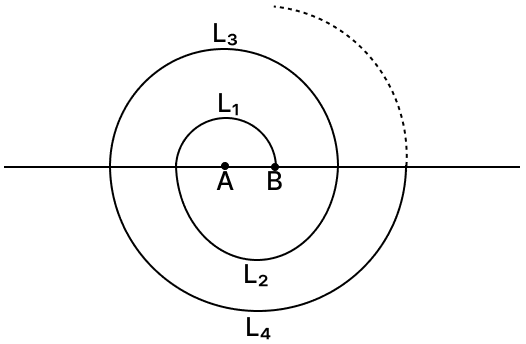
A spiral is made up of successive semicircles, with centers alternately at A and B, starting with center at A, of radii 0.5 cm, 1 cm, 1.5 cm, 2 cm, ...... as shown in the given figure.

A spiral is made up of successive semicircles, with centers alternately at A and B, starting with center at A, of radii 0.5 cm, 1 cm, 1.5 cm, 2 cm, ...... as shown in the given figure. Arithmetic Progression, RSA Mathematics Solutions ICSE Class 10.

Based on this information, answer the following questions:

(Take π = $\frac{22}{7}$)

Show SolutionHide Solution↓

1. 0.5 cm, 1.0 cm, 1.5 cm, 2.0 cm, ....

The radius are in A.P. with

a = 0.5 cm

d = 1.0 - 0.5 = 0.5 cm

n = 9

We know that,

⇒ an = a + (n - 1)d

⇒ r9 = 0.5 + (9 - 1)0.5

= 0.5 + (8)0.5

= 0.5 + 4

= 4.5 cm

Hence, option (b) is the correct option.

2. Calculating the radius of 15th semicircle.

We know that,

⇒ an = a + (n - 1)d

⇒ r15 = 0.5 + (15 - 1)0.5

= 0.5 + 14(0.5)

= 0.5 + 7

= 7.5 cm

By formula,

Length of a semicircle = πr

= 7.5π cm

Hence, option (c) is the correct option.

3. We know that,

Length of a semicircle = πr

The lengths are: 0.5π cm, 1.0π cm, 1.5π cm, 2.0π cm,.... in an A.P. with,

a = 0.5π cm

d = 1.0π cm - 0.5π cm = 0.5π

The difference of lengths of the 19th and 12th semicircles is:

L19 - L12 = πr19 - πr12

= π(r19 - r12)

We know that,

an = a + (n - 1)d

⇒ r19 = 0.5π + (19 - 1)0.5π

= 0.5π + 18(0.5π)

= 0.5π + 9π

= 9.5π cm.

⇒ r12 = 0.5π + (12 - 1)0.5π

= 0.5π + 11(0.5π)

= 0.5π + 5.5π

= 6π cm.

L19 - L12 = (9.5π - 6π)

= 3.5π cm.

Hence, option (a) is the correct option.

4. The lengths are: 0.5π cm, 1.0π cm, 1.5π cm, 2.0π cm,....in an A.P.

a = 0.5π cm

d = 1.0π cm - 0.5π cm = 0.5π

The total length is the sum of the first 7 lengths S7.

We know that,

⇒ Sn = $\frac{n}{2}$ [2a + (n - 1)d]

⇒ S7 = $\frac{7}{2}$ [2(0.5π) + (7 - 1)(0.5π)]

= 3.5[1π + 6(0.5π)]

= 3.5[1π + 3π]

= 3.5(4π)

= 14π cm.

Total length = 14π cm

= $14 \times \frac{22}{7}$

= 44 cm.

Hence, option (c) is the correct option.

5. 0.5π cm, 1.0π cm, 1.5π cm, 2.0π cm, ....

d = 1.0π + 0.5π = 0.5 π cm.

Common difference of the A.P. of lengths = 0.5π cm.

Hence, option (a) is the correct option.

2Case Study Based Questions

Case Study II

The production of TV sets in a factory increases uniformly by a fixed number every year.
It produced 16000 sets in the 6th year and 22600 in the 9th year.

Based on this information, answer the following questions:

Show SolutionHide Solution↓

1. Since, production of TV sets in a factory increases uniformly by a fixed number every year. The production in each year forms an A.P.

Let production of the TV sets during the first year be a and the common difference in production each year be d.

We know that,

an = a + (n - 1)d

Given,

Production in the 6th year = 16000.

⇒ a6 = a + (6 - 1)d

⇒ 16000 = a + 5d

⇒ a + 5d = 16000 ....(1)

Given,

Production in the 9th year = 22600.

⇒ a9 = a + (9 - 1)d

⇒ 22600 = a + 8d

⇒ a + 8d = 22600 ....(2)

Subtracting Eq. (1) from Eq. (2), we get :

⇒ a + 8d - (a + 5d) = 22600 - 16000

⇒ a + 8d - a - 5d = 6600

⇒ 3d = 6600

⇒ d = $\frac{6600}{3}$

⇒ d = 2200.

Substituting d in equation (1), we get :

⇒ a + 5(2200) = 16000

⇒ a + 11000 = 16000

⇒ a = 16000 - 11000

⇒ a = 5000.

Hence, option (c) is the correct option.

2. From question (1),

The uniform increase is the common difference, d.

d = 2200.

Hence, option (d) is the correct option.

3. Given,

The production of TV sets in each year forms an A.P.: 5000, 7200, 9400, .....

a = 5000

n = 8

d = 2200

We know that,

an = a + (n - 1)d

⇒ a8 = 5000 + (8 - 1)2200

= 5000 + 7(2200)

= 5000 + 15400

= 20400.

Production of the TV sets during the 8th year = 20400.

Hence, option (b) is the correct option.

4. Given,

The production of TV sets in each year forms an A.P.: 5000, 7200, 9400.....

a = 5000

l = 16000

n = 6

We know that,

Sn = $\frac{n}{2}$ (a + l)

⇒ S6 = $\frac{6}{2}$ (5000 + 16000)

= 3 × (21000)

= 63000.

Total production of the TV sets during first 6 years = 63000

Hence, option (d) is the correct option.

5. From part 4 we have,

S6 = 63000

The average production is the total production divided by the number of years:

Average = $\frac{S_6}{6}$

= $\frac{63000}{6}$

= 10500.

Hence, option (a) is the correct option.

3Case Study Based Questions

Case Study III

200 logs are stacked in the following manner:
20 logs in the bottom row, 19 in the next row, 18 in the next row and so on.

Based on this information, answer the following questions:

Show SolutionHide Solution↓

1. Given,

Logs stacked in rows form an A.P.: 20, 19, 18.....

Sn = 200

a = 20

d = 19 - 20 = -1

We know that,

Sn = $\frac{n}{2}$ [2a + (n - 1)d]

Let 200 logs be stacked in n rows.

⇒ 200 = $\frac{n}{2}$ [2(20) + (n - 1)(-1)]

⇒ 200 × 2 = n[40 - n + 1]

⇒ 400 = n[41 - n]

⇒ 400 = 41n - n2

⇒ n2 - 41n + 400 = 0

⇒ n2 - 16n - 25n + 400 = 0

⇒ n(n - 16) - 25(n - 16) = 0

⇒ (n - 25)(n - 16) = 0

⇒ (n - 25) = 0 or (n - 16) = 0

⇒ n = 25 or n = 16.

If n = 25, a25 = a + 24d = 20 + 24(-1) = -4 (Impossible, the 25th row would have –4 logs).

If n = 16, a16 = a + 15d = 20 + 15(-1) = 5 (Valid).

The number of rows is 16.

Hence, option (c) is the correct option.

2. Given,

Logs stacked in rows form an A.P.: 20, 19, 18, .....

a = 20

n = 16 (16 total rows of logs in the stack i.e top row is 16th.)

d = -1

We know that,

an = a + (n - 1)d

⇒ a16 = 20 + (16 - 1)(-1)

= 20 + 15(-1)

= 20 - 15

= 5.

The number of logs in the top row is 5.

Hence, option (b) is the correct option.

3. Given,

Logs stacked in rows form an A.P.: 20, 19, 18.....

a = 20

Total rows = 16

n = 8, (A.P. starts from bottom only)

d = -1

We know that,

⇒ an = a + (n - 1)d

⇒ a8 = 20 + (8 - 1)(-1)

= 20 + 7(-1)

= 20 - 7

= 13.

The number of logs in the 8th row from the bottom is 13.

Hence, option (d) is the correct option.

4. Given,

Logs stacked in rows form an A.P.: 20, 19, 18, .....

a = 20

d = -1

n = 6

We know that,

Sn = $\frac{n}{2}$ [2a + (n - 1)d]

⇒ S6 = $\frac{6}{2}$ [2(20) + (6 - 1)(-1)]

= 3(40 - 5)

= 3 × (35)

= 105.

Total number of logs in the first six rows from the bottom is 105.

Hence, option (a) is the correct option.

5. The 5th row from the top is the (16 - 5 + 1) = 12th row from the bottom (a12):

Logs stacked in rows form an A.P.: 20, 19, 18.....

We know that,

an = a + (n - 1)d

⇒ a12 = 20 + (12 - 1)(-1)

= 20 - 11

= 9.

Hence, option (b) is the correct option.
Press ↓ to reveal a solution and move to the next question. Back to RS Aggarwal Mathematics.

Free sample bank