Section Formula

ICSE Class 10 Mathematics · ML Aggarwal Mathematics · 61 solved questions

Exercise
Marks
1Exercise 11

Find the coordinates of the mid-points of the line segments joining the following pairs of points :

(i) (2, -3), (-6, 7)

(ii) (5, -11), (4, 3)

(iii) (a + 3, 5b), (2a - 1, 3b + 4).

Show SolutionHide Solution↓

(i) We know that,

Coordinates of mid-point of pair of points (x1, y1) and (x2, y2) is given by,

$\Rightarrow \Big(\frac{x_1 + x_2}{2}, \frac{y_1 + y_2}{2}\Big)$

∴ Mid-point of (2, -3), (-6, 7) is,

$$\begin{aligned}\Rightarrow \Big(\frac{2 + (-6)}{2}, \frac{(-3) + (7)}{2}\Big) \\[1em] = \Big(-\frac{4}{2}, \frac{4}{2}\Big) \\[1em] = (-2, 2).\end{aligned}$$

Hence, (-2, 2) is the mid-point of (2, -3) and (-6, 7).

(ii) We know that,

Coordinates of mid-point of pair of points (x1, y1) and (x2, y2) is given by,

$\Rightarrow \Big(\frac{x_1 + x_2}{2}, \frac{y_1 + y_2}{2}\Big)$

∴ Mid-point of (5, -11), (4, 3) is,

$$\begin{aligned}\Rightarrow \Big(\frac{5 + 4}{2}, \frac{(-11) + 3}{2}\Big) \\[1em] = \Big(\frac{9}{2}, -\frac{8}{2}\Big) \\[1em] = \Big(\frac{9}{2}, -4\Big).\end{aligned}$$

Hence, $(\frac{9}{2}, -4)$ is the mid-point of (5, -11) and (4, 3).

(iii) We know that,

Coordinates of mid-point of pair of points (x1, y1) and (x2, y2) is given by,

$\Rightarrow \Big(\frac{x_1 + x_2}{2}, \frac{y_1 + y_2}{2}\Big)$

∴ Mid-point of (a + 3, 5b), (2a - 1, 3b + 4) is,

$$\begin{aligned}\Rightarrow \Big(\frac{a + 3 + 2a - 1}{2}, \frac{5b + 3b + 4}{2}\Big) \\[1em] = \Big(\frac{3a + 2}{2}, \frac{8b + 4}{2}\Big) \\[1em] = \Big(\frac{3a + 2}{2}, 4b + 2\Big).\end{aligned}$$

Hence, $(\frac{3a + 2}{2}, 4b + 2)$ is the mid-point of (a + 3, 5b) and (2a - 1, 3b + 4).

2Exercise 11

Find a point P which divides internally the line segment joining the points A(-3, 9) and B(1, -3) in the ratio 1 : 3.

Show SolutionHide Solution↓

By section-formula,

Point of division = $\Big(\frac{m_1x_2 + m_2x_1}{m_1+ m_ 2}, \frac{m_1y_2 + m_2y_1}{m_1 + m_2}\Big)$

Given,

m1 : m2 = 1 : 3

(x1, y1) = (-3, 9)

(x2, y2) = (1, -3)

Substituting values we get :

$$\begin{aligned}\Rightarrow P = \Big(\frac{1 \times 1 + 3 \times -3}{1 + 3}, \frac{1 \times -3 + 3 \times 9}{1 + 3}\Big) \\[1em] \Rightarrow P = \Big(\frac{1 - 9}{4}, \frac{-3 + 27}{4}\Big) \\[1em] \Rightarrow P = \Big(\frac{-8}{4}, \frac{24}{4}\Big) \\[1em] \Rightarrow P = (-2, 6).\end{aligned}$$

Hence, the co-ordinates of P = (-2, 6).

3(i)Exercise 11

Find the coordinates of the points of trisection of the line segment joining the points (3, -3) and (6, 9).

Show SolutionHide Solution↓

Let P(x1, y1) and Q(x2, y2) be the points of trisection of the points A(3, -3) and B(6, 9).

Find the coordinates of the points of trisection of the line segment joining the points (3, -3) and (6, 9). Section Formula, ML Aggarwal Understanding Mathematics Solutions ICSE Class 10.

AP = PQ = QB ⇒ 2AP = PB

⇒ $\frac{AP}{PB} = \frac{1}{2}$ ⇒ P divides AB in the ratio 1 : 2, so coordinates of P are

$$\begin{aligned}\Rightarrow \Big(\frac{m_1x_2 + m_2x_1}{m_1 + m_2}, \frac{m_1y_2 + m_2y_1}{m_1 + m_2}\Big) \\[1em] = \Big(\frac{1 \times 6 + 2 \times 3}{1 + 2}, \frac{1 \times 9 + 2 \times (-3)}{1 + 2}\Big) \\[1em] = \Big(\frac{6 + 6}{3}, \frac{9 - 6}{3}\Big) \\[1em] = \Big(\frac{12}{3}, \frac{3}{3}\Big) \\[1em] = (4, 1).\end{aligned}$$

Q divides AB in the ratio 2 : 1, so coordinates of Q are

$$\begin{aligned}\Rightarrow \Big(\frac{m_1x_2 + m_2x_1}{m_1 + m_2}, \frac{m_1y_2 + m_2y_1}{m_1 + m_2}\Big) \\[1em] = \Big(\frac{2 \times 6 + 1 \times 3}{2 + 1}, \frac{2 \times 9 + 1 \times (-3)}{2 + 1}\Big) \\[1em] = \Big(\frac{12 + 3}{3}, \frac{18 - 3}{3}\Big) \\[1em] = \Big(\frac{15}{3}, \frac{15}{3}\Big) \\[1em] = (5, 5).\end{aligned}$$

Hence, (4, 1) and (5, 5) are the coordinates of the points of trisection of the line segment joining the points (3, -3) and (6, 9).

3(ii)Exercise 11

The line segment joining the points (3, -4) and (1, 2) is trisected at the points P and Q. If the coordinates of P and Q are (p, -2) and $\Big(\frac{5}{3}, q\Big)$ respectively, find the values of p and q.

Show SolutionHide Solution↓

Given P and Q trisect the points (3, -4) and (1, 2).

The line segment joining the points (3, -4) and (1, 2) is trisected at the points P and Q. If the coordinates of P and Q are (p, -2) and (5/3, q) respectively, find the values of p and q. Section Formula, ML Aggarwal Understanding Mathematics Solutions ICSE Class 10.

AP = PQ = QB ⇒ 2AP = PB

⇒ $\frac{AP}{PB} = \frac{1}{2}$ ⇒ P divides AB in the ratio 1 : 2, so coordinates of P are,

$$\begin{aligned}\Rightarrow \Big(\frac{m_1x_2 + m_2x_1}{m_1 + m_2}, \frac{m_1y_2 + m_2y_1}{m_1 + m_2}\Big) \\[1em] = \Big(\frac{1 \times 1 + 2 \times 3}{1 + 2}, \frac{1 \times 2 + 2 \times (-4)}{1 + 2}\Big) \\[1em] = \Big(\frac{1 + 6}{3}, \frac{2 - 8}{3}\Big) \\[1em] = \Big(\frac{7}{3}, -\frac{6}{3}\Big) \\[1em] = \Big(\frac{7}{3}, -2\Big).\end{aligned}$$

Q divides AB in the ratio 2 : 1, so coordinates of Q are

$$\begin{aligned}\Rightarrow \Big(\frac{m_1x_2 + m_2x_1}{m_1 + m_2}, \frac{m_1y_2 + m_2y_1}{m_1 + m_2}\Big) \\[1em] = \Big(\frac{2 \times 1 + 1 \times 3}{2 + 1}, \frac{2 \times 2 + 1 \times (-4)}{2 + 1}\Big) \\[1em] = \Big(\frac{2 + 3}{3}, \frac{4 - 4}{3}\Big) \\[1em] = \Big(\frac{5}{3}, 0\Big) \\[1em] = \Big(\frac{5}{3}, 0\Big).\end{aligned}$$

According to question,

Coordinates of P = (p, -2). Comparing it with $\Big(\frac{7}{3}, -2\Big)$ we get, p = $\frac{7}{3}.$

Coordinates of Q = $\Big(\frac{5}{3}, q\Big)$. Comparing it with $\Big(\frac{5}{3}, 0\Big)$ we get, q = 0.

Hence, the value of p = $\frac{7}{3}$ and q = 0.

4Exercise 11

The line segment joining the points A(3, 2) and B(5, 1) is divided at the point P in the ratio 1 : 2 and it lies on the line 3x - 18y + k = 0. Find the value of k.

Show SolutionHide Solution↓

Let (x, y) be the coordinates of the point P which divides the line segment joining A(3, 2) and B(5, 1) in the ratio 1 : 2.

∴ Coordinates of P are $\Big(\frac{m_1x_2 + m_2x_1}{m_1 + m_2}, \frac{m_1y_2 + m_2y_1}{m_1 + m_2}\Big).$

Putting the values from question in above formula we get,

$$\begin{aligned}\Rightarrow \Big(\frac{1 \times 5 + 2 \times 3}{1 + 2}, \frac{1 \times 1 + 2 \times 2}{1 + 2}\Big) \\[1em] = \Big(\frac{5 + 6}{3}, \frac{1 + 4}{3}\Big) \\[1em] = \Big(\frac{11}{3}, \frac{5}{3}\Big).\end{aligned}$$

Since, P lies on the line 3x - 18y + k = 0.
∴ It will satisfy it.

$$\begin{aligned}\Rightarrow 3\Big(\frac{11}{3}\Big) - 18\Big(\frac{5}{3}\Big) + k = 0 \\[1em] \Rightarrow 11 - 30 + k = 0 \\[1em] \Rightarrow -19 + k = 0 \\[1em] \Rightarrow k = 19.\end{aligned}$$

Hence, the value of k = 19.

5Exercise 11

Find the coordinates of the point which is three-fourth of the way from A(3, 1) to B(-2, 5).

Show SolutionHide Solution↓

Let P(x, y) be the required point. Then according to question,

Find the coordinates of the point which is three-fourth of the way from A(3, 1) to B(-2, 5). Section Formula, ML Aggarwal Understanding Mathematics Solutions ICSE Class 10.

AP = $\frac{3}{4}$AB

$$\begin{aligned}\therefore \frac{AP}{AB} = \frac{3}{4} \\[1em] \Rightarrow \frac{AP}{AP + PB} = \frac{3}{4} \\[1em] \Rightarrow 4AP = 3AP + 3PB \\[1em] \Rightarrow 4AP - 3AP = 3PB \\[1em] \Rightarrow AP = 3PB \\[1em] \Rightarrow \frac{AP}{PB} = \frac{3}{1} \\[1em] \therefore m_1 = 3, m_2 = 1.\end{aligned}$$

∴ By section formula coordinates of P are

$\Big(\frac{m_1x_2 + m_2x_1}{m_1 + m_2}, \frac{m_1y_2 + m_2y_1}{m_1 + m_2}\Big)$

Putting the values from question in above formula we get,

$$\begin{aligned}\Rightarrow \Big(\frac{3 \times (-2) + 1 \times 3}{3 + 1}, \frac{3 \times 5 + 1 \times 1}{3 + 1}\Big) \\[1em] = \Big(\frac{-6 + 3}{4}, \frac{15 + 1}{4}\Big) \\[1em] = \Big(-\frac{3}{4}, \frac{16}{4}\Big) \\[1em] = \Big(-\frac{3}{4}, 4\Big).\end{aligned}$$

Hence, the coordinates of P are $(-\frac{3}{4}, 4).$

6Exercise 11

The line segment joining A(-3, 1) and B(5, -4) is a diameter of a circle whose centre is C. Find the coordinates of the point C.

Show SolutionHide Solution↓

Given, C is the centre of the circle and AB is the diameter.

C is the midpoint of AB.

Let coordinates of C be (x, y)

$$\begin{aligned}\therefore x = \frac{x_1 + x_2}{2}, y = \frac{y_1 + y_2}{2} \\[1em] \Rightarrow x = \frac{-3 + 5}{2}, y = \frac{1 + (-4)}{2} \\[1em] \Rightarrow x = \frac{2}{2}, y = -\frac{3}{2} \\[1em] \Rightarrow x = 1, y = -\frac{3}{2}.\end{aligned}$$

Hence, coordinates of C are $(1, -\frac{3}{2})$.

7Exercise 11

The mid-point of the line segment joining the points (3m, 6) and (-4, 3n) is (1, 2m - 1). Find the values of m and n.

Show SolutionHide Solution↓

We know by mid-point formula,

$x = \frac{x_1 + x_2}{2} \text{ and } y = \frac{y_1 + y_2}{2}$

Given, the mid-point of (3m, 6) and (-4, 3n) is (1, 2m - 1).

$$\begin{aligned}\therefore \text{x-coordinate } = 1 = \frac{3m + (-4)}{2} \\[1em] \Rightarrow 1 = \frac{3m - 4}{2} \\[1em] \Rightarrow 3m - 4 = 2 \\[1em] \Rightarrow 3m = 2 + 4 \\[1em] \Rightarrow 3m = 6 \\[1em] \Rightarrow m = 2.\end{aligned}$$

Similarly by midpoint formula,

$\text{y-coordinate } = 2m - 1 = \frac{6 + 3n}{2}$

Putting value of m = 2 in above equation we get,

$$\begin{aligned}\Rightarrow 2 \times 2 - 1 = \frac{6 + 3n}{2} \\[1em] \Rightarrow 2(4 - 1) = 6 + 3n \\[1em] \Rightarrow 6 = 6 + 3n \\[1em] \Rightarrow 3n = 0 \\[1em] \Rightarrow n = 0.\end{aligned}$$

Hence, the value of m = 2 and n = 0.

8Exercise 11

The coordinates of the mid-point of the line segment PQ are (1, -2). The coordinates of P are (-3, 2). Find the coordinates of Q.

Show SolutionHide Solution↓

Let the coordinates of Q be (x, y)

Coordinates of P are (-3, 2) and mid-point of PQ are (1, -2) then by mid-point formula, we get

$1 = \frac{(-3 + x)}{2} \text{ and } (-2) = \frac{(2 + y)}{2}$

⇒ -3 + x = 2 and 2 + y = -4
⇒ x = 2 + 3 and y = -4 - 2
⇒ x = 5 and y = -6.

Hence, coordinates of Q are (5, -6).

9Exercise 11

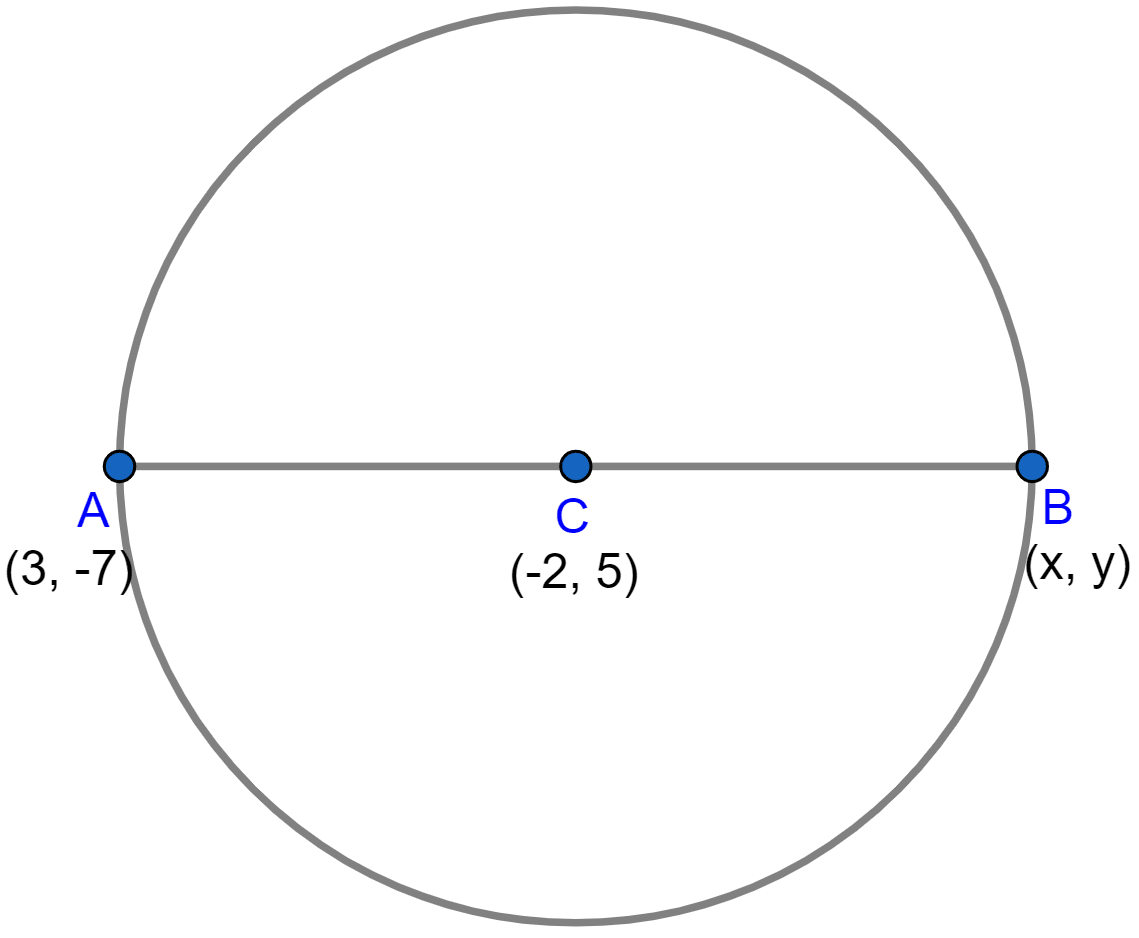
AB is a diameter of a circle with centre C(-2, 5). If the point A is (3, -7). Find :

(i) The length of radius AC.

(ii) The coordinates of B.

Show SolutionHide Solution↓

Below figure shows the circle with Centre C(-2, 5)

AB is a diameter of a circle with centre C(-2, 5). If the point A is (3, -7). Find (i) The length of radius AC. (ii) The coordinates of B. Section Formula, ML Aggarwal Understanding Mathematics Solutions ICSE Class 10.

(i) We know that,

Distance formula = $\sqrt{(x_2 - x_1)^2 + (y_2 - y_1)^2}$

∴ The length of radius AC = $\sqrt{(-2 - 3)^2 + (5 - (-7))^2}$

$$\begin{aligned}= \sqrt{(-5)^2 + (12)^2} \\[1em] = \sqrt{25 + 144} \\[1em] = \sqrt{169} \\[1em] = 13.\end{aligned}$$

Hence, the length of radius AC is 13 units.

(ii) Given, AB is the diameter and C is the mid-point

Let coordinates of B are (x, y) so, by mid-point formula,

$\frac{(3 + x)}{2} = -2 \text{ and } \frac{(y - 7)}{2} = 5$
⇒ 3 + x = -4 and y - 7 = 10
⇒ x = -4 - 3 and y = 10 + 7
⇒ x = -7 and y = 17.

Hence, coordinates of B are (-7, 17).

10Exercise 11

Find the reflection (image) of the point (5, -3) in the point (-1, 3).

Show SolutionHide Solution↓

Let the coordinates of the image of the point A(5, -3) be A'(x, y) in the point (-1, 3) then,

The point (-1, 3) will be the mid-point of AA'

By midpoint formula,

$\Rightarrow -1 = \frac{(5 + x)}{2} \text{ and } 3 = \frac{(-3 + y)}{2}$
⇒ 5 + x = -2 and -3 + y = 6
⇒ x = -2 - 5 and y = 6 + 3
⇒ x = -7 and y = 9.

∴ A' = (x, y) = (-7, 9).

Hence, the coordinates of the images of (5, -3) in the point (-1, 3) is (-7, 9).

11Exercise 11

The line segment joining A $\Big(-1, \frac{5}{3}\Big)$ and B(a, 5) is divided in the ratio 1 : 3 at P, the point where the line segment AB intersects y-axis. Calculate

(i) the value of a.

(ii) the coordinates of P.

Show SolutionHide Solution↓

(i) Let P(x, y) divide the line segment joining the points A$\Big(-1, \frac{5}{3}\Big)$, B(a, 5) in the ratio 1 : 3

We know that,

Section-formula = $\Big(\frac{m_1x_2 + m_2x_1}{m_1 + m_2}, \frac{m_1y_2 + m_2y_1}{m_1 + m_2}\Big).$

Putting values in above equation we get, coordinates of P

$$\begin{aligned}= \Big(\frac{1 \times a + 3 \times (-1)}{1 + 3}, \frac{1 \times 5 + 3 \times \frac{5}{3}}{1 + 3}\Big) \\[1em] = \Big(\frac{a - 3}{4}, \frac{5 + 5}{4}\Big) \\[1em] = \Big(\frac{a - 3}{4}, \frac{10}{4}\Big) \\[1em] = \Big(\frac{a - 3}{4}, \frac{5}{2}\Big).\end{aligned}$$

According to the question,

The point P lies on y-axis so, x coordinate will be equal to zero.

$\therefore \frac{a - 3}{4} = 0$
⇒ a - 3 = 0
⇒ a = 3.

Hence, the value of a = 3.

(ii) From part (i) we get the y coordinate of P = $\frac{5}{2}$.

Hence, the coordinates of P are $\Big(0, \frac{5}{2}\Big).$

12Exercise 11

The point P(-4, 1) divides the line segment joining the points A(2, -2) and B in the ratio 3 : 5. Find the point B.

Show SolutionHide Solution↓

Let the coordinates of B be (x, y).

As the point P(-4, 1) divides the line segment joining the points A (2, -2) and B (x, y) in the ratio 3 : 5, we have

We know that,

Section-formula = $\Big(\frac{m_1x_2 + m_2x_1}{m_1 + m_2}, \frac{m_1y_2 + m_2y_1}{m_1 + m_2}\Big).$

Putting values in above equation we get coordinates of P as

$$\begin{aligned}= \Big(\frac{3 \times x + 5 \times 2}{3 + 5}, \frac{3 \times y + 5 \times (-2)}{3 + 5}\Big) \\[1em] = \Big(\frac{3x + 10}{8}, \frac{3y - 10}{8}\Big).\end{aligned}$$

According to question the coordinates of P are (-4, 1) comparing we get,

$\Rightarrow \frac{3x + 10}{8} = -4 \text{ and } \frac{3y - 10}{8} = 1$
⇒ 3x + 10 = -32 and 3y - 10 = 8
⇒ 3x = -32 - 10 and 3y = 8 + 10
⇒ 3x = -42 and 3y = 18
⇒ x = -14 and y = 6.

∴ B = (x, y) = (-14, 6).

Hence, the coordinates of B are (-14, 6).

13(i)Exercise 11

In what ratio does the point (5, 4) divide the line segment joining the points (2, 1) and (7, 6) ?

Show SolutionHide Solution↓

Let the point P(5, 4) divide the line segment joining the points (2, 1), (7, 6) in the ratio m1 : m2.

By Section-formula, we get the coordinates of point P as:

$\Big(\frac{m_1x_2 + m_2x_1}{m_1 + m_2}, \frac{m_1y_2 + m_2y_1}{m_1 + m_2}\Big).$

Putting values in x coordinate of above equation we get,

$$\begin{aligned}= \frac{m_1 \times 7 + m_2 \times 2}{m_1 + m_2} \\[1em] = \frac{7m_1 + 2m_2}{m_1 + m_2} \\[1em]\end{aligned}$$

According to question, the x-coordinate of P = 5. Comparing we get,

$$\begin{aligned}\Rightarrow \frac{7m_1 + 2m_2}{m_1 + m_2} = 5 \\[1em] \Rightarrow 7m_1 + 2m_2 = 5m_1 + 5m_2 \\[1em] \Rightarrow 7m_1 - 5m_1 = 5m_2 - 2m_2 \\[1em] \Rightarrow 2m_1 = 3m_2 \\[1em] \Rightarrow \frac{m_1}{m_2} = \frac{3}{2}.\end{aligned}$$

Hence, the ratio in which point (5, 4) divides the line segment is 3 : 2.

13(ii)Exercise 11

In what ratio does the point (-4, b) divide the line segment joining the points P(2, -2), Q(-14, 6)? Hence, find the value of b.

Show SolutionHide Solution↓

Let the point P(-4, b) divide the line segment joining the points P(2, -2) and Q(-14, 6) in the ratio m1 : m2.

By section formula, the x-coordinate = $\Big(\frac{m_1x_2 + m_2x_1}{m_1 + m_2}\Big)$

Putting value in above formula we get,

$$\begin{aligned}\Rightarrow -4 = \frac{m_1 \times -14 + m_2 \times 2}{m_1 + m_2} \\[1em] \Rightarrow -4m_1 - 4m_2 = -14m_1 + 2m_2 \\[1em] \Rightarrow -4m_1 + 14m_1 = 2m_2 + 4m_2 \\[1em] \Rightarrow 10m_1 = 6m_2 \\[1em] \Rightarrow \frac{m_1}{m_2} = \frac{6}{10} \\[1em] \Rightarrow m_1 : m_2 = 3 : 5.\end{aligned}$$

By section formula, y-coordinate = $\Big(\frac{m_1y_2 + m_2y_1}{m_1 + m_2}\Big)$

Putting value in above formula we get,

$$\begin{aligned}\Rightarrow b = \frac{m_1 \times 6 + m_2 \times -2}{m_1 + m_2} \\[1em] = \frac{6m_1 - 2m_2}{m_1 + m_2} \\[1em] = \frac{6 \times 3 - 2 \times 5}{3 + 5} \\[1em] = \frac{18 - 10}{8} \\[1em] = \frac{8}{8} \\[1em] = 1.\end{aligned}$$

Hence, the ratio is 3 : 5 and the value of b = 1.

14Exercise 11

The line segment joining A(2, 3) and B(6, -5) is intersected by x-axis at a point K. Write down the ordinate of the point K. Hence, find the ratio in which K divides AB. Also find the coordinates of point K.

Show SolutionHide Solution↓

Let the coordinates of K be (x, 0) as it intersects x-axis. Let point K divides the line segment joining the points
A(2, 3) and B(6, -5) in the ratio m1 : m2.

By section formula, y-coordinate = $\Big(\frac{m_1y_2 + m_2y_1}{m_1 + m_2}\Big)$

Putting value in above formula we get,

$$\begin{aligned}\Rightarrow 0 = \frac{m_1 \times (-5) + m_2 \times 3}{m_1 + m_2} \\[1em] \Rightarrow 0 = -5m_1 + 3m_2 \\[1em] \Rightarrow 5m_1 = 3m_2 \\[1em] \Rightarrow \frac{m_1}{m_2} = \frac{3}{5}\end{aligned}$$

Now for x coordinate by section formula we get,

$$\begin{aligned}x = \frac{m_1x_2 + m_2x_1}{m_1 + m_2} \\[1em] = \frac{3 \times 6 + 5 \times 2}{3 + 5} \\[1em] = \frac{18 + 10}{8} \\[1em] = \frac{28}{8} \\[1em] = \frac{7}{2}.\end{aligned}$$

∴ K = (x, 0) = $\Big(\frac{7}{2}, 0\Big).$

Hence, the coordinates of K are $\Big(\frac{7}{2}, 0\Big)$ and the ratio is 3 : 5.

15Exercise 11

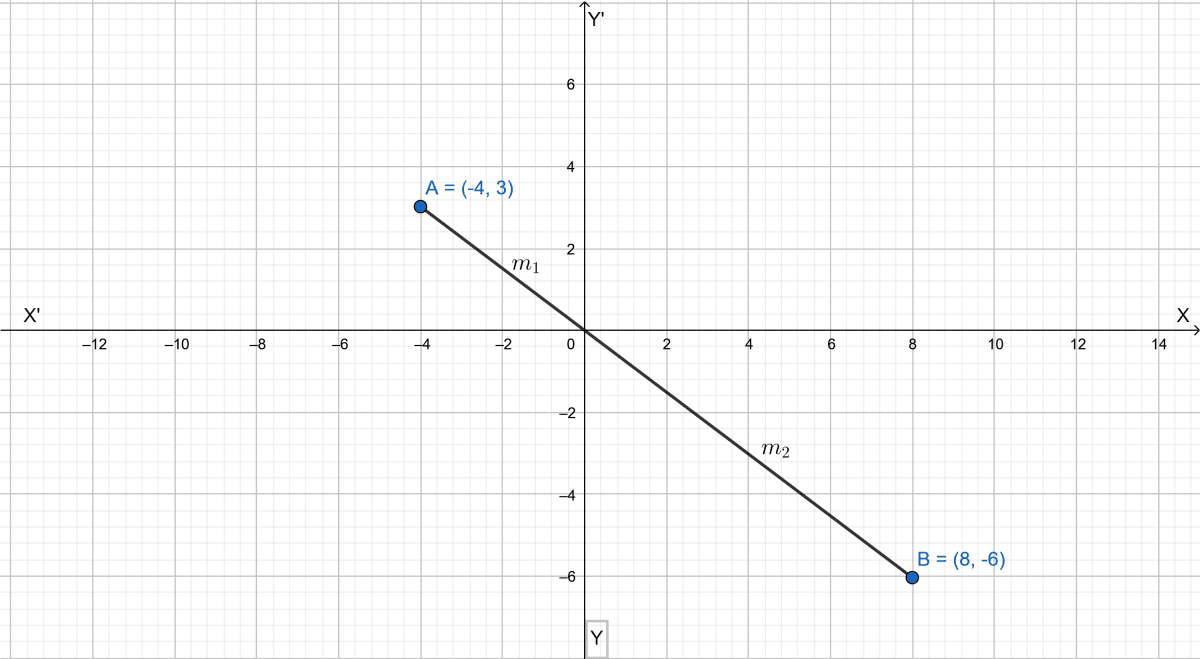
If A = (-4, 3) and B = (8, -6),

(i) find the length of AB.

(ii) in what ratio is the line segment joining AB, divided by the x-axis?

Show SolutionHide Solution↓

The graph is given below:

If A = (-4, 3) and B = (8, -6), (i) find the length of AB. (ii) in what ratio is the line segment joining AB, divided by the x-axis? Section Formula, ML Aggarwal Understanding Mathematics Solutions ICSE Class 10.

(i) Given,

A = (-4, 3), B = (8, -6)

$$\begin{aligned}\text{Length of AB = } \sqrt{(x_2 - x_1)^2 + (y_2 - y_1)^2} \\[1em] = \sqrt{(8 - (-4))^2 + (-6 - 3)^2} \\[1em] = \sqrt{(8 + 4)^2 + (-6 - 3)^2} \\[1em] = \sqrt{12^2 + (-9)^2} \\[1em] = \sqrt{144 + 81} \\[1em] = \sqrt{225} \\[1em] = 15.\end{aligned}$$

Hence, the length of AB = 15 units.

(ii) From graph, we see that O (0, 0) lies on AB.
Let O divide AB in the ratio m1 : m2.

By section-formula the coordinates of point dividing a line in m1 : m2 are given by

$\Big(\frac{m_1x_2 + m_2x_1}{m_1 + m_2}, \frac{m_1y_2 + m_2y_1}{m_1 + m_2}\Big)$

Putting values in above equation for finding x coordinates we get,

$$\begin{aligned}\Rightarrow \frac{m_1 \times 8 + m_2 \times -4}{m_1 + m_2} \\ \\[1em] \Rightarrow \frac{8m_1 - 4m_2}{m_1 + m_2}.\end{aligned}$$

Since origin (0, 0) is the dividing point the x-coordinate = 0. Comparing it with above equation we get,

$$\begin{aligned}\frac{8m_1 - 4m_2}{m_1 + m_2} = 0 \\[1em] 8m_1 - 4m_2 = 0 \\[1em] 8m_1 = 4m_2 \\[1em] \frac{m_1}{m_2} = \frac{4}{8} \\[1em] \frac{m_1}{m_2} = \frac{1}{2}.\end{aligned}$$

∴ m1 : m2 = 1 : 2.

Hence, the x-axis divides the line segment AB in the ratio 1 : 2.

16Exercise 11

In what ratio does the line x - y - 2 = 0 divide the line segment joining the points (3, -1) and (8, 9)? Also, find the coordinates of the point of division.

Show SolutionHide Solution↓

Let the point A be (3, -1) and point B be (8, 9) and let the line x - y - 2 = 0 divide the line segment AB in the ratio m1 : m2 at point P(x, y) then,

$$\begin{aligned}x = \frac{m_1x_2 + m_2x_1}{m_1 + m_2} \\[1em] = \frac{m_1 \times 8 + m_2 \times 3}{m_1 + m_2} \\[1em] = \frac{8m_1 + 3m_2}{m_1 + m_2} \qquad \text{....[Eq 1]} \\[1em] \text{and y } = \frac{m_1y_2 + m_2y_1}{m_1 + m_2} \\[1em] = \frac{m_1 \times 9 + m_2 \times -1}{m_1 + m_2} \\[1em] = \frac{9m_1 - m_2}{m_1 + m_2} \qquad \text{....[Eq 2]}.\end{aligned}$$

Given, the point P(x, y) lies on the line x - y - 2 = 0.

$$\begin{aligned}\therefore \frac{8m_1 + 3m_2}{m_1 + m_2} - \frac{9m_1 - m_2}{m_1 + m_2} - 2 = 0 \\[1em] \Rightarrow \frac{8m_1 + 3m_2 - 9m_1 + m_2 - 2m_1 - 2m_2}{m_1 + m_2} = 0 \\[1em] \Rightarrow -3m_1 + 2m_2 = 0 \\[1em] \Rightarrow 3m_1 = 2m_2 \\[1em] \Rightarrow \frac{m_1}{m_2} = \frac{2}{3} \\[1em].\end{aligned}$$

Putting value of m1 : m2 in Eq 1,

$$\begin{aligned}\Rightarrow x = \frac{8 \times 2 + 3 \times 3}{2 + 3} \\[1em] = \frac{16 + 9}{5} \\[1em] = \frac{25}{5} \\[1em] = 5.\end{aligned}$$

Putting value of m1 : m2 in Eq 2,

$$\begin{aligned}\Rightarrow y = \frac{9 \times 2 - 3}{2 + 3} \\[1em] = \frac{18 - 3}{5} \\[1em] = \frac{15}{5} \\[1em] = 3.\end{aligned}$$

Hence, the ratio is 2 : 3 and coordinates of P are (5, 3).

17Exercise 11

Given, a line segment AB joining the points A(-4, 6) and B(8, -3). Find :

(i) The ratio in which AB is divided by the y-axis.

(ii) The coordinates of the point of intersection.

(iii) The length of AB.

Show SolutionHide Solution↓

(i) Let the y-axis divide AB in the ratio m1 : m2.

By section formula, the x-coordinate = $\Big(\frac{m_1x_2 + m_2x_1}{m_1 + m_2}\Big)$

Since, the x coordinate on y-axis is 0. Putting value in above formula we get,

$$\begin{aligned}\Rightarrow 0 = \frac{m_1 \times 8 + m_2 \times (-4)}{m_1 + m_2} \\[1em] \Rightarrow 8m_1 - 4m_2 = 0 \\[1em] \Rightarrow 8m_1 = 4m_2 \\[1em] \Rightarrow \frac{m_1}{m_2} = \frac{4}{8} \\[1em] \Rightarrow m_1 : m_2 = 1 : 2\end{aligned}$$

Hence, required ratio = $\frac{1}{2} : 1$ or 1 : 2.

(ii) By section formula, the y-coordinate is given by

$\Big(\frac{m_1y_2 + m_2y_1}{m_1 + m_2}\Big)$

Putting value in above formula we get,

$$\begin{aligned}\Rightarrow y = \frac{1 \times -3 + 2 \times 6}{1 + 2} \\[1em] = \frac{-3 + 12}{3} \\[1em] = \frac{9}{3} \\[1em] = 3.\end{aligned}$$

Hence, the coordinates of the point of intersection are (0, 3).

(iii) Distance formula = $\sqrt{(x_2 - x_1)^2 + (y_2 - y_1)^2}$

By distance formula,

$$\begin{aligned}AB = \sqrt{(8 - (-4))^2 + (-3 - 6)^2} \\[1em] = \sqrt{12^2 + (-9)^2} \\[1em] = \sqrt{144 + 81} \\[1em] = \sqrt{225} \\[1em] = 15.\end{aligned}$$

Hence, the length of AB = 15 units.

18Exercise 11

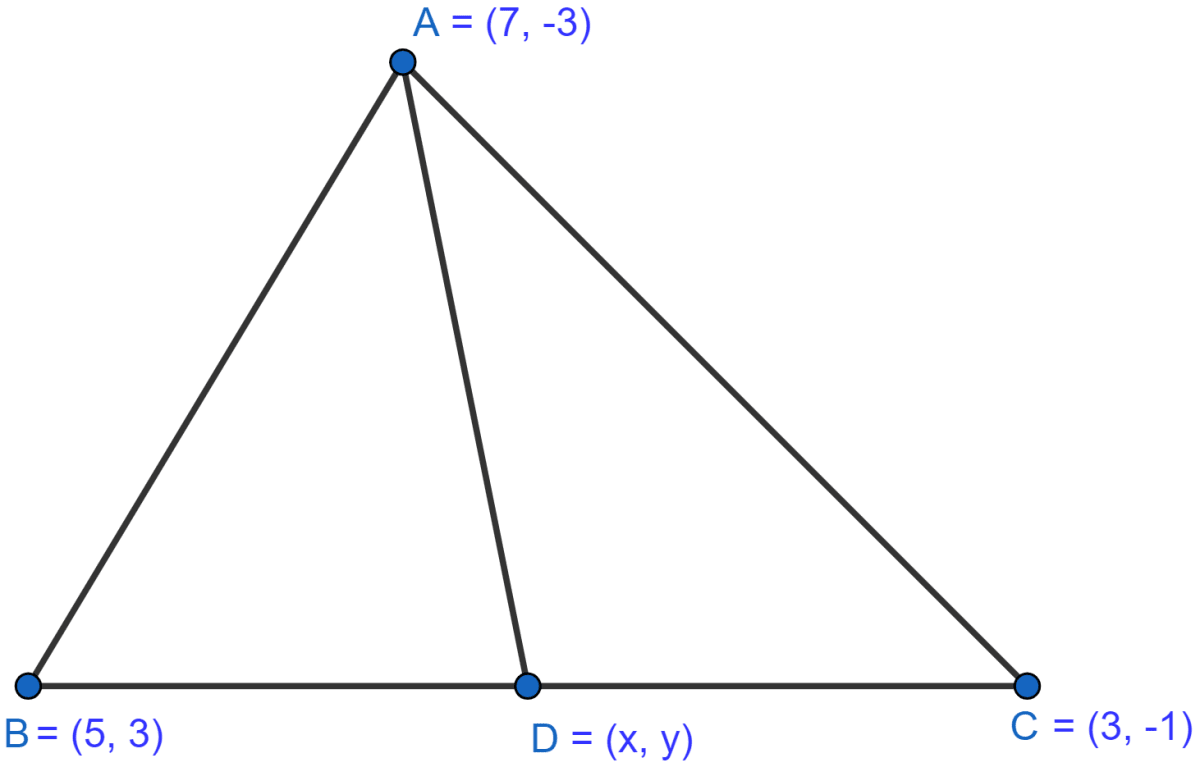
Calculate the length of the median through the vertex A of the triangle ABC with vertices A(7, -3), B(5, 3) and C(3, -1).

Show SolutionHide Solution↓

Below figure shows the triangle ABC with vertices A(7, -3), B(5, 3) and C(3, -1):

Calculate the length of the median through the vertex A of the triangle ABC with vertices A(7, -3), B(5, 3) and C(3, -1). Section Formula, ML Aggarwal Understanding Mathematics Solutions ICSE Class 10.

Let D (x, y) be the mid-point of BC, then AD is the median through A.

As D is the mid-point of BC, then coordinates of D by mid-point formula are

$$\begin{aligned}\Rightarrow x = \frac{5 + 3}{2} \text{ and } y = \frac{3 + (-1)}{2} \\[1em] \Rightarrow x = \frac{8}{2} \text{ and } y = \frac{2}{2} \\[1em] \Rightarrow x = 4 \text{ and } y = 1.\end{aligned}$$

Hence, coordinates of D are (4, 1).

Distance formula = $\sqrt{(x_2 - x_1)^2 + (y_2 - y_1)^2}$

By distance formula length of median,

$$\begin{aligned}AD = \sqrt{(7 - 4)^2 + (-3 - 1)^2} \\[1em] = \sqrt{3^2 + (-4)^2} \\[1em] = \sqrt{9 + 16} \\[1em] = \sqrt{25} \\[1em] = 5.\end{aligned}$$

Hence, the length of the median through vertex A is 5 units.

19Exercise 11

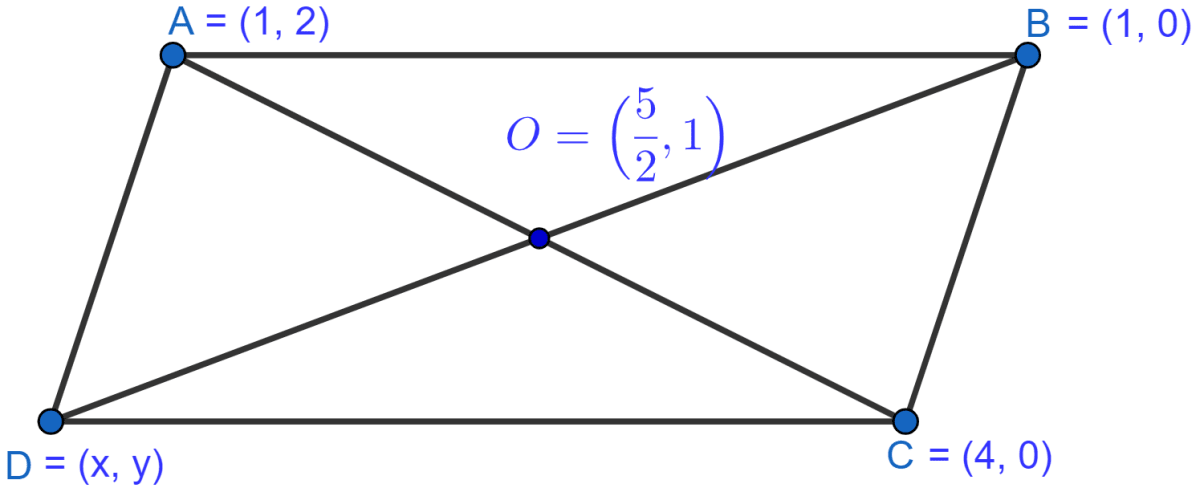
Three consecutive vertices of a parallelogram ABCD are A(1, 2), B(1, 0) and C(4, 0). Find the fourth vertex D.

Show SolutionHide Solution↓

In the parallelogram ABCD, the three consecutive vertices are A(1, 2), B(1, 0) and C(4, 0). Let the fourth vertex D be (x, y) as shown in the figure below:

Three consecutive vertices of a parallelogram ABCD are A(1, 2), B(1, 0) and C(4, 0). Find the fourth vertex D. Section Formula, ML Aggarwal Understanding Mathematics Solutions ICSE Class 10.

Let O be the mid-point of AC, the diagonal of ABCD.

By Mid-point formula, the coordinates of O = $\Big(\frac{1 + 4}{2}, \frac{2 + 0}{2}\Big)$

∴ Coordinates of O will be $\Big(\frac{5}{2}, 1\Big)$

The mid-point of BD is $\Big(\frac{1 + x}{2}, \frac{y}{2}\Big)$

Since, the diagonals of a parallelogram bisect each other, the mid-points of AC and BD are same.

$$\begin{aligned}\therefore \frac{5}{2} = \frac{1 + x}{2} \text{ and } 1 = \frac{0 + y}{2} \\[1em] \Rightarrow 5 = 1 + x \text{ and } y + 0 = 2 \\[1em] \Rightarrow x = 5 - 1 \text{ and } y = 2. \\[1em] \Rightarrow x = 4 \text{ and } y = 2.\end{aligned}$$

Hence, coordinates of D are (4, 2).

20Exercise 11

If the points A(-2, -1), B(1, 0), C(p, 3) and D(1, q) form a parallelogram ABCD, find the values of p and q.

Show SolutionHide Solution↓

A(-2, -1), B(1, 0), C(p, 3) and D(1, q) are the vertices of a parallelogram ABCD as shown in the figure below:

If the points A(-2, -1), B(1, 0), C(p, 3) and D(1, q) form a parallelogram ABCD, find the values of p and q. Section Formula, ML Aggarwal Understanding Mathematics Solutions ICSE Class 10.

∴ Diagonal AC and BD bisect each other at O.
O is the mid-point of AC as well as BD. Let the coordinates of O be (x, y).

When O is the mid-point of AC, then by mid-point formula

$$\begin{aligned}\Rightarrow x = \frac{p + (-2)}{2} \text{ and y = } \frac{3 + (-1)}{2} \\[1em] \Rightarrow x = \frac{p - 2}{2} \text{ and y = } \frac{2}{2} \\[1em] \therefore x = \frac{p - 2}{2} \text{ and } y = 1.\end{aligned}$$

When O is the mid-point of BD, then by mid-point formula

$$\begin{aligned}\Rightarrow x = \frac{1 + 1}{2} \text{ and y = } \frac{0 + q}{2} \\[1em] \Rightarrow x = \frac{2}{2} \text{ and y = } \frac{q}{2} \\[1em] \therefore x = 1 \text{ and } y = \frac{q}{2}.\end{aligned}$$

Now comparing, we get the values of the coordinates of point O in both cases,

$$\begin{aligned}\Rightarrow \frac{p - 2}{2} = 1 \text{ and } \frac{q}{2} = 1 \\[1em] \Rightarrow p - 2 = 2 \text{ and } q = 2 \\[1em] \Rightarrow p = 4 \text{ and } q = 2.\end{aligned}$$

Hence, the value of p = 4 and q = 2.

21Exercise 11

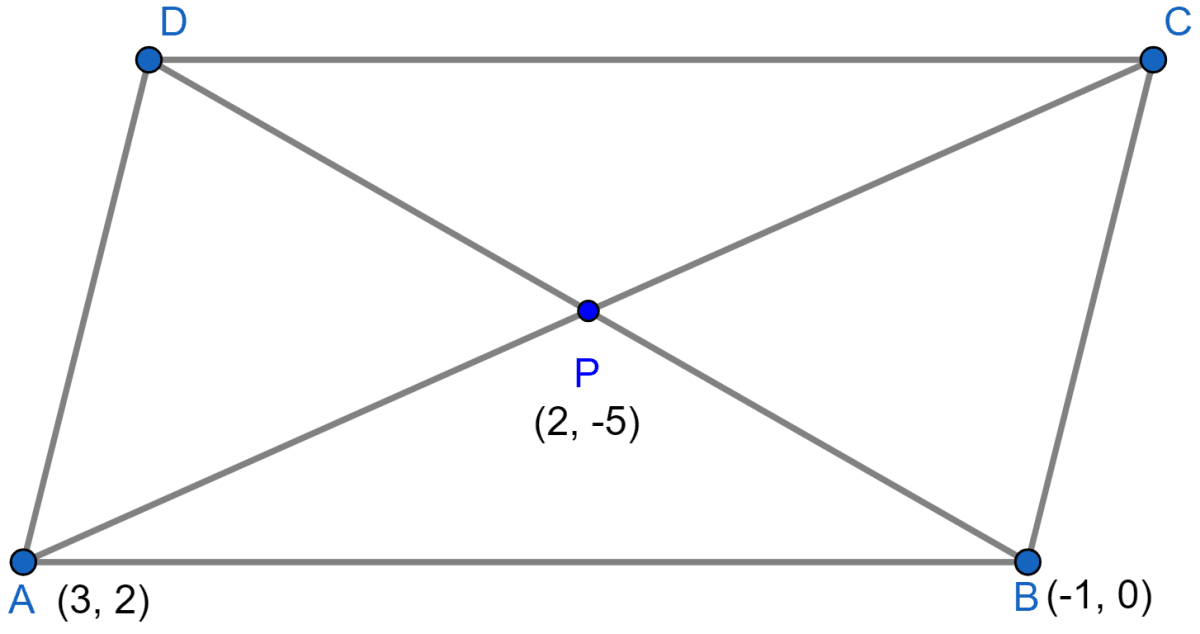
If two vertices of a parallelogram are (3, 2), (-1, 0) and its diagonals meet at (2, -5), find the other two vertices of the parallelogram.

Show SolutionHide Solution↓

The mid-point of the line segment joining the points (3, 2) and (-1, 0) is $\Big(\frac{3 + (-1)}{2}, \frac{2 + 0}{2}\Big)$ = (1, 1) which is not the same as (2, -5), therefore, the given points cannot be the opposite vertices. Hence, these vertices are adjoining.

The below figure shows the parallelogram:

If two vertices of a parallelogram are (3, 2), (-1, 0) and its diagonals meet at (2, -5), find the other two vertices of the parallelogram. Section Formula, ML Aggarwal Understanding Mathematics Solutions ICSE Class 10.

Let coordinates of C be (x, y) then by mid-point formula,

$\Rightarrow 2 = \frac{x + 3}{2} \text{ and} -5 = \frac{y + 2}{2}$
⇒ x + 3 = 4 and y + 2 = -10
⇒ x = 1 and y = -12.

∴ Coordinates of C are (1, -12).

Now finding coordinates of D, let D be (m, n). Applying mid-point formula we get,

$\Rightarrow 2 = \frac{m - 1}{2} \text{ and } -5 = \frac{n + 0}{2}$
⇒ m - 1 = 4 and n = -10
⇒ m = 5 and n = -10.

∴ Coordinates of D are (5, -10).

Hence, the coordinates of C are (1, -12) and D are (5, -10).

22Exercise 11

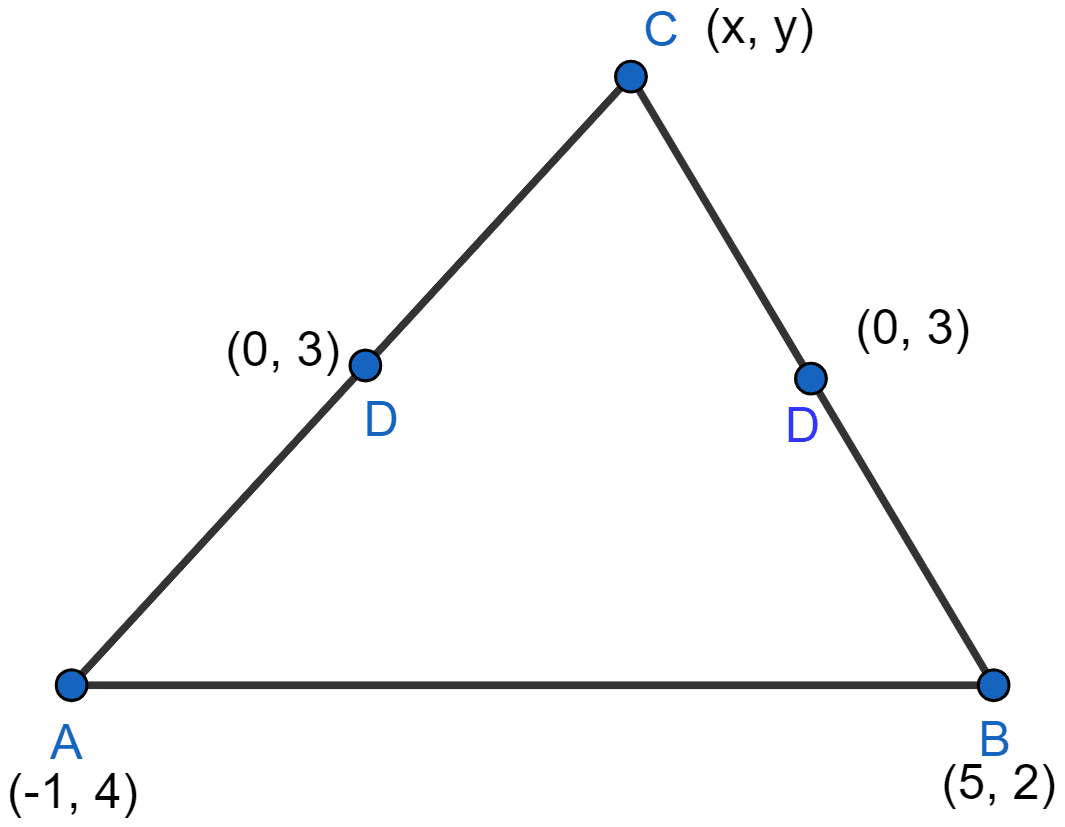
Find the third vertex of a triangle if its two vertices are (-1, 4) and (5, 2) and mid-point of one side is (0, 3).

Show SolutionHide Solution↓

Let A(-1, 4) and B(5, 2) be the two points and let C(x, y) be the third vertex of the triangle as shown in the figure below:

Find the third vertex of a triangle if its two vertices are (-1, 4) and (5, 2) and mid-point of one side is (0, 3). Section Formula, ML Aggarwal Understanding Mathematics Solutions ICSE Class 10.

By mid-point formula, mid-point of AB

$$\begin{aligned}= \Big(\frac{-1 + 5}{2}, \frac{4 + 2}{2}\Big) \\[1em] = \Big(\frac{4}{2}, \frac{6}{2}\Big) \\[1em] = (2, 3)\end{aligned}$$

Since, (0, 3) is not the mid-point of AB hence, it is either the mid point of AC or BC.

Let D(0, 3) be the midpoint of AC. So, by mid-point formula,

$0 = \frac{x + (-1)}{2} \text{ and } 3 = \frac{y + 4}{2}$
⇒ x - 1 = 0 and y + 4 = 6
⇒ x = 1 and y = 2.

∴ Coordinates of C will be (1, 2).

Let D(0, 3) be the midpoint of BC. So, by mid-point formula,

$0 = \frac{5 + x}{2} \text{ and } 3 = \frac{2 + y}{2}$
⇒ x + 5 = 0 and y + 2 = 6
⇒ x = -5 and y = 4.

∴ Coordinates of C will be (-5, 4).

Hence, the coordinates of C will be (1, 2) or (-5, 4).

23Exercise 11

Find the coordinates of the vertices of the triangle, the middle points of whose sides are $\Big(0, \frac{1}{2}\Big), \Big(\frac{1}{2}, \frac{1}{2}\Big) \text{ and } \Big(\frac{1}{2}, 0\Big)$.

Show SolutionHide Solution↓

Let ABC be a triangle in which D, E and F are the mid-points of sides AB, BC and CA respectively.

Let coordinates of A be (x1, y1), B(x2, y2), C(x3, y3).

Find the coordinates of the vertices of the triangle, the middle points of whose sides are (0, 1/2), (1/2, 1/2) and (1/2,0). Section Formula, ML Aggarwal Understanding Mathematics Solutions ICSE Class 10.

Applying mid-point formula on side AB,

$$\begin{aligned}0 = \frac{x_1 + x_2}{2} \\[1em] \Rightarrow x_1 + x_2 = 0 \qquad \text{....[Eq 1]} \\[1.5em] \frac{1}{2} = \frac{y_1 + y_2}{2} \\[1em] \Rightarrow y_1 + y_2 = 1 \qquad \text{....[Eq 2]} \\[1em]\end{aligned}$$

Applying mid-point formula on side BC,

$$\begin{aligned}\frac{1}{2} = \frac{x_2 + x_3}{2} \\[1em] \Rightarrow x_2 + x_3 = 1. \qquad \text{....[Eq 3]} \\[1em] \frac{1}{2} = \frac{y_2 + y_3}{2} \\[1em] \Rightarrow y_2 + y_3 = 1 \qquad \text{....[Eq 4]} \\[1em]\end{aligned}$$

Applying mid-point formula on side CA,

$$\begin{aligned}\frac{1}{2} = \frac{x_3 + x_1}{2} \\[1em] \Rightarrow x_3 + x_1 = 1. \qquad \text{....[Eq 5]} \\[1em] 0 = \frac{y_3 + y_1}{2} \\[1em] \Rightarrow y_3 + y_1 = 0 \qquad \text{....[Eq 6]} \\[1em]\end{aligned}$$

Adding Eq 1, 3 and 5,

$x_1 + x_2 + x_2 + x_3 + x_3 + x_1 = 0 + 1 + 1.$
∴ x1 + x2 + x3 = 1. $\qquad \text{....[Eq 7]}$

On subtracting Eq 3 from Eq 7 we get,
x1 + x2 + x3 - (x2 + x3) = 1 - 1
x1 + x2 + x3 - x2 - x3 = 0
x1 = 0.

On subtracting Eq 5 from Eq 7 we get,
x1 + x2 + x3 - (x3 + x1) = 1 - 1
x1 + x2 + x3 - x3 - x1 = 0
x2 = 0.

On subtracting Eq 1 from Eq 7 we get,
x1 + x2 + x3 - (x1 + x2) = 1 - 0
x1 + x2 + x3 - x1 - x2 = 1
x3 = 1.

Adding Eq 2, 4 and 5,

$y_1 + y_2 + y_2 + y_3 + y_3 + y_1 = 1 + 1 + 0.$
∴ y1 + y2 + y3 = 1. (Eq 8)

On subtracting Eq 4 from Eq 8 we get,
y1 + y2 + y3 - (y2 + y3) = 1 - 1
y1 + y2 + y3 - y2 - y3 = 0
y1 = 0.

On subtracting Eq 6 from Eq 8 we get,
y1 + y2 + y3 - (y3 + y1) = 1 - 0
y1 + y2 + y3 - y3 - y1 = 1
y2 = 1.

On subtracting Eq 2 from Eq 8 we get,
y1 + y2 + y3 - (y1 + y2) = 1 - 1
y1 + y2 + y3 - y1 - y2 = 1 - 1
y3 = 0.

Hence, coordinates of vertices of triangle are (0, 0), (0, 1) and (1, 0) respectively.

24Exercise 11

Show by section formula that the points (3, -2), (5, 2) and (8, 8) are collinear.

Show SolutionHide Solution↓

Let the point (5, 2) divides the line joining the points (3, -2) and (8, 8) in the ratio m1 : m2.

By section formula the x-coordinate of dividing points is given by

$\Big(\frac{m_1x_2 + m_2x_1}{m_1 + m_2}\Big)$

Putting values we get,

$$\begin{aligned}5 = \frac{m_1 \times 8 + m_2 \times 3}{m_1 + m_2} \\[1em] \Rightarrow 8m_1 + 3m_2 = 5m_1 + 5m_2 \\[1em] \Rightarrow 8m_1 - 5m_1 = 5m_2 - 3m_2 \\[1em] \Rightarrow 3m_1 = 2m_2 \\[1em] \Rightarrow \frac{m_1}{m_2} = \frac{2}{3}. \qquad \text{....[Eq 1]}\end{aligned}$$

By section formula the y-coordinate of dividing points is given by

$\Big(\frac{m_1y_2 + m_2y_1}{m_1 + m_2}\Big)$

Putting values we get,

$$\begin{aligned}2 = \frac{m_1 \times 8 + m_2 \times (-2)}{m_1 + m_2} \\[1em] \Rightarrow 8m_1 - 2m_2 = 2m_1 + 2m_2 \\[1em] \Rightarrow 8m_1 - 2m_1 = 2m_2 + 2m_2 \\[1em] \Rightarrow 6m_1 = 4m_2 \\[1em] \Rightarrow \frac{m_1}{m_2} = \frac{4}{6} \\[1em] \Rightarrow \frac{m_1}{m_2} = \frac{2}{3} \qquad \text{....[Eq 2]}\end{aligned}$$

Since, we get ratio m1 : m2 from both the equations it means that the point (5, 2) lies on the line joining the points (3, -2) and (8, 8).

Hence, proved that the points (3, -2), (5, 2) and (8, 8) are collinear.

25Exercise 11

Find the value of p for which the points (-5, 1), (1, p) and (4, -2) are collinear.

Show SolutionHide Solution↓

Since, the points A, B are C are collinear then the point A(-5, 1) divides BC in the ratio of m1 : m2.

For x-coordinate using section formula,

$$\begin{aligned}x = \frac{m_1x_2 + m_2x_1}{m_1 + m_2} \\[1em] \Rightarrow -5 = \frac{m_1 \times 4 + m_2 \times 1}{m_1 + m_2} \\[1em] \Rightarrow -5 = \frac{4m_1 + m_2}{m_1 + m_2} \\[1em] \Rightarrow -5m_1 - 5m_2 = 4m_1 + m_2 \\[1em] \Rightarrow -5m_1 - 4m_1 = m_2 + 5m_2 \\[1em] \Rightarrow -9m_1 = 6m_2 \\[1em] \Rightarrow \frac{m_1}{m_2} = -\frac{6}{9} = -\frac{2}{3} \qquad \text{....[Eq 1]}\end{aligned}$$

For y-coordinate using section formula,

$$\begin{aligned}y = \frac{m_1y_2 + m_2y_1}{m_1 + m_2} \\[1em] \Rightarrow 1 = \frac{m_1 \times (-2) + m_2 \times p}{m_1 + m_2} \\[1em] \Rightarrow 1 = \frac{-2m_1 + m_2p}{m_1 + m_2} \\[1em] \Rightarrow m_1 + m_2 = -2m_1 + m_2p \\[1em] \Rightarrow m_1 + 2m_1 = m_2p - m_2 \\[1em] \Rightarrow 3m_1 = m_2(p - 1) \\[1em] \Rightarrow \frac{m_1}{m_2} = \frac{p - 1}{3} \qquad \text{....[Eq 2]}\end{aligned}$$

Comparing Eq 1 and 2,

$$\begin{aligned}\Rightarrow -\frac{2}{3} = \frac{p - 1}{3} \\[1em] \Rightarrow -\frac{2}{3} = \frac{p - 1}{3} \\[1em] \Rightarrow -2 \times 3 = 3(p - 1) \\[1em] \Rightarrow -6 = 3p - 3 \\[1em] \Rightarrow 3p = -3 \\[1em] \Rightarrow p = -1.\end{aligned}$$

Hence, the value of p = -1.

26Exercise 11

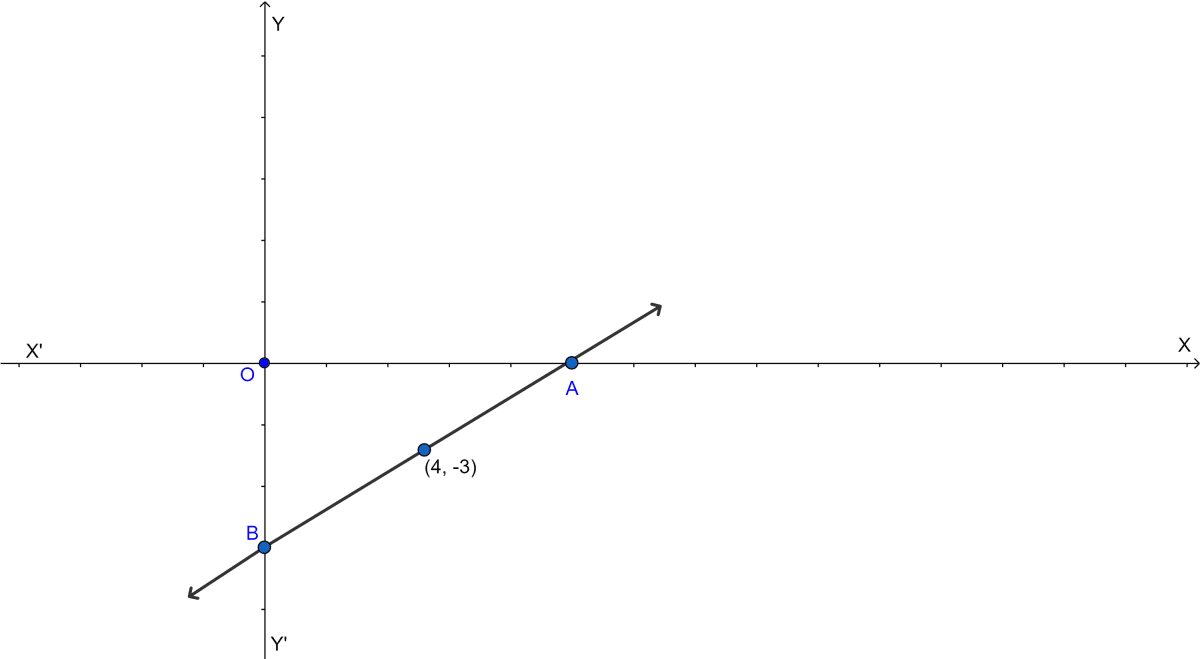
The mid-point of the line segment AB shown in the adjoining diagram is (4, -3). Write down the coordinates of A and B.

The mid-point of the line segment AB shown in the adjoining diagram is (4, -3). Write down the coordinates of A and B. Section Formula, ML Aggarwal Understanding Mathematics Solutions ICSE Class 10.
Show SolutionHide Solution↓

From graph we see,

A lies on x-axis and B be on the y-axis.
Let coordinates of A be (x, 0) and of B be (0, y). P(4, -3) is the mid-point of AB.

$\therefore 4 = \frac{x + 0}{2} \text{ and } -3 = \frac{0 + y}{2}$
⇒ x = 8 and y = -6.

Hence, coordinates of A will be (8, 0) and of B will be (0, -6).

27Exercise 11

Find the coordinates of the centroid of a triangle whose vertices are :

A(-1, 3), B(1, -1) and C(5, 1).

Show SolutionHide Solution↓

Coordinates of the centroid of the triangle whose vertices are (x1, y1), (x2, y2) and (x3, y3) is given by

$\Big(\frac{x_1 + x_2 + x_3}{3}, \frac{y_1 + y_2 + y_3}{3}\Big)$

Putting values in the formula we get,

$$\begin{aligned}= \Big(\frac{-1 + 1 + 5}{3}, \frac{3 + (-1) + 1}{3}\Big) \\[1em] = \Big(\frac{5}{3}, \frac{3}{3}\Big) \\[1em] = \Big(\frac{5}{3}, 1\Big).\end{aligned}$$

Hence, the coordinates of the centroid of the triangle are $\Big(\frac{5}{3}, 1\Big)$.

28Exercise 11

Two vertices of a triangle are (3, -5) and (-7, 4). Find the third vertex given that the centroid is (2, -1).

Show SolutionHide Solution↓

Let the coordinates of third vertex be (x, y) and other two vertices are (3, -5) and (-7, 4) and centroid = (2, -1).

Coordinates of Centroid of the triangle are given by

$$\begin{aligned}\Big(\frac{x_1 + x_2 + x_3}{3}, \frac{y_1 + y_2 + y_3}{3}\Big) \\[1em] \Rightarrow 2 = \frac{3 + (-7) + x}{3} \text{ and } -1 = \frac{-5 + 4 + y}{3} \\[1em] \Rightarrow 6 = x - 4 \text{ and } -3 = y - 1 \\[1em] \Rightarrow x = 6 + 4 \text{ and } y = -3 + 1 \\[1em] \Rightarrow x = 10 \text{ and } y = -2.\end{aligned}$$

Hence, the coordinates of centroid are (10, -2).

29Exercise 11

The vertices of a triangle are A(-5, 3), B(p, -1) and C(6, q). Find the values of p and q if the centroid of the triangle ABC is the point (1, -1).

Show SolutionHide Solution↓

The vertices of the triangle ABC are A(-5, 3), B(p, -1), C(6, q) and the centroid of the △ABC will be

$\Big(\frac{x_1 + x_2 + x_3}{3}, \frac{y_1 + y_2 + y_3}{3}\Big)$

Putting the values in above formula,

$$\begin{aligned}= \Big(\frac{-5 + p + 6}{3}, \frac{3 + (-1) + q}{3}\Big) \\[1em] = \Big(\frac{1 + p}{3}, \frac{2 + q}{3}\Big).\end{aligned}$$

Given, the centroid of the triangle is (1, -1).

Comparing we get,

$\frac{1 + p}{3} = 1 \text{ and } \frac{q + 2}{3} = -1$
⇒ 1 + p = 3 and 2 + q = -3
⇒ p = 3 - 1 and q = -3 - 2
⇒ p = 2 and q = -5.

Hence, the values are p = 2 and q = -5.

11 Mark · Multiple Choice Questions

The points A(9, 0), B(9, 6), C(-9, 6) and D(-9, 0) are the vertices of a

Show SolutionHide Solution↓

We know that,

Distance-Formula = $\sqrt{(x_2 - x_1)^2 + (y_2 - y_1)^2}$

Given, A(9, 0), B(9, 6), C(-9, 6) and D(-9, 0)

Calculating the length of sides by distance formula.

$$\begin{aligned}AB = \sqrt{(9 - 9)^2 + (6 - 0)^2} \\[1em] = \sqrt{0 + 36} \\[1em] = 6 \text{ units.} \\[1em] BC = \sqrt{(-9 - 9)^2 + (6 - 6)^2} \\[1em] = \sqrt{(-18)^2 + 0^2} \\[1em] = \sqrt{324} \\[1em] = 18 \text{ units.} \\[1em] CD = \sqrt{(-9 - (-9))^2 + (0 - 6)^2} \\[1em] = \sqrt{0 + 36} \\[1em] = \sqrt{36} \\[1em] = 6 \text{ units.} \\[1em] DA = \sqrt{(9 - (-9))^2 + (0 - 0)^2} \\[1em] = \sqrt{18^2 + 0} \\[1em] = \sqrt{324} \\[1em] = 18 \text{ units.}\end{aligned}$$

Since, AB = CD and BC = DA means opposite sides are equal.

Hence, Option 1 is the correct option.

21 Mark · Multiple Choice Questions

If $P(\frac{a}{3}, 4)$ is the mid-point of the line segment joining the points Q(-6, 5) and R(-2, 3), then the value of a is

Show SolutionHide Solution↓

We know that,

Mid-point formula = $\Big(\frac{(x_1 + x_2)}{2}, \frac{(y_1 + y_2)}{2}\Big)$

Given, P is the midpoint of line segment QR. Putting the values in mid-point formula for x-coordinate we get,

$$\begin{aligned}\Rightarrow \frac{a}{3} = \frac{-6 + (-2)}{2} \\[1em] \Rightarrow a = \frac{-8}{2} \times 3 \\[1em] \Rightarrow a = -4 \times 3 \\[1em] \Rightarrow a = -12.\end{aligned}$$

Hence, Option 4 is the correct option.

31 Mark · Multiple Choice Questions

If the end points of a diameter of a circle are A(-2, 3) and B(4, -5) then the coordinates of its centre are

Show SolutionHide Solution↓

We know that,

Mid-point formula = $\Big(\frac{(x_1 + x_2)}{2}, \frac{(y_1 + y_2)}{2}\Big)$

Given A and B are end points of the diameter so by mid-point formula the coordinates of the centre of the circle are,

$$\begin{aligned}\Rightarrow \Big(\frac{-2 + 4}{2}, \frac{3 + (-5)}{2}\Big) \\[1em] \Rightarrow \Big(\frac{2}{2}, \frac{-2}{2}\Big) \\[1em] \Rightarrow (1, -1).\end{aligned}$$

Hence, Option 2 is the correct option.

41 Mark · Multiple Choice Questions

If one end of a diameter of a circle is (2,3) and the centre is (-2, 5), then the other end is

Show SolutionHide Solution↓

Let B(x, y) be the other end of the diameter, whose one end is A(2, 3)

∴ The mid-point of AB is $\Big(\frac{x + 2}{2}, \frac{y + 3}{2}\Big)$

The center of the circle is (-2, 5).

Since, the centre of the circle is the mid-point of AB,

$$\begin{aligned}\Rightarrow \frac{2 + x}{2} = -2 \text{ and } \frac{y + 3}{2} = 5 \\[1em] \Rightarrow 2 + x = -4 \text{ and } y + 3 = 10 \\[1em] \Rightarrow x = -4 - 2 \text{ and } y = 10 - 3 \\[1em] \Rightarrow x = -6 \text{ and } y = 7.\end{aligned}$$

∴ Coordinates of other end are (-6, 7).

Hence, Option 1 is the correct option.

51 Mark · Multiple Choice Questions

If the mid-point of the line segment joining the points P(a, b - 2) and Q(-2, 4) is R(2, -3), then the values of a and b are

Show SolutionHide Solution↓

The mid-point of the line segment joining the points P(a, b - 2) and Q(-2, 4) is $\frac{a + (-2)}{2}, \frac{b - 2 + 4}{2}$.

Given R(2, -3) is the mid-point.

Comparing the values of mid-point we get,

$\frac{a + (-2)}{2} = 2 \text{ and } \frac{b - 2 + 4}{2} = -3$
⇒ a - 2 = 4 and b + 2 = -6
⇒ a = 4 + 2 and b = -6 - 2
⇒ a = 6 and b = -8.

Hence, Option 3 is the correct option.

61 Mark · Multiple Choice Questions

The point which lies on the perpendicular bisector of the line segment joining the points A(-2, -5) and B(2, 5) is

Show SolutionHide Solution↓

The point which lies on the perpendicular bisector of the line segment is the mid-point of the line.

Mid-point formula = $\Big(\frac{x_1 + x_2}{2} + \frac{y_1 + y_2}{2}\Big)$

Putting values to find mid point of AB,

$= \Big(\frac{-2 + 2}{2}, \frac{-5 + 5}{2}\Big) = (0, 0).$

Hence, Option 1 is the correct option.

71 Mark · Multiple Choice Questions

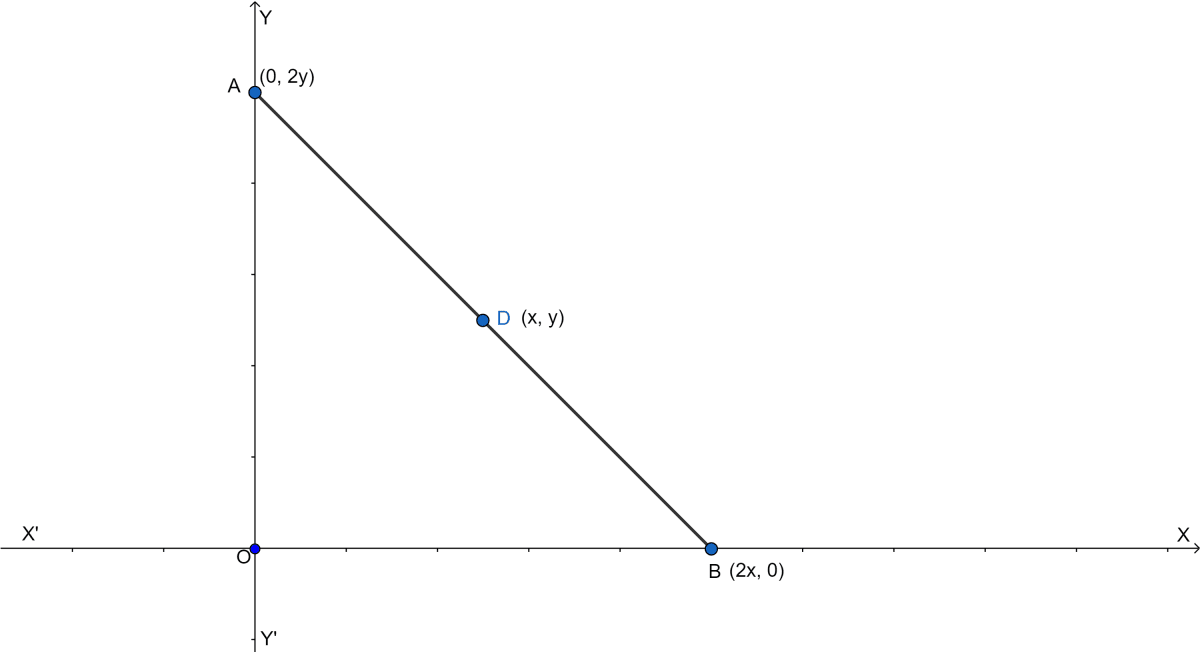
The coordinates of the point which is equidistant from the three vertices of △AOB (shown in the adjoining figure) are

The coordinates of the point which is equidistant from the three vertices of △AOB(shown in the given figure) are (a) (x, y) (b) (y, x) (c) (x/2, y/2) (d) (y/2, x/2). Section Formula, ML Aggarwal Understanding Mathematics Solutions ICSE Class 10.
Show SolutionHide Solution↓

Since the triangle AOB is the right angled triangle the point which is equidistant from O, A and B is the mid-point of AB. Let that mid-point be D.

Applying mid-point formula, coordinates are,

$$\begin{aligned}= \frac{0 + 2x}{2}, \frac{2y + 0}{2} \\[1em] = \frac{2x}{2}, \frac{2y}{2} \\[1em] = (x, y).\end{aligned}$$

Hence, Option 1 is the correct option.

81 Mark · Multiple Choice Questions

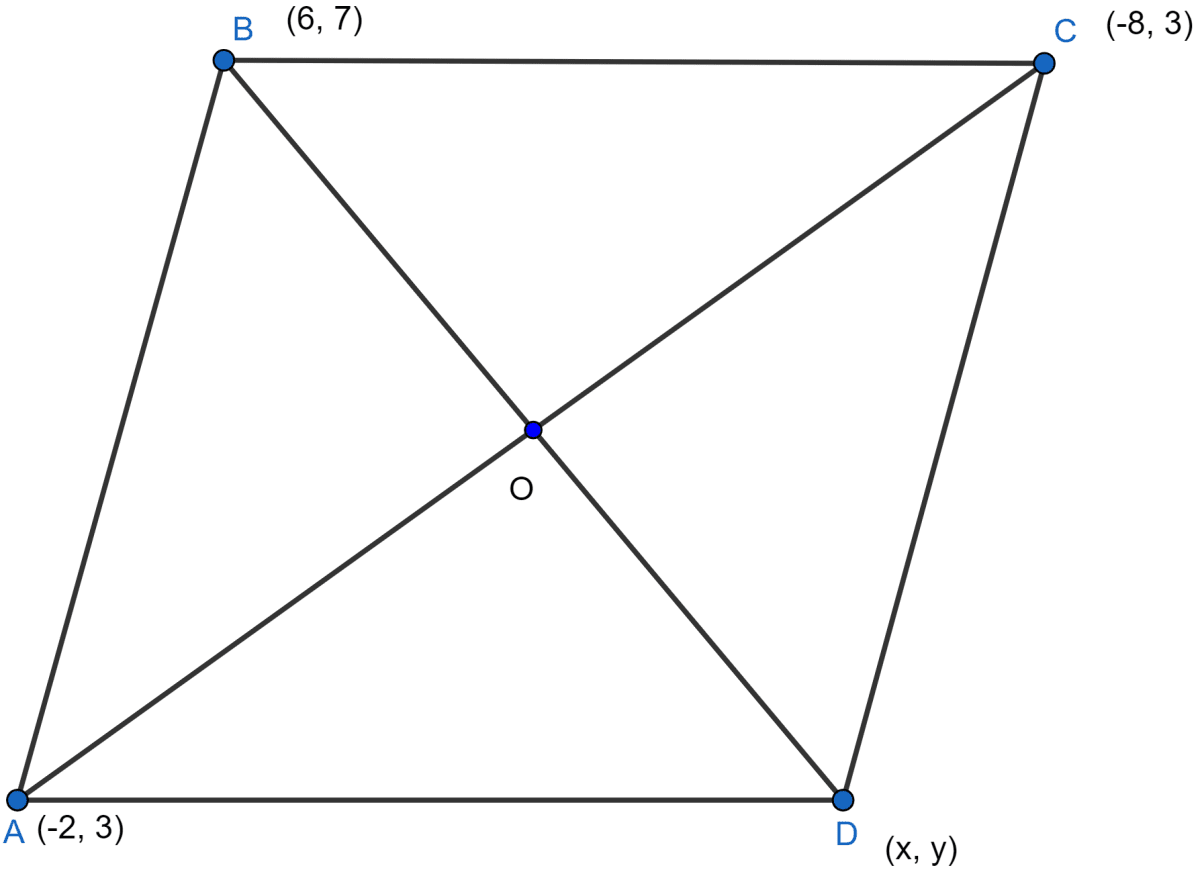
The fourth vertex D of a parallelogram ABCD whose vertices are A(-2, 3), B(6, 7) and C(8, 3) is

Show SolutionHide Solution↓

ABCD is a parallelogram whose three vertices are A(-2, 3), B(6, 7) and C(8, 3). Let coordinates of its fourth vertex D be (x, y).

The diagonals AC and BD bisect each other at O so O is the mid-point of AC as well as BD.

The fourth vertex D of a parallelogram ABCD whose vertices are A(-2, 3), B(6, 7) and C(8, 3) is. Section Formula, ML Aggarwal Understanding Mathematics Solutions ICSE Class 10.

So, by mid-point formula the coordinates of O are,

$$\begin{aligned}= \Big(\frac{-2 + 8}{2}, \frac{3 + 3}{2}\Big) \\[1em] = \Big(\frac{6}{2}, \frac{6}{2}\Big) \\[1em] = (3, 3).\end{aligned}$$

Since, (3, 3) is the mid-point of BD so,

$$\begin{aligned}\Rightarrow 3 = \frac{x + 6}{2} \text{ and } 3 = \frac{y + 7}{2} \\[1em] \Rightarrow 6 = x + 6 \text{ and } 6 = y + 7 \\[1em] \Rightarrow x = 6 - 6 \text{ and } y = 6 - 7 \\[1em] \Rightarrow x = 0 \text{ and } y = -1.\end{aligned}$$

∴ Coordinates of D are (0, -1).

Hence, Option 2 is the correct option.

91 Mark · Multiple Choice Questions

The point which divides the line segment joining the points (7, -6) and (3, 4) in the ratio 1 : 2 internally lies in the

Show SolutionHide Solution↓

Let P(x, y) be the point which divides the line segment joining the points.

Given, A(7, -6) and B(3, 4) is divided by P in ratio 1 : 2.

By section formula,

$$\begin{aligned}x = \frac{m_1x_2 + m_2x_1}{m_1 + m_2} \text{ and } y = \frac{m_1y_2 + m_2y_1}{m_1 + m_2} \\[1em] = \frac{1 \times 3 + 2 \times 7}{1 + 2} \text{ and } \frac{1 \times 4 + 2 \times (-6)}{1 + 2} \\[1em] = \frac{3 + 14}{3} \text{ and } \frac{4 - 12}{3} \\[1em] = \frac{17}{3} \text{ and } -\frac{8}{3}.\end{aligned}$$

We see that x is positive and y is negative.

∴ It lies in the fourth quadrant.

Hence, Option 4 is the correct option.

101 Mark · Multiple Choice Questions

The centroid of the triangle whose vertices are (-4, -2), (6, 2) and (4, 6) is

Show SolutionHide Solution↓

By formula,

Centroid of triangle = $\Big(\frac{x_1 + x_2 + x_3}{3}, \frac{y_1 + y_2 + y_3}{3}\Big)$

Centroid of triangle ABC (G)

$$\begin{aligned}= \Big(\frac{-4 + 6 + 4}{3}, \frac{-2 + 2 + 6}{3}\Big) \\[1em] = \Big(\frac{6}{3}, \frac{6}{3}\Big) \\[1em] = (2, 2).\end{aligned}$$

Hence, Option 1 is the correct option.

111 Mark · Multiple Choice Questions

A(1, 4), B(4, 1) and C(x, 4) are the vertices of △ABC. If the centroid of the triangles is G(4, 3), then x is equal to

Show SolutionHide Solution↓

By formula,

Centroid of triangle = $\Big(\frac{x_1 + x_2 + x_3}{3}, \frac{y_1 + y_2 + y_3}{3}\Big)$

Substituting values we get :

$$\begin{aligned}\Rightarrow (4, 3) = \Big(\frac{1 + 4 + x}{3}, \frac{4 + 1 + 4}{3}\Big) \\[1em] \Rightarrow (4, 3) = \Big(\frac{x + 5}{3}, \frac{9}{3}\Big) \\[1em] \Rightarrow (4, 3) = \Big(\frac{x + 5}{3}, 3\Big) \\[1em] \Rightarrow 4 = \frac{x + 5}{3} \\[1em] \Rightarrow x + 5 = 12 \\[1em] \Rightarrow x = 12 - 5 = 7.\end{aligned}$$

Hence, option 3 is the correct option.

1Assertion-Reason Type Questions

Assertion (A): The point P(3, -1) divides the line segment joining the points A(1, -3) and B(6, 2) internally in the ratio 2 : 3.

Reason (R): The coordinates of the point which divides the line segment joining the points A(x1, y1) and B(x2, y2) internally in the ratio m1 : m2 are $\Big(\frac{m_1x_2 + m_2x_1}{m_1 + m_2}, \frac{m_1y_2 + m_2y_1}{m_1 + m_2}\Big)$.

Show SolutionHide Solution↓

By section-formula,

The coordinates of the point which divides the line segment joining the points A(x1, y1) and B(x2, y2) internally in the ratio m1 : m2 are

$\Big(\frac{m_1x_2 + m_2x_1}{m_1 + m_2}, \frac{m_1y_2 + m_2y_1}{m_1 + m_2}\Big)$.

So, reason (R) is true.

Let us find the point P which divides the line segment joining A(1, -3) and B(6, 2) in the ratio 2 : 3, by section-formula.

$$\begin{aligned}\Rightarrow \text{P} = \Big(\frac{2 \times 6 + 3 \times 1}{2 + 3}, \frac{2 \times 2 + 3 \times (-3)}{2 + 3}\Big)\\[1em] = \Big(\frac{12 + 3}{5}, \frac{4 - 9}{5}\Big)\\[1em] = \Big(\frac{15}{5}, \frac{-5}{5}\Big)\\[1em] = (3, -1)\end{aligned}$$

So, assertion (A) is true.

Thus, both A and R are correct, and R clearly explains A.

Hence, option 3 is the correct option.

2Assertion-Reason Type Questions

Assertion (A): If the coordinates of the mid-points of the sides AB and AC of Δ ABC are D(3, 5) and E(-3, 5) respectively, then BC = 12 units.

Reason (R): The line joining the mid-points of two sides of a triangle is parallel to the third side and equal to half of it.

Show SolutionHide Solution↓

By mid-point theorem,

The line joining the mid-points of two sides of a triangle is parallel to the third side and equal to half of it."

So, reason (R) is true.

Given,

D(3, 5) is mid-points of AB and E(-3, 5) is mid-points of AC. By midpoint Theorem:

DE || BC and DE = $\frac{1}{2}$ BC.

By distance formula,

Distance between two points = $\sqrt{(x_2 - x_1)^2 + (y_2 - y_1)^2}$

$$\begin{aligned}DE = \sqrt{((-3) - 3)^2 + (5 - 5)^2}\\[1em] = \sqrt{(-6)^2 + 0^2}\\[1em] = \sqrt{36}\\[1em] = \text{6 units}\end{aligned}$$

BC = 2 x DE = 2 x 6 = 12 units.

So, assertion (A) is true.

Thus, both A and R are correct, and R clearly explains A.

Hence, option 3 is the correct option.

3Assertion-Reason Type Questions

Assertion (A): The point (-5, 0) lies on the x-axis.

Reason (R): The y-coordinates of a point on x-axis is zero.

Show SolutionHide Solution↓

We know that,

A point lies on the x-axis if its y-coordinate is 0.

So, reason (R) is true.

Here, the point is (−5, 0), so the y-coordinate is 0.

So, assertion (A) is true.

Thus, both A and R are correct, and R clearly explains A.

Hence, option 3 is the correct option.

1Chapter Test

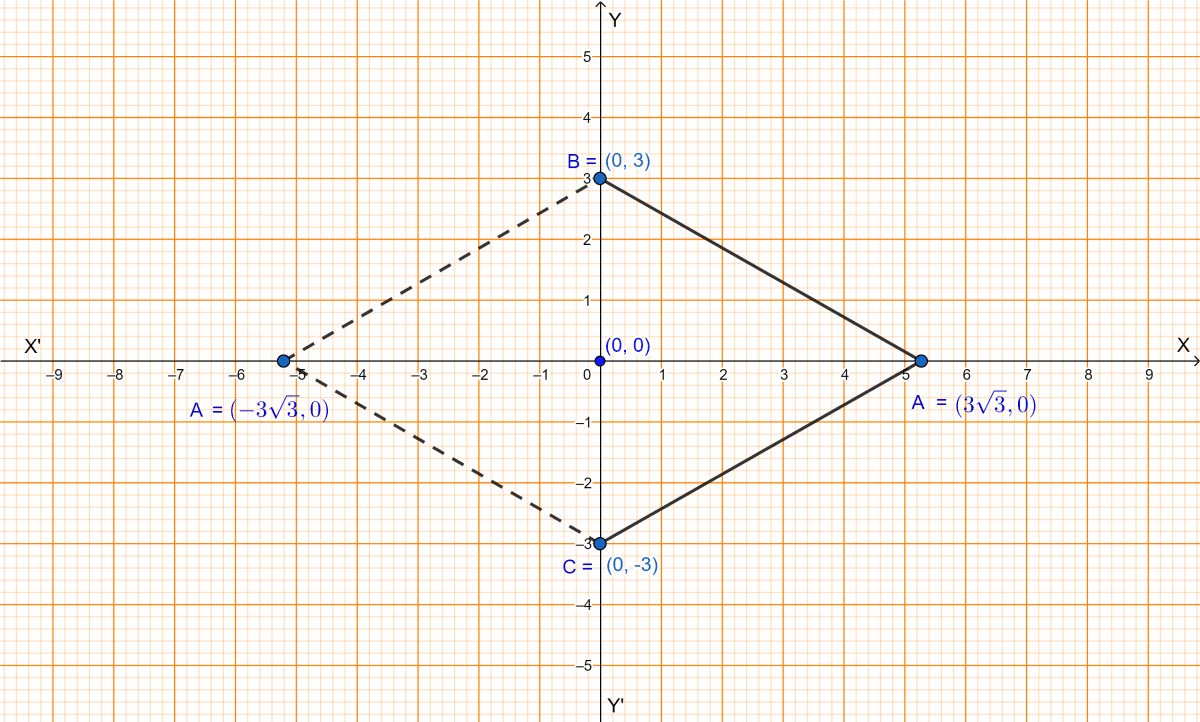
The base BC of an equilateral triangle ABC lies on y-axis. The coordinates of the point C are (0, -3). If origin is the mid-point of the base BC, find the coordinates of the points A and B.

Show SolutionHide Solution↓

Given, base BC of an equilateral triangle ABC lies on y-axis and coordinates of the point C are (0, -3).

Let coordinates of B be (x, y). Since, origin is the mid-point of the BC. So, by mid-point formula,

$$\begin{aligned}\Rightarrow 0 = \frac{x + 0}{2} \text{ and } \frac{y - 3}{2} = 0 \\[1em] \Rightarrow \frac{x}{2} = 0 \text{ and } y - 3 = 0 \\[1em] \Rightarrow x = 0 \text{ and } y - 3 = 0 \\[1em] \Rightarrow x = 0 \text{ and } y = 3.\end{aligned}$$

∴ Coordinates of B are (0, 3).

The base BC of an equilateral triangle ABC lies on y-axis. The coordinates of the point C are (0, -3). If origin is the mid-point of the base BC, find the coordinates of the points A and B. Section Formula, ML Aggarwal Understanding Mathematics Solutions ICSE Class 10.

From graph we can see that BC = 6 units. Since, ABC is an equilateral triangle so, AB = BC = AC.

Let coordinates of A be (a, 0) as it lies on x-axis.

AB = $\sqrt{(a - 0)^2 + (0 - 3)^2}$

Since AB = 6 units,

$$\begin{aligned}\therefore \sqrt{(a - 0)^2 + (0 - 3)^2} = 6 \\[1em] \Rightarrow \sqrt{a^2 + 9} = 6 \\[1em] \Rightarrow a^2 + 9 = 36 \\[1em] \Rightarrow a^2 = 36 - 9 \\[1em] \Rightarrow a^2 = 27 \\[1em] \Rightarrow a = \sqrt{27} \\[1em] \Rightarrow a = ±3\sqrt{3}.\end{aligned}$$

∴ Coordinates of A are $(±3\sqrt{3}, 0)$.

Hence, coordinates of A are $(±3\sqrt{3}, 0)$ and of B are (0, 3).

2Chapter Test

Find the coordinates of the point that divides the line segment joining the points P(5, -2) and Q(9, 6) internally in the ratio of 3 : 1.

Show SolutionHide Solution↓

Let R be the point whose co-ordinates are (x, y) which divides PQ in the ratio of 3 : 1.

By section formula, x-coordinate is given by,

$$\begin{aligned}x = \frac{m_1x_2 + m_2x_1}{m_1 + m_2} \\[1em] = \frac{3 \times 9 + 1 \times 5}{3 + 1} \\[1em] = \frac{27 + 5}{4} \\[1em] = \frac{32}{4} \\[1em] = 8.\end{aligned}$$

Similarly y-coordinate is given by,

$$\begin{aligned}y = \frac{m_1y_2 + m_2y_1}{m_1 + m_2} \\[1em] = \frac{3 \times 6 + 1 \times (-2)}{3 + 1} \\[1em] = \frac{18 + (-2)}{4} \\[1em] = \frac{16}{4} \\[1em] = 4.\end{aligned}$$

∴ R = (8, 4).

Hence, coordinates of point that divides PQ in the ratio 3 : 1 is (8, 4).

3Chapter Test

Find the coordinates of the point P which is three-fourth of the way from A(3, -1) to B(-2, 5).

Show SolutionHide Solution↓

Coordinates of A(3, 1) and B(-2, 5).

Let P divides AB in ratio m1 : m2. Given P lies on AB such that,

AP = $\frac{3}{4}$AB = $\frac{3}{4}$(AP + PB)
⇒ 4AP = 3AP + 3PB
⇒ 4AP - 3AP = 3PB
⇒ AP = 3PB
⇒ AP : PB = 3 : 1.

∴ m1 : m2 = 3 : 1.

Let coordinates of P be (x, y). By section formula,

$$\begin{aligned}x = \frac{m_1x_2 + m_2x_1}{m_1 + m_2} \\[1em] = \frac{(3 \times (-2) + 1 \times 3)}{3 + 1} \\[1em] = \frac{-6 + 3}{4} \\[1em] = -\frac{3}{4}.\end{aligned}$$

Similarly applying section formula we get y-coordinate,

$$\begin{aligned}y = \frac{m_1y_2 + m_2y_1}{m_1 + m_2} \\[1em] = \frac{3 \times 5 + 1 \times 1}{3 + 1} \\[1em] = \frac{15 + 1}{4} \\[1em] = \frac{16}{4} \\[1em] = 4.\end{aligned}$$

∴ P = $\Big(-\frac{3}{4}, 4\Big).$

Hence, coordinates of P are $\Big(-\frac{3}{4}, 4\Big).$

4Chapter Test

P and Q are the points on the line segment joining the points A(3, -1) and B(-6, 5) such that AP = PQ = QB. Find the coordinates of P and Q.

Show SolutionHide Solution↓

Given, AP = PQ = QB

P and Q are the points on the line segment joining the points A(3, -1) and B(-6, 5) such that AP = PQ = QB. Find the coordinates of P and Q. Section Formula, ML Aggarwal Understanding Mathematics Solutions ICSE Class 10.

∴ P divides AB in the ratio of 1 : 2 and Q divides it in 2 : 1.

Let coordinates of P be (a, b) and of Q be (c, d)

Applying section formula for x coordinate of P we get,

$$\begin{aligned}a = \frac{m_1x_2 + m_2x_1}{m_1 + m_2} \\[1em] = \frac{1 \times (-6) + 2 \times 3}{1 + 2} \\[1em] = \frac{-6 + 6}{3} \\[1em] = 0.\end{aligned}$$

Similarly, applying section formula for y coordinate of P we get,

$$\begin{aligned}b = \frac{m_1y_2 + m_2y_1}{m_1 + m_2} \\[1em] = \frac{1 \times 5 + 2 \times (-1)}{1 + 2} \\[1em] = \frac{5 - 2}{3} \\[1em] = \frac{3}{3} \\[1em] = 1.\end{aligned}$$

∴ Coordinates of P = (a, b) = (0, 1).

Applying section formula for x coordinate of Q we get,

$$\begin{aligned}c = \frac{m_1x_2 + m_2x_1}{m_1 + m_2} \\[1em] = \frac{2 \times (-6) + 1 \times 3}{2 + 1} \\[1em] = \frac{-12 + 3}{3} \\[1em] = -3.\end{aligned}$$

Similarly, applying section formula for y coordinate of Q we get,

$$\begin{aligned}d = \frac{m_1y_2 + m_2y_1}{m_1 + m_2} \\[1em] = \frac{2 \times 5 + 1 \times (-1)}{2 + 1} \\[1em] = \frac{10 + (-1)}{3} \\[1em] = \frac{9}{3} \\[1em] = 3.\end{aligned}$$

∴ Coordinates of Q = (c, d) = (-3, 3).

Hence, coordinates of P = (0, 1) and Q = (-3, 3).

5Chapter Test

The center of a circle is (α + 2, α - 5). Find the value of α, given that the circle passes through points (2, -2) and (8, -2).

Show SolutionHide Solution↓

Given O(α + 2, α - 5) is the center of the circle. A and B are the points on the circle. So, we can say OA = OB = radius.

From distance formula we get,

$$\begin{aligned}OA = \sqrt{(2 - (α + 2))^2 + (-2 - (α - 5))^2} \\[1em] = \sqrt{(2 - α - 2)^2 + (-2 - α + 5)^2} \\[1em] = \sqrt{(-α)^2 + (-α + 3)^2} \\[1em] = \sqrt{α^2 + α^2 + 9 - 6α} \\[1em] = \sqrt{2α^2 - 6α + 9} \qquad \text{....[Eq 1]} \\[1em] OB = \sqrt{(8 - (α + 2))^2 + (-2 - (α - 5))^2} \\[1em] = \sqrt{(8 - α - 2)^2 + (-2 - α + 5)^2} \\[1em] = \sqrt{(6 - α)^2 + (3 - α)^2} \\[1em] = \sqrt{36 + α^2 - 12α + 9 + α^2 - 6α} \\[1em] = \sqrt{2α^2 + 45 - 18α} \qquad \text{....[Eq 2]}\end{aligned}$$

Comparing both the Equation, since they are equal to radius,

$$\begin{aligned}\Rightarrow \sqrt{2α^2 - 6α + 9} = \sqrt{2α^2 + 45 - 18α} \\[1em]\end{aligned}$$

Squaring both sides we get,

$$\begin{aligned}\Rightarrow 2α^2 - 6α + 9 = 2α^2 + 45 - 18α \\[1em] \Rightarrow 2α^2 - 2α^2 - 6α + 18α + 9 - 45 = 0 \\[1em] \Rightarrow 12α - 36 = 0 \\[1em] \Rightarrow 12α = 36 \\[1em] \Rightarrow α = 3.\end{aligned}$$

Hence, the value of α = 3.

6Chapter Test

The mid-point of the line segment joining A(2, p) and B(q, 4) is (3, 5). Calculate the values of p and q.

Show SolutionHide Solution↓

Given, (3, 5) is the mid-point of A(2, p) and B(q, 4).

By mid-point formula,

$$\begin{aligned}\Rightarrow 3 = \frac{(2 + q)}{2} \text{ and } 5 = \frac{(p + 4)}{2} \\[1em] \Rightarrow 2 + q = 6 \text{ and } p + 4 = 10 \\[1em] \Rightarrow q = 4 \text{ and } p = 6.\end{aligned}$$

Hence, p = 6 and q = 4.

7Chapter Test

The ends of a diameter of a circle have the coordinates (3, 0) and (-5, 6). PQ is another diameter where Q has the coordinates (-1, -2). Find the coordinates of P and the radius of the circle.

Show SolutionHide Solution↓

Let AB be the diameter where coordinates of A are (3, 0) and of B are (-5, 6).

∴ Coordinates of its midpoint will be $\Big(\frac{3 + (-5)}{2}, \frac{0 + 6}{2}\Big)$ or (-1, 3).

Now PQ is another diameter in which the coordinates of Q are (-1, -2).

Let coordinates of P be (x, y), then by mid-point formula coordinates of mid-point will be $\Big(\frac{-1 + x}{2}, \frac{-2 + y}{2}\Big)$

Since, the diameters of circle intersect at their midpoint.

$$\begin{aligned}\therefore \frac{-1 + x}{2} = -1 \text{ and } \frac{-2 + y}{2} = 3 \\[1em] \Rightarrow -1 + x = -2 \text{ and } -2 + y = 6 \\[1em] \Rightarrow x = -2 + 1 \text{ and } y = 6 + 2 \\[1em] \Rightarrow x = -1 \text{ and } y = 8.\end{aligned}$$

∴ Coordinates of P will be (-1, 8).

Radius = OP, by distance-formula we get,

$$\begin{aligned}OP = \sqrt{(-1 - (-1))^2 + (8 - 3)^2} \\[1em] = \sqrt{(-1 + 1)^2 + (5)^2} \\[1em] = \sqrt{0^2 + 25} \\[1em] = \sqrt{25} \\[1em] = 5 \text{ units}.\end{aligned}$$

Hence, the radius of circle is 5 units and the coordinates of P is (-1, 8).

8Chapter Test

In what ratio does the point (-4, 6) divide the line segment joining the points A(-6, 10) and B(3, -8) ?

Show SolutionHide Solution↓

Let the point (-4, 6) divide the line segment joining the points A(-6, 10) and B(3, -8) in the ratio m : n

Using section-formula,

x-coordinate = $\Big(\frac{mx_2 + nx_1}{m + n}\Big)$

Comparing,

$$\begin{aligned}\Rightarrow -4 = \Big(\frac{m \times 3 + n \times (-6)}{m + n} \Big) \\[1em] \Rightarrow -4 = \frac{3m - 6n}{m + n} \\[1em] \Rightarrow -4(m + n) = 3m - 6n \\[1em] \Rightarrow -4m -4n = 3m - 6n \\[1em] \Rightarrow -4m - 3m = -6n + 4n \\[1em] \Rightarrow -7m = -2n \\[1em] \Rightarrow \frac{m}{n} = \frac{2}{7} \\[1em] \Rightarrow m : n = 2 : 7.\end{aligned}$$

The ratio in which the point (-4, 6) divides the line segment is 2 : 7.

9Chapter Test

Find the ratio in which the point P(-3, p) divides the line segment joining the points (-5, -4) and (-2, 3). Hence, find the value of p.

Show SolutionHide Solution↓

Let (-3, p) divides the line segment in the ratio of m : n.

By section-formula,

x-coordinate = $\Big(\frac{mx_2 + nx_1}{m + n}\Big)$

$$\begin{aligned}\therefore -3 = \frac{m \times (-2) + n \times (-5)}{m + n} \\[1em] \Rightarrow -3 = \frac{-2m - 5n}{m + n} \\[1em] \Rightarrow -3(m + n) = -2m - 5n \\[1em] \Rightarrow -3m - 3n = -2m - 5n \\[1em] \Rightarrow -3m + 2m = -5n + 3n \\[1em] \Rightarrow -m = -2n \\[1em] \Rightarrow \frac{m}{n} = \frac{2}{1} \\[1em] \Rightarrow m : n = 2 : 1. \\[1em]\end{aligned}$$

By section formula, y-coordinate = p

$$\begin{aligned}= \frac{my_2 + ny_1}{m + n} \\[1em] = \frac{2 \times 3 + 1 \times (-4)}{2 + 1} \\[1em] = \frac{6 - 4}{3} \\[1em] = \frac{2}{3}.\end{aligned}$$

Hence, the value of p = $\frac{2}{3}$ and the ratio in which point P divides the line segment is 2 : 1.

10Chapter Test

In what ratio is the line joining the points (4, 2) and (3, -5) divided by the x-axis? Also find the coordinates of the point of division.

Show SolutionHide Solution↓

Let the point P which is on the x-axis, divide the line segment joining the points A(4, 2) and B(3, -5) in the ratio of m : n. Let the coordinates of P be (x, 0).

By section formula,

y-coordinate = $\frac{my_2 + ny_1}{m + n}$

$$\begin{aligned}\Rightarrow 0 = \frac{m \times (-5) + n \times 2}{m + n} \\[1em] \Rightarrow 0 = -5m + 2n \\[1em] \Rightarrow 5m = 2n \\[1em] \Rightarrow \frac{m}{n} = \frac{2}{5} \\[1em] \Rightarrow m : n = 2 : 5.\end{aligned}$$

Putting value of m : n in section-formula for x-coordinate,

x-coordinate = $\frac{mx_2 + nx_1}{m+ n}$

$$\begin{aligned}= \frac{2 \times 3 + 5 \times 4}{2 + 5} \\[1em] = \frac{6 + 20}{7} \\[1em] = \frac{26}{7}.\end{aligned}$$

Hence, coordinates of P are $(\frac{26}{7}, 0)$ and 2 : 5 is the ratio in which the line joining the points (4, 2) and (3, -5) is divided by the x-axis.

11Chapter Test

If the abscissa of a point P is 2, find the ratio in which it divides the line segment joining the points (-4, 3) and (6, 3). Hence, find the coordinates of P.

Show SolutionHide Solution↓

Let coordinates of A be (-4, 3) and of B be (6, 3) and of P be (2, y).

Let the ratio in which the P divides AB be m : n.

If the abscissa of a point P is 2, find the ratio in which it divides the line segment joining the points (-4, 3) and (6, 3). Hence, find the coordinates of P. Section Formula, ML Aggarwal Understanding Mathematics Solutions ICSE Class 10.

By section formula,

x-coordinate = $\frac{mx_2 + nx_1}{m+ n}$

$$\begin{aligned}\Rightarrow 2 = \frac{m \times 6 + n \times (-4)}{m + n} \\[1em] \Rightarrow 2 = \frac{6m - 4n}{m + n} \\[1em] \Rightarrow 2(m + n) = 6m - 4n \\[1em] \Rightarrow 2m + 2n = 6m - 4n \\[1em] \Rightarrow 2n + 4n = 6m - 2m \\[1em] \Rightarrow 6n = 4m \\[1em] \Rightarrow 6n = 4m \\[1em] \Rightarrow \frac{m}{n} = \frac{6}{4} \\[1em] \Rightarrow m : n = 3 : 2.\end{aligned}$$

Similarly for y-coordinate,

$$\begin{aligned}\Rightarrow y = \frac{my_2 + ny_1}{m + n} \\[1em] = \frac{3 \times 3 + 2 \times 3}{3 + 2} \\[1em] = \frac{9 + 6}{5} \\[1em] = \frac{15}{5} \\[1em] = 3.\end{aligned}$$

Hence, the coordinates of P is (2, 3) and it divides the line in the ratio 3 : 2.

12Chapter Test

Determine the ratio in which the line 2x + y - 4 = 0 divide the line segment joining the points A(2, -2) and B(3, 7). Also find the coordinates of the point of the division.

Show SolutionHide Solution↓

Let the line 2x + y - 4 divide the line segment AB in the ratio m : n at P. So, by section-formula coordinates of P are,

x-coordinate = x = $\frac{m \times x_2 + n \times x_1}{m + n}$

$$\begin{aligned}= \frac{m \times 3 + n \times 2}{m + n} \\[1em] = \frac{3m + 2n}{m + n} \qquad \text{....[Eq 1]} \\[1em]\end{aligned}$$

Similarly,

y-coordinate = y = $\frac{m \times y_2 + n \times y_1}{m + n}$

$$\begin{aligned}= \frac{m \times 7 + n \times (-2)}{m + n} \\[1em] = \frac{7m - 2n}{m + n} \qquad \text{....[Eq 2]} \\[1em]\end{aligned}$$

Since, P lies on the line 2x + y - 4 = 0.

$$\begin{aligned}\therefore 2\frac{(3m + 2n)}{m + n} + \frac{7m - 2n}{m + n} - 4 = 0 \\[1em] \Rightarrow \frac{6m + 4n + 7m - 2n -4(m + n)}{m + n} = 0 \\[1em] \Rightarrow 6m + 4n + 7m - 2n - 4m - 4n = 0 \\[1em] \Rightarrow 9m - 2n = 0 \\[1em] \Rightarrow 9m = 2n \\[1em] \Rightarrow \frac{m}{n} = \frac{2}{9} \\[1em]\end{aligned}$$

Putting values in Eq 1 for x-coordinate we get,

$$\begin{aligned}\therefore x = \frac{3 \times 2 + 2 \times 9}{2 + 9} \\[1em] = \frac{6 + 18}{11} \\[1em] = \frac{24}{11}. \\[1em]\end{aligned}$$

Putting values in Eq 2 for y-coordinate we get,

$$\begin{aligned}\text{y = } \frac{7 \times 2 - 2 \times 9}{2 + 9} \\[1em] = \frac{14 - 18}{11} \\[1em] = -\frac{4}{11}.\end{aligned}$$

Hence, coordinates of P will be $\Big(\frac{24}{11}, -\frac{4}{11}\Big)$ and 2 : 9 is the ratio in which the line 2x + y - 4 divides AB.

13Chapter Test

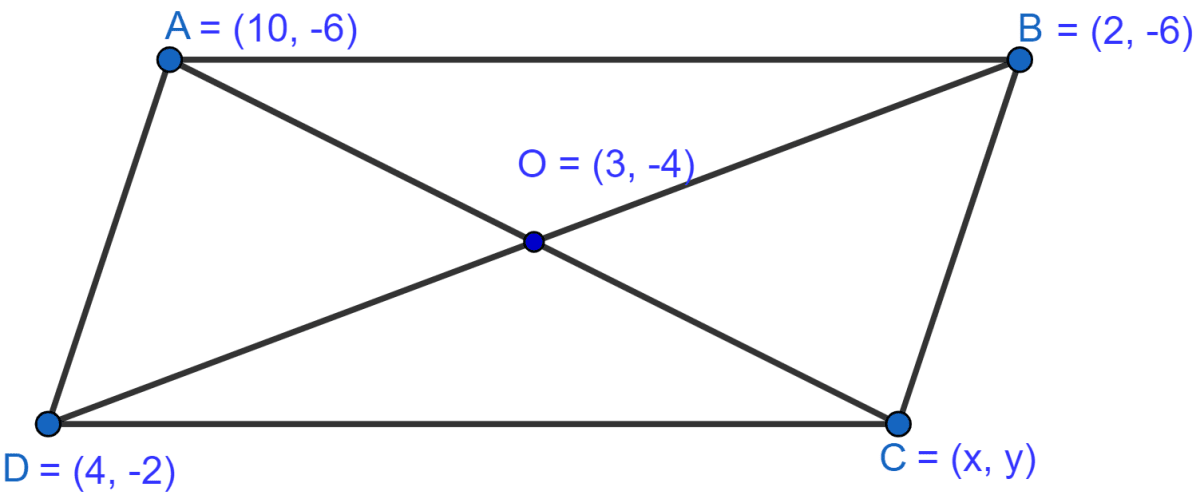
ABCD is a parallelogram. If the coordinates of A, B and D are (10, -6), (2, -6) and (4, -2) respectively, find the coordinates of C.

Show SolutionHide Solution↓

Let the coordinates of C be (x, y) and other three vertices of the given parallelogram are A(10, -6), B(2, -6) and D(4, -2).

Since, ABCD is a parallelogram, its diagonals bisect each other.

ABCD is a parallelogram. If the coordinates of A, B and D are (10, -6), (2, -6) and (4, -2) respectively, find the coordinates of C. Section Formula, ML Aggarwal Understanding Mathematics Solutions ICSE Class 10.

Let AC and BD intersect each other at O.

So, O is the mid-point of BD, so coordinates of O are,

$$\begin{aligned}\Rightarrow \Big(\frac{2 + 4}{2}, \frac{-6 + (-2)}{2}\Big) \\[1em] = \Big(\frac{6}{2}, \frac{-8}{2}\Big) \\[1em] = (3, -4).\end{aligned}$$

The mid-point of AC is

$\Rightarrow \Big(\frac{10 + x}{2}, \frac{-6 + y}{2}\Big)$

Since O is the mid-point of AC so comparing,

$$\begin{aligned}\Rightarrow \frac{10 + x}{2} = 3 \text{ and } \frac{-6 + y}{2} = -4 \\[1em] \Rightarrow 10 + x = 6 \text{ and } -6 + y = -8 \\[1em] \Rightarrow x = 6 - 10 \text{ and } y = -8 + 6 \\[1em] \Rightarrow x = -4 \text{ and } y = -2.\end{aligned}$$

Hence, the coordinates of P are (-4, -2).

14Chapter Test

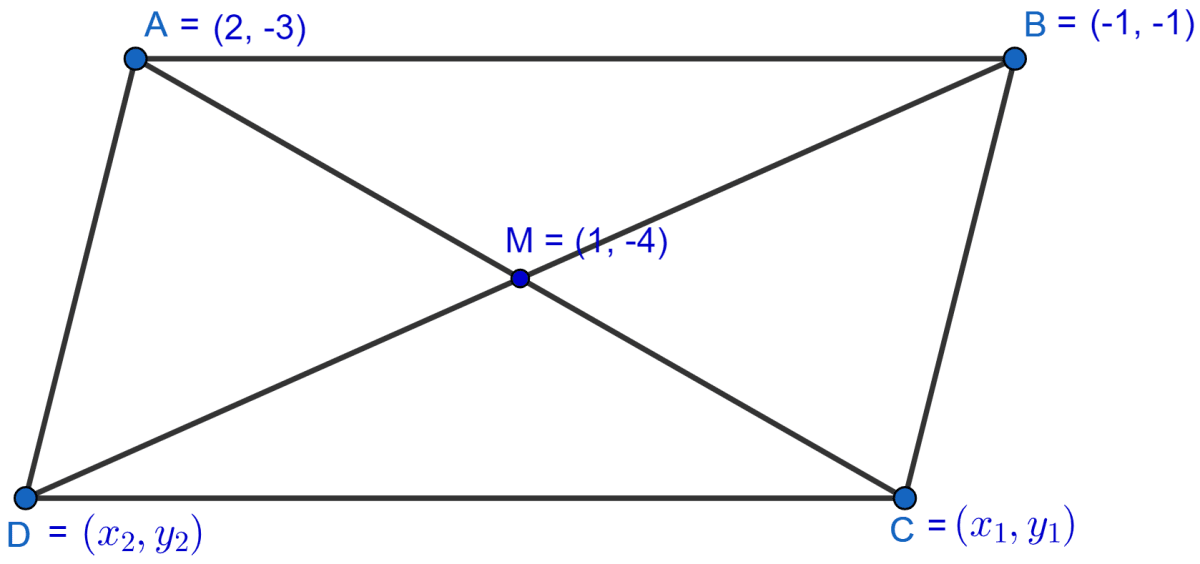
ABCD is a parallelogram whose vertices A and B have coordinates (2, -3) and (-1, -1) respectively. If the diagonals of the parallelogram meet at the point M(1, -4), find the coordinates of C and D. Hence, find the perimeter of the parallelogram.

Show SolutionHide Solution↓

Coordinates of A are (2, -3) and B (-1, -1).

Since, M is the point where diagonals meet, hence it is midpoint of AC and BD.

Let coordinates of C and D be (x1, y1) and (x2, y2).

ABCD is a parallelogram whose vertices A and B have coordinates (2, -3) and (-1, -1) respectively. If the diagonals of the parallelogram meet at the point M(1, -4), find the coordinates of C and D. Hence, find the perimeter of the parallelogram. Section Formula, ML Aggarwal Understanding Mathematics Solutions ICSE Class 10.

When M(1, -4) is the midpoint of AC then by midpoint formula,

$$\begin{aligned}\Rightarrow 1 = \frac{2 + x_1}{2} \text{ and } -4 = \frac{-3 + y_1}{2} \\[1em] \Rightarrow 2 + x_1 = 2 \text{ and } -3 + y_1 = -8 \\[1em] \Rightarrow x_1 = 2 - 2 \text{ and } y_1 = -8 + 3 \\[1em] \Rightarrow x_1 = 0 \text{ and } y_1 = -5.\end{aligned}$$

∴ Coordinates of C are (0, -5)

When M(1, -4) is the midpoint of BD then by midpoint formula,

$$\begin{aligned}\Rightarrow 1 = \frac{-1 + x_2}{2} \text{ and } -4 = \frac{-1 + y_2}{2} \\[1em] \Rightarrow -1 + x_2 = 2 \text{ and } -1 + y_2 = -8 \\[1em] \Rightarrow x_2 = 2 + 1 \text{ and } y_2 = -8 + 1 \\[1em] \Rightarrow x_2 = 3 \text{ and } y_2 = -7.\end{aligned}$$

∴ Coordinates of D are (3, -7).

By distance formula, the length of AB is,

$$\begin{aligned}= \sqrt{[2 - (-1)]^2 + [(-3) - (-1)]^2} \\[1em] = \sqrt{(2 + 1)^2 + (-3 + 1)^2} \\[1em] = \sqrt{3^2 + (-2)^2} \\[1em] = \sqrt{9 + 4} \\[1em] = \sqrt{13}.\end{aligned}$$

By distance formula, the length of BC is,

$$\begin{aligned}= \sqrt{[0 - (-1)]^2 + [(-5) - (-1)]^2} \\[1em] = \sqrt{(1)^2 + (-5 + 1)^2} \\[1em] = \sqrt{1 + (-4)^2} \\[1em] = \sqrt{1 + 16} \\[1em] = \sqrt{17}.\end{aligned}$$

Perimeter of parallelogram ABCD = 2(AB + BC) = $2(\sqrt{13} + \sqrt{17}).$

Hence, the coordinates of C and D are (0, -5) and (3, -7) respectively. The perimeter of parallelogram ABCD is $2(\sqrt{13} + \sqrt{17})$ units.

15Chapter Test

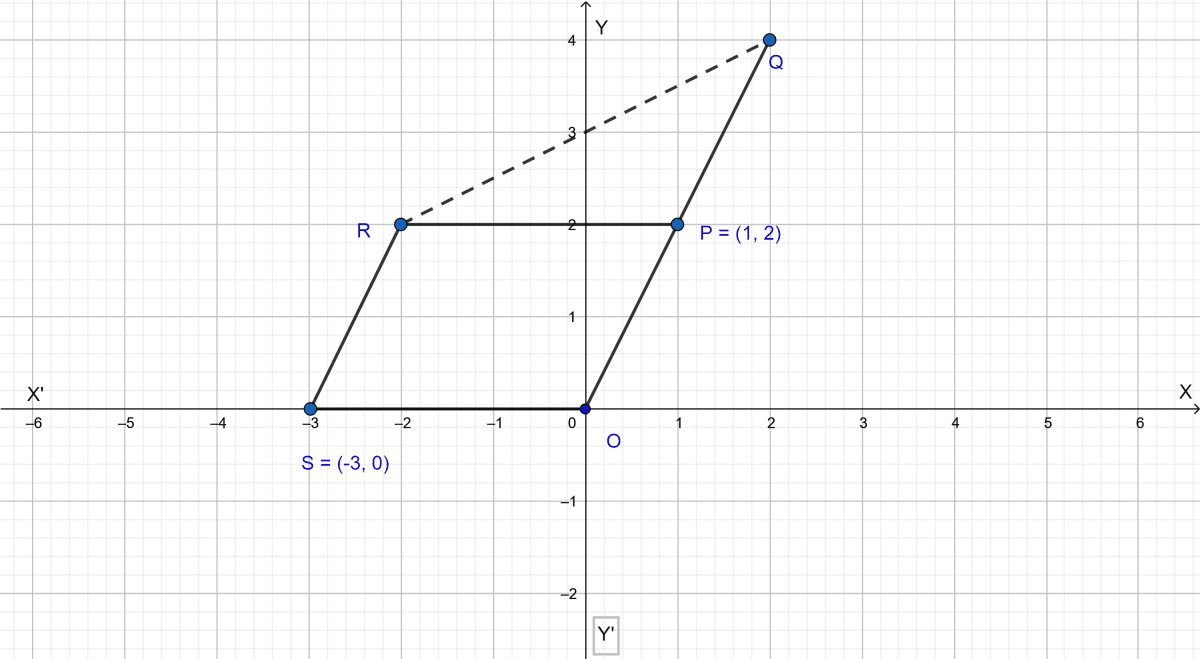
Given O (0, 0), P(1, 2), S(-3, 0). P divides OQ in the ratio 2 : 3 and OPRS is a parallelogram.

Given O (0, 0), P(1, 2), S(-3, 0). P divides OQ in the ratio 2 : 3 and OPRS is a parallelogram. Find (i) the coordinates of Q. (ii) the coordinates of R. (iii) the ratio in which RQ is divided by the x-axis. Section Formula, ML Aggarwal Understanding Mathematics Solutions ICSE Class 10.

Find :

(i) the coordinates of Q.

(ii) the coordinates of R.

(iii) the ratio in which RQ is divided by the x-axis.

Show SolutionHide Solution↓

(i) Let coordinates of Q be (a, b).

Given, point P(1, 2) divides OQ in the ratio of 2 : 3. Here, O(0, 0) is the origin.

By section formula we get x,

x-coordinate = $\frac{m_1x_2 + m_2x_1}{m_1 + m_2}$

$$\begin{aligned}\Rightarrow 1 = \frac{2 \times a + 3 \times 0}{2 + 3} \\[1em] \Rightarrow 1 = \frac{2a}{5} \\[1em] \Rightarrow a = \frac{5}{2}.\end{aligned}$$

By section formula we get y,

y-coordinate = $\frac{m_1y_2 + m_2y_1}{m_1 + m_2}$

$$\begin{aligned}\Rightarrow 2 = \frac{2 \times b + 3 \times 0}{2 + 3} \\[1em] \Rightarrow 2 = \frac{2b}{5} \\[1em] \Rightarrow b = 5.\end{aligned}$$

Hence, coordinates of Q are $(\frac{5}{2}, 5)$.

(ii) In OPRS, OR and PS are diagonals. Let them bisect each other at point M which is the mid-point of both the diagonals. Let coordinates of R be (c, d).

Since, M is the midpoint of PS, by mid-point formula, coordinates of M

$$\begin{aligned}= \Big(\frac{1 + (-3)}{2}, \frac{2 + 0}{2}\Big) \\[1em] = \Big(\frac{-2}{2}, \frac{2}{2}\Big) \\[1em] = (-1, 1).\end{aligned}$$

Since, M is the mid-point of OR also so,

$$\begin{aligned}\Rightarrow -1 = \frac{0 + c}{2} \text{ and } 1 = \frac{0 + d}{2} \\[1em] \Rightarrow c = -2 \text{ and } d = 2.\end{aligned}$$

Hence, coordinates of R are (-2, 2).

(iii) Let the point on y-axis that divides RQ is N and it divides in ratio m1 : m2.

Since, N lies on y-axis so abscissa(x) = 0.

By section formula we get,

$$\begin{aligned}\text{x-coordinate } = \frac{m_1x_2 + m_2x_1}{m_1 + m_2} \\[1em] \Rightarrow 0 = \frac{m_1 \times \frac{5}{2} + m_2 \times (-2)}{m_1 + m_2} \\[1em] \Rightarrow \frac{5m_1}{2} - 2m_2 = 0 \\[1em] \Rightarrow \frac{5}{2}m_1 = 2m_2 \\[1em] \Rightarrow m_1 : m_2 = \frac{2 \times 2}{5} \\[1em] \Rightarrow m_1 : m_2 = 4 : 5.\end{aligned}$$

Hence, RQ is divided in the ratio 4 : 5 by x-axis.

16Chapter Test

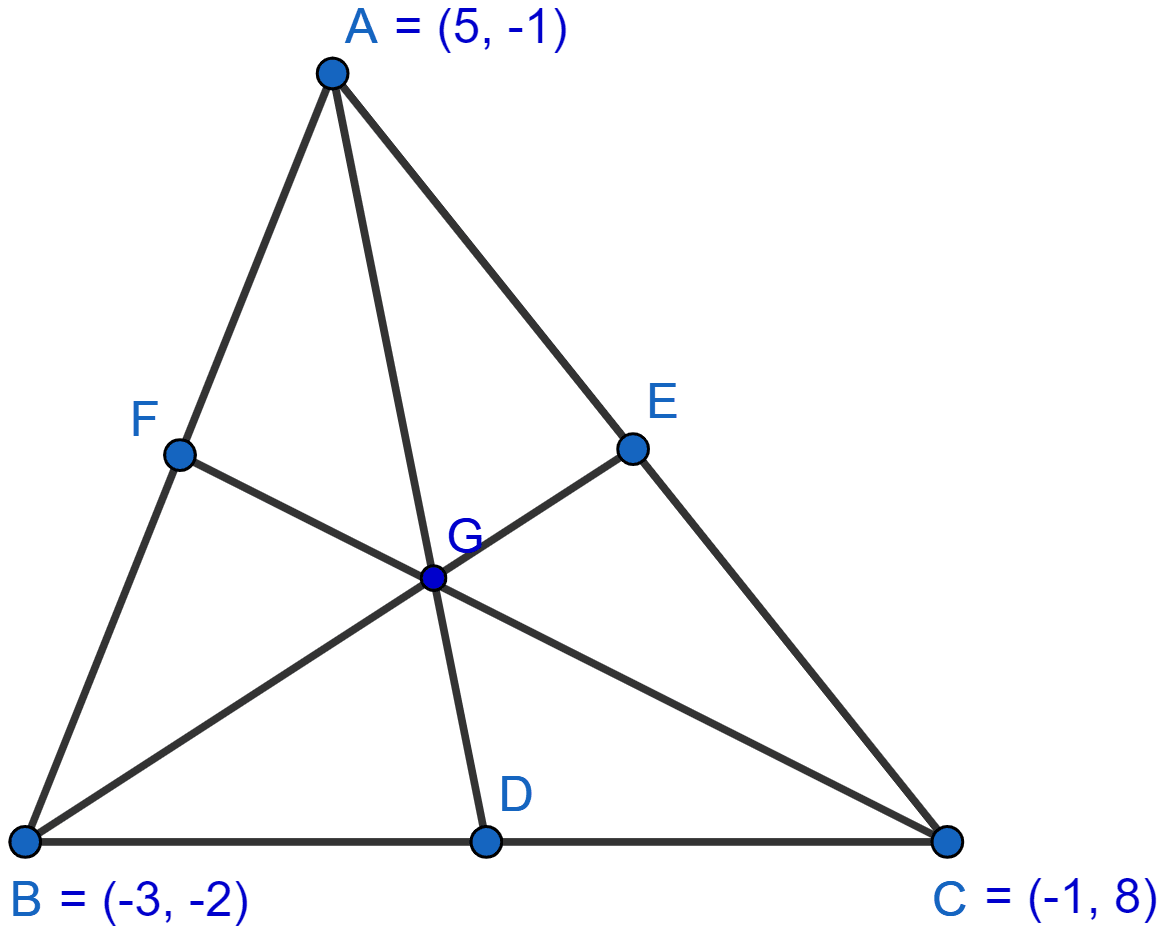
If A(5, -1), B(-3, -2) and C(-1, 8) are the vertices of a triangle ABC, find the length of the median through A and the coordinates of the centroid of triangle ABC.

Show SolutionHide Solution↓

A(5, -1), B(-3, -2) and C(-1, 8) are the vertices of △ABC. Below figure shows the triangle:

If A(5, -1), B(-3, -2) and C(-1, 8) are the vertices of a triangle ABC, find the length of the median through A and the coordinates of the centroid of triangle ABC. Section Formula, ML Aggarwal Understanding Mathematics Solutions ICSE Class 10.

Let D be the midpoint of BC. By midpoint formula, coordinates of D are,

$$\begin{aligned}= \Big(\frac{-3 + (-1)}{2}, \frac{-2 + 8}{2}\Big) \\[1em] = \Big(\frac{-4}{2}, \frac{6}{2}\Big) \\[1em] = (-2, 3).\end{aligned}$$

By distance formula we get,

$$\begin{aligned}AD = \sqrt{(x_2 - x_1)^2 + (y_2 - y_1)^2} \\[1em] = \sqrt{(-2 - 5)^2 + (3 - (-1))^2} \\[1em] = \sqrt{(-7)^2 + (3 + 1)^2} \\[1em] = \sqrt{49 + 16} \\[1em] = \sqrt{65} \text{ units.}\end{aligned}$$

Coordinates of centroid is given by $\Big(\frac{x_1 + x_2 + x_3}{3}, \frac{y_1 + y_2 + y_3}{3}\Big)$

$$\begin{aligned}= \Big(\frac{5 + (-3) + (-1)}{3}, \frac{-1 + (-2) + 8}{3}\Big) \\[1em] = \Big(\frac{1}{3}, \frac{5}{3}\Big).\end{aligned}$$

Hence, the coordinates of the centroid of triangle is $\Big(\frac{1}{3}, \frac{5}{3}\Big)$ and the length of the median through A is $\sqrt{65}$ units.

Press ↓ to reveal a solution and move to the next question. Back to ML Aggarwal Mathematics.

Free sample bank