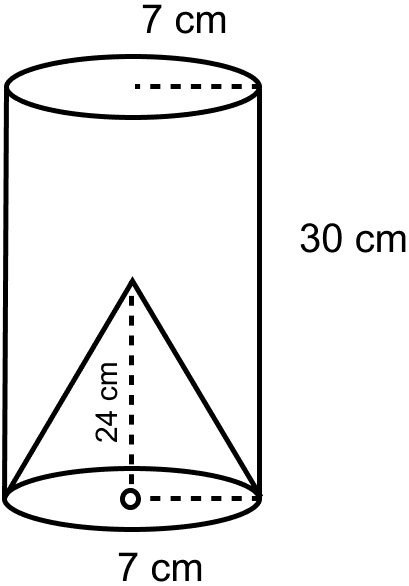
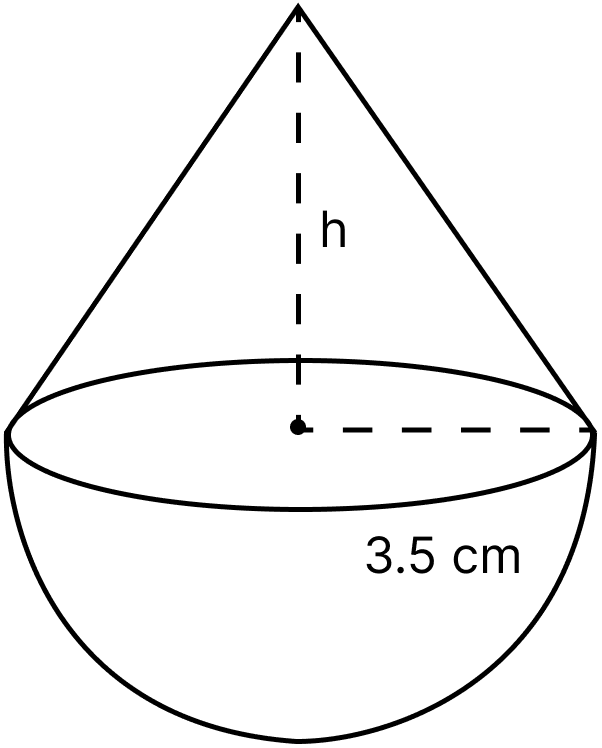
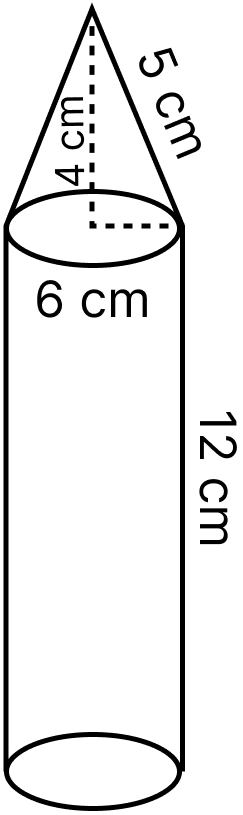
(i) Given, l = 25 cm and r = 7 cm.
We know that,
l2 = r2 + h2
⇒ 252 = 72 + h2
⇒ h2 = 252 - 72
⇒ h2 = 625 - 49
⇒ h2 = 576
⇒ h = $\sqrt{576}$ = 24 cm.
Volume of cone = $\frac{1}{3}πr^2h$
Putting values in equation we get,
Volume of cone = $\frac{1}{3} \times \frac{22}{7} \times (7)^2 \times 24 = \frac{22 × 49 × 24}{3 \times 7}$ = 22 × 7 × 8 = 1232 cm3.
Since 1 litre = 1000 cm3 or, 1 cm3 = $\frac{1}{1000}$ litre.
∴ 1232 cm3 = $1232 \times \frac{1}{1000}$ litre = 1.232 litre.
Hence, the volume of cone = 1.232 litre.
(ii) Given, l = 13 cm and h = 12 cm.
We know that,
l2 = r2 + h2
⇒ 132 = r2 + 122
⇒ r2 = 132 - 122
⇒ r2 = 169 - 144
⇒ r2 = 25
⇒ r = $\sqrt{25}$ = 5 cm.
Volume of cone = $\frac{1}{3}πr^2h$
Putting values in equation we get,
Volume of cone = $\frac{1}{3} \times \frac{22}{7} \times (5)^2 \times 12 = \frac{22 × 25 × 12}{3 \times 7} = \frac{6600}{21}$cm3.
Since 1 litre = 1000 cm3 or, 1 cm3 = $\frac{1}{1000}$ litre.
∴ $\frac{6600}{21}$ cm3 = $\frac{6600}{21} \times \frac{1}{1000} = \frac{66}{210} = \frac{11}{35}$ litres.
Hence, the volume of cone = $\frac{11}{35}$ litres.