Given,
P = {x : 5 < 2x - 1 ≤ 11, x ∈ R}
$\Rightarrow 5 \lt 2x - 1 \le 11$
Solving left side,
$$\begin{aligned}5 \lt 2x -1 \\[0.5em] \Rightarrow 6 \lt 2x \\[0.5em] \Rightarrow 3 \lt x \\[0.5em] \Rightarrow x \gt 3 \\[0.5em]\end{aligned}$$
Solving right side,
$$\begin{aligned}2x -1 \le 11 \\[0.5em] \Rightarrow 2x \le 12 \\[0.5em] \Rightarrow x \le 6\end{aligned}$$
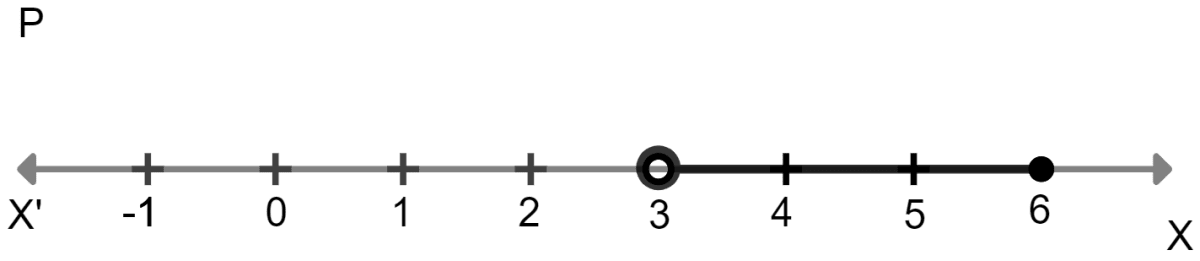
∴ P = {x : x ∈ R, 3 < x ≤ 6}.
The graph of the solution set of P is represented by thick black line starting from 3 (not including 3) till 6 (including 6).
Given,
Q = {x : - 1 ≤ 3 + 4x < 23, x ∈ I}
$$\begin{aligned}\Rightarrow -1 \le 3 + 4x \lt 23 \\[0.5em] \Rightarrow -1 \le 3 + 4x \text{ and } 3 + 4x \lt 23 \\[0.5em] \Rightarrow -4x \le 3 + 1 \text{ and } 4x \lt 20 \\[0.5em] \Rightarrow -4x \le 4 \text{ and } x \lt 5 \\[0.5em] \Rightarrow -x \le 1 \text{ and } x \lt 5 \\[0.5em] \Rightarrow x \ge -1 \text{ and } x \lt 5\end{aligned}$$
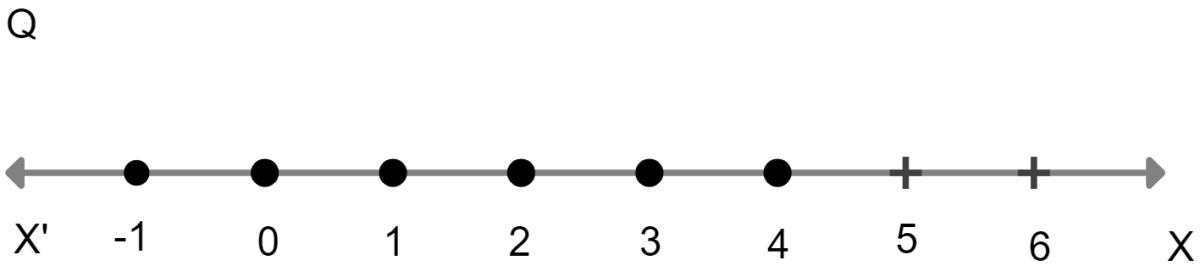
∴ Q = {x : x ∈ I, -1 ≤ x < 5} = {-1, 0, 1, 2, 3, 4}.
The graph of the solution set of Q is represented by thick black dots.
∴ P ∩ Q = {4}
























