ICSE Class 10 Mathematics · Competency Practice · 49 solved questions
Exercise
Marks
11 Mark · Multiple Choice Questions
A retailer buys an article at its listed price from a wholesaler and sells it to a consumer in the same state after marking up the price by 20%. The list price of the article is ₹ 2500, and the rate of GST is 12%. What is the tax liability of the retailer to the central government?
Dev brought an electrical fan which has a marked price of ₹ 800. If the GST on the goods is 7%, then the SGST is :
(a)₹ 24
(b)₹ 28
(c)₹ 56
(d)₹ 80
Show SolutionHide Solution↓
Since, GST rate is 7%, then SGST = $\frac{7}{2}$ = 3.5%.
M.P. of electrical fan = ₹ 800.
SGST = 3.5% of ₹ 800
= $\frac{3.5}{100} \times 800$
= ₹ 28.
Hence, Option 2 is the correct option.
31 Mark · Multiple Choice Questions
₹ P is deposited for n number of months in a recurring deposit account which pays interest at the rate of r% per annum. The nature and time of interest calculated is :
∴ The nature and time of interest calculated is simple interest for one month.
Hence, Option 4 is the correct option.
41 Mark · Multiple Choice Questions
Anwesha intended to open a Recurring Deposit account of ₹ 1000 per month for 1 year in a Bank, paying a 5% per annum rate of simple interest. The bank reduced the rate to 4% per annum. How much must Anwesha deposit monthly for 1 year so that her interest remains the same?
$$\begin{aligned}\therefore 325 = x \times \frac{12 \times 13}{2 \times 12} \times \frac{4}{100} \\[1em] \Rightarrow 325 = x \times \frac{13}{2} \times \frac{1}{25}\\[1em] \Rightarrow x = \frac{325 \times 25 \times 2}{13} \\[1em] \Rightarrow x = \frac{16250}{13} = \text{₹ 1250.}\end{aligned}$$
Hence, Option 2 is the correct option.
51 Mark · Multiple Choice Questions
Mr. Das invests in ₹ 100, 12% shares of Company A available at ₹ 60 each. Mr. Singh invests in ₹ 50, 16% shares of Company B available at ₹ 40 each. Use this information to state which of the following statements is true.
(a)The rate of return for Mr. Das is 12%
(b)The rate of return for Mr. Singh is 10%
(c)Both Mr. Das and Mr. Singh have the same rate of return of 10%
(d)Both Mr. Das and Mr. Singh have the same rate of return of 20%
Show SolutionHide Solution↓
For Mr. Das,
Face value of each share = ₹ 100
Market value of each share = ₹ 60
Dividend per share = 12% of ₹ 100 = ₹ 12.
Rate of return = $\frac{\text{Dividend per share}}{\text{M.V. of each share}} \times 100 = \frac{12}{60} \times 100$ = 20%.
For Mr. Singh,
Face value of each share = ₹ 50
Market value of each share = ₹ 40
Dividend per share = 16% of ₹ 50 = ₹ 8.
Rate of return = $\frac{\text{Dividend per share}}{\text{M.V. of each share}} \times 100 = \frac{8}{40} \times 100$ = 20%.
∴ Both Mr. Das and Mr. Singh have the same rate of return of 20%.
Hence, Option 4 is the correct option.
61 Mark · Multiple Choice Questions
Amit invested a certain sum of money in ₹ 100 shares, paying a 7.5% dividend. The rate of return on his investment is 10%. The money invested by Amit to purchase 10 shares is :
(a)₹ 250
(b)₹ 750
(c)₹ 900
(d)₹ 1100
Show SolutionHide Solution↓
Let ₹ P be the price per share.
Amit brought 10 shares, so total investment = ₹ 10P
Dividend = 7.5%
Dividend per share = $\frac{7.5}{100} \times 100$ = ₹ 7.5
The ratio of diameter to height of a Borosil cylindrical glass is 3 : 5. If the actual diameter of the glass is 6 cm, then the curved surface area of the glass is :
(a)120π
(b)60π
(c)30π
(d)18π
Show SolutionHide Solution↓
Given,
Ratio of diameter to height of a Borosil cylindrical glass is 3 : 5.
Radius = $\frac{\text{Diameter}}{2} = \frac{6}{2}$ = 3 cm.
By formula,
Curved surface area of glass = 2πrh
= 2π × 3 × 10
= 60π cm2.
Hence, Option 2 is the correct option.
151 Mark · Multiple Choice Questions
If the polynomial 2x3 + 3x2 - 2x - 3 is completely divisible by (2x + a), and the quotient is equal to (x2 - 1), then one of the values of a is :
(a)-3
(b)-1
(c)1
(d)3
Show SolutionHide Solution↓
Given,
The polynomial 2x3 + 3x2 - 2x - 3 is completely divisible by (2x + a) and quotient is equal to (x2 - 1).
∴ 2x3 + 3x2 - 2x - 3 = (2x + a)(x2 - 1)
⇒ 2x3 + 3x2 - 2x - 3 = 2x3 - 2x + ax2 - a
⇒ 2x3 - 2x3 + 3x2 - 2x + 2x - 3 = ax2 - a
⇒ 3x2 - 3 = ax2 - a
From above equation,
a = 3.
Hence, Option 4 is the correct option.
161 Mark · Multiple Choice Questions
A polynomial in x is x3 + 5x2 - kx - 24. Which of the following is a factor of the given polynomial so that the value of k is 2?
(a)(x + 2)
(b)(x - 3)
(c)(x + 4)
(d)(x - 4)
Show SolutionHide Solution↓
By factor theorem,
(x - a) is a factor of f(x), if f(a) = 0.
Given,
Polynomial = x3 + 5x2 - kx - 24
If k = 2, then :
Polynomial = x3 + 5x2 - 2x - 24.
Dividing polynomial by (x + 4) or substituting -4 in polynomial, we get :
⇒ (-4)3 + 5(-4)2 - 2(-4) - 24
⇒ -64 + 5(16) + 8 - 24
⇒ -64 + 80 + 8 - 24
⇒ 88 - 88
⇒ 0.
Since, on substituting -4 in polynomial, we get remainder = 0.
∴ (x + 4) is the factor of x3 + 5x2 - kx - 24, when k = 2.
Hence, Option 3 is the correct option.
171 Mark · Multiple Choice Questions
If A = $$\begin{bmatrix*}[r] a & b \end{bmatrix*} \text{ and } \begin{bmatrix*}[r] c \\ d \end{bmatrix*}$$, then :
(a)only matrix AB is possible
(b)only matrix BA is possible
(c)both matrices AB and BA are possible
(d)both matrices AB and BA are possible, AB = BA
Show SolutionHide Solution↓
Order of matrix A = 1 × 2
Order of matrix B = 2 × 1
Since, no. of columns in A is equal to the no. of rows in B and no. of columns in B is equal to the no. of rows in A.
∴ AB and BA are possible.
$$AB = \begin{bmatrix*}[r] a \times c + b \times d \end{bmatrix*} \\[1em] = \begin{bmatrix*}[r] ac + bd \end{bmatrix*}. \\[1em] BA = \begin{bmatrix*}[r] c \times a & c \times b \\ d \times a & d \times b \end{bmatrix*} \\[1em] = \begin{bmatrix*}[r] ca & cb \\ da & db \end{bmatrix*}.$$
∴ AB ≠ BA.
Hence, Option 3 is the correct option.
181 Mark · Multiple Choice Questions
Matrix A = $$\begin{bmatrix*}[r] 6 & 9 \\ -4 & k \end{bmatrix*} \text{ such that } A^2 = \begin{bmatrix*}[r] 0 & 0 \\ 0 & 0 \end{bmatrix*}$$. Then k is :
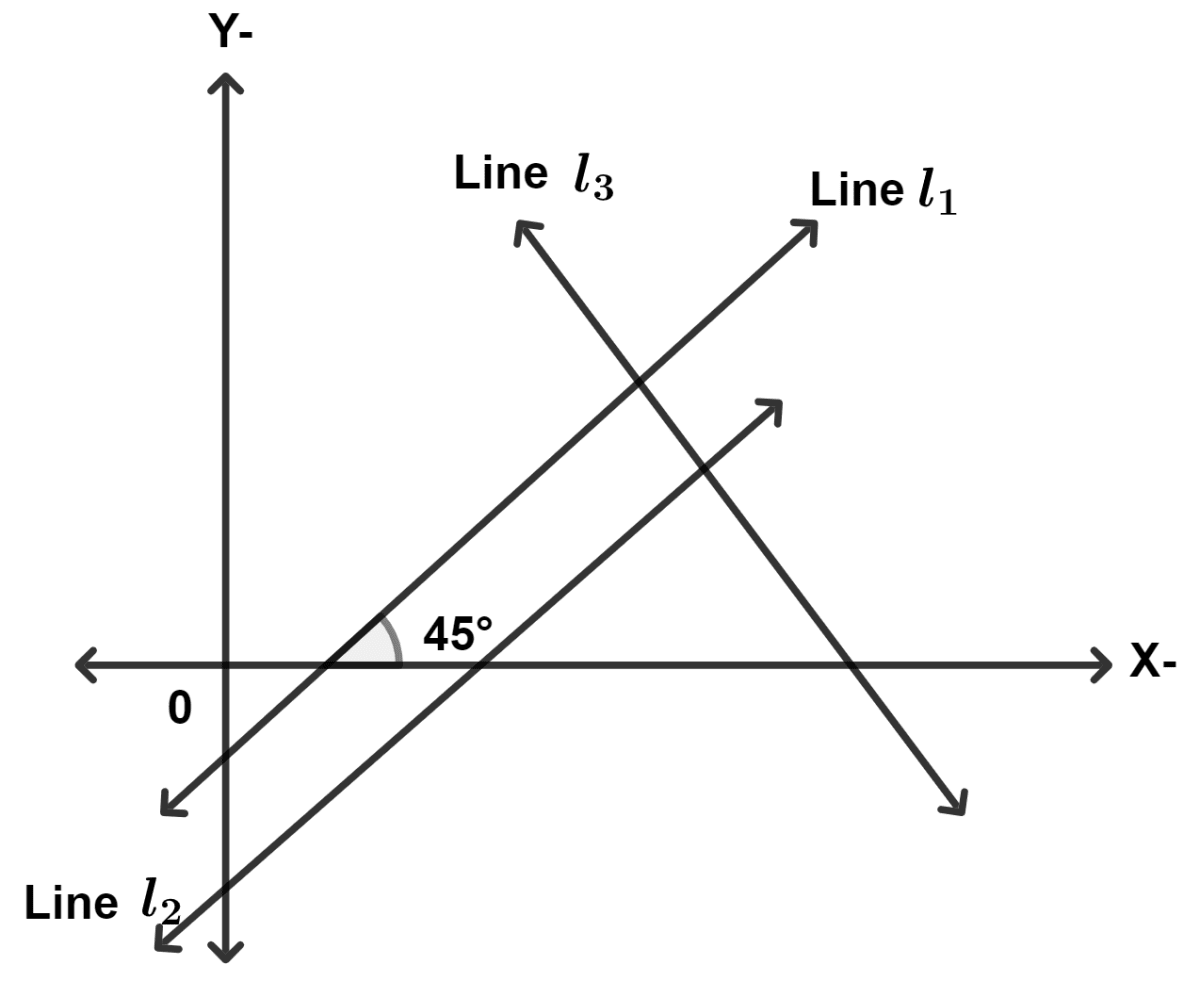
In the given figure line l1 is a parallel to line l2. If line l3 is perpendicular to line l1, then the slopes of lines l2 and l3 respectively are :
(a)1, 1
(b)-1, -1
(c)1, -1
(d)-1, 1
Show SolutionHide Solution↓
Slope of line l1 = tan 45° = 1.
We know that,
Slope of parallel lines are equal.
Slope of line l2 = Slope of line l1 = 1.
We know that,
Product of slope of perpendicular lines is equal to -1.
⇒ Slope of line l2 × Slope of line l3 = -1
⇒ 1 × Slope of line l3 = -1
⇒ Slope of line l3 = -1.
Hence, Option 3 is the correct option.
241 Mark · Multiple Choice Questions
Which of the following lines cut the positive x-axis and positive y-axis at equal distances form the origin?
(a)3x + 3y = 6
(b)5x + 10y = 10
(c)-x + y = 1
(d)10x + 5y = 5
Show SolutionHide Solution↓
Substituting x = 0 in first equation,
⇒ 3(0) + 3y = 6
⇒ 3y = 6
⇒ y = $\frac{6}{3}$
⇒ y = 2.
The line touches y-axis at point (0, 2).
Substituting y = 0 in first equation,
⇒ 3x + 3(0) = 6
⇒ 3x = 6
⇒ x = $\frac{6}{3}$
⇒ x = 2.
The line touches y-axis at point (2, 0).
∴ Line 3x + 3y = 6 cuts positive x-axis and positive y-axis at equal distance i.e. 2 units form the origin.
Hence, Option 1 is the correct option.
251 Mark · Multiple Choice Questions
In the given diagram (not draw to scale), railway stations A, B, C, P and Q are connected by straight tracks. Track PQ is parallel to BC. The time taken by a train travelling at 90 km/hr to reach B from A by the shortest route is :
(a)8 minutes
(b)12 minutes
(c)16.8 minutes
(d)20 minutes
Show SolutionHide Solution↓
In △ APQ and △ ABC,
⇒ ∠PAQ = ∠BAC (Common angle)
⇒ ∠APQ = ∠ABC (Corresponding angles are equal)
∴ △ APQ ~ △ ABC (By A.A. axiom)
From figure,
Let AP = x km.
We know that,
Corresponding sides of similar triangle are proportional.
In the adjoining figure, O is the center of the circle, and a semicircle is drawn on OA as the diameter. ∠APQ = 20°. The degree measure of ∠OAQ is :
(a)25°
(b)40°
(c)50°
(d)65°
Show SolutionHide Solution↓
We know that,
Angle in a semi-circle is a right angle.
∴ ∠OQA = 90°
In △QAP,
⇒ ∠PQA + ∠QAP + ∠APQ = 180°
⇒ 90° + ∠QAP + 20° = 180°
⇒ ∠QAP = 180° - 90° - 20° = 70°.
In △OPA,
⇒ OA = OP (Radii of same circle)
⇒ ∠OAP = ∠OPA (Angle opposite to equal sides are equal)
⇒ ∠OAP = 20°.
From figure,
⇒ ∠OAQ = ∠QAP - ∠OAP = 70° - 20° = 50°.
Hence, Option 3 is the correct option.
301 Mark · Multiple Choice Questions
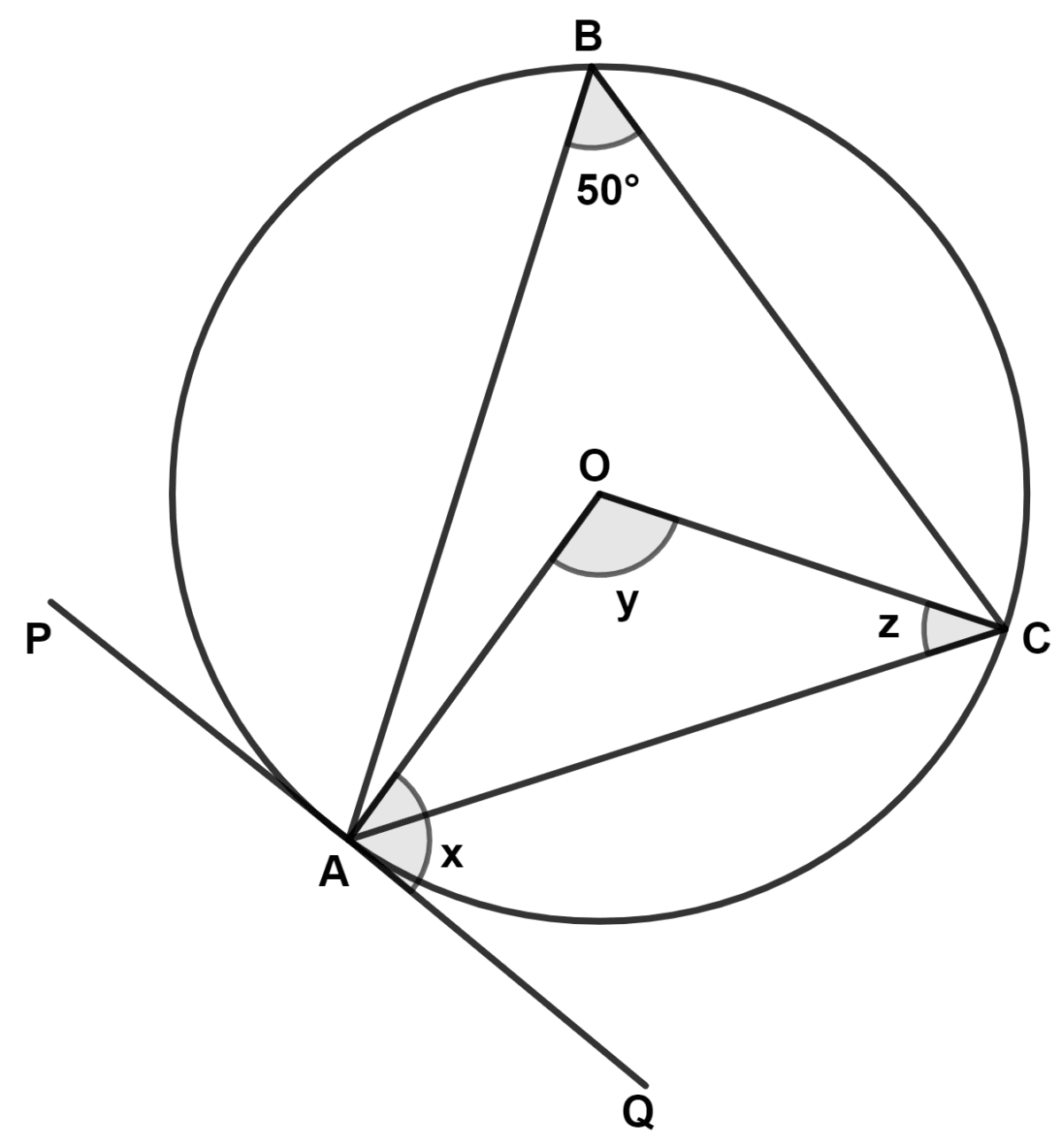
In the given diagram, O is the center of the circle, and PQ is a tangent at A. If ∠ABC = 50°, then values of x, y and z respectively are :
(a)50°, 100°, 40°
(b)50°, 50°, 65°
(c)40°, 80°, 50°
(d)50°, 25°, 78°
Show SolutionHide Solution↓
We know that,
The angle subtended by an arc at the centre is double the angle subtended by it at any point on the remaining part of the circle.
∴ ∠AOC (y) = 2∠ABC = 2 × 50° = 100°.
In △ AOC,
⇒ OA = OC (Radii of same circle)
⇒ ∠OAC = ∠OCA = z (Angle opposite to equal sides are equal)
By angle sum property of triangle,
⇒ ∠OAC + ∠OCA + ∠AOC = 180°
⇒ z + z + 100° = 180°
⇒ 2z = 180° - 100°
⇒ 2z = 80°
⇒ z = $\frac{80°}{2}$ = 40°.
We know that,
The tangent at any point of a circle is perpendicular to the radius through the point of contact.
⇒ ∠CAQ (x) = ∠OAQ - ∠OAC = 90° - 40° = 50°.
Hence, Option 1 is the correct option.
311 Mark · Multiple Choice Questions
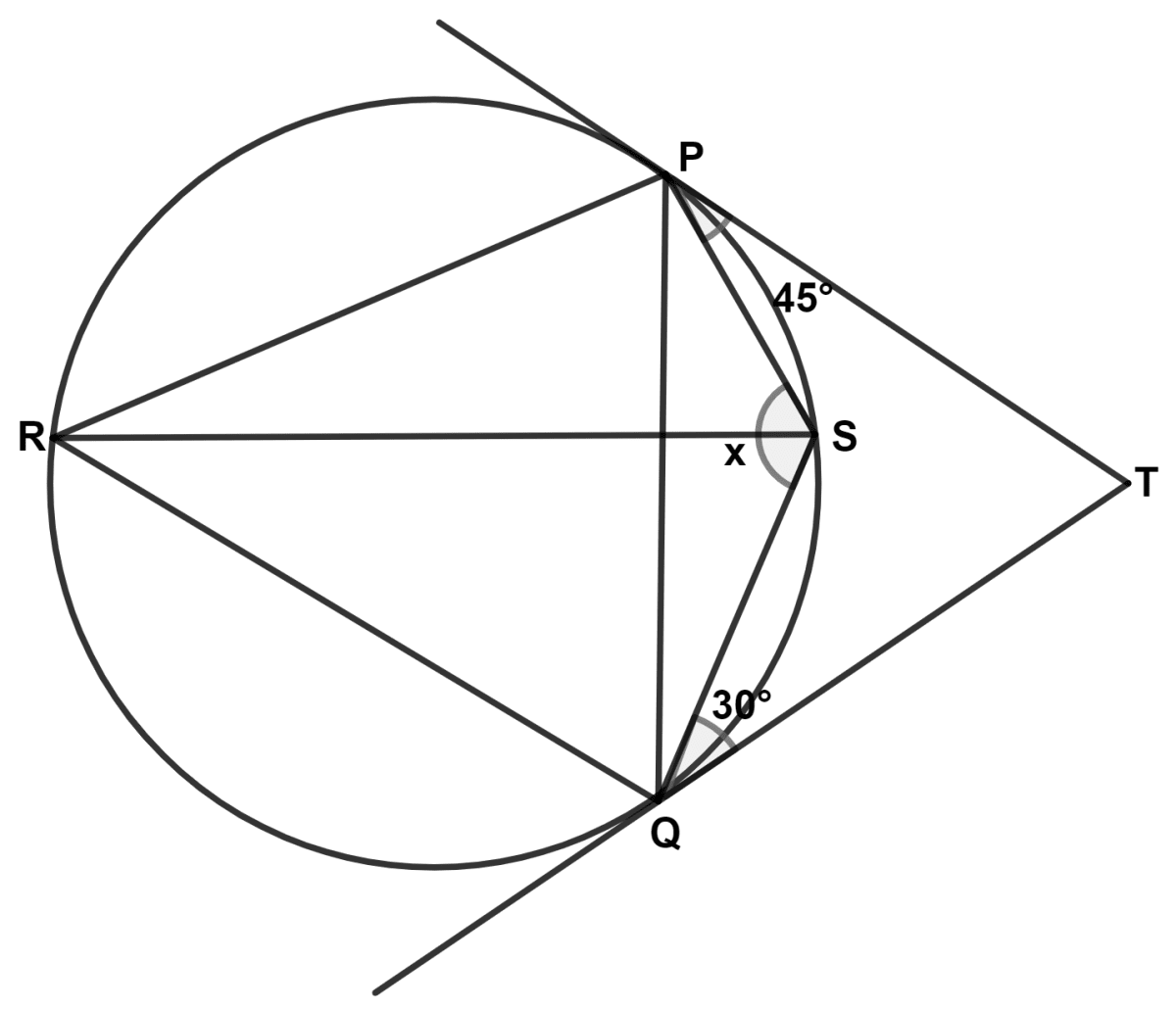
In the given figure, PT and QT are tangents to a circle such that ∠TPS = 45° and ∠TQS = 30°. Then, the value of x is :
(a)30°
(b)45°
(c)75°
(d)105°
Show SolutionHide Solution↓
We know that,
The angle between a tangent and a chord through point of contact is equal to an angle in the alternate segment.
∴ ∠SQP = ∠SPT = 45° and ∠SPQ = ∠SQT = 30°.
In △ SQP,
⇒ ∠SQP + ∠SPQ + ∠QSP = 180°
⇒ 45° + 30° + ∠QSP = 180°
⇒ 75° + ∠QSP = 180°
⇒ ∠QSP (x) = 180° - 75° = 105°.
Hence, Option 4 is the correct option.
321 Mark · Multiple Choice Questions
A cylindrical metallic wire is stretched to double its length. Which of the following will NOT change for the wire after stretching?
(a)Its curved surface area
(b)Its total surface area
(c)Its volume
(d)Its radius
Show SolutionHide Solution↓
On changing the shape of a container, its volume remains same.
Hence, Option 3 is the correct option.
331 Mark · Multiple Choice Questions
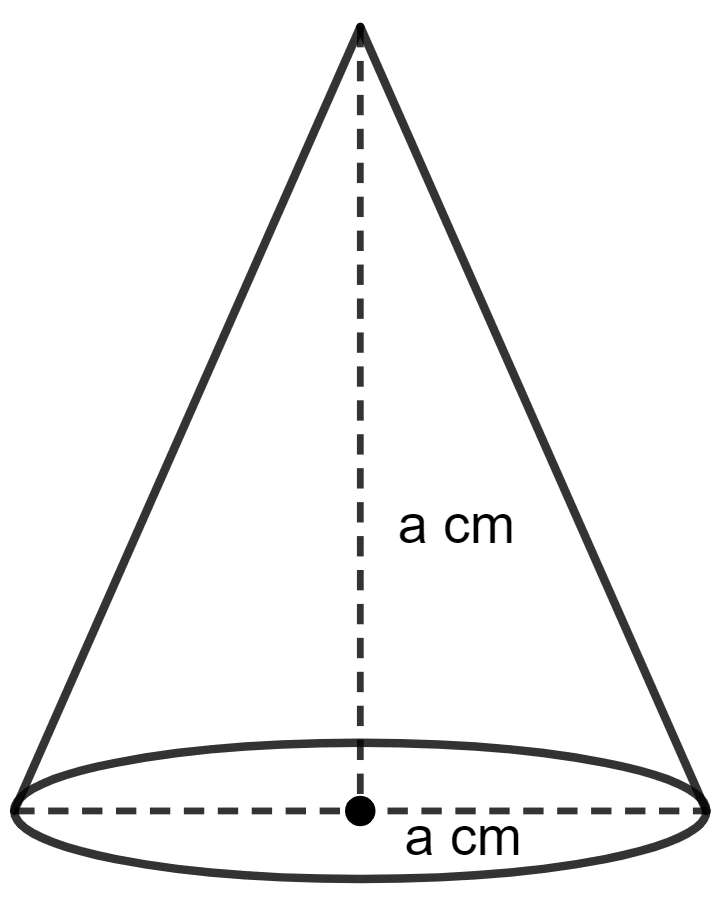
A right circular cone has the radius of the base equal to the height of the cone. If the volume of the cone is 9702 cu. cm, then the diameter of the base of the cone is :
$\Big[\text{Use } \pi = \frac{22}{7}\Big]$
(a)21 cm
(b)42 cm
(c)$21\sqrt{7}$ cm
(d)$2\sqrt{7}$ cm
Show SolutionHide Solution↓
Given,
Height of cone (h) = Radius of cone (r) = a cm (let)
A solid sphere with a radius of 4 cm is cut into 4 identical pieces by two mutually perpendicular planes passing through its center. Find the total surface area of one-quarter piece.
(a)24π
(b)32π
(c)48π
(d)64π
Show SolutionHide Solution↓
Total surface area of semi-hemisphere = 2πr2
= 2π × 42
= 2π × 16
= 32π.
Hence, Option 2 is the correct option.
351 Mark · Multiple Choice Questions
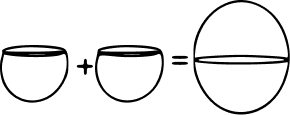
Two identical solid hemispheres are kept in contact to form a sphere. The ratio of the total surface areas of two hemispheres to the surface area of the sphere formed is :
(a)1 : 1
(b)3 : 2
(c)2 : 3
(d)2 : 1
Show SolutionHide Solution↓
Let radius of hemisphere be r.
Total surface area of hemisphere = 3πr2
Total surface area of two hemisphere = 2 × 3πr2 = 6πr2.
Total surface area of sphere = 4πr2
Total surface area of two hemisphere : Total surface area of sphere = 6πr2 : 4πr2
= 6 : 4
= 3 : 2.
Hence, Option 2 is the correct option.
361 Mark · Multiple Choice Questions
cosec2 θ + sec2 θ is equal to :
(a)tan2 θ + cot2 θ
(b)cot θ + tan θ
(c)(cot θ + tan θ)2
(d)1
Show SolutionHide Solution↓
Solving,
cosec2 θ + sec2 θ
= 1 + cot2 θ + 1 + tan2 θ
= cot2 θ + tan2 θ + 2
= (cot θ + tan θ)2
Hence, Option 3 is the correct option.
371 Mark · Multiple Choice Questions
Given a = 3 sec2 θ and b = 3 tan2 θ - 2. The value of (a - b) is :
(a)1
(b)2
(c)3
(d)5
Show SolutionHide Solution↓
a - b = 3 sec2 θ - (3 tan2 θ - 2)
= 3 sec2 θ - 3 tan2 θ + 2
= 3(sec2 θ - tan2 θ) + 2
= 3(1) + 2
= 3 + 2
= 5.
Hence, Option 4 is the correct option.
381 Mark · Multiple Choice Questions
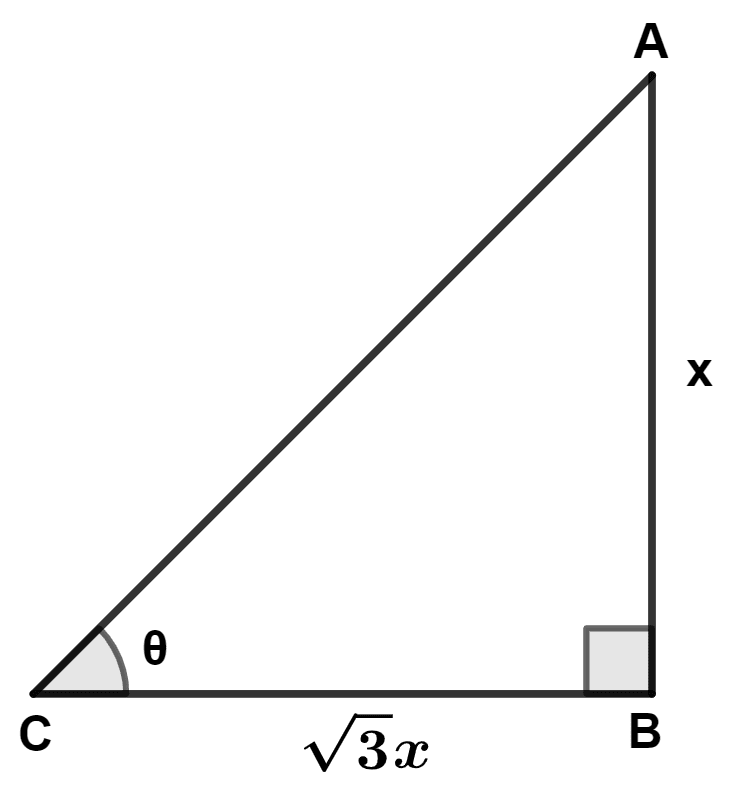
At a certain time of day, the ratio of the height of the pole to the length of its shadow is 1 : $\sqrt{3}$, then the angle of elevation of the sun at that time of the day is :
(a)30°
(b)45°
(c)60°
(d)90°
Show SolutionHide Solution↓
Let AB be the pole and BC be the shadow and angle of elevation of Sun be θ.
From figure,
⇒ tan θ = $\frac{AB}{BC}$
⇒ tan θ = $\frac{x}{\sqrt{3}x}$
⇒ tan θ = $\frac{1}{\sqrt{3}}$
⇒ tan θ = tan 30°
⇒ θ = 30°.
Hence, Option 1 is the correct option.
391 Mark · Multiple Choice Questions
A man standing on a ship approaching the port towards the lighthouse is observing the top of the lighthouse. In 10 minutes, the angle of elevation of the top of the lighthouse changes from α to β. Then :
(a)α > β
(b)α < β
(c)α = β
(d)α ≤ β
Show SolutionHide Solution↓
Let A be the top of the lighthouse, C the initial position of ship and D be the position after 10 minutes.
From figure,
tan α = $\frac{AB}{BC}$
tan β = $\frac{AB}{BD}$
Since, BC is greater than BD.
∴ tan α < tan β
⇒ α < β.
Hence, Option 2 is the correct option.
401 Mark · Multiple Choice Questions
Assertion (A) : The difference in class marks of the modal class and the median class of the following frequency distribution table is 0.
Class interval
Frequency
20-30
1
30-40
3
40-50
2
50-60
6
60-70
4
Reason (R) : Modal class and median class are always the same for a given frequency distribution.
(a)Both A and R are correct, and R is the correct explanation for A.
(b)Both A and R are correct, and R is not the correct explanation for A.
(c)A is true, but R is false.
(d)Both A and R are true.
Show SolutionHide Solution↓
Cumulative frequency distribution table :
Class interval
Class mark
Frequency
Cumulative frequency
20-30
25
1
1
30-40
35
3
4
40-50
45
2
6
50-60
55
6
12
60-70
65
4
16
Median = $\frac{16}{2}$ = 8th term.
The 8th term lies in the class 50-60.
∴ Median class = 50-60
Also, frequency of class 50-60 is highest.
∴ Modal class = 50-60.
∴ Assertion (A) is true.
Modal class and median class are not always the same for a given frequency distribution.
∴ Reason (R) is false.
Hence, Option 3 is the correct option.
411 Mark · Multiple Choice Questions
Assertion (A) : For a collection of 11 arrayed data, the median is the middle number.
Reason (R) : For the data 5, 9, 7, 13, 10, 11, 10, the median is 13.
(a)Both A and R are correct, and R is the correct explanation for A.
(b)Both A and R are correct, and R is not the correct explanation for A.
(c)A is true, but R is false.
(d)Both A and R are true.
Show SolutionHide Solution↓
For 11 arrayed data.
Median = $\frac{n + 1}{2}$ th term
= $\frac{11 + 1}{2}$
= 6th term, which will be the middle term.
∴ For a collection of 11 arrayed data, the median is the middle number.
∴ Assertion (A) is true.
Numbers = 5, 9, 7, 13, 10, 11, 10
Arranging in ascending order, we get :
5, 7, 9, 10, 10, 11, 13.
n = 7, which is odd.
Median = $\frac{n + 1}{2} = \frac{7 + 1}{2} = \frac{8}{2}$ = 4th term = 10.
∴ Reason (R) is false.
Hence, Option 3 is the correct option.
421 Mark · Multiple Choice Questions
Ankit has the option of investing in company A, where 7%, ₹ 100 shares are available at ₹ 120 or in company B, where 8%, ₹ 1000 shares are available at ₹ 1620.
Assertion (A) : Investment in Company A is better than Company B.
Reason (R) : The rate of income in Company A is better than in Company B.
(a)Both A and R are correct, and R is the correct explanation for A.
(b)Both A and R are correct, and R is not the correct explanation for A.
∴ Assertion and Reason both are true and Reason is the correct explanation of Assertion.
Hence, Option 1 is the correct explanation.
431 Mark · Multiple Choice Questions
Assertion (A) : x3 + 2x2 - x - 2 is a polynomial of degree 3.
Reason (R) : x + 2 is a factor of the polynomial.
(a)Both A and R are correct, and R is the correct explanation for A.
(b)Both A and R are correct, and R is not the correct explanation for A.
(c)A is true, but R is false.
(d)Both A and R are true.
Show SolutionHide Solution↓
x3 + 2x2 - x - 2 is a polynomial of degree 3.
By factor theorem,
(x - a) is a factor of f(x) if f(a) = 0.
x + 2 = 0
x = -2
Substituting x = -2 in x3 + 2x2 - x - 2, we get :
⇒ (-2)3 + 2(-2)2 - (-2) - 2
⇒ -8 + 2(4) + 2 - 2
⇒ -8 + 8 + 2 - 2
⇒ 0.
Hence, Option 4 is the correct option.
441 Mark · Multiple Choice Questions
Assertion (A) : The point (-2, 8) is invariant under reflection in line x = -2
Reason (R) : If a point has its x-coordinate 0, it is invariant under reflection in both axes.
(a)Both A and R are correct, and R is the correct explanation for A.
(b)Both A and R are correct, and R is not the correct explanation for A.
(c)A is true, but R is false.
(d)Both A and R are true.
Show SolutionHide Solution↓
Point (-2, 8) lies on the line x = -2.
The point which lies on a line is invariant under reflection in the same line.
∴ (-2, 8) is invariant under reflection in line x = -2.
∴ Assertion (A) is true.
If a point has x-coordinate equal to 0 it means it lies on y-axis.
∴ It will be invariant under reflection in y-axis.
∴ Reason (R) is false.
Hence, Option 3 is the correct option.
451 Mark · Multiple Choice Questions
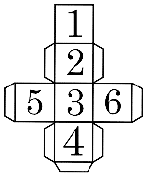
When a die is cast with numbering on its faces, as shown, the ratio of the probability of getting a composite number to the probability of getting a prime number is ............... .
(a)2 : 3
(b)3 : 2
(c)1 : 3
(d)1 : 2
Show SolutionHide Solution↓
From numbers 1 to 6
Prime numbers = 2, 3, 5.
Composite numbers = 4, 6.
Probability of getting a prime number = $\frac{\text{No. of prime numbers}}{\text{No. of possible outcomes}} = \frac{3}{6} = \frac{1}{2}$.
Probability of getting a composite number
= $\frac{\text{No. of composite numbers}}{\text{No. of possible outcomes}} = \frac{2}{6} = \frac{1}{3}$.
Probability of getting a composite number to probability of getting a prime number = $\frac{1}{3} : \frac{1}{2}$ = 2 : 3.
Hence, Option 1 is the correct option.
461 Mark · Multiple Choice Questions
The product of A = $$\begin{bmatrix*}[r] 1 & -2 \\ -3 & 4 \end{bmatrix*}$$ and matrix M, AM = B where B = $$\begin{bmatrix*}[r] 2 \\ 24 \end{bmatrix*}$$, then the order of matrix M is ............... .
(a)2 × 2
(b)2 × 1
(c)1 × 2
(d)4 × 1
Show SolutionHide Solution↓
Order of matrix A = 2 × 2
Order of matrix B = 2 × 1
Order of matrix M (let) = a × b
We know that,
Two matrix can be multiplied if the no. of columns of the first matrix is equal to the no. of rows of the second matrix and the resultant matrix has the no. of rows of first matrix and no. of columns of second matrix.
Given,
⇒ AM = B
⇒ A2 × 2 × Ma × b = B2 × 1
⇒ a = 2 and b = 1.
Order of matrix M = 2 × 1.
Hence, Option 2 is the correct option.
471 Mark · Multiple Choice Questions
Given, a1, a2, a3, ..... and b1, b2, b3, ..... are real numbers such that a1 - b1 = a2 - b2 = a3 - b3 = ......... are all equal.
a1 - b1, a2 - b2, a3 - b3, ........ forms a ......... progression.
(a)Geometric (r = 1)
(b)Arithmetic (d = 1)
(c)Geometric (r < 1)
(d)Arithmetic (d = 0)
Show SolutionHide Solution↓
Since,
a1 - b1 = a2 - b2 = a3 - b3.
∴ a1 - b1, a2 - b2, a3 - b3, ........ forms a arithmetic progression with common difference (d = 0).
Hence, Option 4 is the correct option.
481 Mark · Multiple Choice Questions
Locus of a moving point is ............... if it moves such that it keeps a fixed distance from a fixed point.
(a)Circle
(b)Line
(c)Angle
(d)Line segment
Show SolutionHide Solution↓
Locus of a moving point is circle if it moves such that it keeps a fixed distance from a fixed point.
Hence, Option 1 is the correct option.
491 Mark · Multiple Choice Questions
The point of concurrence of the angle bisectors of a triangle is called the ............... of the triangle.
(a)centroid
(b)incenter
(c)circumcenter
(d)orthocenter
Show SolutionHide Solution↓
The point of concurrence of the angle bisectors of a triangle is called the incenter of the triangle.