In the given diagram, lines AE and BD intersect each other at C such that ∆ABC ~ ∆DEC.
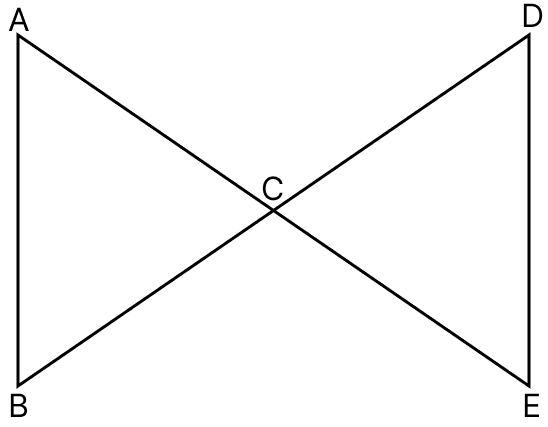
(a) Complete the equation with corresponding sides of ∆ABC and ∆DEC.
$\frac{AB}{DE} = \frac{AC}{?} = \frac{?}{EC}$
(b) ∠ABC is equal to which angle of ∆DEC?
(c) If, AB : DE = 2 : 3, find the ratio of ar (∆ABC) : ar (∆DEC).
Show SolutionHide Solution↓
(a) Since ∆ABC ~ ∆DEC, their corresponding sides are proportional.
$\frac{AB}{DE} = \frac{AC}{DC} = \frac{BC}{EC}$
Hence, $\mathbf{\frac{AB}{DE} = \frac{AC}{DC} = \frac{BC}{EC}}$.
(b) Since ∆ABC ~ ∆DEC, their corresponding angles are equal.
∴ ∠ABC = ∠DEC.
Hence, ∠ABC is equal to ∠DEC.
(c) We know that,
The ratio of areas of similar triangles is equal to the ratio of the squares of their corresponding sides.
$$\begin{aligned}\therefore \frac{\text{ar (∆ABC)}}{\text{ar (∆DEC)}} = \frac{AB^2}{DE^2} \\[1em] = \Big(\frac{2}{3}\Big)^2 \\[1em] = \frac{4}{9} \\[1em] = 4 : 9.\end{aligned}$$
Hence, ar (∆ABC) : ar (∆DEC) = 4 : 9.