Using ruler and compass only construct ∠ABC = 60°, AB = 6 cm and BC = 5 cm.
(a) construct the locus of all points which are equidistant from AB and BC.
(b) construct the locus of all points equidistant from A and B.
(c) mark the point which satisfies both the conditions (a) and (b) as P.
Hence, construct a circle with center P and passing through A and B.
Show SolutionHide Solution↓
Steps of construction :
Draw a line segment BC = 5 cm.
Draw ∠DBC = 120°.
From DB cut off AB = 6 cm.
Draw BE the angle bisector of ∠ABC.
Draw RS, the perpendicular bisector of AB.
Mark point P, the intersection point of RS and BE.
Taking P as center and PA or PB as radius draw a circle.
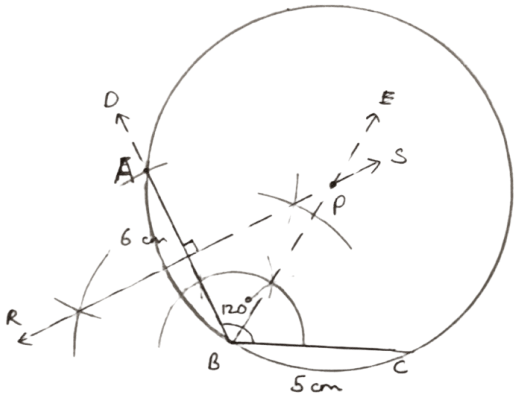
(a) We know that,
The locus of points which are equidistant from two sides is the angular bisector of the angle between two sides.
Hence, required locus is BE.
(b) We know that,
The locus of points which are equidistant from two points is the perpendicular bisector of the line joining the two points.
Hence, required locus is RS.
(c) From figure,
Point P satisfies both the conditions (a) and (b).