Quit India Movement

ICSE Class 10 History & Civics · Total History & Civics · 26 solved questions

Exercise
Marks
11 Mark · Multiple Choice Questions

Arrange the following events chronologically.

(i) Quit India Resolution

(ii) Cripps' Mission

(iii) Resignation of Congress Ministries

(iv) August Offer

Show SolutionHide Solution↓

(iii), (iv), (ii) and (i)

Reason — The Congress Ministries resigned in October–November 1939 when Britain involved India in the Second World War without consulting Indian leaders. After that came the August Offer in 1940, then the Cripps’ Mission in 1942, and finally the Quit India Resolution was adopted at Wardha in July 1942 and passed at Bombay in August 1942. Therefore, the correct chronological order is (iii), (iv), (ii) and (i).

21 Mark · Multiple Choice Questions

In 1942, Japanese forces were marching towards ................ .

Show SolutionHide Solution↓

Assam

Reason — In 1942, the war situation had become very grave. The Japanese Army had already attacked Burma (Myanmar) and was marching towards Assam. This danger convinced Indian leaders that British rule must end immediately. Therefore, Assam is the correct answer.

31 Mark · Multiple Choice Questions

At Wardha the Congress Working Committee adopted a resolution that was passed at Bombay. Name the resolution.

Show SolutionHide Solution↓

Quit India Resolution

Reason — The Congress Working Committee met at Wardha in July 1942 and adopted a resolution known as the Quit India Resolution. This resolution was later ratified and passed by the All-India Congress Committee at Bombay on 8 August 1942. Therefore, the correct answer is Quit India Resolution.

41 Mark · Multiple Choice Questions

Which of the following was NOT stressed by Mahatma Gandhi while exhorting the people to join the Quit India Movement?

Show SolutionHide Solution↓

Freedom of India is an end that will purify all means employed to achieve it.

Reason — While calling upon the people to join the Quit India Movement, Gandhiji stressed Hindu-Muslim unity, absence of hatred towards the British people, and the famous mantra ‘Do or Die’. However, he did not say that the end would purify all means, because his struggle was always based on pure and non-violent means. Therefore, this statement was NOT stressed by Gandhiji.

1Relationship Between Statements (I) & (II)

(I) The Congress ministries resigned in October-November 1939 as the British government joined the Second World War without consulting the Indian National Congress.

(II) The Muslim League celebrated the day when the Congress Ministries resigned as the day of 'thanks-giving'.

Show SolutionHide Solution↓

(I) is the reason for (II)

Explanation — Statement (I) is true because the Congress ministries resigned in October–November 1939 after Britain involved India in the Second World War without consulting Indian leaders.

Statement (II) is also true. The Muslim League celebrated the resignation of the Congress ministries as the day of ‘Deliverance’ or ‘thanks-giving’.

Since the resignation of the Congress ministries led to this celebration by the Muslim League, therefore, Statement (I) is the reason for Statement (II).

2Relationship Between Statements (I) & (II)

(I) Lord Linlithgow made the August Offer in 1940.

(II) The Congress rejected the offer but the Muslim League accepted the offer.

Show SolutionHide Solution↓

(I) is true but (II) is false

Explanation — Statement (I) is true because the August Offer was made in 1940 by Lord Linlithgow, the Viceroy of India.

Statement (II) is false because both the Congress and the Muslim League rejected the August Offer.

Therefore, Statement (I) is true and Statement (II) is false.

3Relationship Between Statements (I) & (II)

(I) The Cripps Mission proposed that India would be given a Dominion Status after the end of the Second World War.

(II) The Cripps Mission failed to fulfill its promise after the Second World War.

Show SolutionHide Solution↓

(I) is true but (II) is false

Explanation — Statement (I) is true because the Cripps Mission proposed that India would be granted Dominion Status after the Second World War.

Statement (II) is false because the Cripps Mission was rejected in 1942 itself by almost all the parties and sections of people. Therefore, there was no accepted promise to be fulfilled after the Second World War.

Therefore, Statement (I) is true but (II) is false.

4Relationship Between Statements (I) & (II)

(I) Gandhiji decided to launch a movement calling upon the British to quit India.

(II) In 1942, Gandhiji declared that the presence of British in India was an invitation to Japan to invade India.

Show SolutionHide Solution↓

(II) is the reason for (I)

Explanation — Statement (I) is true because Gandhiji decided to launch the Quit India Movement in 1942, calling upon the British to leave India.

Statement (II) is also true. During the Second World War, Gandhiji declared that the presence of the British in India was an invitation to Japan to invade India.

This was one of the reasons why Gandhiji wanted the British to quit India immediately.

Therefore, Statement (II) is the reason for Statement (I).

5Relationship Between Statements (I) & (II)

(I) The Quit India movement made independence of India as the only agenda of the National Movement.

(II) After the suppression of the Quit India Movement, the battle for the freedom was carried on beyond India’s frontier by Subhas Chandra Bose.

Show SolutionHide Solution↓

(I) and (II) are independent of each other

Explanation — Statement (I) is true because the Quit India Movement made complete independence from British rule the central and immediate goal of the National Movement.

Statement (II) is also true. After the Quit India Movement was suppressed, Subhas Chandra Bose carried on the struggle for freedom from outside India through the INA.

However, Statement (II) is not the reason for Statement (I). Both refer to different developments in the freedom struggle.

Therefore, Statement (I) and Statement (II) are independent of each other.

1Short Answer Questions

Under what condition, the Congress proposed to support Britain during the Second World War? Why did the Congress Ministeries resign in 1939?

Show SolutionHide Solution↓

The Congress leaders demanded that India must be declared free or at least have effective power before it could actively support Britain during the Second World War. Lord Linlithgow, the Viceroy, could not give any such assurance.

The British government tried to put the religious minorities and Princes against the Congress. The Congress, therefore, asked its ministries to resign.

2Short Answer Questions

What was the reaction of the British Government and the Muslim League to the resignation of Congress ministries in 1939?

Show SolutionHide Solution↓

The resignation of the Congress ministries in October-November 1939 had many implications-

  1. The Viceroy was happy because the Congress ministries had controlled several provinces.
  2. The ministries in Punjab, Bengal and Sind did not resign to win the government's goodwill.
  3. The Muslim League was jubilant over the resignation of Congress Ministries and offered its friendship to the British Government. It celebrated the day when the Congress ministries resigned as a day of 'deliverance' and 'thanks-giving'.
3Short Answer Questions

Give any two salient features of August Offer.

Show SolutionHide Solution↓

Two salient features of August Offer were-

  1. India would be given a Dominion Status when the War would end.
  2. A Constituent Assembly would be set up. It would consist of the members elected by the Lower House of the Indian Legislature and the representatives of the Princely States nominated by their rulers. It would be set up to draft a new Constitution.
4Short Answer Questions

Why was the August Offer rejected by the Congress as well as the Muslim League?

Show SolutionHide Solution↓

The Congress rejected the offer because the minorities especially the Muslim League were assured that no constitutional scheme would be acceptable to the government unless and until it was agreed to by the minorities.

The Muslim League did not accept the offer, as it did not give a clear assurance for the establishment of Pakistan.

5Short Answer Questions

What reasons did the Muslim League put forward for the creation of two independent nations?

Show SolutionHide Solution↓

The Muslim League put forward the following reasons for the creation of two independent nations-

  1. Jinnah and other leaders of the League proclaimed that Muslims could not expect any justice at the hands of the Congress.
  2. To grant the right of self-determination to Muslims, they wanted a nation to themselves.
6Short Answer Questions

How was the Constitution-making body to be constituted according to the Cripps Proposals of 1942?

Show SolutionHide Solution↓

The Cripps' Mission proposed that a Constituent Assembly would be set up. It would consist of the members elected by the Lower House of the Indian Legislature and the representatives of the Princely States nominated by their rulers. It would be set up to draft a new Constitution.

7Short Answer Questions

Which point in the Cripps Offer was against the unity of the nation?

Show SolutionHide Solution↓

The point which was against the unity of the nation was that the Provinces would be free to join the Indian Union. If they would not join the Indian federation, they would formulate their own Constitutions which could have the same status as the Union of India.

8Short Answer Questions

Why did the people of the Princely States oppose the Cripps' mission? What kind of status was promised to India after the War by Sir Stafford Cripps?

Show SolutionHide Solution↓

The people of the Princely States opposed the Cripps' mission because they had no right to send their representatives to the proposed Constitution-making body. Their representatives were to be selected by the rulers.

Dominion status was promised to India after the War by Sir Stafford Cripps.

9Short Answer Questions

What did the Congress think of the threat of a Japanese attack on India in 1942?

Show SolutionHide Solution↓

Gandhiji observed, 'The presence of British in India was an invitation to Japan to invade India. Their withdrawal removes the bait.' The Indian leaders were anxious to save their country from the Japanese invasion but their slavery was a hindrance. Gandhiji and other leaders were convinced that this situation called for complete independence from the British immediately. Gandhiji said, 'India's safety, and Britain's too, lies in the orderly and timely British withdrawal from India'.

10Short Answer Questions

What was meant by the Quit India Movement?

Show SolutionHide Solution↓

The Congress Working Committee met at Wardha in July, 1942. It adopted a resolution, known as the 'Quit India Resolution'. The resolution stated: 'British rule in India must end immediately.'

11Short Answer Questions

Read the excerpt given below and answer the questions that follow:

Govt. Decides to Meet Congress "Challenge"

—Indian Express, August 10, 1942

Which "Challenge" is referred to in the above newspaper article? What 'Action' did the Government take?

Show SolutionHide Solution↓

The challenge referred to in the article is the Quit India Movement.

The Government took the following actions:

  1. Mahatma Gandhi and all prominent Congress leaders were arrested to prevent the movement from spreading.
  2. The Congress was declared an unlawful organization.
  3. Gandhiji was detained at the Agha Khan Palace in Pune while the other leaders were sent to jail in Ahmednagar Fort.
1Structured Questions

The Congress Working Committee passed the famous Quit India Resolution at Wardha in July 1942. With reference to this answer the following questions:

(a) What were the reasons for the passing of this resolution?

(b) What was the British Government's reaction to the Quit India Movement?

(c) How did the Quit India Movement show that national feelings had become too deep-rooted?

Show SolutionHide Solution↓

(a) Reasons for the passing of Quit India resolution:

  1. In 1942, the failure of the Cripps' Mission left no further meeting ground between the British Government and the Congress.
  2. The War situation was discouraging in 1942.
  3. The Japanese Army had attacked Burma (Myanmar) and was marching towards Assam.
  4. Gandhiji observed, 'The presence of the British in India is an invitation to Japan to invade India. Their withdrawal removes the bait'.
  5. The Indian leaders were anxious to save their country from the Japanese invasion but their slavery was a hindrance.
  6. Gandhiji and other leaders were convinced that this situation called for complete independence from the British immediately.
  7. Gandhiji said, 'India's safety, and Britain's too, lies in the orderly and timely British withdrawal from India'.

So they decided to launch Quit India Movement, calling upon the British to quit India.

(b) British Government's reaction to the Quit India Movement:

  1. Before the Congress could start the movement, the Government struck hard.
  2. Early in the morning of August 9, Gandhiji and other Congress leaders were arrested and taken to unknown destinations and the Congress was once again declared illegal.
  3. The Government resorted to severe measures to crush the 1942 Movement.
  4. The Press was completely muzzled.
  5. The demonstrating crowds were machine-gunned and even bombed from the air.
  6. Prisoners were tortured.
  7. The police and secret police reigned supreme.
  8. Nearly ten thousand people were killed and 60,000 people were arrested by the end of 1942.
  9. The military took over many towns and cities.
  10. Rebellious villages had to pay huge sums as punitive fines and the villagers had to undergo mass floggings.
  11. Gandhiji was detained at the Agha Khan Palace in Pune while the other leaders were sent to jail in Ahmednagar Fort.

In the end, the government succeeded in crushing the movement.

(c) Quit India Movement demonstrated the depth of the nationalist feeling in India and the capacity of Indians for struggle and sacrifice. It made it clear that the British would no longer find it possible to rule India against the wishes of its people. People of all sections of society participated in this movement to fight for freedom.

2Structured Questions

Read the excerpt given below and answer the questions that follow:

“I, therefore, want freedom immediately, this very night, before dawn, if it can be had.... Fraud and untruth today are stalking the world. .... You may take it from me that I am not going to strike a bargain with the Viceroy for ministeries and the like. I am not going to be satisfied with anything short of complete freedom. .... Here is a mantra, a short one, that I give you. You may imprint it on your hearts and let every breath of yours give expression to it. The mantra is: “Do or Die”. We shall either free India or die in the attempt; we shall not live to see the perpetuation of our slavery.

(Mahatma Gandhi addressing the Congress delegates on the night of 8 August, 1942)

(a) State briefly the reasons that led Mahatma Gandhi to assert that he would not strike a bargain with the Viceroy.

(b) Which movement was started as a consequence of Mahatma Gandhi's call for ‘Do or Die’? Explain briefly what all happened during this movement.

(c) Was this movement a success or a failure? Give reasons to support your answer.

Show SolutionHide Solution↓

(a) Mahatma Gandhi was not interested in partial autonomy or power-sharing arrangements. He sought complete freedom for India from British rule. He felt that the presence of the British in India is an invitation to Japan to invade India. Their withdrawal removes the bait. Hence, he did not want to compromise freedom for any kind of political settlement. Gandhiji believed that once freedom was attained, the power would belong to the people of India.

(b) The movement that started as a consequence of Mahatma Gandhi’s call for ‘Do or Die’ was the Quit India Movement.

On 8 August 1942, at the session of the All-India Congress Committee in Mumbai, Mahatma Gandhi gave a clear call to end British rule and launched the Quit India Movement. Mahatma Gandhi gave the slogan ‘Do or Die’ to the people of India in a final push to make the British quit. Following the start of the Quit India Movement, many Congress leaders including Jawaharlal Nehru, Sardar Vallabhbhai Patel, Abul Kalam Azad and others along with Mahatma Gandhi were jailed for sedition. Despite the arrests of the leaders, the protest initially remained peaceful but later on homes of freedom fighters and Congress offices were raided, and many were jailed. When all the leading freedom fighters were in jail, Aruna Asaf Ali presided over the Congress session despite warnings from the British government. The movement was brutally crushed by the British rule but it shook the very foundations of the British rule in India. This movement was a significant milestone in India’s journey to independence.

(c) The Quit India Movement did not achieve its immediate goal of forcing the British to leave India but it played a crucial role in mobilizing the masses and intensifying the struggle for independence. The movement was a major success in terms of large-scale participation and mobilization of people from all over the country. It served as an important demonstration of anti-colonial sentiment in Indian society directed toward the British rule. It shook the British government from the roots. Therefore, we can say that though a failure in achieving its goal, the Quit India Movement was successful to weaken the British rule and give a clear and loud message asking the British to leave.
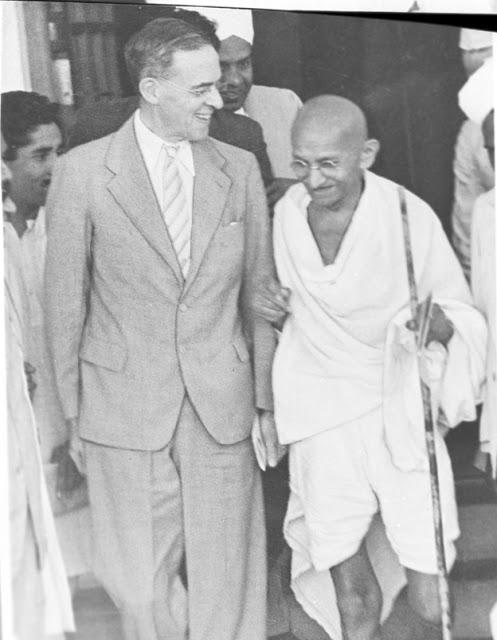
3Structured Questions

Study the picture and answer the following questions:

Identify the person in the picture with Gandhiji. When and why did he come to India? Give any two important points in the proposals given by this person. How did Gandhiji describe his proposals? Name the mass uprising which began in August 1942. Mention the slogan given by Gandhiji during this movement. What was the impact of this uprising on the National Movement? Quit India Movement, Total History and Civics Solutions ICSE Class 10.

(a) Identify the person in the picture with Gandhiji. When and why did he come to India?

(b) Give any two important points in the proposals given by this person. How did Gandhiji describe his proposals?

(c) Why were the proposals of this Mission rejected by both the Congress and the Muslim League?

Show SolutionHide Solution↓

(a) The person shown in the picture with Gandhiji is Sir Stafford Cripps.

Churchill announced in March 1942, that Sir Stafford Cripps, a member of the War Cabinet, would go to India for consultation with all the parties and convince them to assist the British in Second World War.

(b) Two important points in the proposals given by Sir Stafford Cripps were-

  1. India would be given a Dominion Status when the War would end.
  2. A Constituent Assembly would be set up. It would consist of the members elected by the Lower House of the Indian Legislature and the representatives of the Princely States nominated by their rulers. It would be set up to draft a new Constitution.

Mahatma Gandhi described the Cripps' proposals as a 'post-dated cheque on a failing bank.'

(c) The Congress rejected the proposals of the Cripps' Mission on the following grounds:

  1. It did not promise independence of India in the near future.
  2. The plan involved partitioning the country.
  3. The Congress was opposed to the principle of non-accession of the provinces. Gandhiji opposed the Declaration and urged the Working Committee to reject it.
  4. The Congress wanted that all Subjects, including Defence should be handed over to the National Government. The Congress insisted on the immediate formation of a National Government with full responsibility.

The Muslim League rejected the proposals as they did not accept Pakistan specifically. They did not grant the right of self-determination to Muslims.

1Higher Order Thinking Skills

Do you think the masses deviated from the Gandhiji's ideology of a non-violent mass struggle during the Quit India Movement? Give reasons to support your answer.

Show SolutionHide Solution↓

The masses did not deviate from Gandhiji's ideology of a non-violent struggle during the Quit India Movement.
Quit India Movement was largely a non-violent movement. The local pockets of violence that happened during the movement were in the form of attacks against the symbols of British authority — the police stations, post offices, railway stations, cutting of telegraph cables, etc.
Gandhiji refused to condemn the violence of the masses and held the government responsible for this violence. Hence, we can say that Quit India Movement was a peaceful non-violent mass struggle for the freedom of the country.

3Higher Order Thinking Skills

The British put down the Quit India Movement with ruthless brutality and the movement, unlike its predecessor, was short-lived. Despite all this, the Quit India Movement made the British realise that their days were numbered in India. What was the reason for it?

Show SolutionHide Solution↓

Quit India Movement made the British realise that their days were numbered in India because of the following reasons:

  1. It demonstrated the depth of the nationalist feeling in India and the great capacity for struggle and sacrifice that the people had developed.
  2. It was the spontaneous participation of the masses. People from all parts of India took part in processions and demonstrations.
  3. It made it clear that the British would no longer find it possible to rule India against the wishes of its people.

Press ↓ to reveal a solution and move to the next question. Back to Total History & Civics.

Free sample bank