ICSE Class 10 Geography · Total Geography · 175 solved questions
Exercise
1Choose the correct option
What are the crops grown in commercial farms called?
(a)Beverage crops
(b)Cash crops
(c)Fibre crops
(d)Plantation crops
Show SolutionHide Solution↓
Cash crops
Reason — Crops grown mainly for sale in the market to earn income, rather than for personal consumption, are called cash crops. Examples include cotton, sugarcane, jute, and tobacco.
2Choose the correct option
Your uncle has a large farm. He rears animals along with farming. He is practising ............... .
(a)Intensive farming
(b)Mixed farming
(c)Commercial farming
(d)Plantation farming
Show SolutionHide Solution↓
Mixed farming
Reason — The cultivation of crops and raising of animals simultaneously is called mixed farming. As the uncle rears animals along with cultivating crops on his large farm, he is practising mixed farming.
3Choose the correct option
Assertion (A): Agriculture is the mainstay and the backbone of India's economy.
Reason (R): It provides employment to millions of people.
(a)Both A and R are true and R is the correct explanation of A.
(b)Both A and R are true but R does not explain A.
(c)A is true but R is false.
(d)A is false but R is true.
Show SolutionHide Solution↓
Both A and R are true and R is the correct explanation of A.
Explanation — Agriculture is the mainstay and the backbone of India's economy as two-thirds of its population depends on agriculture.
4Choose the correct option
Commercial farming is prevalent in areas where landholdings are ............... and market economy is well developed.
(a)large
(b)small
(c)consolidated
(d)poor in fertility
Show SolutionHide Solution↓
large
Reason — Commercial farming requires large farms and is prevalent in areas where plenty of land is available and the market economy is well developed.
5Choose the correct option
Assertion (A): The agricultural output depends on monsoon.
Reason (R): Nearly 55 per cent of the area sown is dependent on irrigation.
(a)Both A and R are true and R is the correct explanation of A.
(b)Both A and R are true but R does not explain A.
(c)A is true but R is false.
(d)A is false but R is true.
Show SolutionHide Solution↓
A is true but R is false.
Explanation — The agricultural output depends on monsoon as nearly 55 per cent of the area sown is dependent on rainfall.
6Choose the correct option
Intercropping involves growing of two or more crops next to each other at the same ............... .
(a)time
(b)space
(c)height
(d)distance
Show SolutionHide Solution↓
time
Reason — Intercropping refers to the practice of growing two or more crops next to each other at the same time in such a way that they do not compete with each other for space, nutrients, water and sunlight.
7Choose the correct option
............... plantation is being promoted to check the practice of Shifting cultivation.
(a)Mango
(b)Orange
(c)Apple
(d)Timber
Show SolutionHide Solution↓
Timber
Reason — The government is promoting timber tree plantations of fast-growing varieties, which help in the restoration of land and reduce fallow cycles, thereby checking the practice of shifting cultivation.
8Choose the correct option
............... type of farming involves cultivation of small farms using large inputs of labour, manures and fertilizers.
(a)Extensive
(b)Shifting
(c)Intensive
(d)Commercial
Show SolutionHide Solution↓
Intensive
Reason — Intensive farming is the system under which small farms are cultivated intensively using large inputs of manual labour, manures and fertilizers, and it is therefore a labour intensive system.
9Choose the correct option
Which type of agriculture is mainly practised in the irrigated areas of the plains of northern India and the coastal area of south India?
(a)Plantation
(b)Shifting
(c)Extensive
(d)Intensive
Show SolutionHide Solution↓
Intensive
Reason — Intensive farming is practised in the irrigated areas of the plains of northern India and the coastal areas of South India, where the main crops grown are rice and wheat.
10Choose the correct option
The farming which involves cultivation of single agricultural crop over large tracts of land or estates is ............... .
(a)Subsistence agriculture
(b)Commercial agriculture
(c)Plantation farming
(d)Mixed farming
Show SolutionHide Solution↓
Plantation farming
Reason — In plantation farming, a single agricultural crop like tea, coffee, rubber or spices is cultivated as a monoculture over large tracts of land or estates.
11Choose the correct option
Assertion (A): India has the largest irrigated area of cultivated land.
Reason (R): The failure of monsoon or too much rainfall leads to crop failure.
(a)Both A and R are true and R is the correct explanation of A.
(b)Both A and R are true but R does not explain A.
(c)A is true but R is false.
(d)A is false but R is true.
Show SolutionHide Solution↓
Both A and R are true but R does not explain A.
Explanation — Reason (R) does not directly explain Assertion (A) as India's large irrigated area is due to its dependence on agriculture and the need to sustain production, not just because of monsoon failure, which in turn leads to crop failure.
12Choose the correct option
Raj's uncle cultivates tea. What farming does he practice?
(a)Plantation farming
(b)Intensive farming
(c)Extensive farming
(d)Commercial farming
Show SolutionHide Solution↓
Plantation farming
Reason — Tea is one of the main plantation crops of India. As Raj's uncle cultivates a single crop, tea, over a large estate using modern scientific methods, he is practising plantation farming.
13Choose the correct option
Farmers narrate the story of what years of intensive commercial cultivation and over-extraction of nutrients by unsuitable crops has done to their natural resource base. Around 25 years ago, their farm soil was teeming with life — from earthworms to beetles. Now there are no signs of life. The farmers belong to which state?
(a)Bihar
(b)Kerala
(c)Punjab
(d)Rajasthan
Show SolutionHide Solution↓
Punjab
Reason — In Punjab, the pumping of groundwater to grow water-intensive crops like rice, together with years of intensive commercial cultivation, has caused land degradation and loss of soil fertility.
14Choose the correct option
Around 2014-15, a farmer got yields of 95 quintals and 70 quintals per ha in paddy and wheat respectively. Today, with the same quantity of chemical fertilisers, the average yield of paddy and wheat from one ha is 85 quintals and 65 quintals respectively. What has led to the decline in yield?
(a)Soil depletion
(b)Government policies
(c)Irrigation facilities
(d)Seed quality
Show SolutionHide Solution↓
Soil depletion
Reason — The repetitive cultivation of the same crops and the overuse of chemical fertilizers and pesticides deplete the soil fertility, and this loss of soil fertility is responsible for the decline in crop yields.
15Choose the correct option
Increasing rural-urban migration by men has led to rise of women-headed rural households and the resultant increased incomes had led to growth in the production of cash crops which are labour intensive in nature. This is referred to as feminisation of agriculture. Which type of farming would be carried out?
(a)Subsistence
(b)Plantation
(c)Cooperative
(d)Shifting
Show SolutionHide Solution↓
Cooperative
Reason — In cooperative farming, farmers pool their resources and share responsibilities, which lightens the workload and provides extra hands when needed, enabling women-headed households to take up the labour-intensive cultivation of cash crops.
1(a)Answer the following questions
What is meant by the term 'agriculture'?
Show SolutionHide Solution↓
Agriculture is defined as the cultivation of the soil in order to grow crops and rear livestock.
1(b)Answer the following questions
Why is agriculture said to be the backbone of the Indian economy?
Show SolutionHide Solution↓
Agriculture is said to be the backbone of the Indian economy as India is primarily an agricultural country as two-thirds of its population depends on agriculture. According to the Ministry of Statistics and Programme Implementation, agriculture and allied sector accounts for-
16.5% of India's Gross Value Added
17.32% of its Gross Domestic Produce
13% share of total value of export
Employment to 58% of labour force either directly or indirectly
1(c)Answer the following questions
While agriculture in India has achieved grain self-sufficiency but the production is, resource intensive, cereal centric and regionally biased. Mention any three problems of agriculture in India.
Show SolutionHide Solution↓
Three problems of agriculture in India are-
Indian agriculture is dependent to a large extent on the monsoons, which are uncertain, irregular and unequally distributed.
Old and inefficient methods and techniques of farming, inadequate irrigation facilities and inability of the farmers to purchase good quality seed and modern equipment because of paucity of funds and lack of latest know-how and inputs.
Soil erosion is not only a major cause for decreasing soil fertility but also results in loss of valuable crop land.
1(d)Answer the following questions
State three advantages of Mixed farming.
Show SolutionHide Solution↓
Three advantages of mixed farming are-
It ensures a steady income for the farmers because if the agriculture fails due to adverse climate or any other reason, they can look back to the other means like cattle raising for income.
Two or more crops with varying maturing periods are grown together on the same field. The crop maturing early is generally harvested before the growth of the long maturing crop, which ensures the best use of land.
Subsidiary occupations like fruit and vegetable gardening or poultry-farming may also be practised, which provide additional income to the farmers.
2(a)Answer the following questions
What is meant by Green Revolution?
Show SolutionHide Solution↓
Green revolution is regarded as the greatest revolution in the country which helped to transform the economy from food scarcity to food self-sufficiency.
It is a term used for describing the manifold increase in India's farm production and productivity, particularly in the case of major cereal crops like wheat consequent to the adoption of the 'New Agricultural Strategy' since the late-sixties.
2(b)Answer the following questions
State any two negative results of the Green Revolution.
Show SolutionHide Solution↓
Two negative results of Green Revolution in India are-
Land degradation due to overuse of fertilizers and pesticides.
Drying aquifers.
2(c)Answer the following questions
What was the impact of Green Revolution on Indian agriculture?
Show SolutionHide Solution↓
Green Revolution had the following impact on Indian agriculture -
It enabled Indian agriculture to change from subsistence to commercial and market-oriented.
It led to the development of intensive agricultural production system that increased production and paved the way for self-sufficiency in respect of food grains.
The adoption of new technology under Green Revolution created more employment opportunities in agriculture sector.
It enabled the farmers to obtain increasing returns from agriculture by greater utilisation of agricultural inputs.
It increased rural prosperity.
2(d)Answer the following questions
With reference to the given image, answer the following questions:
(i) What are the inputs of the above-mentioned project in transforming Indian agriculture?
(ii) Which crop was experimented with its inputs?
Show SolutionHide Solution↓
(i) The inputs of Green Revolution in transforming Indian agriculture are as follows:
Use of large capital and technological inputs.
Adoption of modern scientific methods of farming.
Use of High Yielding Varieties (HYV) of seeds.
Extension of irrigation facilities, particularly ground water resources.
Proper use of chemical fertilizers.
Improvement in marketing and storage facilities.
Use of insecticides and pesticides.
Consolidation of landholdings.
Supply of agricultural credit.
Rural electrification.
(ii) Wheat.
3(a)Answer the following questions
Give two points of difference between Extensive and Intensive farming.
Show SolutionHide Solution↓
Extensive farming
Intensive farming
Farms are huge in size.
Farms are small in size.
It is highly capital intensive.
It is labour intensive system.
3(b)Answer the following questions
State any two advantages of Commercial farming.
Show SolutionHide Solution↓
Two advantages of commercial farming are-
It increases the yield rate of crops.
By utilizing high-end machinery for cultivating the lands, it takes less time to perform the agricultural operations.
3(c)Answer the following questions
Give a reason for each of the following:
(i) Plantations are managed by large multinational companies.
(ii) Farmers who practice mixed farming have steady income.
(iii) In extensive agriculture, yield per hectare is low but total yield is large.
Show SolutionHide Solution↓
(i) Plantations are managed by large multinational companies because plantation crops are grown on large farms which are modern, scientific and self-contained units. Only one crop is grown on a large-scale. Enormous capital investment is required to set up a plantation and a large number of labourers are employed. Hence, only multinational companies can manage such large scale plantations.
(ii) Farmers who practice mixed farming have steady income because in mixed farming, cultivation of crops and raising of animals are carried out simultaneously. If the agriculture fails due to adverse climate or any other reason, they can look back to the other means like cattle raising for income. Hence, mixed farming ensures a steady income for the farmers.
(iii) In extensive agriculture, yield per hectare is low but total yield is large because it is practised in areas with large land holdings, using less labour and less chemical fertilizers and pesticides.
3(d)Answer the following questions
(i) What type of farming is practised in areas where population is sparse and land is in plenty?
(ii) Name two areas in India where such type of farming is practised.
Show SolutionHide Solution↓
(i) Extensive farming is practised in areas where population is sparse and land is in plenty.
(ii) Extensive farming is practised in Punjab and Haryana.
4(a)Answer the following questions
Give two points of difference between plantation and mixed farming.
Show SolutionHide Solution↓
Plantation farming
Mixed farming
Only one crop is cultivated using modern scientific methods.
Two or more crops are grown together.
Only crops are cultivated.
Crops and animals are raised simultaneously.
4(b)Answer the following questions
Give any two effects of globalisation on Indian agriculture.
Show SolutionHide Solution↓
Two effects of globalisation on Indian agriculture are-
Farmers have started adopting modern techniques of farming.
Establishment of food processing industries has increased employment.
4(c)Answer the following questions
Mention any three measures taken by the government to boost agricultural production.
Show SolutionHide Solution↓
Three measures taken by the government to boost agricultural production are-
Various land reforms have been introduced. Zamindari and all intermediaries have been completely abolished.
Creation of irrigation infrastructure and its optimum utilisation has been given greater importance.
The Government of India provides subsidy on fertilizers to ensure adequate availability of fertilizers to farmers at reasonable rates.
4(d)Answer the following questions
Agriculture in India is a gamble on the monsoon. Explain.
Show SolutionHide Solution↓
Indian agriculture is dependent to a large extent on the monsoons, which are uncertain, irregular and unequally distributed. Nearly 55% of the net sown area continues to depend on rainfall rather than irrigation. Hence, agriculture in India is a gamble on the monsoon.
5Answer the following questions
Punjab is known as the food granary of India growing most of the cereal and cash crops but is facing declining crop yields and poor soil conditions. It is one of the biggest exporter of rice and cotton crops.
(a) What climatic conditions favour rice growth in the above-mentioned area?
(b) What is the difference between cereal and cash crops? Can a cereal be a cash crop?
(c) How did the Green Revolution impact agriculture in Punjab?
(d) Suggest the sustainable agricultural practices to improve soil fertility.
Show SolutionHide Solution↓
(a) The climatic-conditions favouring rice growth in Punjab are as follows-
Temperature — Punjab offers favourable temperature conditions for rice cultivation. During the Kharif season, it experiences warm and humid weather, with temperatures ranging from 16°C to 20°C during the flowering and fertilisation stage, and 18°C to 32°C during ripening which is ideal for healthy rice growth.
Soil — Punjab has fertile alluvial soil that retains water well making it perfect for rice, which needs standing water to grow.
(b) Difference between Cereal and Cash crops
Cereal crops
Cash crops
'Cereals' denotes all kinds of grass-like plants, which have starchy, edible seeds.
Cash crops are those that are primarily grown for sale and not only for use by the grower and his family.
Because of their simple form of cultivation and their high nutritional value, they have formed the basic diet of mankind.
The cash crops provide raw material to agro-based industries. They provide money to the farmers not only to improve their living conditions, but also to improve their farming practices.
Examples- Sugarcane, Oilseeds, Beverages like Tea and Coffee, Fibres like Cotton and Jute, Tobacco, Rubber.
Yes, a cereal crop can also be a cash crop if it is grown primarily for sale. For example- Rice and Wheat.
(c) The Green Revolution had a major impact on agriculture in Punjab, both positive and negative.
Positive impact-
The Green Revolution made Punjab self-sufficient in food production through the use of HYV seeds, chemical fertilisers, and irrigation, greatly increasing wheat and rice production and earning it the title "Food Granary of India."
It promoted commercial farming, increased employment, and improved farmers' incomes.
Negative impact-
Excessive use of fertilisers and pesticides caused soil degradation and declining soil fertility.
Over-extraction of groundwater for water-intensive crops like rice lowered the water table.
It also led to a loss of biodiversity.
(d) The sustainable agricultural practices to improve soil fertility are as follows:
Crop Rotation
Organic farming
Cover cropping
Green Manuring
Agroforestry
Vermicomposting
Mulching
Reduced Tillage
Precision farming
Biofertilizers
6Answer the following questions
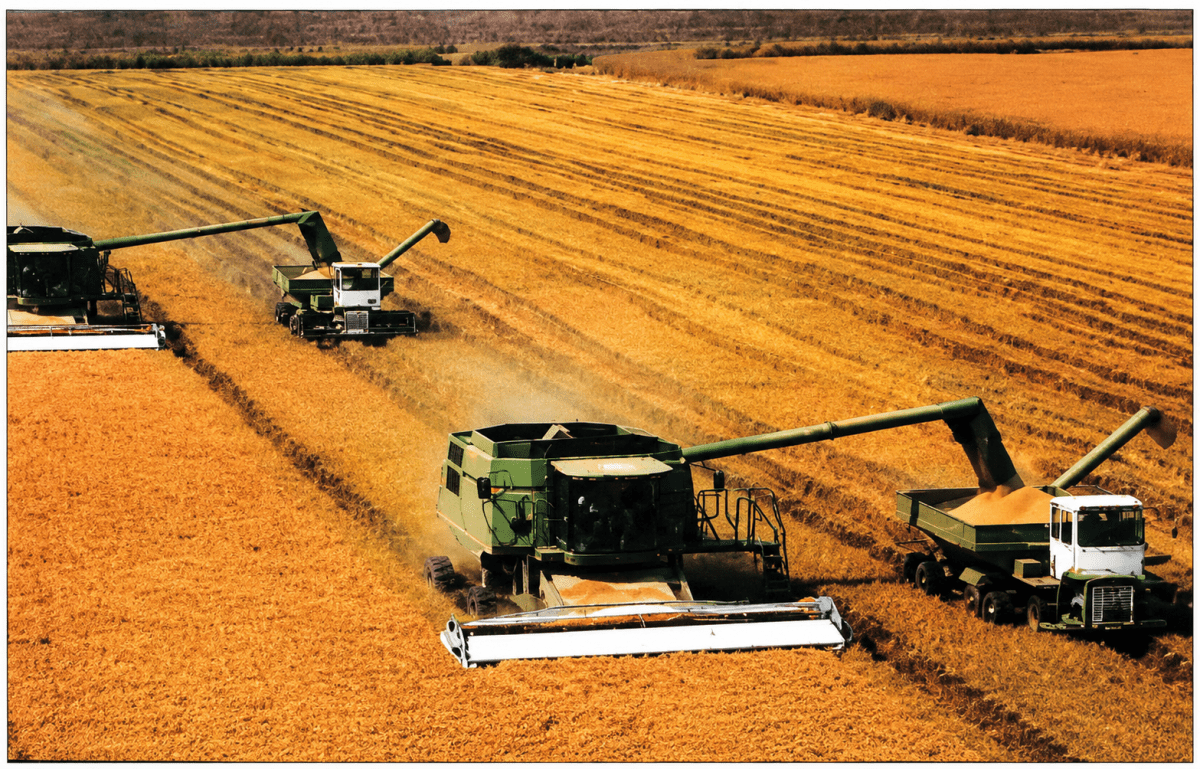
(a) Refer to the picture given below, identify the farming method used. What are the crops cultivated by this method?
(b) List two of its main features.
(c) How does this method of farming differ from subsistence farming?
(d) With the help of an example of an area where this farming is practised explain how is it beneficial to the farmer.
Show SolutionHide Solution↓
(a) The farming method shown in the picture is Commercial farming. The crops cultivated by this method are cash crops such as sugarcane, tobacco, fibre crops and oilseeds.
(b) Two main features of commercial farming are-
Crops are grown mainly for sale.
Large farms are required and mechanised farming is practised.
(c) Difference between Commercial farming and Subsistence farming
Commercial farming
Subsistence farming
Crops are grown mainly for sale in the market.
Most of the food production is consumed by the farmers and their families and there is never a surplus for the market.
Large farms are required and mechanised farming is practised using High Yielding Variety (HYV) seeds, chemical fertilizers, insecticides and pesticides.
Landholdings are small and scattered and farmers use traditional methods of agriculture and primitive tools, like hoe and digging sticks.
Productivity is high.
Productivity is low.
(d) Commercial farming has shown good results in Punjab, Haryana, Western UP, Gujarat and Andhra Pradesh. For example, rice is a commercial crop in Punjab and Haryana. It is beneficial to the farmer because crops are grown mainly for sale; the use of mechanised farming along with HYV seeds, chemical fertilizers, insecticides and pesticides gives higher productivity; and the large surplus produced is sold in the market, earning a good income for the farmer.
1Thinking Skills
Your penfriend, who lives in Australia, has read that India is an agricultural country. He wants to know the details about the nature of agriculture practised in India and the problems faced by the farmers. Write to your friend replying to his queries.
Show SolutionHide Solution↓
Dear Friend,
India is primarily an agricultural country, and agriculture plays a vital role in its economy. Farming includes both subsistence farming, where crops are grown for personal consumption, and cash crop cultivation of crops like cotton, sugarcane, tea, coffee, and spices for commercial purposes.
The Green Revolution of the 1960s and 1970s introduced high-yielding varieties (HYV) of seeds, modern farming methods, fertilisers, and irrigation. This greatly increased agricultural productivity and made India self-sufficient in food production.
However, Indian farmers face several challenges such as fragmented landholdings, dependence on monsoons, lack of access to credit, inadequate infrastructure, climate change, and the use of old and inefficient farming techniques, all of which affect agricultural productivity and farmers' incomes.
Yours sincerely, Your Friend
2Thinking Skills
Your grandfather, a farmer, was a young boy when the Green Revolution began. What does he tell you about the pros and cons of the Green Revolution.
Show SolutionHide Solution↓
My grandfather experienced the Green Revolution as a young boy and he told me many things about the Green Revolution.
The advantages of Green Revolution as per my grandfather are:
Increased Crop Yields — The Green Revolution introduced high-yielding crop varieties and modern farming techniques, resulting in a significant increase in crop production and improved food security.
Improved Livelihoods — Higher crop yields meant increased incomes for farmers, improving their living standards.
Food Self-Sufficiency — The Green Revolution made the country self-sufficient in food production and ensured a stable food supply.
The disadvantages of Green Revolution as per my grandfather are:
Environmental Impact — Intensive use of chemical fertilizers and pesticides led to soil degradation, water pollution, and a loss of biodiversity.
Income Inequality — Large-scale farmers with better access to resources benefitted more, exacerbating income inequality and leaving small-scale farmers at a disadvantage.
Dependency on External Inputs — Farmers became reliant on costly inputs like fertilizers and pesticides.
Loss of Traditional Knowledge — The focus on high-yielding varieties led to a decline in traditional crop varieties, risking the loss of indigenous knowledge and agricultural diversity.
3Thinking Skills
Your uncle, who lives in Punjab, is a farmer involved in the cultivation of crops and livestock rearing. He sells the crops and dairy products in the market. Name the type of agriculture practised by him, the crops he grows and the main features of the agriculture practised by him. Why is this type of agriculture not popular throughout the country?
Show SolutionHide Solution↓
My uncle practices commercial farming which is a system of agriculture that involves cultivation of crops and livestock rearing for sale in the market. He mostly grows rice on the farm. Cash crops like sugarcane, tobacco, fibre crops and oilseeds are also grown.
The main features of commercial agriculture are:
Crops are grown mainly for sale.
Large farms are required.
Mechanised farming is practised.
It is prevalent in areas where farms are large and market economy is well developed.
It involves the use of High Yielding Variety (HYV) seeds, chemical fertilizers, insecticides and pesticides to obtain higher productivity.
Commercial agriculture is not popular throughout the country because in most other States there are small landholdings while commercial agriculture requires large farms.
4Thinking Skills
If you are given a choice, which type of agriculture you would like to practise and why?
Show SolutionHide Solution↓
I would like to practise organic farming because of the following reasons:
It protects the long term fertility of soils by maintaining organic matter levels, and creating optimised conditions for biological activity within the soil.
It provides crop nutrients indirectly using relatively insoluble nutrient sources which are made available to the plant by the action of soil micro-organisms.
It maintains nitrogen self-sufficiency through the use of legumes and biological nitrogen fixation as well as effective recycling of organic materials including crop residues and livestock manures.
It prevents weeds, diseases and pests by relying primarily on crop rotations, natural predator diversity, organic manuring, resistant varieties and limited thermal, biological and chemical intervention.
It provides attentive care and management to livestock, paying full regard to their evolutionary adaptations, behavioural needs and animal welfare issues with respect to nutrition, housing, health, breeding and rearing.
5Thinking Skills
The concept of organic food is fast catching up in metro cities. What are your views on this? Give reasons to support your answer. Are you ready to pay more for organic products?
Show SolutionHide Solution↓
I agree that the concept of organic food is fast catching up in metro cities. People are eager to switch to organic food because of the following reasons:
Health Benefits — Organic food is often perceived as healthier as it is produced without the use of synthetic pesticides, genetically modified organisms (GMOs), or artificial additives. It is believed to have higher nutritional value and lower levels of chemical residues.
Environmental Impact — Organic farming practices prioritize soil health, biodiversity, and the use of natural resources. It can help protect the environment, conserve water, and reduce pollution.
Support for Local Farmers — Organic food production often involves small-scale and local farmers who follow organic principles. Buying organic products can contribute to supporting local communities and sustainable agriculture practices.
Yes, keeping in mind my own health as well as the conservation of our environment, I would be amenable to pay more for organic products.
6Thinking Skills
During my visit to the flood plains of Uttar Pradesh, I witnessed immense agricultural development. Mention the soil type found here and the characteristic features of it.
Show SolutionHide Solution↓
The soil type found in the flood plains of Uttar Pradesh is Khadar Alluvial soil. Its characteristic features are as follows-
Khadar is younger alluvium as flood waters deposit new layers every year.
It is formed of fine silt and clay.
Khadar is light in colour.
It is light and porous. So, it is easily tillable.
Khadar is very fertile and ideal for intensive cultivation.
It is suitable for the growth of a large variety of rabi and kharif crops.
1Choose the correct option
............... crops are associated with the south-west monsoon.
(a)Rabi
(b)Kharif
(c)Zayad
(d)None of the above.
Show SolutionHide Solution↓
Kharif
Reason — Kharif crops are sown with the onset of the South-West Monsoon (June–July) and harvested in autumn. They depend mainly on monsoon rainfall for their growth.
2Choose the correct option
Identify a non-kharif crop.
(a)Sugarcane
(b)Cotton
(c)Rice
(d)Wheat.
Show SolutionHide Solution↓
Wheat
Reason — Wheat is a rabi crop grown in the rabi season, which begins with the onset of winter. Sugarcane, cotton and rice are kharif crops, so wheat is the non-kharif crop among the given options.
3Choose the correct option
Assertion (A): Categorisation of the cropping season does not exist in southern India.
Reason (R): The temperatures are sufficiently high to grow tropical crops during any period in the year provided the soil moisture is available.
(a)Both A and R are true and R is the correct explanation of A.
(b)Both A and R are true but R does not explain A.
(c)A is true but R is false.
(d)A is false but R is true.
Show SolutionHide Solution↓
Both A and R are true and R is the correct explanation of A.
Explanation — Categorisation of the cropping season does not exist in southern India as the temperatures are sufficiently high to grow tropical crops during any period in the year provided the soil moisture is available.
4Choose the correct option
The kharif crops are sown in June and July and harvested in ............... and ............... .
(a)September and October
(b)October and November
(c)March and April
(d)August and September
Show SolutionHide Solution↓
September and October
Reason — Kharif crops are associated with the South-West Monsoon; they are sown in the months of June and July and harvested in the autumn months of September and October.
5Choose the correct option
Wheat and barley are associated with which agricultural season?
(a)Kharif
(b)Zaid
(c)Rabi
(d)None of the above.
Show SolutionHide Solution↓
Rabi
Reason — The rabi season begins with the onset of winter, and its low temperature conditions help in the cultivation of temperate and subtropical crops like wheat and barley.
6Choose the correct option
The crops which are raised throughout the year are known as ............... .
(a)Kharif
(b)Rabi
(c)Zaid
(d)Baid
Show SolutionHide Solution↓
Zaid
Reason — Besides the kharif and rabi crops, there are certain crops which are raised throughout the year. These are known as Zayad or Zaid crops.
7Choose the correct option
Assertion (A): India is by and large self-sufficient in food grains.
Reason (R): Indian agriculture is largely dominated by food crops.
(a)Both A and R are true and R is the correct explanation of A.
(b)Both A and R are true but R does not explain A.
(c)A is true but R is false.
(d)A is false but R is true.
Show SolutionHide Solution↓
Both A and R are true and R is the correct explanation of A.
Explanation — Indian agriculture is largely dominated by food crops which occupy 65% of the total cropped area of the country making India self-sufficient in food grains.
8Choose the correct option
Name the grass-like plants, which have starchy edible seeds that are a warehouse of nutrients.
(a)Cereals
(b)Spices
(c)Beverages
(d)Oilseeds
Show SolutionHide Solution↓
Cereals
Reason — The term 'cereals' denotes all kinds of grass-like plants which have starchy, edible seeds; because of their high nutritional value, they have formed the basic diet of mankind.
9Choose the correct option
Assertion (A): Rice, an indigenous crop, is grown all over the country.
Reason (R): Rice is a kharif crop in north India. In the south, it can be grown throughout the year if irrigation is available.
(a)Both A and R are true and R is the correct explanation of A.
(b)Both A and R are true but R does not explain A.
(c)A is true but R is false.
(d)A is false but R is true.
Show SolutionHide Solution↓
Both A and R are true and R is the correct explanation of A.
Explanation — Rice is grown all over the country. In north India, kharif season provides the right climatic conditions for rice cultivation. In south India, due to tropical climatic conditions it can be grown throughout the year if irrigation is available.
10Choose the correct option
Rice grows best in ............... and ............... areas.
(a)warm, humid
(b)cold, dry
(c)hot, rainy
(d)hot, dry
Show SolutionHide Solution↓
warm, humid
Reason — Rice is mainly a tropical crop, so it grows best in warm and humid areas, which provide the temperature and moisture it needs at the different phases of its growth.
11Choose the correct option
Rice thrives in the ............... soils grown along the river banks.
(a)laterite
(b)red
(c)black
(d)alluvial
Show SolutionHide Solution↓
alluvial
Reason — Deep fertile clayey or loamy soils are well suited for rice cultivation, and rice thrives in the alluvial soils along the river banks which can retain standing water in the field.
12Choose the correct option
A farmer is using the dry method of rice cultivation, seeds are sown in rows with drills. As a student of geography what can you say about the rainfall in the area?
(a)low rainfall
(b)heavy rainfall
(c)moderate rainfall
(d)scanty rainfall
Show SolutionHide Solution↓
heavy rainfall
Reason — In the dry method of cultivation, the seeds are sown in rows with the help of drills in heavy rainfall areas, whereas they are scattered by hand in areas of moderate rainfall.
13Choose the correct option
Assertion (A): Millets serve as food grains for the poorer sections of the society.
Reason (R): They are highly nutritious easily digestible food that grows in harsh conditions.
(a)Both A and R are true and R is the correct explanation of A.
(b)Both A and R are true but R does not explain A.
(c)A is true but R is false.
(d)A is false but R is true.
Show SolutionHide Solution↓
Both A and R are true and R is the correct explanation of A.
Explanation — Millets are highly nutritious easily digestible food that grows in harsh conditions like infertile soil. They are affordable and grow quick. Hence, millets serve as food grains for the poorer sections of the society.
14Choose the correct option
Pulses are important crops because they
(a)compliment the India starch-rich diet.
(b)are rich source of protein.
(c)fix atmospheric nitrogen.
(d)All of the above.
Show SolutionHide Solution↓
All of the above.
Reason — Pulses provide vegetable protein that complements the starchy Indian diet, and being leguminous crops they fix atmospheric nitrogen in the soil and increase its natural fertility. Hence, all the given options are correct.
1(a)Answer the following questions
Name the three cropping seasons in India.
Show SolutionHide Solution↓
The three cropping seasons in India are-
Kharif
Rabi
Zaid
1(b)Answer the following questions
Which is the most important method of rice cultivation in India? Why?
Show SolutionHide Solution↓
The Japanese method is the most important method of rice cultivation in India because it uses high-yielding varieties (HYV) of seeds, seedlings are first raised in nurseries and then transplanted in rows, making weeding and irrigation easier. This method, along with the proper use of fertilisers and irrigation, ensures a higher yield.
1(c)Answer the following questions
Name the two states where rice is grown as a cash crop. Why?
Show SolutionHide Solution↓
In Punjab and West Bengal, the farmers cultivate rice as a cash or commercial crop. Rice is grown in almost all states of India except Gujarat and Rajasthan. Rice can feed more people compared to same amount of any other food grains.
1(d)Answer the following questions
Give three points of difference between upland and lowland rice.
Show SolutionHide Solution↓
Upland rice
Lowland rice
It is grown on mountainous regions.
It is grown in low-lying areas.
It is sown in March-April and harvested in September-October.
It is sown in June and harvested in October.
The entire crop is used locally.
The produce of rice is used for local consumption as well as supplied to other regions.
2(a)Answer the following questions
Why are cereals referred to as 'staff of life'?
Show SolutionHide Solution↓
Cereals are referred to as 'staff of life' because of their simple form of cultivation and their high nutritional value. They have formed the basic diet of mankind.
2(b)Answer the following questions
State two geographical conditions suitable for the cultivation of rice?
Show SolutionHide Solution↓
Two geographical conditions suitable for the cultivation of rice are-
Rice grows best in warm and humid areas. The critical mean temperature for flowering and fertilisation ranges from 16°C to 20°C whereas during ripening, the range is from 18°C to 32°C.
Rice requires good rainfall in the range of 150 to 300 cm.
2(c)Answer the following questions
Give a geographical reason for each of the following:
(i) Wheat cultivation is confined to the northern parts of the country.
(ii) Punjab is the leading producer of wheat in India.
(iii) Government of India is encouraging cultivation of millets.
Show SolutionHide Solution↓
(i) Wheat cultivation is confined to the northern parts of the country because it grows best in cool, moist climate and ripens in warm, dry climate. Also, the winter rain occurring in northern India is beneficial for the crop.
(ii) Punjab is the leading producer of wheat in India because the climate of Punjab is well suited for the cultivation of wheat. During winters, the temperature of the region remains between 10°C to 25°C. Punjab also receives light showers during the winter months from the western disturbances. Such a climate is suited for wheat cultivation.
(iii) Government of India is encouraging cultivation of millets because millets are highly nutritious and easily digestible, being a rich source of iron, calcium, zinc and magnesium. They are hardy crops of short duration that can be grown even in infertile, rocky or sandy soils with very little water. This makes them well suited to dry regions and their cultivation sustainable, which is why the government is encouraging them.
2(d)Answer the following questions
(i) Name the state that produces the highest quantity of rice in India.
(ii) State two advantages of growing rice on lowlands.
Show SolutionHide Solution↓
(i) West Bengal produces the highest quantity of rice in India.
(ii) Two advantages of growing rice on lowlands are-
It is easy to irrigate rice crop and water can be easily accumulated on low lands.
Soil in the lowlands is more fertile as compared to uplands.
3(a)Answer the following questions
What kind of soil is needed for the cultivation of wheat?
Show SolutionHide Solution↓
Wheat grows best in well drained loams and clay loams.
3(b)Answer the following questions
State two geographical conditions necessary for the growth of wheat in India.
Show SolutionHide Solution↓
Two geographical conditions necessary for the growth of wheat in India are-
For the cultivation of wheat, temperature in the range of 10-15°C is suitable for sowing and 20-25°C during harvest.
About 80 cm of annual rainfall is ideal for wheat cultivation.
3(c)Answer the following questions
(i) Name two states that grow wheat extensively.
(ii) What climatic features have helped these states in this respect?
Show SolutionHide Solution↓
(i) Punjab and Uttar Pradesh grow wheat extensively.
(ii) Climatic features that have helped these states in this respect are-
Cool and moist climate for sowing and warm, dry climate for ripening. Ideal temperature ranges from 10-15°C at the time of sowing and 20-25°C during harvesting.
Annual rainfall of about 80 cm. Winter rain caused due to western disturbances are beneficial for the crop.
3(d)Answer the following questions
Give three differences between the climatic conditions needed for wheat and rice cultivation.
Show SolutionHide Solution↓
Climatic Conditions
Wheat
Rice
Temperature during sowing
10 to 15°C
16-20°C
Temperature during ripening/harvest
20-25°C
18-32°C
Rainfall
About 80 cm
About 150 - 300 cm
4(a)Answer the following questions
What is meant by "transplantation"? State two of its advantages.
Show SolutionHide Solution↓
Transplantation is a method of rice cultivation common in deltaic and flood plain regions. The seedlings are first grown in nurseries and after four to five weeks when saplings attain 25-30 cm of height, they are transplanted into prepared rice fields in groups of four to six at a distance of 30-45 cm. In the beginning, the field is flooded with a 2-3 cm deep water. Subsequently, the depth of water level is increased to 4-6 cm till the crop matures.
Two advantages of transplantation method are-
Only the healthy plants are picked for resowing in the field and unhealthy plants are discarded.
Weeds are removed while resowing.
4(b)Answer the following questions
How does the cultivation of pulses usually help in restoration of fertility of the soil?
Show SolutionHide Solution↓
Pulses being leguminous crops, fix atmospheric nitrogen in the soil and increase the natural fertility of soil. Hence, pulses are usually rotated with other crops to maintain or restore soil fertility.
4(c)Answer the following questions
(i) Why are pulses grown as rotational crops?
(ii) Explain why India is the largest consumer of pulses.
Show SolutionHide Solution↓
(i) Pulses are grown as rotational crops as pulses being leguminous crops, fix atmospheric nitrogen in the soil and increase the natural fertility of soil.
(ii) India is the largest consumer of pulses because pulses form a very important part of the Indian diet, especially for those who consume starchy vegetarian diet. This is because pulses provide vegetable protein.
4(d)Answer the following questions
State three methods of growing rice.
Show SolutionHide Solution↓
Three methods of growing rice are-
The dry method of cultivation
The puddled or wet method
Transplanting method
5(a)Answer the following questions
What are millets?
Show SolutionHide Solution↓
The term 'millets' refers to a number of inferior grains like jowar, bajra and ragi, which serve as food grains for the poorer sections of the society.
5(b)Answer the following questions
Why are millets referred to as 'food grains of the poor'?
Show SolutionHide Solution↓
Millets are known as 'food grains of the poor' because these are coarse grains. Further, these do not require adequate water and can be grown in infertile soil owing to its rocky or sandy character.
5(c)Answer the following questions
Why are millets known as dry crops?
Show SolutionHide Solution↓
Millets are known as dry crops because they have a very short growing season and they can be grown under dry and high temperature conditions. Also, millets do not need rain or water and can survive in drought and other extreme conditions.
5(d)Answer the following questions
In what way are the millets different from rice?
Show SolutionHide Solution↓
Rice requires high temperature with adequate water for irrigation while millets can be grown on infertile soil and does not require much water for growth.
Millets have a higher nutritional value than rice.
6(a)Answer the following questions
In which region is ragi grown in India? Why?
Show SolutionHide Solution↓
Ragi is mainly grown in Karnataka (the leading producer), followed by Tamil Nadu, Uttarakhand, Maharashtra, Andhra Pradesh, Odisha, Jharkhand, Rajasthan, and Gujarat.
It is grown in these regions because they have well-drained red, light black, sandy loam, and alluvial loam soils, along with warm climatic conditions that are suitable for ragi cultivation.
6(b)Answer the following questions
In which part of the year is wheat grown in India? Why?
Show SolutionHide Solution↓
Wheat is a rabi crop and mostly grown during the cold weather season. It is usually sown in October and continues till the mid of November. It is harvested by the end of January in the south, and by March-April in the north.
It is so because wheat grows best in cool moist climate and ripens in warm, dry climate.
6(c)Answer the following questions
Why is wheat not grown in the eastern and in the extreme southern parts of India? Name the state that is the largest producer of wheat.
Show SolutionHide Solution↓
Wheat is not grown in the eastern and in the extreme southern parts of India because the temperature required at the time of sowing wheat is 10-15°C which is not possible in these regions.
Also, wheat grows best in well drained loams and clay loam whereas the southern and eastern India have laterite and red soil.
Uttar Pradesh is the largest producer of wheat in India.
6(d)Answer the following questions
In the year 2023-24 the government has imposed restrictions on rice exports, according to news reports. As a student of geography give reasons to support government's decision. [Hint: low rainfall in August 2023]
Show SolutionHide Solution↓
The government imposed restrictions on rice exports in 2023-24 due to the following geographical reasons:
Low Rainfall in August 2023 – A weak monsoon affected rice production, especially in major rice-growing regions, reducing overall yield.
Uncertain Climate Conditions – Fluctuations in monsoon patterns raised concerns about future crop yields, making it necessary to secure available rice stocks.
These measures were taken to safeguard food availability in India.
7Answer the following questions
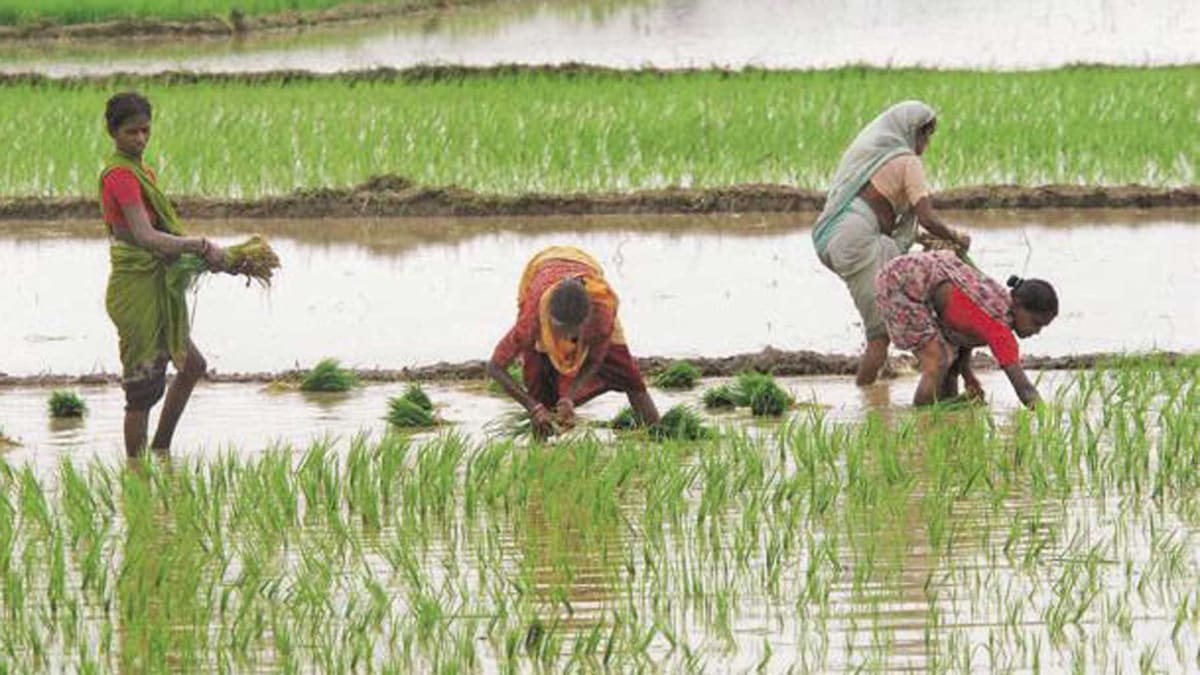
Study the picture given below and answer the following questions:
(a) Name the crop which is being planted. Give one benefit of this method of planting this crop.
(b) Name the other method of planting the crop. In which area is this method practised?
(c) Give a geographical reason for each of the following:
(i) Rice is not the main crop in the Deccan Plateau.
(ii) Punjab is the largest producer of rice despite deficient rainfall.
(iii) Wheat grows well in loamy soil.
(d) Mention the climatic conditions which favour the cultivation of the crop being planted.
Show SolutionHide Solution↓
(a) Rice is being planted. A benefit of this method of plantation is that this method gives higher yield.
(b) Another method of planting the crop is drilling method. It is practised in Peninsular India.
(c)
(i) Rice is not the main crop in the Deccan Plateau because the soil required for rice cultivation is clayey or loamy soil while deccan plateau has black soil. Also, rice requires adequate water for irrigation and this region falls in the rain shadow region of the western ghats.
(ii) Punjab is the largest producer of rice despite deficient rainfall because here, 97% of the rice area is irrigated and due to higher input of High Yielding Variety seeds, fertilisers and mechanisation the per hectare yield is the highest.
(iii) Wheat grows well in loamy soil because loamy soil is a mixture of sand, silt and clay which provides ideal nutrition for wheat. The fertile, well-drained loamy soil allows for rapid absorption of water and air by plant roots, which encourages growth of the wheat plant.
(d) The climatic conditions suitable for the cultivation of rice are-
Rice grows best in warm and humid areas. The critical mean temperature for flowering and fertilisation ranges from 16°C to 20°C whereas during ripening, the range is from 18°C to 32°C.
Rice requires good rainfall in the range of 150 to 300 cm.
8(a)Answer the following questions
What is dry farming?
Show SolutionHide Solution↓
Dry farming is a method of farming practiced in areas with very little rainfall and no irrigation. It relies on conserving moisture in the soil and growing crops that need less water.
8(b)Answer the following questions
Name one crop that can be grown by dry farming. Name the soil which enables dry farming.
Show SolutionHide Solution↓
One crop that can be grown using dry farming is millets (like jowar or bajra). Black soil is suitable for dry farming because it can retain moisture for a long time.
8(c)Answer the following questions
Give a geographical reason for each of the following:
(i) The soil should be able to retain standing water in the field.
(ii) Rice is the leading crop of West Bengal.
(iii) In north India wheat is a rabi crop.
Show SolutionHide Solution↓
(i) For rice cultivation, the soil should be able to retain standing water because rice needs a lot of water to grow. Soils that can hold water, like clayey soils, keep the roots submerged, which helps the rice plants grow well and also controls weeds.
(ii) Rice is the leading crop of West Bengal because the state has favourable climate (tropical with abundant rainfall), fertile alluvial soil, and extensive river network, all of which create ideal conditions for growing a water-intensive crop like rice.
(iii) Wheat is a rabi crop in North India because it grows best in cool, moist climate and ripens in a warm, dry climate. Its sown usually in October and continues till the mid of November. The winter rain occurring in northern India is beneficial for the crop.
8(d)Answer the following questions
In the state of West Bengal, three crops of rice are grown annually. It is the leading rice growing state of India and has favourable conditions for its growth. Write the climatic factors which favour its growth in the mentioned region of India.
Show SolutionHide Solution↓
The climatic factors that favour rice cultivation in West Bengal are:
High Temperature – Rice needs a warm climate. West Bengal has temperatures between 20°C to 32°C during the growing season, which is ideal for rice.
Heavy Rainfall – The state receives more than 150 cm of rainfall annually, mostly during the monsoon. This provides the water needed for rice, which grows well in flooded fields.
High Humidity – The humid climate of West Bengal supports healthy growth of rice plants.
Fertile Alluvial Soil – The soil in the plains of West Bengal is rich, clayey, and able to retain water, which is perfect for rice cultivation.
9(a)Answer the following questions
The United Nations declared 2023 as International Year of Millets to encourage the cultivation and increase awareness of the nutritional benefits and the sustainability of millets. How can cultivation of millets promote sustainability?
Show SolutionHide Solution↓
The cultivation of millets promotes sustainability in several important ways:
Low Water Requirement: Millets can grow in dry, arid regions with very little water. This means they help save water — an essential step for sustainable farming, especially in areas facing water shortages.
Minimal Use of Chemicals: Millets require fewer chemical fertilizers and pesticides, which helps protect the soil and nearby water bodies from pollution.
Climate Resilience: Millets can withstand harsh weather conditions such as droughts and high temperatures. This makes them reliable even when climate change causes extreme weather — supporting stable food production.
Improved Soil Health: Millets grow well in poor soils and can help prevent soil erosion. Some millets also add organic matter back into the soil, which improves its quality over time.
Support for Local Economies: Since they can be grown with fewer resources, millets are affordable for small farmers and can create local jobs, reducing the need for importing food.
By encouraging millet farming, countries can protect natural resources, ensure food for everyone, and support the environment, making agriculture more sustainable for future generations.
9(b)Answer the following questions
State the advantages of cultivation of pulses.
Show SolutionHide Solution↓
The advantages of cultivation of pulses are as follows:
Pulses are a very important source of vegetable protein.
Being leguminous crops, pulses fix atmospheric nitrogen in the soil and increase the natural fertility of soil.
Pulses are usually rotated with other crops to maintain or restore soil fertility.
Pulses serve as an excellent forage and grain concentrates in the feed of cattle.
9(c)Answer the following questions
Sapan is a farmer who has purchased seeds called Japonica.
(i) Which crop is he cultivating?
(ii) Briefly describe two practices that he would need to follow.
Show SolutionHide Solution↓
(i) Sapan is cultivating Rice, specifically a variety known as Japonica.
(ii) Two practices that he would need to follow are-
The seedlings are first grown in the nurseries and after four to five weeks when saplings attain 25-30 cm of height they are transplanted into prepared rice fields in groups of four to six.
The rows of plants are fixed at a distance of 25cm. Similarly, the distance between the plants is about 15cm. It is easy for the farmer to give proper care to the plants by weeding them.
9(d)Answer the following questions
The government of Punjab is encouraging its farmers to shift away from rice cultivation.
(i) What has prompted this action?
(ii) Which alternate crops are encouraged?
Show SolutionHide Solution↓
(i) This action was prompted due to factors like —
Ground water depletion
Environmental degradation
Soil becoming infertile
(ii) Alternate crops being encouraged are less-water intensive ones like Maize, Pulses, Millets and Oilseeds.
1Thinking Skills
Indian agriculture is largely dominated by food crops. What is the reason for it? Give examples to support your answer.
Show SolutionHide Solution↓
Indian agriculture is largely dominated by food crops due to the following reasons:
Food Security — India has a large population, and ensuring food security is a top priority. Food crops such as wheat, rice, and millets are essential for meeting the country's dietary needs and preventing hunger.
Subsistence Agriculture — Many farmers practice subsistence agriculture, where the focus is on growing crops for personal consumption rather than commercial purposes.
Demand and Market Stability — There is a consistent and stable demand for food crops in the domestic market as food crops are essential staples in Indian cuisine.
Government Policies and Support — The Indian government has historically provided support, subsidies and incentives for food crop cultivation to ensure food self-sufficiency and stabilize prices in the market. This further encourages farmers to focus on growing food crops.
Some examples of cultivation of food crops are as follows:
Rice is widely grown in West Bengal, Punjab, and Tamil Nadu.
Wheat is mainly grown in Punjab, Haryana, and Uttar Pradesh.
Millets such as jowar and bajra are cultivated in Rajasthan, Maharashtra, and Karnataka.
2Thinking Skills
You live in a state which has a number of rivers, deltas and estuaries, good rainfall and heavy soils. Which cereal crop is ideal for growth in your state? During which season would this crop be sown and which method of cultivation would be used?
Show SolutionHide Solution↓
Rice crop is ideal for growth in my state.
Rice is a kharif crop. It is sown in the month of June-July and harvested in the month of September-October.
The puddled or wet method of cultivation would be used as we have assured supply of water for irrigation. In this method, the land is ploughed thoroughly and filled with three to five centimetres of standing water in the field. This water is maintained in the fields up to a depth of two to three centimetres till the seedlings are well established.
3Thinking Skills
Though India is an agricultural country, the cost of food is rising sharply. Give reasons to explain the causes of this rise in prices of food.
Show SolutionHide Solution↓
The rising cost of food in India can be attributed to several factors:
Increasing Population — The rising population in India leads to increased demand for food, putting pressure on the available supply and driving up prices.
Inflation and Economic Factors — Inflationary pressures, rising fuel prices, transportation costs, and input costs for farmers contribute to higher food prices.
Weather and Climate Change — Adverse weather events like droughts, floods and extreme temperatures affect crop yields and reduce the overall food supply, leading to price increases.
Supply Chain Issues — Inadequate infrastructure, storage facilities and transportation networks result in post-harvest losses and wastage, leading to higher prices.
Income Disparities — Income disparities affect food prices, as higher-income groups demand costlier food products, driving up prices.
Export and Import Policies — Trade policies and restrictions on agricultural commodities can create imbalances between supply and demand, impacting domestic food prices.
Global Market Influences — Global commodity prices, exchange rates, and geopolitical events have a trickle-down effect on domestic food prices in India.
1Choose the correct option
In a sugarcane, the sugar is stored in its ............... .
(a)roots
(b)stem
(c)leaves
(d)fruit
Show SolutionHide Solution↓
stem
Reason — Sugarcane stores sucrose (sugar) in its thick, juicy stem, which is crushed to extract sugar and produce gur, khandsari, and other sugar products.
2Choose the correct option
............... are cuttings taken from old plants and planted to grow new canes.
(a)Setts
(b)Retts
(c)Ratoons
(d)Batoons
Show SolutionHide Solution↓
Setts
Reason — Setts are cuttings taken from old sugarcane plants which quickly become established, and after a few days buds sprout to form new stalks.
3Choose the correct option
What is the successive crop obtained from the roots of the leftover sugarcane crop called?
(a)Ratoon
(b)Stalk
(c)Stem
(d)Cane
Show SolutionHide Solution↓
Ratoon
Reason — In ratooning, during the first harvest the sugarcane is cut leaving a little of the stalk in the soil with the roots, and the successive crop obtained from the roots of this leftover crop is called a Ratoon.
4Choose the correct option
Assertion (A): Sugarcane grows well in tropical regions with rainfall well distributed throughout the year.
Reason (R): The sucrose content decreases if heavy rains continue for long and a rainfall deficiency produces a fibrous crop.
(a)Both A and R are true and R is the correct explanation of A.
(b)Both A and R are true but R does not explain A.
(c)A is true but R is false.
(d)A is false but R is true.
Show SolutionHide Solution↓
Both A and R are true and R is the correct explanation of A.
Explanation — Sugarcane grows well in tropical regions with rainfall well distributed throughout the year. This is because the sucrose content decreases if heavy rains continue for long and a rainfall deficiency produces a fibrous crop.
5Choose the correct option
The yield from each successive ratoon crop is ............... than the previous one.
(a)better
(b)higher
(c)lesser
(d)same
Show SolutionHide Solution↓
lesser
Reason — Sugarcane is a perennial crop, but the yield from each successive ratoon crop is lesser than the previous one, and after two or three ratoons the old roots are no longer economical.
6Choose the correct option
Which of the following states is not a major producer of sugarcane?
(a)Kerala
(b)Punjab
(c)Uttar Pradesh
(d)Maharashtra
Show SolutionHide Solution↓
Kerala
Reason — The major sugarcane producing states are Uttar Pradesh, Maharashtra, Tamil Nadu, Karnataka and Andhra Pradesh; Kerala is not a major producer of sugarcane.
7Choose the correct option
Assertion (A): Sugarcane exhausts the fertility of the soil.
Reason (R): Sugarcane is a perennial crop.
(a)Both A and R are true and R is the correct explanation of A.
(b)Both A and R are true but R does not explain A.
(c)A is true but R is false.
(d)A is false but R is true.
Show SolutionHide Solution↓
Both A and R are true but R does not explain A.
Explanation — Sugarcane exhausts the fertility of the soil because of its high nutrient demand, not because it is a perennial crop. Hence, Reason (R) does not correctly explain Assertion (A).
8Choose the correct option
Groundnut oil is extracted from the nuts found in the ............... of the plant.
(a)stem
(b)leaves
(c)roots
(d)branches
Show SolutionHide Solution↓
roots
Reason — Groundnut contains about 42 per cent oil, which is extracted from the nuts found in the roots of the plant.
9Choose the correct option
Name the state that is the leading producer of groundnuts in India.
(a)Telangana
(b)Gujarat
(c)Maharashtra
(d)Rajasthan
Show SolutionHide Solution↓
Gujarat
Reason — Gujarat is the leading producer of groundnuts in India, followed by other producing states such as Maharashtra, Karnataka, Andhra Pradesh and Rajasthan.
10Choose the correct option
Name the oil obtained from flaxseeds.
(a)Linseed
(b)Mustard
(c)Castor
(d)Safflower
Show SolutionHide Solution↓
Linseed
Reason — Linseed oil is obtained from flaxseeds and is good for health.
11Choose the correct option
Assertion (A): The groundnut is a rabi crop in Odisha and in southern states.
Reason (R): Groundnuts require light to moderate rainfall between 50 to 100 cm.
(a)Both A and R are true and R is the correct explanation of A.
(b)Both A and R are true but R does not explain A.
(c)A is true but R is false.
(d)A is false but R is true.
Show SolutionHide Solution↓
Both A and R are true but R does not explain A.
Explanation — The groundnut is a rabi crop in Odisha and in southern states as it thrives well in the tropical and subtropical climates there, not just because of moderate rainfall.
12Choose the correct option
Soya bean : Kharif :: Mustard : ............... .
(a)Kharif
(b)Zaid
(c)Rabi
(d)None of the above
Show SolutionHide Solution↓
Rabi
Reason — Just as soya bean is raised as a kharif crop, mustard is grown mostly as a pure rabi crop in the cool winter season.
13Choose the correct option
............... is the leading producer of soya bean.
(a)Rajasthan
(b)Maharashtra
(c)Madhya Pradesh
(d)Gujarat
Show SolutionHide Solution↓
Madhya Pradesh
Reason — Madhya Pradesh, along with the adjoining districts of Rajasthan and Maharashtra, forms the most important soya bean producing area, making it the leading producer of soya bean.
14Choose the correct option
Soya bean is sown in the month of June and early onset of monsoon ruins the crop. Why?
(a)Heavy rainfall has adverse effects on seed germination.
(b)Heavy rainfall leads to rotting of seedlings.
(c)Soya bean is a rainfed crop.
(d)All of the above.
Show SolutionHide Solution↓
Heavy rainfall has adverse effects on seed germination.
Reason — A time-lag of about two weeks is kept between sowing and the onset of heavy monsoon rains because heavy rainfall adversely affects the germination of soya bean seeds.
15Choose the correct option
Before sowing soya bean seeds are covered with jaggery and rhizobium. Why?
(a)Jaggery acts as a binding agent for the nitrogen fixing bacteria and the seed.
(b)Jaggery is rich in nutrients like iron and magnesium.
(c)Jaggery is a natural soil conditioner.
(d)All of the above.
Show SolutionHide Solution↓
Jaggery acts as a binding agent for the nitrogen-fixing bacteria and the seed.
Reason — Before sowing, jaggery is used as a sticking (binding) agent to help the Rhizobium bacteria adhere to the soybean seeds. The bacteria then fix atmospheric nitrogen, improving soil fertility.
16Choose the correct option
Which of the following crops are grown together as they have same climatic requirements?
(a)Mustard and Wheat
(b)Sugarcane and Soya bean
(c)Mustard and groundnuts
(d)All of them.
Show SolutionHide Solution↓
Mustard and Wheat
Reason — Mustard is grown with wheat, gram and barley in rows in the same climatic conditions, as both mustard and wheat thrive in the cool climate of the rabi season.
17Choose the correct option
Which is a soil exhausting crop with time-sensitive processing requirements?
(a)Groundnut
(b)Sugarcane
(c)Soya bean
(d)Mustard
Show SolutionHide Solution↓
Sugarcane
Reason — Sugarcane exhausts the fertility of the soil, and after harvesting the canes must be processed within 24 hours of cutting to preserve the sugar content, making it a soil exhausting crop with time-sensitive processing.
18Choose the correct option
Name the crop that is a Kharif crop in most of India but a summer crop in Tamil Nadu.
(a)Sugarcane
(b)Rice
(c)Soya bean
(d)Mustard
Show SolutionHide Solution↓
Sugarcane
Reason — The winter rainfall along the Tamil Nadu coast is not beneficial for the crop, allowing cultivation during the summer season.
1(a)Answer the following questions
Name one state in North and one in South India where sugarcane is grown extensively.
Show SolutionHide Solution↓
In North India, sugarcane is grown extensively in Uttar Pradesh and in South India, sugarcane is grown extensively in Tamil Nadu.
1(b)Answer the following questions
Why is the sugarcane production increasing in Maharashtra?
Show SolutionHide Solution↓
Sugarcane production is increasing in Maharashtra because Maharashtra has a longer harvesting season and better quality of crop owing to the favourable maritime climate free from the effects of summer loo and winter frost, sufficient irrigation and new farming techniques.
1(c)Answer the following questions
Explain briefly the Sett method of planting sugarcane.
Show SolutionHide Solution↓
In Sett method, new canes are usually planted by taking cuttings from the old plants. These cuttings, known as setts, quickly become established and after a few days buds sprout to form new stalks. Four to five stalks grow from each cutting. The sugarcane takes anything from 8 months to a year to mature.
1(d)Answer the following questions
What is Ratooning? State two advantages of Ratooning.
Show SolutionHide Solution↓
Ratooning is a method of cultivation of sugarcane. In this method, during the first harvest, the sugarcane is cut leaving a little bit of the stalk in the soil with the roots. The stalk soon puts out new shoots or ratoons. The second or any other successive crop obtained from the roots of the leftover crop is called ratoon.
Two advantages of ratooning are-
Crop need not be planted again, it saves labour.
The ratoon matures early.
2(a)Answer the following questions
How does heavy rainfall affect the quality of sugarcane?
Show SolutionHide Solution↓
Heavy rainfall affects the quality of sugarcane adversely as the sucrose content decreases if heavy rains continue for long.
2(b)Answer the following questions
Why does the cultivation of sugarcane require cheap labour?
Show SolutionHide Solution↓
The cultivation of sugarcane requires plenty of cheap labour as most of the work is done by hand. The crop is cut by hand using a long curved knife.
2(c)Answer the following questions
Why do the stalks of sugarcane need to be cut as near as possible to the ground?
Show SolutionHide Solution↓
The stalks of sugarcane need to be cut as near as possible to the ground because the greatest accumulation of sucrose is in the base of the stem.
2(d)Answer the following questions
State any three problems faced by sugarcane cultivators.
Show SolutionHide Solution↓
Three problems faced by sugarcane cultivators are-
Sugarcane is a soil exhausting crop and therefore, the cost of fertilizers increases the cost of production.
It requires high input of irrigation means.
The cost of transport increases the cost of production.
3(a)Answer the following questions
What extra care needs to be taken for soil health when sugarcane is cultivated?
Show SolutionHide Solution↓
Extra care needs to be taken for soil health when sugarcane is cultivated because sugarcane exhausts the fertility of the soil. Hence, the soil is supplemented with manures and nitrogenous fertilizers.
3(b)Answer the following questions
Mention the climate that is suitable for sugarcane cultivation.
Show SolutionHide Solution↓
The climate that is suitable for sugarcane cultivation is as follows-
Temperature — Sugarcane grows best in areas with 20°C to 26°C temperature. Frost is fatal for the crop. Short cool dry winter season during ripening and harvesting is ideal.
Rainfall — Sugarcane grows well in tropical regions with 100-150 cm of rainfall well distributed throughout the year. Irrigation is necessary in areas with lower rainfall or even in areas of higher rainfall during the long dry spells.
3(c)Answer the following questions
What advantage does South India have over the North with reference to sugarcane cultivation?
Show SolutionHide Solution↓
South India has a higher yield per hectare of sugarcane because of a longer harvesting season and better quality of crop owing to the favourable maritime climate free from the effects of summer loo and winter frost, sufficient irrigation and new farming techniques.
3(d)Answer the following questions
Mention two different ways in which sugarcane is propagated.
Show SolutionHide Solution↓
Two different ways in which sugarcane is propagated are-
Sett method
Ratooning
4(a)Answer the following questions
What conditions of temperature and rainfall favour the growth of groundnut?
Show SolutionHide Solution↓
The climatic conditions that favour the growth of groundnut are-
Temperature — Groundnut requires about 20°C to 25°C temperature. Dry weather is needed during the time of ripening.
Rainfall — It requires light to moderate rainfall between 50 to 100 cm. Rainfall should be well distributed.
4(b)Answer the following questions
Which two states in India are the leading producers of groundnut? Why is groundnut mostly grown in Peninsular India?
Show SolutionHide Solution↓
Gujarat and Tamil Nadu in India are the leading producers of groundnut.
Groundnut is mostly grown in Peninsular India because the red, yellow and black cotton soils of Peninsular India suit it well. Such light soils are essential as the nut ripens in the soil.
4(c)Answer the following questions
Give three uses of groundnut.
Show SolutionHide Solution↓
Three uses of groundnut are-
It is used for the manufacture of hydrogenated oil.
It is used for making margarine, medical emulsions and soap.
Groundnut oil is used as a cooking medium and the nuts are eaten raw, roasted, salted or sweetened.
4(d)Answer the following questions
What is the residue after crushing oilseeds called? Give two of its uses.
Show SolutionHide Solution↓
The residue after crushing oilseeds is called oilcake.
Oilcake is used as a fodder for animals and also serves as a good manure in the fields.
5(a)Answer the following questions
Name any two oilseeds grown in India. Which oilseed is grown as a rainfed crop?
Show SolutionHide Solution↓
Two oilseeds grown in India are groundnut and linseed.
Groundnut is grown as a rainfed crop.
5(b)Answer the following questions
State the conditions of temperature and rainfall necessary for the growth of mustard.
Show SolutionHide Solution↓
The climatic conditions necessary for the growth of mustard are-
Temperature — Mustard grows best in cool climate. Ideal temperature ranges from 10°C to 20°C.
Rainfall — The crop requires rainfall varying between 25 to 40 cm.
5(c)Answer the following questions
(i) Which soil type favours the growth of mustard? Name an area where it grows.
(ii) Mention two uses of mustard.
Show SolutionHide Solution↓
(i) Mustard can be grown on loams but slightly heavier soils are preferred.
Mustard is widely grown in the Sutlej-Ganga plain.
(ii) Two uses of mustard are-
Its seeds are crushed for edible oil.
The oilcake of mustard is an important cattle feed.
5(d)Answer the following questions
Mention the climatic conditions necessary to grow soya bean. State two uses of soya bean.
Show SolutionHide Solution↓
The climatic conditions necessary to grow soya bean are-
Temperature — Soyabean requires temperature in the range of 13°C to 24°C. Temperature above 13°C is necessary for the normal growth of soyabean.
Rainfall — It grows in regions with 40 cm to 60 cm rainfall. The rainfall should be well distributed throughout the growing season.
Two uses of Soyabean are-
It is eaten as vegetable or made into soya sauce.
Due to its high protein content, it is consumed as soya milk or tofu (cheese) as a substitute for animal protein.
6(a)Answer the following questions
The floods in Maharashtra in August-September 2019 submerged sugarcane fields for over 20 days. How did this affect farmers?
Show SolutionHide Solution↓
The floods in Maharashtra in August–September 2019 had a severe impact on sugarcane farmers.
Crop Destruction: Sugarcane fields submerged for over 20 days led to waterlogging, which caused rotting of roots and crop damage, especially since sugarcane cannot withstand prolonged standing water.
Loss of Income: Sugarcane is a high-investment, long-duration crop (typically 10-12 months). Its destruction meant that farmers lost both their money and time invested over many months.
Delayed Harvest and Processing Issues: Flooded fields delayed harvest and reduced sucrose content, affecting both yield quality and recovery rate during sugar processing.
Soil Health Deterioration: Prolonged flooding led to soil nutrient loss and soil compaction, affecting future crops too.
Debt Burden: Many farmers took loans for fertilizers, irrigation, and labour. Crop loss increased their financial distress and indebtedness.
6(b)Answer the following questions
Savinder, a farmer in Punjab, has asked you, a student of geography, to advise him on ratooning. What would you say?
Show SolutionHide Solution↓
In the method of Ratooning, during the first harvest, sugarcane is cut leaving a little bit of the stalk in the soil with roots. The stalk soon puts out new shoots or ratoons. The second or any other successive crop obtained from the roots of the leftover crop is called Ratoon. Sugarcane is a perennial crop and, in theory, the same plants could continue to produce canes for many years. However, the yield from each successive ratoon crop is lesser than the previous one. After two or three ratoons, the old roots are no longer economical and new setts must be planted.
6(c)Answer the following questions
Give a geographical reason for each of the following:
(i) Frost is fatal for the sugarcane crop.
(ii) A 40-45 cm distance between two saplings of sugarcane is maintained.
(iii) The Sutlej-Ganga plains are the traditional growers of sugarcane.
Show SolutionHide Solution↓
(i) Frost is fatal for the sugarcane crop. This is because Sugarcane is a tropical crop. It grows well in warm climate, and being exposed to excessive cold temperatures or frost can lead to degradation in its sucrose content.
(ii) A 40-45 cm distance between two saplings of sugarcane is maintained to facilitate hoeing, weeding, irrigation and harvesting.
(iii) This is because of the fertile alluvium which is renewed every year by numerous mountain streams flowing in this area, sufficiently high temperatures and rainfall, and availability of high water level enabling easy irrigation.
6(d)Answer the following questions
(i) Give two reasons why sugarcane is harvested before winter sets in.
(ii) Why are the sugarcane stocks cut as close to the ground as possible?
Show SolutionHide Solution↓
(i) Sugarcane is harvested before winter to avoid frost damage and ensure optimal sugar content, as frost can significantly reduce both yield and sugar recovery.
(ii) The stalks must be cut as near as possible to the ground because the greatest accumulation of sucrose is in the base of the stem.
1Thinking Skills
Imagine you are a farmer living in Bihar and you want to grow a cash crop on your farm. Which one will you choose and why?
Show SolutionHide Solution↓
As a farmer living in Bihar, if I were to choose a cash crop for my farm, I would select mustard because of the following reasons:
Agro-climatic Suitability — Mustard is well-suited to the agro-climatic conditions of Bihar, including its diverse climate with hot summers and cold winters.
Market Demand — Mustard oil extracted from mustard seeds is widely used for cooking purposes, ensuring a consistent market demand and potential profitability.
Crop Rotation Benefits — Mustard fits well into crop rotation systems, helping suppress weeds, pests, and diseases.
Diversification — Cultivating mustard allows for diversification of income sources on the farm, reducing dependence on a single crop and mitigating risks associated with market fluctuations.
2Thinking Skills
You live in Uttar Pradesh and your cousin lives in Karnataka. Tell the benefits of an edible oil seed grown in your state and get the information about an oilseed that is extensively grown in your cousin's state.
Show SolutionHide Solution↓
As a resident of Uttar Pradesh, one of the significant oilseeds grown in the state is mustard. Mustard cultivation offers several benefits:
Multiple Uses — Mustard oil extracted from mustard seeds is commonly used for cooking purposes in many households. Additionally, mustard seeds are used in pickles, condiments, and spice blends, adding flavour to various dishes.
Nutritional Value — Mustard seeds are rich in essential nutrients like omega-3 fatty acids, protein, fiber, vitamins, and minerals, which contribute to a healthy diet.
Adaptability — Mustard is a versatile crop that can be grown in various agro-climatic conditions.
Crop Rotation Benefits — Mustard is an excellent choice for crop rotation due to its ability to suppress weeds and diseases.
Income Generation — Mustard farming can generate income for farmers due to consistent market demand.
In Karnataka, one extensively grown oilseed is Groundnut. Some of the important information regarding Groundnut cultivation include:
Climate conditions — Groundnut is a tropical crop. It thrives well in the tropical and subtropical climates and is highly susceptible to frost.
Temperature — Groundnut requires about 20°C to 25°C temperature. Dry weather is needed during the time of ripening.
Rainfall — Groundnuts require well-distributed, light to moderate rainfall between 50 to 100 cm. Prolonged drought, continuous rains, stagnant water and frost harm the crop adversely.
Soil type — Sandy loams, loams and well-drained black soils, which allow enough of aeration, are considered suitable for groundnut cultivation. The red, yellow and black cotton soils of Peninsular India suit it well. Such light soils are essential as the nut ripens in the soil.
Multiple Uses — It is used in making hydrogenated oil, margarine, medical emulsions and soap. Groundnut oil is used as a cooking medium, its oil cake is used as cattle feed. The nuts are eaten raw, roasted, salted or sweetened.
3Thinking Skills
Dia has purchased agricultural land in Madhya Pradesh. She wants to cultivate an oilseed in her farm. Which oilseed, in your opinion, should she cultivate? Prepare a feasibility report supporting your opinion.
Show SolutionHide Solution↓
Dia should consider cultivating Soyabean as her oilseed crop in Madhya Pradesh.
Feasibility Report for Soyabean Cultivation in Madhya Pradesh
Climate and Temperature: Madhya Pradesh has a tropical to subtropical climate with a warm growing season. Soyabean thrives in such conditions, as it requires a warm environment with temperatures ranging from 13°C to 24°C.
Rainfall Pattern: Soyabean grows in regions with 40cm to 60cm of rainfall. Madhya Pradesh receives a moderate and well-distributed monsoon, which is ideal for soyabean crop.
Soil Type: Soyabean grows well in a variety of soils, including the alluvial and black soils found in Madhya Pradesh. These soils have good drainage and sufficient fertility, which support the healthy growth of soyabean plants.
Market Demand: Soyabean is a major oilseed crop in India and contributes significantly to the edible oil and animal feed industries. There is a robust domestic and export market for soyabean oil.
Profitability: With established cultivation practices and improved seed varieties, soyabean offers a favorable yield-to-investment ratio, contributing to better farm incomes.
Alternative to water-intensive crops: As an oilseed crop, soyabean provides farmers with an alternative to water-intensive crops like rice, reducing the pressure on groundwater resources, a significant concern in central India.
1Choose the correct option
Cotton plant is extremely sensitive to ............... which can kill the plant and destroy the crop.
(a)temperature
(b)rainfall
(c)frost
(d)humidity
Show SolutionHide Solution↓
frost
Reason — The cotton plant is highly sensitive to frost and late spring early autumn frost can kill the plant and destroy the crop.
2Choose the correct option
The clear October skies are beneficial to the cotton plant.
(a)Sunny skies and no rainfall help in the flowering.
(b)Sunny skies help in ripening and bursting of cotton bolls.
(c)Sunny skies make harvesting expensive
(d)All of the above.
Show SolutionHide Solution↓
Sunny skies help in ripening and bursting of cotton bolls.
Reason — During October, the day temperature should be above 26°C, which helps the ripening and bursting of cotton bolls under the sunny skies.
3Choose the correct option
Which soils are ideal for cotton cultivation?
(a)Deltaic alluvial soils of West Bengal.
(b)Black soils of the Deccan and Malwa Plateaus
(c)Alluvial Soils of the Coastal regions.
(d)All of the above.
Show SolutionHide Solution↓
Black soils of the Deccan and Malwa Plateaus
Reason — The deep and medium black soils of the Deccan and the Malwa Plateaus and Gujarat are considered ideal for cotton cultivation.
4Choose the correct option
Assertion (A): The cotton crop is harvested in three to four pickings as the bolls mature.
Reason (R): Yield of cotton decreases with successive pickings.
(a)Both A and R are true and R is the correct explanation of A.
(b)Both A and R are true but R does not explain A.
(c)A is true but R is false.
(d)A is false but R is true.
Show SolutionHide Solution↓
Both A and R are true but R does not explain A.
Explanation — Cotton is picked in stages because bolls mature at different times. Though yields do drop with each picking, that isn't the main reason for multiple harvests. So, both statements are true, but R doesn't explain A.
5Choose the correct option
Tejas has a farm in Gujarat. He uses terminology such as lint, ginning and sliver. What do you think he cultivates?
(a)Jute
(b)Cotton
(c)Silk
(d)Coffee
Show SolutionHide Solution↓
Cotton
Reason — Lint, ginning and sliver are terms associated with the processing of cotton. Ginning is the process used to separate the fibres or lint from the cotton seeds, and the lint (fibres) are washed and combed to form a rope-like mass of fibres known as sliver. Hence, Tejas cultivates cotton.
6Choose the correct option
More than 50% of the area under cultivation of cotton is in which of the following states?
(a)Gujarat and Maharashtra
(b)Telangana and Andhra Pradesh
(c)Karnataka
(d)All of them.
Show SolutionHide Solution↓
All of them.
Reason — About 72 per cent of the total area under cotton in India is contributed by Gujarat, Maharashtra, Telangana, Andhra Pradesh and Karnataka.
7Choose the correct option
Name the process by which cotton fibre is separated from the seeds ............... .
(a)ginning
(b)spinning
(c)pruning
(d)deseeding
Show SolutionHide Solution↓
ginning
Reason — Ginning is the process used to separate the fibres or lint from the cotton seeds and the short fibres or linters which adhere to them.
8Choose the correct option
Assertion (A): Cotton crops exhaust the fertility of soils rapidly.
Reason (R): Regular application of manures and fertilisers to the soils is necessary.
(a)Both A and R are true and R is the correct explanation of A.
(b)Both A and R are true but R does not explain A.
(c)A is true but R is false.
(d)A is false but R is true.
Show SolutionHide Solution↓
Both A and R are true and R is the correct explanation of A.
Explanation — Cotton is a soil-exhausting crop because it remains in the field for a long period and removes large amounts of nutrients from the soil. Therefore, regular application of manures and fertilisers is necessary to restore soil fertility, making R the correct explanation of A.
9Choose the correct option
Why are cotton farmers opting for other crops?
(a)Reduced global demand for cotton.
(b)Increased cost of cultivation.
(c)Erratic rainfall due to climate change.
(d)All of the above.
Show SolutionHide Solution↓
All of the above.
Reason — Cotton farmers are increasingly shifting to other crops due to reduced global demand, rising cultivation costs, and erratic rainfall caused by climate change, all of which reduce profitability.
10Choose the correct option
Name the inferior substitute for jute which can withstand drought conditions and be cultivated in non-traditional areas.
(a)Testa
(b)Mesta
(c)Cesta
(d)Jesta
Show SolutionHide Solution↓
Mesta
Reason — Mesta is an inferior substitute for jute. It can withstand drought conditions and is therefore grown where jute cannot be grown, such as in some parts of Assam, Bihar, Odisha and Kerala.
11Choose the correct option
The ............... soil gives the heaviest yield of Jute.
(a)clayey
(b)loamy
(c)dry
(d)sandy
Show SolutionHide Solution↓
clayey
Reason — Jute grows best on the soil enriched by new alluvium brought by river inundation. Among these, the clayey soil gives the heaviest yield while sandy soils produce coarse fibre.
12Choose the correct option
Which process softens the outer bark of jute facilitating the easy extraction of the fibre?
(a)Jetting
(b)Retting
(c)Metting
(d)Netting
Show SolutionHide Solution↓
Retting
Reason — Retting softens the outer bark and facilitates the early removability of the fibre within.
13Choose the correct option
Assertion (A): Loamy soils are most suitable for jute production.
Reason (R): The clay particles of loam help to hold the plant nutrients preventing them from getting washed away by water.
(a)Both A and R are true and R is the correct explanation of A.
(b)Both A and R are true but R does not explain A.
(c)A is true but R is false.
(d)A is false but R is true.
Show SolutionHide Solution↓
Both A and R are true and R is the correct explanation of A.
Explanation — Loamy soils are most suitable for jute production as the clay particles of loam help to hold the plant nutrients preventing them from getting washed away by water.
14Choose the correct option
Tea develops most vigorously under ............... and no ............... .
(a)sunshine, rains
(b)light shade, dry spells
(c)moisture, high temperature
(d)clear sky, rains
Show SolutionHide Solution↓
light shade, dry spells
Reason — Tea is a shade loving plant and develops more vigorously under light shade. The tea plants grow well in a humid climate and cannot stand long spells of dry weather at any time of the year.
15Choose the correct option
The tea shrub continues to be productive for about ............... years.
(a)20
(b)25
(c)50
(d)70
Show SolutionHide Solution↓
50
Reason — The tea shrub continues to be productive for about 50 years, after which restocking is necessary.
16Choose the correct option
Complete the following with respect to tea production. World : China :: India : ...............
(a)Tamil Nadu
(b)Kerala
(c)West Bengal
(d)Assam
Show SolutionHide Solution↓
Assam
Reason — Just as China is the leading producer of tea in the world, Assam is the leading producer of tea in India.
17Choose the correct option
Name a crop that is cultivated on slopes as they cannot stand stagnant water.
(a)Jute
(b)Tea
(c)Cotton
(d)All of them.
Show SolutionHide Solution↓
Tea
Reason — Waterlogging is harmful for the growth of tea bushes, so tea is grown on hill slopes. The slopes provide proper drainage and protect the crop from annual inundations and stagnant water during the rains.
18Choose the correct option
Tea-picking is a skilful job involving fine plucking which is
(a)Plucking the tender leaves
(b)Plucking two tender leaves and a bud
(c)Plucking a bud with its stalk
(d)Plucking the bud only.
Show SolutionHide Solution↓
Plucking two tender leaves and a bud
Reason — Tea-picking is a skilful job, requiring patience and judgement. Two tender leaves and a bud or shoot are usually plucked from each stem and this is known as fine plucking.
19Choose the correct option
Jassu loves drinking tea and has a refined palate. She intends to become a tea-taster. Which state will provide her the best opportunity to become a master in her craft?
(a)Tamil Nadu
(b)West Bengal
(c)Assam
(d)Kerala
Show SolutionHide Solution↓
Assam
Reason — Assam is the largest producer of tea in India, contributing 53.2 per cent of the total area and 51% of the tea produced in India. Being the largest tea producing state, Assam would provide Jassu the best opportunity to master her craft of tea-tasting.
1(a)Answer the following questions
What are fibre crops? Give two examples of plant fibre crops.
Show SolutionHide Solution↓
Fibre crops are crops that are primarily grown for obtaining fibre. The fibre is traditionally used to make paper, cloth, or rope.
Two fibre crops are cotton and jute.
1(b)Answer the following questions
What conditions of soil favour the growth of cotton? Why?
Show SolutionHide Solution↓
Cotton grows best in well-drained clayey soils rich in lime and phosphates. Deep and medium black soils are ideal because their high clay content and good water-holding capacity provide favourable conditions for cotton cultivation. Since cotton is a soil-exhausting crop, regular application of manures and fertilisers is necessary to maintain soil fertility.
1(c)Answer the following questions
(i) Name the two chief cotton-growing areas in India.
(ii) Which climatic conditions favour the cultivation of cotton?
Show SolutionHide Solution↓
(i) Two chief cotton-growing areas in India are-
The north western Deccan on the fertile Black cotton soil
The central and southern Deccan of Karnataka and Tamil Nadu
(ii) The climatic conditions that favour the cultivation of cotton are:
Temperature — Cotton requires uniformly high temperatures between 21°C and 30°C. A long growing period of at least 200 frost-free days is required for the plant to mature.
Rainfall — Rainfall should be moderate, ranging between 50 to 75 cm. Sufficient rainfall is required during the early stages of the growth, but a sunny and dry weather is required after flowering.
1(d)Answer the following questions
(i) How is frost harmful for the growth of cotton plant? Why is dry weather necessary at the time of harvesting cotton?
(ii) Why is the net sown area of the cotton crop declining?
Show SolutionHide Solution↓
(i) The cotton plant is extremely sensitive to frost and late spring or early autumn frosts can kill the plant and destroy the crop. The soil temperature below 20°C reduces root growth thus retarding plant growth.
Dry weather is necessary during boll-opening and harvesting because rainfall damages the open bolls and makes the crop more susceptible to pests and diseases.
(ii) The net sown area under cotton is declining due to low global demand, frequent pest attacks, low yields, poor returns, and erratic rainfall caused by climate change. As a result, many farmers are shifting to more profitable and less risky crops such as pulses and maize.
2(a)Answer the following questions
What advantages does Long Staple Cotton have?
Show SolutionHide Solution↓
Long staple cotton is long, fine, strong, soft, and lustrous, making it ideal for producing fine, superior-quality fabrics. Fabrics made from long staple cotton fray less, pill less, wrinkle less, and are more durable than those made from short staple cotton.
2(b)Answer the following questions
Why Gujarat and Maharashtra are the leading producers of Cotton?
Show SolutionHide Solution↓
Gujarat and Maharashtra are the leading producers of Cotton because the moist climate of both the states is well suited for cotton cultivation and the temperature is ideal for the cotton industries as the cotton threads tend to break in dry climate while they rarely break in moist and humid climate.
2(c)Answer the following questions
Given on the right is a sketch of the processes involved in ginning. Describe the process in your own words.
Show SolutionHide Solution↓
The stages in Ginning of Cotton are-
The cotton first goes through the dryers to reduce moisture content.
Then, it goes through the cleaning equipment to remove foreign matter.
The cotton is then air conveyed to gin stands where its circular saws pull the lint through closely spaced ribs that prevent the seed from passing through.
The lint is removed from the saw teeth by rotating brushes and then compressed into bales.
2(d)Answer the following questions
Akola is known as the 'Cotton City of India' due to its high cotton production. Shyamlal a cotton farmer from the district does not want his son to follow his vocation. Instead he wants his son to find employment in Pune. What are the problems associated with the growing of cotton that is influencing Shyamlal?
Show SolutionHide Solution↓
Shyamlal's reluctance for his son to continue in cotton farming in Akola and find employment in Pune stems from several significant challenges associated with cotton cultivation, such as:
Declining global demand for cotton
Lack of financial facility
Shortage of labour
Inadequate water supply
Severity of diseases
Lack of technology
High cost of inputs
Low quality of fertilizers and pesticides
Poor quality of seeds
3(a)Answer the following questions
State the soil conditions that favour the growth of jute.
Show SolutionHide Solution↓
Jute grows best in new alluvial soils deposited by river floods. Loamy soils are most suitable as they retain nutrients, while clayey soils produce the highest yield. Sandy soils produce coarse fibres.
3(b)Answer the following questions
In what way is Ganga-Brahmaputra Delta suitable for jute cultivation?
Show SolutionHide Solution↓
Ganga-Brahmaputra Delta has loamy soil which is most suitable for jute production as the clay particles of loam help to hold the plant nutrients preventing them from getting washed away by water.
3(c)Answer the following questions
Concretisation was forbidden on the floodplains, but this led to increased dust on tracks whenever walkers or cyclists used them. This caused inconvenience to users and added to environmental dust. To resolve this, Delhi government implemented loosely-knitted jute carpeting on the tracks. The pilot project at Asita Park proved successful, mitigating dust while allowing grass to grow beneath the carpeting, further securing it to the ground. "The use of jute also allowed grass to sprout through the gaps in the carpet, fixing it more strongly to the ground," a DDA official said. "This eco-friendly measure not only benefits the environment but also supports local farmers (Jute farmers)," the official noted. — Times of India, 28 April, 2025
How is jute an important fibre?
Show SolutionHide Solution↓
Jute is the most important natural fibre in India. Its fibre, obtained from the inner bark of the plant, is soft and strong and can be drawn out into yarn of good lengths. It is referred to as the 'golden fibre' as it provides huge revenue to the government.
Jute is important because of its wide range of uses. It is used for manufacturing rough quality cloth, sacks and other packing material, and many utility products like carpets, rugs, twine, upholstery and tarpaulins. As highlighted in the passage, jute is also an eco-friendly material. Being hardy, highly adaptable and biodegradable, its cultivation and industries provide employment to many people and support local farmers.
3(d)Answer the following questions
(i) Why is jute retted?
(ii) Describe briefly the retting of jute with the help of the pictures given below.
Show SolutionHide Solution↓
(i) Jute is retted because retting softens the outer bark and facilitates the early removal of the fibre within.
(ii) Retting is the process of rotting the jute stems in order to loosen and separate the fibre from the woody stalk. When the plants mature, they are cut, bundled and submerged in ponds, streams or special tanks of water. After about 20 to 25 days, the bark softens; the fibre is then peeled and stripped from the plant by hand and separated from the pith. The extracted fibre is rinsed and washed thoroughly in clean water, and finally spread out and dried in the sun before being pressed into bales.
4(a)Answer the following questions
Why is mesta an inferior substitute for jute? Where is it grown?
Show SolutionHide Solution↓
Mesta is an inferior substitute for jute as the fibre is more coarse and not as strong as jute fibre.
Mesta is cultivated in some parts of Assam, Bihar, Odisha and Kerala.
4(b)Answer the following questions
By what other name is jute referred to? Why?
Show SolutionHide Solution↓
Jute is also called 'Golden fibre' as it provides huge revenue to the government.
4(c)Answer the following questions
(i) Why are floods beneficial for the growth of jute?
(ii) Mention one advantage and one disadvantage of delay in jute harvest.
Show SolutionHide Solution↓
(i) Floods are beneficial for the growth of jute because plenty of water is needed for the process of retting and a new soil cover is available.
(ii) One advantage of delay in jute harvest is that it adds to the yield and one disadvantage of delay in jute harvest is that it usually produces coarse fibre.
4(d)Answer the following questions
State any three uses of jute.
Show SolutionHide Solution↓
Three uses of jute are-
It is used for manufacturing rough quality cloth, sacks and other packaging material.
It is used for making many utility products like carpets, rugs, etc.
It provides a huge revenue to the government.
5(a)Answer the following questions
"Any setback to growers and manufacturers in the tea hub naturally translates into the industry's overall productivity taking a hit," Hemant Bangur, chairperson of the Indian Tea Association (ITA), told TOI. April could yet be the cruellest month, with a record import of cheap African tea this time last year setting the tone. ITA officials acknowledge that blending cheap imported tea with local produce for export would damage the Indian tea's reputation, built over a century and a half. Another concern is the dwindling production of GI-tagged Darjeeling tea. Output has almost halved to 6-6.5 million kg from the peak, achieved in the 70s. Smuggled Nepal-origin tea seems to have filled the void. "Green-fly infestation is now a year-round threat. Last year, the impact wasn't as much in Darjeeling hills and Assam's South Bank as in the nearby Dooars, Terai and North Bank tea belts. But when you look at the overall crop loss, it was 10-11%. In the affected areas, it peaked at 50%," ITA vice-chairperson Atul Rastogi told TOI. "We fear the crisis could escalate this season." Lower rainfall than usual in 2024 aggravated the impact of green-fly infestation. Rastogi said invading swarms also seem to have become immune to commonly used pesticides. — Times of India, 17 April, 2025
State any two conditions that favour the growth of tea in the areas mentioned in this article.
Show SolutionHide Solution↓
The areas mentioned in the article are the Darjeeling hills, Assam, the Dooars and the Terai. Two conditions that favour the growth of tea in these areas are-
Rainfall — The areas have a humid climate with abundant, well-distributed rainfall of at least 150 cm throughout the year. In the Assam tea areas the annual rainfall averages between 125 cm and 375 cm, while in the Duars and Darjeeling it ranges from 250 cm to 500 cm.
Temperature and relief — A warm temperature between 24°C and 30°C, along with high humidity, heavy dew and morning fog, aids the rapid development of young leaves. The hill slopes also provide good drainage and protect the crop from annual inundations and stagnant water.
5(b)Answer the following questions
State the advantages of growing tea plants on hill slopes.
Show SolutionHide Solution↓
Tea plantations require even distribution of water without any water logging. Hill slopes provide proper drainage and prevents water logging problems. This is the reason why tea plantations are usually grown on hill slopes.
5(c)Answer the following questions
(i) Name the different varieties of tea grown in India.
(ii) Why is blending necessary for tea?
Show SolutionHide Solution↓
(i) The different varieties of tea grown in India are-
Black tea
Green tea
Oolong tea
Brick tea
(ii) Blending is necessary for tea to give it a special aroma and make many proprietary brands.
5(d)Answer the following questions
(i) Name the leading producer of tea in India. State two factors that have helped it to become the leading state in tea production.
(ii) Define the following terms:
(a)Clonal Planting
(b)Pruning
Show SolutionHide Solution↓
(i) Assam is the leading producer of tea in India.
Two factors that have helped Assam to become the leading state in tea production are-
No stagnant water due to hilly terrain
Availability of cheap labour
(ii) The definitions of Clonal Planting & Pruning are given below:
Clonal Planting — Tea shrubs can be grown in nurseries from cuttings of high yielding varieties. This is known as clonal planting.
Pruning — Pruning means plucking of tea leaves. Frequent pruning encourages the rapid production of fresh leaves and shoots. Pruning of tea bush starts after two years in order to maintain the height and diameter of the plant limited to one metre.
1Thinking Skills
Cotton and Jute are the two crops which can provide employment to a large number of people and enhance the foreign exchange of the country. Give your opinion on the statement.
Show SolutionHide Solution↓
I agree that cotton and jute are two crops that can provide employment to a large number of people and enhance the foreign exchange of India.
Both cotton and jute cultivation and related industries have the potential to generate employment opportunities, particularly in rural areas. These crops require labour-intensive activities such as sowing, harvesting, and processing, which can provide jobs to a significant number of people, especially during peak seasons.
Cotton and jute can contribute to foreign exchange earnings through their exports. Cotton is a valuable raw material for textile industries, and jute is used for manufacturing various products like sacks, bags, and carpets. The export of cotton textiles and jute goods can generate foreign currency for the country.
With proper attention to improving productivity, enhancing value addition, promoting innovation, and addressing challenges, the cotton and jute sectors can further contribute to employment generation and foreign exchange earnings, supporting the overall economic development of India.
2Thinking Skills
Tea plantations should be developed as tourist spots to promote agri-tourism and provide an alternative source of income to the farmers. What do you think about this proposal?
Show SolutionHide Solution↓
I believe that developing tea plantations as tourist spots to promote agri-tourism and provide an alternative source of income to farmers can be a beneficial proposal due to the following reasons:
Tourism Potential — Tea plantations, usually located on scenic hill slopes, offer beautiful landscapes that are attractive to tourists.
Diversification of Income — Agri-tourism provides an additional source of income for farmers, reducing reliance on agricultural yields alone.
Cultural Exchange and Education — Visitors can learn about tea cultivation, processing, and local traditions, enriching their travel experience.
Employment Opportunities — Developing plantations as tourist spots creates jobs in hospitality, tourism, and service sectors.
Conservation and Sustainability — Agri-tourism can encourage sustainable practices in plantations, promoting environmental conservation.