(a) Name the three classes in which elements are classified. Which was the first metal used by man?
(b) Name the metal and non-metal present in abundance in the earth crust.
Show SolutionHide Solution↓
(a) The three classes in which elements are classified are –
metals,
non-metals and
metalloids.
Copper was the first metal used by man for making utensils, weapons and for other purposes.
(b) The most abundant metal present in the earth’s crust is Aluminum and the most abundant non-metal present in the earth’s crust is Oxygen.
2Exercise 7A
Name the metal which is a constituent of:
(a) blood pigment
(b) plant pigment
Show SolutionHide Solution↓
(a) Iron is a component of blood pigment (haemoglobin).
(b) Magnesium is present in plant pigment (chlorophyll).
3Exercise 7A
Give the importance of the following for living beings:
(a) Nitrogen
(b) Hydrogen
(c) Carbon
Show SolutionHide Solution↓
(a) Nitrogen — It is the most abundant element present in the atmosphere. It's presence in air reduces the rate of combustion. Due to it's inertness, it is used to preserve food.
(b) Hydrogen — It is the lightest element known and is used in the hydrogenation of vegetable oils to make ghee. As a fuel and in the manufacture of compounds. It is also the essential part of organic compounds.
(c) Carbon — Proteins, fats, carbohydrates, enzymes, vitamins, etc. are all compounds of carbon and are essential for the growth and development of living organisms.
4Exercise 7A
State the position of the following in the periodic table:
(a) Alkali metals
(b) Alkaline earth metals
(c) Halogens
(d) Aluminum
Show SolutionHide Solution↓
(a) Alkali metals — Group I (IA), the first column on the left of the periodic table.
(b) Alkaline earth metals — Group 2 (IIA), the second column on the left of the periodic table
(c) Halogens — Group 17 (VII A)
(d) Aluminium — Group 13 (III A), present on the right of periodic table.
5Exercise 7A
Name:
(a) a liquid non-metal
(b) two metalloids
(c) a metal which does not corrode easily
(d) two metals which react with cold water
(e) a non-metal which can form a positive ion.
(f) a non-metal which shows reducing property.
Show SolutionHide Solution↓
(a) a liquid non-metal — bromine
(b) two metalloids — boron and silicon
(c) metal which does not corrode easily — gold
(d) two metals which react with cold water — potassium and sodium
(e) a non-metal which can form a positive ion — hydrogen
(f) a non-metal which shows reducing property — carbon
6Exercise 7A
From the list of characteristics given below, select the five which are relevant to non-metals and their compounds:
A. Ductile
B. Conduct electricity
C. Brittle
D. Acidic oxides
E. Basic oxides
F. Discharged at anode
G. Discharged at cathode
H. Ionic chlorides
I. Covalent chlorides
J. Reaction with dilute sulphuric acid yields hydrogen
K. 1, 2 or 3 valence electrons
L. 5, 6, 7 valence electrons
(Write the five letters corresponding to the correct characteristics)
Show SolutionHide Solution↓
D. Acidic oxides
C. Brittle
F. Discharged at anode
I. Covalent chlorides
L. 5,6,7 valence electrons
7aExercise 7A
Why are alkali metals kept in kerosene oil?
Show SolutionHide Solution↓
Alkali metals are very reactive, they react with atmospheric reagents like oxygen, carbon dioxide and water vapour and form compounds, so they are kept in inert solvent.
7bExercise 7A
Why is hydrogen kept in the metal activity series?
Show SolutionHide Solution↓
Hydrogen, though a non-metal is kept in the metal activity series because it can form a positive ion H+ similar to metals.
7cExercise 7A
Why do gold ornaments look new even after several years of use?
Show SolutionHide Solution↓
As gold is less reactive, and do not react under normal conditions with oxygen, water, carbon dioxide and other reagents. Hence, it looks new and does not lose it's glitter and shine even after years.
8Exercise 7A
From the metals : copper, iron, magnesium, sodium and zinc, select a different metal in each case which :
(a) does not react with dilute hydrochloric acid,
(b) can form 2+ and 3+ ions,
(c) arrange the above metals in the decreasing order of reactivity.
Show SolutionHide Solution↓
(a) does not react with dilute hydrochloric acid — Copper
(b) can form 2+ and 3+ ions — Iron
(c) arrange the above metals in the decreasing order of reactivity — Na > Mg > Zn > Fe > Cu
9Exercise 7A
Which metal occurs as :
(a) a sulphide,
(b) a halide,
(c) a carbonate,
(d) an oxide.
Also give the names of their respective ores.
Show SolutionHide Solution↓
(a) a sulphide — Zn; Ore — Zinc Blende [ZnS]
(b) a halide — Sodium; Ore — Rock salt [NaCl]
(c) a carbonate — Calcium; Ore — Limestone [CaCO3]
(d) an oxide — Aluminium; Ore — Bauxite [Al2O3.2H2O]
10aExercise 7A
Distinguish between a mineral and an ore.
Show SolutionHide Solution↓
Mineral
Ore
The compounds of various metals found in nature associated with their earthly impurities are called minerals.
The naturally occurring minerals from which metals can be extracted profitably and conveniently are called ores.
All minerals are not ores.
All ores are minerals.
10bExercise 7A
Distinguish between an ore and a metallic compound.
Show SolutionHide Solution↓
Ore
Metallic compound
The naturally occurring minerals from which metals can be extracted profitably and conveniently are called ores.
Metallic compound is a compound that contains one or more metals.
Ores are naturally occurring substances.
Metallic compounds can be naturally occurring or synthesized.
Ores are extracted for the purpose of obtaining metal.
Metallic compounds can serve various purposes such as being used in industry as raw materials, in medicine, as catalysts, as jewellery and so on.
11Exercise 7A
Which metal can be extracted from each one of the following ores:
(a) bauxite
(b) calamine
(c) haematite
Show SolutionHide Solution↓
(a) Bauxite - Aluminum [Al]
(b) Calamine - Zinc [Zn]
(c) Haematite - Iron [Fe]
12Exercise 7A
Explain the following terms:
(a) ore
(b) gangue
Show SolutionHide Solution↓
(a) Ores are those minerals from which metals are extracted commercially at a comparatively lower cost with minimum efforts.
(b) The earthly impurities like soil, mud, sand, silica (SiO2), limestone, rocks, etc. that are mixed with valuable minerals in an ore deposit are called gangue or matrix.
1Exercise 7B
Choose the correct option:
(a) The metal other than aluminum, which has a strong affinity for oxygen is:
(A) Copper
(B) Magnesium
(C) Silver
(D) Gold
(b) A metallic oxide which cannot be reduced by normal reducing agents:
(A) Zinc oxide
(B) Magnesium oxide
(C) Copper (II) oxide
(D) Iron (III) oxide
Show SolutionHide Solution↓
(a) Magnesium Reason — Oxides of highly active metals like potassium, sodium, calcium, magnesium and aluminium have great affinity for oxygen
(b) Magnesium oxide Reason — Oxides of highly active metals like potassium, sodium, calcium, magnesium and aluminium have great affinity for oxygen and so cannot be reduced by common reducing agents like carbon, carbon monoxide or hydrogen. They are obtained by electrolytic reduction of fused metallic salts (halides and oxides) using inert electrodes.
2Exercise 7B
Name:
(a) the processes involved in (i) dressing of the ores (ii) refining of the ores.
(b) two metallic oxides which cannot be reduced by carbon, carbon monoxide or hydrogen.
Show SolutionHide Solution↓
(a) The processes involved in:
(i) Dressing of ores are:
Gravity separation /Hydraulic washing
Froth floatation
Magnetic separation
Chemical method/Leaching
(ii) Refining of ores are:
Distillation
Liquation
Electro refining
(b) sodium oxide and potassium oxide
3Exercise 7B
Give the principles of:
(a) Hydrolytic method
(b) Froth floatation process
(c) Electromagnetic separation
Show SolutionHide Solution↓
(a) Hydrolytic method — The difference in the densities of the ore and the gangue is the main criterion.
(b) Froth floatation process — The process depends on the preferential wettability of the ore with oil (pine oil) and the gangue particles by water .
(c) Electromagnetic separation — Magnetic properties of the ores.
4Exercise 7B
(a) Name the methods by which concentrated ore is converted to metallic oxide
(b) State three objectives achieved during the roasting of ores.
Show SolutionHide Solution↓
(a) Roasting and Calcination are the methods of converting concentrated ore to metallic oxide.
(b) During roasting:
Moisture is removed
Organic matter is oxidised and removed.
It makes the ore porous and so ore gets heated uniformly.
5Exercise 7B
(a) Define roasting. Name an ore on which roasting is done. Give balanced equation.
(b) Define calcination. Give an example and equation for calcination.
Show SolutionHide Solution↓
(a) Roasting — It is the process of heating the concentrated ore to a high temperature in the presence of excess air.
Example — Zinc blende (ZnS) is roasted to yield it's oxide, zinc oxide
(b) Calcination — If an ore is carbonate or a hydrated oxide, it is heated in the absence of air to a temperature that is high but insufficient to melt the ore. The process is known as Calcination.
Example — carbonate and hydrated ores are calcinated like ZnCO3
Iron and zinc are moderately reactive metals. They tend to react with other elements, such as oxygen and sulphur forming iron oxides and zinc sulphides. These compounds are more stable and are found as minerals in nature.
7Exercise 7B
What do you observe when hydrogen is passed over heated copper oxide?
Show SolutionHide Solution↓
When hydrogen is passed over heated copper oxide (CuO), the black CuO changes to pink/brown Cu and H2O is released.
(a) Some metallic oxides can be reduced by hydrogen, carbon, carbon monoxide and some cannot. Explain.
(b) Write balanced equation for the reduction of copper (II) oxide by hydrogen.
Show SolutionHide Solution↓
(a) The metals in the middle of the activity series such as iron, lead, copper, etc., are moderately reactive and are found as sulphides or carbonates in nature. They are obtained by the reduction of their oxides with carbon, carbon monoxide and hydrogen. While, oxides of highly active metals like sodium and potassium have great affinity for oxygen and so cannot be reduced by common reducing agents like carbon, carbon monoxide or hydrogen.
An ore on being heated in air forms sulphurous anhydride. Write the process used for the concentration of this ore.
Show SolutionHide Solution↓
Froth floatation process can be used for the concentration of this ore as formation of sulphurous anhydride suggests that it is a sulphide ore. Sulphide ores are lighter than the impurities present hence froth floatation process is used for the concentration of this ore.
13Exercise 7B
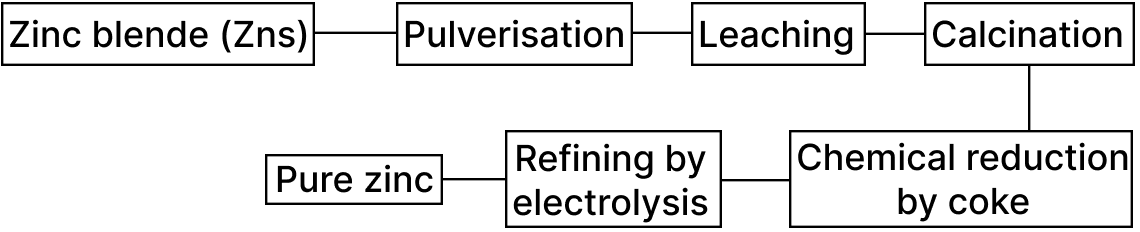
The following flow chart shows the process of extraction of zinc. Out of the 5 steps, 2 steps are incorrect. Identify and correct them.
Show SolutionHide Solution↓
Step
Process in Chart
Status
Correct Process
1
Pulverisation
Correct
Pulverisation
2
Leaching
Incorrect
Froth Floatation
3
Calcination
Incorrect
Roasting
4
Reduction by Coke
Correct
Reduction by Coke
5
Refining by Electrolysis
Correct
Refining by Electrolysis
1st Incorrect Step: Leaching Correction: Froth Floatation Reason: Zinc blende is a sulphide ore. Sulphide ores are preferentially wetted by oil and are concentrated using the Froth Floatation process rather than leaching.
2nd Incorrect Step: Calcination Correction: Roasting Reason: Calcination is used for carbonate ores (heating in the absence of air). Since Zinc blende is a sulphide ore, it must be heated strongly in the presence of excess air to convert it into zinc oxide (ZnO). This process is called Roasting.
14Exercise 7B
State why aluminium is extracted from it's oxide by electrolysis while copper, lead, iron by reducing agents and mercury and silver by thermal decomposition.
Show SolutionHide Solution↓
Oxides of highly active metals like potassium, sodium, calcium, magnesium and aluminium have great affinity towards oxygen and so cannot be reduced by common reducing agents like carbon, carbon monoxide or hydrogen.
They are obtained by electrolytic reduction of fused metallic salts (halides and oxides) using inert electrodes.
The metals in the middle of the activity series such as iron, lead, copper, etc., are moderately reactive and are found as sulphides or carbonates in nature. They are obtained by the reduction of their oxides with carbon, carbon monoxide and hydrogen.
Mercury and silver are very less reactive, placed in the end of the reactivity series. The oxides of these metals are reduced to metals by heating alone.
15Exercise 7B
How are the metals like sodium, potassium and calcium obtained. Give equations.
Show SolutionHide Solution↓
Oxides of highly active metals like sodium, potassium and calcium are obtained by electrolytic reduction of fused metallic salts (halides and oxides) using inert electrodes.
Sodium
Electrolyte : Fused sodium chloride
Reaction : NaCl ⇌ Na+ + Cl-
Reaction at cathode : Na+ + e- ⟶ Na
Reaction at anode : Cl- - e- ⟶ Cl
Cl + Cl ⟶ Cl2
Potassium
Electrolyte : Fused potassium bromide
Reaction : KBr ⇌ K+ + Br-
Reaction at cathode : K+ + e- ⟶ K
Reaction at anode : Br- - e- ⟶ Br
Br + Br ⟶ Br2
Calcium
Electrolyte : Fused calcium chloride
Reaction : CaCl2 ⇌ Ca2+ + 2Cl-
Reaction at cathode : Ca2+ + 2e- ⟶ Ca
Reaction at anode : Cl- - e- ⟶ Cl
Cl + Cl ⟶ Cl2
16Exercise 7B
(a) On which factors does purification of metals depend?
(b) Name the methods used for purification.
(c) With a labelled diagram explain electro-refining of a particular metal.
Show SolutionHide Solution↓
(a) Purification of metal depends on:
nature of metal
nature of impurities present in the metal and
purpose for which the metal is to be used.
(b) Methods used for purification are :
Distillation
Liquation
Electro refining
(c) The below labelled diagram shows the electro-refining of a particular metal:
An electrolytic cell is used in electro-refining to refine impure metal using electrical energy to drive a chemical reaction. The cell consists of an electrolyte, two conducting electrodes (cathode and anode) in a non-conducting vessel. The impure metal is made the anode, and a thin sheet of pure metal is the cathode. The electrolyte is a salt solution of the metal to be refined, with a small amount of sulphuric acid added to increase conductivity. On passing electric current, metal ions are reduced to metal at the cathode. Equivalent mass of anode dissolves from the anode and goes into the solution as metal ions.
At anode: M - ne- ⟶ Mn+
At cathode: Mn+ + ne- ⟶ M [M is a metal]
Pure metal deposits at cathode while impurities settle down and form anode mud.
1Exercise 7C
State the position of aluminium in the periodic table.
Show SolutionHide Solution↓
Aluminum — Period 3, Group 13 (III A).
2Exercise 7C
(a) Give the chemical names and formulae of the main ores of
(i) aluminium,
(ii) iron and
(iii) zinc.
(b) Which impurities are present in bauxite?
(c) What is red mud, how is it removed?
Show SolutionHide Solution↓
(i) Ores of aluminium :
Name
Chemical name
Formula
Bauxite
Hydrated aluminium oxide
Al2O3.2H2O
Cryolite
Sodium aluminium flouride
Na3AlF6
(ii) Ores of iron:
Name
Chemical name
Formula
Red haematite
Anhydrous ferric oxide
Fe2O3
Brown haematite
Hydrated ferric oxide
2Fe2O3.3H2O
(iii) zinc
Name
Chemical name
Formula
Zinc Blende
Zinc sulphide
ZnS
Calamine
Zinc Carbonate
ZnCO3
(b) Bauxite contains 60% aluminium oxide, the rest being sand, ferric oxide and titanium oxide.
(c) Finely grinded Bauxite is heated under pressure with caustic soda. Bauxite dissolves and forms sodium meta aluminate, leaving behind insoluble impurities called red mud. It consists of ferric oxide, sand etc. which are removed by filtration.
3Exercise 7C
Distinguish between electrolytic methods of reduction and refining.
Show SolutionHide Solution↓
Electrolytic reduction
Electrolytic refining
Metals higher in the activity series like potassium and sodium cannot be reduced by common reducing agents like CO or C, hence, these metals are obtained by electrolytic reduction of fused metallic salts.
It is the method by which crude metal is purified.
Cathode is usually made of iron and anode of graphite.
Impure metal is made the anode while pure metal is the cathode.
It precedes electrolytic refining.
It is done after electrolytic reduction.
4Exercise 7C
Give three ways in which the metal zinc differs from the non-metal carbon. At least one of the differences must be a chemical difference.
Show SolutionHide Solution↓
Zinc
Carbon
Zinc is a metal.
Carbon is a non-metal.
Zinc forms electrovalent bonds.
Carbon forms covalent bonds.
Zinc has a relatively low melting point of 419.5°C.
Carbon has a high melting point of 3500°C.
5Exercise 7C
(a) Aluminium is a more active metal than iron but suffers less corrosion. Why?
(b) Explain and give reasons why aluminium vessels should not be cleaned with powders containing alkalis.
Show SolutionHide Solution↓
(a) Aluminum forms a thin, protective layer of aluminium oxide (Al2O3) on its surface that prevents further oxidation and corrosion. The oxide layer acts as a barrier that protects the metal underneath from being exposed to the elements, thus minimizing corrosion.
(b) Aluminium vessels should not be cleaned with powders containing alkalis because alkalis are water soluble and aluminum metal will react with alkalis to form sodium meta aluminate that can be toxic to our health.
2Al + 2NaOH + 2H2O ⟶ 2NaAlO2 + 3H2
6aExercise 7C
Explain with reasons:
In the electrolytic reduction of alumina, the graphite anode is gradually consumed.
or
Why the anode has to be replaced from time to time in this process?
Show SolutionHide Solution↓
In the electrolytic reduction of alumina, the graphite (anode) is oxidized by oxygen to CO and further forms CO2, so it is consumed and has to be replaced from time to time.
Equation:
2C + O2 ⟶ 2CO
2CO + O2 ⟶ 2CO2
6bExercise 7C
Explain with reasons:
Roasting is carried out on sulphide ores and not on carbonates ores.
Show SolutionHide Solution↓
Roasting is done in presence of air and provides oxygen to metal sulphides, which is required to convert them to metallic oxide and SO2. Whereas, carbonate is changed to oxide by loss of CO2, which occurs in the absence of air and when heated to a high temperature. Hence, roasting is not done on carbonates.
6cExercise 7C
Explain with reasons:
Carbon can reduce lead oxide but not aluminium oxide.
Show SolutionHide Solution↓
Oxides of highly active metals like sodium, potassium, aluminium have great affinity for oxygen and so cannot be reduced by common reducing agents like carbon, carbon monoxide or hydrogen whereas lead is in the middle of activity series and is moderately active. So carbon can reduce lead oxide easily.
6dExercise 7C
Explain with reasons:
Electrolytic reduction is done to obtain aluminium.
Show SolutionHide Solution↓
Oxides of highly active metals like potassium, sodium, calcium, magnesium and aluminium have great affinity for oxygen and so cannot be reduced by common reducing agents like carbon, carbon monoxide or hydrogen.
They are obtained by electrolytic reduction of fused metallic salts (halides and oxides) using inert electrodes.
6eExercise 7C
Explain with reasons:
Why 'the food containing iron salts' should not be cooked in aluminium utensils?
Show SolutionHide Solution↓
As aluminium is above iron in the metal reactivity series hence, it can displace iron from iron salts. Therefore, food containing iron salts should not be cooked in aluminium utensils.
6fExercise 7C
Explain with reasons:
A neutral gas other than oxygen is formed at the anode during electrolysis of fused alumina.
Show SolutionHide Solution↓
The oxygen gas produced at anode reacts with carbon electrode, which further produces carbon monoxide, a neutral gas.
2C + O2 ⟶ 2CO
6gExercise 7C
Explain with reasons:
Why is powdered coke sprinkled on top of the electrolyte?
Show SolutionHide Solution↓
The layer of powdered coke is sprinkled on top of the electrolyte as :
it prevents the burning of anode.
it reduces heat loss by radiation.
7Exercise 7C
For each substance listed below, explain it's significance in the extraction of aluminium:
(a) Bauxite
(b) Sodium hydroxide
(c) Cryolite
(d) Graphite
Show SolutionHide Solution↓
(a) Bauxite — Main ore from which aluminium is extracted. It contains 60% Al2O3
(b) Sodium hydroxide — Sodium hydroxide is used in the purification of bauxite ore by converting it into alumina. It acts as an effective solvent for the aluminum oxide in bauxite and helps to remove impurities like ferric oxide, sand, etc. which are collectively called as red mud.
(c) Cryolite — Lowers the fusion temperature from 2050°C to 950°C. and enhances conductivity.
(d) Graphite — Thick Graphite rods attached to copper clamps dipping into fused electrolyte are used as anode.
8Exercise 7C
In order to obtain 1 tonne of aluminium, the following inputs are required: 4 tonnes of bauxite, 150 kg of sodium hydroxide and 600 kg of graphite. The aluminium compound in bauxite is aluminium oxide and the main impurity is iron (III) oxide. Aluminium is obtained by the electrolysis of aluminium oxide dissolved in cryolite.
(a) When bauxite is treated with sodium hydroxide solution, what happens to
(i) the aluminium oxide
(ii) the iron (III) oxide
(b) (i) Name the process used for the purification of bauxite.
(ii) Write the equation for the action of heat on aluminium hydroxide.
(c) (i) Write the formula of cryolite.
(ii) Write down the word which correctly completes the following sentence:
By dissolving aluminium oxide in cryolite a ............... (conducting/non-conducting) solution is produced.
(iii) Why is so much graphite required for the electrolytic process?
(iv) Write the equation for the reaction which takes place at the cathode
(v) What is the cathode made up of?
Show SolutionHide Solution↓
(a) Aluminium oxide dissolves and forms sodium meta aluminate. Iron (III) oxide is left behind as red mud and is removed by filtration.
Al2O3.2H2O + 2NaOH ⟶ 2NaAlO2 + 3H2O
(b) (i) Bayer's process
(ii) The equation for the action of heat on aluminium hydroxide is:
(ii) By dissolving aluminium oxide in cryolite, a conducting solution is produced.
(iii) Thick Graphite rods attached to copper clamps dipping into fused electrolyte are used as anode. The graphite (anode) is oxidized by oxygen to CO and further forms CO2, so it is consumed and has to be replaced from time to time. Hence, large amount of graphite is required. Equation: 2C + O2 ⟶ 2CO 2CO + O2 ⟶ 2CO2
(iv) Reaction at the cathode: 4Al3+ + 12e- ⟶ 4Al
(v) Inner carbon lining of the electrolytic cell
9Exercise 7C
Aluminium is extracted from it's chief ore, bauxite. The ore is first purified and then the metal is extracted from it by electrolytic reduction.
(a) Name a chemical used for dissolving aluminium oxide. In which state is the chemical used?
(b) State the reason for addition of caustic alkali to bauxite ore during the purification of bauxite.
(c) Write three balanced equations for the purification of bauxite.
(d) Write an equation for the reaction which takes place at the anode during the extraction of aluminium by the electrolytic process.
Show SolutionHide Solution↓
(a) The chemical used for dissolving aluminium oxide is cryolite. It is used in molten state.
(b) Reason for addition of caustic alkali:
During the Baeyer's Process, bauxite is treated with concentrated Caustic Soda (NaOH) to selectively dissolve the aluminium oxide. Aluminium oxide is amphoteric and reacts with the alkali to form soluble sodium aluminate. The major impurities in the ore (like ferric oxide and silica) remain insoluble and can be filtered out as "red mud."
(c) The three balanced equations for the purification of bauxite are:
With respect to the Hall Heroult process, justify the following:
(a) Powdered coke is sprinkled over the electrolytic mixture undergoing electrolytic reduction.
(b) Graphite anodes are continuously replaced during the electrolysis.
(c) Cryolite and fluorspar must be added to the electrolytic mixture.
(d) Along with cryolite and alumina, another substance is added to the electrolyte mixture. Name the substance and give one reason for the addition.
Show SolutionHide Solution↓
(a) The layer of powdered coke is sprinkled over the electrolytic mixture as:
It prevents burning of carbon electrodes in air at the emergence point from the bath.
It minimizes or prevents heat loss by radiation.
(b) The graphite anodes are continuously replaced during the electrolysis because:
The oxygen evolved at the anode escapes as a gas or reacts with the carbon anode.
The carbon anode is thus oxidized to carbon monoxide which either burns giving carbon dioxide or escapes out through an outlet. 2C + O2 ⟶ 2CO 2CO + O2 ⟶ 2CO2
(c) Cryolite and fluorspar are added to the electrolytic mixture because their addition:
lowers the fusion point of the mixture i.e., mixture fuses around 950°C instead of 2050°C.
enhances the mobility of the fused mixture by acting as a solvent for the electrolytic mixture.
enhances the conductivity of the mixture since, pure alumina is almost a non-conductor of electricity.
(d) Fluorspar (CaF2) is the additional substance added because it acts as a solvent and increases the fluidity of the electrolytic bath so the molten aluminium can settle at the bottom more easily.
1Exercise 7D
Explain the following:
(a) Zinc is used to cover iron so as to prevent rusting of iron. Why?
(b) In construction work, why is the alloy of aluminium–duralumin used rather than pure aluminium?
Show SolutionHide Solution↓
(a) As zinc is more reactive than iron, hence it forms a dense and impermeable layer of zinc oxide over iron which protects the iron beneath from rusting.
(b) As duralumin has strength up to six times greater than pure aluminium hence, alloy of aluminium–duralumin is used rather than pure aluminium in construction work.
2Exercise 7D
What is an alloy? How do the properties of an alloy differ from its constituents?
Show SolutionHide Solution↓
An alloy is a homogeneous mixture of two or more metals or of one or more metals with certain non-metallic elements.
The properties of alloys are often greatly different from those of the components.
Gold is too soft to be used without a small percentage of copper.
The corrosion and oxidation resistance of steel is markedly increased by adding 15 to 18% of chromium and often a few percent of nickle (stainless steel).
The presence of carbon up to 1.5% greatly affects the properties of steel.
A low percentage of molybdenum improves the toughness and wear resistance of steel.
Alloys are made to change the property of their major constituent to achieve a specific objective.
3Exercise 7D
Both Brass and bronze contain copper as major constituents. Name other elements in these alloys.
Show SolutionHide Solution↓
The other element in Brass is Zinc
The other elements in Bronze are Tin and Zinc.
4Exercise 7D
Name an alloy of:
(a) Aluminium used in aircraft construction.
(b) Lead used in electrical wiring or electrical work in joining metals.
(c) Copper in electrical appliances or household vessels.
(d) Zinc used in naval ships.
Show SolutionHide Solution↓
(a) Aircraft construction — Duralumin
(b) Electrical wiring or electrical work in joining metals — Solder or fuse metal
What is an amalgam? State its use with an example.
Show SolutionHide Solution↓
Amalgam is a mixture or an alloy of mercury with a number of metals or alloys such as sodium, zinc, gold, and silver, as well as some non-metals.
For example, Dental amalgam is a mixture of mercury and a silver-tin alloy. It is often used in dentistry as a filling material for cavities in teeth. The mercury acts as a binding agent that holds the other metals together to form a solid, durable material.
6Exercise 7D
(a) State two properties of brass that render it more useful for some purposes than it's components.
(b) Name a metal which forms a liquid alloy at ordinary temperature.
Show SolutionHide Solution↓
(a) Two properties of brass are:
Hardness and tensile strength — Brass is stronger than its components, Copper and Zinc.
Corrosion resistance — Brass has good corrosion resistance due to the presence of zinc in its composition.
(b) Sodium.
7Exercise 7D
Name the constituents of:
(a) Duralumin
(b) Solder
(c) Bronze
(d) Brass
Show SolutionHide Solution↓
(a) Aluminium (95%), copper (4%), magnesium (0.5%) and manganese (0.5%).
(b) Lead (50%) and tin (50%).
(c) Copper (80%), tin (18%) and zinc (2%).
(d) Copper (60-70%) and zinc (40-30%)
8Exercise 7D
Name the following:
(a) A metal which is liquid at room temperature.
(b) A metal which is always present in the amalgam.
(c) The process of heating an ore to a high temperature in the presence of air.
(d) The compound formed by the reaction between calcium oxide and silica.
(e) A compound which is added to lower the fusion temperature of the electrolytic bath in the extraction of aluminium
(f) Name an allotrope of a non-metal that allows electricity to pass through it.
A fuse wire (alloy of tin and lead) is a safety device for electronic gadgets. Can copper replace tin in this alloy?
Show SolutionHide Solution↓
No. Tin is used because it lowers the melting point of the lead–tin alloy, so the fuse melts quickly when excess current flows and breaks the circuit. Copper has a much higher melting point, so a lead–copper alloy would not melt easily and would not act as an effective fuse.
11Exercise 7D
Duralumin is used rather than pure aluminium in construction work. Why?
Show SolutionHide Solution↓
Duralumin is used rather than pure aluminium in construction work due to the following reasons:
Duralumin is light and strong, while aluminium is light and weak. It is also unaffected by moist air. Duralumin has a strength up to six times greater than pure aluminium.
It is corrosion-resistant and has high tensile strength.
12Exercise 7D
Using the information in the table below, complete the following :
(a) ............... is the metallic element.
(b) Metal atoms tend to have a maximum of ............... electrons in the outermost energy level.
(c) Non-metallic elements tend to form ............... oxides while metals tend to form ............... oxides.
(d) Non-metallic elements tend to be ............... conductors of heat and electricity.
(e) Metals tend to ............... electrons and act as ............... agents in their reactions with elements and compounds.
X
Y
Normal electronic configuration
2, 8, 7
2, 8, 2
Nature of oxide
Dissolves in water and turns blue litmus red
Very low solubility in water. Dissolves in hydrochloric acid
Tendency for oxidizing and reducing reactions
Tends to oxidise elements and compounds
Tends to act as a reducing agent
Electrical and thermal conductivity
Very poor electrical conductor and poor thermal conductivity
Good electrical conductor and good thermal conductor
Tendency to form alloys and amalgams
No tendency to form alloys
Forms alloys
Show SolutionHide Solution↓
(a) Y is the metallic element.
(b) Metal atoms tend to have a maximum of three electrons in the outermost energy level.
(c) Non-metallic elements tend to form acidic oxides while metals tend to form basic oxides.
(d) Non-metallic elements tend to be poor conductors of heat and electricity.
(e) Metals tend to lose electrons and act as reducing agents in their reactions with elements and compounds.
11 Mark · Miscellaneous Exercises — Multiple Choice Type
The main ore used for the extraction of iron is:
(a)Haematite
(b)Calamine
(c)Bauxite
(d)Cryolite
Show SolutionHide Solution↓
Haematite
Reason — Iron is mainly extracted from its chief ore haematite (Fe2O3)
21 Mark · Miscellaneous Exercises — Multiple Choice Type
Heating an ore in a limited supply of air or in the absence of air at a temperature just below its melting point is known as :
(a)Smelting
(b)Ore dressing
(c)Calcination
(d)Bessemerisation
Show SolutionHide Solution↓
Calcination
Reason — When an ore is a carbonate or a hydrated oxide, it is heated in the absence of air (or air might be supplied in a limited quantity) to a temperature that is high but insufficient to melt the ore. The process is known as Calcination.
31 Mark · Miscellaneous Exercises — Multiple Choice Type
The compound that is not an ore of aluminium is:
(a)Cryolite
(b)Corundum
(c)Fluorspar
(d)Bauxite
Show SolutionHide Solution↓
Fluorspar
Reason — Fluorspar, also known as fluorite, is a mineral form of calcium fluoride which acts as a solvent along with cryolite, for the electrolytic mixture. Whereas, Bauxite, Corundum and cryolite are the ores of aluminium.
41 Mark · Miscellaneous Exercises — Multiple Choice Type
Fused alumina is reduced to aluminium by electrolytic reduction, since:
(a)alumina is highly stable.
(b)alumina is least stable.
(c)alumina is not reduced by drying agents.
(d)alumina is not reduced by reducing agents.
Show SolutionHide Solution↓
alumina is not reduced by reducing agents.
Reason — Electrolytic reduction is chosen as the method for reducing alumina. Since, aluminium oxide due to its great affinity for oxygen is a very stable compound. It is not reduced easily by common reducing agents like carbon, carbon monoxide or hydrogen.
51 Mark · Miscellaneous Exercises — Multiple Choice Type
The chemical name of the principal ore of aluminium is:
(a)sodium aluminium fluoride
(b)aluminium oxide
(c)hydrated aluminium fluoride
(d)hydrated aluminium oxide
Show SolutionHide Solution↓
hydrated aluminium oxide
Reason — Main ore of aluminium is bauxite (Al2O3.2H2O) and its chemical name is hydrated aluminium oxide
61 Mark · Miscellaneous Exercises — Multiple Choice Type
Brass is an alloy of
(a)Copper and tin
(b)Copper and zinc
(c)Zinc and lead
(d)Lead and tin
Show SolutionHide Solution↓
Copper and zinc
Reason — Brass is an alloy of Copper and zinc. Brass is stronger than its components.
71 Mark · Miscellaneous Exercises — Multiple Choice Type
Steel is an alloy of iron and:
(a)Nickel
(b)Zinc
(c)Carbon
(d)Aluminium
Show SolutionHide Solution↓
Carbon
Reason — Steel is an alloy of iron, chromium, nickle and carbon. it is made to increase the strength of iron.
81 Mark · Miscellaneous Exercises — Multiple Choice Type
The reason for using aluminium in the alloy duralumin is
(a)Aluminium is brittle.
(b)Aluminium gives strength.
(c)Aluminium brings lightness.
(d)Aluminium lowers melting point.
Show SolutionHide Solution↓
Aluminium brings lightness.
Reason — Aluminium is used in duralumin along with copper because it imparts lightness.
91 Mark · Miscellaneous Exercises — Multiple Choice Type
Duralumin is an alloy with composition:
P — Al and Mg
Q — Al, Cu and Mg
R — Al and Mn
(a)Only P
(b)Only Q
(c)Both P and R
(d)Only R
Show SolutionHide Solution↓
Only Q
Reason — Duralumin ia an alloy with composition of Aluminium (95%), Copper (4%) and Magnesium (0.5%).
101 Mark · Miscellaneous Exercises — Multiple Choice Type
Assertion (A): Hydrogen is a non-metal and can even form positive ions.
Reason (R): Metals are defined as the elements which form positive ions by the loss of electrons.
(a)Both A and R are true and R is the correct explanation of A.
(b)Both A and R are true but R is not the correct explanation of A.
(c)A is true but R is false.
(d)A is false but R is true.
Show SolutionHide Solution↓
Both A and R are true but R is not the correct explanation of A.
Explanation — Hydrogen is a non-metal which also forms positive ions by losing its electron like metals. Hence, assertion (A) is true. Metals are defined as the elements which form positive ions by the loss of electrons. Hence, reason (R) is true.
However, reason (R) does not explain how hydrogen form positive ion. Hence, reason (R) is not correct explanation of assertion (A).
111 Mark · Miscellaneous Exercises — Multiple Choice Type
Assertion (A): Sodium and potassium are reactive elements.
Reason (R): Sodium and potassium occur in free states
(a)Both A and R are true and R is the correct explanation of A.
(b)Both A and R are true but R is not the correct explanation of A.
(c)A is true but R is false.
(d)A is false but R is true.
Show SolutionHide Solution↓
A is true but R is false.
Explanation — Sodium and potassium are highly reactive in nature. Hence, assertion (A) is true. Sodium and potassium are so reactive. So, they do not occur in free states. They quickly combine with other elements. Hence reason (R) is false.
121 Mark · Miscellaneous Exercises — Multiple Choice Type
Assertion (A): Minerals are the substances from which metals can be extracted profitably.
Reason (R): Ores are those minerals from which metals are extracted commercially and profitably.
(a)Both A and R are true and R is the correct explanation of A.
(b)Both A and R are true but R is not the correct explanation of A.
(c)A is true but R is false.
(d)A is false but R is true.
Show SolutionHide Solution↓
A is false but R is true.
Explanation — Minerals are the naturally occurring compounds of metals. But not every mineral can be used to extract metals profitably. Hence assertion (A) is false. Ores are those minerals from which metals are extracted commercially at a comparatively lower cost and with minimum effort. Hence reason (R) is true.
131 Mark · Miscellaneous Exercises — Multiple Choice Type
Assertion (A): Aluminium is extracted from its ore bauxite.
Reason (R): Bauxite is the only ore of aluminium.
(a)Both A and R are true and R is the correct explanation of A.
(b)Both A and R are true but R is not the correct explanation of A.
(c)A is true but R is false.
(d)A is false but R is true.
Show SolutionHide Solution↓
A is true but R is false.
Explanation — Main ore of aluminium is bauxite (Al2O3.2H2O). Hence, assertion (A) is true. Bauxite is not the only ore of aluminium. Aluminium can be extracted from other ores like cryolite and corundum. Hence reason (R) is false.
141 Mark · Miscellaneous Exercises — Multiple Choice Type
Assertion (A): Metallurgy deals with the production and purification of metals.
Reason (R): Reduction is one of the methods of extraction of metals.
(a)Both A and R are true and R is the correct explanation of A.
(b)Both A and R are true but R is not the correct explanation of A.
(c)A is true but R is false.
(d)A is false but R is true.
Show SolutionHide Solution↓
Both A and R are true but R is not the correct explanation of A.
Explanation — Metallurgy deals with the production and purification of metals and manufacture of alloys. Hence, assertion (A) is true. They are many different methods of concentration or purification of an ore and reduction is one of the methods of extraction of metals. Hence, reason (R) is true.
But reason (R) doesn't explain why it is important to purify and produce the pure metal from the process of metallurgy. Hence, reason (R) is not correct explanation of assertion (A).
151 Mark · Miscellaneous Exercises — Multiple Choice Type
Assertion (A): The concentration of aluminium is not done by leaching process.
Reason (R): In leaching process, the ore is dissolved in an acid or alkali
(a)Both A and R are true and R is the correct explanation of A.
(b)Both A and R are true but R is not the correct explanation of A.
(c)A is true but R is false.
(d)A is false but R is true.
Show SolutionHide Solution↓
A is false but R is true.
Explanation — The leaching method is used for the concentration of metals like aluminium, silver and gold. Hence, assertion (A) is false. The ore is treated with a suitable reagent like acid, base or some other reagent, such that the ore is soluble in it but the impurities are not. The impurities are removed by filtration. Hence, reason (R) is true.
161 Mark · Miscellaneous Exercises — Multiple Choice Type
Assertion (A): Bayer's process is used in the extraction of aluminium from its main ore.
Reason (R): Bayer's process is done for the refinement of aluminium.
(a)Both A and R are true and R is the correct explanation of A.
(b)Both A and R are true but R is not the correct explanation of A.
(c)A is true but R is false.
(d)A is false but R is true.
Show SolutionHide Solution↓
A is true but R is false.
Explanation — Bayer's process is used for the purification of bauxite ore. Where, bauxite is converted into alumina. Which is reduced to aluminium using electrolytic reduction. Hence, assertion (A) is true. Refining of aluminium is done by hoope's electrolytic process not bayer's process. Hence, reason (R) is false.
171 Mark · Miscellaneous Exercises — Multiple Choice Type
Assertion (A): Reactive metals like calcium, magnesium cannot be obtained by reduction.
Reason (R): Reactive metals have a great affinity towards oxygen
(a)Both A and R are true and R is the correct explanation of A.
(b)Both A and R are true but R is not the correct explanation of A.
(c)A is true but R is false.
(d)A is false but R is true.
Show SolutionHide Solution↓
Both A and R are true and R is the correct explanation of A.
Explanation — Highly reactive metals like calcium, magnesium have great affinity towards oxygen and so cannot be reduced by common reducing agents like coke (carbon), carbon monoxide or hydrogen. Such metals are obtained by electrolytic reduction. Hence, both assertion (A) and reason (R) are true and reason (R) is the correct explanation of assertion (A).
181 Mark · Miscellaneous Exercises — Multiple Choice Type
Assertion (A): Aluminium is obtained from its oxide by electrolysis (Hall-Heroult process).
Reason (R): Aluminium is generally not found in the form of aluminium oxide.
(a)Both A and R are true and R is the correct explanation of A.
(b)Both A and R are true but R is not the correct explanation of A.
(c)A is true but R is false.
(d)A is false but R is true.
Show SolutionHide Solution↓
A is true but R is false.
Explanation — Since aluminium is very reactive, it exists in nature as stable oxide (Al2O3). To extract aluminium from this stable compound, simple heating or chemical reduction is not sufficient. Therefore, electrolysis of molten alumina is used in the Hall–Héroult process. Hence, assertion (A) is true. Aluminium is actually most commonly found in nature in the form of aluminium oxide (Al2O3), primarily within its main ore, Bauxite. Hence, reason (R) is false.
191 Mark · Miscellaneous Exercises — Multiple Choice Type
Assertion (A): For electrical heating devices like electric iron and heater, alloys are used.
Reason (R): Alloys have a greater resistance and low melting point.
(a)Both A and R are true and R is the correct explanation of A.
(b)Both A and R are true but R is not the correct explanation of A.
(c)A is true but R is false.
(d)A is false but R is true.
Show SolutionHide Solution↓
Both A and R are true but R is not the correct explanation of A.
Explanation — Alloys are used for heating devices like electric iron and heater because of its high resistance to electricity. Hence, assertion (A) is true. Generally alloys have great resistance to electricity. Thus, they can produce more heat and alloys also have lower melting point than its individual component. Hence, reason (R) is true.
However, in case of electrical iron and heater, alloys have high melting point to withstand the heat, Hence, reason (R) is not correct explanation of assertion (A).
201 Mark · Miscellaneous Exercises — Multiple Choice Type
Assertion (A): Bronze is used in making medals, statues, etc.
Reason (R): Bronze is hard and easily cast.
(a)Both A and R are true and R is the correct explanation of A.
(b)Both A and R are true but R is not the correct explanation of A.
(c)A is true but R is false.
(d)A is false but R is true.
Show SolutionHide Solution↓
Both A and R are true and R is the correct explanation of A.
Explanation — Bronze is composed of copper (80%), tin (18%) and zinc (2%). It is used in making medals, statues, utensils, etc. Hence, assertion (A) is true. Bronze is used in making of medals, statues, utensils, bearing and coins because of its hardness and it can be casted easily. Hence, reason (R) is true and it is the correct explanation of assertion (A).
1Miscellaneous Exercises — Very Short Answer…
Fill in the blanks :
(a) During the concentration of bauxite ore, aluminium goes in ............... (soluble/insoluble) part because of its ............... (acidic/basic/amphoteric) nature.
(b) In Hoope's process, pure aluminium is collected at the ............... (top/bottom) of the electrolytic cell.
(c) Usually ............... (sulphide/carbonate) ores are subjected to ............... (calcination/roasting) which is done in the absence of air
(d) Zinc blende is converted to oxide by ............... (roasting/calcination) process.
(e) Froth floatation process is generally used to concentrate ............... ores (sulphides/carbonate)
Show SolutionHide Solution↓
(a) During the concentration of bauxite ore, aluminium goes in soluble part because of it's amphoteric nature.
(b) In Hoope's process, pure aluminium is collected at the top of the electrolytic cell.
(c) Usually carbonate ores are subjected to calcination which is done in the absence of air
(d) Zinc blende is converted to oxide by roasting process.
(e) Froth floatation process is generally used to concentrate sulphides ores.
2Miscellaneous Exercises — Very Short Answer…
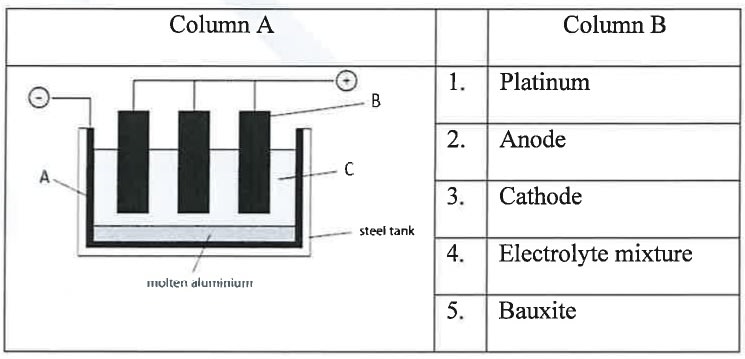
Given below in column A is a schematic diagram of the electrolytic reduction of alumina. Identify the parts labelled as A, B and C with the correct options from the column B.
Show SolutionHide Solution↓
From the above table:
A ⟶ 3. Cathode B ⟶ 2. Anode C ⟶ 4. Electrolytic mixture
3Miscellaneous Exercises — Very Short Answer…
Name the following:
(a) A metal which is found abundantly in the Earth's crust.
(b) The process used for the enrichment of sulphide ore.
(c) A metal present in cryolite other than sodium.
(d) A metal which is unaffected by dilute or concentrated acids.
(e) A metal present in period 3, group 1 of the periodic table.
(f) The property possessed by metals by which they can be beaten into sheets.
(g) A compound added to lower the fusion temperature of electrolytic bath in the extraction of aluminium.
(h) The ore of zinc containing its sulphide.
(i) The solution used to react with Bauxite as a first step in obtaining pure aluminium oxide, in the Baeyer's process.
(j) The compound added to pure alumina to lower the fusion temperature during the electrolytic reduction of alumina.
Show SolutionHide Solution↓
(a) Aluminium
(b) Froth floatation process
(c) Aluminium
(d) Gold
(e) Sodium
(f) Malleability
(g) Cryolite (Na3AlF6)
(h) Zinc Blende (ZnS).
(i) Sodium hydroxide
(j) Cryolite (Na3AlF6)
4Miscellaneous Exercises — Very Short Answer…
Choose the most appropriate answer from the following list of oxides which fit the description. Each answer may be used only once: [SO2, SiO2, Al2O3, MgO, CO, Na2O]
(a) A basic oxide
(b) An oxide which dissolves in water forming an acid
(c) An amphoteric oxide.
(d) A covalent oxide of a metalloid
Show SolutionHide Solution↓
(a) Na2O
(b) SO2
(c) Al2O3
(d) SiO2
1Miscellaneous Exercises — Short Answer Type
State the main components of the following alloys :
(a) Brass
(b) Duralumin
(c) Bronze.
Show SolutionHide Solution↓
(a) Brass — Cu [60-80%], Zn [40-20%]
(b) Duralumin — Al [95%], Mg [0.5%], Mn [0.5%], Cu [4%]
(c) Bronze — Cu [80%], Zn [1%], Sn [19%]
2Miscellaneous Exercises — Short Answer Type
For each of the substances listed below, describe the role played in the extraction of aluminium
(a) Cryolite
(b) Sodium hydroxide
(c) Graphite
Show SolutionHide Solution↓
(a) Addition of Cryolite :
Lowers the fusion point of the mixture i.e., mixture fuses around 950°C instead of 2050°C.
Enhances the mobility of the fused mixture by acting as a solvent for the electrolytic mixture.
Enhances the conductivity of the mixture since, pure alumina is almost a non-conductor of electricity.
(b) Sodium hydroxide is added to bauxite ore during purification of bauxite. Bauxite is reacted with a conc. solution of NaOH under pressure for 2 hrs as a first step in obtaining Al2O3. The impurities present in bauxite mainly Fe2O3 and SiO2 remain unaffected with conc. NaOH as impurities are not amphoteric. Bauxite, being amphoteric reacts with the base forming sodium salt [sodium aluminate] and water. Hence, impurities are separated out.
(c) Thick Graphite rods attached to copper clamps dipping into fused electrolyte are used as anode.
3Miscellaneous Exercises — Short Answer Type
Write the chemical formulae of one main ore of iron and aluminium.
Show SolutionHide Solution↓
Chemical formulae of main ores of iron and aluminium are:
Name
Chemical name
Formula
Ore of iron
Haematite
Ferric oxide
Fe2O3
Ore of aluminium
Bauxite
Hydrated aluminium oxide
Al2O3.2H2O
4Miscellaneous Exercises — Short Answer Type
State the property of the metal being utilised in the following:
Use of metal
Property
Zinc in galvanisation
Aluminium in thermite welding
Show SolutionHide Solution↓
Use of metal
Property
Zinc in galvanisation
It oxidises more readily than iron, thus preventing the rusting of iron
Aluminium in thermite welding
It is a good reducing agent.
5Miscellaneous Exercises — Short Answer Type
Write the constituents of the electrolyte for the extraction of aluminium.
Show SolutionHide Solution↓
It is a mixture of molten alumina (Al2O3) 20%, cryolite (Na3AlF6) 60% and fluorspar (CaF2) 20%.
6Miscellaneous Exercises — Short Answer Type
Write the equation for the reaction where the aluminium oxide for the electrolytic extraction of aluminium is obtained by heating aluminium hydroxide.
Show SolutionHide Solution↓
Conversion of Al(OH)3 - to pure alumina - heat on Al(OH)3
Write the equation for the reaction that occurs at the cathode during the extraction of aluminium by electrolysis.
Show SolutionHide Solution↓
2Al3+ + 6e- ⟶ 2Al
8Miscellaneous Exercises — Short Answer Type
Explain why it is preferable to use a number of graphite electrodes as anode instead of a single electrode, during the extraction of aluminium.
Show SolutionHide Solution↓
The oxygen evolved at the anode escapes as a gas or reacts with the carbon anode. The carbon anode is thus oxidized to carbon monoxide which either burns giving carbon dioxide or escapes out through an outlet. [2C + O2 ⟶ 2CO; 2CO + O2 ⟶ 2CO2] The carbon anode is hence consumed and renewed periodically after a certain period of usage. It is therefore preferable to use a number of graphite electrodes as anode instead of a single electrode.
1Miscellaneous Exercises — Long Answer Type
The following is an extract from 'Metals in the Service of man, Alexander and street/Pelican 1976'.
'Alumina (aluminium oxide) has a very high melting point of over 2000°C so that it cannot readily be liquefied. However, conversion of alumina to aluminium and oxygen, by electrolysis, can occur when it is dissolved in some other substance'.
(a) Which solution is used to react with bauxite as a first step in obtaining pure aluminium oxide?
(b) The aluminium oxide for the electrolytic extraction of aluminium is obtained by heating aluminium hydroxide. Write the equation for this reaction.
(c) Name the element which serves both as the anode and the cathode in the extraction of aluminium.
(d) Write the equation for the reaction that occurs at the cathode during the extraction of aluminium by electrolysis.
(e) Give the equation for the reaction which occurs at the anode when aluminium is purified by electrolysis.
Show SolutionHide Solution↓
(a) Sodium hydroxide
(b) The equation for the action of heat on aluminium hydroxide is:
(c) The element is Carbon. As carbon lining acts as cathode and graphite acts as anode, hence, we can say that element that acts both as cathode and anode is Carbon.
(d) Reaction at the cathode: Al3+ + 3e- ⟶ Al
(e) Reaction at the anode: Al - 3e- ⟶ Al3+
2Miscellaneous Exercises — Long Answer Type
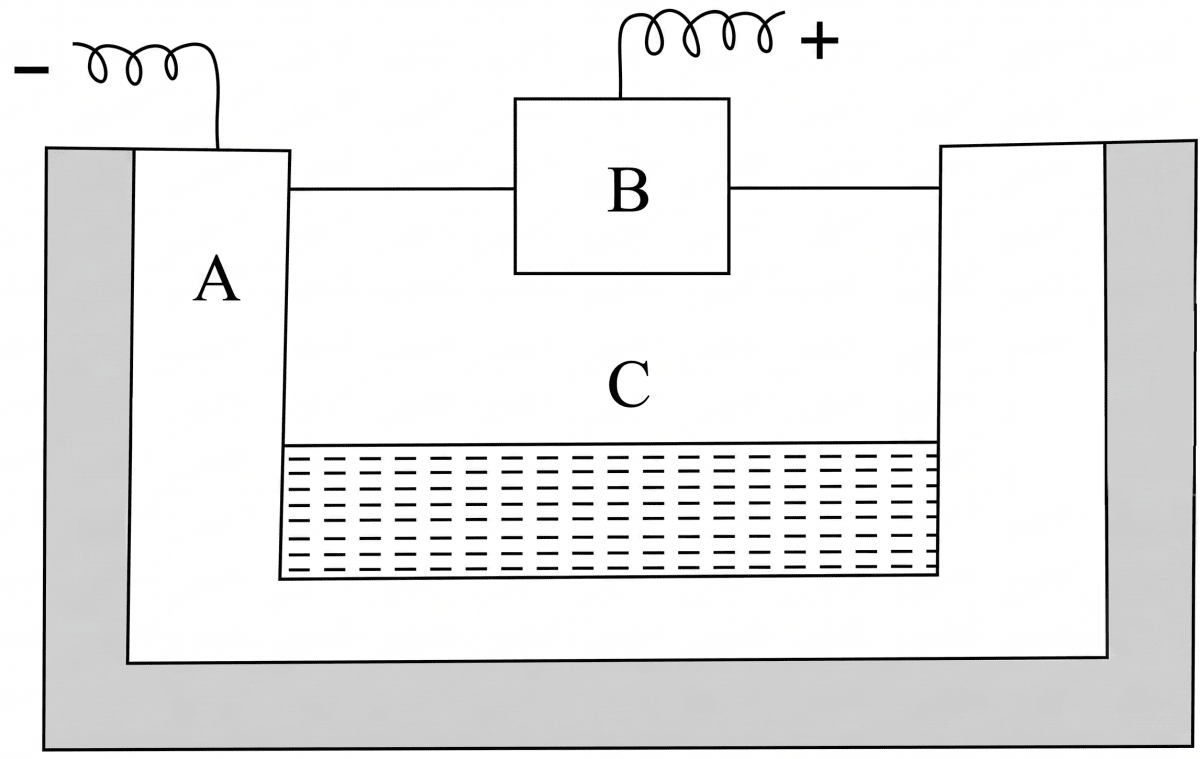
The following is a sketch of an electrolytic cell used in the extraction of aluminium:
(i) What is the substance of which the electrodes A and B are made?
(ii) At which electrode (A or B) is the aluminium formed?
(iii) What are the two aluminium compounds in the electrolyte C?
(iv) Why is it necessary for electrode B to be continuously replaced?
Show SolutionHide Solution↓
(i) A (cathode) is made of carbon and B (anode) is made of graphite.
(ii) Aluminium is formed at cathode i.e., electrode A.
(iii) Two aluminium compounds in the electrolyte C are alumina [Al2O3] and Cryolite [Na3AlF6]
(iv) In the electrolytic reduction of alumina, the graphite (anode) is oxidised by oxygen to CO and further forms CO2, so it is consumed and has to be replaced from time to time.