A solution X turns blue litmus red, so it must contain (i) ............... ions; another solution Y turns red litmus blue and therefore, must contain (ii) ............... ions. When solutions X and Y are mixed together the products will be a (iii) ............... and (iv) ............... . If a piece of magnesium were put into solution X, (v) ............... gas would be evolved.
Show SolutionHide Solution↓
A solution X turns blue litmus red, so it must contain (i) hydronium ions; another solution Y turns red litmus blue and therefore, must contain (ii) hydroxide ions. When solutions X and Y are mixed together the products will be a (iii) salt and (iv) water. If a piece of magnesium were put into solution X, (v) hydrogen gas would be evolved.
22007
Match the following:
Column A
Column B
1.Acid salt
A. Sodium potassium carbonate
2.Normal salt
B. Alum
C. Sodium carbonate
D. Sodium zincate
E. Sodium hydrogen carbonate.
Show SolutionHide Solution↓
Column A
Column B
1.Acid salt
E. Sodium hydrogen carbonate.
2.Normal salt
C. Sodium carbonate
32007
Write balanced equation for formation of PbCl2 from Pb(NO3)2 soln. and NaCl soln.
Show SolutionHide Solution↓
Pb(NO3)2 + 2NaCl ⟶ PbCl2 + 2NaNO3
12008
What is the term defined : i) A base which is soluble in water.
Show SolutionHide Solution↓
Alkali is a base which is soluble in water.
12009
The acid which contains four hydrogen atoms —
(a)Formic acid
(b)Sulphuric acid
(c)Nitric acid
(d)Acetic acid
Show SolutionHide Solution↓
Acetic acid contains four hydrogen atoms.
22009
A black coloured solid which on reaction with dilute sulphuric acid forms a blue coloured solution is:
(a)Carbon
(b)Manganese [IV] oxide
(c)Lead [II] oxide
(d)Copper [II] oxide
Show SolutionHide Solution↓
Copper [II] oxide Reason — Copper [II] oxide is black in colour and the following reaction takes place when it is treated with dilute sulphuric acid —
CuO + H2SO4 ⟶ CuSO4 + H2O
CuSO4 is a blue coloured soln.
32009
Solution A is a strong acid Solution B is a weak acid Solution C is a strong alkali
(i) Which solution contains solute molecules in addition to water molecules?
(ii) Which solution will give a gelatinous white precipitate with zinc sulphate solution? The precipitate disappears when an excess of the solution is added.
(iii) Which solution could be glacial acetic acid solution?
(iv) Give example of a soln. of a weak alkali.
Show SolutionHide Solution↓
(i) Solution B — weak acid Reason — Weak Acid is an acid which dissociates only partially in aqueous solution thereby producing a low concentration of hydrogen [H+] ions [or H3O+ ions]. For example — CH3COOH ⇌ CH3COO- + H+ [contains molecules and ions]
(ii) Solution C — strong alkali Reason — Alkalis react with certain salt solutions to precipitate insoluble hydroxide. Hence, ZnSO4 + 2NaOH ⟶ Na2SO4 + Zn(OH)2 [gelatinous white precipitate]
(iii) Solution B — weak acid Reason — Anhydrous acetic acid on cooling forms crystals of glacial acetic acid and acetic acid is a weak acid.
(iv) Ammonium hydroxide (NH4OH)
42009
Write the equation[s] for the reaction[s] to prepare lead sulphate from lead carbonate.
Show SolutionHide Solution↓
PbCO3 + 2HNO3 ⟶ Pb(NO3)2 + H2O + CO2
Pb(NO3)2 + Na2SO4 ⟶ PbSO4 + 2NaNO3
52009
Define the following terms — Neutralization
Show SolutionHide Solution↓
Neutralization — It is the process due to which [H+] ions of an acid react completely or combine with [OH-] ions of a base to give salt and water only.
Acid + Base ⟶ Salt + Water
HCl + NaOH ⟶ NaCl + H2O
H+Cl- + Na+OH- ⟶ Na+Cl- + H2O
[H+ (aq) + OH- (aq) ⇌ H2O (l)]
12010
A: Nitroso Iron [II] sulphate
B: Iron [III] chloride
C: Chromium sulphate
D: Lead [II] chloride
E: Sodium chloride.
Select from A, B, C, D and E —
(i) A compound soluble in hot water but insoluble in cold water.
(ii) A compound which in the aqueous solution state, is neutral in nature.
Show SolutionHide Solution↓
(i) D: Lead [II] chloride
(ii) E: Sodium chloride
22010
Select the correct answer from A, B, C and D –
(i) A weak organic acid is:
Formic acid
Sulphuric acid
Nitric acid
Hydrochloric acid
(ii) A complex salt is :
(a)Zinc sulphate
(b)Sodium hydrogen sulphate
(c)Iron (II) ammonium sulphate
(d)Tetrammine copper (II) sulphate
Show SolutionHide Solution↓
(i) Formic acid
(ii) Tetrammine copper (II) sulphate
32010
Give an equation for the conversions
(i) ZnSO4 to ZnCO3
(ii) ZnCO3 to Zn(NO3)2
Show SolutionHide Solution↓
(i) ZnSO4 + (NH4)2CO3 ⟶ (NH4)2SO4 + ZnCO3
(ii) ZnCO3 + 2HNO3 ⟶ Zn(NO3)2 + H2O + CO2
42010
Select the one which contains solute ions and molecules.
(a)NaOH soln.
(b)Weak acid
(c)Dil. H2SO4
Show SolutionHide Solution↓
Weak acid Reason — An acid which dissociates only partially in aqueous solution thereby producing a low concentration of hydrogen [H+] ions [or H3O+ ions] is a weak acid.
Example — CH3COOH ⇌ CH3COO- + H+ [contains molecules and ions]
52010
Give balanced equation/s for the preparation of the following salts:
(a)Copper [II] sulphate from CuO.
(b)Iron [III] chloride from Fe.
(c)K2SO4 from KOH soln.
(d)Lead [II] chloride from PbCO3 [give two equations].
Write the balanced chemical equation : Lead nitrate solution is added to sodium chloride solution
Show SolutionHide Solution↓
Pb(NO3)2 + 2NaCl ⟶ PbCl2 + 2NaNO3
22011
Name the method used from the list:
A : Simple displacement B : Neutralization C : Decomposition by acid D : Double decomposition E : Direct synthesis
For preparation of the following salts –
(i) Sodium nitrate
(ii) Iron (III) chloride
(iii) Lead chloride
(iv) Zinc sulphate
(v) Sodium hydrogen sulphate.
Show SolutionHide Solution↓
(i) Sodium nitrate — B : Neutralization
(ii) Iron (III) chloride — E : Direct synthesis
(iii) Lead chloride — D : Double decomposition
(iv) Zinc sulphate — A : Simple displacement
(v) Sodium hydrogen sulphate — C : Decomposition by acid
12012
Match the following i.e.,
(1) Acid salt
(2) Double salt — with the correct choice from — A and B
A : Ferrous ammonium sulphate
B : Sodium hydrogen sulphate
Show SolutionHide Solution↓
Acid salt — B : Sodium hydrogen sulphate
Double salt — A : Ferrous ammonium sulphate
12013
Select the word/s given below which are required to correctly complete the blanks — [ammonia, ammonium, carbonate, carbon dioxide, hydrogen, hydronium, hydroxide, precipitate, salt water] :
(i) A solution M turns blue litmus red, so it must contain (i) ............... ions ; another solution O turns red litmus blue and hence, must contain, (ii) ............... ions.
(ii) When solution M and O are mixed together, the products will be (iii) ............... and (iv) ............... .
(iii) If a piece of magnesium was put into a solution M,(v) ............... gas would be evolved.
Show SolutionHide Solution↓
(i) A solultion M turns blue litmus red, so it must contain (i) hydronium ions ; another solution O turns red litmus blue and hence, must contain, (ii) hydroxide ions.
(ii) When solution M and O are mixed together, the products will be (iii) salt and (iv) water.
(iii) If a piece of magnesium was put into a solution M, (v) hydrogen gas would be evolved.
22013
Give a suitable chemical term for:
(i) A salt formed by incomplete neutralisation of an acid by a base.
(ii) A definite number of water molecules bound to some salts.
Copper (II) sulphate CuCO3 + H2SO4 (dil.) ⟶ CuSO4 + H2O + CO2
Iron (II) sulphate Fe + H2SO4 (dil.) ⟶ FeSO4 + H2
42013
Identify: An acid which is present in vinegar.
Show SolutionHide Solution↓
Acetic acid
12014
Fill in the blank from the choices given:
The basicity of acetic acid is ............... [3, 1, 4].
Show SolutionHide Solution↓
The basicity of acetic acid is 1.
22014
Draw the structure of the stable positive ion formed when an acid dissolves in water.
Show SolutionHide Solution↓
Hydronium ion is the stable positive ion formed when an acid dissolves in water. Its structure is shown below:
32014
State the inference drawn from the observation:
Salt S is prepared by reacting dilute sulphuric acid with copper oxide. Identify S.
Show SolutionHide Solution↓
Salt S is Copper sulphate CuSO4
CuO + H2SO4 (dil.) ⟶ CuSO4 + H2O
42014
Give balanced chemical equations for the preparation of the following salts:
(a)Lead sulphate — from lead carbonate.
(b)Sodium sulphate — using dilute sulphuric acid.
(c)Copper chloride — using copper carbonate.
Show SolutionHide Solution↓
Lead sulphate from lead carbonate. PbCO3 + 2HNO3 ⟶ Pb(NO3)2 + H2O + CO2 Pb(NO3)2 + Na2SO4 ⟶ 2NaNO3 + PbSO4
Sodium sulphate using dilute sulphuric acid. Na2CO3 + H2SO4(dil.) ⟶ Na2SO4 + H2O+ CO2
Copper chloride using copper carbonate. CuCO3 + 2HCl (dil) ⟶ CuCl2 + H2O + CO2
12015
Give a balanced chemical equation for the following conversion.
Fe ⟶ FeCl3
Show SolutionHide Solution↓
2Fe + 3Cl2 ⟶ 2FeCl3
22015
From the list of salts — AgCl, MgCl2, NaHSO4, PbCO3 Choose the salt that most appropriately fits the description given below : An insoluble chloride.
Show SolutionHide Solution↓
AgCl
32015
From — SO2, SiO2, Al2O3, MgO, CO, Na2O — Select an oxide which dissolves in water forming an acid.
Show SolutionHide Solution↓
SO2
The following reaction takes place.
SO2 + H2O ⟶ H2SO3
12016
Fill in the blank: Higher the pH value of a solution, the more ............... [acidic/alkaline] it is.
Show SolutionHide Solution↓
Higher the pH value of a solution, the more alkaline it is.
22016
Match the following salts given below:
(i) Pb(NO3)2 from PbO
(ii) MgCl2 from Mg
(iii) FeCl3 from Fe
(iv) NaNO3 from NaOH
(v) ZnCO3 from ZnSO4
With their correct method of preparation from: A, B, C, D and E.
(A) Simple displacement
(B) Titration
(C) Neutralization
(D) Precipitation
(E) Combination
Show SolutionHide Solution↓
(i) Pb(NO3)2 from PbO — (C) Neutralization
(ii) MgCl2 from Mg — (A) Simple displacement
(iii) FeCl3 from Fe — (E) Combination
(iv) NaNO3 from NaOH — (B) Titration
(v) ZnCO3 from ZnSO4 — (D) Precipitation
12017
Fill in the blanks from the choices given in brackets —
When a metallic oxide is dissolved in water, the solution formed has a high concentration of ............... ions. [H+, H3O+, OH-]
Show SolutionHide Solution↓
When a metallic oxide is dissolved in water, the solution formed has a high concentration of OH- ions.
22017
Choose the correct answer from the options —
(i) To increase the pH value of a neutral solution, we should add :
An acid
An acid salt
An alkali
A salt
(ii) Anhydrous iron [III] chloride is prepared by:
(a)Direct combination
(b)Simple displacement
(c)Decomposition
(d)Neutralization
Show SolutionHide Solution↓
(i) An alkali Reason — The pH of alkali solutions is more than 7 therefore in order to increase the pH value of a neutral solution, an alkali should be added.
(ii) Direct combination Reason — Anhydrous iron [III] chloride is prepared by direct combination of iron and chloride as follows — 2Fe + 3Cl2 ⟶ 2FeCl3
32017
Write a balanced chemical equation for the preparation of each of the following salts:
(i) Copper carbonate
(ii) Ammonium sulphate crystals.
Show SolutionHide Solution↓
(i) CuSO4 + Na2CO3 ⟶ Na2SO4 + CuCO3
(ii) 2NH4OH + H2SO4 ⟶ (NH4)2SO4 + 2H2O
12018
Give one word or a phrase for the statement : The property by which certain hydrated salts, when left exposed to the atmosphere, lose their water of crystallization and crumble into powder.
Show SolutionHide Solution↓
Efflorescence
22018
State one relevant observation for the following : Anhydrous calcium chloride is exposed to air for some time.
Show SolutionHide Solution↓
It absorbs moisture from the atmosphere, dissolve in the same and change into a solution. This property is known as deliquescence
32018
Fill in the blank with the correct choice given in the bracket — The salt prepared by the method of direct combination is ............... [iron [II] chloride / iron [III] chloride]
Show SolutionHide Solution↓
The salt prepared by the method of direct combination is iron [III] chloride
42018
Three solutions P, Q, and R have pH value of 3.5, 5.2 and 12.2 respectively. State which one of these is a:
(i) weak acid
(ii) strong alkali
Show SolutionHide Solution↓
(i) Q Reason — On a pH scale, acids have pH less than 7 whereas weak acids have pH towards 7. Hence, Q will be a weak acid with pH 5.2 .
(ii) R Reason — On a pH scale, alkali have pH more than 7 and alkalinity increases as the pH value moves away from 7. Hence, R will be a strong alkali with pH 12.2 .
52018
Write a balanced equation for the preparation of each of the following salts :
(i) Copper [II] sulphate from copper carbonate
(ii) Zinc carbonate from zinc sulphate
Show SolutionHide Solution↓
(i) CuCO3 + H2SO4 ⟶ CuSO4 + H2O + CO2
(ii) ZnSO4 + (NH4)2CO3 ⟶ (NH4)2SO4 + ZnCO3
12019
Give the appropriate term defined by the statement given : The substance that releases hydronium ion as the only positive ion when dissolved in water.
Show SolutionHide Solution↓
Acid Reason — An acid is a compound which when dissolved in water yields hydronium ions [H3O+] as the only positively charged ion.
HCl (aq) ⇌ H+ + Cl-
H+ + H2O ⇌ H3O+ [hydronium ion]
HCl + H2O ⇌ H3O+ + Cl-
22019
The pH values of three solutions A, B, C are given .
Solution A : pH value 12
Solution B : pH value 2
Solution C : pH value 7
Answer the following questions :
(i) Which solution will have no effect on litmus solution.
(ii) Which solution will liberate CO2 when reacted with sodium carbonate.
(iii) Which solution will turn red litmus solution blue.
Show SolutionHide Solution↓
(i) Solution C : pH value 7
(ii) Solution B : pH value 2
(iii) Solution A : pH value 12
32019
Choose the method of preparation of the following salts, from the methods given in the list:
List — A: Neutralization B: Precipitation C: Direct combination D: Substitution
(i) Lead chloride (ii) Iron [II] Sulphate (iii) Sodium nitrate (iv) Iron [III] chloride
Show SolutionHide Solution↓
(i) Lead chloride — B: Precipitation
(ii) Iron [II] Sulphate — D: Substitution
(iii) Sodium nitrate — A: Neutralization
(iv) Iron [III] chloride — C: Direct combination
12020
Fill in the blanks from the choices given : A salt prepared by displacement reaction is ............... [Ferric chloride, ferrous chloride, silver chloride]
Show SolutionHide Solution↓
Ferrous chloride
22020
Complete the following by selecting the correct options from the choices : pH of acetic acid is greater than dilute sulphuric acid. So, acetic acid contains ............... concentration of H+ ions. [greater, same, low]
Show SolutionHide Solution↓
pH of acetic acid is greater than dilute sulphuric acid. So, acetic acid contains low concentration of H+ ions.
32020
Differentiate between the following pairs based on the information given in the brackets : Acid and alkali [formation of type of ions]
Show SolutionHide Solution↓
Acid
Alkali
An acid is a compound which when dissolved in water yields hydronium ions [H3O+] as the only positively charged ion.
An alkali is a compound which when dissolved in water yields hydroxyl ions [OH-] as the only negatively charged ions.
42020
Write balanced chemical equations, for the preparation of given salts (i) to (iii) by using the methods A to C respectively.
A: Neutralization B: Precipitation C: Titration
(i) Copper sulphate (ii) Zinc carbonate (iii) Ammonium sulphate
Show SolutionHide Solution↓
Preparation of copper sulphate by neutralization CuO + H2SO4 ⟶ CuSO4 + H2O
Preparation of zinc carbonate by precipitation Zn(NO3)2 + Na2CO3 ⟶ 2NaNO3 + ZnCO3
Preparation of ammonium sulphate by titration 2NH4OH + H2SO4 ⟶ (NH4)2SO4 + 2H2O
1Additional Questions
Define the following as per ionic theory with examples and ionic equations wherever relevant :
(i) acid (ii) base (iii) alkali (iv) neutralization
Show SolutionHide Solution↓
(i) Acid — An acid is a compound which when dissolved in water yields hydronium ions [H3O+] as the only positively charged ion.
HCl (aq) ⇌ H+ + Cl-
H+ + H2O ⇌ H3O+ [hydronium ion]
HCl + H2O ⇌ H3O+ + Cl-
(ii) Base — A base is a compound which reacts with hydronium ions of an acid to give salt and water only.
CuO + 2HCl ⟶ CuCl2 + H2O
Cu(OH)2 + H2SO4 ⟶ CuSO4 + 2H2O
Bases are oxides or hydroxides of a metal [including ammonium hydroxide]
Examples of insoluble bases [i.e., not alkalis] — ZnO, PbO, CuO, Fe(OH)2, Pb(OH)2, Cu(OH)2
(iii) Alkali — An alkali is a compound which when dissolved in water yields hydroxyl ions [OH-] as the only negatively charged ions.
NaOH [aq.] ⇌ Na+ + OH- [Hydroxyl or hydroxide ion]
Alkali is a base, soluble in water. [All alkalis are bases, but all bases are not alkalis.]
(iv) Neutralization — It is the process due to which [H+] ions of an acid react completely or combine with [OH-] ions of a base to give salt and water only.
Acid + Base ⟶ Salt + Water
HCl + NaOH ⟶ NaCl + H2O
H+Cl- + Na+OH- ⟶ Na+Cl- + H2O
[H+ (aq) + OH- (aq) ⇌ H2O (l)]
2Additional Questions
Differentiate between:
(i) Organic and inorganic acids.
(ii) Hydracids and oxyacids with examples.
Show SolutionHide Solution↓
(i) Difference between organic and inorganic acids are as follows :
(ii) Difference between hydracids and oxyacids are as follows :
Hydracids
Oxyacids
Acids containing hydrogen and a non-metallic element other than oxygen, e.g. HCl, HBr, HI.
Acids containing hydrogen, another element and oxygen, e.g. HNO3, H2SO4.
3Additional Questions
State on what basis does the strength of an acid and an alkali depend on.
Show SolutionHide Solution↓
Strength of acids depends on the concentration of hydronium ion [H3O+] present in an aqueous solution of an acid.
Strength of alkali depends on the concentration of the hydroxyl ions [OH-] present in an aqueous solution of the alkali.
4Additional Questions
Differentiate between (i) strong and weak acid (ii) strong and weak alkali with suitable examples and ionic equations.
Show SolutionHide Solution↓
(i) Differences between strong and weak acid are as follows :
Strong Acid
Weak Acid
Strong Acid is an acid which dissociates almost completely in aqueous solution there by producing a high concentration of hydrogen [H+] ions [or H3O+ ions]
Weak Acid is an acid which dissociates only partially in aqueous solution thereby producing a low concentration of hydrogen [H+] ions [or H3O+ ions].
HNO3 + H2O ⇌ H3O+ + NO3- [contains almost only ions]
CH3COOH ⇌ CH3COO- + H+ [contains molecules and ions]
Examples : Hydrochloric, Sulphuric and Nitric acid.
Examples : Acetic, citric, carbonic, and formic acid.
(ii) Differences between strong alkali and and weak alkali are as follows :
Strong alkali
Weak Alkali
Strong Alkali is an alkali which dissociates almost completely in aqueous solution thereby producing a high concentration of hydroxyl [OH-] ions.
Weak Alkali is an alkali which dissociates only partially in aqueous solution thereby producing a low concentration of hydroxyl [OH-] ions.
NaOH [aq.] ⇌ Na+ + OH- [contains almost only ions]
NH4OH [aq.] ⇌ NH4+ + OH- [contains molecules and ions]
Examples : Lithium, Sodium and Potassium hydroxide
Examples : Ammonium hydroxide and Calcium hydroxide.
5Additional Questions
Name the ions formed when — HCl; HNO3; H2SO4; CH3COOH; NaOH and NH4OH ionise in aq. soln.
Show SolutionHide Solution↓
(i) When HCl is dissolved in water, it is ionised into hydrogen ion [or H3O+ ion] and chloride ion.
HCl ⟶ H+ + Cl-
The H+ cannot exist independently, therefore, it combines with water molecule to form hydronium ion (H3O+)
H+ + H2O ⟶ H3O+
(ii) When HNO3 is dissolved in water, it is ionised into hydronium ion and nitrate ion.
HNO3 ⟶ H+ + NO3-
H+ + H2O ⟶ H3O+
(iii) When H2SO4 is dissolved in water, it is ionised into hydronium ion and sulphate ion.
H2SO4 ⟶ 2H+ + SO42-
H+ + H2O ⟶ H3O+
(iii) When CH3COOH is dissolved in water, it is ionised into hydronium ion and acetate ion.
CH3COOH ⟶ CH3COO- + H+
H+ + H2O ⟶ H3O+
(iii) When NaOH is dissolved in water, it is ionised into sodium ion and hydroxyl ion.
NaOH ⟶ Na+ + OH-
(iv) When NH4OH is dissolved in water, it is ionised into ammonium ion and hydroxyl ion.
NH4OH ⟶ NH4+ + OH-
6Additional Questions
State giving reasons which is a stronger acid — dil. HCl or conc. H2CO3.
Show SolutionHide Solution↓
Dilute HCl is a stronger acid than concentrated H2CO3 Reason — HCl dissociates almost completely in aqueous solution and produces a high concentration of H+ ions and Cl- ions, hence is a strong acid. Whereas, H2CO3 is a weak acid because it dissociates partially yielding H+ ions and bicarbonate HCO3- ion and hence, contains ions as well as molecules. Therefore, dil. HCl is a stronger acid than conc. H2CO3.
7Additional Questions
State why the basicity of acetic acid is one and acidity of calcium hydroxide is two.
Show SolutionHide Solution↓
Basicity of acid — is the number of hydrogen ions [H+] which can be produced per molecule of the acid in aq. soln. Acetic acid [CH3COOH] ionises in aq. soln. and gives one hydrogen ion per molecule of the acid, hence acetic acid is monobasic i.e., it's basicity is one.
Acidity of base — is the number of hydroxyl ions [OH-] which can be produced per molecule of the base in aq. soln. Calcium hydroxide Ca(OH)2 ionises in aq. soln. and gives two hydroxyl ions per molecule of the base, hence calcium hydroxide is a diacidic base i.e., it's acidity is two.
8Additional Questions
Give three reasons with equations wherever required, why Sulphuric acid is a dibasic acid.
Show SolutionHide Solution↓
Sulphuric acid (H2SO4) is a dibasic acid as :
It ionises in aq. soln. to produce two hydrogen ions per molecule of the acid.
It dissociate in two steps in aq. soln. as shown below: H2SO4 + H2O ⇌ H3O+ + HSO4- HSO4- + H2O ⇌ H3O+ + SO42- H2SO4 + 2H2O ⇌ 2H3O+ + SO42-
It contains two replaceable hydrogen ions per molecule of the acid so forms two types of salt [acid and normal salt] : NaOH + H2SO4 ⟶ NaHSO4 (Acid Salt) + H2O 2NaOH + H2SO4 ⟶ Na2SO4 (Normal Salt) + 2H2O
9Additional Questions
State how acids are defined as per Arrhenius's and Lowry – Bronsted's theory.
Show SolutionHide Solution↓
Arrhenius Theory — Acids are substances which dissociate in aqueous solution to give H+ ions. Strong acids dissociate almost completely, while weak acids dissociate partially.
Lowry – Bronsted's theory — Acids are proton donors and bases are proton acceptors [proton = H+]. HCl [aq.] ⟶ H+ + Cl- [acid - proton donors] NH3 + H+ ⟶ NH4+ [bases - proton acceptors]
10Additional Questions
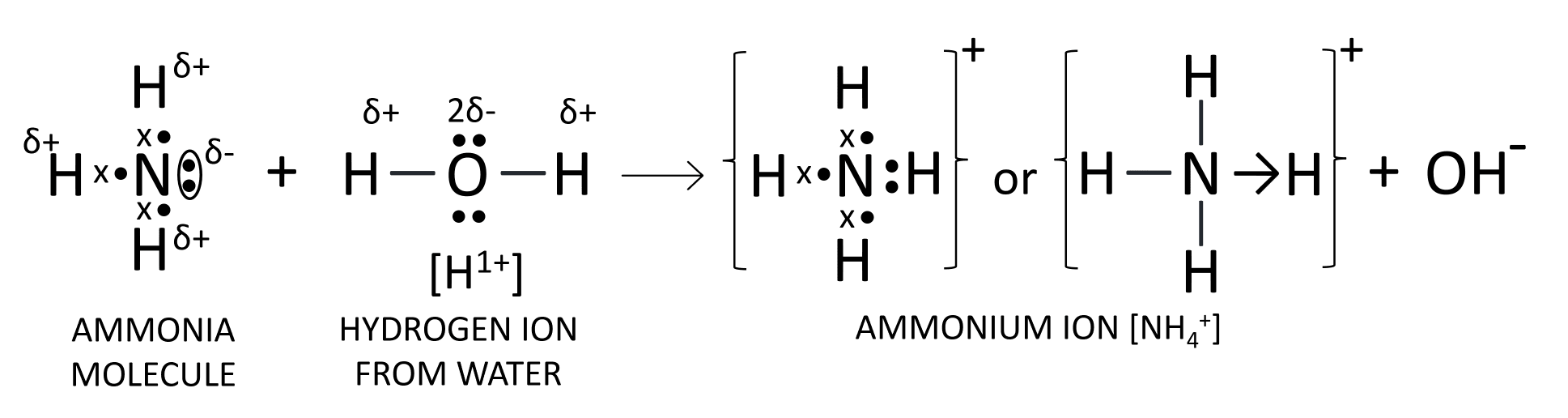
Oxygen atom in water has two 'lone pair of electrons'. Explain the meaning of the term in italics. With the help of an electron dot diagram show the formation of hydronium ion and ammonium ion from a water molecule and an ammonia molecule respectively.
Show SolutionHide Solution↓
Oxygen atom in water has two 'lone pair of electrons' implies that two pairs of electrons on oxygen are not shared with any other atom as shown below:
Formation of hydronium ion
Formation of ammonium ion
11Additional Questions
State how you would obtain:
(a)Sulphuric acid from an acidic oxide
(b)KOH from a basic oxide.
Show SolutionHide Solution↓
Acidic oxides dissolve in water to give an acid. SO3 + H2O ⟶ H2SO4
Basic oxides [soluble] dissolve in water to give a base i.e., alkali. K2O + H2O ⟶ 2KOH
12Additional Questions
State two chemical properties each with equations of a solution containing
(i) H+ ions
(ii) OH- ions
Show SolutionHide Solution↓
(i) Chemical properties of a solution containing H+ (acids) are as follows —
Neutralization — acids neutralizes base to give salt and water only. Example : CuO + H2SO4 ⟶ CuSO4 + H2O
Reaction with active metals — Acids react with active metals [e.g., Mg, Al, Zn, Fe] to liberate hydrogen. Example : Zn + 2HCl ⟶ ZnCl2 + H2
(ii) Chemical properties of a solution containing OH- (bases/alkalis) are as follows —
Neutralization — Alkalis neutralize acids to form salt and water. Example : Ca(OH)2 + 2HCl ⟶ CaCl2 + 2H2O
Reaction with metallic salt — Alkalis react with certain matallic salt solutions to precipitate insoluble hydroxide. Example : FeCl3 + 3NaOH ⟶ 3NaCl + Fe(OH)3 ↓ red brown ppt.
13Additional Questions
Give equations for the decomposition of a metallic (i) chloride (ii) nitrate with conc. H2SO4.
Convert (i) NaHCO3 (ii) Na2CO3 to unstable carbonic acid by action with dil. H2SO4. State the reason why ammonia is evolved when an ammonium salt and alkali are heated.
Ammonia is evolved when an ammonium salt and alkali are heated because a less volatile base (e.g.,NaOH) displace the more volatile base, NH4OH and we get the products NH3 and H2O.
NH4Cl + NaOH ⟶ NaCl + H2O + NH3
16Additional Questions
Define pH value. What would you say about the pH of a solution in which
(i) H+ aq. ions = OH- ions
(ii) evolves CO2 when heated with Na2CO3
(iii) OH-ions > H+ aq. ions.
Show SolutionHide Solution↓
pH is defined as the negative logarithm [to the base 10] of the hydrogen ion concentration expressed in moles/litre. Thus, pH = -log10H+. It represents the strength of acids and alkalis, expressed in terms of hydrogen ion concentration [H+ aq.]
(i) When, H+ ions = OH- ions, the solution is neutral with pH = 7.
(ii) When the solution evolves CO2 when heated with Na2CO3, it is acidic in nature with pH less than 7.
(iii) when, OH-ions > H+ aq. ions, the solution is basic in nature with pH more than 7.
17Additional Questions
State whether litmus is a common acid-base indicator or a universal indicator.
Show SolutionHide Solution↓
Litmus is a common acid-base indicator and not a universal indicator. It only indicates whether a solution is acidic or alkaline. It cannot be utilized for determining the strength of the acidic or alkaline solution.
18Additional Questions
State the colour change in a neutral litmus in presence of (i) acidic (ii) alkaline medium.
Show SolutionHide Solution↓
(i) A neutral litmus is purple in colour. In presence of an acidic medium, the colour of neutral litmus changes from purple to red.
(ii) In an alkaline medium, colour of neutral litmus changes from purple to blue.
19Additional Questions
State the colour change in a universal indicator e.g. pH paper on
(i) slightly acidic soil
(ii) slightly alkaline soil
(iii) dairy milk
(iv) human blood tested for medical diagnosis.
Show SolutionHide Solution↓
(i) The pH paper changes to yellow colour on a slightly acidic soil.
(ii) The pH paper changes to blue colour on a slightly alkaline soil.
(iii) The pH paper changes to green colour in a dairy milk.
(iv) The pH paper changes to green colour in human blood tested for medical diagnosis.
20Additional Questions
Define (i) salt (ii) normal salt (iii) acid salt – with relevant examples and equations.
Show SolutionHide Solution↓
(i) Salt — A salt is a compound formed by partial or complete replacement of the replaceable hydrogen ions of an acid by a metallic ion or ammonium ion [basic radical].
(ii) Normal salt — The salt formed by complete replacement of the replaceable hydrogen ion of an acid molecule by a basic radical [metallic or ammonium ion]. For example,
2NaOH + H2SO4 ⟶ Na2SO4 + 2H2O
2NaOH + H2SO3 ⟶ Na2SO3 + 2H2O
[Both H ions in sulphuric and sulphurous acid are replaced by metallic radical — sodium. ]
(3) Acid salt — The salt formed by partial replacement of the replaceable hydrogen ion of an acid molecule by a basic radical [metallic or ammonium ion]. For example,
NaOH + H2SO4 ⟶ NaHSO4 + H2O
NaOH + H2SO3 ⟶ NaHSO3 + H2O
[Only one H ion in sulphuric and sulphurous acid is replaced by metallic radical — sodium. ]
21Additional Questions
State (i) the formation (ii) the components of – a basic salt.
State which of following salts is an – acid, normal or basic salt.
(i) bleaching powder
(ii) potassium mercuric iodide
(iii) sodium sulphite
(iv) sodium hydrogen sulphite
(v) sodium silver cyanide
(vi) basic lead nitrate
(vii) potassium zincate
(viii) alum
(ix) calcium bicarbonate
(x) basic copper chloride
(xi) trisodium phosphate.
Show SolutionHide Solution↓
(i) Formation of a basic salt — A basic salt is formed by partial replacement of hydroxyl radicals of a diacidic or triacidic base with an acid radical.
(ii) Components of a basic salt — A basic salt contains a cation [metallic], a hydroxyl ion [of a base] and an anion [of an acid].
For example — Basic copper nitrate Cu[OH]NO3 , basic copper chloride Cu[OH]Cl
Acid, normal or basic salt —
(i) bleaching powder — Normal salt (Mixed salt)
(ii) potassium mercuric iodide — Normal salt (Complex salt)
(iii) sodium sulphite — Normal salt
(iv) sodium hydrogen sulphite — Acid salt
(v) sodium silver cyanide — Normal salt (Complex salt)
(vi) basic lead nitrate — Basic salt
(vii) potassium zincate — Normal salt
(viii) alum — Normal salt (Double salt)
(ix) calcium bicarbonate — Acid salt
(x) basic copper chloride — Basic salt
(xi) trisodium phosphate — Normal salt
22Additional Questions
Name three (i) sulphates (ii) chlorides insoluble in water and two (i) oxides (ii) carbonates soluble in water.
Show SolutionHide Solution↓
Insoluble in Water
(i) Three sulphates insoluble in water are:
Lead sulphate (PbSO4)
Calcium sulphate (CaSO4)
Barium sulphate (BaSO4).
(ii) Three chloride insoluble in water are:
Silver chloride (AgCl)
Lead chloride (PbCl2)
Mercury chloride (Hg2Cl2).
Soluble in Water
(i) Two oxides soluble in water are:
Sodium oxide (Na2O)
Potassium oxide (K2O)
(ii) Two carbonates soluble in water are:
Sodium carbonate (Na2CO3)
Ammonium carbonate [(Na4)2CO3]
23Additional Questions
State the method only, generally used for the preparation of the following salts
(i) Zn(NO3)2
(ii) NH4Cl
(iii) ZnSO4
(iv) ZnS
(v) CaCO3
(vi) FeCl3
(vii) PbCl2
(viii) Pb(NO3)2
Show SolutionHide Solution↓
Method of preparation are as follows :
(i) Zn(NO3)2 — By action of dilute acids on carbonate.
(ii) NH4Cl — By neutralisation of an alkali (titration)
(iii) ZnSO4 — By displacement of active metal and acid
(iv) ZnS — Direct combination (Synthesis)
(v) CaCO3 — By precipitation (double decomposition)
Starting from insoluble ZnO how would you obtain insoluble ZnCO3 by precipitation.
Show SolutionHide Solution↓
ZnO + 2HCl ⟶ ZnCl2 + H2O
ZnCl2 + Na2CO3 ⟶ ZnCO3 + 2NaCl
Dissolve zinc oxide in dil. HCl. Add to it a saturated solution of Na2CO3. The precipitate formed by the interchange of radicals is filtered. It is dried to obtain the zinc carbonate.
26Additional Questions
Give balanced equations for the action of a dilute acid on
(i) zinc carbonate,
(ii) potassium bicarbonate for the preparation of the respective salt.
Show SolutionHide Solution↓
(i) ZnCO3 + 2HNO3 (dil) ⟶ Zn(NO3)2 + H2O + CO2
(ii) 2KHCO3 + H2SO4 (dil) ⟶ K2SO4 + 2H2O + 2CO2
27Additional Questions
Give balanced equations for the decomposition of
(a)calcium bicarbonate by dil. HCl
(b)calcium carbonate by dil. HNO3
(c)sodium sulphite by dil. H2SO4
(d)zinc sulphide by dil. H2SO4.
Show SolutionHide Solution↓
Decomposition of calcium bicarbonate by dil. HCl Ca(HCO3)2 + 2HCl ⟶ CaCl2 + 2H2O+ 2CO2
Decomposition of calcium carbonate by dil. HNO3 CaCO3 + 2HNO3 ⟶ Ca(NO3)2 + H2O+ CO2
Decomposition of sodium sulphite by dil. H2SO4 Na2SO3 + H2SO4 (dil.) ⟶ Na2SO4 + H2O + SO2
Decomposition of zinc sulphide by dil. H2SO4 ZnS + H2SO4 ⟶ ZnSO4 + H2S
28Additional Questions
State what will be the effect of each of the following solution on blue litmus —
(i) K2CO3 soln.
(ii) KCl soln.
(iii) NH4NO3 soln.
Show SolutionHide Solution↓
(i) As K2CO3 is a salt of a strong base (KOH) and weak acid (H2CO3), it hydrolyses in water to give alkaline solutions. They have pH more than 7, hence it will have no effect on blue litmus.
(ii) KCl is a salt of a strong acid (HCl) and a strong base (KOH). Hence it's aqueous solution will be neutral in nature and will have no effect on blue litmus.
(iii) NH4NO3 is a salt of a strong acid (HNO3) and weak base (NH4OH), it hydrolyses in water to give an acidic solution. They have pH less than 7, hence will turn blue litmus red.
1Select correct acid/base/salt
An example of an acid derived from a mineral is ............... [citric acid / nitric acid / acetic acid]
Show SolutionHide Solution↓
An example of an acid derived from a mineral is nitric acid.
2Select correct acid/base/salt
An example of a base which is not an alkali is ............... [caustic soda / zinc hydroxide / liquor ammonia / caustic potash]
Show SolutionHide Solution↓
An example of a base which is not an alkali is zinc hydroxide.
3Select correct acid/base/salt
An example of a strong acid is dilute ............... [acetic acid / sulphuric acid / tartaric acid / carbonic acid]
Show SolutionHide Solution↓
An example of a strong acid is dilute sulphuric acid.
4Select correct acid/base/salt
An example of a weak alkali is ............... [potassium hydroxide / calcium hydroxide / sodium hydroxide] solution.
Show SolutionHide Solution↓
An example of a weak alkali is calcium hydroxide solution.
5Select correct acid/base/salt
An acid having basicity 1 is ............... [carbonic acid / acetic acid / sulphurous acid]
Show SolutionHide Solution↓
An acid having basicity 1 is acetic acid.
6Select correct acid/base/salt
An acid obtained by dissolving sulphur trioxide in water is ............... [sulphurous acid / sulphuric acid / oleum]
Show SolutionHide Solution↓
An acid obtained by dissolving sulphur trioxide in water is sulphuric acid.
7Select correct acid/base/salt
A volatile acid obtained when nitre reacts with non-volatile concentrated sulphuric acid on heating is ............... [hydrochloric acid / sulphuric acid / nitric acid]
Show SolutionHide Solution↓
A volatile acid obtained when nitre reacts with non-volatile concentrated sulphuric acid on heating is nitric acid.
8Select correct acid/base/salt
A base obtained when lead nitrate undergoes thermal decomposition is ............... [trilead tetroxide / lead (IV) oxide/ lead (II) oxide].
Show SolutionHide Solution↓
A base obtained when lead nitrate undergoes thermal decomposition is lead (II) oxide.
9Select correct acid/base/salt
An acid obtained when concentrated nitric acid is heated with sulphur is ............... [sulphurous acid / sulphuric acid / nitrous acid]
Show SolutionHide Solution↓
An acid obtained when concentrated nitric acid is heated with sulphur is sulphuric acid.
10Select correct acid/base/salt
The more volatile acid obtained when the less volatile acid reacts with sodium bicarbonate is ............... [sulphuric acid / carbonic acid / nitric acid]
Show SolutionHide Solution↓
The more volatile acid obtained when the less volatile acid reacts with sodium bicarbonate is carbonic acid.
11Select correct acid/base/salt
The insoluble base obtained when sodium hydroxide reacts with iron (III) chloride is ............... [iron (II) hydroxide / iron (III) hydroxide / iron (II) oxide]
Show SolutionHide Solution↓
The insoluble base obtained when sodium hydroxide reacts with iron (III) chloride is Iron (III) hydroxide.
12Select correct acid/base/salt
A solution whose pH is above 7 is ............... [vinegar/milk/liquor ammonia].
Show SolutionHide Solution↓
A solution whose pH is above 7 is liquor ammonia.
13Select correct acid/base/salt
The salt formed when sulphuric acid reacts with excess caustic soda solution is ............... [sodium bisulphite / sodium sulphate / sodium sulphite / sodium bisulphate].
Show SolutionHide Solution↓
The salt formed when sulphuric acid reacts with excess caustic soda solution is sodium sulphate.
14Select correct acid/base/salt
An example of an acid salt is ............... [CH3COONa/NaNO3/Na2HPO4/NaKCO3]
Show SolutionHide Solution↓
An example of an acid salt is Na2HPO4.
15Select correct acid/base/salt
An example of a soluble salt is ............... (AgCl/PbSO4/CaSO4/CaCl2)
Show SolutionHide Solution↓
An example of a soluble salt is CaCl2.
16Select correct acid/base/salt
An example of an insoluble salt is ............... (Na2CO3/K2CO3/MgCO3/(NH4)2CO3)
Show SolutionHide Solution↓
An example of an insoluble salt is MgCO3.
17Select correct acid/base/salt
A salt prepared by neutralization in which titration is involved is ............... [MgCl2/CaCl2/NH4Cl/CuCl2]
Show SolutionHide Solution↓
A salt prepared by neutralization in which titration is involved is NH4Cl.
18Select correct acid/base/salt
An insoluble salt prepared by direct combination or synthesis is ............... [FeCl3/FeSO4/FeS/Fe(NO3)2]
Show SolutionHide Solution↓
An insoluble salt prepared by direct combination or synthesis is FeS.
19Select correct acid/base/salt
A salt prepared by precipitation i.e. by double decomposition of two salt solutions is ............... [Na2SO4/PbSO4/ZnSO4/CuSO4]
Show SolutionHide Solution↓
A salt prepared by precipitation i.e. by double decomposition of two salt solutions is PbSO4.
20Select correct acid/base/salt
A salt prepared by simple displacement i.e. action of dilute acid on a metal is ............... [PbCl2/CuCl2/AlCl3/HgCl]
Show SolutionHide Solution↓
A salt prepared by simple displacement i.e. action of dilute acid on a metal is AlCl3.
21Select correct acid/base/salt
Decomposition of calcium hydrogen carbonate with ............... [dil. HNO3 / dil. HCl / dil. H2SO4] results in formation of calcium chloride.
Show SolutionHide Solution↓
Decomposition of calcium hydrogen carbonate with dil. HCl results in formation of calcium chloride.
22Select correct acid/base/salt
Action of dilute acid on a metallic sulphide results in evolution of ............... [SO2/H2S/CO2] gas.
Show SolutionHide Solution↓
Action of dilute acid on a metallic sulphide results in evolution of H2S gas.
23Select correct acid/base/salt
A salt which on hydrolysis produces a neutral solution is ............... (sodium chloride / ammonium chloride / sodium carbonate)
Show SolutionHide Solution↓
A salt which on hydrolysis produces a neutral solution is sodium chloride .
1Unit Test Paper 3A — Acids, Bases & Salts
Name the following:
(a)A basic solution which does not contain a metallic element.
(b)A normal salt of sodium formed from acetic acid.
(c)A base which reacts with an acid to give a salt which on hydrolysis gives a slightly acidic solution.
(d)An ion which combines with a polar covalent molecule to form an ammonium ion.
(e)A soluble salt formed by direct combination between a light metal & a greenish yellow gas.
Show SolutionHide Solution↓
Ammonium Hydroxide (NH4OH) is a basic solution which does not contain a metallic element.
Sodium acetate (CH3COONa) is a normal salt of sodium formed from acetic acid.
Ammonium hydroxide (NH4OH) is a base which reacts with an acid to give a salt which on hydrolysis gives a slightly acidic solution.
Hydrogen ion (H+) is an ion which combines with a polar covalent molecule to form an ammonium ion.
Aluminium chloride (AlCl3) is a soluble salt formed by direct combination between a light metal & a greenish yellow gas where, light metal is Al and greenish yellow gas is Cl.
2Unit Test Paper 3A — Acids, Bases & Salts
Identify which of the following terms matches with the appropriate descriptions 1 to 5.
A: Hydracid
B: Monobasic acid
C: Less volatile acid
D: Weak acid
E: Tribasic acid
F: Dibasic acid
G: More volatile acid
(a)An acid having basicity 1 and having only one replaceable hydrogen ion per molecule of the acid.
(b)An acid which dissociates to give a low concentration of H+ ions.
(c)An acid containing hydrogen and a non-metallic element other than oxygen.
(d)The type of acid which generally displaces another acid when the acid is heated with a salt.
(e)The type of acid which reacts with a base to give an acid salt and a normal salt.
Show SolutionHide Solution↓
B: Monobasic acid
D: Weak acid
A: Hydracid
C: Less volatile acid
F: Dibasic acid
3Unit Test Paper 3A — Acids, Bases & Salts
State which of the following methods is generally used for preparing the salts 1 to 5 given below:
A: Neutralisation — insoluble base and dil. acid
B: Neutralisation — alkali and dil. acid
C: Simple displacement — active metal and dil. acid
D: Direct combination
E: Precipitation [double decomposition]
(a)PbCO3
(b)Zn(NO3)2
(c)NaCl
(d)Cu(NO3)2
(e)FeS
Show SolutionHide Solution↓
E: Precipitation (Double decomposition)
C: Simple displacement — active metal and dil. acid
B: Neutralisation — alkali and dil. acid
A: Neutralisation — insoluble base and dil. acid
D: Direct combination
4Unit Test Paper 3A — Acids, Bases & Salts
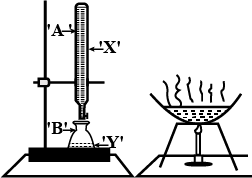
Give balanced equations for the preparation of the following salts:
The diagram represents the preparation of sodium sulphate salt from dil. H2SO4 acid and sodium hydroxide.
(a)Name the apparatus 'A'.
(b)Name the substance 'X' placed in 'A' and the substance 'Y' placed in B.
(c)State the reason for conducting the titration using the apparatus 'A' and 'B'.
(d)State which solution is transferred to the evaporating dish and evaporated to point of crystallization for obtaining the salt.
(e)State why titration is not conducted for the preparation of copper [II] sulphate crystals by neutralization.
Show SolutionHide Solution↓
Burette
Dil. sulphuric acid (H2SO4) is substance 'X' placed in 'A' and sodium hydroxide (NaOH) is the substance 'Y' placed in B.
Titration is conducted to determine the completion of the neutralization reaction, i.e. to determine the amount of sulphuric acid required to neutralize a known amount of sodium hydroxide.
Aqueous sodium sulphate (Na2SO4.10H2O) is transferred to the evaporating dish and evaporated to point of crystallisation for obtaining the salt.
As copper (II) oxide is not soluble in water hence titration is not conducted for the preparation of copper (II) sulphate crystals by neutralization.
6.1Unit Test Paper 3A — Acids, Bases & Salts
Give reasons for the following:
Concentrated sulphuric acid is a weaker acid compared to dilute sulphuric acid.
Show SolutionHide Solution↓
Strength of an acid is determined by the amount of hydronium ions it produces in it's aqueous solution. As dilute sulphuric acid dissociates almost completely thereby producing a high concentration of hydronium ions hence is a stronger acidic than concentrated sulphuric acid.
6.2Unit Test Paper 3A — Acids, Bases & Salts
Give reasons for the following:
An aqueous solution of the salt ammonium chloride is acidic in nature while an aqueous solution of sodium chloride is neutral.
Show SolutionHide Solution↓
As ammonium chloride is a salt of a weak alkali and strong acid, hence it's aqueous solution is acidic in nature. On the other hand, sodium chloride is a product of strong alkali and strong acid hence, it's aqueous solution is neutral in nature.
Neutralization reaction
Base + Acid
Salt
+ water
Nature
Weak alkali + strong acid
NH4OH + HCl
⟶ NH4Cl
+ H2O
acidic
Strong alkali + strong acid
NaOH + HCl
⟶ NaCl
+ H2O
neutral
6.3Unit Test Paper 3A — Acids, Bases & Salts
Give reasons for the following:
In the preparation of an insoluble salt from another insoluble salt by precipitation [double decomposition], dilute nitric acid and not dilute sulphuric acid is generally used.
Show SolutionHide Solution↓
In the preparation of an insoluble salt from another insoluble salt by precipitation, if dil. sulphuric acid is directly used then it forms an insoluble precipitate and slows the reaction.
For example — Direct addition of dil. sulphuric acid to PbCO3 is an impractical method of preparing lead sulphate since PbSO4 is insoluble and forms a coating on PbCO3, thereby the reaction slowly comes to a stop.
6.4Unit Test Paper 3A — Acids, Bases & Salts
Give reasons for the following:
Acetic acid does not form an acid salt but forms a normal salt.
Show SolutionHide Solution↓
Acetic acid (CH3COOH) is a monobasic acid and contains only one replaceable hydrogen atom, hence it can only form normal salt and not acid salts.
6.5Unit Test Paper 3A — Acids, Bases & Salts
Give reasons for the following:
Sulphurous acid forms two types of salts on reaction with an alkali.
Show SolutionHide Solution↓
Sulphurous acid (H2SO3) is a dibasic acid, i.e., it contains two replaceable hydrogen ions per molecule of the acid. Hence, it can form normal salt as well as acid salt on reaction with an alkali.