The diagram given below shows the electroplating of a spoon with silver. With reference to the diagram, answer the following questions:
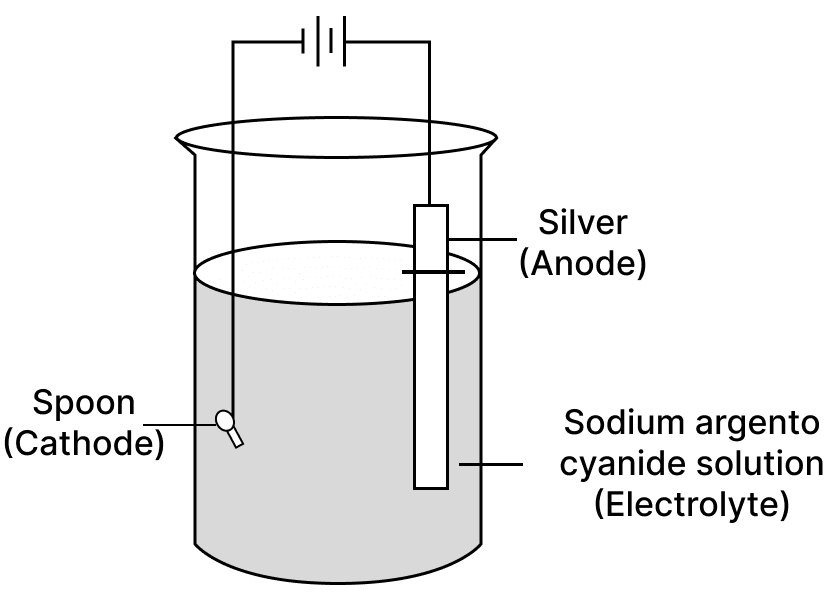
(a) Write an equation for the reaction that occurs at the cathode.
(b) Silver nitrate solution is not preferred as an electrolyte in the above process. Give a reason.
(c) Why is alternating current not used in the process?
(d) What is the observation at the anode?
Show SolutionHide Solution↓
(a) Ag+ + e- ⟶ Ag
(b) Silver nitrate solution is not preferred because it ionises very readily releasing a high concentration of Ag+ ions. This causes silver to be deposited too rapidly on the spoon, producing a non-uniform, loose, and rough coating with poor adhesion. Sodium argentocyanide, on the other hand, releases Ag+ ions slowly, producing a smooth, uniform, and shiny coating.
(c) Alternating current (AC) is not used because in AC, the polarity of electrodes keeps changing. As a result, silver deposited on the spoon at one moment would dissolve back into the electrolyte at the next moment. Hence, direct current (DC) is used to ensure uni-directional flow of ions and continuous deposition of silver on the spoon.
(d) The silver anode gradually dissolves into the electrolyte as silver ions:
Ag - e- ⟶ Ag+
The mass of the anode decreases during the process.