Given below are organic compounds labelled A to F. Answer the questions that follow:
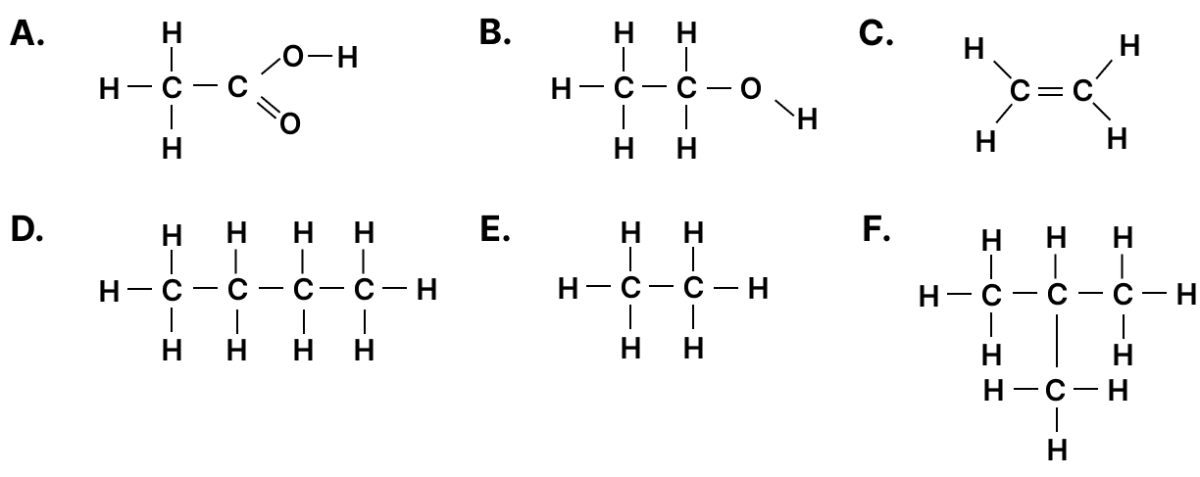
(a) Which compound forms a single product with bromine?
(b) Which two compounds have the same molecular formula?
(c) Which two compounds will react together in the presence of concentrated H2SO4 to form a product with a fruity smell?
Show SolutionHide Solution↓
(a) C
(b) D and F
(c) A and B
Reason
(a) C reacts with bromine to give a single product 1,2-dibromoethane
$\underset{\text{ ethene}}{\text{C}_2\text{H}_4} + \text{Br}_2 \xrightarrow[\text{[inert solvent]}]{\text{CCl}_4} \underset{\text{1,2, dibromooethane [ethylene bromide]}}{\text{C}_2\text{H}_4\text{Br}_2}$
(b) D is a straight-chain butane and F is a branched isobutane or 2-methylpropane, they have the same molecular formula C4H10 and are structural isomers of each other.
(c) A is a carboxylic acid (CH3COOH) and B is an alcohol (CH3CH2OH). In presence of concentrated H2SO4 they undergo esterification to give ethyl ethanoate (ethyl acetate), which has a fruity smell.
$\underset{\text{ethyl alcohol}}{\text{C}_2\text{H}_5\text{OH}} + \text{CH}_3\text{COOH} \xrightarrow{\text{conc. H}_2\text{SO}_4} \underset{\text{ethyl acetate}}{{\text{CH}_3\text{COOC}_2\text{H}_5}} + \text{H}_2\text{O}$