The Reproductive System

ICSE Class 10 Biology · Selina Concise Biology · 53 solved questions

Exercise
Marks
1Progress Check 1

Tick-mark the correct meaning of reproduction

(i) increase in population

(ii) increase in the number of parents

(iii) production of new individuals of the same kind

(iv) production of identical individuals

Show SolutionHide Solution↓

production of new individuals of the same kind
2Progress Check 1

State very briefly the chief function of each of the following :

(i) Seminal vesicles

(ii) Prostate gland

(iii) Cowper's gland

(iv) Sperm duct (vas deferens)

Show SolutionHide Solution↓

(i) Seminal vesicles produce a secretion that serves as a medium for the transportation of the sperms.

(ii) It pours an alkaline secretion into the semen as it passes through the urethra. It neutralises acid in female's vagina.

(iii) The secretion of Cowper's gland serves as a lubricant.

(iv) Sperm duct (vas deferens) help in the transportation of the sperms from the testes upwards to the abdomen.

1Progress Check 2

State whether the following statements are True (T) or False (F):

(i) One egg is released from each of the two ovaries every month.

(ii) The enlarged mature follicle bursts to release the egg.

(iii) The egg is passed down through the oviduct by muscular contractions.

(iv) Clitoris is equivalent to the male penis.

(v) The vagina is a muscular tube.

Show SolutionHide Solution↓

(i) False
Corrected Statement — One egg is released from one of the two ovaries every month.

(ii) True

(iii) True

(iv) True

(v) True

1Progress Check 3

Name the three main regions of the human sperm, and briefly mention the function of each.

Show SolutionHide Solution↓

The three main regions of human sperm and their function are:

  1. Head (Acrosome) — It secretes an enzyme (hyaluronidase) which facilitates entry of sperm into the egg by dissolving the wall of the ovum.
  2. Middle Piece (Mitochondria) — It provides energy for the activity of the sperm to swim.
  3. Tail (Axial filament) — Lashing movements of tail helps in propulsion.
2Progress Check 3

Name the following :

(i) Three accessory glands of human male reproductive system.

(ii) Two hormones secreted from placenta.

(iii) Two types of twins.

(iv) Two layers of the wall of uterus.

Show SolutionHide Solution↓

(i) Three accessory glands of human male reproductive system are:

  1. Seminal vesicles
  2. Prostate gland
  3. Bulbo-urethral gland (or Cowper's gland)

(ii) Two hormones secreted from placenta are:

  1. Oestrogens
  2. Progesterone

(iii) Two types of twins are:

  1. Fraternal Twins
  2. Identical Twins

(iv) Two layers of the wall of uterus are:

  1. Endometrium
  2. Myometrium
3Progress Check 3

List the substances which the foetus receives from the mother through placenta.

Show SolutionHide Solution↓

The foetus receives following substances from the mother through placenta:

  1. Oxygen
  2. Glucose
  3. Amino acids
  4. Lipids, fatty acids and glycerol
  5. Vitamins
  6. Mineral ions such as Na, K, Ca, Cl, etc.
  7. Certain drugs
  8. Alcohol, nicotine
  9. Antibodies
  10. Viruses
4Progress Check 3

How are carbon dioxide and urea, excreted by the foetus, removed?

Show SolutionHide Solution↓

The placenta is formed of two sets of finger-like projections, the villi. One set is given out by uterine wall and the other set by allantois from the embryo. These two set of villi are interlocked. The impurities excreted by foetus are exchanged by their capillaries to the capillaries of uterine wall (mother).

5Progress Check 3

Write one sentence each using the following terms pertaining to reproduction in humans.

(i) Gestation

(ii) 280 days

(iii) Head first

(iv) Placenta

(v) After-birth

(vi) Tied and cut

Show SolutionHide Solution↓

(i) The gestation period refers to the full term of the embryo in the uterus.

(ii) In humans, the gestation period is 280 days.

(iii) During parturition, the baby is pushed out by powerful contraction, head first.

(iv) Placenta is the disc like structure attached to the uterine wall.

(v) After about 15 minutes of birth of baby, the placenta breaks from the uterus and is expelled out as "after-birth".

(vi) The umbilical cord is tied and cut after birth.

6Progress Check 3

Does the foetus inside the mother's uterus breathe? Yes/No

Show SolutionHide Solution↓

No

Reason — No, the foetus inside the mother's uterus does not breathe in the same way as a born baby or an adult. The exchange of gases between the mother's blood and the foetal blood takes place in the placenta, and the foetus obtains the necessary oxygen and eliminates carbon dioxide through this process. The actual breathing, as in inhaling and exhaling air into the lungs, only begins after birth when the baby takes its first breath.

7Progress Check 3

Mention if the following statements are True (T) or False (F):

(i) Placenta produces certain hormones.

(ii) Amniotic fluid serves to provide oxygen to the foetus.

(iii) Heart and blood vessels have been formed by the end of five weeks of pregnancy.

(iv) Mother's blood flows into the foetus through placenta.

Show SolutionHide Solution↓

(i) True

(ii) False
Corrected Statement — Amniotic fluid serves to provide protection to the foetus.

(iii) True

(iv) False
Corrected Statement — Mother's blood and the foetal blood do not directly mix in the placenta. Instead, the placenta acts as a barrier between the maternal and foetal circulations to allow for the exchange of oxygen, nutrients, and waste products without direct mixing of blood.

8Progress Check 3

Complete the following by filling in the blanks 1 to 5 with appropriate words:

The human female gonads are ovaries. A maturing egg in the ovary is present in a sac of cells called ...............(1). As the egg grows larger, the follicle enlarges and gets filled with a fluid and is now called the ............... (2) follicle. The process of releasing the egg from the ovary is called ............... (3). The ovum is picked up by the oviductal funnel and fertilization takes place in the ...............(4). In about a week the blastocyst gets fixed in the endometrium of the uterus and this process is called ...............(5).

Show SolutionHide Solution↓

The human female gonads are ovaries. A maturing egg in the ovary is present in a sac of cells called follicle(1). As the egg grows larger, the follicle enlarges and gets filled with a fluid and is now called the Graafian (2) follicle. The process of releasing the egg from the ovary is called ovulation (3). The ovum is picked up by the oviductal funnel and fertilization takes place in the fallopian tube (4). In about a week the blastocyst gets fixed in the endometrium of the uterus and this process is called implantation (5).

11 Mark · Multiple Choice Type

The male accessory gland whose secretion neutralizes the acidity of the urethra and vagina is:

Show SolutionHide Solution↓

Prostate gland

Reason — The secretion of prostate gland is alkaline in nature and it neutralises the acidity of the urethra and vagina.

21 Mark · Multiple Choice Type

The onset of menstruation in women is called ;

Show SolutionHide Solution↓

Menarche

Reason — The term used for onset of menstruation in young female is called Menarche.

31 Mark · Multiple Choice Type

In the human menstrual cycle, the ovulation occurs around :

Show SolutionHide Solution↓

14 days

Reason — Ovulation occurs during mid-menstrual cycle.

41 Mark · Multiple Choice Type

Fertilization takes place in :

Show SolutionHide Solution↓

Fallopian tube

Reason — Fertilization takes place in oviduct or Fallopian tube.

51 Mark · Multiple Choice Type

The packing tissues between the coils of the seminiferous tubules are called as :

Show SolutionHide Solution↓

Leydig cells

Reason — The packing tissues between the coils of the seminiferous tubules are called as interstitial cells or Leydig cells.

61 Mark · Multiple Choice Type

Which of the following cannot pass readily through the placenta to the foetus ?

Show SolutionHide Solution↓

Haemoglobin

Reason — There is exchange of substances between the capillaries of foetus and mother but their blood never mixes. Therefore, there is no exchange of Haemoglobin.

71 Mark · Multiple Choice Type

The thin-walled sac of skin in which testis descends is :

Show SolutionHide Solution↓

Scrotal sac

Reason — Testis descends into scrotal sac.

81 Mark · Multiple Choice Type

The outermost layer of uterine wall around the foetus is :

Show SolutionHide Solution↓

Chorion

Reason — The outermost layer of uterine wall around the foetus is chorion.

91 Mark · Multiple Choice Type

The period of pregnancy is called :

Show SolutionHide Solution↓

Gestation

Reason — The duration between fertilization and birth of baby is called gestation period. It is 280 days in case of humans.

101 Mark · Multiple Choice Type

The canal through which each testis descends into the scrotum just before the birth of a male baby is :

Show SolutionHide Solution↓

Inguinal canal

Reason — The canal through which each testis descends into the scrotum just before the birth of a male baby is inguinal canal.

111 Mark · Multiple Choice Type

Given below are the functions of male accessory glands in humans.

(i) Prostate gland pours an acidic secretion into the semen.

(ii) The secretion of bulbo-urethral glands serves as a lubricant.

(iii) The secretion of prostate gland neutralises the alkali in a human vagina.

(iv) The secretion of seminal vesicles serves as a medium for the transportation of the sperms.

Which of the above options are correct ?

Show SolutionHide Solution↓

(ii) and (iv)

Reason — The bulbo-urethral glands secrete a lubricating fluid. The seminal vesicles secrete a fluid that forms a major part of semen and helps in the transport of sperms.

121 Mark · Multiple Choice Type

Gaurav and Garima are the children of Mr. and Mrs. Pandey. The children are fraternal twins.
Which of the following options explains the appropriate features of these twins ?

P: Fraternal twins are produced from one zygote which splits after the morula stage and produces two children at the same time.

Q: Fraternal twins must have two opposite sexes, i.e. one boy and one girl.

R: These twins are biologically diorular or dizygotlic.

S: Two eggs are released from ovaries at a time and both get fertilized.

Show SolutionHide Solution↓

R and S

Reason — Fraternal twins are dizygotic twins formed from two separate ova, each fertilised by a different sperm cell.

11Assertion Reason type

Assertion (A): The placenta is a vital organ during pregnancy, responsible for providing nutrients and oxygen to the developing foetus.

Reason (R): The placenta develops from the fusion of the zygote and the endometrial lining, forming a specialized tissue structure that facilitates the exchange of substances between the maternal and foetal bloodstreams.

Show SolutionHide Solution↓

Both A and R are True.

Explanation
The placenta begins developing from the blastocyst shortly after implantation. The placenta connects to the fetus via the umbilical cord.

12Assertion Reason type

Assertion (A): Leydig cells produce oestrogen and progesterone.

Reason (R): Leydig cells are also called as interstitial cells which are located as packing tissues between the coils of seminiferous tubules.

Show SolutionHide Solution↓

A is False and R is True.

Explanation
Leydig cells, also known as interstitial cells, primarily produce testosterone, not oestrogen and progesterone. Oestrogen and progesterone are mainly produced by the ovaries in females.

13Assertion Reason type

Assertion (A): Prostate gland pours an alkaline secretion which neutralizes the acidic pH of the vagina.

Reason (R): Prostate gland is a lobulated gland located between the posterior surface of the urinary bladder and the rectum.

Show SolutionHide Solution↓

A is True and R is False.

Explanation
Prostate gland is a bilobed gland located below the bladder and surrounds the urethra.

14Assertion Reason type

Assertion (A): Fertilization of the ovum and sperm occurs in the sperm duct of the female reproductive system.

Reason (R): Vas deferens carries sperms from the epididymis to the urethra of the male reproductive system.

Show SolutionHide Solution↓

A is False and R is True.

Explanation
Fertilization of the ovum and sperm occurs in the fallopian tube of the female reproductive system.

1Very Short Answer Type

Name these:

(a) 3 accessory glands of the human male reproductive system.

(b) 2 hormones secreted from the corpus luteum.

(c) 4 phases of the menstrual cycle.

(d) 2 types of twins.

(e) 3 membranous, protective layers around the foetus.

Show SolutionHide Solution↓

(a) 3 male accessory glands in humans are:

  1. Seminal vesicle
  2. Prostate gland
  3. Cowper's gland

(b) 2 hormones secreted from the corpus luteum are:

  1. Oestrogen
  2. Progesterone

(c) 4 phases of the menstrual cycle are:

  1. Menstrual phase
  2. Follicular phase
  3. Ovulatory phase
  4. Luteal phase

(d) 2 types of twins are:

  1. Fraternal Twins
  2. Identical Twins

(e) 3 membranous, protective layers around the foetus are:

  1. Chorion
  2. Amnion
  3. Allantois
2Very Short Answer Type

Rewrite the terms in the correct order so as to be in a logical sequence.

(a) Implantation, ovulation, child birth, gestation, fertilisation.

(b) Sperm duct, coitus, sperm, vagina, urethra.

(c) Sperm duct, penis, testes, sperms, semen.

(d) Puberty, menopause, menstruals, menarche, reproductive age.

(e) Graafian follicle, ostium, uterus, fallopian tube, ovum.

Show SolutionHide Solution↓

(a) Ovulation → fertilization → implantation → gestation → child birth

(b) Sperm → sperm duct → urethra → coitus → vagina

(c) Testes → Sperms → Sperm duct → Semen → Penis

(d) Reproductive age → Puberty → Menarche → Menstruals → Menopause

(e) Ovum → Graafian follicle → Ostium → Fallopian tube → Uterus.

3Very Short Answer Type

Give appropriate terms for the following processes:

(a) The onset of reproductive phase in a female.

(b) Rupture of follicle and release of ovum from the ovary.

(c) Monthly discharge of blood and disintegrated tissues in human female.

(d) Process of fusion of ovum and sperm.

(e) Fixing of developing zygote (blastocyst) on the uterine wall.

Show SolutionHide Solution↓

(a) Menarche

(b) Ovulation

(c) Menstruation

(d) Fertilization

(e) Implantation

4Very Short Answer Type

Match the items in column I with those in column II and write down the matching pairs (some may not match)

Column IColumn II
(a) Acrosome(i) An embryo which looks like human baby
(b) Gestation(ii) Luteinizing hormone
(c) Menopause(iii) Ovum producing cells
(d) Foetus(iv) Semen
(e) Oogenesis(v) Spermatozoa
(f) Ovulation(vi) Complete stoppage of menstrual cycle
 (vii) Time taken by a fertilized egg till the delivery of baby
Show SolutionHide Solution↓
Column IColumn II
(a) Acrosome(v) Spermatozoa
(b) Gestation(vii) Time taken by a fertilized egg till the delivery of baby
(c) Menopause(vi) complete stoppage of menstrual cycle
(d) Foetus(i) An embryo which looks like human baby
(e) Oogenesis(iii) ovum producing cells
(f) Ovulation(ii) Luteinizing hormone
5Very Short Answer Type

Given below are some groups of terms. In each group, one pair indicates the relationship between the two terms. Rewrite and complete the second pair on a similar basis.

(a) Sperm : Spermatogenesis : Ovum : ...............

(b) Female gonad : Ovaries :: Male gonad : ...............

(c) Follicle cells : Ova :: ............... : Sperms

(d) Leydig cells : Testosterone :: ............... : Oestrogen

(e) Follicular phase : 5-12 days :: Luteal phase : ............... days.

Show SolutionHide Solution↓

(a) Sperm : Spermatogenesis : Ovum : Oogenesis

(b) Female gonad : Ovaries :: Male gonad : testes

(c) Follicle cells : Ova :: Seminiferous tubules : Sperms

(d) Leydig cells : Testosterone :: Corpus Luteum : Oestrogen

(e) Follicular phase : 5-12 days :: Luteal phase : 15-28 days.

6Very Short Answer Type

Choose the odd one out from the group of terms given below and write the category for the remaining terms:

(a) Testis, Epididymis, Uterine tube, Sperm duct.

(b) Seminal vesicle, Seminiferous tubule, Prostate gland, Cowper’s gland.

(c) Uterus, Ureter, Oviduct, Ovaries.

(d) Choroid, Chorion, Amnion, Allantois.

(e) Zona pellucida, Acrosome, Axial filament, Middle piece.

Show SolutionHide Solution↓

(a) Odd term: Uterine tube
Category: Male reproductive system organs

(b) Odd term: Seminiferous tubule
Category: Male accessory glands

(c) Odd term: Ureter
Category: Female reproductive system organs

(d) Odd term: Choroid
Category: Protective membranes around foetus.

(e) Odd term: Zona pellucida
Category: Parts of sperm

1Short Answer Type

(a) State whether the following statements are TRUE (T) or FALSE (F).

(b) Rewrite any two of the wrong statements by correcting only one word either at the beginning or at the end of the sentence.

Show SolutionHide Solution↓

(a)

  1. False
  2. False
  3. False

(b)

  1. Corrected Sentence — Fertilization occurs in the fallopian tube.
  2. Corrected Sentence — Vagina is also known as the birth canal.
  3. Corrected Sentence — Nutrition and oxygen diffuse from the mother's blood into the foetus's blood through placenta.
2Short Answer Type

Complete the following table by writing the name of the structure or the function of the given structure:

StructureFunction
(1) Corpus luteum1. ...............
(2)...............2. Produces male gametes in mass
(3)Leydig cells3. ...............
(4)...............4. Stores the sperms until they mature and become mobile
(5)Umbilical cord5. ...............
(6)Fallopian tube6. ...............
Show SolutionHide Solution↓
StructureFunction
(1) Corpus luteum1. Secretes progesterone & other hormones to prepare the uterine wall for the receival of the embryo.
(2) Testes2. Produces male gametes in mass
(3) Leydig cells3. Produce the male hormone testosterone
(4) Epididymis4. Stores the sperms until they mature and become mobile
(5) Umbilical cord5. Connects placenta with foetus
(6) Fallopian tube6. The site of fertilization for the sperm and ovum.
4Short Answer Type

Write important functions of the following :

(a) Inguinal canal

(b) Testis

(c) Ovary

(d) Oviduct

(e) Uterus

Show SolutionHide Solution↓

(a) Inguinal canal allows the descent of testes into scrotal sac.

(b) Testis produce and store sperms and also secrete testosterone hormone.

(c) Ovaries produce the egg cells, called the ova. The corpus luteum in the ovary secretes two hormones — Oestrogen and Progesterone.

(d) Oviducts (Fallopian tubes) carry the released ovum from the ovary to the uterus. Fertilisation also occurs in the Oviduct.

(e) The uterus is responsible for nurturing and housing a developing fetus during pregnancy.

5Short Answer Type

Write the specific location of each of the following :

(a) Seminal vesicle

(b) Uterus

(c) Placenta

(d) Acrosome

(e) Vagina

Show SolutionHide Solution↓

(a) Seminal vesicles are located between the posterior surface of the urinary bladder and the rectum in males.

(b) Uterus is situated in the pelvic cavity between the urinary bladder and the rectum in females.

(c) Placenta is attached to the uterine wall.

(d) Head of sperm.

(e) Vagina starts from lower end of uterus to outside.

1Descriptive Type

Define the following terms:

(a) Reproduction

(b) Hernia

(c) Ovulation

(d) Puberty

(e) Fertilization

(f) Hymen

Show SolutionHide Solution↓

(a) Reproduction — Reproduction is the process of formation of new individuals by sexual or asexual means, which can repeat the process in their own turn.

(b) Hernia — Hernia is an abnormal condition which is caused when the intestine due to the pressure in abdomen bulges into the scrotum through the inguinal canal.

(c) Ovulation — Ovulation is the rupture of the follicle releasing the egg .

(d) Puberty — Puberty is the period during which immature reproductive system in boys and girls matures and becomes capable of reproduction.

(e) Fertilization — The fusion of the male gamete (sperm) and the female gamete (ovum) to form a zygote is called fertilisation.

(f) Hymen — Hymen is a thin membrane which partially covers the opening of the vagina in young females.

2Descriptive Type

Distinguish between the following pairs:

(a) Spermatogenesis and oogenesis

(b) Implantation and gestation

(c) Pregnancy and parturition

(d) Placenta and umbilical cord

(e) Identical and fraternal twins

(f) Menarche and menopause

Show SolutionHide Solution↓

(a) Difference between spermatogenesis and oogenesis —

SpermatogenesisOogenesis
It is the process of production of sperms in seminiferous tubules of testes.Oogenesis is the process in which the ova - producing cells give rise to the mature ovum.

(b) Difference between implantation and gestation —

ImplantationGestation
The process of fixing of the blastocyst to the wall of the uterus/endometrium is termed implantation.The full term of the development of the embryo in the uterus is called gestation.

(c) Difference between pregnancy and parturition —

PregnancyParturition
It is the state of carrying a developing embryo or a foetus within the female body.It is the act of expelling the full term foetus from the mother's uterus at the end of gestation.

(d) Difference between placenta and umbilical cord —

PlacentaUmbilical cord
Placenta is the intimate connection established between the foetal membranes and uterine wall permitting diffusion of nourishment from the mother's blood to that of the growing foetus and disposal of wastes from the blood of the foetus to that of the mother.It is a cord containing blood vessels which connects the placenta with the foetus.

(e) Difference between identical and fraternal twins —

Identical twinsFraternal twins
Identical twins are produced by a single fertilised egg getting split into two parts during its early stages of cell division.Fraternal twins are produced by two different eggs which are released from the ovaries at a time and both got fertilised together.
Identical twins are either both boys or both girls.Fraternal twins may be either both boys or both girls or one boy and one girl.

(f) Difference between Menarche and Menopause —

MenarcheMenopause
It is the onset of menstruation in a young female at about the age of 13 years.It is the permanent stoppage of menstruation in females at about the age of 45 years.
3Descriptive Type

What is the significance of the testes being located in the scrotal sacs outside the abdomen? Can there be any abnormal situation regarding their location? If so, what is that and what is the harm caused due to it?

Show SolutionHide Solution↓

Testes are responsible for the production of male gametes i.e. sperms. The normal body temperature does not allow the maturation of the sperms. Being suspended outside the body cavity, the temperature in the scrotal sac is 2 to 3°C lower than that of the body which is the suitable temperature for the maturation of the sperms.
When it is too hot, the skin of the scrotum loosens so that the testes hang down away from the body. When it is too cold, the skin contracts in a folded manner and draws the testes closer to the body for warmth.
In an abnormal condition, in the embryonic stage, the testes do not descend into the scrotum. It can lead to sterility or incapability to produce sperms.

4Descriptive Type

What are the secondary sexual characteristics in the human male and female respectively?

Show SolutionHide Solution↓

Secondary sexual characteristics in males:

  1. Deeper voice
  2. Hair growth on the face in the form of beard and moustache
  3. Stronger muscular built

Secondary sexual characteristics in females:

  1. High pitched voice
  2. Broad hips
  3. Development of breasts
5Descriptive Type

What are the accessory reproductive organs?

Show SolutionHide Solution↓

The accessory reproductive organs include all those structures, ducts and glands which help in the transfer and meeting of two kinds of sex cells leading to fertilization and in the growth and development of the egg up to the birth of the baby.

For example: Uterus in females, Penis in males.

6Descriptive Type

Differentiate between the primary and accessory reproductive organs.

Show SolutionHide Solution↓
Primary Reproductive OrgansAccessory Reproductive Organs
The primary reproductive organs do not help in the development of baby.The accessory organs help in the growth and development of egg up to the birth of baby.
The primary reproductive organs produce sex cells — the sperms and eggs.The accessory reproductive organs help in the transfer and meeting of two kinds of sex cells leading to fertilization.
Example: Testes in males and Ovaries in females.Example: Penis in males, Uterus, Vagina in female.
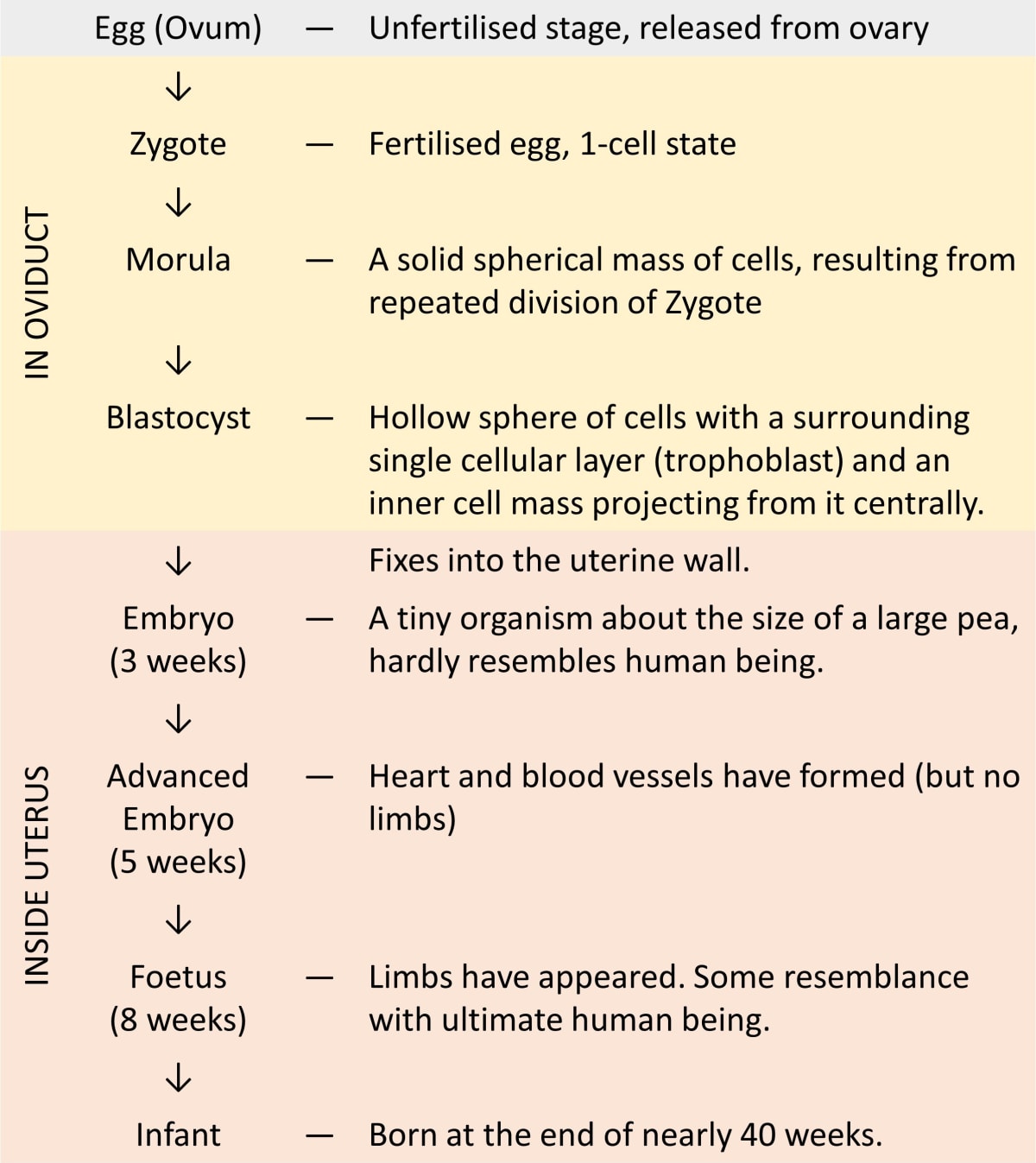
7Descriptive Type

Name and describe very briefly, the stages in the development of human embryo.

Show SolutionHide Solution↓

The different stages in the development of human embryo are described below:

Name and describe very briefly, the stages in the development of human embryo. The Reproductive System, Concise Biology Solutions ICSE Class 10.
8Descriptive Type

Is it correct to say that the testes produce testosterone? Discuss.

Show SolutionHide Solution↓

Testosterone is the male reproductive hormone produced by the interstitial cells or the Leydig cells. These cells are located in the testes. They serve as a packing tissue between the coils of the seminiferous tubules. Therefore, it can be said that the testes produce the male hormone testosterone.

1Structured / Application / Skill Type

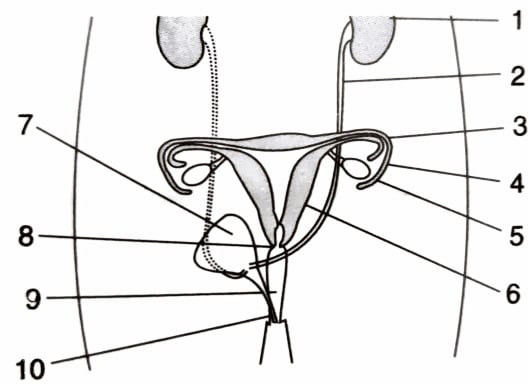
Given below is a diagram of two systems together in the human body.

Given below is a diagram of two systems together in the human body. Name the systems. Name the parts numbered 1-10. Describe the functions of the parts 3, 4, 5 and 6. What will happen if the part 3 on both sides gets blocked? The Reproductive System, Concise Biology Solutions ICSE Class 10.

(a) Name the systems.

(b) Name the parts numbered 1-10.

(c) Describe the functions of the parts 3, 4, 5 and 6.

(d) What will happen if the part 3 on both sides gets blocked?

Show SolutionHide Solution↓

(a) Excretory system and Female Reproductive system.

(b) The parts numbered 1-10 are:

  • 1 → Kidney
  • 2 → Ureter
  • 3 → Fallopian Tube
  • 4 → Oviducal Funnel
  • 5 → Ovary
  • 6 → Uterus
  • 7 → Urinary Bladder
  • 8 → Cervix
  • 9 → Vagina
  • 10 → Vulva

(c) Functions of the parts are:

  • Fallopian Tube (part 3) — The fallopian tubes carry the ovum released from the ovary to the uterus.
  • Oviducal Funnel (part 4) — It is the funnel shaped distal end of the ovary which picks up the released ovum and pushes it further on its passage into the fallopian tube.
  • Ovary (part 5) — Ovary produces female gametes i.e. ova.
  • Uterus (part 6) — Uterus allows the growth and development of the embryo.

(d) If fallopian tube (part 3) on both sides gets blocked, the ovum released by the ovary will not be pushed into the oviduct and hence, there will be no possibility of fertilisation.

2Structured / Application / Skill Type

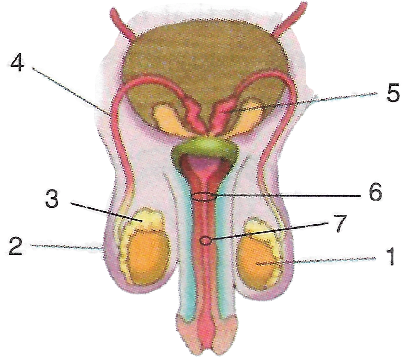
The figure given ahead is an organ system of humans. Study the same and answer the following questions.

The figure is an organ system of humans. Identify the organ system. Label the guidelines 1 to 7. The Reproductive System, Concise Biology Solutions ICSE Class 10.

(a) Identify the organ system.

(b) Label the guidelines 1 to 7.

(c) Write one important role of parts 3 and 6.

(d) Name the cells of part 1 that produce testosterone.

(e) What is the significance of the part 1 being located in a separate sac suspended outside the body ?

Show SolutionHide Solution↓

(a) Male Reproductive Organ System

(b)

  • 1 → Testes
  • 2 → Scrotal sac
  • 3 → Epididymis
  • 4 → Sperm duct
  • 5 → Seminal vesicle
  • 6 → Bulbo-Urethral Gland
  • 7 → Urethra

(c) Part 3 (Epididymis) — It stores the sperms for some days during which they mature and become motile.
Part 6 (Bulbo-Urethral Gland) — Their secretion serves as a lubricant.

(d) Leydig cells

(e) The normal body temperature does not allow the maturation of the sperms. Being suspended outside the body cavity, the temperature in the scrotal sac is 2 to 3°C lower than that of the body which is the suitable temperature for the maturation of the sperms.

3Structured / Application / Skill Type

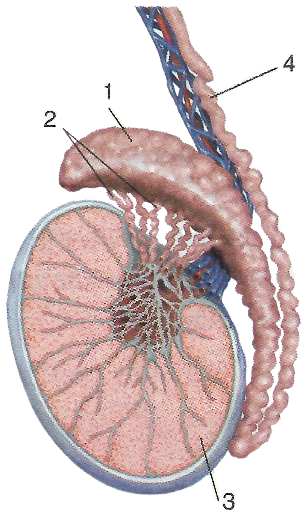
The figure given below is an important gonad of humans. Study the figure and answer the following questions.

The figure is an important gonad of humans. Identify the organ. Write its specific location in the body. The Reproductive System, Concise Biology Solutions ICSE Class 10.

(a) Identify the organ. Write its specific location in the body.

(b) Label the parts shown in the figure as 1 to 4.

(c) Write important functions of parts 2 and 4.

(d) Name one cellular structure and one hormone which are produced in part 3.

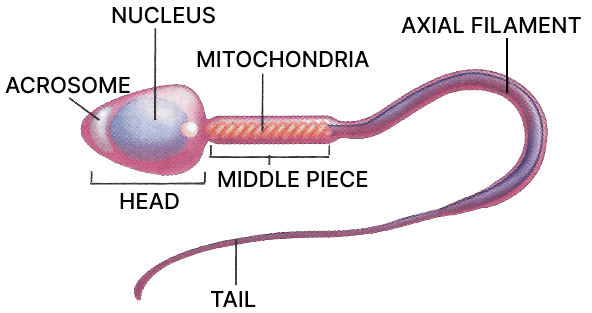
(e) Draw a neat and labelled diagram of the cellular structure mentioned by you in (d).

Show SolutionHide Solution↓

(a) Testis.
They are located in scrotal sac.

(b)

  • 1 → Epididymis
  • 2 → Efferent ducts
  • 3 → Seminiferous tubules
  • 4 → Sperm duct

(c) Efferent ducts (Part 2) conduct sperm to epididymis.
Sperm duct (Part 4) transmit sperms from testes to urethra.

(d) Sperms and testosterone.

(e) Labelled diagram of the cellular structure of the sperm is given below:

Labelled diagram of the cellular structure of the sperm. The Reproductive System, Concise Biology Solutions ICSE Class 10.
4Structured / Application / Skill Type

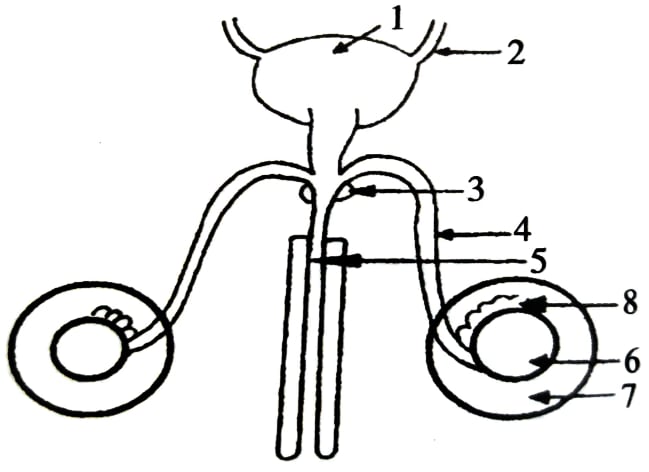
Given below is the outline of the male reproductive system. Name the parts labelled 1 to 8. Also name the corresponding structure of part (4) in the female reproductive system.

Given below is the outline of the male reproductive system. Name the parts labelled 1 to 8. Also name the corresponding structure of part (4) in the female reproductive system. The Reproductive System, Concise Biology Solutions ICSE Class 10.
Show SolutionHide Solution↓
  • 1 → Urinary bladder
  • 2 → Ureter
  • 3 → Bulbo-urethral glands
  • 4 → Sperm duct/Vas deferens
  • 5 → Urethra
  • 6 → Testis
  • 7 → Scrotum
  • 8 → Epididymis

Fallopian tubes (oviducts) in females are analogous to sperm ducts in males. Sperm ducts carry sperms to the urethra, while fallopian tubes carry ova to the uterus.

5Structured / Application / Skill Type

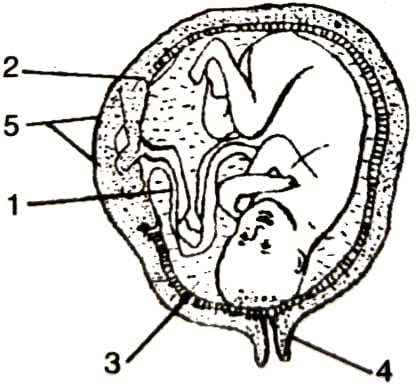
The diagram below is that of a developing human foetus in the womb. Study the same and answer the questions that follow:

The diagram  below is that of a developing human foetus in the womb. Study the same and answer the questions. Name the parts 1 to 5 indicated by guidelines. What term is given to the period of development of the foetus in the womb? How many days does the foetus take to be fully developed? Mention two functions of the parts labelled 2 other than its endocrine functions. Name any one hormone produced by the part labelled 2. The Reproductive System, Concise Biology Solutions ICSE Class 10.

(a) Name the parts '1' to '5' indicated by guidelines.

(b) What term is given to the period of development of the foetus in the womb?

(c) How many days does the foetus take to be fully developed?

(d) Mention two functions of the parts labelled '2' other than its endocrine functions.

(e) Name any one hormone produced by the part labelled '2'.

Show SolutionHide Solution↓

(a) The parts 1 to 5 are:

  • 1 → Umbilical cord
  • 2 → Placenta
  • 3 → Amnion
  • 4 → Mouth of uterus
  • 5 → Muscular wall of uterus

(b) Gestation

(c) 280 days

(d) Placenta provides the foetus with oxygen and nutrients. In addition, the placenta also removes carbon dioxide and waste products of the foetus.

(e) Progesterone

6Structured / Application / Skill Type

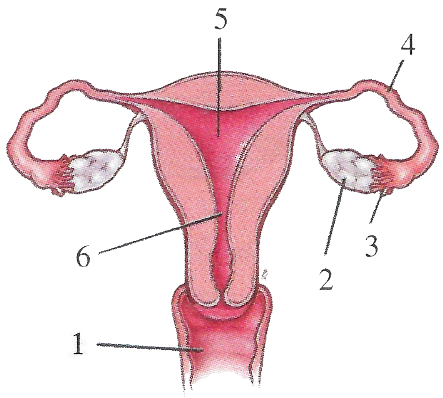
The figure given below is the human female reproductive system. Study the same and answer the following questions.

The figure is the human female reproductive system. Label the guidelines 1 to 6 shown in the figure. The Reproductive System, Concise Biology Solutions ICSE Class 10.

(a) Label the guidelines 1 to 6 shown in the figure.

(b) What is the normal gestation period in human ?

(c) Where are the sperms released during coitus ?

(d) Write two important functions of part 2.

(e) Mention the technical term for the fixing of developing zygote to the uterine wall.

Show SolutionHide Solution↓

(a) The labelled guidelines are:

  • 1 → Vagina
  • 2 → Ovary
  • 3 → Funnel of Oviduct
  • 4 → Fallopian tube
  • 5 → Uterus
  • 6 → Uterus lining

(b) 280 days

(c) Vagina

(d) Ovary releases egg and produces hormones (oestrogen, progesterone)

(e) Implantation

7Structured / Application / Skill Type

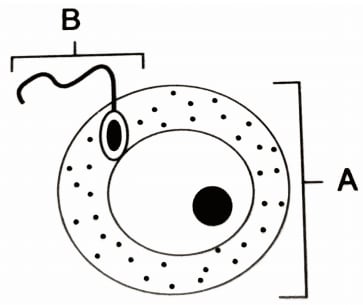
The diagram below represents two reproductive cells A and B. Study the same and then answer the questions that follow:

The diagram below represents two reproductive cells A and B. Study the same and then answer the questions. Identify the reproductive cells A and B Name the specific part of the reproductive system where the above cells are produced. Where in the female reproductive system do these cells unite? Name the main hormone secreted by the (1) ovary (2) testes. Name an accessory gland found in the male reproductive system and state the function of its secretion. The Reproductive System, Concise Biology Solutions ICSE Class 10.

(a) Identify the reproductive cells A and B

(b) Name the specific part of the reproductive system where the above cells are produced.

(c) Where in the female reproductive system do these cells unite?

(d) Name the main hormone secreted by the (1) ovary (2) testes.

(e) Name an accessory gland found in the male reproductive system and state the function of its secretion.

Show SolutionHide Solution↓

(a) The reproductive cells A and B are:

  • A → Ovum
  • B → Sperm

(b) Parts of the reproductive system where the above cells are produced are:

  • Sperms are produced in the testis.
  • The ovum is produced in the ovary.

(c) The reproductive cells unite in the fallopian tubes of the female reproductive system.

(d) The main hormone secreted are:

  • Ovary → Oestrogen and progesterone
  • Testis →Testosterone

(e) Accessory glands found in the male reproductive system along with their functions are mentioned below:

  • Seminal vesicle — They produce a secretion which serves as a medium for the transportation of the sperms.
  • Prostate gland — It produces an alkaline secretion which mixes with the semen and helps neutralise acid in female's vagina.
  • Bulbo-urethral gland — They produce a secretion which serves as a lubricant.

Press ↓ to reveal a solution and move to the next question. Back to Selina Concise Biology.

Free sample bank