1
Name the three great cultural revolutions that favoured a steep rise in population.
Show SolutionHide Solution↓
- Tool making revolution
- Agricultural revolution
- Scientific industrial revolution
ICSE Class 10 Biology · Selina Concise Biology · 50 solved questions
Name the three great cultural revolutions that favoured a steep rise in population.
Mention two areas of medical sciences which have indirectly contributed to high growth in human population.
Is the present day human population growth following a J-shaped curve or S-shaped curve?
S-shaped curve
Write any six factors which have contributed to a rapid rise of human population in recent times in the world.
Factors which have contributed to a rapid rise of human population in recent times in the world are:
Give the approximate figures for the population in India in million at (a) the beginning and (b) the end of twentieth century.
(a) 238 millions
(b) 1027 millions
Mention whether the following statements are True or False.
(i) Urbanisation is the enlargement of towns covering a very large area together with modern facilities.
(ii) Rising population is leading to an increased coverage of land for raising forests.
(iii) Coal and iron are inexhaustible resources.
(i) True
(ii) False
Corrected Statement — Rising population is leading to decreased coverage of land for raising forests.
(iii) False
Corrected Statement — Coal and iron are exhaustible resources.
Fill up the blanks by choosing the right option.
(i) Public conveyances like buses and railways are ............... (necessities/luxuries).
(ii) Many sets of garments per member in a family is ............... (a necessity/fashion).
(iii) Petroleum is a resource of the same category as that of ............... (copper/ground water).
(i) Public conveyances like buses and railways are necessities.
(ii) Many sets of garments per member in a family is fashion.
(iii) Petroleum is a resource of the same category as that of copper.
Give the technical terms for the following :
(i) Statistical study of human population.
(ii) Number of deaths per 1000 people per year.
(iii) Number of individuals per sq. km. at any given time.
(iv) Difference between birth rate and death rate.
(i) Demography
(ii) Death rate or Mortality
(iii) Birth rate or Natality
(iv) Growth rate of population
List any three consequences of high population density.
Three consequences of high population density are:
List any five major disadvantages of having large families.
Five major disadvantages of having large families are:
What are the age restrictions for marriage for boys and girls respectively in India ?
The age restrictions for marriage for boys is 21 years and for girls is 18 years.
What are the three aspects covered under family welfare ?
The three aspects covered under family welfare are:
State whether the following statements are True (T) or False (F). If false, write the correct word for the one which is wrong.
(i) Some vitamin preparations prevent the release of the egg from the ovary.
(ii) Use of a condom for contraception is a barrier method.
(iii) IUDs prevent implantation of embryo in vagina.
(iv) Tubectomy is performed on females.
(i) False
Corrected Statement — Some hormones prevent the release of the egg from the ovary.
(ii) True
(iii) False
Corrected Statement — IUDs prevent implantation of embryo in uterus.
(iv) True
Write the full form of MTP. In what circumstances is it recommended?
MTP stands for Medical Termination of Pregnancy.
It is recommended in case of serious genetic disease or if the couple does not want to have the child. It is only permitted within 5 months of pregnancy.
The statistical study of human population is :
Demography
Reason — Demography is the statistical study of human population with reference to size and density, distribution etc.
Surgical method of sterilization in women involves cutting and tying of :
Fallopian tube
Reason — Surgical method of sterilization in women involves cutting and tying of fallopian tube which does not allow eggs to pass to uterus.
When the number of individuals added to the population exceeds the number of individuals lost, there is :
Exponential population growth
Reason — When the number of individuals added to the population exceeds the number of individuals lost, there is exponential population growth.
The symbol of family welfare is :
Red inverted triangle
Reason — The symbol of family welfare is a red inverted triangle as shown below:

Death rate is the number of deaths:
per 1000 people per year
Reason — Death rate is the number of deaths per 1000 of population per year.
What was directly responsible for the rapid rise of world population in the twentieth century ?
Better healthcare
Reason — Better healthcare facilities lead to decreased death rate and hence increase in population.
Which of the following is not a non-conventional source of energy ?
Petroleum energy
Reason — Petroleum energy is a conventional source of energy.
Birth rate is technically termed as :
Natality
Reason — Birth rate is technically termed as natality.
Which of the following is an exhaustible source of energy ?
Fossil fuels
Reason — Fossil fuels are exhaustible source of energy.
What are the age restrictions for marriage by law for boys and girls in India?
21 years, 18 years
Reason — The age restrictions for marriage by law for boys and girls in India is 21 years and 18 years respectively.
Increasing population would need more and more energy. So various new sources of energy, like solar energy, tidal energy and wind energy are being used to cope with the rising energy demands. The figure given below shows a solar battery which can be used to produce energy for big buildings like schools, hospitals, etc.

Which of the following options holds true for solar energy ?
Solar energy is non-conventional and renewable
Reason — Solar energy is a non-conventional source of energy and is renewable because it is obtained from the Sun, which is a continuous source of energy.
Assertion (A): Population density is the number of individuals in an area of 100 square kilometers per year.
Reason (R): Population density gives us an idea of all the living organisms of different species in a particular area every year.
Both A and R are False.
Explanation
Population density is the number of individuals per square kilometer. It gives an idea of average number of individuals of a species living in an area.
Assertion (A): Tubectomy is a temporary method of contraception for males in which the sperm ducts are cut and ligated with a nylon thread.
Reason (R): Tubectomy closes the passage of the sperms. The sperm duct is also known as vas deferens, which stores the sperms for some days during which they mature and become motile.
Both A and R are False.
Explanation
Tubectomy, also known as female sterilization, is a surgical procedure that involves blocking or sealing a woman’s fallopian tubes to prevent the eggs from reaching the uterus. It is a permanent method of contraception.
Assertion (A): Fossil fuels are renewable and non-conventional sources of energy.
Reason (R): The underground reserves of coal and petroleum are depleting fast. People should look at other non-conventional sources of energy like solar energy, tidal energy, etc. for their use.
A is False and R is True.
Explanation
Fossil fuels are non-renewable or conventional sources of energy. They are limited in amount.
Give the technical term for statistical study of human population of a region.
Demography
Name two surgical techniques (one for the human male and another for the human female) that can be used to prevent pregnancy.
Mention whether the following statements are true (T) or false (F).
(a) Vasectomy is the surgical method of sterilisation in human males.
(b) Tubectomy is the placing of a diaphragm on the cervix.
(c) Cow was the first domesticated animal.
(d) Rapidly growing industries favoured population rise.
(e) Present human population growth is following arithmetic progression.
(f) Birth rate (natality) is the number of live births per hundred people of population per decade.
(g) Tubectomy is a popular surgical method of contraception in human males.
(a) True
(b) False
Corrected statement — In tubectomy, fallopian tubes are cut or ligated i.e. tied with nylon thread to close the passage of the egg.
(c) False
Corrected statement — Dog was the first domesticated animal.
(d) True
(e) False
Corrected statement — Present human population growth is following geometrical progression.
(f) False
Corrected statement — Birth rate (natality) is the number of live births per 1000 people of population per year.
(g) False
Corrected statement — Vasectomy is a popular surgical method of contraception in human males.
Give two advantages of a small family.
Two advantages of small family are:
List three major landmarks in human history which contributed to the sudden rise in population of the world.
The three major landmarks in human history which contributed to the sudden rise in population of the world were:
What is meant by family welfare centres? What is the symbol of family welfare in our country?
The department which plays a significant role in controlling population and is committed to provide advice and help about family planning is known as Family Welfare Centre Department. These places could be any hospitals, dispensaries, etc. The inverted red triangle as shown below is the symbol of family welfare in India.
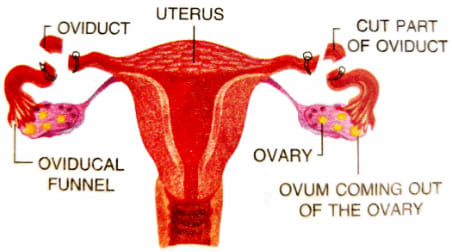
Sterilisation in men means preventing the flow of sperms into the seminal vesicles by cutting and ligating the vas deferens. Can there be a corresponding operation made in women? If yes, where?
Yes, there could be a corresponding operation made in women. The name of the surgical procedure in females is 'tubectomy'. In tubectomy, the abdomen is opened and the fallopian tubes (oviducts) are cut or ligated i.e. tied with nylon thread to close the passage of the egg. Diagram showing the procedure of tubectomy is shown below:
Write the full forms of the following abbreviations:
(a) IUDs
(b) MTP
(a) IUDs — Intra-Uterine Devices
(b) MTP — Medical Termination of Pregnancy
Explain briefly the relationship between poverty and population and how one affects the other.
Poverty and the lack of access to education leads to higher birthrates and overpopulation. Rapid population growth is likely to reduce per capita income growth and well being, which tends to increase poverty. Poverty is believed to be the leading cause of overpopulation. Poverty and population have been closely linked ever since the world faced changes due to the major revolutions. Poverty has its own effects on the population and vice versa. Poverty prevails because of illiteracy and traditional beliefs in the economically weaker strata. Since illiteracy and traditional beliefs prevail in the people from this stratum, they regard children as gift of God and a sign of prosperity. They consider children to be helping hands in increasing the family income, hence they keep producing more children forgetting that their current situation would do no good for the children and they would add more to this already overburdened poverty strata. Hence, the population keeps on rising and so does poverty. As the population increases the quality of life goes down.
Mention two reasons for the rapid increase of population in India.
Two reasons for the rapid increase of population in India are:
Match the terms given in column A with those in column B.
| Column A | Column B |
|---|---|
| (a) Forest | (i) Arithmetic progression |
| (b) Food | (ii) Geometric progression |
| (c) Population | (iii) Deforestation |
| (d) Coal | (iv) Afforestation |
| (e) Flash floods | (v) Renewable source of energy |
| (vi) Non-renewable source of energy |
| Column A | Column B |
|---|---|
| (a) Forest | (v) Renewable source of energy |
| (b) Food | (i) Arithmetic progression |
| (c) Population | (ii) Geometric progression |
| (d) Coal | (vi) Non-renewable source of energy |
| (e) Flash floods | (iii) Deforestation |
Given below are some sets of paired terms. The first pair indicates the relationship between the two terms. Rewrite and complete the second pair on a similar basis.
(a) Death rate : Mortality :: Birth rate : ...............
(b) Tubectomy : Oviduct :: Vasectomy : ...............
(c) Intrauterine device : Copper-T :: Oral pills: ...............
(d) Barrier method : Diaphragms :: Surgical method : ...............
(e) Cutting down of forests : Deforestation :: Planting more trees: ...............
(a) Death rate : Mortality :: Birth rate : Natality
(b) Tubectomy : Oviduct :: Vasectomy : Vas deferens
(c) Intrauterine device : Copper-T :: Oral pills: Mala-D
(d) Barrier method : Diaphragms :: Surgical method : Tubectomy
(e) Cutting down of forests : Deforestation :: Planting more trees: Afforestation
Define the following terms:
(a) Population
(b) Population density
(c) Demography
(d) Resources
(e) Growth rate of population
(a) Population — A population is defined as a group of individuals of the same species living and interbreeding within a given area.
(b) Population density — It is the number of individuals per square kilometre (km2) at any given time.
(c) Demography — It is the statistical study of human population specifically with reference to size and density, distribution and other vital statistics.
(d) Resources — Resource is any substance (natural or artificial), energy or organism which is used by humans for their welfare.
(e) Growth rate of population — It is the difference between the birth rate and the death rate. As long as the birth rate exceeds the death rate, the population grows. If the birth rate is lower than the death rate, the population declines.
Distinguish between the following pairs:
(a) Exhaustible and Inexhaustible resources
(b) Conventional and Non-conventional sources of energy
(c) Natality and Mortality
(d) Tubectomy and Vasectomy
(e) Deforestation and Afforestation
(a) Difference between exhaustible and inexhaustible resources —
| Exhaustible resources | Inexhaustible resources |
|---|---|
| Resources which cannot be renewed readily by natural means and are available in finite quantities in nature which can be easily consumed are called exhaustible resources. | Resources which are abundantly available in nature and can be used for unlimited time and cannot be exhausted by humans are called inexhaustible resources. |
| Examples: Coal, petroleum. | Examples: Wind, sun |
(b) Difference between conventional and non-conventional sources of energy —
| Conventional sources of energy | Non-conventional sources of energy |
|---|---|
| Conventional sources of energy are the natural energy resources which are present in a limited quantity and are being used for a long time. | Non-conventional sources of energy are the energy sources which cannot be exhausted easily and are continuously replenished by natural processes. |
| Examples: Coal, petroleum. | Examples: Solar energy, wind energy. |
(c) Difference between natality and mortality:
| Natality | Mortality |
|---|---|
| The total number of live births per 1000 people of population per year is called birth rate or natality. | The total number of deaths per 1000 people of population per year is called death rate or mortality. |
(d) Difference between tubectomy and vasectomy —
| Tubectomy | Vasectomy |
|---|---|
| It is the process which involves cutting or ligating of fallopian tubes by nylon thread to close the passage of egg. | It is the process in which vas deferens from each testes is ligated and a small piece between the two ligatures is removed. |
| It is contraceptive practice in females. | It is contraceptive practice in males. |
(e) Difference between deforestation and afforestation —
| Deforestation | Afforestation |
|---|---|
| It is the destruction of trees and forests for human habitation and use. | It is the planting of trees in a previously barren environment. |
| It has a detrimental effect on the environment. | It has a beneficial effect on the environment. |
What do you mean by the 3Rs in the context of sustainable development?
The 3Rs in the context of sustainable development are Reduce, Reuse and Recycle.
Reduction of excessive use of natural resources.
Recycling and reuse of resources wherever possible.
More use of renewable resources such as solar energy, wind power,etc.
Our resources cannot keep pace with the rising population. Give three examples in support of this statement.
Three examples which show that our resources cannot keep pace with the rising population are explained below:
How can the knowledge of the processes of reproduction help people in limiting the size of their families? Give two concrete examples.
It is necessary that the people should be educated about the need to limit the population and about the steps which can be taken in this direction —
What is the idea behind the phrase "population explosion"?
Population explosion refers to the rapid and massive rise in the world population that has occurred over the last few hundred years. It began in the middle of the nineteenth century. Two-thirds of the present world population belongs to the developing nations where more than half the people live below the poverty line. The effects of this population increase are evident in increasing poverty, unemployment, air and water pollution, and shortage of food, health resources, and educational resources. Some of the reasons for this population explosion are poverty, lack of family planning knowledge, certain superstitions, better medical facilities, and immigration from the neighbouring countries. For developing countries like India, population explosion is a curse and is damaging the development of the country and its society.
Given below are hypothetical figures in regard to population (in crores) of two countries A and B during the last three decades.
| Country | 1971 | 1981 | 1991 |
|---|---|---|---|
| A | 6.4 | 9.6 | 10.6 |
| B | 15.7 | 15.7 | 15.3 |
Fill in the blanks:
(a) Rate of growth of population of country ............... has declined between years ............... and ............... .
(b) The country ............... shows negative population growth between years ............... and ............... .
(c) The country ............... shows zero population growth between years ............... and ............... .
(a) Rate of growth of population of country B has declined between years 1981 and 1991
(b) The country B shows negative population growth between years 1981 and 1991
(c) The country B shows zero population growth between years 1971 and 1981.
Observe the diagrams (A) and (B) given below and answer the following questions.

(a) Label the parts 1 to 5.
(b) What does figure A depict?
(c) What does figure B depict?
(d) Comment on P and Q.
(e) Mention one function each of part 2 and 4.
(a) The parts 1 to 5 are labelled below:
(b) Figure A depicts Vasectomy
(c) Figure B depicts Tubectomy
(d) P is the cut part of vas deferens while Q is the cut part of the oviduct. A small piece of oviduct in females and vas deferens in males is cut and then the remaining portions are ligated as a part of the contraceptive process of tubectomy and vasectomy respectively.
(e) One function each of part 2 and 4 is mentioned below:
Kishan and Malti are married and have three children. They have decided not to have any more children and are considering permanent surgical methods of contraception.
(a) Which surgical method can Kishan undergo ?
(b) Can Malti also undergo some sort of a permanent surgical method like Kishan as answered by you in (a)?
(c) Out of (a) and (b), explain why (a) is preferred over (b) when considering permanent contraception ?
(a) Kishan can undergo vasectomy.
(b) Yes, Malti can undergo a permanent surgical method called tubectomy.
(c) Vasectomy is preferred over tubectomy because it is a simpler surgical procedure, takes less time, and is safer than tubectomy.
Rising population is one of the major issues that India is facing currently. It has adversely impacted the environment as well as food production capacity. Answer the questions that follow :
(a) Mention two main factors responsible for population explosion.
(b) 'It is the need of the hour to adopt population control measures'. Give two reasons to substantiate the above statement.
(c) Mention two Intro Uterine Devices (IUDs) that are commonly used for contraception in India.
(a) Two main factors responsible for population explosion are:
(b) It is necessary to adopt population control measures as:
(c) Two commonly used Intra-Uterine Devices (IUDs) in India are:
Press ↓ to reveal a solution and move to the next question. Back to Selina Concise Biology.