Photosynthesis

ICSE Class 10 Biology · Selina Concise Biology · 55 solved questions

Exercise
Marks
1Progress Check 1

Answer the following in "Yes" or "No"

(i) All parts of a green plant carry out photosynthesis.

(ii) All green parts of a plant carry out photosynthesis.

(iii) Photosynthesis is the only biological process that releases oxygen into the air.

(iv) Out of nine types of chlorophylls, chlorophyll a and b are the most abundant.

(v) Too much light destroys chlorophyll.

(vi) No transpiration occurs during photosynthesis.

(vii) During sunlight, the guard cells turn flaccid to open the stomata.

Show SolutionHide Solution↓

(i) No
Corrected Statement — A few parts of a green plant like roots and flowers does not carry out photosynthesis as they lack chloroplasts and chlorophyll.

(ii) Yes

(iii) Yes

(iv) Yes

(v) Yes

(vi) No
Corrected Statement — Photosynthesis and transpiration go on side by side.

(vii) No
Corrected Statement — During sunlight, the guard cells turn turgid to open the stomata.
1Progress Check 2

Write the overall summary of the chemical equation of photosynthesis.

Show SolutionHide Solution↓

$6\text{CO}_2 + 12\text{H}_2\text{O} \xrightarrow[\text{chlorophyll}]{\text{light energy}} \text{C}_6\text{H}_{12}\text{O}_6 + 6\text{H}_2\text{O} + 6\text{O}_2 \uparrow$

2Progress Check 2

Which single substance in the above equation is repeated in raw material as well as reproduced as an end product?

Show SolutionHide Solution↓

Water

3Progress Check 2

What is the source of oxygen released in photosynthesis — CO2 or H2O ?

Show SolutionHide Solution↓

H2O

4Progress Check 2

What happens in photolysis?

Show SolutionHide Solution↓

The energy of Sun absorbed is used in splitting the water molecule into its two components (Hydrogen and Oxygen) and releasing electrons. This process is termed as photolysis.

5Progress Check 2

Dark reaction involves utilisation of CO2 in producing C6H12O6 (glucose). Why is this phase called dark reaction ?

Show SolutionHide Solution↓

The given reaction does not require light. It can occur during day as well as night. Therefore, it is known as Dark reaction.

6Progress Check 2

Glucose produced during photosynthesis is soon polymerised into starch. What does polymerisation mean?

Show SolutionHide Solution↓

The process of conversion of many simpler molecules into a complex, bigger molecule is termed as polymerisation. Several molecules of glucose join together to form a starch molecule.

7Progress Check 2

Why is it better to call the dark phase of photosynthesis as "light-independent phase"?

Show SolutionHide Solution↓

The old term 'dark-phase' did not mean that it occurs when it is dark i.e. night. It only means that the reactions are not dependent on light. That is why, it is now better called as "light-independent phase".

1Progress Check 3

How do the following favour increased photosynthesis?

(i) Large surface area of the leaf.

(ii) Thinness of the leaf.

(iii) More numerous stomata.

Show SolutionHide Solution↓

(i) Large surface area of the leaf enables maximum light absorption by plant. Increased absorption of solar energy increases the Photosynthesis.

(ii) Thinness of the leaf reduces the distance between cells facilitating rapid transport of raw materials and translocation of food.

(iii) More numerous stomata allow rapid gaseous exchange and speed up the process of photosynthesis.

2Progress Check 3

Name the three end-products of photosynthesis and mention the fate of each of them in the plant.

Show SolutionHide Solution↓

The three end products of photosynthesis are:

  1. Glucose (C6H12O6) — It is used in following four ways:
    1. immediately consumed by the plant cells
    2. stored in the form of insoluble starch
    3. converted into sucrose
    4. used in synthesizing fats, proteins,etc.
  2. Water — can be reutilized in continuance of photosynthesis.
  3. Oxygen — It is used in respiration in the leaf cells. Extra oxygen is released and diffused out in atmosphere.
3Progress Check 3

If we keep on increasing CO2 concentration in the air, will the rate of photosynthesis also keep on increasing in direct proportion? Yes/No. Explain.

Show SolutionHide Solution↓

Increasing carbon dioxide concentration increases rate of photosynthesis but it is stabilised at a particular point (upto 0.02% of CO2 ) if there is no change in light intensity. If the light intensity is increased then increase in carbon dioxide concentration further increases the rate of photosynthesis and is again stabilised at 0.05% of CO2.

1Progress Check 4

Why is it necessary to destarch the leaves of a plant before performing an experiment on photosynthesis?

Show SolutionHide Solution↓

In any experiment on photosynthesis, the presence of starch shows that the process of photosynthesis occurred. Therefore it is necessary to remove any pre-existing starch from the leaves. For destarching, the plant is kept for 24-48 hours in dark. It stops the synthesis of starch and the pre-existing starch, by then, is removed from leaves and is stored in storage organs.

2Progress Check 4

Why do we perform the iodine test ?

Show SolutionHide Solution↓

We perform the iodine test to test the presence of starch.

3Progress Check 4

What chemical do you use to remove CO2 from inside a flask in certain experiments on photosynthesis ?

Show SolutionHide Solution↓

Potassium hydroxide

4Progress Check 4

All food chains start with a plant. Why is this so?

Show SolutionHide Solution↓

The plants are called producers. They are the only organism with ability to convert the solar energy into chemical energy of the food. Therefore, all food chains start with a plant.

5Progress Check 4

The honey bee produces honey. In terms of the food chain, is the honey bee a producer or a consumer?

Show SolutionHide Solution↓

In terms of food chain, the honey bee is a consumer as it consumes plant nectar and derive its energy from nectar to carry out all the physiological processes. Honey produced by it is derived indirectly from plants. Therefore, Honey bee cannot be called as a producer.

11 Mark · Multiple Choice Type

Chlorophyll is located in :

Show SolutionHide Solution↓

Thylakoid

Reason — Chlorophyll is located in the walls of thylakoid.

21 Mark · Multiple Choice Type

Which of the following is not applicable to the process of photosynthesis ?

Show SolutionHide Solution↓

Carbon dioxide is evolved

Reason — In the process of photosynthesis, carbon dioxide is absorbed and oxygen is evolved as a by-product.

31 Mark · Multiple Choice Type

The colour of VIBGYOR spectrum which is reflected by chlorophyll is:

Show SolutionHide Solution↓

Green

Reason — The colour of any object is the light that is reflected by it. The chlorophyll reflects green colour and therefore it is green to our eyes.

41 Mark · Multiple Choice Type

The basic functional unit of solar energy which is absorbed by the pigment chlorophyll is:

Show SolutionHide Solution↓

Photon

Reason — The basic functional unit of solar energy is photon that is absorbed by the chlorophyll molecules and this leads to start of chain of reactions of photosynthesis.

51 Mark · Multiple Choice Type

The molecules of water split during:

Show SolutionHide Solution↓

Photolysis

Reason — The chlorophyll molecule absorbs solar energy and this energy is used to split the water molecule. This process ia called photolysis. (photo means light, lysis means disintegration)

61 Mark · Multiple Choice Type

The granum is a pile of many :

Show SolutionHide Solution↓

Thylakoids

Reason — Stacked thylakoids are known as granum.

71 Mark · Multiple Choice Type

Which of the following is used to remove chlorophyll from the leaves:

Show SolutionHide Solution↓

Methylated spirit

Reason — The leaf is boiled in Methylated spirit to remove chlorophyll.

81 Mark · Multiple Choice Type

The raw material which is reduced during photosynthesis is :

Show SolutionHide Solution↓

Carbon dioxide

Reason — Carbon dioxide loses its oxygen or is reduced to form glucose. (loss of oxygen is reduction)

91 Mark · Multiple Choice Type

The optimum temperature for the process of photosynthesis is :

Show SolutionHide Solution↓

35°C

Reason — The rate of photosynthesis is maximum at 35°C and falls beyond it.

101 Mark · Multiple Choice Type

Conversion of several glucose molecules into starch is termed as :

Show SolutionHide Solution↓

Polymerisation

Reason — Polymerisation is the process by which simple monomers (glucose) join to form complex polymers (starch).

11Assertion Reason type

Assertion (A): Photosynthesis occurs in all parts of a green plant.

Reason (R): Chlorophyll is the green pigment which traps solar energy during daytime.

Show SolutionHide Solution↓

A is False and R is True.

Explanation
Photosynthesis only occurs in green parts of the plant. For example, roots and non-green tissues do not perform photosynthesis.
Chlorophyll is the pigment responsible for absorbing light energy from the sun, which is then used to drive the process of photosynthesis.

12Assertion Reason type

Assertion (A): Guard cells regulate the opening and closing of the stomatal aperture.

Reason (R): Guard cells contain chloroplasts and are mostly located on the lower surface of the leaves. Other cells of the lower epidermis do not contain chloroplasts.

Show SolutionHide Solution↓

Both A and R are True.

Explanation
Guard cells are found in the lower portion of leaf and their function is to close and open the stomata as per need. They contain chloroplasts and carry out photosynthesis.

13Assertion Reason type

Assertion (A): Palisade cells of mesophyll are loosely arranged towards the lower epidermis of a dorsiventral leaf.

Reason (R): Palisade cells contain the maximum amount of chlorophyll, trap solar energy and help in the process of photosynthesis.

Show SolutionHide Solution↓

A is False and R is True.

Explanation
Palisade cells of mesophyll are loosely arranged towards the upper epidermis of a dorsiventral leaf. They along with spongy tissues are engaged in photosynthesis.

14Assertion Reason type

Assertion (A): Phosphorylation occurs in all organisms only during the process of respiration.

Reason (R): Photophosphorylation is the process during which ADP combines with inorganic phosphate (iP) and produces ATP.

Show SolutionHide Solution↓

A is False and R is True.

Explanation
Phosphorylation, the process of adding a phosphate group to a molecule (like ADP to form ATP), occurs during both respiration and photosynthesis. In respiration, this process is called oxidative phosphorylation, while in photosynthesis, it is called photophosphorylation.

15Assertion Reason type

Assertion (A): A plant should be placed in dark for 24 to 48 hours before using it for experiments on photosynthesis.

Reason (R): During this period, all the starch from the leaves, is either utilized in the process of respiration or stored in the storage organs.

Show SolutionHide Solution↓

Both A and R are True.

Explanation
The plant is kept in the dark for 24 to 48 hours to destarch it. In the absence of light, photosynthesis does not occur, so no new starch is formed. During this time, the starch already present in the leaves is used in respiration or transported to the storage organs.

1Very Short Answer Type

Name the following:

(a) The category of organisms that prepare their own food from basic raw materials.

(b) The kind of plastids found in the mesophyll cells of the leaf.

(c) The compound which stores energy in the cells.

(d) The first form of food substance produced during photosynthesis.

(e) The source of CO2 for aquatic plants.

(f) The part of chloroplast where the dark reaction of photosynthesis takes place.

Show SolutionHide Solution↓

(a) Autotrophs.

(b) Chloroplasts.

(c) ATP (Adenosine triphosphate).

(d) Glucose.

(e) The carbon dioxide dissolved in water.

(f) Stroma.

2Very Short Answer Type

Given below are groups of terms. In each group, the first pair indicates the relationship between the two terms. Complete the second pair accordingly.

(a) Chlorophyll : Magnesium :: Haemoglobin : ............... .

(b) Light reaction : Granum :: Dark reaction : ............... .

(c) Producers : Autotrophs :: Consumers : ............... .

(d) Respiration : Carbon dioxide :: Photosynthesis : ............... .

(e) Water and minerals : Xylem :: Prepared food : ............... .

Show SolutionHide Solution↓

(a) Chlorophyll : Magnesium :: Haemoglobin : Iron

(b) Light reaction : Granum :: Dark reaction : Stroma

(c) Producers : Autotrophs :: Consumers : Heterotrophs

(d) Respiration : Carbon dioxide :: Photosynthesis : Oxygen

(e) Water and minerals : Xylem :: Prepared food : Phloem

3Very Short Answer Type

Given below is the internal structure of chloroplast. Read the information given ahead and fill in the blanks:

The chloroplast is an important cellular structure located in the green parts of the plant. It is covered by a double layered membrane. The main function of chloroplast is to prepare food material for all the parts of plant during daytime.

Given below is the internal structure of chloroplast. Read the information given ahead and fill in the blanks: Cell Cycle, Cell Division, Chromosomes, Concise Biology Solutions ICSE Class 10.

The chloroplast is a kind of (a) ............... suspended in the cytoplasm of the plant cells. It contains a vital pigment (b) ............... which traps solar energy for the process of (c) ............... . The photochemical phase of photosynthesis occurs in (d) ............... of granum and the biosynthetic phase occurs in the (e) ............... of chloroplast.

Show SolutionHide Solution↓

(a) Plastid

(b) Chlorophyll

(c) Photosynthesis

(d) Thylakoids

(d) Stroma

1Short Answer Type

Identify the false statements and rewrite them correctly by changing the first or last word only.

(a) Dark reaction of photosynthesis occurs during night time.

(b) Photosynthesis requires enzymes.

(c) Green plants are consumers.

(d) Photosynthesis results in loss of dry weight of the plants.

(e) Photosynthesis stops at a temperature of about 35°C.

(f) Photosynthesis occurs only in cells containing chloroplasts.

(g) Green plants perform photosynthesis.

(h) Algae are autotrophs.

Show SolutionHide Solution↓

(a) False
Corrected statement — Dark reaction of photosynthesis occurs simultaneously with light reaction.

(b) True

(c) False
Corrected statement — Green plants are producers.

(d) False
Corrected statement — Respiration results in loss of dry weight of the plants.

(e) False
Corrected statement — Photosynthesis stops at a temperature of about 40°C.

(f) True

(g) True

(h) True

2Short Answer Type

Fill in the blanks with the appropriate answer from the choices given in the brackets.

(a) The site of light reaction in the cells of a leaf is ............... (cytoplasm, stroma, grana).

(b) The chemical substance used to test the presence of starch in the cell of a leaf is ............... (CaCl2, iodine solution, Benedict solution).

(c) Stroma is the ground substance in ............... (cytoplasm, chloroplast, ribosomes).

(d) The dark reaction of photosynthesis is known as ............... (Hill reaction, cyclic phosphorylation, Calvin cycle).

(e) In the flowering plants, food is transported in the form of ............... (sucrose, glucose, starch).

Show SolutionHide Solution↓

(a) The site of light reaction in the cells of a leaf is grana.

(b) The chemical substance used to test the presence of starch in the cell of a leaf is iodine solution.

(c) Stroma is the ground substance in chloroplast.

(d) The dark reaction of photosynthesis is known as Calvin cycle.

(e) In the flowering plants, food is transported in the form of Sucrose.

3Short Answer Type

Are the following statements true or false? Give reason in support of your answer.

(a) The rate of photosynthesis continues to rise as long as the intensity of light rises.

(b) The outside atmospheric temperature has no effect on the rate of photosynthesis.

(c) If you immerse a leaf intact on the plant in ice cold water, it will continue to photosynthesise in bright sunshine.

(d) Destarching of the leaves of a potted plant can occur only at night.

(e) If a plant is kept in bright light all the 24 hours for a few days, the dark reaction (biosynthetic phase) will fail to occur.

(f) Photosynthesis is considered as a process supporting all life on earth.

Show SolutionHide Solution↓

(a) False
Corrected statement — Photosynthesis increases with the light intensity up to a certain limit only, and then it gets stabilised at the point S'(0.02% CO2).

(b) False
Corrected statement — The atmospheric temperature is an important external factor affecting photosynthesis. With the rise in temperature, the rate of photosynthesis rises. This rise occurs up to the optimum temperature of 35°C (maximum suitable temperature when the photosynthesis occurs best) after which the rate falls and stops above 40°C.

(c) False
Corrected statement — Ice cold water will hamper the process of photosynthesis in the immersed leaf, even if there is sufficient sunshine because the temperature is an important factor for the rate of photosynthesis.

(d) False
Corrected statement — For destarching, the potted plant can be kept in a dark room for 24-48 hours. During this period, all the starch will be removed from the leaves and stored in the storage organs.

(e) False
Corrected statement — If a plant is kept in bright light all the 24 hours for a few days, the dark reaction (biosynthetic phase) will continue to occur because the dark reaction is independent of light and it occurs simultaneously with the light dependent reaction.

(f) True

4Short Answer Type

Given below are five terms. Rewrite the terms in the correct order so as to be in logical sequence with regard to photosynthesis: (i) water molecules, (ii) oxygen, (iii) grana, (iv) hydrogen and hydroxyl ions, (v) photons.

Show SolutionHide Solution↓

Photons, grana, water molecules, hydrogen and hydroxyl ions, oxygen.

5Short Answer Type

State any four differences between photosynthesis and respiration.

Show SolutionHide Solution↓
PhotosynthesisRespiration
Photosynthesis utilizes carbon dioxide and water in the presence of light to produce glucose and oxygen.Respiration uses oxygen and glucose to power the activities of the cell.
Photosynthesis results in gain of dry weight of the plants.Respiration results in loss of dry weight of the plants.
The raw materials for the photosynthesis are water, carbon dioxide and sunlight.The raw material for respiration is glucose.
Photosynthesis occurs in plants and some photosynthetic bacteria.Respiration occurs in all living organisms.
6Short Answer Type

Complete the following food chains by writing the names of appropriate organisms in the blanks:

(i) Grass → ............... → Snake → ...............

(ii) ............... → Mouse ............... → Peacock

Show SolutionHide Solution↓

(i) Grass → Grasshopper → Snake → Hawk

(ii) Corn → Mouse → Snake → Peacock

7Short Answer Type

Name these :

(a) Two aquatic plants which can be used for the experiment of photosynthesis.

(b) Two plants having variegated leaves.

(c) Two raw materials for photosynthesis.

(d) Four essentials for photosynthesis.

(e) Two main phases of photosynthesis.

Show SolutionHide Solution↓

(a) Hydrilla, Elodea

(b) Geranium, Croton

(c) Carbon dioxide, water

(d) Light, Chlorophyll, Carbon dioxide and water

(e) Photo-chemical phase, Biosynthetic phase

8Short Answer Type

Match the terms given in column A with column B:

Column AColumn B
ChlorophyllRemoves/absorbs CO2
Methylated spiritTests presence of starch
Potassium hydroxideTraps solar energy
Iodine solutionProduces oxygen
WaterBleaches chlorophyll
Show SolutionHide Solution↓
Column AColumn B
ChlorophyllTraps solar energy
Methylated spiritBleaches chlorophyll
Potassium hydroxideRemoves/absorbs CO2
Iodine solutionTests presence of starch
WaterProduces oxygen
9Short Answer Type

Complete the following by filling the blanks 1 to 5 with appropriate words/ terms/ phrases:

To test the leaf for starch, the leaf is boiled in water to (1) ............... . It is next boiled in methylated spirit to (2) ............... . The leaf is placed in warm water to soften it. It is then placed in a dish and (3) ............... solution is added. The region, which contains starch, turns (4) ............... and the region, which does not contain starch, turns (5) ............... .

Show SolutionHide Solution↓

To test the leaf for starch, the leaf is boiled in water to (1) kill the cells. It is next boiled in methylated spirit to (2) remove chlorophyll. The leaf is placed in warm water to soften it. It is then placed in a dish and (3) iodine solution is added. The region, which contains starch, turns (4) blue-black and the region, which does not contain starch, turns (5) brown..

10Short Answer Type

Write the exact location of each :

(a) Chlorophyll

(b) Chloroplast in the parts of a plant

(c) Stroma

(d) Guard cells

(e) Palisade cells

Show SolutionHide Solution↓

(a) Wall of thylakoid.

(b) Mesophyll cells of upper and lower epidermis of leaves.

(c) Chloroplast.

(d) Stomata.

(e) Beneath epidermis.

1Descriptive Type

Define the following terms:

(a) Photosynthesis

(b) Thylakoids

(c) Chloroplast

(d) Photolysis of water

(e) Polymerisation

Show SolutionHide Solution↓

(a) Photosynthesis — Photosynthesis is the process by which living plant cells, containing chlorophyll, produce food substances (glucose and starch), from carbon dioxide and water, by using light energy and release oxygen as a by-product.

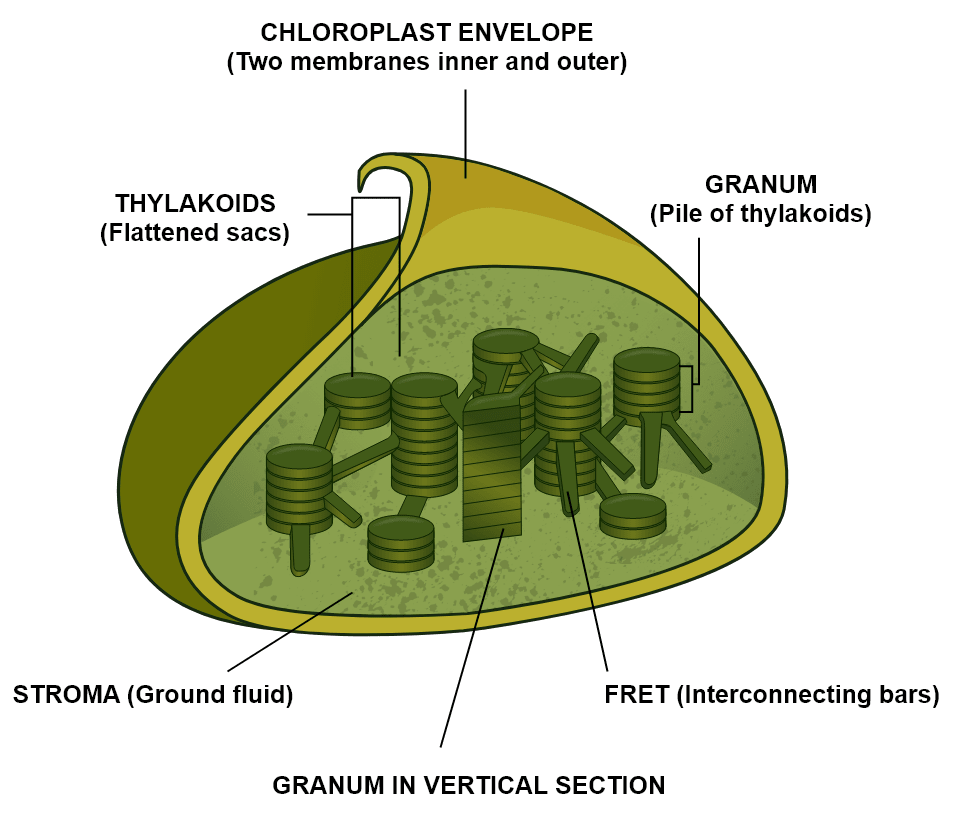
(b) Thylakoids — Closely packed flattened sacs arranged in piles in the interior of chloroplasts are called Thylakoids.

(c) Chloroplast — Chloroplasts are minute oval bodies bounded by a double membrane which contains Thylakoids arranged in piles called Grana lying in a colourless ground substance called Stroma.

(d) Photolysis of water — Photolysis of water is defined as the splitting of H2O molecules into hydrogen ions and oxygen in the presence of light.

(e) Polymerisation — Polymerisation is the process in which several glucose molecules are transformed to produce one molecule of starch.

2Descriptive Type

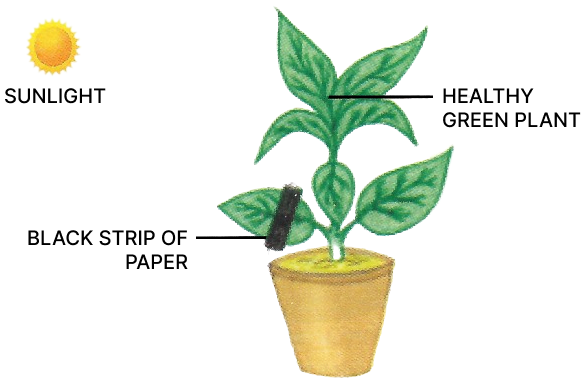
Given below is the figure of an experimental set-up, showing a physiological act of the plants. Study and answer the following questions.

What is the objective of this experiment? Name and define the process shown here. Photosynthesis, Concise Biology Solutions ICSE Class 10.

(a) What is the objective of this experiment ?

(b) Name and define the process shown here.

(c) Why do we destarch the leaves before performing the experiment ?

(d) How do we destarch the leaves ?

(e) What will be the observation when we pour iodine solution over the bleached experimental leaf.

(f) Write a well-balanced equation of the above process.

Show SolutionHide Solution↓

(a) The objective of given experiment is to show that sunlight is necessary for photosynthesis.

(b) The process shown here is photosynthesis.

Photosynthesis is the process by which living plant cells, containing chlorophyll, produce food substances (glucose and starch), from carbon dioxide and water, by using light energy and release oxygen as a by-product.

(c) We destarch the leaves before experiment in order to remove the starch from leaves so that occurence of photosynthesis can be detected.

(d) To destarch the leaves the plant is kept in dark for 24-48 hours. This stops photosynthesis in the plant. During this time the starch already present in the leaves is translocated to storage organ of the plant fom the leaves.

(e) When we pour iodine solution over the bleached experimental leaf the area where starch is present turns blue.

(f) The equation for photosynthesis is given below:

$6\text{CO}_2 + 12\text{H}_2\text{O} \xrightarrow[\text{chlorophyll}]{\text{light energy}} \text{C}_6\text{H}_{12}\text{O}_6 + 6\text{H}_2\text{O} + 6\text{O}_2 \uparrow$

3Descriptive Type

Give reasons/explain:

(a) It is necessary to place a plant in the dark before starting an experiment on photosynthesis.

(b) It is not possible to demonstrate respiration in a green plant kept in sunlight.

(c) Most leaves have the upper surface more green and shiny than the lower surface.

(d) During the starch test, the leaf is -

Show SolutionHide Solution↓

(a) A plant used for experiments on photosynthesis should initially be placed in the dark for 24 to 48 hours to destarch the leaves. During this period, all the starch will be removed from the leaves and stored in the storage organs. The leaves will not show the presence of starch. So the various experiments on photosynthesis can be carried out effectively.

(b) If a green plant is kept in bright light, it tends to use up all the CO2 produced during respiration, for photosynthesis. Thus, the release of CO2 cannot be demonstrated. Hence, it is difficult to demonstrate respiration as these two processes occur simultaneously.

(c) Due to more amount of chlorophyll on the upper surface more light is trapped. The chloroplasts are concentrated in the upper layers of the leaf which helps cells to trap the sunlight quickly. The upper surface is more green and shiny because it has a waxy coating to prevent loss of water due to evaporation.

(d) During the starch test,

  1. The leaf is boiled in water to kill the cells.
  2. The leaf is boiled in methylated spirit till it becomes pale-white due to the removal of chlorophyll. The leaf now becomes hard and brittle.
4Descriptive Type

Distinguish between the following pairs on the basis of words indicated in the brackets ( )

(a) Light reaction and Dark reaction (end products)

(b) Producers and Consumers (organisms)

(c) Grass and Grasshopper (mode of nutrition)

(d) Stoma and Stroma (structure)

Show SolutionHide Solution↓

(a) Differences between light reaction and dark reaction (end products) —

Light ReactionDark Reaction
ATP and NADPH are the end products of this reaction.Glucose is the main product formed during dark reaction.
The water molecule split into hydrogen and oxygen.No splitting of water.

(b) Differences between producers and consumers (organisms) —

ProducersConsumers
They are autotrophs.They are heterotrophs.
They can convert inorganic substances into organic substances.They cannot convert inorganic substances into organic substances.
It includes green plants and photosynthetic micro-organisms.It includes herbivores and carnivores.
For example — green plantsFor example — Animals

(c) Differences between grass and grasshopper (mode of nutrition) —

GrassGrasshopper
Green grass being a producer is capable of producing its own food by photosynthesis.Grasshopper is a primary consumer (herbivore) and directly feeds on producers like grass.

(d) Differences between stoma and stroma (structure) —

StomaStroma
A stoma is a microscopic pore surrounded by two specialized guard cells found in the leaves and stems. Its main function is gaseous exchange.Stroma is the colourless ground substance found in the chloroplast. It is the site of the light independent reactions of photosynthesis.
1Structured / Application / Skill Type

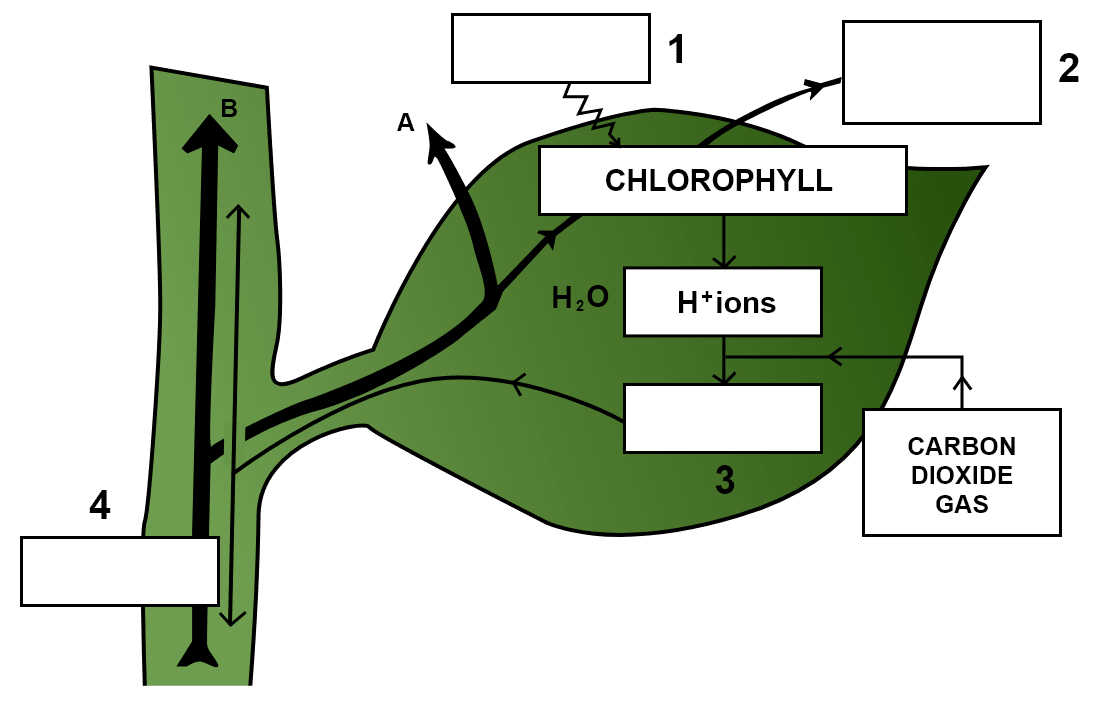
Given below is a schematic diagram to illustrate some aspects of photosynthesis.

(a) Fill up the gaps, in blank spaces (1-4), by writing the names of the correct items.

(b) What phenomenon do the thick arrows A and B indicate?

Given is a schematic diagram to illustrate some aspects of photosynthesis. Fill up the gaps, in blank spaces (1-4), by writing the names of the correct items. What phenomenon do the thick arrows A and B indicate? Photosynthesis, Concise Biology Solutions ICSE Class 10.
Show SolutionHide Solution↓

(a) Blank spaces (1-4) are labelled below:

  • 1 → Sunlight
  • 2 → Oxygen
  • 3 → Glucose
  • 4 → Xylem

(b) Phenomena represented by thick arrows A and B are:

  • A → Transpiration
  • B → Translocation
2Structured / Application / Skill Type

Given below is the representation of a certain phenomenon in nature with four organisms 1-4.

Given below is the representation of a certain phenomenon in nature with four organisms 1-4. Name the phenomenon represented. Name any one organism that could be shown at No. 5. Name the biological process which was the starting point of the whole chain. Name one natural element which all the organisms 2-4 and even 5 are getting from No. 1 for their survival. Photosynthesis, Concise Biology Solutions ICSE Class 10.

(a) Name the phenomenon represented.

(b) Name any one organism that could be shown at No .5

(c) Name the biological process which was the starting point of the whole chain.

(d) Name one natural element which all the organisms 2-4 and even 5 are getting from No. 1 for their survival.

Show SolutionHide Solution↓

(a) Food chain

(b) Hawk, Eagle

(c) Photosynthesis

(d) Oxygen

3Structured / Application / Skill Type

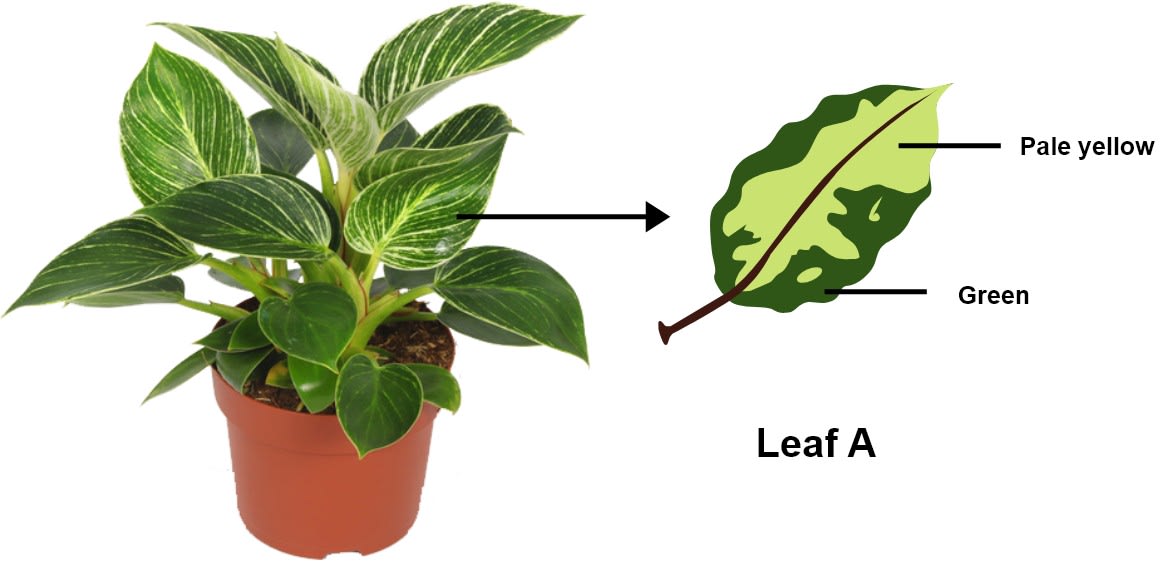
A potted plant with variegated leaves was taken in order to prove a factor necessary for photosynthesis. The potted plant was kept in the dark for 24 hours and then placed in bright sunlight for a few hours. Observe the diagram and answer the questions:

A potted plant with variegated leaves was taken in order to prove a factor necessary for photosynthesis. The potted plant was kept in the dark for 24 hours and then placed in bright sunlight for a few hours. Observe the diagram and answer the questions.**What** aspect of photosynthesis is being tested in the above diagram? Why was the plant placed in the dark before beginning the experiment? Write a balanced chemical equation to represent the process of photosynthesis. What will be the result of starch test when performed on leaf A shown in the diagram? Draw a neat and labelled diagram of a chloroplast. Photosynthesis, Concise Biology Solutions ICSE Class 10.

(a) What aspect of photosynthesis is being tested in the above diagram?

(b) Why was the plant placed in the dark before beginning the experiment?

(c) Write a balanced chemical equation to represent the process of photosynthesis.

(d) What will be the result of starch test when performed on leaf A shown in the diagram?

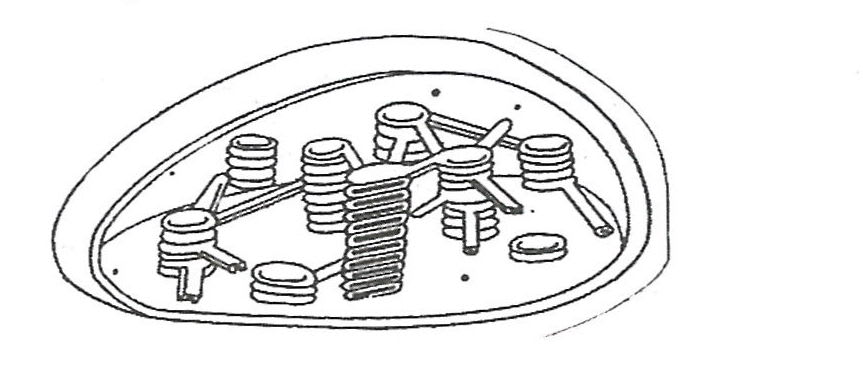
(e) Draw a neat and labelled diagram of a chloroplast.

Show SolutionHide Solution↓

(a) The above experiment is conducted to show that chlorophyll is necessary for photosynthesis.

(b) The plant was placed in the dark before beginning the experiment to destarch the leaves.

(c) Balanced chemical equation representing the process of photosynthesis is given below:

$6\text{CO}_2 + 12\text{H}_2\text{O} \xrightarrow[\text{chlorophyll}]{\text{light energy}} \text{C}_6\text{H}_{12}\text{O}_6 + 6\text{H}_2\text{O} + 6\text{O}_2 \uparrow$

(d) After the starch test on leaf A, only the green parts of the leaf turn bluish, showing the presence of starch.

(e) Below diagram shows Chloroplast with its different parts labelled:

Draw a neat and labelled diagram of a chloroplast. Photosynthesis, Concise Biology Solutions ICSE Class 10.
4Structured / Application / Skill Type

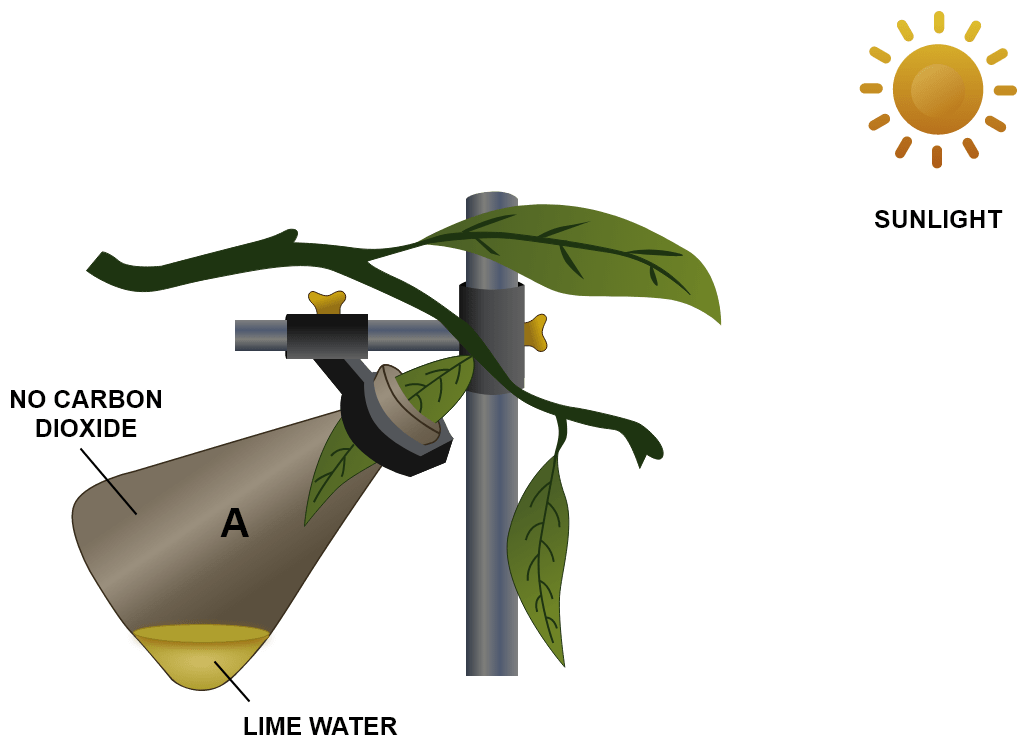
Given below is the diagram of an experimental set-up:

Given is the diagram of an experimental set-up. What is the objective of this experiment? Will it work satisfactorily? Given reason. What alteration (s) will you make in it for obtaining expected result? Would you take any step before starting the experiment? Describe this step and explain its necessity. Photosynthesis, Concise Biology Solutions ICSE Class 10.

a. What is the objective of this experiment?

b. Will it work satisfactorily? Given reason.

c. What alteration (s) will you make in it for obtaining expected result?

d. Would you take any step before starting the experiment? Describe this step and explain its necessity.

Show SolutionHide Solution↓

(a) The objective is to prove that carbon dioxide is necessary for photosynthesis.

(b) No, the experiment will not work satisfactorily because, the beaker contains lime water which does not absorb CO2

(c) To obtain expected result replace the lime water from potassium hydroxide because it absorbs carbon dioxide.

(d) Before starting the experiment, it is necessary to destarch the leaves of the plant by keeping the plant in complete darkness for 48 hours. This is because if the plant is not destarched, then the experiment will give false results because starch stored previously may be detected in the leaf placed in the beaker even if no starch is produced during the experiment.

5Structured / Application / Skill Type

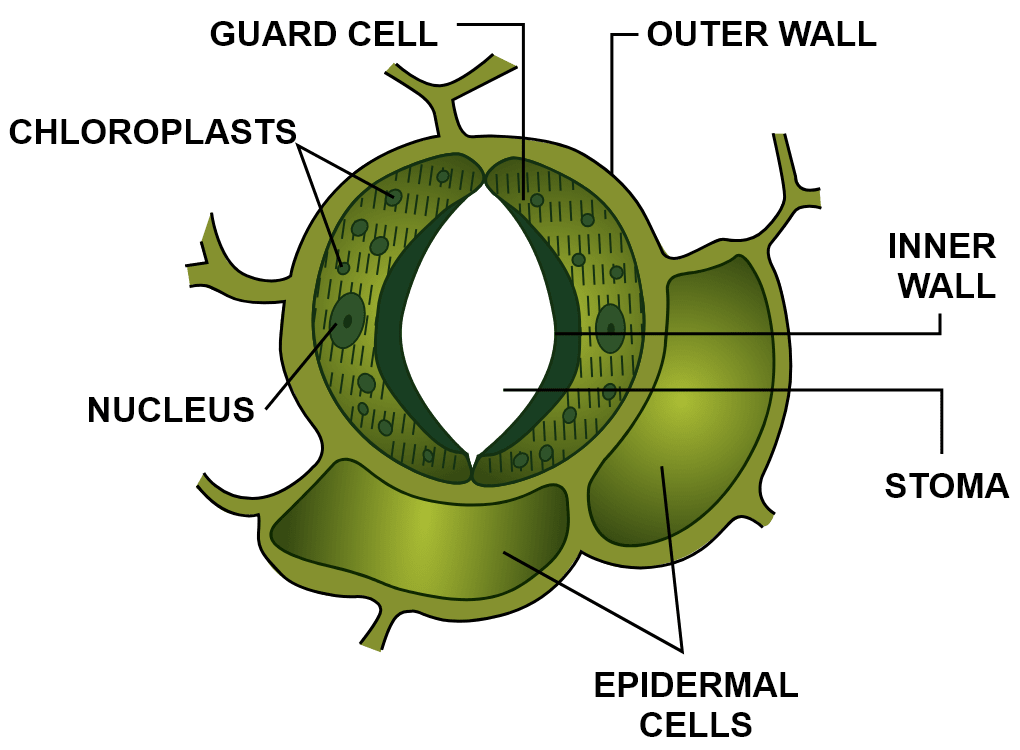
Draw a neat diagram of the stomatal apparatus found in the epidermis of leaves and label the Stoma, Guard cells, Chloroplast, Epidermal cells, Cell wall and Nucleus.

Show SolutionHide Solution↓

Below diagram shows the stomatal apparatus found in the epidermis of leaves with all the different parts labelled:

Draw a neat diagram of the stomatal apparatus found in the epidermis of leaves and label the Stoma, Guard cells, Chloroplast, Epidermal cells, Cell wall and Nucleus. Photosynthesis, Concise Biology Solutions ICSE Class 10.
6Structured / Application / Skill Type

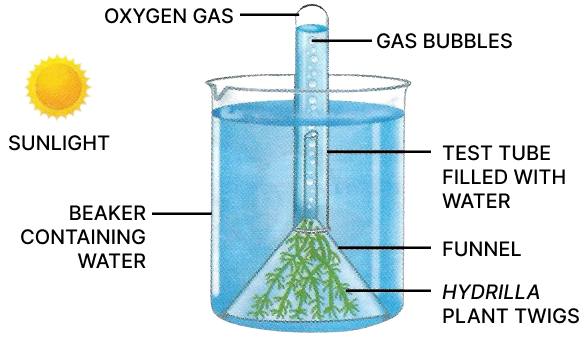
Given below is the diagram of an experimental set-up (final stage). Study the same and answer the following questions :

What is the main aim of the experiment? Oxygen gas shown in the experiment is released from which of the raw materials? Photosynthesis, Concise Biology Solutions ICSE Class 10.

(a) What is the main aim of the experiment?

(b) Oxygen gas shown in the experiment is released from which of the raw materials ?

(c) How would you confirm the presence of oxygen gas?

(d) Name the chemical substance which can be added in water to enhance the process/rate of release of oxygen gas.

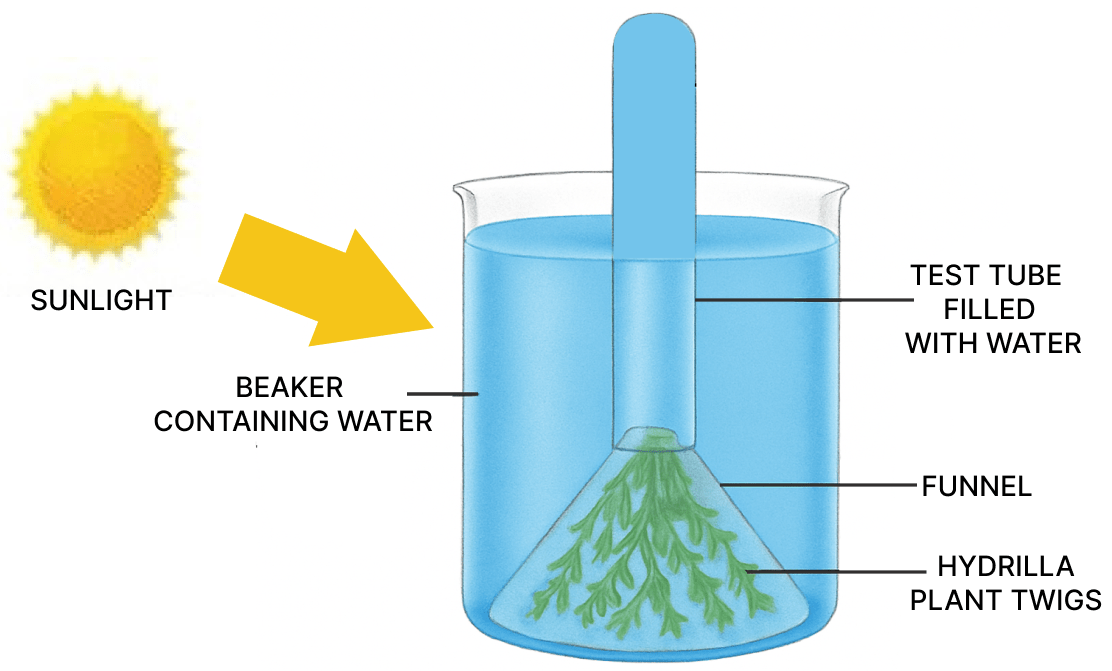
(e) Draw a neat and labelled diagram of the same experiment for its initial stage.

Show SolutionHide Solution↓

(a) The main aim of the experiment is to show that oxygen is produced during photosynthesis.

(b) Oxygen is released from Water (H2O).

(c) The gas present in the test tube makes a glowing splinter bursts into flames. This shows the presence of oxygen.

(d) Sodium Bicarbonate

(e) labelled diagram of the same experiment for its initial stage shown below:

Draw a neat and labelled diagram of the same experiment for its initial stage. Photosynthesis, Concise Biology Solutions ICSE Class 10.
7Structured / Application / Skill Type

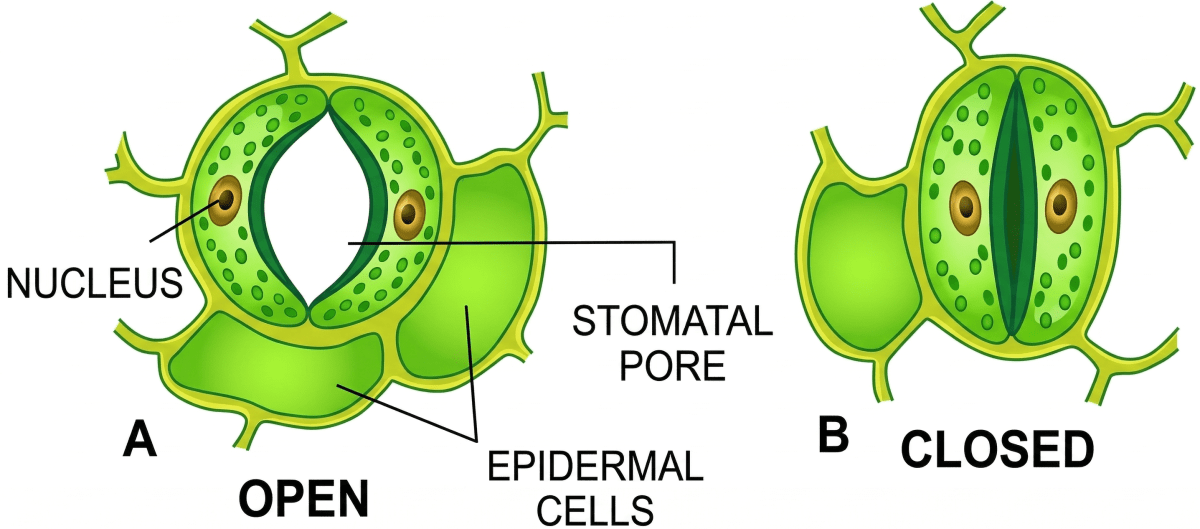
Given below are figures (A) and (B) showing open and closed stomatal apertures respectively.

Given below are figures (A) and (B) showing open and closed stomatal apertures respectively. Photosynthesis, Concise Biology Solutions ICSE Class 10.

Answer the questions that follow :

(a) When do these stomata open (day/night) ?

(b) What is the condition of the guard cells when the stomata are open (turgid/flaccid) ?

(c) Name the gas taken in and released out through these pores during photosynthesis.

(d) Name the cells of the lower epidermis that contain chloroplasts.

(e) Write two characteristic features of both the inner and outer walls of the guard cells.

Show SolutionHide Solution↓

(a) Stomata open during the day.

(b) The guard cells become turgid when stomata are open.

(c) During photosynthesis, the gas taken in through these pores is carbon dioxide, and the gas released is oxygen.

(d) The cells of the lower epidermis that contain chloroplasts are the guard cells.

(e) Characteristic features of inner wall:

  1. They are thick.
  2. They are less elastic.

Characteristic features of outer wall:

  1. They are thin.
  2. They are more elastic.

Press ↓ to reveal a solution and move to the next question. Back to Selina Concise Biology.

Free sample bank