Model Question Paper 2

ICSE Class 10 Biology · Selina Concise Biology · 50 solved questions

Exercise
1(i)Section A

The soluble protein present in the blood plasma which is responsible for blood clotting is :

Show SolutionHide Solution↓

Fibrinogen

Reason — Thrombin reacts with soluble fibrinogen in presence of calcium ions to form insoluble fibrin.
1(ii)Section A

The abnormal rise of erythrocytes in blood is :

Show SolutionHide Solution↓

Polycythaemia

Reason — Polycythaemia is a condition of abnormal rise of erythrocytes in blood.

1(iii)Section A

The part of nephron where ultrafiltration occurs :

Show SolutionHide Solution↓

Glomerulus

Reason — Glomerulus has afferent arteriole and narrow efferent arteriole due to which high pressure is exerted and ultrafiltration occurs.

1(iv)Section A

Blood enters the glomerulus through :

Show SolutionHide Solution↓

Afferent arteriole

Reason — Blood enters the glomerulus through afferent arteriole and leaves through efferent arteriole.

1(v)Section A

The part of brain which acts like the thermoregulatory centre of the body :

Show SolutionHide Solution↓

Hypothalamus

Reason — Hypothalamus is the centre for thermal regulation in the body.

1(vi)Section A

The fibrous sheet which connects into cerebral hemisphere is :

Show SolutionHide Solution↓

Corpus callossum

Reason — Corpus callossum is a sheet of fibres connecting the two cerebral hemispheres.

1(vii)Section A

Cinematography makes use of :

Show SolutionHide Solution↓

After image

Reason — The image seen by us persists for one-tenth of a second. This is known as after image. In movies, pictures are projected on a screen at the rate of about 24 pictures per second which gives an illusion of life-like continuous movement.

1(viii)Section A

Which of the following is not an involuntary action ?

Show SolutionHide Solution↓

Chewing

Reason — Chewing is an action which can be controlled by us.

1(ix)Section A

The gland which is located just above the kidneys :

Show SolutionHide Solution↓

Adrenal

Reason — Adrenal glands are like caps on top of each kidney.

1(x)Section A

Which of the following is not an endocrine gland ?

Show SolutionHide Solution↓

Liver

Reason — Liver secretes bile through duct hence, it is not an endocrine gland.

1(xi)Section A

Sperms are produced in :

Show SolutionHide Solution↓

Seminiferous tubule

Reason — Sperms are produced in Seminiferous tubule in testis.

1(xii)Section A

The statistical study of human population is called :

Show SolutionHide Solution↓

Demography

Reason — Demography is the term given to statistical study of human population.

1(xiii)Section A

The basic structural unit of human chromosome is :

Show SolutionHide Solution↓

Nucleosome

Reason — Nucleic acid along with histone protein form nucleosome which is the basic structural unit of human chromosome.

1(xiv)Section A

The phenotypic ratio in F2 generation of a monohybrid cross is :

Show SolutionHide Solution↓

3:1

Reason — The phenotypic ratio in F2 generation of a monohybrid cross is 3:1 because of segregation of genes which leads to recessive homozygous condition.

1(xv)Section A

The waxy substance of cuticle layer consists of :

Show SolutionHide Solution↓

Cutin

Reason — The waxy substance of cuticle layer consists of cutin and polysaccharides.

2(a)Section A

Name the following :

(i) The organelle which initiates cell division.

(ii) The genetic constitution of an organism.

(iii) The plastid which contains coloured pigments (yellow/orange/red, etc.)

(iv) A solution whose concentration is greater than that of the cell sap.

(v) The biological process which is the starting point of the food chain.

Show SolutionHide Solution↓

(i) Centriole

(ii) Genotype

(iii) Chromoplast

(iv) Hypertonic

(v) Photosynthesis

2(b)Section A

Arrange and rewrite the terms in each group in the correct order so as to be in a logical sequence beginning with the term that is underlined (highlighted).

(i) Prophase, Telophase, Anaphase, Metaphase

(ii) Kidney, Urethra, Ureter, Urinary bladder

(iii) Right ventricle, Lungs, Pulmonary vein, Pulmonary artery

(iv) Ear pinna, Membranous labyrinth, Ear ossicles, Auditory canal

(v) Stimulus, Effector, Receptor, CNS.

Show SolutionHide Solution↓

(i) Prophase → Metaphase→ Anaphase→ Telophase

(ii) Kidney → Ureter→ Urinary bladder→ Urethra

(iii) Right ventricle → Pulmonary artery→ Lungs→ Pulmonary vein

(iv) Ear pinna → Auditory canal→ Ear ossicles→ Membranous labyrinth

(v) Stimulus → Receptor→ CNS→ Effector

2(c)Section A

Match the items given in column I with the most appropriate ones in column II and rewrite the correct matching pairs.

Column IColumn II
(i) Endosmosis1. Hydathodes
(ii) Exosmosis2. Hydrophilic
(iii) Guttation3. Hypertonic solution
(iv) Cellulose4. Hydrostatic pressure
(v) Ultrafiltration5. Hypotonic solution
 6. Haematuria
 7. Haemin
Show SolutionHide Solution↓
Column IColumn II
(i) Endosmosis5. Hypotonic solution
(ii) Exosmosis3. Hypertonic solution
(iii) Guttation1. Hydathodes
(iv) Cellulose2. Hydrophilic
(v) Ultrafiltration4. Hydrostatic pressure
2(d)Section A

Choose the odd one out from the following terms and name the category to which the others belong :

(i) Chloroplast, Chromoplast, Chromosome, Leucoplast

(ii) Adenine, Adrenaline, Thymine, Cytosine

(iii) Thrombokinase, Thrombocytes, Leucocytes, Erythrocytes

(iv) Urea, Uric acid, Urochrome, Ammonia

(v) Wisdom teeth, Oesophagus, Vermiform appendix, Ear pinna

Show SolutionHide Solution↓

(i) Odd one : Chromosome
Chloroplast, Chromoplast, Leucoplast — Plastids

(ii) Odd one : Adrenaline
Adenine, Thymine, Cytosine — Nitrogenous base

(iii) Odd one : Thrombokinase
Thrombocytes, Leucocytes, Erythrocytes — Blood cells

(iv) Odd one : Urochrome
Urea, Uric acid, Ammonia — Constituents of urine

(v) Odd one : Oesophagus
Wisdom teeth, Vermiform appendix, Ear pinna — Vestigial organs

2(e)Section A

State the exact location of the following structures:

(i) Leydig cells

(ii) Prostate gland

(iii) Macula lutea

(iv) Mitral valve

(v) Nissl granules

Show SolutionHide Solution↓

(i) Testis

(ii) At origin of urethra from bladder (in males)

(iii) Retina of eye

(iv) Between left auricle and left ventricle.

(v) Cyton

3(a)Section B

Define : 'Apical dominance'

Show SolutionHide Solution↓

The phenomenon of the suppression of growth of lateral buds by apical buds is called apical dominance.

3(b)Section B

Distinguish between erythrocytes and leucocytes (life-span).

Show SolutionHide Solution↓

The average life of erythrocytes is about 120 days and that of leucocytes is 14-15 days.

3(c)Section B

What are Phytohormones ? Give one example.

Show SolutionHide Solution↓

Phytohormones or plant hormones are naturally occurring small organic molecules. For example : Auxins.

3(d)Section B

What is the significance of transpiration. State in two points.

Show SolutionHide Solution↓

Significance of transpiration:

  1. Maintains the temperature of plant.
  2. Transpirational pull helps in absorption of water and mineral by roots.
3(e)Section B

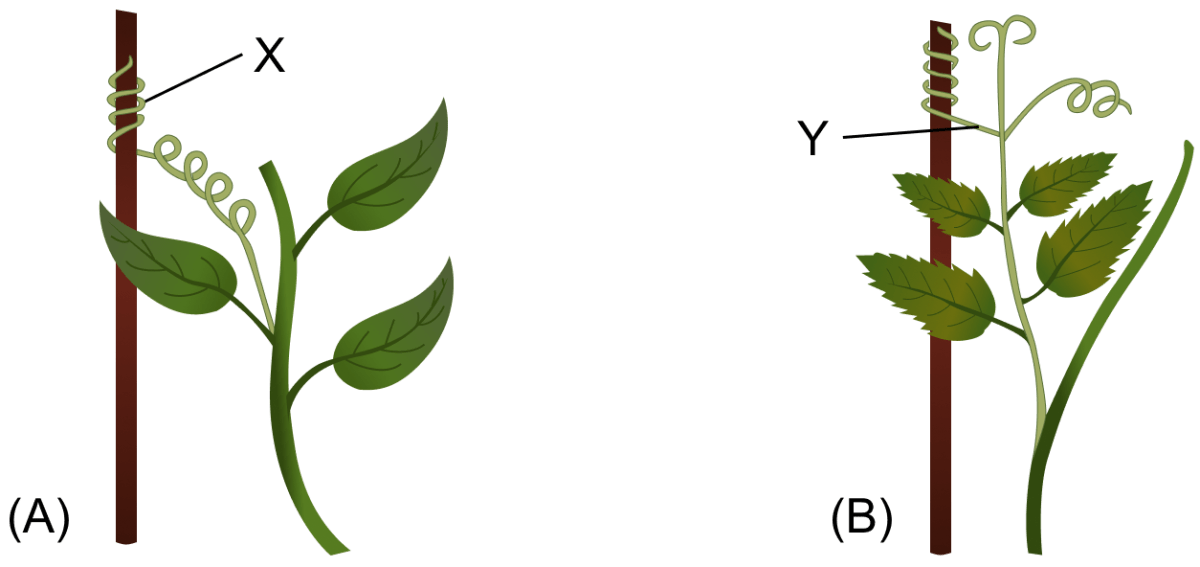
The figures given below depict a phenomenon of the plants. Study the figure and answer the questions.

The figures depict a phenomenon of the plants. Name and define the phenomenon. Name the structure shown as X and Y in the figure (A) and (B), respectively. Write the functions performed by the structures X and Y. Model Question Paper 1, Concise Biology Solutions ICSE Class 10.

(i) Name and define the phenomenon.

(ii) Name the structure shown as X and Y in the figure (A) and (B), respectively.

(iii) Write the functions performed by the structures X and Y.

Show SolutionHide Solution↓

(i) Thigmotropism is the phenomenon depicted. It is the directional growth movement of plant parts in response to touch stimulus.

(ii) X → Stem tendril, Y → Leaf tendril

(iii) Stem tendrils (X) and leaf tendrils (Y) enable the plant to climb up a support.

4(a)Section B

Expand the abbreviation - NADP.

Show SolutionHide Solution↓

Nicotinamide Adenine Dinucleotide Phosphate

4(b)Section B

Name the two main phases of photosynthesis.

Show SolutionHide Solution↓

The two main phases of photosynthesis are:

  1. Light phase
  2. Dark phase
4(c)Section B

What do you mean by 'Adaptation of Eye' ? Write its two kinds.

Show SolutionHide Solution↓

Adaptation of the eye is the process by which the eyes adjust to changes in light levels, allowing us to see clearly in both bright and dim environments. Its two kinds are:

  1. Light adaptation
  2. Dark adaptation
4(d)Section B

Write two important functions of human ovaries.

Show SolutionHide Solution↓

Two important functions of human ovaries are:

  1. They produce eggs.
  2. They secrete the reproductive hormones, Oestrogen and Progesterone.
4(e)Section B

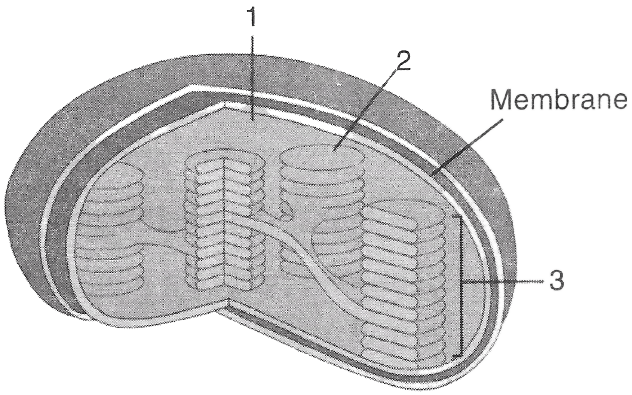
Given below is a figure of the internal structure of an organelle found in plants cells. Study the figure and answer the following questions :

The figure shows the internal structure of an organelle found in plants cells. Identify the organelle and name the physiological process that occurs in this organelle. Model Question Paper 1, Concise Biology Solutions ICSE Class 10.

(i) Identify the organelle and name the physiological process that occurs in this organelle.

(ii) Label the guidelines 1 and 3 of the figure.

(iii) Write a well balanced equation for the above metabolic process.

Show SolutionHide Solution↓

(i) The given organelle is Chloroplast. Photosynthesis occurs in this organelle.

(ii) The labelled guidelines are:

  • 1 → Stroma
  • 2 → Thylokoid
  • 3 → Granum

(iii) Balanced chemical equation representing the process of photosynthesis is given below:

$6\text{CO}_2 + 12\text{H}_2\text{O} \xrightarrow[\text{chlorophyll}]{\text{light energy}} \text{C}_6\text{H}_{12}\text{O}_6 + 6\text{H}_2\text{O} + 6\text{O}_2 \uparrow$

5(a)Section B

Define - 'Pollution'

Show SolutionHide Solution↓

Pollution is the addition of any such constituent to air, water or land which deteriorates the natural quality of the environment.

5(b)Section B

Differentiate between stomata and lenticels with reference to their location.

Show SolutionHide Solution↓

Stomata are present on leaves whereas lenticels are present on stem and other plant parts except leaves.

5(c)Section B

Name two famous biologists who proposed the "Theories of Evolution".

Show SolutionHide Solution↓

Jean Baptiste de Lamarck and Charles Robert Darwin.

5(d)Section B

What are the two surgical methods of contraception in human males and females respectively ?

Show SolutionHide Solution↓

Vasectomy in males and tubectomy in females.

5(e)Section B

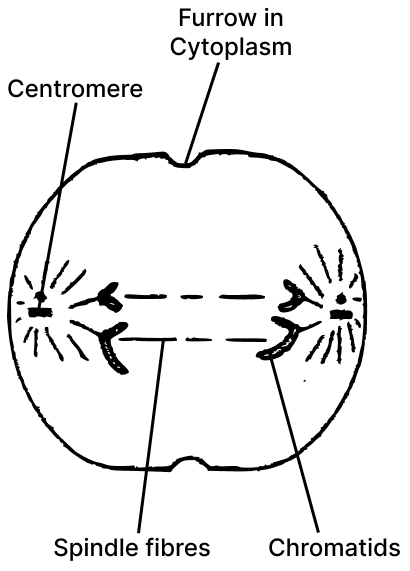
Draw a neat and labelled diagram of an animal cell showing the anaphase stage of mitosis with two pairs of chromosomes.

Show SolutionHide Solution↓

Below labelled diagram shows the anaphase stage of mitosis in an animal cell with two pairs of chromosomes:

Draw a neat and labelled diagram of an animal cell showing the anaphase stage of mitosis with two pairs of chromosomes. Model Question Paper 1, Concise Biology Solutions ICSE Class 10.
6(a)Section B

Define - 'Population'

Show SolutionHide Solution↓

A population is defined as a group of individuals of the same species living and interbreeding within a given area.

6(b)Section B

Differentiate between ureter and uterus with reference to their functions.

Show SolutionHide Solution↓
UreterUterus
It is a tube which carries urine from kidney to urinary bladder.It is a small pouch like structure wherein the foetus grows during gestation.
6(c)Section B

State the function of choroid and cochlea respectively.

Show SolutionHide Solution↓

The choroid layer provides nourishment to the eye. It contains a dark black pigment (melanin) which prevents the light rays from reflecting and scattering inside the eye.

Cochlea contains organ of Corti which contains sensory cells for hearing.

6(d)Section B

Gametes must be produced by meiosis. Explain.

Show SolutionHide Solution↓

Gametes must be produced by meiosis so that the number of chromosomes in them is halved (n). It is so because when two such gametes fuse to form a zygote the original number of chromosomes is restored (2n). If the gametes are formed by mitosis their chromosome number will remain 2n and after fusion the resulting zygote will have 4n chromosomes which is not a normal condition for a species.

6(e)Section B

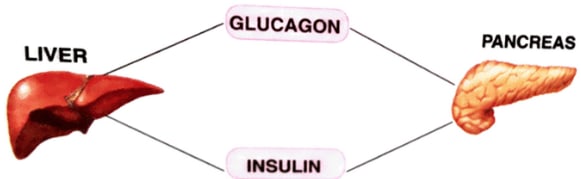
Study the diagram given below and answer the questions that follow:

Study the diagram and then answer the questions. Name the cells of the pancreas that produce (1) glucagon (2) insulin. State the main function of (1) glucagon and (2) insulin. What is the technical term for the cells of the pancreas that produce endocrine hormones? Model Question Paper 1, Concise Biology Solutions ICSE Class 10.

(i) Name the cells of the pancreas that produce glucagon and insulin.

(ii) State the main function of glucagon and insulin.

(iii) What is the technical term for the cells of the pancreas that produce hormones?

Show SolutionHide Solution↓

(i) Beta cells and Alpha cells of the islets of Langerhans produce Insulin and Glucagon, respectively.

(ii) The main function of Glucagon is to raise the blood glucose levels by stimulating the breakdown of glycogen to glucose in the liver.
The main function of Insulin is to maintain the levels of glucose (sugar) in the blood.

(iii) The Islets of Langerhans

7(a)Section B

Explain - Karyotype

Show SolutionHide Solution↓

A karyotype is a visual representation of an individual's chromosomes, arranged and organized in a specific pattern.

7(b)Section B

What are the two main causes of long sightedness ?

Show SolutionHide Solution↓

The two main causes of long sightedness are:

  1. Shortening of the eyeball.
  2. Lens is too flat
7(c)Section B

Write two important roles of vitreous humour.

Show SolutionHide Solution↓

Two important roles of vitreous humour are:

  1. It helps in keeping the shape of the eyeball.
  2. It protects the retina and its nerve endings.
7(d)Section B

What is the difference between Dominant and Recessive alleles ?

Show SolutionHide Solution↓
Dominant alleleRecessive allele
Dominant allele expresses itself in heterozygous as well as homozygous condition.Recessive allele expresses itself only in homozygous condition.
It is represented by capital letter.It is represented by small letter.
7(e)Section B

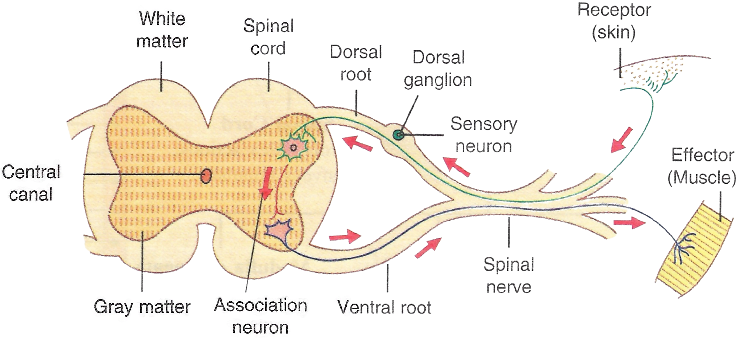
Draw a neat diagram of the cross section of spinal cord showing a reflex action and label the following parts :

(i) Central canal

(ii) Ventral root

(iii) Gray matter

Show SolutionHide Solution↓

Diagram of the cross section of spinal cord showing a reflex action is given below:

Draw a neat diagram of the cross section of spinal cord showing a reflex action. Model Question Paper 1, Concise Biology Solutions ICSE Class 10.
8(a)Section B

Define - Evolution.

Show SolutionHide Solution↓

Evolution is a slow and continuous process whereby complex forms of life have emerged from simpler forms through millions of years.

8(b)Section B

What are the two ways by which we can control vehicular air pollution ?

Show SolutionHide Solution↓

Two ways to control vehicular air pollution are:

  1. Use of efficient engines.
  2. Use of unleaded petrol and CNG (Compressed Natural Gas) in automobiles.
8(c)Section B

State "Mendel's Law of Independent Assortment".

Show SolutionHide Solution↓

Law of Independent Assortment, states that when there are two pairs of contrasting characters, the distribution of the members of one pair into the gametes is independent of the distribution of the other pair.

8(d)Section B

Name two abnormalities which are caused due to the hypersecretion of the growth hormone in humans.

Show SolutionHide Solution↓

Abnormalities caused due to hypersecretion of growth hormone in humans are:

  1. Gigantism
  2. Acromegaly
8(e)Section B

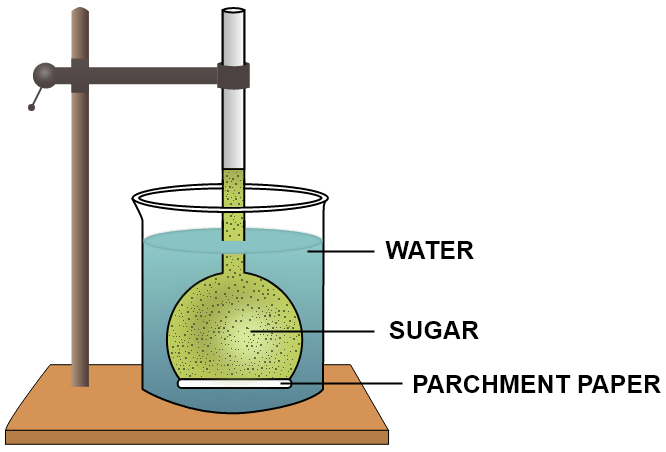
The diagram given below is an experimental set-up to study a very important physiological process. Study the same and answer the questions that follow :

The diagram shows an experimental set-up to study a very important physiological process. Name and define the process. Name part of a plant cell which is represented by and acts like sugar solution and parchment paper. Model Question Paper 1, Concise Biology Solutions ICSE Class 10.

(i) Name and define the process.

(ii) Name the part of a plant cell which is represented by and acts like the sugar solution and parchment paper.

(iii) Draw a "Control set-up" for the same experiment and label it.

Show SolutionHide Solution↓

(i) The process is osmosis. Osmosis is the movement of water molecules from their region of higher concentration (dilute solution or with a lower solute concentration) to their region of lower concentration (concentrated solution or with a higher solute concentration) through a semi permeable membrane.

(ii) Cell sap acts like sugar solution and cell membrane acts like parchment paper.

(iii) The control setup is shown below:

Draw a neat and labelled diagram of an animal cell showing the anaphase stage of mitosis with two pairs of chromosomes. Model Question Paper 1, Concise Biology Solutions ICSE Class 10.

Press ↓ to reveal a solution and move to the next question. Back to Selina Concise Biology.

Free sample bank