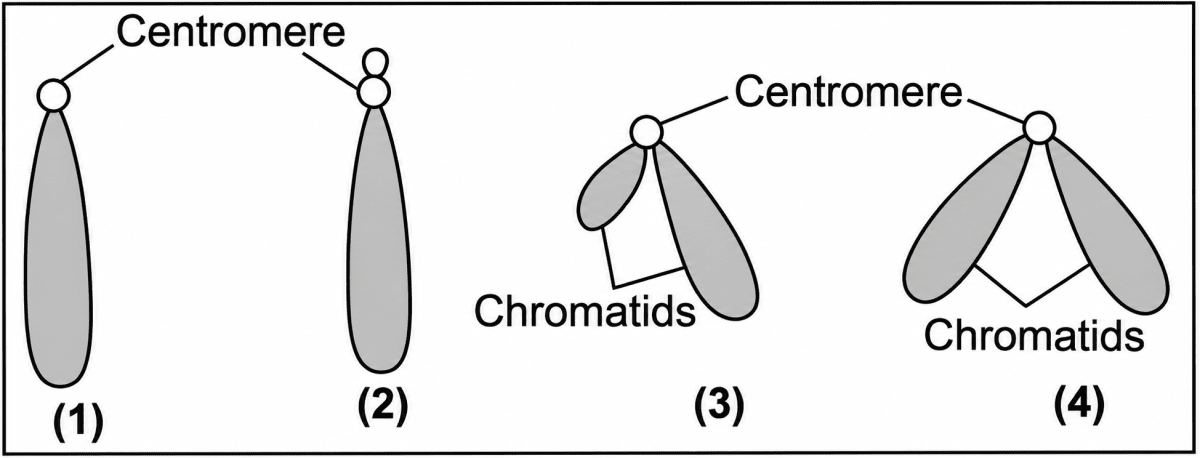
(i) Telocentric
Reason — A telocentric chromosome is rod-shaped and has its centromere at the proximal (terminal) end. According to the classification used in the chapter, an acrocentric chromosome is rod-shaped with the centromere near one end, a submetacentric chromosome is T- or L-shaped with the centromere almost at the middle, and a metacentric chromosome is V-shaped with the centromere at the centre.
(ii) Centromere at slightly below the one end
Reason — An acrocentric chromosome is rod-shaped and has its centromere near one end, slightly below the terminal position. This distinguishes it from a telocentric chromosome, whose centromere is at the proximal end.
(iii) Metacentric
Reason — A metacentric chromosome has the centromere at the centre, forming two equal arms and giving it a V-shaped appearance. In the chapter, submetacentric chromosomes are described as T- or L-shaped, while telocentric and acrocentric chromosomes are rod-shaped.
(iv) Kinetochore
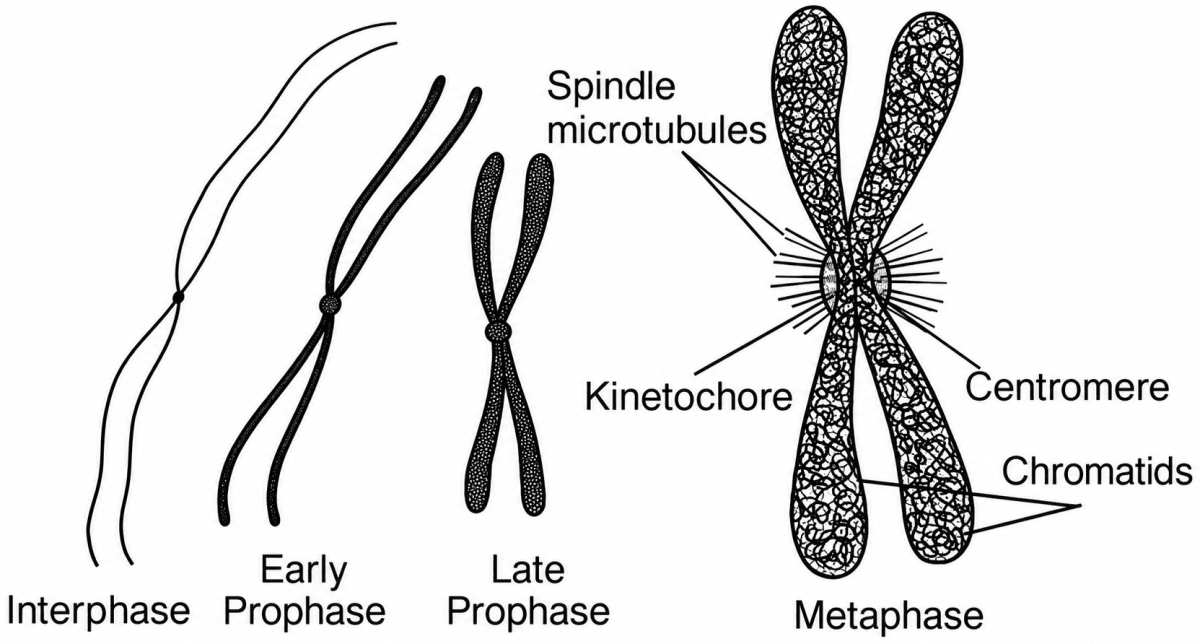
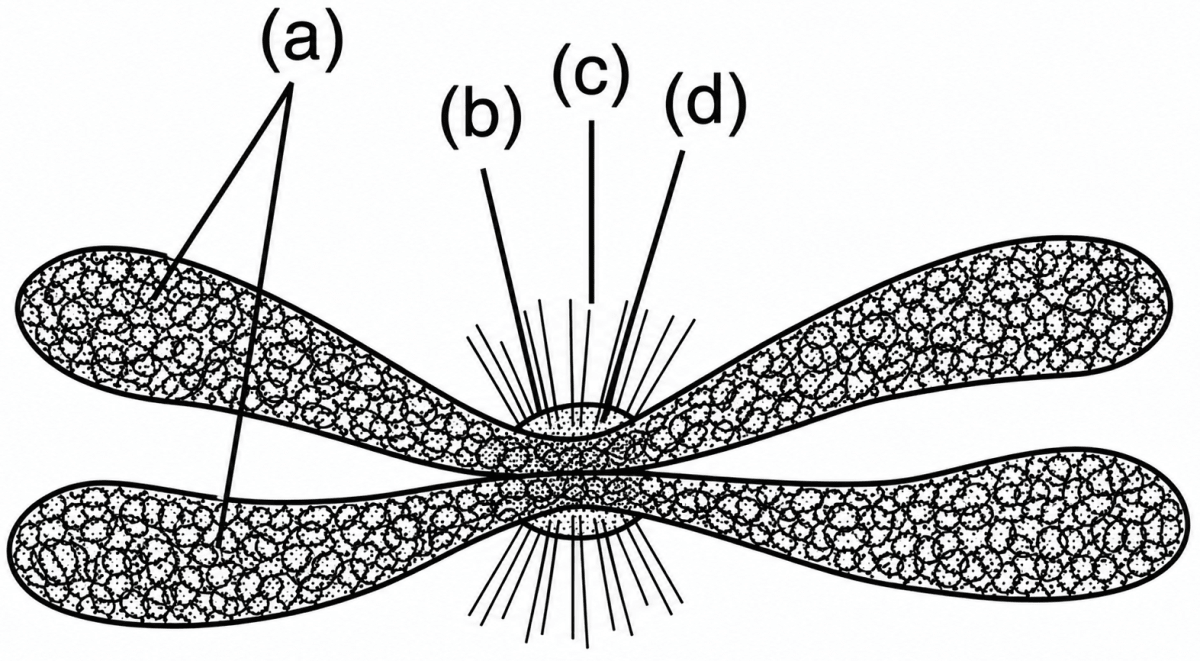
Reason — The kinetochore is a protein structure present on the centromere where spindle microtubules attach during cell division.
Spindle fibres do not attach to the chromosome arms. They attach to the kinetochore. The kinetochore, which is located on the centromere, is the actual site of spindle fibre attachment. The centrosome organizes spindle fibres but does not serve as the attachment site on chromosomes.