Study the diagram given below and then answer the questions that follow:
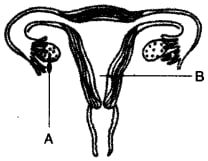
(i) Name the part labelled A. Name any two hormones produced by the part labelled A.
(ii) What happens to the part labelled B:
- If fertilisation takes place?
- If fertilisation does not take place?
(iii) Where does fertilisation occur?
(iv) Draw a neat diagram of the human sperm as seen under high magnification and label the following parts:
- (a)Acrosome
- (b)Mitochondria
Show SolutionHide Solution↓
(i) The part labelled A is Ovary. Two hormones produced by it are:
- Oestrogen
- Progesterone
(ii) (1) If fertilisation takes place, part B i.e. the uterus gets prepared to receieve the embryo. The endometrial lining thickens and gets highly vascularised. (2) If fertilisation does not take place, the thickened lining of part B i.e. the uterus (endometrium) restarts shedding on the 28th day of the menstrual cycle. Finally it is discharged out along with the unfertilised ovum as the menstrual flow through the cervix and the vagina.
(iii) Fertilisation occurs in the fallopian tube/oviduct.
(iv) Below diagram shows the human sperm with Acrosome and Mitochondria labelled:
